

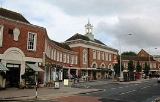
Exeter Central railway station

Encyclopedia
Exeter Central railway station is the most centrally located of the railway stations in Exeter
, Devon
, England. It is smaller than St Davids
which is on the west side of the city but it is served by trains on the London Waterloo to Exeter main line
, and is also by local services to , and . From 1860, when it opened, until 1933 it was known as Exeter Queen Street. Originally opened by the London and South Western Railway
it is currently operated by First Great Western
.
(LSWR) opened its Exeter Extension from on 19 July 1860 and its station at Queen Street in the city centre became the terminus for services from London Waterloo station. From 1 May 1861 it was also the terminus for trains on the new Exeter and Exmouth Railway
. This was also operated by the LSWR but the physical junction between the two lines was at Exmouth Junction
, 1.1 miles (1.8 km) east of Queen Street.
The final piece of the LSWR’s network in Exeter was opened on 1 February 1862 when a steep line descended from the west end of Queen Street station to reach the Bristol and Exeter Railway
's station at which had been opened in 1844. Here the LSWR connected with the Exeter and Crediton Railway
and over that line eventually reached Plymouth
, , , and Most trains to these destinations changed locomotives at Queen Street and many had carriages added or removed too. A locomotive shed
was situated at the station but it was replaced by a new maintenance depot at Exmouth Junction in 1887. The space was later used for enlarged carriage sidings; further carriage sidings were situated at the west end of the station beyond the Queen Street bridge.
The original station had just a single platform with two tracks which were covered by a large train shed
. A second platform and train shed was added in 1874 and two sidings were laid to give a total of four tracks between the platforms. The LSWR became a part of the Southern Railway (SR) in 1923 and two years later the eastbound platform was lengthened from 600 feet (182.9 m) to 1210 feet (368.8 m), taking it beyond the New North Road bridge at the east end of the station. A fire damaged the original wooden buildings on the westbound platform in 1927 and work on rebuilding the station started in 1931. The train sheds were demolished and new brick buildings were officially opened on 1 July 1933 when the station was renamed 'Exeter Central'. At this time there were four platform tracks – east-facing terminal platforms 1 and 4 and through platforms 2 and 3 – and two additional through lines in the centre of the station.
On 1 January 1948 the SR was nationalised to become the Southern Region of British Railways
but in 1963 the Southern Region lines west of were transferred to the Western Region
and by 1967 services from London Waterloo were reduced with very few running beyond Exeter St Davids. The entrance at the east end of the station from New North Road was closed in 1966. Goods yards had been provided on the north side of the line, both behind the eastbound platform and also on the other side of the Queen Street bridge. General goods traffic was withdrawn on 4 December 1967 but cement traffic continued until January 1980. The eastbound through line (the 'up through') was taken out of use on 9 November 1969, as was the 'down through' on 13 October 1984.
On 2 July 1984 the entrance from New North Road was reopened and a new ramped footbridge installed to give direct access from there to the east end of both platforms. Sectorisation in the 1980s saw Exeter Central became the most westerly station operated by Network SouthEast
but it was later transferred to Regional Railways
sector which operated the services to Exmouth. Privatisation therefore saw it pass to Wales and West
and then Wessex Trains
.
was sited to the east of the station on the south side of the line. The original 170 feet (51.8 m) shed was extended to 234 feet (71.3 m) in 1872 and further modernised facilities were brought into use five years later. Despite these alterations the space was too small to handle all the locomotives working in and out of the station so a new maintenance depot was opened at Exmouth Junction in 1887. A few sidings and the turntable
was retained at Queen Street. This turntable was 42 feet (12.8 m) long but in 1888 it was replaced by a 50 feet (15.2 m) example.
es were brought into use in 1875 when three controlled the extensive layout: 'Queen Street A' and 'Queen Street B' at the east end of the station, with 'Queen Street C' situated at the west end between the two platforms. These signal boxes were all closed in the 1920s. The C box was replaced by a new one at the west end of the eastbound platform on 13 September 1925. The A and B boxes were replaced by a new, larger box on the north side of the line beyond the New North Road bridge on 15 November 1927. This was named 'Queen Street A' and the C box was renamed 'Queen Street B'; six years later they were renamed again as 'Exeter Central A' and 'Exeter Central B'.
The B box was closed on 23 February 1970 and the A box was then renamed just 'Exeter Central'. This too closed on 6 May 1985 when control was transferred to the new panel signal box at St Davids. With this change came resignalling; the westbound platform 2 was signalled for trains to run in either direction as was the line westbound line to St Davids. The signals are interlocked so that trains cannot start from either St Davids or Central until their route is clear right through to their platform at the other station; a feature replicated from the days of steam locomotives with less power or brakes than today’s diesels when it was undesirable for trains to come to a stand on this steeply graded section of line.
are located near the steps down to the platforms, the first of which leads down to platform 2 which is used by all trains towards St Davids but can also handle trains in the opposite direction. At platform level the old Queen Street C signal box
built in 1925 and taken out of use in 1970 can still be seen standing at the end of platform 3 between the footbridge and Queen Street. Beyond this the line can be seen dropping steeply at 1 in 37 (2.7%) and curving northwards towards the 184 yards (168.2 m) St Davids Tunnel. The level areas alongside this line used to be a goods yard (on the right) and carriage sidings (on the left).
The wide and long platforms – they are long enough to handle 14-coach trains – are covered for most of their length by simple canopies. At the eastern end of platform 2 is the terminal platform 1, although this is seldom used nowadays as most trains approaching from this end continue at least as far as St Davids. At the far end of the platform a ramp leads up to another footbridge and another entrance, again on the south side of the line, from New North Road.
Ticket barriers we installed in early 2011 with a line of 4 at the main entrance and 2 at the New North Road Entrance.
The statistics cover twelve month periods that start in April.
operated by South West Trains
from London Waterloo station to . Local services are provided by First Great Western along the Avocet Line
from to Exeter St Davids where they generally continue to either or .
On summer Sundays there are also trains to in connection with the Dartmoor Sunday Rover network. Occasionally weekend services to are operated by First Great Western when their route to London Paddington station is closed for engineering work.
Exeter
Exeter is a historic city in Devon, England. It lies within the ceremonial county of Devon, of which it is the county town as well as the home of Devon County Council. Currently the administrative area has the status of a non-metropolitan district, and is therefore under the administration of the...
, Devon
Devon
Devon is a large county in southwestern England. The county is sometimes referred to as Devonshire, although the term is rarely used inside the county itself as the county has never been officially "shired", it often indicates a traditional or historical context.The county shares borders with...
, England. It is smaller than St Davids
Exeter St Davids railway station
Exeter St Davids station is the most important of seven National Rail stations in the city of Exeter in southwest England. Today the station is owned by Network Rail and operated by First Great Western.-History:...
which is on the west side of the city but it is served by trains on the London Waterloo to Exeter main line
West of England Main Line
The West of England Main Line is a British railway line that runs from , Hampshire to Exeter St Davids in Devon, England. Passenger services run between London Waterloo station and Exeter...
, and is also by local services to , and . From 1860, when it opened, until 1933 it was known as Exeter Queen Street. Originally opened by the London and South Western Railway
London and South Western Railway
The London and South Western Railway was a railway company in England from 1838 to 1922. Its network extended from London to Plymouth via Salisbury and Exeter, with branches to Ilfracombe and Padstow and via Southampton to Bournemouth and Weymouth. It also had many routes connecting towns in...
it is currently operated by First Great Western
First Great Western
First Great Western is the operating name of First Greater Western Ltd, a British train operating company owned by FirstGroup that serves Greater London, the South East, South West and West Midlands regions of England, and South Wales....
.
History
The London and South Western RailwayLondon and South Western Railway
The London and South Western Railway was a railway company in England from 1838 to 1922. Its network extended from London to Plymouth via Salisbury and Exeter, with branches to Ilfracombe and Padstow and via Southampton to Bournemouth and Weymouth. It also had many routes connecting towns in...
(LSWR) opened its Exeter Extension from on 19 July 1860 and its station at Queen Street in the city centre became the terminus for services from London Waterloo station. From 1 May 1861 it was also the terminus for trains on the new Exeter and Exmouth Railway
Avocet Line
The Avocet Line is the railway line in England connecting Exeter with Exmouth. It was originally built by the London and South Western Railway. The line follows the Exe Estuary for most of its route, giving views of the estuary...
. This was also operated by the LSWR but the physical junction between the two lines was at Exmouth Junction
Exmouth Junction
Exmouth Junction is the railway junction where the Exmouth branch line diverges from the London Waterloo to Exeter main line in Exeter, Devon, England. It was for many years the location for one of the largest engine sheds in the former London and South Western Railway...
, 1.1 miles (1.8 km) east of Queen Street.
The final piece of the LSWR’s network in Exeter was opened on 1 February 1862 when a steep line descended from the west end of Queen Street station to reach the Bristol and Exeter Railway
Bristol and Exeter Railway
The Bristol & Exeter Railway was a railway company formed to connect Bristol and Exeter.The company's head office was situated outside their Bristol station...
's station at which had been opened in 1844. Here the LSWR connected with the Exeter and Crediton Railway
Exeter and Crediton Railway
The Exeter and Crediton Railway was a broad gauge railway that linked Exeter and Crediton, Devon, England.Although built in 1847, it was not opened until 12 May 1851 due to disagreement about the gauge to be used...
and over that line eventually reached Plymouth
Plymouth Friary railway station
Plymouth Friary railway station was the London and South Western Railway terminus in Plymouth, Devon, England.-History:London and South Western Railway trains first arrived at Plymouth on 17 May 1876, entering the town from the east...
, , , and Most trains to these destinations changed locomotives at Queen Street and many had carriages added or removed too. A locomotive shed
Motive power depot
Motive power depot, usually abbreviated to MPD, is a name given to places where locomotives are stored when not being used, and also repaired and maintained. They were originally known as "running sheds", "engine sheds", or, for short, just sheds. Facilities are provided for refuelling and...
was situated at the station but it was replaced by a new maintenance depot at Exmouth Junction in 1887. The space was later used for enlarged carriage sidings; further carriage sidings were situated at the west end of the station beyond the Queen Street bridge.
The original station had just a single platform with two tracks which were covered by a large train shed
Train shed
A train shed is an adjacent building to a railway station where the tracks and platforms are covered by a roof. It is also known as an overall roof...
. A second platform and train shed was added in 1874 and two sidings were laid to give a total of four tracks between the platforms. The LSWR became a part of the Southern Railway (SR) in 1923 and two years later the eastbound platform was lengthened from 600 feet (182.9 m) to 1210 feet (368.8 m), taking it beyond the New North Road bridge at the east end of the station. A fire damaged the original wooden buildings on the westbound platform in 1927 and work on rebuilding the station started in 1931. The train sheds were demolished and new brick buildings were officially opened on 1 July 1933 when the station was renamed 'Exeter Central'. At this time there were four platform tracks – east-facing terminal platforms 1 and 4 and through platforms 2 and 3 – and two additional through lines in the centre of the station.
On 1 January 1948 the SR was nationalised to become the Southern Region of British Railways
Southern Region of British Railways
The Southern Region was a region of British Railways from 1948. The region ceased to be an operating unit in its own right in the 1980s and was wound up at the end of 1992. The region covered south London, southern England and the south coast, including the busy commuter belt areas of Kent, Sussex...
but in 1963 the Southern Region lines west of were transferred to the Western Region
Western Region of British Railways
The Western Region was a region of British Railways from 1948. The region ceased to be an operating unit in its own right in the 1980s and was wound up at the end of 1992...
and by 1967 services from London Waterloo were reduced with very few running beyond Exeter St Davids. The entrance at the east end of the station from New North Road was closed in 1966. Goods yards had been provided on the north side of the line, both behind the eastbound platform and also on the other side of the Queen Street bridge. General goods traffic was withdrawn on 4 December 1967 but cement traffic continued until January 1980. The eastbound through line (the 'up through') was taken out of use on 9 November 1969, as was the 'down through' on 13 October 1984.
On 2 July 1984 the entrance from New North Road was reopened and a new ramped footbridge installed to give direct access from there to the east end of both platforms. Sectorisation in the 1980s saw Exeter Central became the most westerly station operated by Network SouthEast
Network SouthEast
Network SouthEast was one of three passenger sectors of British Rail created in 1982. NSE principally operated commuter trains in the London area and inter-urban services in densely populated South East England, although the network reached as far west as Exeter...
but it was later transferred to Regional Railways
Regional Railways
Regional Railways was one of the three passenger sectors of British Rail created in 1982 that existed until 1996, 3 years after privatisation. The sector was originally called Provincial....
sector which operated the services to Exmouth. Privatisation therefore saw it pass to Wales and West
Wales and West
Wales & West was a British Train Operating Company that ran services from 1997 to 2001, and was one of the original 25 Train Operating Companies that were set up after the UK Rail Industry was privatised...
and then Wessex Trains
Wessex Trains
Wessex Trains was the primary passenger rail operator in the South West of England. The company operated trains in the region bounded by Penzance, Cardiff, Gloucester, Worcester and Brighton...
.
Locomotive shed
The three-track locomotive shedMotive power depot
Motive power depot, usually abbreviated to MPD, is a name given to places where locomotives are stored when not being used, and also repaired and maintained. They were originally known as "running sheds", "engine sheds", or, for short, just sheds. Facilities are provided for refuelling and...
was sited to the east of the station on the south side of the line. The original 170 feet (51.8 m) shed was extended to 234 feet (71.3 m) in 1872 and further modernised facilities were brought into use five years later. Despite these alterations the space was too small to handle all the locomotives working in and out of the station so a new maintenance depot was opened at Exmouth Junction in 1887. A few sidings and the turntable
Turntable (railroad)
A railway turntable is a device for turning railroad rolling stock. When steam locomotives were still in wide use, many railroads needed a way to turn the locomotives around for return trips as their controls were often not configured for extended periods of running in reverse and in many...
was retained at Queen Street. This turntable was 42 feet (12.8 m) long but in 1888 it was replaced by a 50 feet (15.2 m) example.
Signalling
In the 1860s there was just a single track to the East but two tracks to the West; all the points and signals were operated on the ground. The first signal boxSignal box
On a rail transport system, signalling control is the process by which control is exercised over train movements by way of railway signals and block systems to ensure that trains operate safely, over the correct route and to the proper timetable...
es were brought into use in 1875 when three controlled the extensive layout: 'Queen Street A' and 'Queen Street B' at the east end of the station, with 'Queen Street C' situated at the west end between the two platforms. These signal boxes were all closed in the 1920s. The C box was replaced by a new one at the west end of the eastbound platform on 13 September 1925. The A and B boxes were replaced by a new, larger box on the north side of the line beyond the New North Road bridge on 15 November 1927. This was named 'Queen Street A' and the C box was renamed 'Queen Street B'; six years later they were renamed again as 'Exeter Central A' and 'Exeter Central B'.
The B box was closed on 23 February 1970 and the A box was then renamed just 'Exeter Central'. This too closed on 6 May 1985 when control was transferred to the new panel signal box at St Davids. With this change came resignalling; the westbound platform 2 was signalled for trains to run in either direction as was the line westbound line to St Davids. The signals are interlocked so that trains cannot start from either St Davids or Central until their route is clear right through to their platform at the other station; a feature replicated from the days of steam locomotives with less power or brakes than today’s diesels when it was undesirable for trains to come to a stand on this steeply graded section of line.
Description
The station is situated below road level to the east of Queen Street, where the main entrance is situated amongst the shops in the 259 feet (78.9 m) curved brick building erected in 1933 on the south side of the line. A small ticket office is placed by the entrance to the covered footbridge that spans the tracks parallel to Queen Street. LiftsElevator
An elevator is a type of vertical transport equipment that efficiently moves people or goods between floors of a building, vessel or other structures...
are located near the steps down to the platforms, the first of which leads down to platform 2 which is used by all trains towards St Davids but can also handle trains in the opposite direction. At platform level the old Queen Street C signal box
Signal box
On a rail transport system, signalling control is the process by which control is exercised over train movements by way of railway signals and block systems to ensure that trains operate safely, over the correct route and to the proper timetable...
built in 1925 and taken out of use in 1970 can still be seen standing at the end of platform 3 between the footbridge and Queen Street. Beyond this the line can be seen dropping steeply at 1 in 37 (2.7%) and curving northwards towards the 184 yards (168.2 m) St Davids Tunnel. The level areas alongside this line used to be a goods yard (on the right) and carriage sidings (on the left).
The wide and long platforms – they are long enough to handle 14-coach trains – are covered for most of their length by simple canopies. At the eastern end of platform 2 is the terminal platform 1, although this is seldom used nowadays as most trains approaching from this end continue at least as far as St Davids. At the far end of the platform a ramp leads up to another footbridge and another entrance, again on the south side of the line, from New North Road.
Ticket barriers we installed in early 2011 with a line of 4 at the main entrance and 2 at the New North Road Entrance.
Passenger volume
Exeter Central is the third busiest station in Devon, but handles around 1,000,000 fewer people than St Davids. Comparing the year from April 2007 to that which started in April 2002, passenger numbers increased by 29%.| 2002-03 | 2004-05 | 2005-06 | 2006-07 | 2007-08 | |
|---|---|---|---|---|---|
| Entries | 548,330 | 534,955 | 554,714 | 655,459 | 699,302 |
| Exits | 529,449 | 510,743 | 526,457 | 637,034 | 686,015 |
| Interchanges | unknown | 20,142 | 26,646 | 26,423 | 25,886 |
| Total | 1,065,839 | 1,107,817 | 1,318,916 | 1,411,201 |
The statistics cover twelve month periods that start in April.
Services
Exeter Central is served by trains on the West of England Main LineWest of England Main Line
The West of England Main Line is a British railway line that runs from , Hampshire to Exeter St Davids in Devon, England. Passenger services run between London Waterloo station and Exeter...
operated by South West Trains
South West Trains
South West Trains is a British train operating company providing, under franchise, passenger rail services, mostly out of Waterloo station, to the southwest of London in the suburbs and in the counties of Surrey, Hampshire, Dorset, Devon, Somerset, Berkshire, and Wiltshire and on the Isle of Wight...
from London Waterloo station to . Local services are provided by First Great Western along the Avocet Line
Avocet Line
The Avocet Line is the railway line in England connecting Exeter with Exmouth. It was originally built by the London and South Western Railway. The line follows the Exe Estuary for most of its route, giving views of the estuary...
from to Exeter St Davids where they generally continue to either or .
On summer Sundays there are also trains to in connection with the Dartmoor Sunday Rover network. Occasionally weekend services to are operated by First Great Western when their route to London Paddington station is closed for engineering work.