

.gif)
Let It Be (album)

Encyclopedia
Let It Be is the 12th and final studio album released by the English rock
band The Beatles
. It was released on 8 May 1970 by the band's Apple Records
label shortly after the group announced their break-up.
Most of Let It Be was recorded in January 1969, before the recording and release of the album Abbey Road. For this reason some critics and fans, such as Mark Lewisohn
, argue that Abbey Road should be considered the group's final album and Let It Be the penultimate. Let It Be was originally intended to be released before Abbey Road during mid-1969 as Get Back, but The Beatles were unhappy with this version, which was mixed and compiled by Glyn Johns
, and it was temporarily shelved. A new version of the album was created by Phil Spector
in 1970 and finally released as Let It Be, serving as the album for the 1970 motion picture of the same name
. While three songs from the sessions were released as singles before the album's release, "Get Back
"/"Don't Let Me Down
" and "Let It Be
", the songs were remixed by Spector for the album and "Don't Let Me Down" was not included.
Despite a largely negative review from Rolling Stone
magazine at the time of its release, the album was ranked number 86 in the magazine's list of the 500 greatest albums of all time in 2003.
Let It Be... Naked was released in 2003, an alternative version of the album stripping much of Phil Spector
's production work and using some different versions of songs.
was eager for the group to perform live again. The sessions for that year's The Beatles
(commonly known as the White Album) had seen a number of serious arguments and strained relations among the group. McCartney felt that the group's cohesiveness had been lost through years without playing live, and from using the studio not to record ensemble performances but to make increasingly complex recordings made up of parts played individually by each Beatle as overdubs
rather than as a group. He believed that the best way to improve band relations and revive enthusiasm was to get the group back into rehearsal as quickly as possible (the White Album sessions having only been concluded in October 1968) and begin work on a new album that made little or no use of studio artifice or multiple overdubbing. This would allow the group to return to their roots by playing as a true ensemble, perhaps recording some or all of the new album during a one-off live concert or full concert tour. This idea mirrored the "back to basics" attitude of a number of rock musicians at this time in reaction against the psychedelic and progressive music dominant in the previous two years. McCartney believed that a return to live performance would reinstill the same sort of ensemble spirit and sense of togetherness that they had in their early years together.
McCartney also decided to invite producer/engineer Glyn Johns to contribute to the recording. His proposed role was apparently not clearly defined, as McCartney also wished to retain the services of George Martin
. As a result, Johns was not entirely sure whether he was supposed to be producing (or co-producing) the album or merely engineering it, with Martin having no clear idea of where he stood either.
The other three Beatles were less enthusiastic about McCartney's proposals. They had just completed five months' work on their previous album and were sceptical about the prospects of returning to live performance. George Harrison
in particular was very opposed to the idea of touring, having taken the strongest dislike of any of the group to the gruelling tours of the Beatlemania era. However he had recently enjoyed a series of jam sessions with Bob Dylan
and Delaney and Bonnie in the US, rediscovering his liking for straightforward ensemble playing, and he was attracted to the idea of the "back to basics" approach. The same approach greatly appealed to John Lennon
, who had grown increasingly wary of what he regarded as the excessive technical artifice used on their recordings since Revolver
and had also made a recent return to no-frills ensemble playing in the shape of an appearance on The Rolling Stones Rock and Roll Circus
. In addition, all the group members had greatly enjoyed the recording of Lennon's song "Happiness is a Warm Gun
" during the recent White Album sessions which, due to its multiple sections and myriad time signature
changes, had required all four members of the group to focus sharply and revive their ensemble playing skills to lay down a coherent basic rhythm track before any overdubbing could be applied. In the end, the group agreed to convene for rehearsals immediately following New Year's Day 1969 to begin work, even though no suitable conclusion or even firm direction for the new project had been agreed upon.
resumed soon after the rehearsals began. The band wasn't getting along, and Lennon and McCartney weren't working together as before. McCartney assumed the role of the leader, while a laid back Lennon was more interested in spending time/making music with his soon-to-be wife Yoko Ono
, who was now present in the studio with him at all times. All of this caused frictions within the band. At one point, Harrison walked out and quit the group after several arguments with McCartney, and a severe fall-out with Lennon, due to the former's perfectionism and the latter's growing lack of interest in the band, only to be coaxed back some days later. The film version is famous for showcasing a number of conflicts between the group members and has frequently been referred to as a documentary intended to show the making of an album but instead showing "the break-up of a band".
mono recorders solely for the purpose of the film sound track; no professional multi-track recordings were made of these sessions as The Beatles were simply rehearsing for a proposed live performance. Phil Spector later used a snippet of dialogue from one of these rehearsals (Lennon announcing "Queen says no to pot-smoking FBI
members") to introduce "For You Blue
" on the finished album. Numerous bootleg records taken from the many hours of these soundtrack recordings are in wide circulation and various bits of music and dialogue from the same source were eventually used on the second disc of the 2003 release Let It Be... Naked.
The rehearsals quickly disintegrated into acrimony. Unable to generate much enthusiasm or focus their attention, their playing was largely ragged and unprofessional, not helped by the fact that they were severely out of practice at playing as a live ensemble. McCartney tried to organise and encourage his bandmates, but his attempts to hold the band together and rally spirits were seen by the others as controlling and patronising. Matters came to a head on 6 January, when Harrison had a heated argument with McCartney during a rehearsal of "Two of Us", which later became one of the most famous sequences in the Let It Be film. What is not shown in the film is another, allegedly much more severe argument Harrison had with Lennon on 10 January. Harrison had become fed up with Lennon's creative and communicative disengagement from the band and the two had a blazing row. According to journalist Michael Housego of The Daily Sketch, this descended into violence with Harrison and Lennon allegedly throwing punches at each other, though in a 16 January interview for the Daily Express, Harrison said, "There was no punch-up. We just fell out." After lunch, Harrison announced that he was "leaving the band now" and told the others "see you round the clubs". He promptly walked out, getting in his car and instead of returning home to his wife Pattie
at his Esher
home Kinfauns, he drove straight to his parents' home in Speke
, Liverpool
.
After Harrison's departure that afternoon, the three remaining Beatles attempted to continue the rehearsal. As a practical solution to the problem of Harrison's absence, Lennon suggested hiring Eric Clapton to replace Harrison, possibly as a full time member of The Beatles if Harrison stuck with his decision to quit the band permanently. McCartney and Starr vetoed this suggestion, with the former arguing that the group could not truly be considered as The Beatles without all four traditional members of the band.
to ease tensions and supplement the band for the live performances. Preston worked with The Beatles throughout their stay at Apple Studios.
The live concert idea culminated with The Beatles and Preston performing on 30 January on the rooftop of The Beatles' Apple
Building at 3 Savile Row
before a small audience of friends and employees. The performance was cut short by the police after complaints about noise. The complete concert has circulated among bootleg
collectors for many years. Three numbers recorded at the rooftop concert, "Dig a Pony
", "I've Got a Feeling
" and "One After 909
", do appear on the album, while several spoken parts of the concert appear between tracks that were recorded in studio.
The band played hundreds of songs during the Get Back/Let It Be sessions. Aside from original songs ultimately released on the Let It Be album, there were early versions of many songs that appeared on Abbey Road, including "Mean Mr. Mustard
", "She Came in Through the Bathroom Window
", "Sun King
", "Polythene Pam
", "Golden Slumbers", "Carry That Weight
", "Something
", "Maxwell's Silver Hammer
", "Oh! Darling
", "Octopus's Garden
", and "I Want You (She's So Heavy)
". Still others would eventually end up on Beatles' solo albums, including Lennon's "Jealous Guy
" (called "Child of Nature" at the time and originally written and rehearsed for the White Album
) and "Gimme Some Truth
", Harrison's "All Things Must Pass
", "Isn't It a Pity
", "Let It Down" and "Hear Me Lord", and McCartney's "Another Day
", "Teddy Boy
", "Junk
" (originally written for the White Album
) and "The Back Seat of My Car" (which appeared on McCartney's album Ram
). Much of the band's attention was focused on a broad range of covers, extended jams on 12-bar blues, and occasional new efforts such as Lennon's uncompleted "Madman
". These included classical pieces such as Samuel Barber
's "Adagio for Strings
", jazz standards such as "Ain't She Sweet
", and an encyclopaedic array of songs from the early rock and roll era such as "Stand By Me
", "Words of Love
", "Lonely Sea", "Bésame Mucho
" by Mexican composer Consuelo Velázquez
(a song that was part of The Beatles' repertoire in the early days) and "Blue Suede Shoes
". Multiple Bob Dylan
songs were also played, including "Positively 4th Street
", "All Along the Watchtower
" and "I Shall Be Released
". Only a handful of these were complete performances; the vast majority were fragmentary renditions with at most a verse or two of misremembered lyrics. The rehearsals and recording sessions were filmed and formed the basis of The Beatles' film of the same name
.
Two songs appearing on the album were not recorded during the Apple Studios sessions. "Across the Universe" had been recorded at EMI Studios in February 1968, and "I Me Mine" was not recorded until January 1970 after John Lennon's unannounced departure from the group.
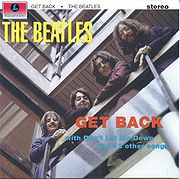
, with the band looking down the stairwell of EMI
's headquarters office block in Manchester Square, London
. A different photograph from the same photo session was later used on the compilation album 1967–1970 (aka The Blue Album).
Engineer Glyn Johns
put together a rough version of Get Back on acetate
in March 1969, which included many of the same songs that made the final cut, plus McCartney's "Teddy Boy". Johns played the acetate for The Beatles, who were not really interested in the project any longer. At least one copy of the acetate made its way to America and was aired on local radio stations in Buffalo, New York
, and Boston
in September.
 In March 1969, Lennon and McCartney called Glyn Johns to EMI and offered him free rein to produce an album from the Get Back recordings. Johns booked time at Olympic Studios
between 3 April and 28 May to mix the album and presented the final banded master tape to the group on 28 May. Only one track, "One After 909", was taken from the rooftop concert, with "I've Got a Feeling" and "Dig a Pony" (then called "All I Want Is You") being studio recordings instead. Johns also favoured earlier, rougher versions of "Two of Us" and "Let It Be" over the more polished performances from the final 31 January session (which were eventually chosen for the Let It Be album). It also included a jam
called "Rocker", a brief rendition of The Drifters
' "Save the Last Dance for Me
", Lennon's "Don't Let Me Down
" and a 5-minute version of "Dig It".
Get Back version one, May 1969:
Side one
Side two
The Get Back album was intended for release in July 1969, but its release was pushed back to September to coincide with the planned television special and the theatrical film about the making of the album. In September, the album's release was pushed back to December because The Beatles had just recorded Abbey Road and wanted to release that album instead. By December the album had been shelved.
On 15 December, The Beatles again approached Glyn Johns
to produce an album from the 'Get Back' tapes but this time with the instruction that the songs must match those included in the as yet unreleased Get Back film. Between 15 December 1969 and 8 January 1970, new mixes were prepared. Glyn Johns' new mix omitted "Teddy Boy" as the song did not appear in the film (and possibly because McCartney had indicated to Johns that he had re-recorded the song for his upcoming McCartney
album). It also added "Across the Universe" (a remix
of the 1968 studio version, as the January 1969 rehearsals of the song were judged unsatisfactory) and "I Me Mine", on which only McCartney, Harrison and Ringo Starr
performed (Lennon was on holiday in Denmark and had essentially left the band by that time). "I Me Mine" was newly recorded at 3 January 1970, as it appeared in the film and no multi-track recording had yet been made. The Beatles once again rejected the album.
Get Back version two, January 1970:
Side one
Side two
. Spector worked on the tracks and compiled the eventually released album—by now entitled Let It Be. The album and the film with the same name
were released on 8 May 1970; The Beatles had already broken up by that time. The film captured the critical tensions within the band, and also included footage from the rooftop concert. The rooftop performance closed with the song "Get Back", and afterwards Lennon said, "I'd like to say 'thank you' on behalf of the group and ourselves, and I hope we passed the audition." The joke was added to the studio version of the song that appeared on the album.
Several songs from the recording sessions have been released officially in versions different from those on the Let It Be album. "Get Back"/"Don't Let Me Down" and "Let It Be" were released as singles in 1969 and 1970, respectively. Seven tracks were live performances, in accordance with the original album concept: "I've Got a Feeling", "One After 909" and "Dig a Pony" from the rooftop performance, and "Two of Us", "Dig It", "Get Back" and "Maggie Mae" from studio sessions. Contrary to the original concept, the album versions of "For You Blue", "I Me Mine", "Let It Be" and "The Long and Winding Road" feature editing, splicing and/or overdubs. "Don't Let Me Down" was not included on the album. The twelfth track on the album is an edited version of the original 1968 recording of "Across the Universe", slowed down from D-major to D-flat, which had only been rehearsed at Twickenham and not professionally recorded on multi-track tape during the January 1969 sessions.
McCartney was deeply dissatisfied with Spector's treatment of some songs, particularly "The Long and Winding Road". McCartney had conceived of the song as a simple piano ballad, but Spector dubbed in orchestral and choral accompaniment. McCartney unsuccessfully attempted to halt release of Spector's version of the song. He was fine with the orchestra, but he wanted the choir and harp to be removed. Despite the criticisms levelled at Spector over the years for his handling of the material, Lennon defended him in his famous Playboy
interview 10 years later, saying, "He was given the shittiest load of badly-recorded shit with a lousy feeling to it ever, and he made something of it."
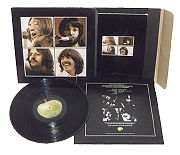 In the UK, the album was originally issued by Apple (and distributed by EMI) in a lavish box that also included a book featuring stills from the Let It Be film. Several months later, the album was reissued in Great Britain in a standard LP jacket, sans book. In the United States, the Let It Be album was issued in a standard jacket, without the book. The American release was also originally issued by Apple Records, but because United Artists
distributed the film, United Artists also held the rights to distribute the record in America. (EMI subsidiary Capitol
, which held The Beatles' US contract, had simultaneous rights to the music on the album, and could distribute the songs on various singles and compilation albums. Capitol, however, did not have the rights to release or distribute the actual album.) To indicate that Let It Be was not distributed by Capitol, the original record label in America sported a red apple, rather than The Beatles' usual green Granny Smith
apple. In early 1976, when The Beatles' Apple Record contract expired, most of the group's catalogue in the US transferred from Apple to Capitol; Let It Be, however, went out-of-print in America for three years. In 1979, Capitol/EMI acquired United Artists Records
; with this acquisition, Capitol acquired the rights to two Beatles' albums previously distributed in the US by United Artists, Let It Be and the soundtrack album A Hard Day's Night
. (As A Hard Day's Night had never been issued by Apple in the US, it remained in print in America under the United Artists label when the Apple contract expired in 1976.) Shortly after acquiring United Artists Records, Capitol re-issued both UA distributed Beatles' albums on the Capitol label.
The album was first released on CD on 19 October 1987. Along with the other Beatles' albums, EMI released a re-mastered CD on 9 September 2009 and an electronic version (24-bit FLAC
and MP3
formats on a USB drive) on 4 December 2009. Most critics felt that the sound was significantly improved over the 1987 CD, given the superior digital transfer technology available in 2009.
The Beatles won the Academy Award for the Best Original Song Score in 1970 for the songs in the film.
critic Alan Smith wrote "If the new Beatles' soundtrack is to be their last then it will stand as a cheapskate epitaph, a cardboard tombstone, a sad and tatty end to a musical fusion which wiped clean and drew again the face of pop." Rolling Stone
magazine was also critical of the album, citing Spector's production embellishments as a sore point: "Musically, boys, you passed the audition. In terms of having the judgment to avoid either over-producing yourselves or casting the fate of your get-back statement to the most notorious of all over-producers, you didn't."
Additional musicians
Production
, Katie Stevens
, Boney M., Annie Lennox
, George Michael
, Willie Nelson
, Pearl Jam
, David Bowie
, Fiona Apple
, Billy Ocean
, Elvis Presley
, Diana Ross
, Status Quo, Seether
, Stereophonics
, Rod Stewart
and Paul Weller
. In addition, the Slovenian group Laibach
covered the entire album
.
Rock music
Rock music is a genre of popular music that developed during and after the 1960s, particularly in the United Kingdom and the United States. It has its roots in 1940s and 1950s rock and roll, itself heavily influenced by rhythm and blues and country music...
band The Beatles
The Beatles
The Beatles were an English rock band, active throughout the 1960s and one of the most commercially successful and critically acclaimed acts in the history of popular music. Formed in Liverpool, by 1962 the group consisted of John Lennon , Paul McCartney , George Harrison and Ringo Starr...
. It was released on 8 May 1970 by the band's Apple Records
Apple Records
Apple Records is a record label founded by The Beatles in 1968, as a division of Apple Corps Ltd. It was initially intended as a creative outlet for the Beatles, both as a group and individually, plus a selection of other artists including Mary Hopkin, James Taylor, Badfinger, and Billy Preston...
label shortly after the group announced their break-up.
Most of Let It Be was recorded in January 1969, before the recording and release of the album Abbey Road. For this reason some critics and fans, such as Mark Lewisohn
Mark Lewisohn
Mark Lewisohn is an English author and historian, regarded as the world's leading authority on the English rock band The Beatles.-The Beatles and related subjects:...
, argue that Abbey Road should be considered the group's final album and Let It Be the penultimate. Let It Be was originally intended to be released before Abbey Road during mid-1969 as Get Back, but The Beatles were unhappy with this version, which was mixed and compiled by Glyn Johns
Glyn Johns
Glyn Johns is a musician, recording engineer and record producer.-Career:He has worked with such artists as Bob Dylan, The Beatles, The Easybeats, The Band, The Rolling Stones, The Who, Led Zeppelin, Eagles, Eric Clapton, The Clash, The Steve Miller Band, Small Faces, Spooky Tooth, The Ozark...
, and it was temporarily shelved. A new version of the album was created by Phil Spector
Phil Spector
Phillip Harvey "Phil" Spector is an American record producer and songwriter, later known for his conviction in the murder of actress Lana Clarkson....
in 1970 and finally released as Let It Be, serving as the album for the 1970 motion picture of the same name
Let It Be (film)
Let It Be is a 1970 documentary film about The Beatles rehearsing and recording songs for the album Let It Be in January 1969. The film features an unannounced rooftop concert by the group, their last performance in public...
. While three songs from the sessions were released as singles before the album's release, "Get Back
Get Back
"Get Back" is a song by The Beatles, composed by Paul McCartney and frequently attributed to Lennon–McCartney. The song was originally released as a single on 11 April 1969, and credited to "The Beatles with Billy Preston." A different mix of the song later became the closing track of Let It Be ,...
"/"Don't Let Me Down
Don't Let Me Down (The Beatles song)
"Don't Let Me Down" is a song by The Beatles , recorded in 1969 during the Get Back sessions.-Composition:...
" and "Let It Be
Let It Be (song)
"Let It Be" is a song by The Beatles, released in March 1970 as a single, and as the title track of their album Let It Be. It was written by Paul McCartney, but credited to Lennon–McCartney. It was their final single before McCartney announced his departure from the band...
", the songs were remixed by Spector for the album and "Don't Let Me Down" was not included.
Despite a largely negative review from Rolling Stone
Rolling Stone
Rolling Stone is a US-based magazine devoted to music, liberal politics, and popular culture that is published every two weeks. Rolling Stone was founded in San Francisco in 1967 by Jann Wenner and music critic Ralph J...
magazine at the time of its release, the album was ranked number 86 in the magazine's list of the 500 greatest albums of all time in 2003.
Let It Be... Naked was released in 2003, an alternative version of the album stripping much of Phil Spector
Phil Spector
Phillip Harvey "Phil" Spector is an American record producer and songwriter, later known for his conviction in the murder of actress Lana Clarkson....
's production work and using some different versions of songs.
Concept
By late 1968, more than two years after The Beatles gave up touring, Paul McCartneyPaul McCartney
Sir James Paul McCartney, MBE, Hon RAM, FRCM is an English musician, singer-songwriter and composer. Formerly of The Beatles and Wings , McCartney is listed in Guinness World Records as the "most successful musician and composer in popular music history", with 60 gold discs and sales of 100...
was eager for the group to perform live again. The sessions for that year's The Beatles
The Beatles (album)
The Beatles is the ninth official album by the English rock group The Beatles, a double album released in 1968. It is also commonly known as "The White Album" as it has no graphics or text other than the band's name embossed on its plain white sleeve.The album was written and recorded during a...
(commonly known as the White Album) had seen a number of serious arguments and strained relations among the group. McCartney felt that the group's cohesiveness had been lost through years without playing live, and from using the studio not to record ensemble performances but to make increasingly complex recordings made up of parts played individually by each Beatle as overdubs
Overdubbing
Overdubbing is a technique used by recording studios to add a supplementary recorded sound to a previously recorded performance....
rather than as a group. He believed that the best way to improve band relations and revive enthusiasm was to get the group back into rehearsal as quickly as possible (the White Album sessions having only been concluded in October 1968) and begin work on a new album that made little or no use of studio artifice or multiple overdubbing. This would allow the group to return to their roots by playing as a true ensemble, perhaps recording some or all of the new album during a one-off live concert or full concert tour. This idea mirrored the "back to basics" attitude of a number of rock musicians at this time in reaction against the psychedelic and progressive music dominant in the previous two years. McCartney believed that a return to live performance would reinstill the same sort of ensemble spirit and sense of togetherness that they had in their early years together.
McCartney also decided to invite producer/engineer Glyn Johns to contribute to the recording. His proposed role was apparently not clearly defined, as McCartney also wished to retain the services of George Martin
George Martin
Sir George Henry Martin CBE is an English record producer, arranger, composer and musician. He is sometimes referred to as "the Fifth Beatle"— a title that he often describes as "nonsense," but the fact remains that he served as producer on all but one of The Beatles' original albums...
. As a result, Johns was not entirely sure whether he was supposed to be producing (or co-producing) the album or merely engineering it, with Martin having no clear idea of where he stood either.
The other three Beatles were less enthusiastic about McCartney's proposals. They had just completed five months' work on their previous album and were sceptical about the prospects of returning to live performance. George Harrison
George Harrison
George Harrison, MBE was an English musician, guitarist, singer-songwriter, actor and film producer who achieved international fame as lead guitarist of The Beatles. Often referred to as "the quiet Beatle", Harrison became over time an admirer of Indian mysticism, and introduced it to the other...
in particular was very opposed to the idea of touring, having taken the strongest dislike of any of the group to the gruelling tours of the Beatlemania era. However he had recently enjoyed a series of jam sessions with Bob Dylan
Bob Dylan
Bob Dylan is an American singer-songwriter, musician, poet, film director and painter. He has been a major and profoundly influential figure in popular music and culture for five decades. Much of his most celebrated work dates from the 1960s when he was an informal chronicler and a seemingly...
and Delaney and Bonnie in the US, rediscovering his liking for straightforward ensemble playing, and he was attracted to the idea of the "back to basics" approach. The same approach greatly appealed to John Lennon
John Lennon
John Winston Lennon, MBE was an English musician and singer-songwriter who rose to worldwide fame as one of the founding members of The Beatles, one of the most commercially successful and critically acclaimed acts in the history of popular music...
, who had grown increasingly wary of what he regarded as the excessive technical artifice used on their recordings since Revolver
Revolver (album)
Revolver is the seventh studio album by the English rock group The Beatles, released on 5 August 1966 on the Parlophone label and produced by George Martin. Many of the tracks on Revolver are marked by an electric guitar-rock sound, in contrast with their previous LP, the folk rock inspired Rubber...
and had also made a recent return to no-frills ensemble playing in the shape of an appearance on The Rolling Stones Rock and Roll Circus
The Rolling Stones Rock and Roll Circus
The Rolling Stones Rock and Roll Circus is a film released in 1996 of an 11 December 1968 event put together by The Rolling Stones. The event comprised two concerts on a circus stage and included such acts as The Who, Taj Mahal, Marianne Faithfull, and Jethro Tull...
. In addition, all the group members had greatly enjoyed the recording of Lennon's song "Happiness is a Warm Gun
Happiness Is a Warm Gun
"Happiness Is a Warm Gun" is a song by The Beatles, featured on the eponymous double-disc album The Beatles, also known as The White Album...
" during the recent White Album sessions which, due to its multiple sections and myriad time signature
Time signature
The time signature is a notational convention used in Western musical notation to specify how many beats are in each measure and which note value constitutes one beat....
changes, had required all four members of the group to focus sharply and revive their ensemble playing skills to lay down a coherent basic rhythm track before any overdubbing could be applied. In the end, the group agreed to convene for rehearsals immediately following New Year's Day 1969 to begin work, even though no suitable conclusion or even firm direction for the new project had been agreed upon.
Conflicts
The rehearsals and recording sessions for the album did not run smoothly. The acrimony that began during the recording of the previous year's White AlbumThe Beatles (album)
The Beatles is the ninth official album by the English rock group The Beatles, a double album released in 1968. It is also commonly known as "The White Album" as it has no graphics or text other than the band's name embossed on its plain white sleeve.The album was written and recorded during a...
resumed soon after the rehearsals began. The band wasn't getting along, and Lennon and McCartney weren't working together as before. McCartney assumed the role of the leader, while a laid back Lennon was more interested in spending time/making music with his soon-to-be wife Yoko Ono
Yoko Ono
is a Japanese artist, musician, author and peace activist, known for her work in avant-garde art, music and filmmaking as well as her marriage to John Lennon...
, who was now present in the studio with him at all times. All of this caused frictions within the band. At one point, Harrison walked out and quit the group after several arguments with McCartney, and a severe fall-out with Lennon, due to the former's perfectionism and the latter's growing lack of interest in the band, only to be coaxed back some days later. The film version is famous for showcasing a number of conflicts between the group members and has frequently been referred to as a documentary intended to show the making of an album but instead showing "the break-up of a band".
Twickenham rehearsals
Since all the rehearsals were to be filmed by Lindsay-Hogg and his film crew, the decision was made to use a film studio for rehearsals and the sound stage at Twickenham Studios was chosen. The group began rehearsals there on 2 January 1969. Sound recordings were made on NagraNagra
Nagra is the trademark referring to any of the series of mostly battery-operated portable professional audio recorders produced by Kudelski SA, based in Cheseaux-sur-Lausanne, Switzerland....
mono recorders solely for the purpose of the film sound track; no professional multi-track recordings were made of these sessions as The Beatles were simply rehearsing for a proposed live performance. Phil Spector later used a snippet of dialogue from one of these rehearsals (Lennon announcing "Queen says no to pot-smoking FBI
Federal Bureau of Investigation
The Federal Bureau of Investigation is an agency of the United States Department of Justice that serves as both a federal criminal investigative body and an internal intelligence agency . The FBI has investigative jurisdiction over violations of more than 200 categories of federal crime...
members") to introduce "For You Blue
For You Blue
"For You Blue" is a Beatles song written by George Harrison. It was the B-side to "The Long and Winding Road" and the eleventh track on the Beatles' final LP release, Let It Be...
" on the finished album. Numerous bootleg records taken from the many hours of these soundtrack recordings are in wide circulation and various bits of music and dialogue from the same source were eventually used on the second disc of the 2003 release Let It Be... Naked.
The rehearsals quickly disintegrated into acrimony. Unable to generate much enthusiasm or focus their attention, their playing was largely ragged and unprofessional, not helped by the fact that they were severely out of practice at playing as a live ensemble. McCartney tried to organise and encourage his bandmates, but his attempts to hold the band together and rally spirits were seen by the others as controlling and patronising. Matters came to a head on 6 January, when Harrison had a heated argument with McCartney during a rehearsal of "Two of Us", which later became one of the most famous sequences in the Let It Be film. What is not shown in the film is another, allegedly much more severe argument Harrison had with Lennon on 10 January. Harrison had become fed up with Lennon's creative and communicative disengagement from the band and the two had a blazing row. According to journalist Michael Housego of The Daily Sketch, this descended into violence with Harrison and Lennon allegedly throwing punches at each other, though in a 16 January interview for the Daily Express, Harrison said, "There was no punch-up. We just fell out." After lunch, Harrison announced that he was "leaving the band now" and told the others "see you round the clubs". He promptly walked out, getting in his car and instead of returning home to his wife Pattie
Pattie Boyd
Patricia Anne "Pattie" Boyd is an English model and photographer, and the former wife of both George Harrison and Eric Clapton...
at his Esher
Esher
Esher is a town in the Surrey borough of Elmbridge in South East England near the River Mole. It is a very prosperous part of the Greater London Urban Area, largely suburban in character, and is situated 14.1 miles south west of Charing Cross....
home Kinfauns, he drove straight to his parents' home in Speke
Speke
Speke is an area of Liverpool, Merseyside, England, close to the boundaries of the Metropolitan Borough of Knowsley. It is south east of the city centre and to the west of the town of Widnes....
, Liverpool
Liverpool
Liverpool is a city and metropolitan borough of Merseyside, England, along the eastern side of the Mersey Estuary. It was founded as a borough in 1207 and was granted city status in 1880...
.
After Harrison's departure that afternoon, the three remaining Beatles attempted to continue the rehearsal. As a practical solution to the problem of Harrison's absence, Lennon suggested hiring Eric Clapton to replace Harrison, possibly as a full time member of The Beatles if Harrison stuck with his decision to quit the band permanently. McCartney and Starr vetoed this suggestion, with the former arguing that the group could not truly be considered as The Beatles without all four traditional members of the band.
Recording sessions
A week later the band agreed to Harrison's terms for returning to the group, which included abandoning the cold and cavernous soundstage at Twickenham. Sessions resumed on 22 January when the group moved to Apple Studios. Multi-track recording began on that date and continued until 31 January. Harrison brought in keyboardist Billy PrestonBilly Preston
William Everett "Billy" Preston was a musician who gained notoriety and fame, first as a session musician for the likes of Sam Cooke, Ray Charles and The Beatles, and later finding fame as a solo artist with hits such as "Space Race", "Will It Go Round in Circles" and "Nothing from...
to ease tensions and supplement the band for the live performances. Preston worked with The Beatles throughout their stay at Apple Studios.
The live concert idea culminated with The Beatles and Preston performing on 30 January on the rooftop of The Beatles' Apple
Apple Corps
Apple Corps Ltd. is a multi-armed multimedia corporation founded in January 1968 by the members of The Beatles to replace their earlier company and to form a conglomerate. Its name is a pun. Its chief division is Apple Records, which was launched in the same year...
Building at 3 Savile Row
Savile Row
Savile Row is a shopping street in Mayfair, central London, famous for its traditional men's bespoke tailoring. The term "bespoke" is understood to have originated in Savile Row when cloth for a suit was said to "be spoken for" by individual customers...
before a small audience of friends and employees. The performance was cut short by the police after complaints about noise. The complete concert has circulated among bootleg
Bootleg recording
A bootleg recording is an audio or video recording of a performance that was not officially released by the artist or under other legal authority. The process of making and distributing such recordings is known as bootlegging...
collectors for many years. Three numbers recorded at the rooftop concert, "Dig a Pony
Dig a Pony
"Dig a Pony" is a song by The Beatles, originally released on their 1970 album Let It Be. "Dig a Pony" was the penultimate song played at the concert on the rooftop of Apple Studios in Savile Row, London on 30 January 1969.-Composition:...
", "I've Got a Feeling
I've Got a Feeling
"I've Got a Feeling" is a song by The Beatles, from the 1970 album Let It Be. It is one of the songs on the album from the Rooftop Concert...
" and "One After 909
One After 909
"One After 909" is a song by The Beatles, written by John Lennon, with input from Paul McCartney , and originally released in 1970 on the album Let It Be. The album version is the live performance from the rooftop concert which took place on 30 January 1969...
", do appear on the album, while several spoken parts of the concert appear between tracks that were recorded in studio.
The band played hundreds of songs during the Get Back/Let It Be sessions. Aside from original songs ultimately released on the Let It Be album, there were early versions of many songs that appeared on Abbey Road, including "Mean Mr. Mustard
Mean Mr. Mustard
"Mean Mr. Mustard" is a song written by John Lennon, and performed by The Beatles on their album Abbey Road...
", "She Came in Through the Bathroom Window
She Came in Through the Bathroom Window
"She Came in Through the Bathroom Window" is a song written by Paul McCartney and performed by The Beatles on their album Abbey Road as part of the Abbey Road medley.-Origin:...
", "Sun King
Sun King (song)
"Sun King" is a song written primarily by John Lennon, but credited to Lennon–McCartney and recorded by The Beatles for their 1969 album, Abbey Road. It is the second song of the B-side's climactic medley.-History:...
", "Polythene Pam
Polythene Pam
"Polythene Pam" is a song written by John Lennon, credited to Lennon–McCartney, and performed by The Beatles on their album Abbey Road. The song is the part of the B-side medley in which Lennon declares that the title heroine "is so good looking but she looks like a man."-Background and...
", "Golden Slumbers", "Carry That Weight
Carry That Weight
"Carry That Weight" is a song by The Beatles. Released on Abbey Road and part of the long, climactic medley that closes the album, it features vocals from all four Beatles...
", "Something
Something
"Something" is a song by The Beatles, written by lead guitarist George Harrison in 1969. It was featured on the album Abbey Road, and was also the first song written by Harrison to appear on the A-side of a Beatles' single...
", "Maxwell's Silver Hammer
Maxwell's Silver Hammer
"Maxwell's Silver Hammer" is a song by The Beatles, on their album, Abbey Road, sung by Paul McCartney. It was written by McCartney, though credited to Lennon–McCartney.-Background:...
", "Oh! Darling
Oh! Darling
"Oh! Darling" is a song by The Beatles composed by Paul McCartney and appearing as the fourth song on the album, Abbey Road, in 1969. Its working title was "Oh! Darling "...
", "Octopus's Garden
Octopus's Garden
"Octopus's Garden" is a song by The Beatles written by Ringo Starr from their 1969 album Abbey Road....
", and "I Want You (She's So Heavy)
I Want You (She's So Heavy)
"I Want You " is a song by The Beatles, from their album Abbey Road. It was written by John Lennon, although credited to Lennon–McCartney....
". Still others would eventually end up on Beatles' solo albums, including Lennon's "Jealous Guy
Jealous Guy
"Jealous Guy" is a song written and performed by John Lennon which first appeared on his 1971 album Imagine. It is one of the most commonly covered Lennon songs, with at least ninety-two recorded cover versions, the most notable being Roxy Music's version, which reached number one in several...
" (called "Child of Nature" at the time and originally written and rehearsed for the White Album
The Beatles (album)
The Beatles is the ninth official album by the English rock group The Beatles, a double album released in 1968. It is also commonly known as "The White Album" as it has no graphics or text other than the band's name embossed on its plain white sleeve.The album was written and recorded during a...
) and "Gimme Some Truth
Gimme Some Truth
"Gimme Some Truth" is a protest song written and performed by John Lennon from his 1971 album Imagine.Like several songs on the album, such as the title track "Imagine", "Gimme Some Truth" has blatant political references emerging from the time it was written, during the latter years of the Vietnam...
", Harrison's "All Things Must Pass
All Things Must Pass
All Things Must Pass is a triple album by George Harrison, recorded and released in 1970. The original vinyl release featured two LPs of rock songs as well as Apple Jam, a third LP of informal jams...
", "Isn't It a Pity
Isn't It a Pity
"Isn't It a Pity" is a song by George Harrison from his 1970 solo album All Things Must Pass. It was written in 1966 but was rejected by John Lennon. It was released as the B-side of "My Sweet Lord" in the United States on November 23, 1970....
", "Let It Down" and "Hear Me Lord", and McCartney's "Another Day
Another Day (Paul McCartney song)
"Another Day" is a song recorded by Paul McCartney in New York in 1970, during the sessions for his album Ram. Although it was the first single of McCartney's solo career, "Another Day" was actually written and previewed during The Beatles' Let It Be Sessions in 1969. It was officially released on...
", "Teddy Boy
Teddy Boy (song)
"Teddy Boy" is a song by Paul McCartney and was first released on his first solo album McCartney, released in April 1970 after The Beatles disbanded. It was written by McCartney and originally recorded during the sessions for what became the Beatles' Let It Be album...
", "Junk
Junk (song)
"Junk" is a song written by Paul McCartney in 1968 while The Beatles were in India. It was originally under consideration for The Beatles . It was passed over for that LP, as it was for Abbey Road. It was eventually released on McCartney's debut solo album McCartney in 1970...
" (originally written for the White Album
The Beatles (album)
The Beatles is the ninth official album by the English rock group The Beatles, a double album released in 1968. It is also commonly known as "The White Album" as it has no graphics or text other than the band's name embossed on its plain white sleeve.The album was written and recorded during a...
) and "The Back Seat of My Car" (which appeared on McCartney's album Ram
Ram (album)
Ram is an album by Paul McCartney and Linda McCartney, released in 1971, the only album credited to the pair. It was the second of the two albums McCartney released between leaving The Beatles and forming Wings...
). Much of the band's attention was focused on a broad range of covers, extended jams on 12-bar blues, and occasional new efforts such as Lennon's uncompleted "Madman
Madman (song)
"Madman" is an unfinished song by John Lennon and was recorded by The Beatles in January 1969 during studio sessions later identified as the "Let It Be" sessions.-Recording:...
". These included classical pieces such as Samuel Barber
Samuel Barber
Samuel Osborne Barber II was an American composer of orchestral, opera, choral, and piano music. His Adagio for Strings is his most popular composition and widely considered a masterpiece of modern classical music...
's "Adagio for Strings
Adagio for Strings
Adagio for Strings is a work by Samuel Barber, arranged for string orchestra from the second movement of his String Quartet, Op. 11. Barber finished the arrangement in 1936, the same year as he wrote the quartet...
", jazz standards such as "Ain't She Sweet
Ain't She Sweet
Ain't She Sweet was an American album featuring four tracks recorded in Hamburg in 1961 by The Beatles featuring Tony Sheridan and cover versions of Beatles and British Invasion-era songs recorded by the Swallows...
", and an encyclopaedic array of songs from the early rock and roll era such as "Stand By Me
Stand by Me (song)
"Stand by Me" is the title of a song originally performed by Ben E. King and written by King, Jerry Leiber, and Mike Stoller, based on the spiritual "Lord Stand by Me,", plus two lines rooted in Psalms 46:2-3...
", "Words of Love
Words of Love
"Words of Love" is a song written by Buddy Holly and recorded by him on April 8, 1957. Holly harmonized for himself, by tape-recording each part and combining them. The song was not a notable hit for Holly, although it is regarded as one of his important recordings, and is available in most...
", "Lonely Sea", "Bésame Mucho
Bésame Mucho
"Bésame Mucho" is a Spanish language song written in 1940 by Mexican songwriter Consuelo Velázquez.-Inspiration:According to Velázquez herself, she wrote this song even though she had never been kissed yet at the time, and kissing as she heard was considered a sin.She was inspired by the piano...
" by Mexican composer Consuelo Velázquez
Consuelo Velázquez
Consuelo Velázquez was a Mexican concert pianist, songwriter and recording artist.According to her obituary, she was 88 years old when she died...
(a song that was part of The Beatles' repertoire in the early days) and "Blue Suede Shoes
Blue Suede Shoes
"Blue Suede Shoes" is a rock and roll standard written and first recorded by Carl Perkins in 1955 and is considered one of the first rockabilly records and incorporated elements of blues, country and pop music of the time...
". Multiple Bob Dylan
Bob Dylan
Bob Dylan is an American singer-songwriter, musician, poet, film director and painter. He has been a major and profoundly influential figure in popular music and culture for five decades. Much of his most celebrated work dates from the 1960s when he was an informal chronicler and a seemingly...
songs were also played, including "Positively 4th Street
Positively 4th Street
"Positively 4th Street" is a song written and performed by Bob Dylan, first recorded by Dylan in New York City on July 29, 1965. It was released as a single by Columbia Records on September 7, 1965, reaching #1 on Canada's RPM chart, #7 on the U.S. Billboard Hot 100, and #8 on the UK Singles Chart...
", "All Along the Watchtower
All Along the Watchtower
"All Along the Watchtower" is a song written and recorded by American singer-songwriter Bob Dylan. The song, which has been included on most of Dylan's greatest hits compilations, initially appeared on his 1967 album John Wesley Harding. Over the past 35 years, he has performed it in concert more...
" and "I Shall Be Released
I Shall Be Released
"I Shall Be Released" is a 1967 song written by Bob Dylan.The Band played it on their debut album, Music from Big Pink , with Richard Manuel singing lead vocals, and Rick Danko and Levon Helm harmonizing in the chorus...
". Only a handful of these were complete performances; the vast majority were fragmentary renditions with at most a verse or two of misremembered lyrics. The rehearsals and recording sessions were filmed and formed the basis of The Beatles' film of the same name
Let It Be (film)
Let It Be is a 1970 documentary film about The Beatles rehearsing and recording songs for the album Let It Be in January 1969. The film features an unannounced rooftop concert by the group, their last performance in public...
.
Two songs appearing on the album were not recorded during the Apple Studios sessions. "Across the Universe" had been recorded at EMI Studios in February 1968, and "I Me Mine" was not recorded until January 1970 after John Lennon's unannounced departure from the group.
Get Back albums
After increasing use of overdubs and multi-layered recordings on recent albums, there was at first a consensus to record the new album live. In keeping with the back-to-roots concept, the cover artwork was planned to be an update of the cover of their first album, Please Please MePlease Please Me
Please Please Me is the debut album by the English rock band The Beatles. Parlophone rush-released the album on 22 March 1963 in the United Kingdom to capitalise on the success of singles "Please Please Me" and "Love Me Do" .Of the album's fourteen songs, eight were written by Lennon–McCartney...
, with the band looking down the stairwell of EMI
EMI
The EMI Group, also known as EMI Music or simply EMI, is a multinational music company headquartered in London, United Kingdom. It is the fourth-largest business group and family of record labels in the recording industry and one of the "big four" record companies. EMI Group also has a major...
's headquarters office block in Manchester Square, London
Manchester Square
Manchester Square is an 18th century garden square in the Marylebone area in London, England, a short distance north of Oxford Street. It is one of the smaller but better preserved Georgian squares in central London...
. A different photograph from the same photo session was later used on the compilation album 1967–1970 (aka The Blue Album).
Engineer Glyn Johns
Glyn Johns
Glyn Johns is a musician, recording engineer and record producer.-Career:He has worked with such artists as Bob Dylan, The Beatles, The Easybeats, The Band, The Rolling Stones, The Who, Led Zeppelin, Eagles, Eric Clapton, The Clash, The Steve Miller Band, Small Faces, Spooky Tooth, The Ozark...
put together a rough version of Get Back on acetate
Acetate disc
An acetate disc, also known as a test acetate, dubplate , lacquer , transcription disc or instantaneous disc...
in March 1969, which included many of the same songs that made the final cut, plus McCartney's "Teddy Boy". Johns played the acetate for The Beatles, who were not really interested in the project any longer. At least one copy of the acetate made its way to America and was aired on local radio stations in Buffalo, New York
Buffalo, New York
Buffalo is the second most populous city in the state of New York, after New York City. Located in Western New York on the eastern shores of Lake Erie and at the head of the Niagara River across from Fort Erie, Ontario, Buffalo is the seat of Erie County and the principal city of the...
, and Boston
Boston
Boston is the capital of and largest city in Massachusetts, and is one of the oldest cities in the United States. The largest city in New England, Boston is regarded as the unofficial "Capital of New England" for its economic and cultural impact on the entire New England region. The city proper had...
in September.
Olympic Studios
Olympic Studios was a renowned independent commercial recording studio located at 117 Church Road, Barnes, South West London, England. The studio is best known for the huge number of famous rock and pop recordings made there from the late 1960s onward....
between 3 April and 28 May to mix the album and presented the final banded master tape to the group on 28 May. Only one track, "One After 909", was taken from the rooftop concert, with "I've Got a Feeling" and "Dig a Pony" (then called "All I Want Is You") being studio recordings instead. Johns also favoured earlier, rougher versions of "Two of Us" and "Let It Be" over the more polished performances from the final 31 January session (which were eventually chosen for the Let It Be album). It also included a jam
Jam session
Jam sessions are often used by musicians to develop new material, find suitable arrangements, or simply as a social gathering and communal practice session. Jam sessions may be based upon existing songs or forms, may be loosely based on an agreed chord progression or chart suggested by one...
called "Rocker", a brief rendition of The Drifters
The Drifters
The Drifters are a long-lived American doo-wop and R&B/soul vocal group with a peak in popularity from 1953 to 1963, though several splinter Drifters continue to perform today. They were originally formed to serve as Clyde McPhatter's backing group in 1953...
' "Save the Last Dance for Me
Save The Last Dance For Me
"Save the Last Dance for Me" is the title of a popular song written by Doc Pomus and Mort Shuman, first recorded in 1960 by Ben E. King with The Drifters....
", Lennon's "Don't Let Me Down
Don't Let Me Down (The Beatles song)
"Don't Let Me Down" is a song by The Beatles , recorded in 1969 during the Get Back sessions.-Composition:...
" and a 5-minute version of "Dig It".
Get Back version one, May 1969:
Side one
- "The One After 909One After 909"One After 909" is a song by The Beatles, written by John Lennon, with input from Paul McCartney , and originally released in 1970 on the album Let It Be. The album version is the live performance from the rooftop concert which took place on 30 January 1969...
" - "Rocker (Improvisation)"
- "Save the Last Dance for MeSave The Last Dance For Me"Save the Last Dance for Me" is the title of a popular song written by Doc Pomus and Mort Shuman, first recorded in 1960 by Ben E. King with The Drifters....
" - "Don't Let Me DownDon't Let Me Down (The Beatles song)"Don't Let Me Down" is a song by The Beatles , recorded in 1969 during the Get Back sessions.-Composition:...
" - "Dig a PonyDig a Pony"Dig a Pony" is a song by The Beatles, originally released on their 1970 album Let It Be. "Dig a Pony" was the penultimate song played at the concert on the rooftop of Apple Studios in Savile Row, London on 30 January 1969.-Composition:...
" - "I've Got a FeelingI've Got a Feeling"I've Got a Feeling" is a song by The Beatles, from the 1970 album Let It Be. It is one of the songs on the album from the Rooftop Concert...
" - "Get BackGet Back"Get Back" is a song by The Beatles, composed by Paul McCartney and frequently attributed to Lennon–McCartney. The song was originally released as a single on 11 April 1969, and credited to "The Beatles with Billy Preston." A different mix of the song later became the closing track of Let It Be ,...
"
Side two
- "For You BlueFor You Blue"For You Blue" is a Beatles song written by George Harrison. It was the B-side to "The Long and Winding Road" and the eleventh track on the Beatles' final LP release, Let It Be...
" - "Teddy BoyTeddy Boy (song)"Teddy Boy" is a song by Paul McCartney and was first released on his first solo album McCartney, released in April 1970 after The Beatles disbanded. It was written by McCartney and originally recorded during the sessions for what became the Beatles' Let It Be album...
" - "Two of Us"
- "Maggie Mae"
- "Dig It"
- "Let It BeLet It Be (song)"Let It Be" is a song by The Beatles, released in March 1970 as a single, and as the title track of their album Let It Be. It was written by Paul McCartney, but credited to Lennon–McCartney. It was their final single before McCartney announced his departure from the band...
" - "The Long and Winding RoadThe Long and Winding Road"The Long and Winding Road" is a ballad written by Paul McCartney that originally appeared on The Beatles' album Let It Be. It became The Beatles' 20th and last number-one song in the United States on 23 May 1970, and was the last single released by the quartet...
" - "Get BackGet Back"Get Back" is a song by The Beatles, composed by Paul McCartney and frequently attributed to Lennon–McCartney. The song was originally released as a single on 11 April 1969, and credited to "The Beatles with Billy Preston." A different mix of the song later became the closing track of Let It Be ,...
" (reprise)
The Get Back album was intended for release in July 1969, but its release was pushed back to September to coincide with the planned television special and the theatrical film about the making of the album. In September, the album's release was pushed back to December because The Beatles had just recorded Abbey Road and wanted to release that album instead. By December the album had been shelved.
On 15 December, The Beatles again approached Glyn Johns
Glyn Johns
Glyn Johns is a musician, recording engineer and record producer.-Career:He has worked with such artists as Bob Dylan, The Beatles, The Easybeats, The Band, The Rolling Stones, The Who, Led Zeppelin, Eagles, Eric Clapton, The Clash, The Steve Miller Band, Small Faces, Spooky Tooth, The Ozark...
to produce an album from the 'Get Back' tapes but this time with the instruction that the songs must match those included in the as yet unreleased Get Back film. Between 15 December 1969 and 8 January 1970, new mixes were prepared. Glyn Johns' new mix omitted "Teddy Boy" as the song did not appear in the film (and possibly because McCartney had indicated to Johns that he had re-recorded the song for his upcoming McCartney
McCartney (album)
McCartney is the debut solo album by Paul McCartney. Apart from Linda McCartney's vocal contributions, McCartney performed the entire album solo...
album). It also added "Across the Universe" (a remix
Remix
A remix is an alternative version of a recorded song, made from an original version. This term is also used for any alterations of media other than song ....
of the 1968 studio version, as the January 1969 rehearsals of the song were judged unsatisfactory) and "I Me Mine", on which only McCartney, Harrison and Ringo Starr
Ringo Starr
Richard Starkey, MBE better known by his stage name Ringo Starr, is an English musician and actor who gained worldwide fame as the drummer for The Beatles. When the band formed in 1960, Starr was a member of another Liverpool band, Rory Storm and the Hurricanes. He became The Beatles' drummer in...
performed (Lennon was on holiday in Denmark and had essentially left the band by that time). "I Me Mine" was newly recorded at 3 January 1970, as it appeared in the film and no multi-track recording had yet been made. The Beatles once again rejected the album.
Get Back version two, January 1970:
Side one
- "The One After 909One After 909"One After 909" is a song by The Beatles, written by John Lennon, with input from Paul McCartney , and originally released in 1970 on the album Let It Be. The album version is the live performance from the rooftop concert which took place on 30 January 1969...
" - "Rocker"
- "Save the Last Dance for MeSave The Last Dance For Me"Save the Last Dance for Me" is the title of a popular song written by Doc Pomus and Mort Shuman, first recorded in 1960 by Ben E. King with The Drifters....
" - "Don't Let Me DownDon't Let Me Down (The Beatles song)"Don't Let Me Down" is a song by The Beatles , recorded in 1969 during the Get Back sessions.-Composition:...
" - "Dig a PonyDig a Pony"Dig a Pony" is a song by The Beatles, originally released on their 1970 album Let It Be. "Dig a Pony" was the penultimate song played at the concert on the rooftop of Apple Studios in Savile Row, London on 30 January 1969.-Composition:...
" - "I've Got a FeelingI've Got a Feeling"I've Got a Feeling" is a song by The Beatles, from the 1970 album Let It Be. It is one of the songs on the album from the Rooftop Concert...
" - "Get BackGet Back"Get Back" is a song by The Beatles, composed by Paul McCartney and frequently attributed to Lennon–McCartney. The song was originally released as a single on 11 April 1969, and credited to "The Beatles with Billy Preston." A different mix of the song later became the closing track of Let It Be ,...
" - "Let It BeLet It Be (song)"Let It Be" is a song by The Beatles, released in March 1970 as a single, and as the title track of their album Let It Be. It was written by Paul McCartney, but credited to Lennon–McCartney. It was their final single before McCartney announced his departure from the band...
"
Side two
- "For You BlueFor You Blue"For You Blue" is a Beatles song written by George Harrison. It was the B-side to "The Long and Winding Road" and the eleventh track on the Beatles' final LP release, Let It Be...
" - "Two of Us"
- "Maggie Mae"
- "Dig It"
- "The Long and Winding RoadThe Long and Winding Road"The Long and Winding Road" is a ballad written by Paul McCartney that originally appeared on The Beatles' album Let It Be. It became The Beatles' 20th and last number-one song in the United States on 23 May 1970, and was the last single released by the quartet...
" - "I Me MineI Me Mine"I Me Mine" is a song by The Beatles, written and sung by George Harrison. I Me Mine is also the title of Harrison's autobiography. The song traces its origins to the January 1969 Get Back/Let It Be sessions, when it was rehearsed by the band at Twickenham Film Studios.-Origin:The set of pronouns...
" - "Across the UniverseAcross the Universe"Across the Universe" is a song by the English group The Beatles. It was written by John Lennon, and credited to Lennon–McCartney. The song first appeared on the various artists charity compilation album No One's Gonna Change Our World in December 1969, and later, in different form, on Let It Be,...
" - "Get BackGet Back"Get Back" is a song by The Beatles, composed by Paul McCartney and frequently attributed to Lennon–McCartney. The song was originally released as a single on 11 April 1969, and credited to "The Beatles with Billy Preston." A different mix of the song later became the closing track of Let It Be ,...
" (reprise)
Completion and release
In March 1970 the session tapes were given to American producer Phil SpectorPhil Spector
Phillip Harvey "Phil" Spector is an American record producer and songwriter, later known for his conviction in the murder of actress Lana Clarkson....
. Spector worked on the tracks and compiled the eventually released album—by now entitled Let It Be. The album and the film with the same name
Let It Be (film)
Let It Be is a 1970 documentary film about The Beatles rehearsing and recording songs for the album Let It Be in January 1969. The film features an unannounced rooftop concert by the group, their last performance in public...
were released on 8 May 1970; The Beatles had already broken up by that time. The film captured the critical tensions within the band, and also included footage from the rooftop concert. The rooftop performance closed with the song "Get Back", and afterwards Lennon said, "I'd like to say 'thank you' on behalf of the group and ourselves, and I hope we passed the audition." The joke was added to the studio version of the song that appeared on the album.
Several songs from the recording sessions have been released officially in versions different from those on the Let It Be album. "Get Back"/"Don't Let Me Down" and "Let It Be" were released as singles in 1969 and 1970, respectively. Seven tracks were live performances, in accordance with the original album concept: "I've Got a Feeling", "One After 909" and "Dig a Pony" from the rooftop performance, and "Two of Us", "Dig It", "Get Back" and "Maggie Mae" from studio sessions. Contrary to the original concept, the album versions of "For You Blue", "I Me Mine", "Let It Be" and "The Long and Winding Road" feature editing, splicing and/or overdubs. "Don't Let Me Down" was not included on the album. The twelfth track on the album is an edited version of the original 1968 recording of "Across the Universe", slowed down from D-major to D-flat, which had only been rehearsed at Twickenham and not professionally recorded on multi-track tape during the January 1969 sessions.
McCartney was deeply dissatisfied with Spector's treatment of some songs, particularly "The Long and Winding Road". McCartney had conceived of the song as a simple piano ballad, but Spector dubbed in orchestral and choral accompaniment. McCartney unsuccessfully attempted to halt release of Spector's version of the song. He was fine with the orchestra, but he wanted the choir and harp to be removed. Despite the criticisms levelled at Spector over the years for his handling of the material, Lennon defended him in his famous Playboy
Playboy
Playboy is an American men's magazine that features photographs of nude women as well as journalism and fiction. It was founded in Chicago in 1953 by Hugh Hefner and his associates, and funded in part by a $1,000 loan from Hefner's mother. The magazine has grown into Playboy Enterprises, Inc., with...
interview 10 years later, saying, "He was given the shittiest load of badly-recorded shit with a lousy feeling to it ever, and he made something of it."
United Artists
United Artists Corporation is an American film studio. The original studio of that name was founded in 1919 by D. W. Griffith, Charles Chaplin, Mary Pickford and Douglas Fairbanks....
distributed the film, United Artists also held the rights to distribute the record in America. (EMI subsidiary Capitol
Capitol Records
Capitol Records is a major United States based record label, formerly located in Los Angeles, but operating in New York City as part of Capitol Music Group. Its former headquarters building, the Capitol Tower, is a major landmark near the corner of Hollywood and Vine...
, which held The Beatles' US contract, had simultaneous rights to the music on the album, and could distribute the songs on various singles and compilation albums. Capitol, however, did not have the rights to release or distribute the actual album.) To indicate that Let It Be was not distributed by Capitol, the original record label in America sported a red apple, rather than The Beatles' usual green Granny Smith
Granny Smith
The Granny Ramsey Smith green apple is a tip-bearing apple cultivar, which originated in Australia in 1868. It is named after Maria Ann Smith, who propagated the cultivar from a chance seedling. The tree is thought to be a hybrid of Malus sylvestris, the European Wild Apple, with the domestic...
apple. In early 1976, when The Beatles' Apple Record contract expired, most of the group's catalogue in the US transferred from Apple to Capitol; Let It Be, however, went out-of-print in America for three years. In 1979, Capitol/EMI acquired United Artists Records
United Artists Records
United Artists Records was a record label founded by Max E. Youngstein of United Artists in 1957 initially to distribute records of its movie soundtracks, though it soon branched out into recording music of a number of different genres.-History:...
; with this acquisition, Capitol acquired the rights to two Beatles' albums previously distributed in the US by United Artists, Let It Be and the soundtrack album A Hard Day's Night
A Hard Day's Night (album)
A Hard Day's Night is the third studio album by The Beatles, released on 10 July 1964 as the soundtrack to their film A Hard Day's Night. The American version of the album was released two weeks earlier, on 26 June 1964 by United Artists Records, with a different track listing...
. (As A Hard Day's Night had never been issued by Apple in the US, it remained in print in America under the United Artists label when the Apple contract expired in 1976.) Shortly after acquiring United Artists Records, Capitol re-issued both UA distributed Beatles' albums on the Capitol label.
The album was first released on CD on 19 October 1987. Along with the other Beatles' albums, EMI released a re-mastered CD on 9 September 2009 and an electronic version (24-bit FLAC
FLAC
FLAC is a codec which allows digital audio to be losslessly compressed such that file size is reduced without any information being lost...
and MP3
MP3
MPEG-1 or MPEG-2 Audio Layer III, more commonly referred to as MP3, is a patented digital audio encoding format using a form of lossy data compression...
formats on a USB drive) on 4 December 2009. Most critics felt that the sound was significantly improved over the 1987 CD, given the superior digital transfer technology available in 2009.
The Beatles won the Academy Award for the Best Original Song Score in 1970 for the songs in the film.
Let It Be... Naked
At the same time the film's re-release was announced, McCartney announced plans to release a new version of the album that is closer to what he had originally intended for the project. The new collection, Let It Be... Naked, was released on 17 November 2003, in a two-disc format—the second disc contained fly-on-the-wall recordings of the band chit-chatting during the Get Back Sessions. The songs were re-mixed from the original multitrack recordings. The recording did not contain the humorous spoken passages and lavish orchestral overdubs from Let It Be. The album received mixed reviews, some critics praising the simpler re-mixes and others expressing disappointment that the new album lacked the fun and humour of Let It Be.Reception
Although Let It Be would earn the top spot on both the American and British record charts, with the "Let It Be" single and "The Long and Winding Road" also reaching number one in the US, the album was met with mixed reviews at the time of its release. NMENME
The New Musical Express is a popular music publication in the United Kingdom, published weekly since March 1952. It started as a music newspaper, and gradually moved toward a magazine format during the 1980s, changing from newsprint in 1998. It was the first British paper to include a singles...
critic Alan Smith wrote "If the new Beatles' soundtrack is to be their last then it will stand as a cheapskate epitaph, a cardboard tombstone, a sad and tatty end to a musical fusion which wiped clean and drew again the face of pop." Rolling Stone
Rolling Stone
Rolling Stone is a US-based magazine devoted to music, liberal politics, and popular culture that is published every two weeks. Rolling Stone was founded in San Francisco in 1967 by Jann Wenner and music critic Ralph J...
magazine was also critical of the album, citing Spector's production embellishments as a sore point: "Musically, boys, you passed the audition. In terms of having the judgment to avoid either over-producing yourselves or casting the fate of your get-back statement to the most notorious of all over-producers, you didn't."
Track listing
Chart positions
| Chart | Year | Peak position |
|---|---|---|
| UK Albums Chart UK Albums Chart The UK Albums Chart is a list of albums ranked by physical and digital sales in the United Kingdom. It is compiled every week by The Official Charts Company and broadcast on a Sunday on BBC Radio 1 , and published in Music Week magazine and on the OCC website .To qualify for the UK albums chart... |
1970 | 1 |
Personnel
The Beatles- George HarrisonGeorge HarrisonGeorge Harrison, MBE was an English musician, guitarist, singer-songwriter, actor and film producer who achieved international fame as lead guitarist of The Beatles. Often referred to as "the quiet Beatle", Harrison became over time an admirer of Indian mysticism, and introduced it to the other...
– leadLead vocalistThe lead vocalist is the member of a band who sings the main vocal portions of a song. They may also play one or more instruments. Lead vocalists are sometimes referred to as the frontman or frontwoman, and as such, are usually considered to be the "leader" of the groups they perform in, often the...
vocalsSingingSinging is the act of producing musical sounds with the voice, and augments regular speech by the use of both tonality and rhythm. One who sings is called a singer or vocalist. Singers perform music known as songs that can be sung either with or without accompaniment by musical instruments...
on "I Me Mine" and "For You Blue", leadLead guitarLead guitar is a guitar part which plays melody lines, instrumental fill passages, guitar solos, and occasionally, some riffs within a song structure...
and rhythmRhythm guitarRhythm guitar is a technique and rôle that performs a combination of two functions: to provide all or part of the rhythmic pulse in conjunction with singers or other instruments; and to provide all or part of the harmony, ie. the chords, where a chord is a group of notes played together...
guitarGuitarThe guitar is a plucked string instrument, usually played with fingers or a pick. The guitar consists of a body with a rigid neck to which the strings, generally six in number, are attached. Guitars are traditionally constructed of various woods and strung with animal gut or, more recently, with...
s, acoustic guitarAcoustic guitarAn acoustic guitar is a guitar that uses only an acoustic sound board. The air in this cavity resonates with the vibrational modes of the string and at low frequencies, which depend on the size of the box, the chamber acts like a Helmholtz resonator, increasing or decreasing the volume of the sound...
on "For You Blue" and "I Me Mine", tamburaTamburaThe tambura, tanpura, or tambora is a long-necked plucked lute . The body shape of the tambura somewhat resembles that of the sitar, but it has no frets – only the open strings are played to accompany other musicians...
on "Across the Universe", six-stringExtended-range bassExtended-range bass refers to an electric bass guitar with greater frequency range than the standard 4-string bass guitar. Bass guitars tuned one octave lower than a standard four-string instrument are also considered an extended-range bass...
bass guitarBass guitarThe bass guitar is a stringed instrument played primarily with the fingers or thumb , or by using a pick....
on "Two of Us" and "Maggie Mae" - John LennonJohn LennonJohn Winston Lennon, MBE was an English musician and singer-songwriter who rose to worldwide fame as one of the founding members of The Beatles, one of the most commercially successful and critically acclaimed acts in the history of popular music...
– lead and backing vocals, rhythm guitar, lead guitar on "Get Back", lap steel guitarLap steel guitarThe lap steel guitar is a type of steel guitar, an instrument derived from and similar to the guitar. The player changes pitch by pressing a metal or glass bar against the strings instead of by pressing strings against the fingerboard....
on "For You Blue", acoustic guitar on "Two of Us", "Across the Universe" and "Maggie Mae", six-string bass guitar on "Dig It", "Let It Be" and "The Long and Winding Road" - Paul McCartneyPaul McCartneySir James Paul McCartney, MBE, Hon RAM, FRCM is an English musician, singer-songwriter and composer. Formerly of The Beatles and Wings , McCartney is listed in Guinness World Records as the "most successful musician and composer in popular music history", with 60 gold discs and sales of 100...
– lead and backing vocals, bass guitar, pianoPianoThe piano is a musical instrument played by means of a keyboard. It is one of the most popular instruments in the world. Widely used in classical and jazz music for solo performances, ensemble use, chamber music and accompaniment, the piano is also very popular as an aid to composing and rehearsal...
on "Dig It", "Let It Be", "The Long and Winding Road", and "For You Blue", acoustic guitar on "Two of Us" and "Maggie Mae", HammondHammond organThe Hammond organ is an electric organ invented by Laurens Hammond in 1934 and manufactured by the Hammond Organ Company. While the Hammond organ was originally sold to churches as a lower-cost alternative to the wind-driven pipe organ, in the 1960s and 1970s it became a standard keyboard...
organOrgan (music)The organ , is a keyboard instrument of one or more divisions, each played with its own keyboard operated either with the hands or with the feet. The organ is a relatively old musical instrument in the Western musical tradition, dating from the time of Ctesibius of Alexandria who is credited with...
and electric pianoElectric pianoAn electric piano is an electric musical instrument.Electric pianos produce sounds mechanically and the sounds are turned into electrical signals by pickups. Unlike a synthesizer, the electric piano is not an electronic instrument, but electro-mechanical. The earliest electric pianos were invented...
on "I Me Mine" - Ringo StarrRingo StarrRichard Starkey, MBE better known by his stage name Ringo Starr, is an English musician and actor who gained worldwide fame as the drummer for The Beatles. When the band formed in 1960, Starr was a member of another Liverpool band, Rory Storm and the Hurricanes. He became The Beatles' drummer in...
– drumsDrum kitA drum kit is a collection of drums, cymbals and often other percussion instruments, such as cowbells, wood blocks, triangles, chimes, or tambourines, arranged for convenient playing by a single person ....
and percussionPercussion instrumentA percussion instrument is any object which produces a sound when hit with an implement or when it is shaken, rubbed, scraped, or otherwise acted upon in a way that sets the object into vibration...
Additional musicians
- Richard Anthony HewsonRichard Anthony HewsonRichard Anthony Hewson is an English producer, arranger, conductor and multi-instrumentalist, who is best recognized for his studio group The RAH Band.-Career:...
– stringString instrumentA string instrument is a musical instrument that produces sound by means of vibrating strings. In the Hornbostel-Sachs scheme of musical instrument classification, used in organology, they are called chordophones...
and brassBrass instrumentA brass instrument is a musical instrument whose sound is produced by sympathetic vibration of air in a tubular resonator in sympathy with the vibration of the player's lips...
arrangementArrangementThe American Federation of Musicians defines arranging as "the art of preparing and adapting an already written composition for presentation in other than its original form. An arrangement may include reharmonization, paraphrasing, and/or development of a composition, so that it fully represents...
s on "I Me Mine" and "The Long and Winding Road" - John BarhamJohn BarhamJohn Barham is an English pianist, composer, arranger, producer and educator.Born in London, and educated at London’s Royal College of Music and London University’s School of Oriental and African Studies , he has played and / or collaborated with a number of significant figures in the entertainment...
– choralChoirA choir, chorale or chorus is a musical ensemble of singers. Choral music, in turn, is the music written specifically for such an ensemble to perform.A body of singers who perform together as a group is called a choir or chorus...
arrangements on "Across the Universe", "I Me Mine" and "The Long and Winding Road" - George MartinGeorge MartinSir George Henry Martin CBE is an English record producer, arranger, composer and musician. He is sometimes referred to as "the Fifth Beatle"— a title that he often describes as "nonsense," but the fact remains that he served as producer on all but one of The Beatles' original albums...
– shaker on "Dig It", string and brass arrangements on "Let It Be" - Linda McCartneyLinda McCartneyLinda Louise McCartney, Lady McCartney was an American photographer, musician and animal rights activist. Her father and mother were Lee Eastman and Louise Sara Lindner Eastman....
– backing vocals on "Let It Be" - Billy PrestonBilly PrestonWilliam Everett "Billy" Preston was a musician who gained notoriety and fame, first as a session musician for the likes of Sam Cooke, Ray Charles and The Beatles, and later finding fame as a solo artist with hits such as "Space Race", "Will It Go Round in Circles" and "Nothing from...
– electric piano on "Dig a Pony", "I've Got a Feeling", "One After 909", "The Long and Winding Road", and "Get Back", Hammond organ on "Dig It" and "Let It Be" - Brian Rogers – string and brass arrangements on "Across the Universe"
Production
- Glyn JohnsGlyn JohnsGlyn Johns is a musician, recording engineer and record producer.-Career:He has worked with such artists as Bob Dylan, The Beatles, The Easybeats, The Band, The Rolling Stones, The Who, Led Zeppelin, Eagles, Eric Clapton, The Clash, The Steve Miller Band, Small Faces, Spooky Tooth, The Ozark...
– audio engineeringAudio engineeringAn audio engineer, also called audio technician, audio technologist or sound technician, is a specialist in a skilled trade that deals with the use of machinery and equipment for the recording, mixing and reproduction of sounds. The field draws on many artistic and vocational areas, including...
, mixingAudio mixing (recorded music)In audio recording, audio mixing is the process by which multiple recorded sounds are combined into one or more channels, most commonly two-channel stereo. In the process, the source signals' level, frequency content, dynamics, and panoramic position are manipulated and effects such as reverb may... - George MartinGeorge MartinSir George Henry Martin CBE is an English record producer, arranger, composer and musician. He is sometimes referred to as "the Fifth Beatle"— a title that he often describes as "nonsense," but the fact remains that he served as producer on all but one of The Beatles' original albums...
– producer - Alan ParsonsAlan ParsonsAlan Parsons is a British audio engineer, musician, and record producer. He was involved with the production of several significant albums, including The Beatles' Abbey Road and Let It Be, as well as Pink Floyd's The Dark Side of the Moon for which Pink Floyd credit him as an important contributor...
– assistant engineer - Phil SpectorPhil SpectorPhillip Harvey "Phil" Spector is an American record producer and songwriter, later known for his conviction in the murder of actress Lana Clarkson....
– "re-producer" (final overdubs), final mixing
Cover versions
The album's songs have been covered by numerous performers including Brooke WhiteBrooke White
Brooke Elizabeth White is an American indie pop/folk-pop singer-songwriter and actress from Mesa, Arizona who was the fifth place finalist on the seventh season of American Idol. In 2005, White released her first studio album, called Songs from the Attic.White's first post-Idol album High Hopes &...
, Katie Stevens
Katie Stevens
Katherine Mari "Katie" Stevens is an American singer from Middlebury, Connecticut who finished in eighth place on the ninth season of American Idol.-Biography:...
, Boney M., Annie Lennox
Annie Lennox
Annie Lennox, OBE , born Ann Lennox, is a Scottish singer-songwriter, political activist and philanthropist. After achieving minor success in the late 1970s with The Tourists, with fellow musician David A...
, George Michael
George Michael
George Michael is a British musician, singer, songwriter and record producer who rose to fame in the 1980s when he formed the pop duo Wham! with his school friend, Andrew Ridgeley...
, Willie Nelson
Willie Nelson
Willie Hugh Nelson is an American country music singer-songwriter, as well as an author, poet, actor, and activist. The critical success of the album Shotgun Willie , combined with the critical and commercial success of Red Headed Stranger and Stardust , made Nelson one of the most recognized...
, Pearl Jam
Pearl Jam
Pearl Jam is an American rock band that formed in Seattle, Washington, in 1990. Since its inception, the band's line-up has included Eddie Vedder , Jeff Ament , Stone Gossard , and Mike McCready...
, David Bowie
David Bowie
David Bowie is an English musician, actor, record producer and arranger. A major figure for over four decades in the world of popular music, Bowie is widely regarded as an innovator, particularly for his work in the 1970s...
, Fiona Apple
Fiona Apple
Fiona Apple McAfee Maggart is an American singer-songwriter and pianist. Apple met international acclaim for her 1996 debut album, Tidal, which was a critical and commercial success...
, Billy Ocean
Billy Ocean
Billy Ocean is a Trinidad-born English Grammy Award winning popular music performer who had a string of rhythm and blues international pop hits in the 1970s and 1980s. He was the most popular British-based R&B singer / songwriter of the early to mid-1980s...
, Elvis Presley
Elvis Presley
Elvis Aaron Presley was one of the most popular American singers of the 20th century. A cultural icon, he is widely known by the single name Elvis. He is often referred to as the "King of Rock and Roll" or simply "the King"....
, Diana Ross
Diana Ross
Diana Ernestine Earle Ross is an American singer, record producer, and actress. Ross was lead singer of the Motown group The Supremes during the 1960s. After leaving the group in 1970, Ross began a solo career that included successful ventures into film and Broadway...
, Status Quo, Seether
Seether
Seether is a post-grunge/alternative metal band from Pretoria, South Africa, formed in 1999. The band is currently signed to Wind-up Records...
, Stereophonics
Stereophonics
The Stereophonics are a Welsh rock band now living in turners x that formed in 1992 in the village of Cwmaman in Cynon Valley, Wales. The band currently comprises lead vocalist and guitarist Kelly Jones, bassist and backing vocalist Richard Jones, drummer Javier Weyler, guitarist and backing...
, Rod Stewart
Rod Stewart
Roderick David "Rod" Stewart, CBE is a British singer-songwriter and musician, born and raised in North London, England and currently residing in Epping. He is of Scottish and English ancestry....
and Paul Weller
Paul Weller
Paul Weller is an English singer-songwriter. Starting with the band The Jam , Weller then went on to branch out musically to a more soulful style with The Style Council...
. In addition, the Slovenian group Laibach
Laibach (band)
Laibach is a Slovenian avant-garde music group associated with industrial, martial, and neo-classical musical styles. Laibach formed June 1, 1980 in Trbovlje, Slovenia . Laibach represents the music wing of the Neue Slowenische Kunst art collective, of which it was a founding member in 1984...
covered the entire album
Let It Be (Laibach album)
Let It Be is the fifth album by Laibach, released in 1988. It is a cover of the Beatles' album Let It Be recorded in Laibach style with military rhythms and choirs, though a few tracks deviate from this formula, most notably "Across the Universe"...
.