
All Topics  
Adagio for Strings

 
Adagio for Strings

   Email Print
   Bookmark   Link


Adagio for Strings


"Adagio for Strings" is a work for string orchestra
String orchestra

A string orchestra is understood as an orchestra composed solely of instruments of the violin family. These instruments are the violin, the viola, the cello and the double bass ....
, arranged by the American
United States

The United States of America is a Federal government constitutional republic comprising U.S. state and a federal district. The country is situated mostly in central North America, where its Contiguous United States and Washington, D.C., the Capital districts and territories, lie between the Pacific Ocean and Atlantic Oceans, Borders of the U...
 composer
Composer

A composer is a person who creates music, usually in the medium of musical notation, for interpretation and performance. The level of distinction between composers and other musicians varies, which affects issues such as copyright and the deference given to individual interpretations of a particular piece of music....
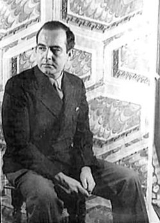
 Samuel Barber
Samuel Barber

Samuel Osborne Barber II was an American composer of orchestral, opera, choral, and piano music. His Adagio for Strings is among his most popular compositions and widely considered a masterpiece of modern classical music....
 from his first string quartet.

er's "Adagio for Strings" originated as the second movement in his String Quartet No. 1, Op. 11, composed in 1936. In the original it follows a violently contrasting first movement, and is succeeded by a brief reprise of this music.

In January 1938 Barber sent the piece to Arturo Toscanini
Arturo Toscanini

Arturo Toscanini was an Italian people conductor. One of the most acclaimed musicians of the late 19th and 20th Centuries, he was renowned for his brilliant intensity, his restless perfectionism, his phenomenal ear for orchestral detail and sonority, and his photographic memory....
.


Discussion
Ask a question about 'Adagio for Strings'
Start a new discussion about 'Adagio for Strings'
Answer questions from other users
Full Discussion Forum


Recent Posts


Encyclopedia


"Adagio for Strings" is a work for string orchestra
String orchestra

A string orchestra is understood as an orchestra composed solely of instruments of the violin family. These instruments are the violin, the viola, the cello and the double bass ....
, arranged by the American
United States

The United States of America is a Federal government constitutional republic comprising U.S. state and a federal district. The country is situated mostly in central North America, where its Contiguous United States and Washington, D.C., the Capital districts and territories, lie between the Pacific Ocean and Atlantic Oceans, Borders of the U...
 composer
Composer

A composer is a person who creates music, usually in the medium of musical notation, for interpretation and performance. The level of distinction between composers and other musicians varies, which affects issues such as copyright and the deference given to individual interpretations of a particular piece of music....
 Samuel Barber
Samuel Barber

Samuel Osborne Barber II was an American composer of orchestral, opera, choral, and piano music. His Adagio for Strings is among his most popular compositions and widely considered a masterpiece of modern classical music....
 from his first string quartet.

Genesis

Barber's "Adagio for Strings" originated as the second movement in his String Quartet No. 1, Op. 11, composed in 1936. In the original it follows a violently contrasting first movement, and is succeeded by a brief reprise of this music.

In January 1938 Barber sent the piece to Arturo Toscanini
Arturo Toscanini

Arturo Toscanini was an Italian people conductor. One of the most acclaimed musicians of the late 19th and 20th Centuries, he was renowned for his brilliant intensity, his restless perfectionism, his phenomenal ear for orchestral detail and sonority, and his photographic memory....
. The conductor returned the score without comment, and Barber was annoyed and avoided the conductor. Subsequently Toscanini sent word through a friend that he was planning to perform the piece and had returned it simply because he had already memorized it. It was reported that Toscanini did not look at the music again until the day before the premiere.

The work was given its first performance in a radio broadcast by Arturo Toscanini
Arturo Toscanini

Arturo Toscanini was an Italian people conductor. One of the most acclaimed musicians of the late 19th and 20th Centuries, he was renowned for his brilliant intensity, his restless perfectionism, his phenomenal ear for orchestral detail and sonority, and his photographic memory....
 with the NBC Symphony Orchestra
NBC Symphony Orchestra

The NBC Symphony Orchestra was a radio orchestra established by David Sarnoff of the National Broadcasting Company especially for conductor Arturo Toscanini....
 on November 5, 1938 in New York.

The composer also transcribed the piece in 1967 for eight-part choir
Choir

A choir, chorale, or chorus is a musical ensemble of singers. Choral Music, in turn, is the music written specifically for a choir to perform....
, as a setting of the Agnus Dei
Agnus Dei

Agnus Dei is a Latin language term meaning Lamb of God, and was originally used to refer to Jesus Christ in his role of the perfect sacrificial lamb that atonement for the sins of humanity in Christian theology, harkening back to ancient Jewish Temple sacrifices....
 ("Lamb of God").

Analysis


The piece uses an arch form
Arch form

In music, arch form is a section_al musical form for a piece of music based on repetition, in reverse order, of all or most musical sections such that the overall form is symmetric, most often around a central movement....
, employing and then inverting
Inversion (music)

In music theory, the word inversion has several meanings. There are inverted chords, inverted melodies, inverted intervals, and inverted voices....
, expanding, and varying
Variation (music)

In music, variation is a formal technique where material is altered during repetition: reiteration with changes. The changes may involve harmony, melody, counterpoint, rhythm, timbre or orchestration....
 a stepwise ascending melody
Melody

In music, a melody , also tune, voice, or line, is a linear succession of musical tones which is perceived as a single entity....
. It is in the key of B-Flat Minor and is in 4/2 time.

The long, flowing melodic line moves freely between the voices in the string choir; for example, the first section of the Adagio begins with the principal melodic cell played by first violins, but ends with its restatement by violas, transposed down a fifth. Violas continue with a variation on the melodic cell in the second section; the basses are silent for this and the next section. The expansive middle section begins with cellos playing the principal melodic cell in mezzo-soprano range; as the section builds, the string choir moves up the scale to their highest registers, culminating in a fortissimo-forte climax followed by sudden silence. A brief series of mournful chords serve as a coda to this portion of the piece, and reintroduces the bass section. The last section is a restatement of the original theme, with an inversion of the second piece of the melodic cell, played by first violins and violas in unison; the piece ends with first violins slowly restating the first five notes of the melody in alto register, holding the last note over a brief silence and a fading accompaniment.

Popularity and influence

The recording of the 1938 world premiere, with Arturo Toscanini conducting the NBC Orchestra, was selected in 2005 for permanent preservation in the National Recording Registry
National Recording Registry

The National Recording Registry is a list of sound recordings that "are culturally, historically, or aesthetically important, and/or inform or reflect life in the United States." The registry was established by the National Recording Preservation Act of 2000, which created the National Recording Preservation Board, whose members are appointed...
 at the United States Library of Congress
Library of Congress

The Library of Congress is the de facto national library of the United States and the research arm of the United States Congress. Located in three buildings in Washington, D.C., it is the largest library in the world by shelf space and holds the largest number of books....
.

The piece was played at the funerals of Franklin D. Roosevelt
Franklin D. Roosevelt

Franklin Delano Roosevelt , often referred to by his initials FDR, was the List of Presidents of the United States President of the United States....
 and Prince Rainier of Monaco
Rainier III, Prince of Monaco

Rainier III, Prince of Monaco , styled His Serene Highness The Sovereign Prince of Monaco, ruled the Principality of Monaco for more than 50 years, making him one of the List of longest reigning monarchs of the 20th century....
. It was also performed in 2001 at a ceremony at the World Trade Center
World trade center

The World Trade Centers Association founded in 1970, is a not-for-profit, non-political association dedicated to the establishment and effective operation of World Trade Centers as instruments for trade expansion representing 316 members in 91 countries....
 to commemorate the victims of the September 11 attacks.

In 2004, listeners of the BBC's Today
Today programme

Today, sometimes referred to as the Today programme to avoid ambiguity, is BBC Radio 4's long-running early morning news and current affairs programme, which is now broadcast from 6am to 9am from Monday to Friday and from 7am to 9am on Saturdays....
 program voted Adagio the "saddest classical" work ever, ahead of "Dido's Lament" from Dido and Ćneas by Henry Purcell
Henry Purcell

Henry Purcell...
, the "Adagietto" from Gustav Mahler
Gustav Mahler

Gustav Mahler was a Bohemian-born Austrian composer and conducting. He was best known during his own lifetime as one of the leading orchestral and operatic conductors of the day....
's 5th symphony
Symphony No. 5 (Mahler)

The Symphony No. 5 by Gustav Mahler was written in 1901 and 1902 mostly during the summer months at Mahler's cottage at Maiernigg. It is arguably the best known Mahler symphony....
, Metamorphosen
Metamorphosen

Metamorphosen is a composition for 23 solo strings by Richard Strauss. Written during the closing months of the Second World War, and first performed in January 1946 , it was written as a statement of mourning for Germany's destruction during the Second World War, in particular the bombing of the Munich Opera House, the Goethehaus,...
 by Richard Strauss
Richard Strauss

Richard Georg Strauss was a German composer of the late Romantic music and early modern eras, particularly of operas, Lieder and tone poems. Strauss was also a prominent Conducting....
 and Gloomy Sunday
Gloomy Sunday

"Gloomy Sunday" is a song composed by Hungary pianist and composer Rezso Seress in 1933 to a Hungarian poem written by L?szl? J?vor , in which the singer mourns the untimely death of a lover and contemplates suicide....
 as sung by Billie Holiday
Billie Holiday

Billie Holiday was an American jazz singer and songwriter.Nicknamed Lady Day by her loyal friend and musical partner Lester Young, Holiday was a seminal influence on jazz and pop singing....
.

Adagio for Strings may be heard on many film and TV soundtracks. Among these is Oliver Stone's Oscar-winning film Platoon
Platoon (film)

Platoon is a 1986 in film war film written and directed by Oliver Stone and starring Charlie Sheen, Tom Berenger, Willem Dafoe, Forest Whitaker, Kevin Dillon, Keith David, John C....
, David Lynch
David Lynch

David Keith Lynch is an United States film director, screenwriter, Film producer, Painting, cartoonist, composer, video artist and performance artist....
's 1980 Oscar-nominated film The Elephant Man
The Elephant Man (film)

The Elephant Man is a American film loosely based on the story of Joseph Merrick , a severely deformity man in 19th century London. The film was directed by David Lynch and stars John Hurt, Anthony Hopkins, Anne Bancroft, John Gielgud, Wendy Hiller, Michael Elphick, Hannah Gordon and Freddie Jones....
, and Jean-Pierre Jeunet
Jean-Pierre Jeunet

Jean-Pierre Jeunet is a France film director....
's Oscar-nominated 2001 film Amélie
Amélie

Le Fabuleux Destin d'Am?lie Poulain is a 2010 in film France film directed by Jean-Pierre Jeunet and starring Audrey Tautou. Written by Jeunet with Guillaume Laurant, the film is a whimsical and somewhat idealised depiction of contemporary Parisian life, set in Montmartre....
.

The Agnus Dei arrangement of Adagio for Strings by Santa Barbara's Quire of Voyces has appeared prominently in Relic Entertainment's first computer game Homeworld
Homeworld

Homeworld is a real-time strategy computer game released on September 28, 1999 developed by Relic Entertainment and published by Sierra Entertainment....
.

A recorded performance by the London Symphony Orchestra
London Symphony Orchestra

The London Symphony Orchestra is a major orchestra of the United Kingdom, as well as one of the best-known orchestras in the world. Since 1982, the LSO has been based in London's Barbican Arts Centre....
 was, for a time, the highest selling classical piece on iTunes
ITunes

iTunes is a Proprietary software digital media media player application, used for playing and organizing digital music and video files. The program is also an interface to manage the contents on Apple's popular iPod digital media players as well as the iPhone....
.

Several modern artists have arranged the work for the Electronic dance music
Electronic dance music

Electronic dance music, also commonly abbreviated as EDM, is electronic music that is produced primarily for the purposes of use within a nightclub setting or in an environment that is centered upon dance-based entertainment....
 genre, such as William Orbit
William Orbit

William Orbit is an England musician composer and record producer, perhaps best known to most for his work on Madonna 's album Ray of Light, which received four Grammy Awards, sold 4 million copies in the United States, and sold 16 million copies worldwide....
, Ferry Corsten
Ferry Corsten

Ferry Corsten, also known under the alias System F, is a pioneer and producer of trance music, in addition to being a world-renowned Disc jockey and remixer....
 and Tiësto
Tiësto

Ti?sto is a Netherlands Trance music disc jockey and record producer. He has become one of the world's most famous people in the trance and electronic dance music scenes....
.

Audio

  • on the selection of the 1938 broadcast debut of "Adagio for Strings" to the 2005 National Recording Registry
    National Recording Registry

    The National Recording Registry is a list of sound recordings that "are culturally, historically, or aesthetically important, and/or inform or reflect life in the United States." The registry was established by the National Recording Preservation Act of 2000, which created the National Recording Preservation Board, whose members are appointed...
  • to a sample at last.fm
    Last.fm

    Last.fm is a United Kingdom-based Internet radio and music community website, founded in 2002. It claims over 21 million active users based in more than 200 countries....
  • to a sample of the choral arrangement at last.fm
    Last.fm

    Last.fm is a United Kingdom-based Internet radio and music community website, founded in 2002. It claims over 21 million active users based in more than 200 countries....


External Links