
In Depth
See Also

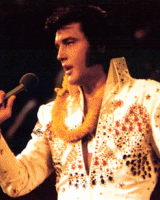
Elvis Presley

Elvis Aaron Presley , often known simply as Elvis and also called "The King of Rock 'n' Roll" or simply "The King", was an American United States

The United States of America, also known as the United States, the U.S., the U.S.A., a... 

 singer Singer

A singer is a type of musician [i] who uses his or her voice [i] to produce music [i]. ... 

 and actor Actor

An actor is a person who acts [i], or plays a role, in a dramatic production. ... 

. Presley started as a singer of rockabilly Rockabilly

Rockabilly is one of the earliest forms of rock and roll [i] as a distinct style of music. ... 

, singing many songs from rhythm and blues Rhythm and blues

Rhythm and blues is a popular music [i] genre [i] combining jazz [i], gospel [i], and blues [i] ... 

 , gospel and country. This combination inadvertantly morphed into rock & roll. He was the most commercially successful singer of rock and roll, but he also had huge success with ballads, country, gospel, blues, pop, folk and even semi-operatic standards. His voice had a unique tonality, with a range very few other popular artists have.

Discussions

  Discussion Features

   Ask a question about 'Elvis Presley'

   Start a new discussion about 'Elvis Presley'

   Answer questions about 'Elvis Presley'

   'Elvis Presley' discussion forum

Timeline

1935   Elvis Presley is born in a two room shotgun house Shotgun house

The shotgun house is a narrow rectangular domestic residence, usually no more than 12 feet [i] ... 

 in Tupelo, Mississippi Tupelo, Mississippi

Tupelo, birthplace of Elvis Presley [i] ... 

.

1935   Born

1954   In Memphis, Tennessee Memphis, Tennessee

Memphis is a city [i] in Shelby County [i], Tennessee [i], of which it is the county seat [i] ... 

, WHBQ becomes the first radio Radio

Radio is the wireless transmission of signals [i], by modulation [i] of electromagnetic waves [i] ... 

 station to air an Elvis Presley record

1955   First film footage of Elvis Presley in a planned film short about Cleveland disc jockey Bill Randle Bill Randle

Bill Randle was an American [i] disc jockey [i], lawyer [i] and university [i] professor [i] ... 

1956   Elvis Presley enters the United States United States

The United States of America, also known as the United States, the U.S., the U.S.A., a... 

 music charts for the first time, with "Heartbreak Hotel."

1956   Elvis Presley releases his first Gold Album titled ''Elvis Presley''.

1957   Jailhouse Rock opens nationally and Elvis Presley continues to gain more notoriety.

1960   March 3 — Elvis Presley returns home from Germany Germany

Germany , officially the Federal Republic of Germany , is a country [i] in central Europe [i]. ... 

, after being away on duty for 2 years.

1967   Elvis Presley and Priscilla Beaulieu Priscilla Presley

Priscilla Beaulieu Presley, Ne Priscilla Ann Wagner is an American [i] model [i] ... 

 are married in Las Vegas.

1970   Elvis Presley begins his first concert tour since 1958 in Phoenix, Arizona Phoenix, Arizona

Phoenix is the capital of the state of Arizona [i] in the Southwestern [i] United States [i]... 

 at the Veterans Memorial Coliseum.

   More Events >>


Quotations

Thank you very much.

Quote frequently used by impersonators of Elvis and used with a drawl

The image is one thing and the human being is another...it's very hard to live up to an image.

Press conference (June, 1972)

Fuck those people! There's no way I'll ever get involved with that son-of-a-bitchin' group. All they want is my money.

Los Angeles, Scientology Center on Sunset

A live concert to me is exciting because of all the electricity that is generated in the crowd and on stage. It's my favorite part of the business — live concerts.

Press conference (September 5th, 1972)

       More Quotes >>


Encyclopedia

Elvis Aaron Presley , often known simply as Elvis and also called "The King of Rock 'n' Roll" or simply "The King", was an American United States

The United States of America, also known as the United States, the U.S., the U.S.A., a... 

 singer Singer

A singer is a type of musician [i] who uses his or her voice [i] to produce music [i]. ... 

 and actor Actor

An actor is a person who acts [i], or plays a role, in a dramatic production. ... 

.

Presley started as a singer of rockabilly Rockabilly

Rockabilly is one of the earliest forms of rock and roll [i] as a distinct style of music. ... 

, singing many songs from rhythm and blues Rhythm and blues

Rhythm and blues is a popular music [i] genre [i] combining jazz [i], gospel [i], and blues [i] ... 

 , gospel and country. This combination inadvertantly morphed into rock & roll. He was the most commercially successful singer of rock and roll, but he also had huge success with ballads, country, gospel, blues, pop, folk and even semi-operatic standards. His voice had a unique tonality, with a range very few other popular artists have. In a musical career of over two decades, Presley set many records, such as concert attendance, television ratings, and record sales, and became one of the best-selling artists in music history.

Elvis Presley is an icon of modern American pop culture. He represents the American Dream American Dream

The American Dream is the belief that in the United States of America, hard work and determination can l... 

, rising from humble beginnings to extreme heights in popular music through charisma with a capital "C", unique good looks, raw talent and hard work, more often representing teen sexuality with a hint of delinquency. During the late 1960's and through a large portion of the 1970's, Presley re-emerged as a live performer of old and new hit songs, both on tour and in Las Vegas, Nevada Las Vegas, Nevada

Las Vegas is the most populous city in the state of Nevada [i], United States [i], and a major vacation [i] ... 

, where he was known for his on-stage highly energetic performances both vocally and physically, his sartorial jump-suits and capes adding to the drama. He attracted massive attendance figures. His concert performances were staggering in quantity, considering they numbered over 1,100 in 8 years. He continued to perform before sell-out audiences around the U.S. until his death in 1977. His death was premature at 42, despite alarming concerns about his health. When he died on 16 August 1977, it was a huge shock to the world. However, it soon became clear that a combination of over-work, weight gain, depression, bad diet and severe abuse of prescription drugs, accelerated his premature departure. His popularity as a singer has survived his death and continues to confound his strongest critics.

Parents, childhood and youth

Elvis Aaron Presley was born on January 8, 1935 at around 4:13 a.m. in a two-room shotgun house Shotgun house

The shotgun house is a narrow rectangular domestic residence, usually no more than 12 feet [i] ... 

 in East Tupelo Tupelo, Mississippi

Tupelo, birthplace of Elvis Presley [i]
... 

, Mississippi Mississippi

Mississippi is a southern [i] state [i] of the United States [i]. ... 

 to Vernon Elvis Presley, a truck driver, and Gladys Love Smith, a sewing machine operator. His twin brother, Jesse Garon Presley, was stillborn, thus leaving him to grow up as an only child. The surname Presley was Anglicized from the German name "Pressler" during the Civil War American Civil War

The American Civil War was a sectional conflict in the United States of America [i] between the federal ... 

. His ancestor Johann Valentin Pressler emigrated to America United States

The United States of America, also known as the United States, the U.S., the U.S.A., a... 

 in 1710. Presley was mostly of Scottish Scottish people

This article is about the Scottish as an ethnic group [i]. ... 

,Native American Native Americans in the United States

American Indian and Alaskan NativesU.S. state [i]s and several of the inhabited insular areas [i] that a ... 

, Irish Irish people

The Irish are a northwest European ethnic group [i] who originated in Ireland [i]. ... 

, and German Germans

Germans are defined as an ethnic group [i], or Volk [i], in the sense of sharing a common German culture [i] ... 

 roots. Elvis was born "Elvis Aron Presley" but later incorrectly spelt "Aaron".

Presley's parents were very protective of their only surviving child. His mother Gladys "worshipped him", said a neighbor, "from the day he was born." In his teens he was a very shy person, a "kid who had spent scarcely a night away from home in his nineteen years." He was teased by his fellow classmates who threw "things at him - rotten fruit and stuff - because he was different, because he was quiet and he stuttered and he was a mama's boy."

In 1938, when Presley was three years old, his father was convicted of forgery. Vernon, Gladys's brother Travis Smith, and Luther Gable went to prison for altering a check from Orville Bean, Vernon's boss, from $3 to $8 and then cashing it at a local bank. Vernon was sentenced to three years at Mississippi State Penitentiary. Though Vernon was released after serving eight months, this event deeply influenced the life of the young family. During her husband's absence, Gladys lost the house and was forced to move in briefly with her in-laws next door. The Presley family lived just above the poverty line during their years in East Tupelo.

In 1941 Presley started school at the East Tupelo Consolidated. There he seems to have been an outsider. His few friends relate that he was separate from any crowd and did not belong to any "gang", but, according to his teachers, he was a sweet and average student, and he loved comic books. In 1943 Vernon moved to Memphis, where he found work and stayed throughout the war, coming home only on weekends.

In January 1945 Gladys took Elvis shopping for a birthday present at Tupelo hardware. And she bought him his first guitar, in lieu of a bike and rifle, for $12.75.

In 1946 Presley started at a new school, Milam, which went from grades 5 through 9, but in 1948 the family left Tupelo, moving 110 miles northwest to Memphis, Tennessee Memphis, Tennessee

Memphis is a city [i] in Shelby County [i], Tennessee [i], of which it is the county seat [i] ... 

. Here too, the thirteen-year-old lived in the city's poorer section of town and attended a Pentecostal church. At this time, he was very much influenced by the Memphis blues music and the gospel sung at his church.

Presley entered Humes High School in Memphis taking up work at the school library and after school at Loew's State Theatre. In 1951 he enrolled in the school's ROTC Reserve Officers' Training Corps

The Reserve Officer Training Corps is a training program of the United States armed forces [i] present o... 

 unit, tried unsuccessfully to qualify for the high school football team , spending his spare time around the African-American section of Memphis, especially on Beale Street Beale Street

[i]
[i]
... 

. In 1953 he graduated from Humes, majoring in History, English, and Shop.

After graduation Presley worked first at Parker Machinists Shop, and then for the Precision Tool Company with his father, finally working for the Crown Electric Company driving a truck, where he began wearing his hair the trademarked pompadour style.

Musical roots

The common story that the Presleys formed a popular gospel trio who sang in church and travelled about to various revival meetings is probably not true. However, in 1945 Presley, just ten years old, entered a singing contest at the Mississippi-Alabama Fair and Dairy Show. Decked out in a cowboy outfit, he had to stand on a chair to reach the microphone singing Red Foley's "Old Shep." He won second place, a $5 prize and a free ticket to all the rides.

On his birthday in January 1946 he received a guitar purchased from Tupelo Hardware Store. In his seventh-grade year at Milam he seems to have taken this guitar to school every day. Many of the other children denigrated him as a "trashy" kind of boy playing trashy "hillbilly" music. Over the next year, Vernon's brother Johnny Smith and Assembly of God pastor Frank Smith gave him basic guitar lessons.

Some years later, in Memphis, Tennessee Memphis, Tennessee

Memphis is a city [i] in Shelby County [i], Tennessee [i], of which it is the county seat [i] ... 

, the young Presley "spent much of his spare time hanging around the black section of town, especially on Beale Street Beale Street

[i]
[i]
... 

, where bluesmen like Furry Lewis Furry Lewis

Furry Lewis was a blues [i] guitarist from Memphis, Tennessee [i].... 

 and B.B. King B. B. King

Riley B. King aka B. B.... 

 performed". B.B. King says that he "knew Elvis before he was popular. He used to come around and be around us a lot. There was a place we used to go and hang out on Beale Street". Beale Street in Memphis was notorious for its bars, prostitutes and gambling establishments. Music producer Jim Dickinson called it "the center of all evil in the known universe". But it was a place where young Presley could hear black music.

The opening chapter of Peter Guralnick's Peter Guralnick

Peter Guralnick is an American [i] music critic [i], author, screenwriter ... 

 book Last Train To Memphis deals with musical influence coming from birth exclusively through his family's attendance at the Assembly of God Assemblies of God

The Assemblies of God is the world's largest Pentecostal [i] denomination with approximately 52.5 millio ... 

, a Pentecostal Holiness church. Rolling Stone Rolling Stone

Rolling Stone is an American [i] magazine [i] devoted to music [i], politics [i] and popular culture [i] ... 

 magazine wrote that: "Gospel pervaded Elvis' character and was a defining and enduring influence all of his days." The United States government Federal government of the United States

The government [i] of the United States of America [i], established by the U.S. Constitution [i]... 

 mandatory personal examination of Presley as part of the approval process to make his Graceland Graceland

[i]
... 

 home a National Historic Landmark National Historic Landmark

A National Historic Landmark is a building [i], district [i], site [i], structure [i], or object, almost... 

 wrote that Presley "clearly embraced African American African American

An African American is a member of an ethnic group [i] in the United States [i] whose ancestors, usual... 

 music and culture Culture

The word culture, from the Latin [i] colo, -ere, with its root meaning "to cultivate", generall ... 

 and did so at a pivotal point of cultural change in American history" but that " Gospel music was his primary musical influence." The U.S. government historian stated that "In the early years of the twentieth century, the evangelical Pentecostal movement with its "vibrant worship style" became extremely popular with working-class Christians, black Black people

Black is a term that commonly refers to the indigenous [i] peoples of Africa [i] and their diasporic p ... 

 and white White

White is a color [i] that has high brightness but zero hue [i]. ... 

." The church services in which the Presley family participated was where people "jumped, shouted, danced, and fell out for Jesus Jesus

Jesus,Some of the historians and Biblical scholars who place the birth and death of Jesus within this ra... 

, because, in a word, they acted "crazy, " they became a national laughingstock, the Holy Rollers of fable and cliché." According to the study, the family's move to Memphis expanded his musical horizons when he began to attend Sunday services at the East Trigg Baptist Church.

Sun recordings


On July 18, 1953 Presley paid $3.25 to record the first of two double-sided demos acetates at Sun Studios Sun Records

Sun Records was a record label [i] based in Memphis, Tennessee [i] starting operations on March 27 [i], ... 

, "My Happiness" and "That's When Your Heartaches Begin", which were popular ballads at the time. According to the official Presley website, Presley gave it to his mother as a much-belated birthday present. Presley returned to Sun Studios on January 4, 1954. He again paid $8.25 to record a second demo, "I'll Never Stand in Your Way" and "It Wouldn't Be the Same Without You" .

Sun Records Sun Records

Sun Records was a record label [i] based in Memphis, Tennessee [i] starting operations on March 27 [i], ... 

 founder Sam Phillips Sam Phillips

Sam Phillips, born Samuel Cornelius Phillips, was a record producer [i] who played an important ro ... 

, who had already recorded bluesmen such as Howlin' Wolf Howlin' Wolf

Chester Arthur Burnett, better known as Howlin' Wolf or sometimes, The Howlin' Wolf, was an ... 

, James Cotton, B.B. King B. B. King

Riley B. King aka B. B.... 

, Little Milton and Junior Parker Junior Parker

Junior Parker was a Memphis blues [i] singer [i] and musician [i].
... 

 , was looking for "a white man with a Negro sound and the Negro feel," with whom he "could make a billion dollars." The Sun Records producer felt that a black rhythm and blues act stood little chance at the time of gaining the broad exposure needed to achieve large-scale commercial success."

Phillips and assistant Marion Keisker heard the Presley discs and called him on June 26, 1954 to fill in for a missing ballad singer. Although that session was not productive, Phillips put Presley together with local musicians Scotty Moore and Bill Black to see what might develop. During a rehearsal break on July 5, 1954, Presley began singing a blues Blues

Blues music redirects here. For other uses, see Blues [i] and Blues music [i]
... 

 song written by Arthur Crudup called "That's All Right". Phillips liked the resulting record and on July 19, 1954 he released it as a 78-rpm single backed with Presley's hopped-up version of Bill Monroe Bill Monroe

Bill Monroe developed the style of country music [i] known as bluegrass [i], which take ... 

's bluegrass Bluegrass music

Bluegrass music is considered a form of American roots music [i] with its own roots in the English [i] ... 

 song "Blue Moon of Kentucky". Memphis radio station WHBQ began playing it two days later, the record became a local hit and Presley began a regular touring schedule hoping to expand his fame beyond Tennessee Tennessee

Tennessee is a U.S. state [i] located in the Southern [i] United States [i]. ... 

.

However, Sam Phillips had difficulty persuading Southern white disc jockeys to play Presley's first recordings. The only place that played his records at first were in the Negro sections of Chicago Chicago

Chicago is the largest city [i] in the U.S. state [i] of Illinois [i], as well as the third-most populous [i] ... 

 and Detroit Detroit, Michigan

Detroit is the largest city in the U.S. state [i] of Michigan [i] and the seat [i] of Wayne County [i] ... 

 and in California California

California is a state [i] spanning the southern half of the west coast [i] ... 

. However, his music and style began to draw larger and larger audiences as he toured the South in 1955. Soon, demand by white teenagers that their local radio stations play his music overcame much of that resistance and as Rolling Stone Rolling Stone

Rolling Stone is an American [i] magazine [i] devoted to music [i], politics [i] and popular culture [i] ... 

 magazine wrote years later in Presley's biography: "Overnight, it seemed, "race music," as the music industry had labeled the work of black artists, became a thing of the past, as did the pejorative "hillbilly" music. Still, throughout 1955 and even well into 1956 when he had become a national phenomenon, Presley had to deal with an entrenched racism of die-hard segregationists and their continued labeling of his sound and style as vulgar "nigger music". Allegations of racism were made against Presley, possibly by those segregationist elements who hated what he was doing. Jet examined the issue and in its August 1, 1957 edition, the African American magazine concluded that: "To Elvis, people are people regardless of race, color or creed."

Country music star Hank Snow Hank Snow

Clarence Eugene Snow, better known as Hank Snow, was a Hall of Fame country music [i] singer [i] a ... 

 arranged to have Presley perform at Nashville Nashville, Tennessee

Nashville is the capital of the U.S. state [i] of Tennessee [i].... 

's Grand Ole Opry Grand Ole Opry

The Grand Ole Opry is a weekly Saturday night country music [i] radio program [i] ... 

and his performance was well received. Nonetheless, one of the show's executives was not impressed and hinted that Presley should give up his music.

Presley's second single, "Good Rockin' Tonight", with "I Don't Care if the Sun Don't Shine" on the B-side, was released on September 25, 1954. He then continued to tour the South Southern United States

The Southern United States or the South constitutes a distinctive region [i] covering a large port ... 

. On October 16, 1954, he made his first appearance on Louisiana Hayride, a radio broadcast of live country music in Shreveport, Louisiana Shreveport, Louisiana

Shreveport, Louisiana is the second largest city and the third largest metropolitan area [i] in the U.S. state [i] ... 

, and was a hit with the large audience. His releases began to reach the top of the country charts. Following this, Presley was signed to a one-year contract for a weekly performance, during which time he was introduced to Colonel Tom Parker.

National exposure began on January 28, 1956, when Presley, Moore, Black and drummer D.J. Fontana made their first National Television appearance on the Dorsey brothers' Stage Show. It was the first of six appearances on the show and the first of eight performances recorded and broadcast from CBS TV Studio 50 at 1697 Broadway, New York. After the success of their first appearance they were signed to five more in early 1956 .

Presley and his manager "Colonel" Tom Parker

On August 15, 1955, Presley was signed by "Hank Snow Attractions", a management company jointly owned by singer Hank Snow Hank Snow

Clarence Eugene Snow, better known as Hank Snow, was a Hall of Fame country music [i] singer [i] a ... 

 and "Colonel" Tom Parker. Shortly thereafter, "Colonel" Parker took full control and recognizing the limitations of Sun Studios, negotiated a deal with RCA Victor RCA Records

| image = | parent = Sony BMG [i] Music Entertainment, Inc.
... 

 Records to acquire Presley's Sun contract for $35,000 on November 21, 1955. Presley's first single for RCA "Heartbreak Hotel" quickly sold one million copies and within a year RCA would go on to sell ten million Presley singles.

Parker was a master promoter who wasted no time in furthering Presley's image, licensing everything from guitars to cookware. Parker's first major coup was to market Presley on television. First, he had Presley booked in six of the Dorsey Shows . Presley appeared on the show on January 28, 1956, then on February 4, 11 & 18, 1956, with two more appearances on March 17 & 24, 1956. In March, he was able to obtain a lucrative deal with Milton Berle Milton Berle

[i] and [[actor]... 

 , for two appearances: The first appearance on April 3, 1956. The second appearance was controversial pertaining to Presley's performance of "Hound Dog" on the June 5, 1956. It sparked a storm over his "gyrations" while singing. The controversy lasted through the rest of the 50's. However, that show drew such huge ratings that Steve Allen booked him for one appearance, which took place early on July 1, 1956. That night, Allen had for the first time beaten The Ed Sullivan Ed Sullivan

[i] and [[television]... 

 Show
in the Sunday night ratings, prompting Sullivan to book Presley for three appearances: September 9, and October 28, 1956 as well as January 6, 1957, for an unprecedented fee of $50,000. On September 9, 1956, at his first of three appearances on the Sullivan show, Presley drew an estimated 82.5% percent of the television audience, calculated at between 55-60 million viewers.

Parker eventually negotiated a multi-picture seven-year contract with Metro Goldwyn Mayer that shifted Presley's focus from music to films. Under the terms of his contract, Presley earned a fee for performing plus a percentage of the profits on the films, most of which were huge moneymakers. These were usually musicals based around Presley performances, and marked the beginning of his transition from rebellious rock and roller to all-round family entertainer. Presley was praised by all his directors, including the highly respected Michael Curtiz, as unfailingly polite and extremely hardworking.

Presley began his movie career with Love Me Tender . The movies Jailhouse Rock and King Creole King Creole

King Creole is a 1958 Elvis Presley [i] film and soundtrack based on the 1952 Harold Robbins [i] nov ... 

are regarded as among his best early films.

Parker's success led to Presley expanding the "Colonel's" management contract to an even 50/50 split. Over the years, much has been written about "Colonel" Parker, most of it critical. Marty Lacker, a lifelong friend and a member of the Memphis Mafia Memphis Mafia

The Memphis Mafia was the nickname for a group of friends, associates, employees and "yes-men" whose... 

, says he thought of Parker as a "hustler and scam artist" who abused Presley's reliance on him. Priscilla Presley admits that "Elvis detested the business side of his career. He would sign a contract without even reading it." This would explain the strong influence the Colonel had on Presley. Nonetheless, Lacker acknowledged that Parker was a master promoter.

Cultural impact

Even in the 1950s era of blantant racism, Presley would publicly cite his debt to African American music, pointing to artists such as B. B. King B. B. King

Riley B. King aka B. B.... 

, Arthur "Big Boy" Crudup, Jackie Wilson Jackie Wilson

[i]
... 

, Ivory Joe Hunter Ivory Joe Hunter

Ivory Joe Hunter was an African American R&B singer, songwriter and pianist, best known for his hit reco... 

, and Fats Domino Fats Domino

Antoine Dominique "Fats" Domino, is a classic R&B [i] and rock and roll [i] singer [i], songwriter [i] a ... 

. The reporter who conducted Presley's first interview in New York City New York City

[i] in the [[United States]... 

 in 1956 noted that he named blues singers who "obviously meant a lot to him. I was very surprised to hear him talk about the black performers down there and about how he tried to carry on their music." Later that year in Charlotte, North Carolina Charlotte, North Carolina

Charlotte is the largest city in North Carolina [i] and the 20th largest in the United States [i], with ... 

, Presley was quoted as saying: "The colored folks been singing it and playing it just like I’m doin' now, man, for more years than I know. They played it like that in their shanties and in their juke joints and nobody paid it no mind 'til I goosed it up. I got it from them. Down in Tupelo, Mississippi, I used to hear old Arthur Crudup bang his box the way I do now and I said if I ever got to a place I could feel all old Arthur felt, I’d be a music man like nobody ever saw. "

Little Richard said of Presley: "He was an integrator. Elvis was a blessing. They wouldn’t let black music through. He opened the door for black music." B. B. King B. B. King

Riley B. King aka B. B.... 

 said he began to respect Presley after he did Arthur "Big Boy" Crudup material and that after he met him, he thought the singer really was something else and was someone whose music was growing all the time right up to his death.

Up to the mid 1950s black artists had sold miniscule amounts of their recorded music relative to the national market potential. Black songwriters had mostly limited horizons and could only eke out a living. But after Presley purchased the music of African American Otis Blackwell and had his "Gladys Music" company hire talented black songwriter Claude Demetrius, the industry underwent a dramatic change. In the spring of 1957 Presley invited African American performer Ivory Joe Hunter Ivory Joe Hunter

Ivory Joe Hunter was an African American R&B singer, songwriter and pianist, best known for his hit reco... 

 to visit Graceland and the two spent the day together, singing "I Almost Lost My Mind" and other songs. Of Presley, Hunter commented, "He showed me every courtesy, and I think he's one of the greatest."

Years later after his death, certain elements in American society, without examining recorded history or providing any evidence at all, began to simply dismiss Presley as no more than a racist Southerner who stole black music. In his scholarly work Race, Rock, and Elvis , Tennessee State University Tennessee State University

Tennessee State University is a comprehensive, urban, coeducational land-grant university [i] founded in ... 

 professor Michael T. Bertrand examined the relationship between popular culture and social change in America and these allegations against Presley. Professor Bertrand postulated that Presley's rock and roll music brought an unprecedented access to African American culture that challenged that 1950s segregated generation to reassess ingrained segregationist stereotypes. One of the most, if not the most, prestigious source for book reviews is the American Historical Review who wrote: " convincingly argues that the black-and-white character of the sound, as well as Presley's own persona, helped to relax the rigid color line and thereby fed the fires of the civil rights movement." The U.S. government report stated: "Presley has been accused of "stealing" black rhythm and blues, but such accusations indicate little knowledge of his many musical influences. "However much Elvis may have 'borrowed' from black blues performers , he borrowed no less from white country stars and white pop singers ," and most of his borrowings came from the church; its gospel music was his primary musical influence and foundation."

"A danger to American culture"

By the spring of 1956, Presley was fast becoming a national phenomenon and teenagers came to his concerts in unprecedented numbers. When he performed at the Mississippi-Alabama Fair in 1956, 100 National Guardsmen United States National Guard

The United States National Guard is a component of the United States Army [i] and the United States Air ... 

 surrounded the stage to control crowds of excited fans. The singer was considered to represent a threat to the moral well-being of young American women. The Roman Catholic Church Roman Catholic Church

The Roman Catholic Church or Catholic Church is the Christian [i] Church [i] ... 

 denounced him in its weekly magazine in an article headlined "Beware Elvis Presley."

In an interview with PBS Public Broadcasting Service

The Public Broadcasting Service is a non-profit [i] public broadcasting [i] television [i] service with ... 

 television social historian Eric Lott said, "all the citizens' councils in the South called Elvis 'nigger music' and were terribly afraid that Elvis, white as he was, being ambiguously raced just by being working-class, was going to corrupt the youth of America." Robert Kaiser says he was the first who gave the people "a music that hit them where they lived, deep in their emotions, yes, even below their belts. Other singers had been doing this for generations, but they were black." Therefore, his performance style was frequently criticized. Social guardians blasted anyone responsible for exposing impressionable teenagers to his "gyrating figure and suggestive gestures." The Louisville chief of police, for instance, called for a no-wiggle rule to halt "any lewd, lascivious contortions that would excite the crowd." Even Priscilla Presley confirms that "his performances were labeled obscene. My mother stated emphatically that he was 'a bad influence for teenage girls. He arouses things in them that shouldn't be aroused.' "

According to rhythm and blues artist Hank Ballard, "In white society, the movement of the butt, the shaking of the leg, all that was considered obscene. Now here's this white boy that grinding and rolling his belly and shaking that notorious leg. I hadn't even seen the black dudes doing that." Presley complained bitterly in a June 27, 1956, interview about being singled out as “obscene”. Due to his controversial style of song and stage performances, municipal politicians began denying permits for Presley appearances. This caused teens to pile into cars and traveled elsewhere to see him perform. Adult programmers announced they would not play Presley's music on their radio stations due to religious convictions that his music was "devil music" and to racist beliefs that it was "nigger music." Many of Presley's records were condemned as wicked by Pentecostal preachers, warning congregations to keep heathen Paganism

Paganism is a blanket term which has come to connote a broad set of western spiritual [i] ... 

 rock and roll music out of their homes and away from their children's ears However, the economic power of Presley's fans became evident when they tuned in alternative radio stations playing his records. In an era when radio stations were shifting to an all-music format, in reaction to competition from television Television

Television is a telecommunication [i] system for
... 

, profit-conscious radio station owners learned quickly when sponsors bought more advertising time on new all "rock and roll" stations, some of which reached enormous markets at night with clear channel Clear channel

A clear channel, in the general sense, is a communications channel on which only one transmitter operate... 

 signals from AM Mediumwave

Mediumwave radio [i] transmissions serves as the most common band for broadcasting [i]. ... 

 broadcasts.

In August, 1956 in Jacksonville, Florida Jacksonville, Florida

Jacksonville is the most populous city [i] in the state of Florida [i] and the thirteenth most populous [i]... 

 a local Juvenile Court judge called Presley a "savage" and threatened to arrest him if he shook his body while performing at Jacksonville's Florida Theatre, justifying the restrictions by saying his music was undermining the youth of America. Throughout the performance, Presley stood still as ordered but poked fun at the judge by wiggling a finger. Similar attempts to stop his "sinful gyrations" continued for more than a year and included his often-noted January 6, 1957 appearance on The Ed Sullivan Show The Ed Sullivan Show

The Ed Sullivan Show was an American [i] television [i] variety show [i] ... 

, when he was filmed only from the waist up.

American icon

According to , "it was Elvis who made rock 'n' roll the international language of pop." A PBS Public Broadcasting Service

The Public Broadcasting Service is a non-profit [i] public broadcasting [i] television [i] service with ... 

 documentary described Presley as "an American music giant of the 20th century who singlehandedly changed the course of music and culture in the mid-1950s." His recordings, dance moves, attitude and clothing came to be seen as embodiments of rock and roll. His music was heavily influenced by African-American blues, Christian gospel, and Southern country.

Presley sang both hard driving rockabilly Rockabilly

Rockabilly is one of the earliest forms of rock and roll [i] as a distinct style of music. ... 

, rock and roll dance songs and ballads, laying a commercial foundation upon which other rock musicians would build their careers. African-American African American

An African American is a member of an ethnic group [i] in the United States [i] whose ancestors, usual... 

 performers like Little Richard and Chuck Berry Chuck Berry

Charles Edward Anderson "Chuck" Berry is an American [i] guitarist [i], singer [i] ... 

 came to national prominence after Presley's acceptance among mass audiences of white teenagers. Singers like Jerry Lee Lewis Jerry Lee Lewis

Jerry Lee Lewis is an American [i] rock and roll [i] and country music [i] singer [i], songwriter [i] ... 

, the Everly Brothers The Everly Brothers

The Everly Brothers are a pair of brothers who were top-selling country [i]-influenced rock and roll [i] ... 

, Buddy Holly Buddy Holly

Charles Hardin Holley , better known as Buddy Holly, was an American [i] singer, son... 

, Roy Orbison Roy Orbison

Roy Kelton Orbison , nicknamed "The Big O", was an influential American [i] singer-songwriter [i] ... 

 and others immediately followed in his wake. The Beatles superstar John Lennon John Lennon

[i] [[20th century]... 

 later observed, "Before Elvis, there was nothing."

During the post-WWII World War II

World War II, or the Second World War, was a worldwide [i] conflict [i] fought betwe ... 

 economic boom of the 1950s, many parents were able to give their teenaged children much higher weekly allowances, signalling a shift in the buying power and purchasing habits of American teens. During the 1940s bobby soxers had idolized Frank Sinatra Frank Sinatra

Frank Sinatra was an American singer and actor.... 

, but the buyers of his records were mostly between the ages of eighteen and twenty-two. Presley triggered a juggernaut of demand for his records by near-teens and early teens aged ten and up. Along with Presley's "ducktail Duck's Ass

The Duck's Ass was a haircut [i] style popular during the 1950s [i] both in America and across the Weste ... 

" haircut, the demand for black slacks and loose, open-necked shirts resulted in new lines of clothing for teenaged boys whereas a girl might get a pink portable 45 rpm record player for her bedroom. Meanwhile American teenagers began buying newly available portable transistor radio Transistor radio

A transistor radio is a small transistor [i]-based radio [i] receiver. ... 

s and listened to rock 'n' roll on them . Teens were asserting more independence and Presley became a national symbol of their parents' consternation.


Presley's impact on the American youth consumer market was noted on the front page of The Wall Street Journal The Wall Street Journal

The Wall Street Journal is an influential international daily newspaper [i] published in New York City [i] ... 

on December 31, 1956 when business journalist Louis M. Kohlmeier wrote, "Elvis Presley today is a business," and reported on the singer's record and merchandise sales. Half a century later, historian Ian Brailsford commented, "The phenomenal success of Elvis Presley in 1956 convinced many doubters of the financial opportunities existing in the youth market."

Military service

On December 20 1957, at the peak of his career, Presley received his draft board Conscription

Conscription is a general term for involuntary labor demanded by some established authority, but it is m... 

 notice for his mandatory service in the United States Army United States Army

The United States Army is the largest branch of the United States armed forces [i] ... 

. He was worried that his absence in the public eye for 2 years, while serving in the Army, might end his career. Even more worried were Hal Wallis and Paramount who already spent $350,000 on pre-production of Presley's latest film King Creole and they feared of suspending the project or worse canceling it. Fortunately, the Memphis Draft Board granted Wallis and Colonel Parker a deferment until March 20 so Presley could complete his film project.

While serving in Germany, Presley met his wife-to-be - the then 14-year-old Priscilla Beaulieu Priscilla Presley

Priscilla Beaulieu Presley, Ne Priscilla Ann Wagner is an American [i] model [i]... 

; noted International Herald Tribune International Herald Tribune


The International Herald Tribune is a widely read English-language [i] international newspaper [i] ... 

correspondent and humorist Art Buchwald; future US Secretary of State Colin Powell Colin Powell

General Colin Luther Powell, United States Army was the 65th United States Secretary of State [i], se ... 

 ; and Walter Alden, the father of Presley's fiancee Ginger Alden Ginger Alden

Ginger Alden is an American [i] actress/model who is best known as the former fiancee of Elvis Presley [i] ... 

 who inducted Presley into the Army. Presley returned to the United States on March 2, 1960, and was honorably discharged on March 5.

After serving his duty in the military, he became more mature and lost his raw and rebellious edge. However, he gained respect from older and more conservative crowds who initially disliked him before he entered the Army.

1960's film career

Presley was an enthusiastic James Dean James Dean

James Byron Dean was an American film [i] actor [i] who epitomized youthful angst [i]. ... 

 fan and returned from the military eager to make a career as a movie star. Although "he was definitely not the most talented actor around.", he "became a film genre of his own." Pop film staples of the early sixties, such as the Presley musicals and the AlP American International Pictures

American International Pictures was a film production [i] company formed in 1956 [i] from American Releasing Corporation [i] ... 

 beach movies were mainly produced for a teenage audience and called by film critics a "pantheon of bad taste" In the sixties, at Colonel Parker's command, Presley withdrew from concerts and television appearances, after his final appearance with Frank Sinatra on NBC entitled "Welcome Home Elvis" where he sang "Witchcraft/Love Me Tender" with Sinatra, in order to make these movies. "He blamed his fading popularity on his humdrum movies," Priscilla Presley Priscilla Presley

Priscilla Beaulieu Presley, Ne Priscilla Ann Wagner is an American [i] model [i]... 

 recalled in her 1985 autobiography, Elvis and Me Elvis and Me

Elvis and Me is a 1985 American [i] biography [i] written by Priscilla Beaulieu Presley [i] ... 

. "He loathed their stock plots and short shooting schedules. He could have demanded better, more substantial scripts but he didn't." According to most critics, the scripts of the movies "were all the same, the songs progressively worse." The latter were "written on order by men who never really understood Elvis or rock and roll." For Blue Hawaii and its soundtrack LP, "fourteen songs were cut in just three days." Julie Parrish, starring in Paradise, Hawaiian Style, says that Presley hated such songs and that he "couldn't stop laughing while he was recording" one of them.

Although some film critics chastised these movies for their lack of depth, the fans turned out and they were enormously profitable. According to Jerry Hopkins's book, Elvis in Hawaii, Presley's "pretty-as-a-postcard movies" even "boosted the new state's tourism. Some of his most enduring and popular songs came from those movies." Altogether, Presley had made 27 movies during the 1960s, "which had grossed about $130 million, and he had sold a hundred million records, which had made $150 million."

1968 comeback

Presley's star had faded slightly over the 1960s as he made his movies and America was struck by changing styles and tastes after the "British Invasion" spearheaded by the Beatles The Beatles

The Beatles were an English Pop/Rock and Roll band formed in 1962 by Paul McCartney, Ringo Starr, George Harri... 

.

Until the late sixties Presley continued to star in many B-movies, featuring soundtracks that were of increasingly lower quality. He had become deeply dissatisfied with the direction his career had taken over the ensuing seven years, most notably the film contracts with a demanding schedule that eliminated creative recording and giving public concerts. This lead to a triumphant televised performance later dubbed the '68 Comeback Special Elvis Presley's '68 Comeback Special

Elvis Presley's '68 Comeback Special is a 1968 [i] United States [i] television special [i] ... 

, aired on the NBC television network on December 3, 1968 and released as an album by RCA. In a special that saw him return to his rock and roll roots, Rolling Stone Rolling Stone

Rolling Stone is an American [i] magazine [i] devoted to music [i], politics [i] and popular culture [i] ... 

 magazine called it "a performance of emotional grandeur and historical resonance".

The comeback of 1968 was followed by a 1969 return to live performances, first in Las Vegas Las Vegas, Nevada

Las Vegas is the most populous city in the state of Nevada [i], United States [i], and a major vacation [i] ... 

 and then across the United States. The return concerts were noted for the constant stream of sold-out shows, with many setting attendance records in the venues where he performed.

Two concert films were also released: Elvis: That's the Way It Is and Elvis on Tour .

The final years

After seven years off the top of the charts, Presley's song "Suspicious Minds" hit number one on the Billboard music charts on November 1, 1969. He also reached number one on charts elsewhere: "In the Ghetto" did so in West Germany in 1969 and "The Wonder of You" did so in the UK in 1970.

The "" concert in January 1973 was the first of its kind to be broadcast worldwide via satellite Satellite

A satellite is any object that orbit [i]s another object . ... 

 and was seen by at least one billion viewers worldwide. The RCA soundtrack album to the show reached number-one in the charts.

Presley recorded a number of country hits in his final years. Way Down was languishing in the American Country Music chart shortly before his death in 1977, and reached number one the week after his death. It also topped the UK pop charts at the same time.

Between 1969 and 1977 Presley gave over 1,000 sold-out performances in Las Vegas and on tour. He was the first artist to have four shows in a row sold to capacity crowds at New York New York

New York is a state [i] in the northeastern [i] United States [i]. ... 

's Madison Square Garden Madison Square Garden

Madison Square Garden, often abbreviated as MSG, known colloquially simply as The Garden, ha... 

.

From 1971 to his death in 1977 Presley employed the Stamps Quartet, a gospel group, for his backup vocals. He recorded several gospel albums, earning three Grammy Award Grammy Award

The Grammy Awards , presented by the Recording Academy [i] ... 

s for his gospel music. In his later years his live stage performances almost always included a rendition of How Great Thou Art, the 19th century gospel song made famous by George Beverly Shea. Although some critics say that the singer travestied, commercialized and soft-soaped gospel "to the point where it became nauseating.", twenty-four years after his death, the Gospel Music Association inducted him into its Gospel Music Hall of Fame .

After his divorce in 1973 Presley became increasingly isolated, overweight, and battling an addiction to prescription drugs which took a heavy toll on his appearance, health, and performances. He made his last live concert appearance in Indianapolis Indianapolis, Indiana

It has been suggested that the size of the Indianapolis article should be scaled down.... 

 at the Market Square Arena on June 26, 1977.

Death and burial

On August 16, 1977, at his Graceland Graceland

[i]
... 

 mansion in Memphis, Tennessee Memphis, Tennessee

Memphis is a city [i] in Shelby County [i], Tennessee [i], of which it is the county seat [i] ... 

, Presley was found lying on the floor of his bedroom's bathroom by his fiancee, Ginger Alden Ginger Alden

Ginger Alden is an American [i] actress/model who is best known as the former fiancee of Elvis Presley [i] ... 

, who had been asleep. He was taken to Baptist Memorial Hospital, where doctors pronounced him dead at 3:30 P.M. Presley was 42 years old.


At a press conference following his death, one of the medical examiners declared that he had died of a heart attack Myocardial infarction

Acute myocardial infarction , commonly known as a heart attack, is a disease that occurs when the ... 

. Heart disease was very prevalent in his family. His mother, Gladys Presley, had died of a heart attack brought on by acute hepatitis at age 46. Presley's father Vernon died of heart failure two years after his son, at age 63.

Rolling Stone Rolling Stone

Rolling Stone is an American [i] magazine [i] devoted to music [i], politics [i] and popular culture [i] ... 

magazine devoted an entire issue to Presley and his funeral was a national media event. Hundreds of thousands of Presley fans, the press, and celebrities lined the street to witness Presley's funeral and Jackie Kahane gave the eulogy.

Presley was originally buried at Forest Hill Cemetery in Memphis next to his mother. After an attempted theft of the body, his remains and his mother's remains were moved to Graceland Graceland

[i]
... 

 to the "meditation gardens."

Following Presley's death in 1977, US President President

[i], [[trade union]... 

 Jimmy Carter Jimmy Carter

James Earl "Jimmy" Carter, Jr. was the 39th President of the United States [i] and the Nobel Peace laureate [i] ... 

 said, "Elvis Presley's death deprives our country of a part of itself. He was unique and irreplaceable. His music and his personality, fusing the styles of white country and black rhythm and blues, permanently changed the face of American popular culture. His following was immense and he was a symbol to people the world over, of the vitality, rebelliousness, and good humor of his country."

Controversy surrounding death

In her 1987 book Elvis and Kathy, friend and backup vocalist Kathy Westmoreland wrote "Everyone knew he was sick, that each public appearance brought him to the point of exhaustion."

According to Peter Guralnick Peter Guralnick

Peter Guralnick is an American [i] music critic [i], author, screenwriter ... 

's book, Careless Love: The Unmaking of Elvis Presley , "drug use was heavily implicated in this unanticipated death of a middle-aged man with no known history of heart disease...no one ruled out the possibility of anaphylactic shock Anaphylaxis

In medicine, anaphylaxis is a severe and rapid multi-system allergic [i] reaction. ... 

 brought on by the codeine Codeine

Codeine or methylmorphine is an opiate [i] used for its analgesic [i], antitussive [i] and antidi... 

 pills he had gotten from his dentist, to which he was known to have had a mild allergy of long standing...There was little disagreement in fact between the two principal laboratory reports and analyses filed two months later, with each stating a strong belief that the primary cause of death was polypharmacy, and the BioScience Laboratories report...indicating the detection of fourteen drugs in Elvis' system, ten in significant quantity."

In his book, Elvis: The Last 24 Hours, Albert Goldman even went as far as to suggest that Presley committed suicide Suicide

Suicide is the act of willfully ending one's own life [i]. ... 

 by overdosing on a stash of drugs that he stockpiled. David Stanley, Presley's stepbrother, who was at Graceland the day Presley died, is alleged to have removed the needles and drug packets near Presley's body before the paramedics arrived, suggesting that he did not want to see Presley's name tarred with the brush of suicide Suicide

Suicide is the act of willfully ending one's own life [i]. ... 

.

On the other hand, some of his closest family members, friends, band members, and background singers have long disputed stories concerning Presley's alleged prescription drug abuse and "self-destructive" lifestyle. At the same time, they have not denied that he did take prescription medications for bona fide or suspected health problems. For instance, Vernon Presley, Kathy Westmoreland, Charlie Hodge, and J.D. Sumner pointed out that Presley also suffered from severe health problems unrelated to drug abuse. These health problems included glaucoma Glaucoma

Glaucoma is a group of diseases of the optic nerve [i] involving loss of retinal ganglion cells [i] ... 

, chronic insomnia Insomnia

Insomnia is characterized by an inability to sleep [i] and/or to be incapable of remaining asleep for a ... 

, and perhaps even bone cancer Bone tumor

Bone tumor is an inexact term, which can be used for both benign [i] and malignant [i] abnormal growths ... 

. The illness may have increased his dependency on prescription medication. In 1977 alone, his personal physician Dr. George Constantine Nichopoulos had prescribed 10,000 hits of amphetamines, barbiturates, narcotics, tranquilizers, sleeping pills, laxatives, and hormones.

Political beliefs


In the early 1960s he described himself as an admirer of the Democratic President John F. Kennedy John F. Kennedy

John Fitzgerald Kennedy (May 29, 1917 – November 22, 1963), also referred to as John F.... 

. In 1970 however he wrote to J. Edgar Hoover J. Edgar Hoover

John Edgar Hoover KBE [i] was the founder of the Federal Bureau of Investigation [i]... 

 requesting to join the FBI Federal Bureau of Investigation

The Federal Bureau of Investigation is a federal criminal investigative [i], intelligenc ... 

 at the height of its campaign against political activism. In December of that year he met with President Richard Nixon Richard Nixon

Richard Milhous Nixon was the 37th President of the United States [i], serving from 1969 to 1974. ... 

. According to the "Richard Nixon Library & Birthplace Foundation" photo of President Nixon's meeting with Presley in the Oval Office is the most requested image in the history of the U.S. Government.

Presley told the President he was a huge admirer of everything he was doing, and asked to be made a "Federal Agent at Large" in order to help get the country off drugs. Nixon duly made Presley a "Federal Agent at large" in the Bureau of Narcotics and Dangerous Drugs. Extraordinarily, Presley was able to present Nixon with a gift of a Colt .45 handgun in the oval office.

Presley also denounced The Beatles The Beatles

The Beatles were an English Pop/Rock and Roll band formed in 1962 by Paul McCartney, Ringo Starr, George Harri... 

 to Nixon, describing some of their left-wing political statements as "very anti-American."

Relationships


Presley's early experiences being teased by his fellow classmates for being a "mama's boy" had a deep influence on his clumsy advances to girls. He didn't have any friends as a teen. Beginning in his early teens, Presley embarked upon the "indefatigable pursuit of girls", but was totally rebuffed. At school, anyone "wishing to provoke a little girl to tears of rage had only to chalk "Elvis loves -" and then the girl's name on the blackboard when the teacher was out of the room." Presley's first sweetheart was the fifteen-year-old Dixie Locke, whom the singer dated steadily since graduating from Humes and during his Sun Records time. While still a rising star, Presley also had a relationship with June Juanico.

Anita Wood, another girl whom Gladys Presley hoped he would eventually marry, was with Presley as he rose to superstardom, served in the US military and returned home in 1960. Wood lived at Graceland Graceland

[i]
... 

 for a time but moved out after confronting him over Priscilla Beaulieu Priscilla Presley

Priscilla Beaulieu Presley, Ne Priscilla Ann Wagner is an American [i] model [i]... 

. Presley had met Beaulieu in Germany while stationed there with the U.S. Army. They were married on May 1, 1967 in Las Vegas, Nevada Las Vegas, Nevada

Las Vegas is the most populous city in the state of Nevada [i], United States [i], and a major vacation [i] ... 

 and daughter Lisa Marie Lisa Marie Presley

Lisa Marie Presley is an American [i] singer [i], daughter of Elvis Presley [i] and Priscilla Beaulieu Presley [i] ... 

 was born nine months later on February 1, 1968 in Memphis, Tennessee. After five years of marriage Presley and Beaulieu separated on February 23, 1972, agreeing to share custody of their daughter.

Lasting legacy

By 1957 Presley was the most famous entertainer in the world. After pioneer band leader Bill Haley spawned interest in rock and roll in Western Europe Western Europe

Western Europe is mainly a socio-political concept coined [i], forged and used during the Cold War [i]. ... 

, Presley's records triggered a wide shift in tastes with effects lasting many decades. Singers in dozens of countries made Presley-influenced recordings in many languages and his own records were sold around the globe, even behind the former Iron Curtain Iron Curtain

The "Iron Curtain</