

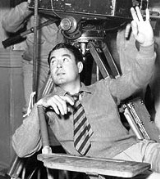
Leo McCarey

Encyclopedia
Thomas Leo McCarey was an American
film director
, screenwriter
and producer
. During his lifetime he was involved in nearly 200 movies, especially comedies. French
director Jean Renoir
once said that "Leo McCarey understood people better than any other Hollywood director."
, he graduated from the University of Southern California
law school and began in the movie business as an assistant director to Tod Browning
in 1920, but honed his skills at the Hal Roach Studios for the rest of that decade. Hired by Hal Roach
in 1923, McCarey initially wrote gags for the Our Gang
series and other studio stars, then produced and directed shorts, including two-reelers with Charley Chase
. While at Roach, McCarey cast Stan Laurel and Oliver Hardy
together and guided development of their onscreen characters, thus creating one of the most enduring comedy teams of all time. He only officially appeared as director of the duo shorts We Faw Down
(1928), Liberty
(1929) and Wrong Again
(1929), but wrote many of the screenplays. By 1929, he was vice-president of production for the entire studio.
In the sound era McCarey ventured into feature-film direction, working with many of the biggest stars of the era, including Gloria Swanson
(Indiscreet
, 1931
), Eddie Cantor
(The Kid From Spain
, 1932
), the Marx Brothers
(Duck Soup, 1933
), W.C. Fields (Six of a Kind
, 1934), Mae West
(Belle of the Nineties
, 1934
), and Harold Lloyd
(The Milky Way
, 1936
). In 1937, McCarey won his first Academy Award for Directing
for The Awful Truth
, with Irene Dunne
and Cary Grant
, a screwball comedy
that launched Cary Grant's unique screen persona, largely concocted by McCarey (Grant also copied many of McCarey's mannerisms). Along with the similarity in their names, McCarey and Cary Grant shared an eerie physical resemblance, making mimicking McCarey's intonations and expressions even easier for Grant. As writer/director Peter Bogdanovich
notes, "After The Awful Truth, when it came to light comedy, there was Cary Grant and then everyone else was an also-ran."
McCarey was a devout Roman Catholic and deeply concerned with social issues. During the 1940s, his work became more serious and his politics more conservative. In 1944 he directed Going My Way
, a story about an enterprising priest, the youthful Father Chuck O'Malley, played by Bing Crosby
, for which he won his second Best Director Oscar. His share in the profits of this smash hit gave McCarey the highest reported income in the U.S. for the year 1944, and its follow-up, The Bells of St. Mary's
(1945), which was made by McCarey's own production company, was similarly successful.
The public reacted negatively to some of his films after the Korean War
. For instance, his anti-communist film My Son John (1952), failed at the box office. Five years later, he co-wrote, produced, and directed An Affair to Remember
starring Cary Grant
and Deborah Kerr
, a remake (with precisely the same script) of his 1939 film Love Affair with Irene Dunne
and Charles Boyer
. He followed this hit with Rally 'Round the Flag, Boys! (1958), a comedy starring Paul Newman
and Joanne Woodward
. Some years later he directed his last picture, the poorly-received Satan Never Sleeps
(1962).
. He was interred in the Holy Cross Cemetery
in Culver City, California
. His brother, director Ray McCarey
, had died 21 years earlier.
United States
The United States of America is a federal constitutional republic comprising fifty states and a federal district...
film director
Film director
A film director is a person who directs the actors and film crew in filmmaking. They control a film's artistic and dramatic nathan roach, while guiding the technical crew and actors.-Responsibilities:...
, screenwriter
Screenwriter
Screenwriters or scriptwriters or scenario writers are people who write/create the short or feature-length screenplays from which mass media such as films, television programs, Comics or video games are based.-Profession:...
and producer
Film producer
A film producer oversees and delivers a film project to all relevant parties while preserving the integrity, voice and vision of the film. They will also often take on some financial risk by using their own money, especially during the pre-production period, before a film is fully financed.The...
. During his lifetime he was involved in nearly 200 movies, especially comedies. French
French people
The French are a nation that share a common French culture and speak the French language as a mother tongue. Historically, the French population are descended from peoples of Celtic, Latin and Germanic origin, and are today a mixture of several ethnic groups...
director Jean Renoir
Jean Renoir
Jean Renoir was a French film director, screenwriter, actor, producer and author. As a film director and actor, he made more than forty films from the silent era to the end of the 1960s...
once said that "Leo McCarey understood people better than any other Hollywood director."
Career
Born in Los Angeles, CaliforniaLos Angeles, California
Los Angeles , with a population at the 2010 United States Census of 3,792,621, is the most populous city in California, USA and the second most populous in the United States, after New York City. It has an area of , and is located in Southern California...
, he graduated from the University of Southern California
University
A university is an institution of higher education and research, which grants academic degrees in a variety of subjects. A university is an organisation that provides both undergraduate education and postgraduate education...
law school and began in the movie business as an assistant director to Tod Browning
Tod Browning
Tod Browning was an American motion picture actor, director and screenwriter.Browning's career spanned the silent and talkie eras...
in 1920, but honed his skills at the Hal Roach Studios for the rest of that decade. Hired by Hal Roach
Hal Roach
Harold Eugene "Hal" Roach, Sr. was an American film and television producer and director, and from the 1910s to the 1990s.- Early life and career :Hal Roach was born in Elmira, New York...
in 1923, McCarey initially wrote gags for the Our Gang
Our Gang
Our Gang, also known as The Little Rascals or Hal Roach's Rascals, was a series of American comedy short films about a group of poor neighborhood children and the adventures they had together. Created by comedy producer Hal Roach, the series is noted for showing children behaving in a relatively...
series and other studio stars, then produced and directed shorts, including two-reelers with Charley Chase
Charley Chase
Charley Chase was an American comedian, actor, screenwriter and film director, best known for his work in Hal Roach short film comedies...
. While at Roach, McCarey cast Stan Laurel and Oliver Hardy
Laurel and Hardy
Laurel and Hardy were one of the most popular and critically acclaimed comedy double acts of the early Classical Hollywood era of American cinema...
together and guided development of their onscreen characters, thus creating one of the most enduring comedy teams of all time. He only officially appeared as director of the duo shorts We Faw Down
We Faw Down
We Faw Down is a 1928 two-reel silent comedy starring Laurel and Hardy and directed by Leo McCarey. It was shot in August and September 1928, and released by Metro-Goldwyn-Mayer on December 29 of that year, with synchronized music and sound effects in theaters wired for sound.The plot line was...
(1928), Liberty
Liberty
Liberty is a moral and political principle, or Right, that identifies the condition in which human beings are able to govern themselves, to behave according to their own free will, and take responsibility for their actions...
(1929) and Wrong Again
Wrong Again
Wrong Again is a 1929 two-reel comedy silent film starring Laurel and Hardy. It was shot in October and November 1928, and released February 23, 1929, by Metro-Goldwyn-Mayer...
(1929), but wrote many of the screenplays. By 1929, he was vice-president of production for the entire studio.
In the sound era McCarey ventured into feature-film direction, working with many of the biggest stars of the era, including Gloria Swanson
Gloria Swanson
Gloria Swanson was an American actress, singer and producer. She was one of the most prominent stars during the silent film era as both an actress and a fashion icon, especially under the direction of Cecil B. DeMille, made dozens of silents and was nominated for the first Academy Award in the...
(Indiscreet
Indiscreet (1931 film)
Indiscreet is an American comedy film directed by Leo McCarey and starring Gloria Swanson and Ben Lyon. The screenplay by Buddy G. DeSylva, Lew Brown, and Ray Henderson, based on their story Obey That Impulse, originally was written as a full-fledged musical, but only two songs - "If You Haven't...
, 1931
1931 in film
-Top grossing films:-Academy Awards:*Best Picture: Cimarron - MGM*Best Actor: Lionel Barrymore - A Free Soul*Best Actor: Wallace Beery - The Champ*Best Actor: Fredric March - Dr. Jekyll and Mr. Hyde...
), Eddie Cantor
Eddie Cantor
Eddie Cantor was an American "illustrated song" performer, comedian, dancer, singer, actor and songwriter...
(The Kid From Spain
The Kid from Spain
The Kid from Spain is a 1932 comedy film directed by Leo McCarey starring Eddie Cantor involving bullfighting. Songs were composed by Harry Ruby and Bert Kalmar. Noteworthy are the musical scenes, directed and choreographed by Busby Berkeley....
, 1932
1932 in film
-Events:*Cary Grant's film career begins*Katharine Hepburn's film career begins*Shirley Temple's film career begins*Disney released Flowers and Trees, the first cartoon in three-strip Technicolor film.*Santa, first sound film made in Mexico released....
), the Marx Brothers
Marx Brothers
The Marx Brothers were an American family comedy act, originally from New York City, that enjoyed success in Vaudeville, Broadway, and motion pictures from the early 1900s to around 1950...
(Duck Soup, 1933
1933 in film
-Events:* March 2 - King Kong premieres in New York City.* June 6 - The first drive-in theater opens, in Camden, New Jersey.* British Film Institute founded....
), W.C. Fields (Six of a Kind
Six of a Kind
Six of a Kind is a 1934 comedy film directed by Leo McCarey. It is a whimsical and often absurd Road movie about three couples who decide to share their expenses on a trip to Hollywood.-Cast:*Charles Ruggles*Mary Boland*George Burns*Gracie Allen...
, 1934), Mae West
Mae West
Mae West was an American actress, playwright, screenwriter and sex symbol whose entertainment career spanned seven decades....
(Belle of the Nineties
Belle of the Nineties
Belle of the Nineties is Mae West's fourth motion picture, directed by Leo McCarey and released by Paramount Pictures. The film was based on West's original story It Ain't No Sin which was also to be the film's title until censors objected...
, 1934
1934 in film
-Events:*January 26 - Samuel Goldwyn purchases the film rights to The Wonderful Wizard of Oz from the L. Frank Baum estate for $40,000.*February 19 - Bob Hope marries Dolores Reade...
), and Harold Lloyd
Harold Lloyd
Harold Clayton Lloyd, Sr. was an American film actor and producer, most famous for his silent comedies....
(The Milky Way
The Milky Way (1936 film)
The Milky Way is a 1936 comedy film starring Harold Lloyd. Directed by comedy veteran Leo McCarey, the film was written by Grover Jones, Frank Butler and Richard Connell based on a play of the same name by Lynn Root and Harry Clork which was presented on Broadway in 1934.An example of the popular...
, 1936
1936 in film
The year 1936 in film involved some significant events.-Events:*May 29 - Fritz Lang's first Hollywood film Fury, starring Spencer Tracy and Bruce Cabot, is released.*November 6 - first Porky Pig animated cartoon...
). In 1937, McCarey won his first Academy Award for Directing
Academy Award for Directing
The Academy Award for Achievement in Directing , usually known as the Best Director Oscar, is one of the Awards of Merit presented by the Academy of Motion Picture Arts and Sciences to directors working in the motion picture industry...
for The Awful Truth
The Awful Truth
The Awful Truth is a 1937 screwball comedy film starring Irene Dunne and Cary Grant. The plot concerns the machinations of a soon-to-be-divorced couple, played by Dunne and Grant, who go to great lengths to try to ruin each other's romantic escapades...
, with Irene Dunne
Irene Dunne
Irene Dunne was an American film actress and singer of the 1930s, 1940s and early 1950s. Dunne was nominated five times for the Academy Award for Best Actress, for her performances in Cimarron , Theodora Goes Wild , The Awful Truth , Love Affair and I Remember Mama...
and Cary Grant
Cary Grant
Archibald Alexander Leach , better known by his stage name Cary Grant, was an English actor who later took U.S. citizenship...
, a screwball comedy
Screwball Comedy
Screwball Comedy is an album by the Japanese band Soul Flower Union. The album found the band going into a simpler, harder-rocking direction, after several heavily world-music influenced albums.-Track listing:...
that launched Cary Grant's unique screen persona, largely concocted by McCarey (Grant also copied many of McCarey's mannerisms). Along with the similarity in their names, McCarey and Cary Grant shared an eerie physical resemblance, making mimicking McCarey's intonations and expressions even easier for Grant. As writer/director Peter Bogdanovich
Peter Bogdanovich
Peter Bogdanovich is an American film historian, director, writer, actor, producer, and critic. He was part of the wave of "New Hollywood" directors, which included William Friedkin, Brian De Palma, George Lucas, Martin Scorsese, Michael Cimino, and Francis Ford Coppola...
notes, "After The Awful Truth, when it came to light comedy, there was Cary Grant and then everyone else was an also-ran."
McCarey was a devout Roman Catholic and deeply concerned with social issues. During the 1940s, his work became more serious and his politics more conservative. In 1944 he directed Going My Way
Going My Way
Going My Way is a 1944 film directed by Leo McCarey. It is a light-hearted musical comedy-drama about a new young priest taking over a parish from an established old veteran . Crosby sings five songs in the film. It was followed the next year by a sequel, The Bells of St. Mary's. This picture was...
, a story about an enterprising priest, the youthful Father Chuck O'Malley, played by Bing Crosby
Bing Crosby
Harry Lillis "Bing" Crosby was an American singer and actor. Crosby's trademark bass-baritone voice made him one of the best-selling recording artists of the 20th century, with over half a billion records in circulation....
, for which he won his second Best Director Oscar. His share in the profits of this smash hit gave McCarey the highest reported income in the U.S. for the year 1944, and its follow-up, The Bells of St. Mary's
The Bells of St. Mary's
The Bells of St. Mary's is a 1945 American film which tells the story of a priest and a nun at a school who set out, despite their good-natured rivalry, to save the school from being shut down. It stars Bing Crosby and Ingrid Bergman...
(1945), which was made by McCarey's own production company, was similarly successful.
The public reacted negatively to some of his films after the Korean War
Korean War
The Korean War was a conventional war between South Korea, supported by the United Nations, and North Korea, supported by the People's Republic of China , with military material aid from the Soviet Union...
. For instance, his anti-communist film My Son John (1952), failed at the box office. Five years later, he co-wrote, produced, and directed An Affair to Remember
An Affair to Remember
An Affair to Remember is a 1957 film starring Cary Grant and Deborah Kerr, and directed by Leo McCarey. It was distributed by Twentieth Century Fox Film Corporation....
starring Cary Grant
Cary Grant
Archibald Alexander Leach , better known by his stage name Cary Grant, was an English actor who later took U.S. citizenship...
and Deborah Kerr
Deborah Kerr
Deborah Kerr, CBE was a Scottish film and television actress from Glasgow. She won the Sarah Siddons Award for her Chicago performance as Laura Reynolds in Tea and Sympathy, a role which she originated on Broadway, a Golden Globe Award for the motion picture The King and I, and was a three-time...
, a remake (with precisely the same script) of his 1939 film Love Affair with Irene Dunne
Irene Dunne
Irene Dunne was an American film actress and singer of the 1930s, 1940s and early 1950s. Dunne was nominated five times for the Academy Award for Best Actress, for her performances in Cimarron , Theodora Goes Wild , The Awful Truth , Love Affair and I Remember Mama...
and Charles Boyer
Charles Boyer
Charles Boyer was a French actor who appeared in more than 80 films between 1920 and 1976. After receiving an education in drama, Boyer started on the stage, but he found success in movies during the 1930s. His memorable performances were among the era's most highly praised romantic dramas,...
. He followed this hit with Rally 'Round the Flag, Boys! (1958), a comedy starring Paul Newman
Paul Newman
Paul Leonard Newman was an American actor, film director, entrepreneur, humanitarian, professional racing driver and auto racing enthusiast...
and Joanne Woodward
Joanne Woodward
Joanne Gignilliat Trimmier Woodward is an American actress, television and theatrical producer, and widow of Paul Newman...
. Some years later he directed his last picture, the poorly-received Satan Never Sleeps
Satan Never Sleeps
Satan Never Sleeps , a film directed by Leo McCarey , is his final film. It is about a priest, Father O'Banion , who arrives at a mission-post in China accompanied by a young native girl, Siu Lan , who has joined him along the way...
(1962).
Death
Leo McCarey died in 1969, aged 70, from emphysemaEmphysema
Emphysema is a long-term, progressive disease of the lungs that primarily causes shortness of breath. In people with emphysema, the tissues necessary to support the physical shape and function of the lungs are destroyed. It is included in a group of diseases called chronic obstructive pulmonary...
. He was interred in the Holy Cross Cemetery
Holy Cross Cemetery, Culver City
Holy Cross Cemetery is a Roman Catholic cemetery at 5835 West Slauson Avenue in Culver City, California, operated by the Roman Catholic Archdiocese of Los Angeles....
in Culver City, California
Culver City, California
Culver City is a city in western Los Angeles County, California. As of the 2010 census, the city had a population of 38,883, up from 38,816 at the 2000 census. It is mostly surrounded by the city of Los Angeles, but also shares a border with unincorporated areas of Los Angeles County. Culver...
. His brother, director Ray McCarey
Ray McCarey
Raymond Benedict "Ray" McCarey was an American film director. He began working at Hal Roach Studios, where he did work on short films with Our Gang and Laurel and Hardy. Most of his feature film work consisted of "B" pictures and low-budget films...
, had died 21 years earlier.
Partial filmography
(As director, unless otherwise specified)- Isn't Life Terrible?Isn't Life Terrible?Isn't Life Terrible? is a 1925 film starring Charley Chase and featuring Oliver Hardy and Fay Wray. This short is a parody on D. W. Griffith's 1924 drama Isn't Life Wonderful.-Cast:* Charley Chase - Charley* Katherine Grant - The Wife...
(1925 short) - Mighty Like a MooseMighty Like a MooseMighty Like a Moose is a Charley Chase short silent film that was directed by Leo McCarey. It was released on July 18, 1926.In this short silent comedy, a homely husband and his equally unsightly wife improve their looks with plastic surgery without telling each other...
(1926 short) - Sugar DaddiesSugar DaddiesSugar Daddies is a 1927 short comedy silent film starring Jimmy Finlayson, and a pre-teamed Stan Laurel and Oliver Hardy.- Cast :*James Finlayson as Oil tycoon Cyrus Brittle*Stan Laurel as Brittle's lawyer*Oliver Hardy as Brittle's butler...
(1927 short) - Pass the GravyPass the GravyPass the Gravy is a 1928 short comedy silent film in which neighbors argue over their pet chickens and their children, who are in love. It stars Max Davidson, Gene Morgan, Spec O'Donnell, Martha Sleeper, and Bert Sprotte....
(1928 short) - Should Married Men Go Home?Should Married Men Go Home?Should Married Men Go Home? is a silent two-reel comedy produced by the Hal Roach Studios and starring Laurel and Hardy. It was filmed in March and May 1928, and released by Metro-Goldwyn-Mayer on September 8 of that year...
(1928 short), also writer - Habeas CorpusHabeas Corpus (1928 film)Habeas Corpus is a 1928 short comedy silent film starring Laurel and Hardy as grave-robbers hired by a mad scientist. It was shot in July 1928 and released by M-G-M on December 1st...
(1928 short) - We Faw DownWe Faw DownWe Faw Down is a 1928 two-reel silent comedy starring Laurel and Hardy and directed by Leo McCarey. It was shot in August and September 1928, and released by Metro-Goldwyn-Mayer on December 29 of that year, with synchronized music and sound effects in theaters wired for sound.The plot line was...
(1928 short) - LibertyLiberty (1929 film)Liberty is a 1929 short comedy film starring Laurel and Hardy as escaped convicts who, while trying to change pants, wind up on a skyscraper in construction.-Cast:*Stan Laurel as Stanley...
(1929 short), also writer - Wrong AgainWrong AgainWrong Again is a 1929 two-reel comedy silent film starring Laurel and Hardy. It was shot in October and November 1928, and released February 23, 1929, by Metro-Goldwyn-Mayer...
(1929 short) - Big BusinessBig Business (1929 film)Big Business is a 1929 silent Laurel and Hardy comedy short subject directed by James W. Horne and supervised by Leo McCarey from a McCarey and H. M. Walker script. The film was deemed culturally significant and entered into the United States National Film Registry in 1992.- Plot :Stan and Ollie...
(1929 short), also uncredited writer - IndiscreetIndiscreet (1931 film)Indiscreet is an American comedy film directed by Leo McCarey and starring Gloria Swanson and Ben Lyon. The screenplay by Buddy G. DeSylva, Lew Brown, and Ray Henderson, based on their story Obey That Impulse, originally was written as a full-fledged musical, but only two songs - "If You Haven't...
(1931) - Duck Soup (1933)
- Belle of the NinetiesBelle of the NinetiesBelle of the Nineties is Mae West's fourth motion picture, directed by Leo McCarey and released by Paramount Pictures. The film was based on West's original story It Ain't No Sin which was also to be the film's title until censors objected...
(1934) - Ruggles of Red GapRuggles of Red GapRuggles of Red Gap was serialized beginning December 26, 1914 in the Saturday Evening Post and became a best selling novel in 1915 by Harry Leon Wilson, adapted for the Broadway stage as a musical the same year, and made into a movie several times, most famously in 1935.In the comedy Western film...
(1935)
- The Milky WayThe Milky Way (1936 film)The Milky Way is a 1936 comedy film starring Harold Lloyd. Directed by comedy veteran Leo McCarey, the film was written by Grover Jones, Frank Butler and Richard Connell based on a play of the same name by Lynn Root and Harry Clork which was presented on Broadway in 1934.An example of the popular...
(1936) - Make Way for TomorrowMake Way for TomorrowMake Way for Tomorrow is a 1937 American drama film directed by Leo McCarey. The plot concerns an elderly couple who are forced to separate when they lose their house and none of their five children will take both parents in....
(1937), also producer - The Awful TruthThe Awful TruthThe Awful Truth is a 1937 screwball comedy film starring Irene Dunne and Cary Grant. The plot concerns the machinations of a soon-to-be-divorced couple, played by Dunne and Grant, who go to great lengths to try to ruin each other's romantic escapades...
(1937), also producer - The Cowboy and the LadyThe Cowboy and the Lady (1938 film)The Cowboy and the Lady is a 1938 American western romantic comedy film directed by H.C. Potter, and starring Gary Cooper and Merle Oberon. The film was written by S.N. Behrman and Sonya Levien, based on a story by Frank R. Adams and veteran film director Leo McCarey...
(1938), writer - Love Affair (1939), also producer
- My Favorite WifeMy Favorite WifeMy Favorite Wife is a 1940 screwball comedy produced and co-written by Leo McCarey and directed by Garson Kanin. The movie stars Irene Dunne as a woman who returns to her husband and children after being shipwrecked on a tropical island for several years, and Cary Grant as her husband...
(1940), producer and writer - Once Upon a HoneymoonOnce Upon a HoneymoonOnce Upon a Honeymoon is a 1956 musical sponsored film about a couple wishing for a new home. It starts off with a group of angels who decide to help a couple have a honeymoon. The husband tries to write a song, while the wife daydreams about a new home, and imagines what it would be like to have...
(1942), also writer and uncredited producer - Going My WayGoing My WayGoing My Way is a 1944 film directed by Leo McCarey. It is a light-hearted musical comedy-drama about a new young priest taking over a parish from an established old veteran . Crosby sings five songs in the film. It was followed the next year by a sequel, The Bells of St. Mary's. This picture was...
(1944), also producer - The Bells of St. Mary'sThe Bells of St. Mary'sThe Bells of St. Mary's is a 1945 American film which tells the story of a priest and a nun at a school who set out, despite their good-natured rivalry, to save the school from being shut down. It stars Bing Crosby and Ingrid Bergman...
(1945), also producer and writer - Good SamGood SamGood Sam is a 1948 American romantic comedy-drama film starring Gary Cooper as a Good Samaritan who is helpful to others at the expense of his own family. The film was directed by Leo McCarey and produced by McCarey's production company, Rainbow Productions.-Cast:*Gary Cooper as Samuel R....
(1948), also producer and writer - An Affair to RememberAn Affair to RememberAn Affair to Remember is a 1957 film starring Cary Grant and Deborah Kerr, and directed by Leo McCarey. It was distributed by Twentieth Century Fox Film Corporation....
(1957), also producer and writer - Rally 'Round the Flag, Boys! (1958), also producer
- Satan Never Sleeps (1962) , also producer
Academy Awards
- 1957 An Affair to RememberAn Affair to RememberAn Affair to Remember is a 1957 film starring Cary Grant and Deborah Kerr, and directed by Leo McCarey. It was distributed by Twentieth Century Fox Film Corporation....
Best Music, Original SongAcademy Award for Best Original SongThe Academy Award for Best Original Song is one of the awards given annually to people working in the motion picture industry by the Academy of Motion Picture Arts and Sciences . It is presented to the songwriters who have composed the best original song written specifically for a film...
Nominated - 1952 My Son John Best Writing, Motion Picture StoryAcademy Award for Best StoryThe Academy Award for Best Story was an Academy Award given from the beginning of the Academy Awards until 1957, when it was eliminated in favor of the Academy Award for Writing Original Screenplay, which had been introduced in 1940.-1920s:...
Nominated - 1945 The Bells of St. Mary'sThe Bells of St. Mary'sThe Bells of St. Mary's is a 1945 American film which tells the story of a priest and a nun at a school who set out, despite their good-natured rivalry, to save the school from being shut down. It stars Bing Crosby and Ingrid Bergman...
Best Motion PictureAcademy Award for Best PictureThe Academy Award for Best Picture is one of the Academy Awards of Merit presented annually by the Academy of Motion Picture Arts and Sciences to artists working in the motion picture industry. The Best Picture category is the only category in which every member of the Academy is eligible not only...
and Best Director Nominated - 1944 Going My WayGoing My WayGoing My Way is a 1944 film directed by Leo McCarey. It is a light-hearted musical comedy-drama about a new young priest taking over a parish from an established old veteran . Crosby sings five songs in the film. It was followed the next year by a sequel, The Bells of St. Mary's. This picture was...
Best Motion PictureAcademy Award for Best PictureThe Academy Award for Best Picture is one of the Academy Awards of Merit presented annually by the Academy of Motion Picture Arts and Sciences to artists working in the motion picture industry. The Best Picture category is the only category in which every member of the Academy is eligible not only...
, Best Director and Best Original Motion Picture StoryAcademy Award for Best StoryThe Academy Award for Best Story was an Academy Award given from the beginning of the Academy Awards until 1957, when it was eliminated in favor of the Academy Award for Writing Original Screenplay, which had been introduced in 1940.-1920s:...
Won - 1940 My Favorite WifeMy Favorite WifeMy Favorite Wife is a 1940 screwball comedy produced and co-written by Leo McCarey and directed by Garson Kanin. The movie stars Irene Dunne as a woman who returns to her husband and children after being shipwrecked on a tropical island for several years, and Cary Grant as her husband...
Best Original StoryAcademy Award for Best StoryThe Academy Award for Best Story was an Academy Award given from the beginning of the Academy Awards until 1957, when it was eliminated in favor of the Academy Award for Writing Original Screenplay, which had been introduced in 1940.-1920s:...
Nominated - 1939 Love Affair Outstanding ProductionAcademy Award for Best PictureThe Academy Award for Best Picture is one of the Academy Awards of Merit presented annually by the Academy of Motion Picture Arts and Sciences to artists working in the motion picture industry. The Best Picture category is the only category in which every member of the Academy is eligible not only...
and Best Original StoryAcademy Award for Best StoryThe Academy Award for Best Story was an Academy Award given from the beginning of the Academy Awards until 1957, when it was eliminated in favor of the Academy Award for Writing Original Screenplay, which had been introduced in 1940.-1920s:...
Nominated - 1937 The Awful TruthThe Awful TruthThe Awful Truth is a 1937 screwball comedy film starring Irene Dunne and Cary Grant. The plot concerns the machinations of a soon-to-be-divorced couple, played by Dunne and Grant, who go to great lengths to try to ruin each other's romantic escapades...
Won Best Director Nominated Outstanding Production
| Year | Award !! Film !! Result | ||
|---|---|---|---|
| 1937 | Outstanding Production Academy Award for Best Picture The Academy Award for Best Picture is one of the Academy Awards of Merit presented annually by the Academy of Motion Picture Arts and Sciences to artists working in the motion picture industry. The Best Picture category is the only category in which every member of the Academy is eligible not only... |
The Awful Truth The Awful Truth The Awful Truth is a 1937 screwball comedy film starring Irene Dunne and Cary Grant. The plot concerns the machinations of a soon-to-be-divorced couple, played by Dunne and Grant, who go to great lengths to try to ruin each other's romantic escapades... |
|
| Academy Award for Best Director | |||
External links
- Senses of Cinema: Great Directors Critical Database
- Leo McCarey: Hollywood Auteur, Hollywood Renegade
- They Shoot Pictures, Don't They?
- News story about the auction of a counterfeit Oscar statuette which the owner claimed was McCarey's
- Paul Vecchiali, Le génie américain: Leo McCarey, "La furia umana", n. 1, 2009, http://www.lafuriaumana.it
- (A Response to McCarey's My Son John - TCM Movie Morlocks)
- (What Are the Whispers About My Son John? - TCM)
- Literature on Leo McCarey