


L. L. Zamenhof

Encyclopedia
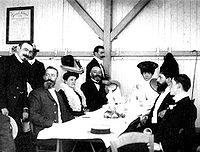
December 15, 1859 – April 14, 1917) was the inventor of Esperanto
Esperanto
is the most widely spoken constructed international auxiliary language. Its name derives from Doktoro Esperanto , the pseudonym under which L. L. Zamenhof published the first book detailing Esperanto, the Unua Libro, in 1887...
, the most successful constructed language
Constructed language
A planned or constructed language—known colloquially as a conlang—is a language whose phonology, grammar, and/or vocabulary has been consciously devised by an individual or group, instead of having evolved naturally...
designed for international communication.
Cultural background
Zamenhof was born on December 15 (December 3 OS), 1859 in the town of Białystok in the Russian EmpireRussian Empire
The Russian Empire was a state that existed from 1721 until the Russian Revolution of 1917. It was the successor to the Tsardom of Russia and the predecessor of the Soviet Union...
(now part of Poland
Poland
Poland , officially the Republic of Poland , is a country in Central Europe bordered by Germany to the west; the Czech Republic and Slovakia to the south; Ukraine, Belarus and Lithuania to the east; and the Baltic Sea and Kaliningrad Oblast, a Russian exclave, to the north...
). He considered his native language to be his father's Russian
Russian language
Russian is a Slavic language used primarily in Russia, Belarus, Uzbekistan, Kazakhstan, Tajikistan and Kyrgyzstan. It is an unofficial but widely spoken language in Ukraine, Moldova, Latvia, Turkmenistan and Estonia and, to a lesser extent, the other countries that were once constituent republics...
, but he also spoke his mother's Yiddish
Yiddish language
Yiddish is a High German language of Ashkenazi Jewish origin, spoken throughout the world. It developed as a fusion of German dialects with Hebrew, Aramaic, Slavic languages and traces of Romance languages...
natively; as he grew older, he spoke more Polish
Polish language
Polish is a language of the Lechitic subgroup of West Slavic languages, used throughout Poland and by Polish minorities in other countries...
, and that became the native language of his children. His father was a teacher of German
German language
German is a West Germanic language, related to and classified alongside English and Dutch. With an estimated 90 – 98 million native speakers, German is one of the world's major languages and is the most widely-spoken first language in the European Union....
, and he also spoke that language fluently, though not as comfortably as Yiddish. Later he learned French
French language
French is a Romance language spoken as a first language in France, the Romandy region in Switzerland, Wallonia and Brussels in Belgium, Monaco, the regions of Quebec and Acadia in Canada, and by various communities elsewhere. Second-language speakers of French are distributed throughout many parts...
, Latin
Latin
Latin is an Italic language originally spoken in Latium and Ancient Rome. It, along with most European languages, is a descendant of the ancient Proto-Indo-European language. Although it is considered a dead language, a number of scholars and members of the Christian clergy speak it fluently, and...
, Greek
Greek language
Greek is an independent branch of the Indo-European family of languages. Native to the southern Balkans, it has the longest documented history of any Indo-European language, spanning 34 centuries of written records. Its writing system has been the Greek alphabet for the majority of its history;...
, Hebrew
Hebrew language
Hebrew is a Semitic language of the Afroasiatic language family. Culturally, is it considered by Jews and other religious groups as the language of the Jewish people, though other Jewish languages had originated among diaspora Jews, and the Hebrew language is also used by non-Jewish groups, such...
, and English
English language
English is a West Germanic language that arose in the Anglo-Saxon kingdoms of England and spread into what was to become south-east Scotland under the influence of the Anglian medieval kingdom of Northumbria...
, and had an interest in Italian
Italian language
Italian is a Romance language spoken mainly in Europe: Italy, Switzerland, San Marino, Vatican City, by minorities in Malta, Monaco, Croatia, Slovenia, France, Libya, Eritrea, and Somalia, and by immigrant communities in the Americas and Australia...
, Spanish
Spanish language
Spanish , also known as Castilian , is a Romance language in the Ibero-Romance group that evolved from several languages and dialects in central-northern Iberia around the 9th century and gradually spread with the expansion of the Kingdom of Castile into central and southern Iberia during the...
and Lithuanian
Lithuanian language
Lithuanian is the official state language of Lithuania and is recognized as one of the official languages of the European Union. There are about 2.96 million native Lithuanian speakers in Lithuania and about 170,000 abroad. Lithuanian is a Baltic language, closely related to Latvian, although they...
.
In addition to the Yiddish-speaking Jewish majority, the population of Białystok was made up of three other ethnic groups: Poles
Poles
thumb|right|180px|The state flag of [[Poland]] as used by Polish government and diplomatic authoritiesThe Polish people, or Poles , are a nation indigenous to Poland. They are united by the Polish language, which belongs to the historical Lechitic subgroup of West Slavic languages of Central Europe...
, Germans
Germans
The Germans are a Germanic ethnic group native to Central Europe. The English term Germans has referred to the German-speaking population of the Holy Roman Empire since the Late Middle Ages....
, and Belarusians
Belarusians
Belarusians ; are an East Slavic ethnic group who populate the majority of the Republic of Belarus. Introduced to the world as a new state in the early 1990s, the Republic of Belarus brought with it the notion of a re-emerging Belarusian ethnicity, drawn upon the lines of the Old Belarusian...
. Zamenhof was saddened and frustrated by the many quarrels among these groups. He supposed that the main reason for the hate and prejudice lay in the mutual misunderstanding caused by the lack of one common language
Language
Language may refer either to the specifically human capacity for acquiring and using complex systems of communication, or to a specific instance of such a system of complex communication...
. If such a language existed, Zamenhof postulated, it could play the role of a neutral communication tool between people of different ethnic and linguistic backgrounds.
Work for an international language
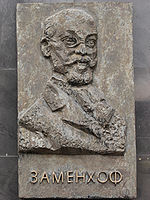
Russian language
Russian is a Slavic language used primarily in Russia, Belarus, Uzbekistan, Kazakhstan, Tajikistan and Kyrgyzstan. It is an unofficial but widely spoken language in Ukraine, Moldova, Latvia, Turkmenistan and Estonia and, to a lesser extent, the other countries that were once constituent republics...
and Yiddish and his adopted language Polish
Polish language
Polish is a language of the Lechitic subgroup of West Slavic languages, used throughout Poland and by Polish minorities in other countries...
, his linguistics attempts were also aided by his mastering of German, a good passive understanding of Latin, Hebrew and French, and a basic knowledge of Greek, English and Italian.
By 1878, his project Lingwe uniwersala was almost finished. However, Zamenhof was too young then to publish his work. Soon after graduation from school he began to study medicine
Medicine
Medicine is the science and art of healing. It encompasses a variety of health care practices evolved to maintain and restore health by the prevention and treatment of illness....
, first in Moscow, and later in Warsaw. In 1885, Zamenhof graduated from a university
University
A university is an institution of higher education and research, which grants academic degrees in a variety of subjects. A university is an organisation that provides both undergraduate education and postgraduate education...
and began his practice as a doctor in Veisiejai
Veisiejai
Veisiejai is a city in the Lazdijai district municipality, Lithuania. It is located south-east of Lazdijai. The Esperanto language was created in Veisiejai where L. L. Zamenhof started his practice as an ophtalmologist in 1885. There is a church dedicated to St...
and after 1886 as an ophthalmologist
Ophthalmology
Ophthalmology is the branch of medicine that deals with the anatomy, physiology and diseases of the eye. An ophthalmologist is a specialist in medical and surgical eye problems...
in Płock and Vienna
Vienna
Vienna is the capital and largest city of the Republic of Austria and one of the nine states of Austria. Vienna is Austria's primary city, with a population of about 1.723 million , and is by far the largest city in Austria, as well as its cultural, economic, and political centre...
. While healing people there he continued to work on his project of an international language.
For two years he tried to raise funds to publish a booklet describing the language until he received the financial help from his future wife's father. In 1887, the book titled Lingvo internacia: Antaŭparolo kaj plena lernolibro (International language: Foreword and complete textbook) was published in Russian under the pseudonym
Pseudonym
A pseudonym is a name that a person assumes for a particular purpose and that differs from his or her original orthonym...
"Doktoro Esperanto" (Doctor Hopeful), from which the name of the language derives. For Zamenhof this language, far from being merely a communication tool, was a way of promoting the peaceful coexistence of different people and cultures.
Work on Yiddish language and Jewish issues
In 1879, Zamenhof wrote the first grammar of the Yiddish language, which he published in part years later in the Yiddish magazine Lebn un visnshaft. The complete original Russian text of this manuscript with parallel Esperanto translation was only published in 1982 (translated by Adolf HolzhausAdolf Holzhaus
Adolf Holzhaus was an Esperantist and historian of the Esperanto movement.-Works:*1969:Doktoro kaj lingvo ESPERANTO eldonis Fondumo Esperanto...
in L. Zamenhof, provo de gramatiko de novjuda lingvo, Helsinki, p. 9-36). In this work, not only does he provide a review of Yiddish grammar, but also proposes its transition to the Latin script and other orthographic innovations. In the same period, Zamenhof wrote some other works in Yiddish, including perhaps the first survey of Yiddish poetics (see p. 50 in the above-cited book).
In 1882, a wave of pogrom
Pogrom
A pogrom is a form of violent riot, a mob attack directed against a minority group, and characterized by killings and destruction of their homes and properties, businesses, and religious centres...
s in the Russian empire motivated Zamenhof to take part in the early Zionist movement, the Hibbat Zion
Hovevei Zion
Hovevei Zion , also known as Hibbat Zion , refers to organizations that are now considered the forerunners and foundation-builders of modern Zionism....
. He left the movement in 1887, and in 1901 published a statement in Russian with the title Hillelism, in which he argued that the Zionist project could not solve the problems of the Jewish people.
In 1914, he politely declined an invitation to join a new organization of Jewish Esperantists, the TEHA. In his letter to the organizers, he said: "I am profoundly convinced that every nationalism offers humanity only the greatest unhappiness... It is true that the nationalism of oppressed peoples – as a natural self-defensive reaction – is much more excusable than the nationalism of peoples who oppress; but, if the nationalism of the strong is ignoble, the nationalism of the weak is imprudent; both give birth to and support each other..."
Among the many works Zamenhof translated into Esperanto is the Hebrew Bible
Hebrew Bible
The Hebrew Bible is a term used by biblical scholars outside of Judaism to refer to the Tanakh , a canonical collection of Jewish texts, and the common textual antecedent of the several canonical editions of the Christian Old Testament...
or Old Testament.
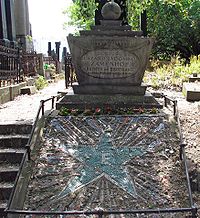
Zamenhof died in Warsaw on April 14, 1917, and is buried in the Okopowa Street Jewish Cemetery
Okopowa Street Jewish Cemetery
The Okopowa Street Jewish Cemetery is one of the largest Jewish cemeteries in Europe. Located on Warsaw's Okopowa street and abutting the Powązki Cemetery at , the Jewish Cemetery was established in 1806 and occupies 33 hectares of land. The cemetery contains over 200,000 marked graves, as well...
in that city.
Religious philosophy
Besides his linguistic work, Zamenhof published a religious philosophy he called Homaranismo (loosely translated as humanitarianismHumanitarianism
In its most general form, humanitarianism is an ethic of kindness, benevolence and sympathy extended universally and impartially to all human beings. Humanitarianism has been an evolving concept historically but universality is a common element in its evolution...
), based on the principles and teachings of Hillel the Elder
Hillel the Elder
Hillel was a famous Jewish religious leader, one of the most important figures in Jewish history. He is associated with the development of the Mishnah and the Talmud...
.
Children
Zamenhof and his wife Klara raised three children, a son, AdamAdam Zamenhof
Adam Zamenhof was a Polish physician known for his work on ophthalmology and was the son of Ludwik Zamenhof, the inventor of Esperanto. During World War II, 6 September 1939, he was head of the Starozakonnych Hospital in Warsaw, and its director...
, and two daughters, Sofia and Lidia
Lidia Zamenhof
Lidia Zamenhof was the youngest daughter of Ludwig Zamenhof, the creator of the international auxiliary language, Esperanto. She was born 29 January 1904 in Warsaw, then in the Russian Empire...
. All three were murdered in the Holocaust
The Holocaust
The Holocaust , also known as the Shoah , was the genocide of approximately six million European Jews and millions of others during World War II, a programme of systematic state-sponsored murder by Nazi...
.
Lidia Zamenhof
Lidia Zamenhof
Lidia Zamenhof was the youngest daughter of Ludwig Zamenhof, the creator of the international auxiliary language, Esperanto. She was born 29 January 1904 in Warsaw, then in the Russian Empire...
in particular took a keen interest in Esperanto, and as an adult became a teacher of the language, traveling through Europe and to America to teach classes in it. Through her friendship with Martha Root
Martha Root
Martha Louise Root was a prominent traveling teacher of the Bahá'í Faith in the late 19th and early 20th century. Shoghi Effendi, the Guardian of the Bahá'í Faith called her "the foremost travel teacher in the first Bahá'í Century", and named her a Hand of the Cause posthumously...
, Lidia accepted Bahá’u’lláh
Bahá'u'lláh
Bahá'u'lláh , born ' , was the founder of the Bahá'í Faith. He claimed to be the prophetic fulfilment of Bábism, a 19th-century outgrowth of Shí‘ism, but in a broader sense claimed to be a messenger from God referring to the fulfilment of the eschatological expectations of Islam, Christianity, and...
and became a member of the Bahá’í faith
Bahá'í Faith
The Bahá'í Faith is a monotheistic religion founded by Bahá'u'lláh in 19th-century Persia, emphasizing the spiritual unity of all humankind. There are an estimated five to six million Bahá'ís around the world in more than 200 countries and territories....
. As one of its social principles, the Bahá’í faith teaches that an auxiliary world language should be selected by the representatives of all the world's nations.
Name discrepancy
Zamenhof's parents gave him the Hebrew name Eliezer, which appeared on his birth certificate in its Yiddish form Leyzer. In his adolescence he used both Leyzer and the Russian equivalent Lazar (the form Lazarus is often used in English texts). In some Russian documents Lazar was followed by the patronymicPatronymic
A patronym, or patronymic, is a component of a personal name based on the name of one's father, grandfather or an even earlier male ancestor. A component of a name based on the name of one's mother or a female ancestor is a matronymic. Each is a means of conveying lineage.In many areas patronyms...
Markovich.
While at university, Zamenhof began using the Russian name Lyudovik (often transcribed Ludovic; in English the form Ludwig is also used) in place of Lazar. When his brother Leon became a doctor and started signing his name "Dr L. Zamenhof", Ludwik reclaimed his birth name Lazar and from 1901 signed his name "Dr L. L. Zamenhof". The two L's do not seem to have specifically represented either name, and the order Ludwik Lazar is a modern convention.
Zamenhof may have chosen the name Ludwik in honor of Francis Lodwick
Francis Lodwick
Francis Lodwick was a pioneer of a priori languages . He was a merchant of Dutch origin who lived in London...
(or Lodowyck), who in 1652 had published an early conlang proposal.
His family name was originally written Samenhof, in German orthography; the spelling Zamenhof reflects the romanization of the Yiddish spelling , as well as the Esperanto and Polish spellings.
Honours and namesakes
In 1910, Zamenhof was nominated for the Nobel Peace PrizeNobel Peace Prize
The Nobel Peace Prize is one of the five Nobel Prizes bequeathed by the Swedish industrialist and inventor Alfred Nobel.-Background:According to Nobel's will, the Peace Prize shall be awarded to the person who...
, by four British Members of Parliament
Member of Parliament
A Member of Parliament is a representative of the voters to a :parliament. In many countries with bicameral parliaments, the term applies specifically to members of the lower house, as upper houses often have a different title, such as senate, and thus also have different titles for its members,...
(including James O'Grady
James O'Grady
Sir James O'Grady, KCMG was a trade unionist and Labour Party politician in the United Kingdom. He was the first colonial governor appointed by the Labour Party from within its own ranks.- Early life :...
, Philip Snowden
Philip Snowden, 1st Viscount Snowden
Philip Snowden, 1st Viscount Snowden PC was a British politician and the first Labour Chancellor of the Exchequer, a position he held in 1924 and again between 1929 and 1931.-Early life: 1864–1906:...
) and Professor Stanley Lane Poole. (The Prize was instead awarded to the International Peace Bureau
International Peace Bureau
International Peace Bureau is the world's oldest international peace federation. It was founded in 1891, and awarded the Nobel Peace Prize in 1910....
.) On the occasion of the 5th Universala Kongreso de Esperanto in Barcelona
Barcelona
Barcelona is the second largest city in Spain after Madrid, and the capital of Catalonia, with a population of 1,621,537 within its administrative limits on a land area of...
, Zamenhof was made a Commander of the Order of Isabella the Catholic by King Alfonso XIII of Spain
Alfonso XIII of Spain
Alfonso XIII was King of Spain from 1886 until 1931. His mother, Maria Christina of Austria, was appointed regent during his minority...
.
The minor planet
Minor planet
An asteroid group or minor-planet group is a population of minor planets that have a share broadly similar orbits. Members are generally unrelated to each other, unlike in an asteroid family, which often results from the break-up of a single asteroid...
(1462) Zamenhof
1462 Zamenhof
Zamenhof is a main belt asteroid, which was discovered by the Finnish astronomer and physicist Yrjö Väisälä on February 6, 1938. It has a diameter of 25.82 km and geometric albedo of 0.1268....
is named in his honor. It was discovered on February 6, 1938, by Yrjö Väisälä
Yrjö Väisälä
Yrjö Väisälä was a Finnish astronomer and physicist.His main contributions were in the field of optics, but he was also very active in geodetics, astronomy and optical metrology...
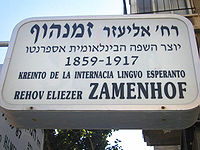
. Also, hundreds of city streets, parks, and bridges worldwide have been named after Zamenhof. In Lithuania
Lithuania
Lithuania , officially the Republic of Lithuania is a country in Northern Europe, the biggest of the three Baltic states. It is situated along the southeastern shore of the Baltic Sea, whereby to the west lie Sweden and Denmark...
, the best-known Zamenhof Street is in Kaunas
Kaunas
Kaunas is the second-largest city in Lithuania and has historically been a leading centre of Lithuanian economic, academic, and cultural life. Kaunas was the biggest city and the center of a powiat in Trakai Voivodeship of the Grand Duchy of Lithuania since 1413. During Russian Empire occupation...
, where he lived and owned a house for some time. There are others in France, Hungary
Hungary
Hungary , officially the Republic of Hungary , is a landlocked country in Central Europe. It is situated in the Carpathian Basin and is bordered by Slovakia to the north, Ukraine and Romania to the east, Serbia and Croatia to the south, Slovenia to the southwest and Austria to the west. The...
, Poland, the Czech Republic
Czech Republic
The Czech Republic is a landlocked country in Central Europe. The country is bordered by Poland to the northeast, Slovakia to the east, Austria to the south, and Germany to the west and northwest....
, Spain (mostly in Catalonia
Catalonia
Catalonia is an autonomous community in northeastern Spain, with the official status of a "nationality" of Spain. Catalonia comprises four provinces: Barcelona, Girona, Lleida, and Tarragona. Its capital and largest city is Barcelona. Catalonia covers an area of 32,114 km² and has an...
), Italy, Israel
Israel
The State of Israel is a parliamentary republic located in the Middle East, along the eastern shore of the Mediterranean Sea...
, and Brazil
Brazil
Brazil , officially the Federative Republic of Brazil , is the largest country in South America. It is the world's fifth largest country, both by geographical area and by population with over 192 million people...
. There are Zamenhof Hills in Hungary and Brazil, and a Zamenhof Island in the Danube River.
Oomoto
Oomoto also known as Oomoto-kyo , is a sect, often categorised as a new Japanese religion originated from Shinto; it was founded in 1892 by Deguchi Nao...
, which encourages the use of Esperanto among its followers. Also, a genus of lichen
Lichen
Lichens are composite organisms consisting of a symbiotic organism composed of a fungus with a photosynthetic partner , usually either a green alga or cyanobacterium...
has been named Zamenhofia rosei in his honour.
His birthday, December 15, is celebrated annually as Zamenhof Day
Zamenhof Day
Zamenhof Day , also called Esperanto Day, is celebrated on 15 December, the birthday of Esperanto creator L. L. Zamenhof...
by users of Esperanto. On December 15, 2009, Esperanto's green-starred flag
Esperanto symbols
Since the earliest days of Esperanto, the colour green has been used as a symbol of mutual recognition and it appears prominently in all Esperanto symbols....
flew on the Google
Google
Google Inc. is an American multinational public corporation invested in Internet search, cloud computing, and advertising technologies. Google hosts and develops a number of Internet-based services and products, and generates profit primarily from advertising through its AdWords program...
search
Google search
Google or Google Web Search is a web search engine owned by Google Inc. Google Search is the most-used search engine on the World Wide Web, receiving several hundred million queries each day through its various services....
web page, in a commemorative Google Doodle
Google logo
Google has had several logos since its renaming from BackRub. The current official Google logo was designed by Ruth Kedar, and is a wordmark based on the Catull typeface....
to mark Zamenhof's 150th birthday.
The house of the Zamenhof family, dedicated to Ludwik Zamenhof and the Białystok Esperanto Centre, are sites of the Jewish Heritage Trail in Białystok, which was opened in June 2008 by volunteers at The University of Białystok Foundation.
See also
- The Life of ZamenhofThe Life of ZamenhofThe Life of Zamenhof is biography of Zamenhof, the founder of Esperanto, written in Esperanto by Edmond Privat. The first edition was in 1920 with 208 pages, and the second edition was in 1923 with 109 pages...
- The Ludwik Zamenhof CentreThe Ludwik Zamenhof CentreThe Ludwik Zamenhof Centre – a city cultural institution established in Bialystok at 19 Warszawska St. upon the motion of the President of the City. It was founded to celebrate the organization of the 94th World Congress of Esperanto that was held from 25 July to 1 August 2009 in Bialystok. The...
in Białystok - 1462 Zamenhof1462 ZamenhofZamenhof is a main belt asteroid, which was discovered by the Finnish astronomer and physicist Yrjö Väisälä on February 6, 1938. It has a diameter of 25.82 km and geometric albedo of 0.1268....
, a minor planet named in Zamenhof's honour - 1421 Esperanto1421 Esperanto1421 Esperanto is a main belt asteroid discovered on March 18, 1936 by the Finnish astronomer Yrjö Väisälä at Iso-Heikkilä Observatory in Turku, Finland. It measures 43.31km in diameter....
, another minor planet, similarly named
External links
- Zamenhof, Esperanto's founder (in English) on lernu!Lernu!lernu! is a multilingual, Web-based free-of-charge project for promoting and teaching Esperanto. Its name is Esperanto for the command "learn." The site is run by E@I, an international youth organization, which started as a working group of the World Esperanto Youth Organisation.The site's content...
, an Esperanto study portal - Zamenhof: The Life, Works, and Ideas of the Author of Esperanto by Aleksandr Korzhenkov – a 53 pages scholarly text abridged from a 2009 book (in English) (in Esperanto)
- ZAMENHOF, LAZARUS LUDWIG by Joseph Jacobs, Isidore Harris. Jewish EncyclopediaJewish EncyclopediaThe Jewish Encyclopedia is an encyclopedia originally published in New York between 1901 and 1906 by Funk and Wagnalls. It contained over 15,000 articles in 12 volumes on the history and then-current state of Judaism and the Jews as of 1901...
, 1906 ed. - L.L. Zamenhof and the Shadow People by Esther Schor, The New RepublicThe New RepublicThe magazine has also published two articles concerning income inequality, largely criticizing conservative economists for their attempts to deny the existence or negative effect increasing income inequality is having on the United States...
, December 30, 2009