

Korean dialects

Encyclopedia
Korean language
Korean is the official language of the country Korea, in both South and North. It is also one of the two official languages in the Yanbian Korean Autonomous Prefecture in People's Republic of China. There are about 78 million Korean speakers worldwide. In the 15th century, a national writing...
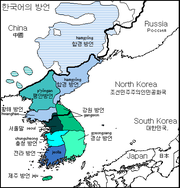
dialects are spoken in the Korean peninsula
Korean Peninsula
The Korean Peninsula is a peninsula in East Asia. It extends southwards for about 684 miles from continental Asia into the Pacific Ocean and is surrounded by the Sea of Japan to the south, and the Yellow Sea to the west, the Korea Strait connecting the first two bodies of water.Until the end of...
. The peninsula
Peninsula
A peninsula is a piece of land that is bordered by water on three sides but connected to mainland. In many Germanic and Celtic languages and also in Baltic, Slavic and Hungarian, peninsulas are called "half-islands"....
is extremely mountainous, and each dialect's "territory" corresponds closely to the natural boundaries between different geographical regions
Regions of Korea
Korea has traditionally been divided into a number of unofficial regions that reflect historical, geographical, and dialect boundaries within the peninsula...
. Most of the dialects are named for one of Korea
Korea
Korea ) is an East Asian geographic region that is currently divided into two separate sovereign states — North Korea and South Korea. Located on the Korean Peninsula, Korea is bordered by the People's Republic of China to the northwest, Russia to the northeast, and is separated from Japan to the...
's traditional Eight Provinces
Eight Provinces (Korea)
During most of the Joseon Dynasty, Korea was divided into eight provinces . The eight provinces' boundaries remained unchanged for almost five centuries from 1413 to 1895, and formed a geographic paradigm that is still reflected today in the Korean Peninsula's administrative divisions, dialects,...
.
Standard dialects
- In South Korea, Standard Korean (표준어/標準語) is defined by the National Institute of the Korean Language as "the modern speech of Seoul widely used by the well-cultivated" (교양있는 사람들이 두루 쓰는 현대 서울말). In practice, it tends not to include features that are found exclusively in Seoul.
- Seoul dialectSeoul dialectThe Seoul dialect is the basis of the standard language of Korean in South Korea. It is spoken in the Seoul National Capital Area, which includes Seoul, Incheon, and Gyeonggi. The dialect does not merely mean 'a standard accent'. The exact form of the South Korea's standard accent is that of...
(서울말) is the basis of the standard dialect in South KoreaSouth KoreaThe Republic of Korea , , is a sovereign state in East Asia, located on the southern portion of the Korean Peninsula. It is neighbored by the People's Republic of China to the west, Japan to the east, North Korea to the north, and the East China Sea and Republic of China to the south...
, and is spoken in SeoulSeoulSeoul , officially the Seoul Special City, is the capital and largest metropolis of South Korea. A megacity with a population of over 10 million, it is the largest city proper in the OECD developed world...
, IncheonIncheonThe Incheon Metropolitan City is located in northwestern South Korea. The city was home to just 4,700 people when Jemulpo port was built in 1883. Today 2.76 million people live in the city, making it Korea’s third most populous city after Seoul and Busan Metropolitan City...
, and Gyeonggi in South Korea, as well as in KaesŏngKaesongKaesŏng is a city in North Hwanghae Province, southern North Korea , a former Directly Governed City, and the capital of Korea during the Koryo Dynasty. The city is near Kaesŏng Industrial Region and it contains the remains of the Manwoldae palace. It was formally named Songdo while it was the...
in North KoreaNorth KoreaThe Democratic People’s Republic of Korea , , is a country in East Asia, occupying the northern half of the Korean Peninsula. Its capital and largest city is Pyongyang. The Korean Demilitarized Zone serves as the buffer zone between North Korea and South Korea...
.
- Seoul dialect
- P'yŏng'an dialectPyongan dialectThe Pyongan dialect is the basis of the standard language of Koreans in North Korea....
(평안방언) is the standard dialect in North KoreaKorean language North-South differencesThere are a small number of differences in the standard forms of the Korean language used in the Democratic People's Republic of Korea and the Republic of Korea , due to the length of time Korea has been divided.-Overview:Korean orthography, as defined by the Korean Language Society in 1933 in the...
, and is spoken in P'yŏngyangPyongyangPyongyang is the capital of the Democratic People's Republic of Korea, commonly known as North Korea, and the largest city in the country. Pyongyang is located on the Taedong River and, according to preliminary results from the 2008 population census, has a population of 3,255,388. The city was...
, the P'yŏng'anPyonganP'yŏngan was one of the Eight Provinces of Korea during the Joseon Dynasty. P'yŏngan was located in the northwest of Korea. The provincial capital was P'yŏngyang.-History:P'yŏngan Province was formed in 1413...
region, and Chagang Province.
Regional dialects
- Hamgyŏng dialectHamgyong dialectHamgyŏng dialect is a dialect of the Korean language used in the North Hamgyŏng, South Hamgyŏng, and Ryanggang Provinces of North Korea, as well as the Yanbian Korean Autonomous Prefecture of northeast China...
(함경 방언) is used in the HamgyŏngHamgyongHamgyŏng was one of the Eight Provinces of Korea during the Joseon Dynasty. Hamgyŏng was located in the northeast of Korea. The provincial capital was Hamhŭng.-History:...
(KwanbukKwanbukKwanbuk is a region in North Hamgyong and South Hamgyong Provinces of North Korea. The region may once have been occupied by the Okjeo people...
& KwannamKwannamKwannam is a traditional Korean term used to refer to the southern region of Hamgyong province, including portions of modern-day North Hamgyong and South Hamgyong, North Korea. Its literal meaning is "South of the Ridge", the ridge in question being Mach'ŏnnyŏng 마천령 摩天嶺...
) region and Ryanggang Province of North Korea as well as the Yanbian Korean Autonomous PrefectureYanbian Korean Autonomous PrefectureYanbian is a Korean Autonomous Prefecture in Jilin Province, in Northeastern China, above the border with North Korea. Yanbian is bordered to the north by Heilongjiang, on the west by Baishan City and Jilin City, on the south by North Hamgyong Province of North Korea, and on the east by Primorsky...
of northeast ChinaNortheast ChinaNortheast China, historically known in English as Manchuria, is a geographical region of China, consisting of the three provinces of Liaoning, Jilin and Heilongjiang. The region is sometimes called the Three Northeast Provinces...
(in JilinJilinJilin , is a province of the People's Republic of China located in the northeastern part of the country. Jilin borders North Korea and Russia to the east, Heilongjiang to the north, Liaoning to the south, and Inner Mongolia to the west...
). - Hwanghae dialect (황해 방언) is used in the HwanghaeHwanghaeHwanghae was one of the Eight Provinces of Korea during the Joseon Dynasty. Hwanghae was located in the northwest of Korea. The provincial capital was Haeju.The regional name for the province was Haesŏ .-History:...
(Haesŏ) region of North Korea. - Gangwon dialect (강원 방언) is used in GangwonGangwon-do (South Korea)Gangwon-do is a province of South Korea, with its capital at Chuncheon. Before the division of Korea in 1945, Gangwon and its North Korean neighbour Kangwŏn formed a single province.-History:...
Province in South Korea and neighbouring Kangwŏn Province in North Korea. - Chungcheong dialectChungcheong dialectChungcheong dialect is used in the Chungcheong region of South Korea, including the city of Daejon....
(충청 방언) is used in the ChungcheongChungcheongChungcheong was one of the eight provinces of Korea during the Joseon Dynasty. Chungcheong was located in the southwest of Korea...
(Hoseo) region of South Korea, including the city of DaejeonDaejeonDaejeon is South Korea's fifth largest metropolis and the provincial capital of Chungnam. Located in the center of the country, Daejeon had a population of over 1.5 million in 2010. It is at the crossroads of Gyeongbu railway, Honam railway, Gyeongbu Expressway, and Honam Expressway. Within the...
. - Gyeongsang dialectGyeongsang dialectThe Gyeongsang dialect is a dialect of the Korean language which is widely used in the Yeongnam region, which includes North and South Gyeongsang provinces. The Gyeongsang Dialect is considered the direct descendant of the Silla language by Korean linguists...
(경상 방언) is used in GyeongsangGyeongsangGyeongsang was one of the eight provinces of Korea during the Joseon Dynasty. Gyeongsang was located in the southeast of Korea....
(YeongnamYeongnamYeongnam is the name of a region that coincides with the former Gyeongsang Province in what is now South Korea....
) region of South Korea, including the cities of BusanBusanBusan , formerly spelled Pusan is South Korea's second largest metropolis after Seoul, with a population of around 3.6 million. The Metropolitan area population is 4,399,515 as of 2010. It is the largest port city in South Korea and the fifth largest port in the world...
, DaeguDaeguDaegu , also known as Taegu, and officially the Daegu Metropolitan City, is a city in South Korea, the fourth largest after Seoul, Busan, and Incheon, and the third largest metropolitan area in the country with over 2.5 million residents. The city is the capital and principal city of the...
, and UlsanUlsanUlsan , officially the Ulsan Metropolitan City, is South Korea's seventh largest metropolis with a population of over 1.1 million. It is located in the south-east of the country, neighboring Busan to the south and facing Gyeongju to the north and the Sea of Japan to the east.Ulsan is the...
. This dialect is easily distinguished from the Seoul dialect because its pitch is more varied. - Jeolla dialectJeolla dialectJeolla dialect is used in the Jeolla region of South Korea, including the city of Gwangju.Along with Chungcheong dialect, it is considered non-standard by some Koreans. Perhaps the most obvious difference comes from common verb endings...
(전라 방언) is used in the JeollaJeollaJeolla was a province in southwestern Korea, one of the historical Eight Provinces of Korea during the Joseon Dynasty. It consisted of the modern South Korean provinces of North Jeolla, South Jeolla and the Special City of Gwangju as well as Jeju Island...
(HonamHonamHonam is a region coinciding with the former Jeolla Province in what is now South Korea. Today, the term refers to North and South Jeolla Provinces....
) region of South Korea, including the city of GwangjuGwangjuGwangju is the sixth largest city in South Korea. It is a designated metropolitan city under the direct control of the central government's Home Minister...
. - Jeju dialectJeju dialectJeju dialect or Jeju language is the dialect used on the island of Jeju in Korea, with the exception of Chuja in the former Bukjeju County area of Jeju City. It differs greatly from the dialects of the mainland, and preserves many archaic words which have since been lost in other Korean dialects...
(제주 방언) is spoken on Jeju IslandJeju-doJeju-do is the only special autonomous province of South Korea, situated on and coterminous with the country's largest island. Jeju-do lies in the Korea Strait, southwest of Jeollanam-do Province, of which it was a part before it became a separate province in 1946...
, off the southwest coast of South Korea.
Outside of the Korean peninsula
- Koryo-marKoryo-marKoryo-mar, Goryeomal or Koryŏmal is the dialect of the Korean language spoken by the Koryo-saram, ethnic Koreans in the former USSR. It is descended from the Hamgyŏng dialect...
(Autonym: Корё мар/고려말, Standard Korean: 중앙아시아 한국어), usually identified as a descendant of the Hamgyŏng dialectHamgyong dialectHamgyŏng dialect is a dialect of the Korean language used in the North Hamgyŏng, South Hamgyŏng, and Ryanggang Provinces of North Korea, as well as the Yanbian Korean Autonomous Prefecture of northeast China...
, is spoken by the Koryo-saramKoryo-saramKoryo-saram is the name which ethnic Koreans in the post-Soviet states use to refer to themselves. Approximately 500,000 ethnic Koreans reside in the former Soviet Union, primarily in the now-independent states of Central Asia. There are also large Korean communities in southern Russia , the...
, ethnic Koreans in the former USSRPost-Soviet statesThe post-Soviet states, also commonly known as the Former Soviet Union or former Soviet republics, are the 15 independent states that split off from the Union of Soviet Socialist Republics in its dissolution in December 1991...
. It consists of a Korean base vocabulary, but takes many loanwords and calques from RussianRussian languageRussian is a Slavic language used primarily in Russia, Belarus, Uzbekistan, Kazakhstan, Tajikistan and Kyrgyzstan. It is an unofficial but widely spoken language in Ukraine, Moldova, Latvia, Turkmenistan and Estonia and, to a lesser extent, the other countries that were once constituent republics...
and the Turkic languagesTurkic languagesThe Turkic languages constitute a language family of at least thirty five languages, spoken by Turkic peoples across a vast area from Eastern Europe and the Mediterranean to Siberia and Western China, and are considered to be part of the proposed Altaic language family.Turkic languages are spoken...
. - Zainichi Korean languageZainichi Korean languageZainichi Korean language is a dialect of Korean spoken by Zainichi Koreans . The speech is based on the southern dialects of Korean, as the majority of first-generation immigrants came from the southern part of the peninsula, including Gyeonggi-do, Jeolla-do, and Jeju-do...
(재일어; 재일조선어) is a language or a dialect spoken among Zainichi KoreanZainichi KoreanKoreans in Japan are the ethnic Korean residents of Japan. They currently constitute the second largest ethnic minority group in Japan. The majority of Koreans in Japan are Zainichi Koreans, also often known as Zainichi for short, who are the permanent ethnic Korean residents of Japan...
s in JapanJapanJapan is an island nation in East Asia. Located in the Pacific Ocean, it lies to the east of the Sea of Japan, China, North Korea, South Korea and Russia, stretching from the Sea of Okhotsk in the north to the East China Sea and Taiwan in the south...
, strongly influenced by JapaneseJapanese languageis a language spoken by over 130 million people in Japan and in Japanese emigrant communities. It is a member of the Japonic language family, which has a number of proposed relationships with other languages, none of which has gained wide acceptance among historical linguists .Japanese is an...
. - As discussed above, Koreans in China use a dialect nearly identical to Hamgyŏng dialect in North Korea, but there are still some differences, as the former has many modern terms that came from ChineseChinese languageThe Chinese language is a language or language family consisting of varieties which are mutually intelligible to varying degrees. Originally the indigenous languages spoken by the Han Chinese in China, it forms one of the branches of Sino-Tibetan family of languages...
.
See also
- Korean language North-South differencesKorean language North-South differencesThere are a small number of differences in the standard forms of the Korean language used in the Democratic People's Republic of Korea and the Republic of Korea , due to the length of time Korea has been divided.-Overview:Korean orthography, as defined by the Korean Language Society in 1933 in the...
- List of Korea-related topics
- Eight Provinces (Korea)Eight Provinces (Korea)During most of the Joseon Dynasty, Korea was divided into eight provinces . The eight provinces' boundaries remained unchanged for almost five centuries from 1413 to 1895, and formed a geographic paradigm that is still reflected today in the Korean Peninsula's administrative divisions, dialects,...
- Regions of KoreaRegions of KoreaKorea has traditionally been divided into a number of unofficial regions that reflect historical, geographical, and dialect boundaries within the peninsula...
- Tsushima dialect of Japanese, which contains loanwords from Korean.