

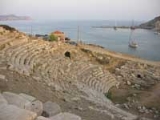
Knidos

Encyclopedia

Turkey
Turkey , known officially as the Republic of Turkey , is a Eurasian country located in Western Asia and in East Thrace in Southeastern Europe...
. It was an ancient Greek
Ancient Greece
Ancient Greece is a civilization belonging to a period of Greek history that lasted from the Archaic period of the 8th to 6th centuries BC to the end of antiquity. Immediately following this period was the beginning of the Early Middle Ages and the Byzantine era. Included in Ancient Greece is the...
city of Caria
Caria
Caria was a region of western Anatolia extending along the coast from mid-Ionia south to Lycia and east to Phrygia. The Ionian and Dorian Greeks colonized the west of it and joined the Carian population in forming Greek-dominated states there...
, part of the Dorian Hexapolis. It was situated on the Datça peninsula
Datça Peninsula
The Datça Peninsula is an 80 km-long, narrow peninsula in southwest Turkey separating the Gulf of Gökova to the north from the Gulf of Hisarönü to the south. The peninsula corresponds almost exactly to the administrative district of Datça, part of Muğla Province...
, which forms the southern side of the Sinus Ceramicus, now known as Gulf of Gökova
Gulf of Gökova
Gulf of Gökova or Gulf of Kerme , is a long , narrow gulf of the Aegean Sea between Bodrum Peninsula and Datça Peninsula in south-west Turkey.Administratively, Gulf of Gökova coastline includes portions of the districts of, clockwise, Bodrum, Milas,...
. By the fourth century BC, Knidos was located at the site of modern Tekir, opposite Triopion Island. But earlier, it was probably at the site of modern Datça (at the half-way point of the peninsula).
It was built partly on the mainland and partly on the Island of Triopion or Cape Krio. The debate about it being an island or cape is caused by the fact that in ancient times it was connected to the mainland by a causeway and bridge. Today the connection is formed by a narrow sandy isthmus
Isthmus
An isthmus is a narrow strip of land connecting two larger land areas usually with waterforms on either side.Canals are often built through isthmuses where they may be particularly advantageous to create a shortcut for marine transportation...
. By means of the causeway the channel between island and mainland was formed into two harbours, of which the larger, or southern, was further enclosed by two strongly built moles that are still in good part entire.
The extreme length of the city was little less than a mile, and the whole intramural area is still thickly strewn with architectural remains. The walls, both of the island and on the mainland, can be traced throughout their whole circuit; and in many places, especially round the acropolis, at the northeast corner of the city, they are remarkably perfect. The first Western knowledge of the site was due to the mission of the Dilettante Society
Dilettante Society
The Dilettante Society or Dilettanti is a society of noblemen and scholars which sponsors the study of ancient Greek and Roman art, and the creation of new work in the style.-History:...
in 1812, and the excavations executed by C. T. Newton
Charles Thomas Newton
Sir Charles Thomas Newton was a British archaeologist. He was made KCB in 1887.Newton was born at Bredwardine in Herefordshire, and educated at Shrewsbury School and Christ Church, Oxford. He entered the British Museum in 1840 as an assistant in the Antiquities Department...
in 1857-1858.
The agora
Agora
The Agora was an open "place of assembly" in ancient Greek city-states. Early in Greek history , free-born male land-owners who were citizens would gather in the Agora for military duty or to hear statements of the ruling king or council. Later, the Agora also served as a marketplace where...
, the theatre, an odeum
Odeon (building)
Odeon is the name for several ancient Greek and Roman buildings built for singing exercises, musical shows and poetry competitions. They were generally small in size, especially compared with a full-size ancient Greek theatre....
, a temple of Dionysus
Dionysus
Dionysus was the god of the grape harvest, winemaking and wine, of ritual madness and ecstasy in Greek mythology. His name in Linear B tablets shows he was worshipped from c. 1500—1100 BC by Mycenean Greeks: other traces of Dionysian-type cult have been found in ancient Minoan Crete...
, a temple of the Muses, a temple of Aphrodite
Aphrodite
Aphrodite is the Greek goddess of love, beauty, pleasure, and procreation.Her Roman equivalent is the goddess .Historically, her cult in Greece was imported from, or influenced by, the cult of Astarte in Phoenicia....
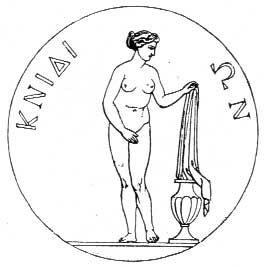
and a great number of minor buildings have been identified, and the general plan of the city has been very clearly made out. The most famous statue by Praxiteles
Praxiteles
Praxiteles of Athens, the son of Cephisodotus the Elder, was the most renowned of the Attic sculptors of the 4th century BC. He was the first to sculpt the nude female form in a life-size statue...
, the Aphrodite of Knidos
Aphrodite of Knidos
The Aphrodite of Cnidus was one of the most famous works of the ancient Greek sculptor Praxiteles of Athens . It and its copies are often referred to as the Venus Pudica type, on account of her covering her naked vulva with her right hand...
, was made for Cnidus. It has perished, but late copies exist, of which the most faithful is in the Vatican Museums
Vatican Museums
The Vatican Museums , in Viale Vaticano in Rome, inside the Vatican City, are among the greatest museums in the world, since they display works from the immense collection built up by the Roman Catholic Church throughout the centuries, including some of the most renowned classical sculptures and...
.
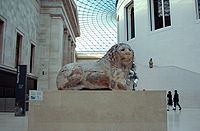
Demeter
In Greek mythology, Demeter is the goddess of the harvest, who presided over grains, the fertility of the earth, and the seasons . Her common surnames are Sito as the giver of food or corn/grain and Thesmophoros as a mark of the civilized existence of agricultural society...
, which he sent back to the British Museum
British Museum
The British Museum is a museum of human history and culture in London. Its collections, which number more than seven million objects, are amongst the largest and most comprehensive in the world and originate from all continents, illustrating and documenting the story of human culture from its...
, and about three miles south-east of the city he came upon the ruins of a splendid tomb, and a colossal figure of a lion carved out of one block of Pentelic marble, ten feet in length and six in height, which has been supposed to commemorate the great naval victory, the Battle of Cnidus
Battle of Cnidus
The Battle of Cnidus , was a joint Athenian and Persian operation against the Spartan naval fleet in the Corinthian War. A combined Athenian-Persian fleet, led by the former Greek admiral Conon, destroyed the Spartan fleet led by the inexperienced Peisander, ending Sparta's brief bid for naval...
in which Conon
Conon
Conon was an Athenian general at the end of the Peloponnesian War, who presided over the crucial Athenian naval defeat at Battle of Aegospotami; later he contributed significantly to the restoration of the political and military power.-Defeat at Aegospotami:Conon had been sent out following the...
defeated the Lacedaemonians in 394 BC
394 BC
Year 394 BC was a year of the pre-Julian Roman calendar. At the time, it was known as the Year of the Tribunate of Camillus, Poplicola, Medullinus, Albinus, Mamercinus and Scipio...
.
Halicarnassus
Halicarnassus was an ancient Greek city at the site of modern Bodrum in Turkey. It was located in southwest Caria on a picturesque, advantageous site on the Ceramic Gulf. The city was famous for the tomb of Mausolus, the origin of the word mausoleum, built between 353 BC and 350 BC, and...
(present day Bodrum
Bodrum
Bodrum is a port city in Muğla Province, in the southwestern Aegean Region of Turkey. It is located on the southern coast of Bodrum Peninsula, at a point that checks the entry into the Gulf of Gökova. The site was called Halicarnassus of Caria in ancient times and was famous for housing the...
, Turkey
Turkey
Turkey , known officially as the Republic of Turkey , is a Eurasian country located in Western Asia and in East Thrace in Southeastern Europe...
) and Kos, and the Rhodian
Rhodes
Rhodes is an island in Greece, located in the eastern Aegean Sea. It is the largest of the Dodecanese islands in terms of both land area and population, with a population of 117,007, and also the island group's historical capital. Administratively the island forms a separate municipality within...
cities of Lindos
Lindos
Lindos is an archaeological site, a town and a former municipality on the island of Rhodes, in the Dodecanese, Greece. Since the 2011 local government reform it is part of the municipality Rhodes, of which it is a municipal unit. It lies on the east coast of the island...
, Kamiros and Ialyssos it formed the Dorian Hexapolis, which held its confederate assemblies on the Triopian headland, and there celebrated games in honour of Apollo
Apollo
Apollo is one of the most important and complex of the Olympian deities in Greek and Roman mythology...
, Poseidon
Poseidon
Poseidon was the god of the sea, and, as "Earth-Shaker," of the earthquakes in Greek mythology. The name of the sea-god Nethuns in Etruscan was adopted in Latin for Neptune in Roman mythology: both were sea gods analogous to Poseidon...
and the nymph
Nymph
A nymph in Greek mythology is a female minor nature deity typically associated with a particular location or landform. Different from gods, nymphs are generally regarded as divine spirits who animate nature, and are usually depicted as beautiful, young nubile maidens who love to dance and sing;...
s.
The city was at first governed by an oligarchic
Oligarchy
Oligarchy is a form of power structure in which power effectively rests with an elite class distinguished by royalty, wealth, family ties, commercial, and/or military legitimacy...
senate
Senate
A senate is a deliberative assembly, often the upper house or chamber of a legislature or parliament. There have been many such bodies in history, since senate means the assembly of the eldest and wiser members of the society and ruling class...
, composed of sixty members, and presided over by a magistrate; but, though it is proved by inscriptions that the old names continued to a very late period, the constitution underwent a popular transformation. The situation of the city was favourable for commerce, and the Knidians acquired considerable wealth, and were able to colonize the island of Lipara, and founded a city on Corcyra Nigra
Korcula
Korčula is an island in the Adriatic Sea, in the Dubrovnik-Neretva County of Croatia. The island has an area of ; long and on average wide — and lies just off the Dalmatian coast. Its 16,182 inhabitants make it the second most populous Adriatic island after Krk...
in the Adriatic
Adriatic Sea
The Adriatic Sea is a body of water separating the Italian Peninsula from the Balkan peninsula, and the system of the Apennine Mountains from that of the Dinaric Alps and adjacent ranges...
. They ultimately submitted to Cyrus
Cyrus the Great
Cyrus II of Persia , commonly known as Cyrus the Great, also known as Cyrus the Elder, was the founder of the Achaemenid Empire. Under his rule, the empire embraced all the previous civilized states of the ancient Near East, expanded vastly and eventually conquered most of Southwest Asia and much...
, and from the battle of Eurymedon to the latter part of the Peloponnesian War
Peloponnesian War
The Peloponnesian War, 431 to 404 BC, was an ancient Greek war fought by Athens and its empire against the Peloponnesian League led by Sparta. Historians have traditionally divided the war into three phases...
they were subject to Athens
Athens
Athens , is the capital and largest city of Greece. Athens dominates the Attica region and is one of the world's oldest cities, as its recorded history spans around 3,400 years. Classical Athens was a powerful city-state...
.
In their expansion into the region, the Romans
Roman Empire
The Roman Empire was the post-Republican period of the ancient Roman civilization, characterised by an autocratic form of government and large territorial holdings in Europe and around the Mediterranean....
easily obtained the allegiance of Knidians, and rewarded them for help given against Antiochus
Antiochus
-The Seleucid Empire:* Antiochus , father of Seleucus I Nicator, founder of the Hellenstic Seleucid Empire* Antiochus I Soter , king of the Seleucid Empire...
by leaving them the freedom of their city.
During the Byzantine
Byzantine Empire
The Byzantine Empire was the Eastern Roman Empire during the periods of Late Antiquity and the Middle Ages, centred on the capital of Constantinople. Known simply as the Roman Empire or Romania to its inhabitants and neighbours, the Empire was the direct continuation of the Ancient Roman State...
period there must still have been a considerable population: for the ruins contain a large number of buildings belonging to the Byzantine style, and Christian sepulchres are common in the neighbourhood.
Eudoxus
Eudoxus of Cnidus
Eudoxus of Cnidus was a Greek astronomer, mathematician, scholar and student of Plato. Since all his own works are lost, our knowledge of him is obtained from secondary sources, such as Aratus's poem on astronomy...
, the astronomer
Astronomer
An astronomer is a scientist who studies celestial bodies such as planets, stars and galaxies.Historically, astronomy was more concerned with the classification and description of phenomena in the sky, while astrophysics attempted to explain these phenomena and the differences between them using...
, Ctesias
Ctesias
Ctesias of Cnidus was a Greek physician and historian from Cnidus in Caria. Ctesias, who lived in the 5th century BC, was physician to Artaxerxes Mnemon, whom he accompanied in 401 BC on his expedition against his brother Cyrus the Younger....
, the writer on Persian history, and Sostratus
Sostratus of Cnidus
Sostratus of Cnidus , was a Greek architect and engineer. He designed the lighthouse of Alexandria, one of the Seven Wonders of the World , on the island of Pharos off Alexandria, Egypt.-External links:*...
, the builder of the celebrated Pharos at Alexandria
Lighthouse of Alexandria
The Lighthouse of Alexandria, also known as the Pharos of Alexandria , was a tower built between 280 and 247 BC on the island of Pharos at Alexandria, Egypt...
, are the most remarkable of the Knidians mentioned in history.