


Klaipeda Region

Encyclopedia
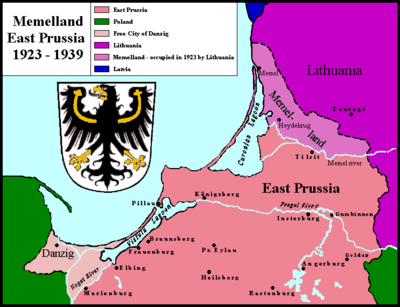
The Klaipėda Region or Memel Territory was defined by the Treaty of Versailles
Treaty of Versailles
The Treaty of Versailles was one of the peace treaties at the end of World War I. It ended the state of war between Germany and the Allied Powers. It was signed on 28 June 1919, exactly five years after the assassination of Archduke Franz Ferdinand. The other Central Powers on the German side of...
in 1920 when it was put under the administration of the Council of Ambassadors
Council of Ambassadors
Council of Ambassadors was an intergovernmental agency, founded in 1919 by decision of the states of the Entente. The Council was to implement the provision of the Treaty of Versailles. It comprised the ambassadors of the United Kingdom, Italy, and Japan in Paris and was chaired by foreign minister...
. The Memel Territory, together with Saar
Saar (League of Nations)
The Territory of the Saar Basin , also referred as the Saar or Saargebiet, was a region of Germany that was occupied and governed by Britain and France from 1920 to 1935 under a League of Nations mandate, with the occupation originally being under the auspices of the Treaty of Versailles...
and Danzig
Free City of Danzig
The Free City of Danzig was a semi-autonomous city-state that existed between 1920 and 1939, consisting of the Baltic Sea port of Danzig and surrounding areas....
, was to remain under the control of the League of Nations
League of Nations
The League of Nations was an intergovernmental organization founded as a result of the Paris Peace Conference that ended the First World War. It was the first permanent international organization whose principal mission was to maintain world peace...
until a future day when the people of these regions would be allowed to vote on whether the land would return to Germany or not.
The original Scalovian and Curonian
Curonians
The Curonians or Kurs were a Baltic tribe living on the shores of the Baltic sea in what are now the western parts of Latvia and Lithuania from the 5th to the 16th centuries, when they merged with other Baltic tribes. They gave their name to the region of Courland , and they spoke the Old...
territory was conquered around 1252 by the Teutonic Knights
Teutonic Knights
The Order of Brothers of the German House of Saint Mary in Jerusalem , commonly the Teutonic Order , is a German medieval military order, in modern times a purely religious Catholic order...
, who constructed Memelburg ("Memel Castle") and the city of Memel (now usually known by its Lithuanian name Klaipėda
Klaipeda
Klaipėda is a city in Lithuania situated at the mouth of the Nemunas River where it flows into the Baltic Sea. It is the third largest city in Lithuania and the capital of Klaipėda County....
). In 1422, a border was drawn up between Prussia and Lithuania under the Treaty of Melno
Treaty of Melno
The Treaty of Melno or Treaty of Lake Melno was a peace treaty ending the Gollub War. It was signed on September 27, 1422, between the Teutonic Knights and an alliance of the Kingdom of Poland and the Grand Duchy of Lithuania at Lake Melno , east of Graudenz...
, and this border existed up to 1918.
The then predominantly ethnic German
Ethnic German
Ethnic Germans historically also ), also collectively referred to as the German diaspora, refers to people who are of German ethnicity. Many are not born in Europe or in the modern-day state of Germany or hold German citizenship...
(other ethnic groups, Prussian Lithuanians
Prussian Lithuanians
The term Prussian Lithuanians or Lietuvininkai refers to a Western Lithuanian ethnic group, which did not form a nation and inhabited a territory in East Prussia called Prussian Lithuania or Lithuania Minor in contrast to the Grand Duchy of Lithuania and later the Republic of Lithuania .Unlike most...
and Memellanders constituted the other ethnic groups) Memel Territory, situated between the river and the town of that name, was occupied by Lithuania
Lithuania
Lithuania , officially the Republic of Lithuania is a country in Northern Europe, the biggest of the three Baltic states. It is situated along the southeastern shore of the Baltic Sea, whereby to the west lie Sweden and Denmark...
in the "Klaipėda Revolt
Klaipeda Revolt
The Klaipėda Revolt took place in January 1923 in the Klaipėda Region . The region, located north of the Neman River, was detached from the East Prussia of the German Empire by the Treaty of Versailles and became a mandate of the League of Nations. It was placed under provisional French...
" of 1923. It was annexed by Nazi Germany
Nazi Germany
Nazi Germany , also known as the Third Reich , but officially called German Reich from 1933 to 1943 and Greater German Reich from 26 June 1943 onward, is the name commonly used to refer to the state of Germany from 1933 to 1945, when it was a totalitarian dictatorship ruled by...
in March, 1939 and immediately reintegrated into East Prussia
East Prussia
East Prussia is the main part of the region of Prussia along the southeastern Baltic Coast from the 13th century to the end of World War II in May 1945. From 1772–1829 and 1878–1945, the Province of East Prussia was part of the German state of Prussia. The capital city was Königsberg.East Prussia...
, just half a year before the outbreak of the Second World War
World War II
World War II, or the Second World War , was a global conflict lasting from 1939 to 1945, involving most of the world's nations—including all of the great powers—eventually forming two opposing military alliances: the Allies and the Axis...
. In the final stages of the war in 1945 it was occupied by Soviet forces, and was formally annexed by the Soviet Union
Soviet Union
The Soviet Union , officially the Union of Soviet Socialist Republics , was a constitutionally socialist state that existed in Eurasia between 1922 and 1991....
in 1946, cleared of its native German population, and made a part of the Lithuanian SSR
Lithuanian SSR
The Lithuanian Soviet Socialist Republic , also known as the Lithuanian SSR, was one of the republics that made up the former Soviet Union...
in 1948. Since the collapse of the Soviet Union in 1990, it has been part of the Republic of Lithuania and contained within Klaipėda
Klaipeda County
Klaipėda County is one of ten counties in Lithuania. It lies in the west of the country and is the only county to have a coastline. Its capital is Klaipėda...
and Tauragė Counties
Taurage County
Tauragė County is one of ten counties in Lithuania. It is in the west of the country, and its capital is Tauragė...
. The border, that was established by the Treaty of Versailles
Treaty of Versailles
The Treaty of Versailles was one of the peace treaties at the end of World War I. It ended the state of war between Germany and the Allied Powers. It was signed on 28 June 1919, exactly five years after the assassination of Archduke Franz Ferdinand. The other Central Powers on the German side of...
along the river, remains in effect as the current international boundary between Lithuania and the Kaliningrad Oblast
Kaliningrad Oblast
Kaliningrad Oblast is a federal subject of Russia situated on the Baltic coast. It has a population of The oblast forms the westernmost part of the Russian Federation, but it has no land connection to the rest of Russia. Since its creation it has been an exclave of the Russian SFSR and then the...
of Russia.
Timeline
| Timeline with changes of control over the territory | |
| pre–1252 | Curonian Curonians The Curonians or Kurs were a Baltic tribe living on the shores of the Baltic sea in what are now the western parts of Latvia and Lithuania from the 5th to the 16th centuries, when they merged with other Baltic tribes. They gave their name to the region of Courland , and they spoke the Old... and Scalovian tribes |
| 1252–1525 | Livonian Order Livonian Order The Livonian Order was an autonomous Livonian branch of the Teutonic Order and a member of the Livonian Confederation from 1435–1561. After being defeated by Samogitians in the 1236 Battle of Schaulen , the remnants of the Livonian Brothers of the Sword were incorporated into the Teutonic Knights... and Monastic State of the Teutonic Knights Monastic State of the Teutonic Knights The State of the Teutonic Order, , also Monastic State of the Teutonic Knights or Ordensstaat , was formed in 1224 during the Northern Crusades, the Teutonic Knights' conquest of the pagan West-Baltic Old Prussians in the 13th century.... (also Monastic State of Prussia) |
| 1525–1657 | Duchy of Prussia, a fief of the Polish-Lithuanian Commonwealth Polish-Lithuanian Commonwealth The Polish–Lithuanian Commonwealth was a dualistic state of Poland and Lithuania ruled by a common monarch. It was the largest and one of the most populous countries of 16th- and 17th‑century Europe with some and a multi-ethnic population of 11 million at its peak in the early 17th century... (with Prussia in personal union Personal union A personal union is the combination by which two or more different states have the same monarch while their boundaries, their laws and their interests remain distinct. It should not be confused with a federation which is internationally considered a single state... with Brandenburg since 1618) |
| 1657–1701 | Duchy of Prussia, a sovereign state in p.u. with Brandenburg, a fief of the Holy Roman Empire (together also called Brandenburg-Prussia Brandenburg-Prussia Brandenburg-Prussia is the historiographic denomination for the Early Modern realm of the Brandenburgian Hohenzollerns between 1618 and 1701. Based in the Electorate of Brandenburg, the main branch of the Hohenzollern intermarried with the branch ruling the Duchy of Prussia, and secured succession... ) |
| 1701–1871 | Kingdom of Prussia Kingdom of Prussia The Kingdom of Prussia was a German kingdom from 1701 to 1918. Until the defeat of Germany in World War I, it comprised almost two-thirds of the area of the German Empire... |
| 1871–1918 | Kingdom of Prussia Kingdom of Prussia The Kingdom of Prussia was a German kingdom from 1701 to 1918. Until the defeat of Germany in World War I, it comprised almost two-thirds of the area of the German Empire... , part of the German Empire German Empire The German Empire refers to Germany during the "Second Reich" period from the unification of Germany and proclamation of Wilhelm I as German Emperor on 18 January 1871, to 1918, when it became a federal republic after defeat in World War I and the abdication of the Emperor, Wilhelm II.The German... |
| 1918–1920 | Free State of Prussia, part of Weimar Republic Weimar Republic The Weimar Republic is the name given by historians to the parliamentary republic established in 1919 in Germany to replace the imperial form of government... |
| 1920–1923 | Council of Ambassadors Council of Ambassadors Council of Ambassadors was an intergovernmental agency, founded in 1919 by decision of the states of the Entente. The Council was to implement the provision of the Treaty of Versailles. It comprised the ambassadors of the United Kingdom, Italy, and Japan in Paris and was chaired by foreign minister... |
| 1923–1939 | Republic of Lithuania Lithuania Lithuania , officially the Republic of Lithuania is a country in Northern Europe, the biggest of the three Baltic states. It is situated along the southeastern shore of the Baltic Sea, whereby to the west lie Sweden and Denmark... |
| 1939–1945 | Nazi Germany Nazi Germany Nazi Germany , also known as the Third Reich , but officially called German Reich from 1933 to 1943 and Greater German Reich from 26 June 1943 onward, is the name commonly used to refer to the state of Germany from 1933 to 1945, when it was a totalitarian dictatorship ruled by... |
| 1945–1948 | Russian SFSR, part of the Soviet Union Soviet Union The Soviet Union , officially the Union of Soviet Socialist Republics , was a constitutionally socialist state that existed in Eurasia between 1922 and 1991.... |
| 1948–1990 | Lithuanian SSR Lithuanian SSR The Lithuanian Soviet Socialist Republic , also known as the Lithuanian SSR, was one of the republics that made up the former Soviet Union... , part of the Soviet Union Soviet Union The Soviet Union , officially the Union of Soviet Socialist Republics , was a constitutionally socialist state that existed in Eurasia between 1922 and 1991.... |
| 1990–present | Republic of Lithuania Lithuania Lithuania , officially the Republic of Lithuania is a country in Northern Europe, the biggest of the three Baltic states. It is situated along the southeastern shore of the Baltic Sea, whereby to the west lie Sweden and Denmark... |
Treaty of Versailles
The eastern boundaries of PrussiaPrussia
Prussia was a German kingdom and historic state originating out of the Duchy of Prussia and the Margraviate of Brandenburg. For centuries, the House of Hohenzollern ruled Prussia, successfully expanding its size by way of an unusually well-organized and effective army. Prussia shaped the history...
(from 1871, part of the German Empire
German Empire
The German Empire refers to Germany during the "Second Reich" period from the unification of Germany and proclamation of Wilhelm I as German Emperor on 18 January 1871, to 1918, when it became a federal republic after defeat in World War I and the abdication of the Emperor, Wilhelm II.The German...
), having remained unchanged since the Treaty of Melno
Treaty of Melno
The Treaty of Melno or Treaty of Lake Melno was a peace treaty ending the Gollub War. It was signed on September 27, 1422, between the Teutonic Knights and an alliance of the Kingdom of Poland and the Grand Duchy of Lithuania at Lake Melno , east of Graudenz...
in 1422, became a matter of discussion following World War I
World War I
World War I , which was predominantly called the World War or the Great War from its occurrence until 1939, and the First World War or World War I thereafter, was a major war centred in Europe that began on 28 July 1914 and lasted until 11 November 1918...
, as the newly independent states of Poland and Lithuania
Lithuania
Lithuania , officially the Republic of Lithuania is a country in Northern Europe, the biggest of the three Baltic states. It is situated along the southeastern shore of the Baltic Sea, whereby to the west lie Sweden and Denmark...
emerged. The separatist Act of Tilsit
Act of Tilsit
The Act of Tilsit was an act, signed in Tilsit by 24 members of the National Council of Lithuania Minor on November 30, 1918. Signatories demanded unification of Lithuania Minor and Lithuania Proper into a single Lithuanian state...
was signed by few pro-Lithuanian oriented Prussian Lithuanians
Prussian Lithuanians
The term Prussian Lithuanians or Lietuvininkai refers to a Western Lithuanian ethnic group, which did not form a nation and inhabited a territory in East Prussia called Prussian Lithuania or Lithuania Minor in contrast to the Grand Duchy of Lithuania and later the Republic of Lithuania .Unlike most...
in 1918, demanding the unification of Prussian Lithuania with Lithuania proper
Lithuania proper
Lithuania proper refers to a region which existed within Grand Duchy of Lithuania, and spoke Lithuanian language. The primary meaning is identical to the Duchy of Lithuania, a land around which Grand Duchy of Lithuania evolved...
. It is traditionally viewed by Lithuanians as expressing the desire of Lithuania Minor to unite with Lithuania. The majority of Prussian Lithuanians did not want to join with Lithuania Tr.: The majority of Prussian Lithuanians did not even want to talk about unification with poor Lithuania.}} and the Prussian Lithuanians did not make up a majority of the population.
The division of Prussia was also promoted by Poland
Poland
Poland , officially the Republic of Poland , is a country in Central Europe bordered by Germany to the west; the Czech Republic and Slovakia to the south; Ukraine, Belarus and Lithuania to the east; and the Baltic Sea and Kaliningrad Oblast, a Russian exclave, to the north...
's Roman Dmowski
Roman Dmowski
Roman Stanisław Dmowski was a Polish politician, statesman, and chief ideologue and co-founder of the National Democracy political movement, which was one of the strongest political camps of interwar Poland.Though a controversial personality throughout his life, Dmowski was instrumental in...
in Versailles
Treaty of Versailles
The Treaty of Versailles was one of the peace treaties at the end of World War I. It ended the state of war between Germany and the Allied Powers. It was signed on 28 June 1919, exactly five years after the assassination of Archduke Franz Ferdinand. The other Central Powers on the German side of...
who acted by orders of Józef Piłsudski: the purpose was to give the lower part of Neman River
Neman River
Neman or Niemen or Nemunas, is a major Eastern European river rising in Belarus and flowing through Lithuania before draining into the Curonian Lagoon and then into the Baltic Sea at Klaipėda. It is the northern border between Lithuania and Russia's Kaliningrad Oblast in its lower reaches...
and its delta, which was located in Germany and called the Memel River, to Lithuania as this would provide her access to the Baltic Sea
Curonian Lagoon
The Curonian Lagoon is separated from the Baltic Sea by the Curonian Spit. Its surface area is . The Neman River supplies about 90% of its inflows; its watershed consists of about 100,450 square kilometers in Lithuania and the Kaliningrad Oblast.-Human history:In the 13th century, the area around...
, while Lithuania itself should be part of Poland. These ideas were supported by the French prime minister Georges Clemenceau
Georges Clemenceau
Georges Benjamin Clemenceau was a French statesman, physician and journalist. He served as the Prime Minister of France from 1906 to 1909, and again from 1917 to 1920. For nearly the final year of World War I he led France, and was one of the major voices behind the Treaty of Versailles at the...
.
In 1920, according to the Treaty of Versailles
Treaty of Versailles
The Treaty of Versailles was one of the peace treaties at the end of World War I. It ended the state of war between Germany and the Allied Powers. It was signed on 28 June 1919, exactly five years after the assassination of Archduke Franz Ferdinand. The other Central Powers on the German side of...
, the German area north of Memel river was given the status of Territoire de Memel under the administration of the Council of Ambassadors
Council of Ambassadors
Council of Ambassadors was an intergovernmental agency, founded in 1919 by decision of the states of the Entente. The Council was to implement the provision of the Treaty of Versailles. It comprised the ambassadors of the United Kingdom, Italy, and Japan in Paris and was chaired by foreign minister...
, and French troops were sent for protection. During the period of French administration, the idea of an independent State of Memelland grew in popularity among local inhabitants. The organisation "Deutsch-Litauischer Heimatbund" (German-Lithuanian homeland federation) promoted the idea of an Freistaat Memelland, which later should return back to Germany. It had 30,000 members, both ethnic German and/or Lithuanian, about 21% of the total population.
Lithuanian takeover
On 9 January 1923, three years after the Versailles Treaty had become effective, Lithuania occupied the territory during the so called Klaipėda RevoltKlaipeda Revolt
The Klaipėda Revolt took place in January 1923 in the Klaipėda Region . The region, located north of the Neman River, was detached from the East Prussia of the German Empire by the Treaty of Versailles and became a mandate of the League of Nations. It was placed under provisional French...
, mainly by militia that had entered from Lithuania
Lithuania
Lithuania , officially the Republic of Lithuania is a country in Northern Europe, the biggest of the three Baltic states. It is situated along the southeastern shore of the Baltic Sea, whereby to the west lie Sweden and Denmark...
. France at the same time had started the Occupation of the Ruhr
Occupation of the Ruhr
The Occupation of the Ruhr between 1923 and 1925, by troops from France and Belgium, was a response to the failure of the German Weimar Republic under Chancellor Cuno to pay reparations in the aftermath of World War I.-Background:...
in Germany, and the French administration in Memel did not take any significant counteractive measures against the rebels and on 19 January, the territory was annexed by Lithuania, and the fait accompli was eventually confirmed by the Council of Ambassadors
Council of Ambassadors
Council of Ambassadors was an intergovernmental agency, founded in 1919 by decision of the states of the Entente. The Council was to implement the provision of the Treaty of Versailles. It comprised the ambassadors of the United Kingdom, Italy, and Japan in Paris and was chaired by foreign minister...
in 1924.
Autonomous region within Lithuania
The area was subsequently annexed by Lithuania. In the Klaipėda ConventionKlaipėda Convention
Klaipėda Convention was an international agreement between Lithuania and the countries of the Conference of Ambassadors signed in Paris on May 8, 1924. According to the Convention, the Klaipėda Region became an autonomous region under unconditional sovereignty of Lithuania...
, signed between Council of Ambassadors and Lithuania, the area was granted a separate parliament, two official languages, capacity to raise its own taxes, charge custom duties, manage its cultural and religious affairs, allowed a separate judicial system, separate citizenship, internal control of agriculture and forestry, as well as a separate social security system. The Council of Ambassadors accepted the resulting arrangement and confirmed the autonomy of the region within the Republic of Lithuania. On 8 May 1924 a further Convention on the Klaipėda region confirmed the annexation, and a resulting autonomy agreement was signed in Paris. Memel Territory was recognized as an integral part of the Republic of Lithuania also by Germany
Weimar Republic
The Weimar Republic is the name given by historians to the parliamentary republic established in 1919 in Germany to replace the imperial form of government...
on 29 January 1928, where the two countries signed the Lithuanian-German Border Treaty.
Importantly, the annexation gave Lithuania control of a year-round ice-free Baltic port. Lithuania
Lithuania
Lithuania , officially the Republic of Lithuania is a country in Northern Europe, the biggest of the three Baltic states. It is situated along the southeastern shore of the Baltic Sea, whereby to the west lie Sweden and Denmark...
made full use of Klaipėda port, modernizing and adapting it, largely for its agricultural exports. The port reconstruction was certainly one of the larger long-term investment projects enacted by the government of Lithuania in the interwar period.
The inhabitants of the area were not given a choice on the ballot whether they wanted to be part of the Lithuanian state or part of Germany. Since the pro-German political parties had an overall majority of more than 80% in all elections to the local parliament (see election statistics below) in the interwar period, there can be little doubt that such a referendum would have been in favour of Germany. In fact, the area had been united since the monastic state
Monastic State of the Teutonic Knights
The State of the Teutonic Order, , also Monastic State of the Teutonic Knights or Ordensstaat , was formed in 1224 during the Northern Crusades, the Teutonic Knights' conquest of the pagan West-Baltic Old Prussians in the 13th century....
of the 13th century, and even many Lithuanian-speakers, regarding themselves as East Prussia
East Prussia
East Prussia is the main part of the region of Prussia along the southeastern Baltic Coast from the 13th century to the end of World War II in May 1945. From 1772–1829 and 1878–1945, the Province of East Prussia was part of the German state of Prussia. The capital city was Königsberg.East Prussia...
ns, declared themselves as "Memellanders/Klaipėdiškiai" in the official census (see below for demographic information) and did not want to belong to a Lithuanian national state. According to the Lithuanian point of view, Memellanders were viewed as Germanised Lithuanians who should be re-Lithuanised.
There was also a strong denominational difference since about 95% of the inhabitants of Lithuania Minor
Lithuania Minor
Lithuania Minor or Prussian Lithuania is a historical ethnographic region of Prussia, later East Prussia in Germany, where Prussian Lithuanians or Lietuvininkai lived. Lithuania Minor enclosed the northern part of this province and got its name due to the territory's substantial...
were Lutherans while more than 90% of Greater Lithuanians were Catholic
Catholic
The word catholic comes from the Greek phrase , meaning "on the whole," "according to the whole" or "in general", and is a combination of the Greek words meaning "about" and meaning "whole"...
s. Following the Agreement concerning the Evangelical Church of the Klaipėda Region of July 23, 1925, concluded between the Directorate of the Klaipėda Region
Directorate of the Klaipėda Region
The Directorate of the Klaipėda Region was the main governing institution in the Klaipėda Region from February 1920 to March 1939. It was established by local German political parties to govern the region between the signing of the Treaty of Versailles and establishment of French provision...
and the Evangelical Church of the old-Prussian Union, a church of united administration
United and uniting churches
United and uniting churches are churches formed from the merger or other form of union of two or more different Protestant denominations.Perhaps the oldest example of a united church is found in Germany, where the Evangelical Church in Germany is a federation of Lutheran, United and Reformed...
of Lutheran and Reformed congregations, the mostly Lutheran congregations (and a single Reformed one in Klaipėda) in the Klaipėda Region were disentangled from the old-Prussian Ecclesiastical Province of East Prussia and formed the Regional Synodal Federation of the Memel Territory (Landessynodalverband Memelgebiet) since, being ranked an old-Prussian ecclesiastical province of its own. An own consistory in Klaipėda
Klaipeda
Klaipėda is a city in Lithuania situated at the mouth of the Nemunas River where it flows into the Baltic Sea. It is the third largest city in Lithuania and the capital of Klaipėda County....
was established in 1927, led by a general superintendent
Superintendent (ecclesiastical)
Superintendent is the head of an administrative division of a Protestant church, largely historical but still in use in Germany.- Superintendents in Sweden :...
(at first F. Gregor, elected in 1927, succeeded by O. Obereiniger, elected by the regional synod in 1933). The Catholic parishes in the Klaipėda Region used to belong to the Bishopric of Ermland until 1926 and were then disentangled, forming the new Territorial Prelature of Klaipėda under Prelate Justinas Staugaitis
Justinas Staugaitis
Justinas Staugaitis was a Lithuanian Roman Catholic bishop, politician, educator, and author. He one of the twenty signatories to the Act of Independence of Lithuania....
.
The government of Lithuania faced considerable opposition from the region's autonomous institutions, among others the Parliament of the Klaipėda Region
Parliament of the Klaipėda Region
The Parliament of the Klaipėda Region was the parliament of the Klaipėda Region , an autonomous region of Lithuania. The parliament was established by the Klaipėda Convention of 1924 and the first elections took place in October 1925. In all elections pro-German parties more than 80% of the vote...
. As years passed, claims were becoming more and more vocal about a re-integration into a resurgent Germany. It was only during the latter period that Lithuania then instituted a policy of "Lithuanization". This was met by even more opposition, as religious and regional differences slowly became insurmountable.
After the December 1926 coup d’état
1926 Lithuanian coup d'état
The 1926 Lithuanian coup d'état was a military coup d'etat in Lithuania that resulted in the replacement of the democratically elected government with a conservative authoritarian government led by Antanas Smetona. The coup took place on December 17, 1926 and was largely organized by the military;...
, Antanas Smetona
Antanas Smetona
Antanas Smetona was one of the most important Lithuanian political figures between World War I and World War II. He served as the first President of Lithuania from April 4, 1919 to June 19, 1920. He again served as the last President of the country from December 19, 1926 to June 15, 1940, before...
came to power. As the status of the Memel Territory was regulated by international treaties, the Memel Territory became an oasis of democracy in Lithuania. Lithuanian intelligentsia often held marriages in Memel/Klaipėda, since Memel Territory was the only place in Lithuania where civil marriage
Civil marriage
Civil marriage is marriage performed by a government official and not a religious organization.-History:Every country maintaining a population registry of its residents keeps track of marital status, and most countries believe that it is their responsibility to register married couples. Most...
was in use, in the rest of Lithuania only church marriage
Marriage
Marriage is a social union or legal contract between people that creates kinship. It is an institution in which interpersonal relationships, usually intimate and sexual, are acknowledged in a variety of ways, depending on the culture or subculture in which it is found...
s were legitimized. Thus, Lithuanian opposition to Smetona's regime was also based in Memel Territory.
At the start of the 1930s, certain leaders and members of pro-Nazi organizations in the region were put on trial by Lithuania "for crimes of terrorism". The 1934–5 proceedings of Neumann and Sass in Kaunas can be presented as the first anti-Nazi trial in Europe. Three members of the organizations were sentenced to death, and their leaders imprisoned. On account of later political and economical pressure from Germany, most were released.
Election results for the local parliament
The local parliament had 29 seats, one for every 5,000 inhabitants. Men and women from age 23 had the right to vote.See also the results http://www.gonschior.de/weimar/Memelgebiet/NV.html of the January 1919 elections to the Nationalversammlung
Weimar National Assembly
The Weimar National Assembly governed Germany from February 6, 1919 to June 6, 1920 and drew up the new constitution which governed Germany from 1919 to 1933, technically remaining in effect even until the end of Nazi rule in 1945...
.
| Year | Memelländische Landwirtschaftspartei ("Agricultural Party") |
Memelländische Volkspartei ("People's Party") |
Sozialdemokratische Partei ("Social Democratic Party") |
Arbeiterpartei (Worker's Party) |
Communist Party |
Others | Lithuanian People's Party |
|---|---|---|---|---|---|---|---|
| 1925 | 38.1%: 11 seats | 36.9%: 11 seats | 16.0%: 5 seats | Others 9.0%: 2 seats | |||
| 1927 | 33.6%: 10 seats | 32.7%: 10 seats | 10.1%: 3 seats | 7.2%: 2 seats | 13.6%: 4 seats | ||
| 1930 | 31.8%: 10 seats | 27.6%: 8 seats | 13.8%: 4 seats | 4.2%: 2 seats | 22.7%: 5 seats | ||
| 1932 | 37.1%: 11 seats | 27.2%: 8 seats | 7.8%: 2 seats | 8.2%: 3 seats | 19.7%: 5 seats | ||
| Unified German Election List | Greater Lithuania Parties | ||||||
| 1935 | 81.2%: 24 seats | 18.8%: 5 seats | |||||
| 1938 | 87.2%: 25 seats | 12.8%: 4 seats | |||||
Demographic data
A Lithuanian census carried out in the region found its total population was 141,000. Declared language was used to classify the inhabitants, and on this basis 43.5 percent were German, 27.6 percent were Lithuanian, and 25.2 percent were "Klaipėdan" (Memelländisch). Other sources give the interwar ethnic composition as 41.9 percent German, 27.1 percent Memelländisch, and 26.6 percent Lithuanian.| Population | German | Memellandish | Lithuanian | other | Religion | Source |
|---|---|---|---|---|---|---|
| 141,645 | 41.9% | 27.1% | 26.6% | 4.4% | 95% Evangelical Christians | http://www.gonschior.de/weimar/Memelgebiet/index.htm |
| 141,645 (1930) | 45.2% | 24.2% (1925) | 26.5% | - | Evangelical Lutheran 95%, Roman Catholic (1925) | http://www.worldstatesmen.org/Lithuania.htm#Memel%20Territory |
Overall, Prussian Lithuanians were more rural than Germans; the part of Lithuanian speakers in the city of Klaipėda itself increased over time due to urbanization and migration from villages into cities and later also from remaining Lithuania (in the city of Klaipėda, Lithuanian-speaking people made up 21.5% in 1912, 32.6% in 1925 and 38.7% in 1932*). Foreign citizens might include some Germans, who opted for German citizenship instead of Lithuanian (although at the time the German government pressured local Germans to take Lithuanian citizenship, so that German presence would remain). There were more Lithuanian speakers in the north of region (Klaipėdos apskritis and Šilutės apskritis) than in south (Pagėgių apskritis). Other locals included people of other nationalities who had citizenship of Lithuania, such as Jews
Jews
The Jews , also known as the Jewish people, are a nation and ethnoreligious group originating in the Israelites or Hebrews of the Ancient Near East. The Jewish ethnicity, nationality, and religion are strongly interrelated, as Judaism is the traditional faith of the Jewish nation...
.
In the 1930s, a novel by local author Ieva Simonaitytė
Ieva Simonaitytė
Ieva Simonaitytė or Ewa Simoneit was a Lithuanian writer. She represented the culture of Lithuania Minor and Klaipėda Region, territories of German East Prussia with large, but dwindling, Lithuanian population...
based on family history illustrated the centuries-old German–Lithuanian relations in the region.
The authoritarian regime of A. Smetona enforced a policy of discrimination and Lithuanisation: it sent administrators from Lithuania, and German teachers, officials and priests were fired from jobs. Local inhabitants—both Germans and Prussian Lithuanians—were not accepted for state service in Memel Territory. People were sent from Kaunas
Kaunas
Kaunas is the second-largest city in Lithuania and has historically been a leading centre of Lithuanian economic, academic, and cultural life. Kaunas was the biggest city and the center of a powiat in Trakai Voivodeship of the Grand Duchy of Lithuania since 1413. During Russian Empire occupation...
instead.
Until 1938, no Governor was appointed from local Prussian Lithuanians. This policy led Prussian Lithuanian intelligentsia and some local Germans to organise a society in 1934 to oppose Lithuanian rule. This group was soon dismantled.
Election results in Memel Territory were irritating for the authoritarian Smetona regime, and it attempted to "colonise" Memel Territory with Lithuanians. The Lithuanian settlements Jakai and Smeltė were built. The number of newcomers increased: in 1926 the number was 5,000, in 1939—30,000.
Lithuania introduced a hard-line Lithuanisation campaign that led to even deeper antagonism between local Prussian Lithuanians, Memellanders, Germans and newcomers.
Heim ins Reich
By late 1938, Lithuania had lost control over the situation in the Territory. In the early hours of 23 March 1939, after an oral ultimatum had caused a Lithuanian delegation to travel to BerlinBerlin
Berlin is the capital city of Germany and is one of the 16 states of Germany. With a population of 3.45 million people, Berlin is Germany's largest city. It is the second most populous city proper and the seventh most populous urban area in the European Union...
, the Lithuanian Minister of Foreign Affairs Juozas Urbšys
Juozas Urbšys
Juozas Urbšys was a prominent interwar Lithuanian diplomat, the last head of foreign affairs in independent interwar Lithuania, and a translator. He served in the military between 1916 and 1922, afterwards joining the Lithuanian Ministry of Foreign Affairs...
and his German counterpart Joachim von Ribbentrop
Joachim von Ribbentrop
Ulrich Friedrich Wilhelm Joachim von Ribbentrop was Foreign Minister of Germany from 1938 until 1945. He was later hanged for war crimes after the Nuremberg Trials.-Early life:...
signed the Treaty of the Cession of the Memel Territory to Germany in exchange for a Lithuanian Free Zone for 99 years in the port of Memel, using the facilities erected in previous years.
Hitler had anticipated this aboard a Kriegsmarine
Kriegsmarine
The Kriegsmarine was the name of the German Navy during the Nazi regime . It superseded the Kaiserliche Marine of World War I and the post-war Reichsmarine. The Kriegsmarine was one of three official branches of the Wehrmacht, the unified armed forces of Nazi Germany.The Kriegsmarine grew rapidly...
naval ship, and at dawn sailed into Memel to celebrate the return heim ins Reich of the Memelland. This proved to be the last of a series of bloodless annexations of territories separated from the German or Austrian Empire by the Treaty of Versailles
Treaty of Versailles
The Treaty of Versailles was one of the peace treaties at the end of World War I. It ended the state of war between Germany and the Allied Powers. It was signed on 28 June 1919, exactly five years after the assassination of Archduke Franz Ferdinand. The other Central Powers on the German side of...
which had been perceived by many if not most Germans as a humiliation. German forces seized the territory even before the official Lithuanian ratification. The United Kingdom and France, as after the revolt of 1923, did not actively protect the autonomy of the territory. It was under these conditions that the Seimas
Seimas
The Seimas is the unicameral Lithuanian parliament. It has 141 members that are elected for a four-year term. About half of the members of this legislative body are elected in individual constituencies , and the other half are elected by nationwide vote according to proportional representation...
was forced to approve the treaty, hoping that Germany would not press any other territorial demands upon Lithuania.
Still, the reunion with Germany was welcomed by the majority of the population, both by Germans and by Memellanders.
According to the treaty, the citizens of Memel Territory were allowed to choose citizenship: either German, or Lithuanian. 303 people (counting family members, 585) asked for Lithuanian citizenship and only 20 requests were granted. Another item stated that persons who had settled in the Memel Territory during the occupation period from 1923 to 1939 should emigrate. About 8,900 Lithuanians did so. At the same time, Nazis expelled about 1,300 (local Memel and Lithuanian) Jews and only about 40 Prussian Lithuanians.
World War II and after
When the area was returned to German control in 1939 under Nazi Germany, many Lithuanians and their organizations began leaving Memel and the surrounding area. Memel was quickly turned into a fortified naval base by the Germans. After the failure of the German invasion of the USSR (Operation BarbarossaOperation Barbarossa
Operation Barbarossa was the code name for Germany's invasion of the Soviet Union during World War II that began on 22 June 1941. Over 4.5 million troops of the Axis powers invaded the USSR along a front., the largest invasion in the history of warfare...
) in 1941, the fate of East Prussia
East Prussia
East Prussia is the main part of the region of Prussia along the southeastern Baltic Coast from the 13th century to the end of World War II in May 1945. From 1772–1829 and 1878–1945, the Province of East Prussia was part of the German state of Prussia. The capital city was Königsberg.East Prussia...
and Memel was sealed. By October 1944 the inhabitants of the area, without ethnic distinction, had to make a decision whether to stay or leave. Nearly all of the population was evacuated from the approaching Red Army
Red Army
The Workers' and Peasants' Red Army started out as the Soviet Union's revolutionary communist combat groups during the Russian Civil War of 1918-1922. It grew into the national army of the Soviet Union. By the 1930s the Red Army was among the largest armies in history.The "Red Army" name refers to...
, but the city itself was defended by the German army during the Battle of Memel
Battle of Memel
The Battle of Memel or the Siege of Memel took place when the Soviets launched their Memel Offensive Operation in late 1944. The offensive led to a three-month siege against German forces in a small bridgehead in the town and its port....
until January 28, 1945. After its capture only six persons were found in the city.
The resulting decisions of the Potsdam Conference
Potsdam Conference
The Potsdam Conference was held at Cecilienhof, the home of Crown Prince Wilhelm Hohenzollern, in Potsdam, occupied Germany, from 16 July to 2 August 1945. Participants were the Soviet Union, the United Kingdom, and the United States...
decreed that East Prussia and therefore the Memel Territory as part of it should be placed under administration of the Soviet Union. On 7 April 1946, the Königsberg Oblast (later renamed Kaliningrad Oblast
Kaliningrad Oblast
Kaliningrad Oblast is a federal subject of Russia situated on the Baltic coast. It has a population of The oblast forms the westernmost part of the Russian Federation, but it has no land connection to the rest of Russia. Since its creation it has been an exclave of the Russian SFSR and then the...
) was founded. It included the Memel Territory and became a new subject of the Russian Soviet Federated Socialist Republic. On 7 April 1948, the Soviet Union
Soviet Union
The Soviet Union , officially the Union of Soviet Socialist Republics , was a constitutionally socialist state that existed in Eurasia between 1922 and 1991....
transferred the Memel/Klaipėda District from Kaliningrad Oblast
Kaliningrad Oblast
Kaliningrad Oblast is a federal subject of Russia situated on the Baltic coast. It has a population of The oblast forms the westernmost part of the Russian Federation, but it has no land connection to the rest of Russia. Since its creation it has been an exclave of the Russian SFSR and then the...
to the Lithuanian SSR and the area was divided between several rayons
Raion
A raion is a type of administrative unit of several post-Soviet countries. The term, which is from French rayon 'honeycomb, department,' describes both a type of a subnational entity and a division of a city, and is commonly translated in English as "district"...
of the Lithuanian SSR.
At the end of the war, the majority of the inhabitants had fled to the West to settle in Germany. Still in 1945–46 there were around 35,000 local inhabitants, both Prussian Lithuanians and Germans. The government of the Lithuanian SSR sent agitators in to the displaced persons camp
Displaced persons camp
A displaced persons camp or DP camp is a temporary facility for displaced persons coerced into forced migration. The term is mainly used for camps established after World War II in West Germany and in Austria, as well as in the United Kingdom, primarily for refugees from Eastern Europe and for the...
s to make promises to former inhabitants that they could return and their property would be restored, yet the promises were never fulfilled. In the period of 1945–50 about 8,000 persons were repatriated. Bilingual Lithuanian-German returners were viewed as Germans.
The few remaining ethnic Germans were then forcibly expelled
Expulsion of Germans after World War II
The later stages of World War II, and the period after the end of that war, saw the forced migration of millions of German nationals and ethnic Germans from various European states and territories, mostly into the areas which would become post-war Germany and post-war Austria...
, with most opting to flee to what would become West Germany
West Germany
West Germany is the common English, but not official, name for the Federal Republic of Germany or FRG in the period between its creation in May 1949 to German reunification on 3 October 1990....
. Autochthonous
Indigenous peoples
Indigenous peoples are ethnic groups that are defined as indigenous according to one of the various definitions of the term, there is no universally accepted definition but most of which carry connotations of being the "original inhabitants" of a territory....
people who remained in the former Memel territory were dismissed from their jobs. Families of notable local Lithuanians, who had opposed German parties before the war, were deported to Siberia
Siberia
Siberia is an extensive region constituting almost all of Northern Asia. Comprising the central and eastern portion of the Russian Federation, it was part of the Soviet Union from its beginning, as its predecessor states, the Tsardom of Russia and the Russian Empire, conquered it during the 16th...
. In 1951 Lithuanian SSR expelled 3,500 people from former Memel Territory to East Germany. In 1958, when emigration was allowed, the majority of the surviving population, both Germans and Prussian Lithuanians, emigrated to West Germany; this event was called a repatriation of Germans by the Lithuanian SSR. Today these formerly Lutheran territories are mostly inhabited by Lithuanians who are Catholic and by Orthodox
Orthodox Christianity
The term Orthodox Christianity may refer to:* the Eastern Orthodox Church and its various geographical subdivisions...
Russians. However, the minority Prussian Lithuanian Protestants
Protestantism
Protestantism is one of the three major groupings within Christianity. It is a movement that began in Germany in the early 16th century as a reaction against medieval Roman Catholic doctrines and practices, especially in regards to salvation, justification, and ecclesiology.The doctrines of the...
historically were concentrated in these regions, and some remain to this day. Only a few thousand autochthons are left. Their continued emigration is facilitated by the fact they are considered German citizens by the Federal Republic of Germany. No property restoration was performed by Republic of Lithuania for owners prior to 1945.
While maintaining that Memel Territory in 1939 was re-annexed by Germany, and Lithuania itself was occupied in 1940 by the Soviets, Lithuania after regaining independence on March 11, 1990, neither restored autonomy to Memel Territory nor returned citizenship and property to former inhabitants, even to those who had opted for Lithuanian citizenship in 1939.
The former Memel Territory is of continuing vital importance to Lithuania, acting as an important harbour, as well as an industrial and agrarian region.
See also
- The Republic of Central Lithuania general election, 1922Republic of Central Lithuania general election, 1922The general election in the Republic of Central Lithuania was an election to the Vilnius Sejm of the Polish-dominated Republic of Central Lithuania on January 8, 1922. The new parliament was intended to formally legalize incorporation of Central Lithuania into Poland. Such measure was fiercely...
- Wilno city
- Memellandic Agricultural PartyMemellandic Agricultural PartyMemel Agricultural Party or MLP was the largest and most influential pro-German political party in the Klaipėda Region from 1925 to 1934. Leaders of the party were Heinrich Conrad, Konrad von Dressler and James Gubba...
- KlaipėdaKlaipedaKlaipėda is a city in Lithuania situated at the mouth of the Nemunas River where it flows into the Baltic Sea. It is the third largest city in Lithuania and the capital of Klaipėda County....
town - The Republic of Central LithuaniaRepublic of Central LithuaniaThe Republic of Central Lithuania or Middle Lithuania , or simply Central Lithuania , was a short-lived political entity, which did not gain international recognition...
- The Lithuanian–Belorussian Soviet Socialist Republic (A.K.A. Litbel)
External links
Joachim Tauber: Das Memelgebiet (1919–1944) in der deutschen und litauischen Historiographie nach 1945 http://www.ikgn.de/zeitschrift_nordost-archiv.volltext.54.htm- Local heritage book Memelland STATUT DU TERRITOIRE DE MEMEL Map of languages in East Prussia, as of 1900 (larger) German translation of the Commission Report to the Council of Ambassadors http://www.ostdeutsches-forum.net/preussen/ostpreussen/Memelland/Bericht-1923.htm German translation of Vygantas Vareikis' thesis Die Rolle des Schützenbundes Litauens bei der Besetzung des Memelgebietes 1923