

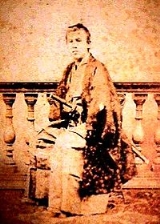
Kido Takayoshi

Encyclopedia
, also referred as Kido Kōin was a Japan
ese statesman during the Late Tokugawa shogunate
and the Meiji Restoration
. He used the alias when he worked against the Shogun
.
, in Chōshū Domain (present-day Yamaguchi prefecture
) as the latest son of , a samurai physician. He was adopted into the Katsura family at age seven, and until 1865 was known as . He was educated at the academy of Yoshida Shōin
, from whom he adopted the philosophy of Imperial loyalism.
In 1852, he went to Edo
to study swordsmanship, established ties with radical samurai from Mito
domain, learned artillery techniques with Egawa Tarōzaemon, and (after observing the construction of foreign ships in Nagasaki and Shimoda
), returned to Chōshū to supervise the construction of the domain's first western-style warship.
movement. Coming under suspicion by the Shogunate for his ties with Mito loyalists after the attempted assassination of Andō Nobumasa
, he was transferred to Kyōto
. However, while in Kyōto, he was unable to prevent the 30 September 1863 coup d'état by the forces of the Aizu
and Satsuma domains, who drove the Chōshū forces out of the city. He was involved in the unsuccessful attempt by Chōshū to regain control of the city on 20 August 1864, and forced into hiding with a geisha
by the name of Ikumatsu, who later became his wife.
After radical elements under Takasugi Shinsaku
gained control of Chōshū politics, Kido was instrumental in establishing the Satchō Alliance
which proved to be critical in the Boshin War
and the subsequent Meiji Restoration
.
, and initiated policies of centralization and modernization. He helped direct the Abolition of the han system
.
In 1871, he accompanied the Iwakura Mission
on its round-the-world voyage to the United States
and Europe, and was especially interested in western educational systems and politics. On his return to Japan, he became a strong advocate of the establishment of constitutional government. Realizing that Japan was not in any position to challenge the western powers in its present state, he also returned to Japan just in time to prevent an invasion of Korea
( Seikanron
).
Kido lost his dominant position in the Meiji oligarchy
to Ōkubo Toshimichi
, and resigned from government in protest of the Taiwan Expedition of 1874
, which he had strenuously opposed.(Kokushi daijiten Vol. 4,p. 170-171.)
Following the Osaka Conference of 1875
, Kido agreed to return to the government, and became chairman of the Assembly of Prefectural Governors that the Ōsaka Conference had created. He was also responsible for the education of the young Emperor Meiji
.
During the middle of Satsuma Rebellion
of 1877 he died of an illness that had been plaguing him for a long time.
Together with Saigō Takamori
and Ōkubo Toshimichi
, he is counted among what was known as the Ishin-no-Sanketsu (維新の三傑), which means, roughly, "three great nobles
of the restoration". His younger sister's grandson was Tokyo
politician Kido Kōichi
(木戸幸一).
and anime
Rurouni Kenshin
by Nobuhiro Watsuki
, as well as its OAV adaptation Tsuiokuhen (Trust & Betrayal)
. While still portrayed as a ruthless radical leader of the Chōshū clan, he serves as a benevolent mentor of sorts to the young Kenshin Himura, who worked under him as the Hitokiri Battōsai. He nonetheless regrets having Kenshin do the dirty work for him after Kenshin's affair with Tomoe Yukishiro (in Tsuiokuhen, he actively encouraged Tomoe to stand by Kenshin to serve as a calming influence), which ended in her death.
He is also the basis for the character of Katsura Kotarou in the manga
and anime
Gin Tama by Hideaki Sorachi
.
Japan
Japan is an island nation in East Asia. Located in the Pacific Ocean, it lies to the east of the Sea of Japan, China, North Korea, South Korea and Russia, stretching from the Sea of Okhotsk in the north to the East China Sea and Taiwan in the south...
ese statesman during the Late Tokugawa shogunate
Late Tokugawa shogunate
, literally "end of the curtain", are the final years of the Edo period when the Tokugawa shogunate came to an end. It is characterized by major events occurring between 1853 and 1867 during which Japan ended its isolationist foreign policy known as sakoku and transitioned from a feudal shogunate...
and the Meiji Restoration
Meiji Restoration
The , also known as the Meiji Ishin, Revolution, Reform or Renewal, was a chain of events that restored imperial rule to Japan in 1868...
. He used the alias when he worked against the Shogun
Shogun
A was one of the hereditary military dictators of Japan from 1192 to 1867. In this period, the shoguns, or their shikken regents , were the de facto rulers of Japan though they were nominally appointed by the emperor...
.
Early life
Kido was born in HagiHagi
Hagi may refer to:* Japanese bush clover or Lespedeza* Hagi, Yamaguchi, a city in Japan** Hagi ware, a type of pottery originating in Hagi* Gheorghe Hagi, a Romanian football player...
, in Chōshū Domain (present-day Yamaguchi prefecture
Yamaguchi Prefecture
is a prefecture of Japan in the Chūgoku region on Honshū island. The capital is the city of Yamaguchi, in the center of the prefecture. The largest city, however, is Shimonoseki.- History :...
) as the latest son of , a samurai physician. He was adopted into the Katsura family at age seven, and until 1865 was known as . He was educated at the academy of Yoshida Shōin
Yoshida Shoin
Yoshida Shōin was one of the most distinguished intellectuals in the closing days of the Tokugawa shogunate...
, from whom he adopted the philosophy of Imperial loyalism.
In 1852, he went to Edo
Edo
, also romanized as Yedo or Yeddo, is the former name of the Japanese capital Tokyo, and was the seat of power for the Tokugawa shogunate which ruled Japan from 1603 to 1868...
to study swordsmanship, established ties with radical samurai from Mito
Mito, Ibaraki
is the capital of Ibaraki Prefecture, Japan and has a central location, moderately offset towards the coast in that prefecture. As of 2005, the city has an estimated population of 263,748 and a total area is 217.45 km², giving a population density of 1,212.91 persons per km²...
domain, learned artillery techniques with Egawa Tarōzaemon, and (after observing the construction of foreign ships in Nagasaki and Shimoda
Shimoda, Shizuoka
is a city and port in Shizuoka, Japan.As of 2010, the city had an estimated population of 25,054 and a population density of 242 persons per square kilometer...
), returned to Chōshū to supervise the construction of the domain's first western-style warship.
Overthrow of the Tokugawa
After 1858, Kido was based at the domain's Edo residence, where he served as liaison between the domain bureaucracy and radical elements among the young, lower-echelon Chōshū samurai who supported the Sonnō jōiSonno joi
is a Japanese political philosophy and a social movement derived from Neo-Confucianism; it became a political slogan in the 1850s and 1860s in the movement to overthrow the Tokugawa bakufu, during the Bakumatsu period.-Origin:...
movement. Coming under suspicion by the Shogunate for his ties with Mito loyalists after the attempted assassination of Andō Nobumasa
Ando Nobumasa
was a Japanese daimyo of the late Edo period, who ruled the Iwakidaira Domain. He was a rōjū in the Tokugawa shogunate, and was active in the wake of Ii Naosuke's assassination...
, he was transferred to Kyōto
Kyoto
is a city in the central part of the island of Honshū, Japan. It has a population close to 1.5 million. Formerly the imperial capital of Japan, it is now the capital of Kyoto Prefecture, as well as a major part of the Osaka-Kobe-Kyoto metropolitan area.-History:...
. However, while in Kyōto, he was unable to prevent the 30 September 1863 coup d'état by the forces of the Aizu
Aizu
is an area comprising the westernmost third of Fukushima Prefecture in Japan. The principal city of the area is Aizuwakamatsu.During the Edo period, Aizu was a feudal domain known as and part of Mutsu Province.-History:...
and Satsuma domains, who drove the Chōshū forces out of the city. He was involved in the unsuccessful attempt by Chōshū to regain control of the city on 20 August 1864, and forced into hiding with a geisha
Geisha
, Geiko or Geigi are traditional, female Japanese entertainers whose skills include performing various Japanese arts such as classical music and dance.-Terms:...
by the name of Ikumatsu, who later became his wife.
After radical elements under Takasugi Shinsaku
Takasugi Shinsaku
was a samurai from the Chōshū Domain of Japan who contributed significantly to the Meiji Restoration.He used the alias to hide his activities from the shogunate.-Early life:...
gained control of Chōshū politics, Kido was instrumental in establishing the Satchō Alliance
Satcho Alliance
The ', or Satchō Alliance was a military alliance between the feudal domains of Satsuma and Chōshū formed in 1866 to combine their efforts to overthrow the Tokugawa shogunate of Japan....
which proved to be critical in the Boshin War
Boshin War
The was a civil war in Japan, fought from 1868 to 1869 between forces of the ruling Tokugawa shogunate and those seeking to return political power to the imperial court....
and the subsequent Meiji Restoration
Meiji Restoration
The , also known as the Meiji Ishin, Revolution, Reform or Renewal, was a chain of events that restored imperial rule to Japan in 1868...
.
Meiji statesman
Following the overthrow of the Tokugawa bakufu, Kido claimed a large role in the establishment of the new Meiji government. As a san'yo (Imperial Advisor) he helped draft the Five Charter OathFive Charter Oath
The was promulgated at the enthronement of Emperor Meiji of Japan on 7 April 1868. The Oath outlined the main aims and the course of action to be followed during Emperor Meiji's reign, setting the legal stage for Japan's modernization...
, and initiated policies of centralization and modernization. He helped direct the Abolition of the han system
Abolition of the han system
The was an act, in 1871, of the new Meiji government of the Empire of Japan to replace the traditional feudal domain system and to introduce centralized government authority . This process marked the culmination of the Meiji Restoration in that all daimyo were required to return their authority...
.
In 1871, he accompanied the Iwakura Mission
Iwakura mission
The Iwakura Mission or Iwakura Embassy was a Japanese diplomatic journey around the world, initiated in 1871 by the oligarchs of the Meiji period. Although it was not the only such "mission", it is the most well-known and possibly most important for the modernization of Japan after a long period...
on its round-the-world voyage to the United States
United States
The United States of America is a federal constitutional republic comprising fifty states and a federal district...
and Europe, and was especially interested in western educational systems and politics. On his return to Japan, he became a strong advocate of the establishment of constitutional government. Realizing that Japan was not in any position to challenge the western powers in its present state, he also returned to Japan just in time to prevent an invasion of Korea
Korea
Korea ) is an East Asian geographic region that is currently divided into two separate sovereign states — North Korea and South Korea. Located on the Korean Peninsula, Korea is bordered by the People's Republic of China to the northwest, Russia to the northeast, and is separated from Japan to the...
( Seikanron
Seikanron
The Seikanron debate was a major political conflagration which occurred in Japan in 1873....
).
Kido lost his dominant position in the Meiji oligarchy
Meiji oligarchy
The Meiji oligarchy was the name used to describe the new ruling class of Meiji period Japan. In Japanese, the Meiji oligarchy is called the ....
to Ōkubo Toshimichi
Okubo Toshimichi
, was a Japanese statesman, a samurai of Satsuma, and one of the three great nobles who led the Meiji Restoration. He is regarded as one of the main founders of modern Japan.-Early life:...
, and resigned from government in protest of the Taiwan Expedition of 1874
Taiwan Expedition of 1874
The , usually referred to in Taiwan and mainland China as the Mudan incident , was a punitive expedition launched by the Japanese in retaliation for the murder of 54 Ryukyuan sailors by Paiwan aborigines near the southwestern tip of Taiwan in December 1871...
, which he had strenuously opposed.(Kokushi daijiten Vol. 4,p. 170-171.)
Following the Osaka Conference of 1875
Osaka Conference of 1875
The was a meeting held by the major leaders of the Meiji Restoration in Osaka, Japan from January-February 1873 to address the issue of forming a representative assembly....
, Kido agreed to return to the government, and became chairman of the Assembly of Prefectural Governors that the Ōsaka Conference had created. He was also responsible for the education of the young Emperor Meiji
Emperor Meiji
The or was the 122nd emperor of Japan according to the traditional order of succession, reigning from 3 February 1867 until his death...
.
During the middle of Satsuma Rebellion
Satsuma Rebellion
The was a revolt of Satsuma ex-samurai against the Meiji government from January 29 to September 24, 1877, 9 years into the Meiji Era. It was the last, and the most serious, of a series of armed uprisings against the new government.-Background:...
of 1877 he died of an illness that had been plaguing him for a long time.
Legacy
Kido's diary reveals an intense internal conflict between his loyalty to his home domain, Chōshū, and the greater interest of the country. He wrote often of having to fight rumors at home that he had betrayed his old friends; the idea of a nation was still relatively new in Japan and so the majority of samurai cared more for securing privileges for their own domain.Together with Saigō Takamori
Saigo Takamori
was one of the most influential samurai in Japanese history, living during the late Edo Period and early Meiji Era. He has been dubbed the last true samurai.-Early life:...
and Ōkubo Toshimichi
Okubo Toshimichi
, was a Japanese statesman, a samurai of Satsuma, and one of the three great nobles who led the Meiji Restoration. He is regarded as one of the main founders of modern Japan.-Early life:...
, he is counted among what was known as the Ishin-no-Sanketsu (維新の三傑), which means, roughly, "three great nobles
Three great nobles
In Japan, Three great nobles are figured playing an important role in the Meiji restoration. They are called in Japan.They are:* Ōkubo Toshimichi of the Satsuma Domain * Saigō Takamori of the Satsuma Domain...
of the restoration". His younger sister's grandson was Tokyo
Tokyo
, ; officially , is one of the 47 prefectures of Japan. Tokyo is the capital of Japan, the center of the Greater Tokyo Area, and the largest metropolitan area of Japan. It is the seat of the Japanese government and the Imperial Palace, and the home of the Japanese Imperial Family...
politician Kido Kōichi
Koichi Kido
Marquis served as Lord Keeper of the Privy Seal from 1940 to 1945, and was the closest advisor to Emperor Showa throughout World War II.Kido was the grandson of Kido Takayoshi, one of the leaders of the Meiji Restoration...
(木戸幸一).
In popular culture
Kido, referred to by his initial name Katsura Kogorō, is among the historical personalities present in the mangaManga
Manga is the Japanese word for "comics" and consists of comics and print cartoons . In the West, the term "manga" has been appropriated to refer specifically to comics created in Japan, or by Japanese authors, in the Japanese language and conforming to the style developed in Japan in the late 19th...
and anime
Anime
is the Japanese abbreviated pronunciation of "animation". The definition sometimes changes depending on the context. In English-speaking countries, the term most commonly refers to Japanese animated cartoons....
Rurouni Kenshin
Rurouni Kenshin
, also known as Rurouni Kenshin and Samurai X, is a Japanese manga series written and illustrated by Nobuhiro Watsuki. The fictional setting takes place during the early Meiji period in Japan. The story is about a fictional assassin named Himura Kenshin, from the Bakumatsu who becomes a wanderer to...
by Nobuhiro Watsuki
Nobuhiro Watsuki
is a Japanese manga artist, best known for his samurai-themed series Rurouni Kenshin. He once worked as an assistant for his favorite author Takeshi Obata.-Biography:...
, as well as its OAV adaptation Tsuiokuhen (Trust & Betrayal)
Samurai X: Trust & Betrayal
Rurouni Kenshin: Trust & Betrayal, known in Japan as , is an OVA series that serves as a prequel to the Rurouni Kenshin anime television series. It was released in Japan in 1999, and was directed by Kazuhiro Furuhashi and written by Masashi Sogo....
. While still portrayed as a ruthless radical leader of the Chōshū clan, he serves as a benevolent mentor of sorts to the young Kenshin Himura, who worked under him as the Hitokiri Battōsai. He nonetheless regrets having Kenshin do the dirty work for him after Kenshin's affair with Tomoe Yukishiro (in Tsuiokuhen, he actively encouraged Tomoe to stand by Kenshin to serve as a calming influence), which ended in her death.
He is also the basis for the character of Katsura Kotarou in the manga
Manga
Manga is the Japanese word for "comics" and consists of comics and print cartoons . In the West, the term "manga" has been appropriated to refer specifically to comics created in Japan, or by Japanese authors, in the Japanese language and conforming to the style developed in Japan in the late 19th...
and anime
Anime
is the Japanese abbreviated pronunciation of "animation". The definition sometimes changes depending on the context. In English-speaking countries, the term most commonly refers to Japanese animated cartoons....
Gin Tama by Hideaki Sorachi
Hideaki Sorachi
is a Japanese manga artist best known for his work Gin Tama.- Works :* Bankara One shot, 2010* Gintama Serialization, 2003* 13 One shot* Shirokuro One shot* Samuraider Discontinued at sketch phase...
.
Reference and further reading
- Akamatsu, Paul. Meiji 1868: Revolution and Counter-Revolution in Japan. Trans. Miriam Kochan. New York: Harper & Row, 1972.
- Beasley, William G.William G. BeasleyWilliam Gerard Beasley CBE FBA was a British academic, author, editor, translator and Japanologist. He was Emeritus Professor of the History of the Far East at the School of Oriental and African Studies of London University.-Career:...
(1972). The Meiji Restoration. Stanford: Stanford University Press. 10-ISBN 0804708150/13-ISBN 9780804708159; OCLC 579232
- Beasley, W. G. The Rise of Modern Japan: Political, Economic and Social Change Since 1850. New York: St. Martin's Press, 1995.
- Craig, Albert M.Albert M. CraigAlbert Morton Craig is an American academic, historian, author and professor emeritus in the Department of East Asian Languages and Civilizations at Harvard University.-Early life:...
Chōshū in the Meiji Restoration. Cambridge: Harvard University Press, 1961. OCLC 482814571 - Jansen, Marius B.Marius JansenMarius Berthus Jansen was an American academic, historian, and Emeritus Professor of Japanese History at Princeton University....
and Gilbert Rozman, eds. (1986). Japan in Transition: from Tokugawa to Meiji. Princeton: Princeton University PressPrinceton University Press-Further reading:* "". Artforum International, 2005.-External links:* * * * *...
. 10-ISBN 0691054592/13-ISBN 9780691054599; OCLC 12311985 - Kido, Takayoshi. (1983). The Diary of Kido Takayoshi (Sidney DeVere Brown and Akiko Hirota, translators), Vol. I (1868–1871), Vol. II (1871–1874), Vol. III (1874–1877). Tokyo: University of Tokyo Press.
- Nish, IanIan NishIan Hill Nish CBE is a British academic, a specialist in Japanese studies, and Emeritus Professor of International History at the London School of Economics and Political Science ....
. (1998) The Iwakura Mission to America and Europe: A New Assessment. Richmond, Surrey: Japan Library. 10-ISBN 1873410840/13-ISBN 9781873410844; 10-ISBN 9780415471794/13-ISBN 0415471796; OCLC 40410662
External links
- Photograph of Kido
- Selected Diary Entries of Kido
- National Diet Library photo & bio
- Yomiuri ShimbunYomiuri ShimbunThe is a Japanese newspaper published in Tokyo, Osaka, Fukuoka, and other major Japanese cities. It is one of the five national newspapers in Japan; the other four are the Asahi Shimbun, the Mainichi Shimbun, Nihon Keizai Shimbun, and the Sankei Shimbun...
: Less than 30% of primary school students in Japan know historical significance of Kido, 2008.