


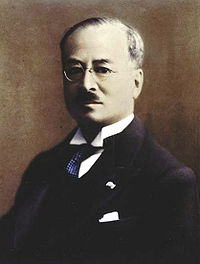
Koichi Kido

Encyclopedia
Marquis
Marquis is a French and Scottish title of nobility. The English equivalent is Marquess, while in German, it is Markgraf.It may also refer to:Persons:...
served as Lord Keeper of the Privy Seal
Lord Keeper of the Privy Seal of Japan
The was an administrative post not of Cabinet rank in the government of the Empire of Japan. The Lord Keeper of the Privy Seal was responsible for keeping the Privy Seal of Japan and State Seal of Japan....
from 1940 to 1945, and was the closest advisor to Emperor Showa
Hirohito
, posthumously in Japan officially called Emperor Shōwa or , was the 124th Emperor of Japan according to the traditional order, reigning from December 25, 1926, until his death in 1989. Although better known outside of Japan by his personal name Hirohito, in Japan he is now referred to...
throughout World War II
World War II
World War II, or the Second World War , was a global conflict lasting from 1939 to 1945, involving most of the world's nations—including all of the great powers—eventually forming two opposing military alliances: the Allies and the Axis...
.
Kido was the grandson of Kido Takayoshi
Kido Takayoshi
, also referred as Kido Kōin was a Japanese statesman during the Late Tokugawa shogunate and the Meiji Restoration. He used the alias when he worked against the Shogun.-Early life:...
, one of the leaders of the Meiji Restoration
Meiji Restoration
The , also known as the Meiji Ishin, Revolution, Reform or Renewal, was a chain of events that restored imperial rule to Japan in 1868...
. A graduate of Kyoto University
Kyoto University
, or is a national university located in Kyoto, Japan. It is the second oldest Japanese university, and formerly one of Japan's Imperial Universities.- History :...
, he held numerous minor bureaucratic posts before becoming Minister of Education
Ministry of Education, Culture, Sports, Science and Technology (Japan)
The , also known as MEXT or Monkashō, is one of the ministries of the Japanese government.The Meiji government created the first Ministry of Education in 1871....
in the first Konoe cabinet (1937), and Home Minister
Home Ministry (Japan)
The ' was a Cabinet-level ministry established under the Meiji Constitution that managed the internal affairs of Empire of Japan from 1873-1947...
in the Hiranuma
Kiichiro Hiranuma
Baron was a prominent pre–World War II right-wing Japanese politician and the 35th Prime Minister of Japan from 5 January 1939 to 30 August 1939. The modern Japanese politician, Takeo Hiranuma, is his adopted son.- Early life :...
Cabinet (1939). During the period from 1937 to 1939 Kido adopted the conspirator's views and devoted himself to this policy wholeheartedly. Kido was zealous in pursuit of the war, even resisting efforts of the general staff to shorten the war by making terms with China. He was intent on Japan's complete military and political domination of China, the whole of East Asia, and South East Asian regions. As education minister he applied himself to the development of a warlike spirit in Japan. He was active with Konoye to replace existing political parties with a single party to dominate all political action. Lord Keeper of the Privy Seal (1940), he recommended to the Emperor that Fumimaro Konoe
Fumimaro Konoe
Prince was a politician in the Empire of Japan who served as the 34th, 38th and 39th Prime Minister of Japan and founder/leader of the Taisei Yokusankai.- Early life :...
succeed Mitsumasa Yonai
Mitsumasa Yonai
was an admiral in the Imperial Japanese Navy, and politician. He was the 37th Prime Minister of Japan from 16 January to 22 July 1940.-Early life & Naval career:...
for a second term as Prime Minister of Japan
Prime Minister of Japan
The is the head of government of Japan. He is appointed by the Emperor of Japan after being designated by the Diet from among its members, and must enjoy the confidence of the House of Representatives to remain in office...
. In 1941, he recommended that Hideki Tōjō
Hideki Tōjō
Hideki Tōjō was a general of the Imperial Japanese Army , the leader of the Taisei Yokusankai, and the 40th Prime Minister of Japan during most of World War II, from 17 October 1941 to 22 July 1944...
become Prime Minister after Konoe.
Kido was also one of the more cautious advisors to the emperor at the beginning of World War II (because he feared the powers of western allies), and one of the chief advocates of peace at the end (trying to ingratiate himself with the conquerors). Kido is known to have advised the emperor against attacking the Dutch East Indies
Dutch East Indies
The Dutch East Indies was a Dutch colony that became modern Indonesia following World War II. It was formed from the nationalised colonies of the Dutch East India Company, which came under the administration of the Netherlands government in 1800....
in 1941, explaining that such an attack might provoke the United States
United States
The United States of America is a federal constitutional republic comprising fifty states and a federal district...
into war, and that any oil obtained by taking the East Indies would still have to be transported, and would be subject to blockades and attacks by plane and submarine. Kido also claimed after the war that Emperor Hirohito was never aware of the plans to attack Pearl Harbor
Pearl Harbor
Pearl Harbor, known to Hawaiians as Puuloa, is a lagoon harbor on the island of Oahu, Hawaii, west of Honolulu. Much of the harbor and surrounding lands is a United States Navy deep-water naval base. It is also the headquarters of the U.S. Pacific Fleet...
until after the attack occurred. Four years later, at the end of the war, Kido is generally credited with convincing the government to accept the Potsdam Declaration
Potsdam Declaration
The Potsdam Declaration or the Proclamation Defining Terms for Japanese Surrender is a statement calling for the Surrender of Japan in World War II. On July 26, 1945, United States President Harry S...
and surrender. He also convinced the emperor that it would be necessary to deliver a personal speech in order to ensure that all civilians and soldiers would cease fighting.
Kido was not only the chief advisor to the emperor; he was a major liaison between the emperor and the government, and a representative of the Japanese government to the Allied Occupation Forces
Supreme Commander of the Allied Powers
Supreme Commander of the Allied Powers was the title held by General Douglas MacArthur during the Occupation of Japan following World War II...
. He advised General MacArthur
Douglas MacArthur
General of the Army Douglas MacArthur was an American general and field marshal of the Philippine Army. He was a Chief of Staff of the United States Army during the 1930s and played a prominent role in the Pacific theater during World War II. He received the Medal of Honor for his service in the...
on many aspects of the logistics surrounding the surrender, the end of the war, and the Occupation of Japan. One of his chief motives was consistently to protect the honor of the emperor.
In the International Military Tribunal for the Far East
International Military Tribunal for the Far East
The International Military Tribunal for the Far East , also known as the Tokyo Trials, the Tokyo War Crimes Tribunal, or simply the Tribunal, was convened on April 29, 1946, to try the leaders of the Empire of Japan for three types of crimes: "Class A" crimes were reserved for those who...
held in Tokyo after the war, Kido was charged as a Class A War Criminal. He initially attempted to plead guilty in order to protect the emperor by taking all responsibility for imperial decisions advocating war unto himself. His personal diary, kept in detail since 1930, was voluntarily turned over to the prosecution, and became a famous and important document in determining the internal workings of the Japanese government during the war. However, none of the lengthy interrogations of Kido were ever entered into direct evidence, and in his testimony as well as the parts of the diary released to the public, he never quoted the Emperor's exact words. Kido was found guilty of Counts 1, 27, 29, 31, and 32, and was sentenced to life imprisonment in Sugamo Prison
Sugamo Prison
Sugamo Prison was located in the district of Ikebukuro, which is now part of the Toshima ward of Tokyo, Japan-History:...
, Tokyo.
In 1951, as the Occupation of Japan was ending, Kido sent a message to the emperor, advising him as he had advised three years earlier, to accept responsibility for the defeat and abdicate, at the end of the American Occupation. In addition, Kido opposed the idea of continuing to punish war criminals under Japanese law after the end of the American Occupation. According to his diary, "those called war criminals by the enemy's standards, especially those in responsible positions, were all performing loyal duties, and to punish them in the name of the emperor would be unbearable" (Dower 477).
In 1953, due to health problems, Kido was released from prison. He lived the rest of his life in Oiso
Oiso, Kanagawa
is a town located in Naka District, Kanagawa Prefecture, Japan. As of 2010, the town had an estimated population of 32,725 and a density of 1,910 persons per km². The total area was 17.18 km².-Geography:...
, and had a flat in Tokyo's Aoyama
Aoyama
Aoyama may refer to:-Places:* Aoyama, Tokyo, Japan** Aoyama Gakuin University, famous university located in Aoyama, Tokyo** Aoyama-itchōme Station, a railway station in Minato, Tokyo, Japan...
. He died at age 88 in 1977. His grave is at the Tama Cemetery in Tokyo.
| Cabinet Positions held by Kido Kōichi: | |||
|---|---|---|---|
| Prime Minister | Position Held | From | Until |
| Fumimaro Konoe Fumimaro Konoe Prince was a politician in the Empire of Japan who served as the 34th, 38th and 39th Prime Minister of Japan and founder/leader of the Taisei Yokusankai.- Early life :... |
Minister of Education | Oct 22, 1937 | May 26, 1938 |
| Fumimaro Konoe Fumimaro Konoe Prince was a politician in the Empire of Japan who served as the 34th, 38th and 39th Prime Minister of Japan and founder/leader of the Taisei Yokusankai.- Early life :... |
Minister of Welfare | Jan 11, 1938 | Jan 5, 1939 |
| Kiichirō Hiranuma Kiichiro Hiranuma Baron was a prominent pre–World War II right-wing Japanese politician and the 35th Prime Minister of Japan from 5 January 1939 to 30 August 1939. The modern Japanese politician, Takeo Hiranuma, is his adopted son.- Early life :... |
Minister of Home Affairs | Jan 5, 1939 | Aug 30, 1939 |