

Kazimierz Pulaski

Encyclopedia
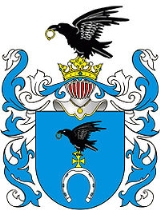
Casimir Pulaski, or Kazimierz Pułaski in Polish (kaʑiˈmʲɛʂ puˈwaski; full name in Polish: Kazimierz Michał Wacław Wiktor Pułaski) of Ślepowron coat-of-arms (March 6, 1745 – October 11, 1779), was a Polish soldier, nobleman
, and politician who has been called "the father of American cavalry
".
A member of the Polish landed nobility, Pulaski was a military commander for the Bar Confederation
and fought against Russian domination of the Polish–Lithuanian Commonwealth. When this uprising failed, he emigrated to North America as a soldier of fortune
. During the American Revolutionary War
, he saved the life of George Washington
and became a general in the Continental Army
. He died of wounds suffered in the Battle of Savannah
. Pulaski is one of only seven people to be awarded honorary United States citizenship
.
 Pulaski was born on March 6, 1745 in the now-nonexistent Pulaski manor house, located near the present address 53 Nowy Świat St. near Warecka St. in Warsaw, Poland. His father, Józef Pułaski, was a well-known lawyer
- the Advocatus
at Crown Tribunal
and the Starosta
of Warka
and one of its most notable inhabitants. Early in his youth, Casimir Pulaski studied at the local college of Theatines
in Warsaw
.
In 1762, he started his career as a page
of Carl Christian Joseph of Saxony, Duke of Courland
and a vassal of the Polish king. However, soon after his arrival at Mitau
, the ducal court was expelled from the palaces by the Russian forces occupying the area. Pulaski returned to Warsaw, where he took part in the 1764 election of the new Polish monarch, Stanisław II August.
A skilled military commander and a son of one of the notable families, Pulaski became one of the co-founders of the Bar Confederation
, together with his father, on February 29, 1768. The confederation, aiming to curtail Russian hegemony
over the Commonwealth, was actively opposed by the Russian forces stationed in Poland. As the Marshal of Nobility of the Land of Łomża, Pulaski became one of the best commanders of the confederate forces. That year, he was besieged in a monastery in Berdyczów, which he defended for two weeks against overwhelming odds. Taken captive by the Russians, he was set free after being forced to pledge that he would not return to the confederates.
However, he did not consider such a forced pledge binding and fought against the Russian forces for four more years. In 1769, he was again besieged by numerically superior forces, this time in the old fortress of Okopy Świętej Trójcy. However, after a brave defense, he was able to break through the Russian siege and lead his men to the Ottoman Empire
, whence they returned to Lithuania
. There, Pulaski incited yet another revolt against Russia, with many local nobles joining the Confederation. Between September 10, 1770, and January 9, 1771, Pulaski also commanded the Polish forces in the siege of Jasna Góra monastery, which he successfully defended.
In November 1771, he was accused of being the main organizer of an attempt to take the King of Poland hostage. However, the attempt failed, and the Confederation was disbanded soon afterward. Pulaski was made a public enemy and sentenced to death in absentia
for attempted regicide
. He fled the country, but no European state would accept him. After a brief stay in Turkey, he moved illegally to France, where he was recruited by Lafayette
and Benjamin Franklin
for service in America. Modern historians have cleared him of any participation in the attempted abduction.
His first military engagement against the British was on September 11, 1777, at the Battle of Brandywine
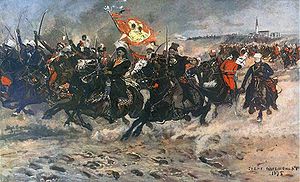
. When the Continental troops began to yield, he reconnoitered with Washington's bodyguard, and reported that the enemy were endeavoring to cut off the line of retreat. He was authorized to collect as many of the scattered troops as came in his way, and employ them according to his discretion, which he did in a manner so prompt as to effect important aid in the retreat of the army. His courageous charge averted a disastrous defeat of the American cavalry and saved the life of Washington. As a result, on September 15, 1777, Washington promoted Pulaski to brigadier general of the American cavalry.
He saved the army from a surprise at Warren Tavern, near Philadelphia, took part in the Battle of Germantown
, and in the winter of 1777/78 engaged in the operations of General Anthony Wayne
, contributing to the defeat of a British division at Haddonfield, New Jersey
. However, the cavalry officers could not be reconciled to the orders of a foreigner who could scarcely speak English and whose ideas of discipline and tactics differed widely from those to which they had been accustomed. In addition, there was his imperious personality. These circumstances prompted him to resign his general command in March 1778, and return to Valley Forge.
At his suggestion, which was adopted by Washington, Congress authorized the formation of a corps of lancers and light infantry, in which even deserters and prisoners of war might enlist. This corps, which became famous under the name of the Pulaski Cavalry Legion, was recruited mainly in Baltimore. In September, it numbered about 350 men, divided into three companies of cavalry and three of infantry. It was one of the few cavalry regiments in the American Continental Army
. Pulaski was put at its head. Henry Wadsworth Longfellow
commemorated in verse this episode of Pulaski's life.
The "father of the American cavalry" demanded much of his men and trained them in tested cavalry tactics. He used his own personal finances when money from Congress was scarce, in order to assure his forces of the finest equipment and personal safety. Congress named him "Commander of the Horse".
In the autumn he was ordered to Little Egg Harbor
with his legion, a company of artillery, and a party of militia. A Hessian deserter, Lt. Gustav Juliet, who held a grudge against Col. de Bosen, the leader of the infantry, betrayed their whereabouts to the British, who made a night attack on De Bosen's camp. Pulaski heard the tumult and, assembling his cavalry, repelled the enemy, but the legion suffered a loss of forty men. During the following winter he was stationed at Minisink
, at that time in New Jersey
. He was dissatisfied with his petty command, and intended to leave the service and return to Europe, but was dissuaded by Washington. He was ordered to South Carolina.
In February 1779, the legion ejected the British occupiers from Charleston, South Carolina
.
Although he had frequent attacks of malarial fever, he remained in active service. Toward the beginning of September, he received orders to proceed to Augusta
. There he was to join with General Lachlan McIntosh
, and the united force was to move toward Savannah in advance of the army of Gen. Benjamin Lincoln
. Before the enemy was aware of his presence, Pulaski captured a British outpost, and, after several skirmishes, established permanent communications with the French fleet at Beaufort
. He rendered great services during the siege of Savannah
, and in the assault of October 9 commanded the whole cavalry, both French and American. During a cavalry charge, while probing for a weak point in the British lines, Pulaski was mortally wounded by grapeshot
. The grape shot is still on display today at The Powder Magazine military museum in Charleston, SC. After he was wounded, Pulaski was carried from the field by several comrades, including Col. John C. Cooper, and taken aboard the privateer
merchant brigantine
Wasp, where he died two days later, having never regained consciousness.
According to several contemporary witnesses, including Pulaski's aide-de-camp
, he was buried at sea
. Other witnesses however, including Captain Samuel Bulfinch of the Wasp, claimed that the wounded Pulaski was actually later removed from the ship and taken to Greenwich plantation
near Savannah, Georgia
, where he died and was buried.http://www.polamjournal.com/Library/APHistory/buried/buried.html The alleged remains were later reinterred in Monterey Square in Savannah, Georgia. Remains at Monterey Square alleged to be Pulaski's were exhumed in 1996 and examined in a lengthy forensic study. The eight-year examination ended inconclusively, and the remains were reinterred with military honors
in 2004.
and Iowa
; counties in Arkansas, Georgia
, Illinois, Indiana
, Kentucky
, Missouri
, and Virginia
; as well as villages in Illinois (Mt. Pulaski) and Wisconsin
and New York
; and many Townships.
Pulaski Academy in Little Rock Arkansas is one of the top college prepartory schools in the United States, educating children from Pre-K 3 through 12th grade.
Szlachta
The szlachta was a legally privileged noble class with origins in the Kingdom of Poland. It gained considerable institutional privileges during the 1333-1370 reign of Casimir the Great. In 1413, following a series of tentative personal unions between the Grand Duchy of Lithuania and the Kingdom of...
, and politician who has been called "the father of American cavalry
Cavalry
Cavalry or horsemen were soldiers or warriors who fought mounted on horseback. Cavalry were historically the third oldest and the most mobile of the combat arms...
".
A member of the Polish landed nobility, Pulaski was a military commander for the Bar Confederation
Bar Confederation
The Bar Confederation was an association of Polish nobles formed at the fortress of Bar in Podolia in 1768 to defend the internal and external independence of the Polish–Lithuanian Commonwealth against Russian influence and against King Stanisław August Poniatowski and Polish reformers who were...
and fought against Russian domination of the Polish–Lithuanian Commonwealth. When this uprising failed, he emigrated to North America as a soldier of fortune
Mercenary
A mercenary, is a person who takes part in an armed conflict based on the promise of material compensation rather than having a direct interest in, or a legal obligation to, the conflict itself. A non-conscript professional member of a regular army is not considered to be a mercenary although he...
. During the American Revolutionary War
American Revolution
The American Revolution was the political upheaval during the last half of the 18th century in which thirteen colonies in North America joined together to break free from the British Empire, combining to become the United States of America...
, he saved the life of George Washington
George Washington
George Washington was the dominant military and political leader of the new United States of America from 1775 to 1799. He led the American victory over Great Britain in the American Revolutionary War as commander-in-chief of the Continental Army from 1775 to 1783, and presided over the writing of...
and became a general in the Continental Army
Continental Army
The Continental Army was formed after the outbreak of the American Revolutionary War by the colonies that became the United States of America. Established by a resolution of the Continental Congress on June 14, 1775, it was created to coordinate the military efforts of the Thirteen Colonies in...
. He died of wounds suffered in the Battle of Savannah
Siege of Savannah
The Siege of Savannah or the Second Battle of Savannah was an encounter of the American Revolutionary War in 1779. The year before, the city of Savannah, Georgia, had been captured by a British expeditionary corps under Lieutenant-Colonel Archibald Campbell. The siege itself consisted of a joint...
. Pulaski is one of only seven people to be awarded honorary United States citizenship
Honorary Citizen of the United States
A person of exceptional merit, generally a non-United States citizen, may be declared an Honorary Citizen of the United States by an Act of Congress, or by a proclamation issued by the President of the United States, pursuant to authorization granted by Congress.Seven people have been so honored,...
.
In Poland
Lawyer
A lawyer, according to Black's Law Dictionary, is "a person learned in the law; as an attorney, counsel or solicitor; a person who is practicing law." Law is the system of rules of conduct established by the sovereign government of a society to correct wrongs, maintain the stability of political...
- the Advocatus
Advocatus
An advocatus, or advocate, was generally a medieval term meaning "lawyer". The term was also used in continental Europe as the title of the lay lord charged with the protection and representation in secular matters of an abbey, known more fully as an advocatus ecclesiae.-Middle Ages:The office is...
at Crown Tribunal
Crown Tribunal
Crown Tribunal – was the highest appeal court in the Crown of the Polish Kingdom for most cases, exceptions being the cases were a noble landowner was threatened with loss of life and/or property - then he could appeal to the Sejm court .In 1578 king Stefan Batory created the...
and the Starosta
Starosta
Starost is a title for an official or unofficial position of leadership that has been used in various contexts through most of Slavic history. It can be translated as "elder"...
of Warka
Warka
Warka is a town in central Poland, located on the left bank of the Pilica river , with 11,035 inhabitants . It has been situated in Grójec County, in the Masovian Voivodeship, since 1999; previously it was in the Radom Voivodeship from 1975 to 1998.Warka obtained its city charter in 1321...
and one of its most notable inhabitants. Early in his youth, Casimir Pulaski studied at the local college of Theatines
Theatines
The Theatines or the Congregation of Clerks Regular of the Divine Providence are a male religious order of the Catholic Church, with the post-nominal initials "C.R."-Foundation:...
in Warsaw
Warsaw
Warsaw is the capital and largest city of Poland. It is located on the Vistula River, roughly from the Baltic Sea and from the Carpathian Mountains. Its population in 2010 was estimated at 1,716,855 residents with a greater metropolitan area of 2,631,902 residents, making Warsaw the 10th most...
.
In 1762, he started his career as a page
Page (servant)
A page or page boy is a traditionally young male servant, a messenger at the service of a nobleman or royal.-The medieval page:In medieval times, a page was an attendant to a knight; an apprentice squire...
of Carl Christian Joseph of Saxony, Duke of Courland
Carl Christian Joseph of Saxony, Duke of Courland
Prince Karl Christian Joseph of Saxony was a German prince from the House of Wettin and Duke of Courland.Born in Dresden, he was the fifth but third surviving son of Augustus III, King of Poland and Elector of Saxony, and Maria Josepha of Austria.-Causes of his election as Duke of Courland:The...
and a vassal of the Polish king. However, soon after his arrival at Mitau
Jelgava
-Sports:The city's main football team, FK Jelgava, plays in the Latvian Higher League and won the 2009/2010 Latvian Football Cup.- Notable people :*August Johann Gottfried Bielenstein - linguist, folklorist, ethnographer...
, the ducal court was expelled from the palaces by the Russian forces occupying the area. Pulaski returned to Warsaw, where he took part in the 1764 election of the new Polish monarch, Stanisław II August.
A skilled military commander and a son of one of the notable families, Pulaski became one of the co-founders of the Bar Confederation
Bar Confederation
The Bar Confederation was an association of Polish nobles formed at the fortress of Bar in Podolia in 1768 to defend the internal and external independence of the Polish–Lithuanian Commonwealth against Russian influence and against King Stanisław August Poniatowski and Polish reformers who were...
, together with his father, on February 29, 1768. The confederation, aiming to curtail Russian hegemony
Hegemony
Hegemony is an indirect form of imperial dominance in which the hegemon rules sub-ordinate states by the implied means of power rather than direct military force. In Ancient Greece , hegemony denoted the politico–military dominance of a city-state over other city-states...
over the Commonwealth, was actively opposed by the Russian forces stationed in Poland. As the Marshal of Nobility of the Land of Łomża, Pulaski became one of the best commanders of the confederate forces. That year, he was besieged in a monastery in Berdyczów, which he defended for two weeks against overwhelming odds. Taken captive by the Russians, he was set free after being forced to pledge that he would not return to the confederates.
However, he did not consider such a forced pledge binding and fought against the Russian forces for four more years. In 1769, he was again besieged by numerically superior forces, this time in the old fortress of Okopy Świętej Trójcy. However, after a brave defense, he was able to break through the Russian siege and lead his men to the Ottoman Empire
Ottoman Empire
The Ottoman EmpireIt was usually referred to as the "Ottoman Empire", the "Turkish Empire", the "Ottoman Caliphate" or more commonly "Turkey" by its contemporaries...
, whence they returned to Lithuania
Grand Duchy of Lithuania
The Grand Duchy of Lithuania was a European state from the 12th /13th century until 1569 and then as a constituent part of Polish-Lithuanian Commonwealth until 1791 when Constitution of May 3, 1791 abolished it in favor of unitary state. It was founded by the Lithuanians, one of the polytheistic...
. There, Pulaski incited yet another revolt against Russia, with many local nobles joining the Confederation. Between September 10, 1770, and January 9, 1771, Pulaski also commanded the Polish forces in the siege of Jasna Góra monastery, which he successfully defended.
In November 1771, he was accused of being the main organizer of an attempt to take the King of Poland hostage. However, the attempt failed, and the Confederation was disbanded soon afterward. Pulaski was made a public enemy and sentenced to death in absentia
In absentia
In absentia is Latin for "in the absence". In legal use, it usually means a trial at which the defendant is not physically present. The phrase is not ordinarily a mere observation, but suggests recognition of violation to a defendant's right to be present in court proceedings in a criminal trial.In...
for attempted regicide
Regicide
The broad definition of regicide is the deliberate killing of a monarch, or the person responsible for the killing of a monarch. In a narrower sense, in the British tradition, it refers to the judicial execution of a king after a trial...
. He fled the country, but no European state would accept him. After a brief stay in Turkey, he moved illegally to France, where he was recruited by Lafayette
Gilbert du Motier, marquis de La Fayette
Marie-Joseph Paul Yves Roch Gilbert du Motier, Marquis de La Fayette , often known as simply Lafayette, was a French aristocrat and military officer born in Chavaniac, in the province of Auvergne in south central France...
and Benjamin Franklin
Benjamin Franklin
Dr. Benjamin Franklin was one of the Founding Fathers of the United States. A noted polymath, Franklin was a leading author, printer, political theorist, politician, postmaster, scientist, musician, inventor, satirist, civic activist, statesman, and diplomat...
for service in America. Modern historians have cleared him of any participation in the attempted abduction.
In the United States
Franklin recommended that General George Washington accept Pulaski as a volunteer in the American cavalry and said that Pulaski "was renowned throughout Europe for the courage and bravery he displayed in defense of his country's freedom." After arriving in America, Pulaski wrote to Washington, "I came here, where freedom is being defended, to serve it, and to live or die for it."His first military engagement against the British was on September 11, 1777, at the Battle of Brandywine
Battle of Brandywine
The Battle of Brandywine, also known as the Battle of the Brandywine or the Battle of Brandywine Creek, was fought between the American army of Major General George Washington and the British-Hessian army of General Sir William Howe on September 11, 1777. The British defeated the Americans and...
. When the Continental troops began to yield, he reconnoitered with Washington's bodyguard, and reported that the enemy were endeavoring to cut off the line of retreat. He was authorized to collect as many of the scattered troops as came in his way, and employ them according to his discretion, which he did in a manner so prompt as to effect important aid in the retreat of the army. His courageous charge averted a disastrous defeat of the American cavalry and saved the life of Washington. As a result, on September 15, 1777, Washington promoted Pulaski to brigadier general of the American cavalry.
He saved the army from a surprise at Warren Tavern, near Philadelphia, took part in the Battle of Germantown
Battle of Germantown
The Battle of Germantown, a battle in the Philadelphia campaign of the American Revolutionary War, was fought on October 4, 1777, at Germantown, Pennsylvania between the British army led by Sir William Howe and the American army under George Washington...
, and in the winter of 1777/78 engaged in the operations of General Anthony Wayne
Anthony Wayne
Anthony Wayne was a United States Army general and statesman. Wayne adopted a military career at the outset of the American Revolutionary War, where his military exploits and fiery personality quickly earned him a promotion to the rank of brigadier general and the sobriquet of Mad Anthony.-Early...
, contributing to the defeat of a British division at Haddonfield, New Jersey
Haddonfield, New Jersey
Haddonfield is a borough located in Camden County, New Jersey. As of the 2010 United States Census, the borough had a total population of 11,593....
. However, the cavalry officers could not be reconciled to the orders of a foreigner who could scarcely speak English and whose ideas of discipline and tactics differed widely from those to which they had been accustomed. In addition, there was his imperious personality. These circumstances prompted him to resign his general command in March 1778, and return to Valley Forge.
At his suggestion, which was adopted by Washington, Congress authorized the formation of a corps of lancers and light infantry, in which even deserters and prisoners of war might enlist. This corps, which became famous under the name of the Pulaski Cavalry Legion, was recruited mainly in Baltimore. In September, it numbered about 350 men, divided into three companies of cavalry and three of infantry. It was one of the few cavalry regiments in the American Continental Army
Continental Army
The Continental Army was formed after the outbreak of the American Revolutionary War by the colonies that became the United States of America. Established by a resolution of the Continental Congress on June 14, 1775, it was created to coordinate the military efforts of the Thirteen Colonies in...
. Pulaski was put at its head. Henry Wadsworth Longfellow
Henry Wadsworth Longfellow
Henry Wadsworth Longfellow was an American poet and educator whose works include "Paul Revere's Ride", The Song of Hiawatha, and Evangeline...
commemorated in verse this episode of Pulaski's life.
The "father of the American cavalry" demanded much of his men and trained them in tested cavalry tactics. He used his own personal finances when money from Congress was scarce, in order to assure his forces of the finest equipment and personal safety. Congress named him "Commander of the Horse".
In the autumn he was ordered to Little Egg Harbor
Little Egg Harbor
Little Egg Harbor is a brackish bay along the coast of southeast New Jersey. It was originally called Egg Harbor by the Dutch sailors because of the eggs found in nearby gull nests.The bay is part of the Intracoastal Waterway.-External links:...
with his legion, a company of artillery, and a party of militia. A Hessian deserter, Lt. Gustav Juliet, who held a grudge against Col. de Bosen, the leader of the infantry, betrayed their whereabouts to the British, who made a night attack on De Bosen's camp. Pulaski heard the tumult and, assembling his cavalry, repelled the enemy, but the legion suffered a loss of forty men. During the following winter he was stationed at Minisink
Minisink, New York
Minisink is a town located in southwest Orange County, New York northeast of the New Jersey border between the Town of Greenville and the Town of Warwick...
, at that time in New Jersey
New Jersey
New Jersey is a state in the Northeastern and Middle Atlantic regions of the United States. , its population was 8,791,894. It is bordered on the north and east by the state of New York, on the southeast and south by the Atlantic Ocean, on the west by Pennsylvania and on the southwest by Delaware...
. He was dissatisfied with his petty command, and intended to leave the service and return to Europe, but was dissuaded by Washington. He was ordered to South Carolina.
In February 1779, the legion ejected the British occupiers from Charleston, South Carolina
Siege of Charleston
The Siege of Charleston was one of the major battles which took place towards the end of the American Revolutionary War, after the British began to shift their strategic focus towards the American Southern Colonies. After about six weeks of siege, Continental Army Major General Benjamin Lincoln...
.
Although he had frequent attacks of malarial fever, he remained in active service. Toward the beginning of September, he received orders to proceed to Augusta
Augusta, Georgia
Augusta is a consolidated city in the U.S. state of Georgia, located along the Savannah River. As of the 2010 census, the Augusta–Richmond County population was 195,844 not counting the unconsolidated cities of Hephzibah and Blythe.Augusta is the principal city of the Augusta-Richmond County...
. There he was to join with General Lachlan McIntosh
Lachlan McIntosh
Lachlan McIntosh was a British-born American military and political leader during the American Revolution and the early United States. In a 1777 duel, he shot dead Button Gwinnett, a signer of the Declaration of Independence.-Arrival in Georgia:Lachlan McIntosh was born near Raits, Badenoch,...
, and the united force was to move toward Savannah in advance of the army of Gen. Benjamin Lincoln
Benjamin Lincoln
Benjamin Lincoln was an American army officer. He served as a major general in the Continental Army during the American Revolutionary War...
. Before the enemy was aware of his presence, Pulaski captured a British outpost, and, after several skirmishes, established permanent communications with the French fleet at Beaufort
Beaufort, South Carolina
Beaufort is a city in and the county seat of Beaufort County, South Carolina, United States. Chartered in 1711, it is the second-oldest city in South Carolina, behind Charleston. The city's population was 12,361 in the 2010 census. It is located in the Hilton Head Island-Beaufort Micropolitan...
. He rendered great services during the siege of Savannah
Siege of Savannah
The Siege of Savannah or the Second Battle of Savannah was an encounter of the American Revolutionary War in 1779. The year before, the city of Savannah, Georgia, had been captured by a British expeditionary corps under Lieutenant-Colonel Archibald Campbell. The siege itself consisted of a joint...
, and in the assault of October 9 commanded the whole cavalry, both French and American. During a cavalry charge, while probing for a weak point in the British lines, Pulaski was mortally wounded by grapeshot
Grapeshot
In artillery, a grapeshot is a type of shot that is not a one solid element, but a mass of small metal balls or slugs packed tightly into a canvas bag. It was used both in land and naval warfare. When assembled, the balls resembled a cluster of grapes, hence the name...
. The grape shot is still on display today at The Powder Magazine military museum in Charleston, SC. After he was wounded, Pulaski was carried from the field by several comrades, including Col. John C. Cooper, and taken aboard the privateer
Privateer
A privateer is a private person or ship authorized by a government by letters of marque to attack foreign shipping during wartime. Privateering was a way of mobilizing armed ships and sailors without having to spend public money or commit naval officers...
merchant brigantine
Brigantine
In sailing, a brigantine or hermaphrodite brig is a vessel with two masts, only the forward of which is square rigged.-Origins of the term:...
Wasp, where he died two days later, having never regained consciousness.
According to several contemporary witnesses, including Pulaski's aide-de-camp
Aide-de-camp
An aide-de-camp is a personal assistant, secretary, or adjutant to a person of high rank, usually a senior military officer or a head of state...
, he was buried at sea
Burial at sea
Burial at sea describes the procedure of disposing of human remains in the ocean, normally from a ship or boat. It is regularly performed by navies, but also can be done by private citizens in many countries.-By religion:...
. Other witnesses however, including Captain Samuel Bulfinch of the Wasp, claimed that the wounded Pulaski was actually later removed from the ship and taken to Greenwich plantation
Plantation
A plantation is a long artificially established forest, farm or estate, where crops are grown for sale, often in distant markets rather than for local on-site consumption...
near Savannah, Georgia
Savannah, Georgia
Savannah is the largest city and the county seat of Chatham County, in the U.S. state of Georgia. Established in 1733, the city of Savannah was the colonial capital of the Province of Georgia and later the first state capital of Georgia. Today Savannah is an industrial center and an important...
, where he died and was buried.http://www.polamjournal.com/Library/APHistory/buried/buried.html The alleged remains were later reinterred in Monterey Square in Savannah, Georgia. Remains at Monterey Square alleged to be Pulaski's were exhumed in 1996 and examined in a lengthy forensic study. The eight-year examination ended inconclusively, and the remains were reinterred with military honors
Military funeral
A military funeral is a specially orchestrated funeral given by a country's military for a soldier, sailor, marine or airman who died in battle, a veteran, or other prominent military figures or heads of state. A military funeral may feature guards of honor, the firing of volley shots as a salute,...
in 2004.
Tributes
Pulaski is one of the most honored persons in American history, in terms of places and events named in his honor.Cities and other locales
Several cities and counties in US states are named after Pulaski, including the cities of Pulaski, TennesseePulaski, Tennessee
Pulaski is a city in Giles County, Tennessee, United States. The population was 7,870 at the 2010 census. It is the county seat of Giles County. It was named to honor the Polish-born American Revolutionary War hero Kazimierz Pułaski...
and Iowa
Pulaski, Iowa
Pulaski is a city in Davis County, Iowa, United States. The population was 249 at the 2000 census.- Corn Show :The Pulaski Corn Show, held annually on a September weekend, is a citywide celebration with a parade.-Geography:...
; counties in Arkansas, Georgia
Pulaski County, Georgia
Pulaski County is a county located in the U.S. state of Georgia. As of 2000, the population was 9,588. The 2010 U.S. Census reports the population at 12,010, with a growth rate of 25.3% from 2000 to 2010, while surpassing Georgia's change of 18.3%., making it one of Georgia's fastest growing...
, Illinois, Indiana
Pulaski County, Indiana
As of the census of 2000, there were 13,755 people, 5,170 households, and 3,779 families residing in the county. The population density was 32 people per square mile . There were 5,918 housing units at an average density of 14 per square mile...
, Kentucky
Pulaski County, Kentucky
Pulaski County is a county located in the U.S. state of Kentucky. The population was 63,063 in the 2010 Census. Its county seat is Somerset6. The county is named for Count Kazimierz Pułaski. Most of the county is a prohibition or dry county...
, Missouri
Pulaski County, Missouri
Pulaski County is a county located in the U.S. state of Missouri. The county was organized in 1833 and named for Kazimierz Pułaski, Polish patriot who died fighting in the American Revolution. As of 2010, the population was 52,274, an increase of 27% from the 2000 Census count of 41,165. Its...
, and Virginia
Pulaski County, Virginia
As of the census of 2000, there were 35,127 people, 14,643 households, and 10,147 families residing in the county. The population density was 110 people per square mile . There were 16,325 housing units at an average density of 51 per square mile...
; as well as villages in Illinois (Mt. Pulaski) and Wisconsin
Pulaski, Wisconsin
Pulaski is a village in Brown, Oconto, and Shawano Counties in the U.S. state of Wisconsin. The population was 3,060 at the 2000 census.The Brown and Oconto County portions of Pulaski are part of the Green Bay Metropolitan Statistical Area.-History:...
and New York
Pulaski, New York
Pulaski is a village in Oswego County, New York, United States. The population was 2,365 at the 2010 census.The Village of Pulaski is within the Town of Richland, and lies between the eastern shore of Lake Ontario and the Tug Hill region. The village is located on US Route 11 and is adjacent to...
; and many Townships.
Parks
- In Freedom PlazaFreedom PlazaFreedom Plaza, originally known as Western Plaza, is an open plaza in Northwest Washington, D.C., United States, located at the corner of 14th Street and Pennsylvania Avenue NW, adjacent to Pershing Park. Constructed in 1980, the plaza is mostly composed of stone, inlaid with a depiction of parts...
, Washington, D.C.Washington, D.C.Washington, D.C., formally the District of Columbia and commonly referred to as Washington, "the District", or simply D.C., is the capital of the United States. On July 16, 1790, the United States Congress approved the creation of a permanent national capital as permitted by the U.S. Constitution....
, there is a statue dedicated to Pulaski located at Pennsylvania AvenuePennsylvania AvenuePennsylvania Avenue is a street in Washington, D.C. that joins the White House and the United States Capitol. Called "America's Main Street", it is the location of official parades and processions, as well as protest marches...
, between 13th and 14th Streets. - "Pulaski Park" sits on Main Street between City Hall and the historic Academy of Music Theater, in the town of Northampton, MassachusettsNorthampton, MassachusettsThe city of Northampton is the county seat of Hampshire County, Massachusetts, United States. As of the 2010 census, the population of Northampton's central neighborhoods, was 28,549...
. Northampton and the surrounding area is home to many Polish-American immigrants and their descendants. - "Pulaski Park" in Manchester, New HampshireManchester, New HampshireManchester is the largest city in the U.S. state of New Hampshire, the tenth largest city in New England, and the largest city in northern New England, an area comprising the states of Maine, New Hampshire, and Vermont. It is in Hillsborough County along the banks of the Merrimack River, which...
, located at the corner of Union and Bridge Streets, is home to an equestrian statue of Pulaski. - "Casimir Pulaski Memorial Park" is located in Chepachet, Rhode IslandChepachet, Rhode IslandChepachet is a village and census-designated place in the town of Glocester in the northwestern part of the U.S. state of Rhode Island. It is centered at the intersection of U.S. Route 44 and RI Route 102...
, within the 4000 acres (16.2 km²) George Washington Management Area. The 100 acres (404,686 m²) park features the 13 acres (52,609.2 m²) Peck Pond, hiking, and cross-country skiing, and general recreation facilities. - In Hammond, IndianaHammond, IndianaHammond is a city in Lake County, Indiana, United States. It is part of the Chicago metropolitan area. The population was 80,830 at the 2010 census.-Geography:Hammond is located at ....
, there is a park named in his honor on the north part of Hammond which is 2 blocks square between Sheffield Avenue and Grover Avenue and between 137th St. and 139th St. - "Pulaski Park" sits along 20th Street, between Cleveland and Oklahoma Avenues, in Milwaukee, Wisconsin.
Roadways and bridges
- The (General) Pulaski SkywayPulaski SkywayThe General Pulaski Skyway is a four-lane freeway composed of connected bridges in the northeastern part of the U.S. state of New Jersey, carrying the designation of U.S. Route 1/9 for most of its length. The landmark structure has a total length of with the longest bridge spanning...
, a 3.5-mile series of bridges between Jersey City and NewarkNewark, New JerseyNewark is the largest city in the American state of New Jersey, and the seat of Essex County. As of the 2010 United States Census, Newark had a population of 277,140, maintaining its status as the largest municipality in New Jersey. It is the 68th largest city in the U.S...
that connects to the Holland TunnelHolland TunnelThe Holland Tunnel is a highway tunnel under the Hudson River connecting the island of Manhattan in New York City with Jersey City, New Jersey at Interstate 78 on the mainland. Unusual for an American public works project, it is not named for a government official, politician, or local hero or...
, opened in 1932 in his honor. Interstate 93 in BostonBostonBoston is the capital of and largest city in Massachusetts, and is one of the oldest cities in the United States. The largest city in New England, Boston is regarded as the unofficial "Capital of New England" for its economic and cultural impact on the entire New England region. The city proper had...
has a Pulaski Skyway as well. The North-South Arterial (Rtes 5, 8 and 12) in Utica, New YorkUtica, New YorkUtica is a city in and the county seat of Oneida County, New York, United States. The population was 62,235 at the 2010 census, an increase of 2.6% from the 2000 census....
is also named the Casimir Pulaski Highway. There is also a statue of him on Utica's Memorial Parkway. - The Pulaski BridgePulaski BridgeThe Pulaski Bridge in New York City connects Long Island City in Queens to Greenpoint in Brooklyn over Newtown Creek. It was named after Polish military commander and American Revolutionary War fighter Kazimierz Pułaski because of the large Polish-American population in Greenpoint...
connects the neighborhood of Greenpoint, BrooklynGreenpoint, BrooklynGreenpoint is the northernmost neighborhood in the New York City borough of Brooklyn. It is bordered on the southwest by Williamsburg at the Bushwick inlet, on the southeast by the Brooklyn-Queens Expressway and East Williamsburg, on the north by Newtown Creek and Long Island City, Queens at the...
, one of the largest PoloniaPoloniaThe Polish diaspora refers to people of Polish origin who live outside Poland. The Polish diaspora is also known in modern Polish language as Polonia, which is the name for Poland in Latin and in many other Romance languages....
s in America, to Long Island City, QueensLong Island City, QueensLong Island City is the westernmost neighborhood of the borough of Queens in New York City. L.I.C. is notable for its rapid and ongoing gentrification, its waterfront parks, and its thriving arts community. L.I.C. has among the highest concentration of art galleries, art institutions, and studio...
. - In Little Egg Harbor, New Jersey, the town where the Little Egg Harbor massacreLittle Egg Harbor massacreThe Little Egg Harbor massacre took place on October 15, 1778, place in New Jersey, USA, during the American Revolution. The massacre took place about one week after the Battle of Chestnut Neck, a British raid aimed at suppressing privateers who used the area as a base to harass and seize British...
occurred, there is a section of the Mystic IslandsMystic Island, New JerseyMystic Island is a large, mostly-waterfront development originally planned as a resort community within Little Egg Harbor Township, in Ocean County, New Jersey...
development named "Pulaski's Village", with a street named "Pulaski Blvd", which is home to a monument in Pulaski's honor. The monument is the starting point for the town's Memorial Day celebration and parade. - Other streets named for Pulaski, in various cities including Riverhead, New YorkRiverhead (town), New YorkThe town of Riverhead is in Suffolk County, New York, on the north shore of Long Island. The population was 33,506 at the 2010 census. The name signifies that the mouth of the Peconic River is in this town...
, Huntington, New York, Brooklyn, NY, Hamtramck, MichiganHamtramck, MichiganHamtramck is a city in Wayne County of the U.S. state of Michigan. As of the 2010 census, the city population was 22,423. Hamtramck is surrounded by the city of Detroit except for a small portion of the western border that touches the similarly surrounded city of Highland Park...
, Bellingham, MassachusettsBellingham, MassachusettsBellingham is a town in Norfolk County, Massachusetts, United States. The population was 16,332 at the 2010 census. The town sits on the southwestern fringe of Metropolitan Boston, along the rapidly growing "outer belt" that is Route 495...
, South Bend, IndianaSouth Bend, IndianaThe city of South Bend is the county seat of St. Joseph County, Indiana, United States, on the St. Joseph River near its southernmost bend, from which it derives its name. As of the 2010 Census, the city had a total of 101,168 residents; its Metropolitan Statistical Area had a population of 316,663...
, Columbia, South CarolinaColumbia, South CarolinaColumbia is the state capital and largest city in the U.S. state of South Carolina. The population was 129,272 according to the 2010 census. Columbia is the county seat of Richland County, but a portion of the city extends into neighboring Lexington County. The city is the center of a metropolitan...
, Athens, GeorgiaAthens, GeorgiaAthens-Clarke County is a consolidated city–county in U.S. state of Georgia, in the northeastern part of the state, comprising the former City of Athens proper and Clarke County. The University of Georgia is located in this college town and is responsible for the initial growth of the city...
, Toledo, OhioToledo, OhioToledo is the fourth most populous city in the U.S. state of Ohio and is the county seat of Lucas County. Toledo is in northwest Ohio, on the western end of Lake Erie, and borders the State of Michigan...
, Pulaski Street in Peabody, Ma, and Pulaski RoadPulaski Road (Chicago)Pulaski Road is a major north-south thoroughfare in the city of Chicago, at 4000 W., or exactly five miles west of State Street. It is named after revolutionary war hero Casimir Pulaski...
in Chicago. Interstate 65Interstate 65Interstate 65 is a major Interstate Highway in the United States. The southern terminus is located at an intersection with Interstate 10 in Mobile, Alabama, and its northern terminus is at an interchange with Interstate 90 , U.S. Route 12, and U.S...
through Lake County, IndianaLake County, IndianaLake County is a county located in the U.S. state of Indiana. In 2010, its population was 496,005, making it Indiana's second-most populous county. The county seat is Crown Point. This county is part of Northwest Indiana and the Chicago metropolitan area. The county contains a mix of urban,...
is designated as Casimir Pulaski Memorial Highway. U.S. Route 40U.S. Route 40U.S. Route 40 is an east–west United States highway. As with most routes whose numbers end in a zero, U.S. 40 once traversed the entire United States. It is one of the original 1920s U.S. Highways, and its first termini were San Francisco, California, and Atlantic City, New Jersey...
from Midvale, Delaware, to Baltimore, Maryland, is named Pulaski Highway, and the latter city's Patterson Park contains a monument in honor of him.
Holidays
- The United States has long commemorated Pulaski's contributions to the American War of Independence, but Polish immigration in the 20th century heightened the interest. In 1929, Congress passed a resolution recognizing October 11 of each year as "General Pulaski Memorial DayGeneral Pulaski Memorial DayGeneral Pulaski Memorial Day is a United States holiday in honor of General Kazimierz Pułaski , a Polish hero of the American Revolution. This holiday is held every year on October 11 by Presidential Proclamation, to commemorate his death from wounds suffered at the Siege of Savannah on October 9,...
", dedicated to Pulaski's memory and to the heritage of Polish-Americans. Each October Grand Rapids, MichiganGrand Rapids, MichiganGrand Rapids is a city in the U.S. state of Michigan. The city is located on the Grand River about 40 miles east of Lake Michigan. As of the 2010 census, the city population was 188,040. In 2010, the Grand Rapids metropolitan area had a population of 774,160 and a combined statistical area, Grand...
, celebrates "Pulaski DaysPulaski DaysThe Pulaski Days is an annual local three-day celebration of General Casimir Pulaski in Grand Rapids, Michigan where the normally private Polish Halls open their doors to the public. The celebration takes place on the first full weekend in October...
".http://www.pulaskidays.org There is also a statue of Pulaski in Detroit, MichiganDetroit, MichiganDetroit is the major city among the primary cultural, financial, and transportation centers in the Metro Detroit area, a region of 5.2 million people. As the seat of Wayne County, the city of Detroit is the largest city in the U.S. state of Michigan and serves as a major port on the Detroit River...
, in the intersection of Washington Boulevard and Michigan Avenue. - The Commonwealth of KentuckyKentuckyThe Commonwealth of Kentucky is a state located in the East Central United States of America. As classified by the United States Census Bureau, Kentucky is a Southern state, more specifically in the East South Central region. Kentucky is one of four U.S. states constituted as a commonwealth...
has by law, since before 1942, recognized General Pulaski's Day. The State of IllinoisIllinoisIllinois is the fifth-most populous state of the United States of America, and is often noted for being a microcosm of the entire country. With Chicago in the northeast, small industrial cities and great agricultural productivity in central and northern Illinois, and natural resources like coal,...
has since 1977 celebrated Casimir Pulaski DayCasimir Pulaski DayCasimir Pulaski Day is a holiday observed in Illinois on the first Monday of every March in memory of Casimir Pulaski , a Revolutionary War cavalry officer born in Poland as Kazimierz Pułaski. He is known for his contributions to the U.S...
on the first Monday of March, when all state government buildings are closed. School districts have the option of observing Pulaski Day as a holiday. WisconsinWisconsinWisconsin is a U.S. state located in the north-central United States and is part of the Midwest. It is bordered by Minnesota to the west, Iowa to the southwest, Illinois to the south, Lake Michigan to the east, Michigan to the northeast, and Lake Superior to the north. Wisconsin's capital is...
and IndianaIndianaIndiana is a US state, admitted to the United States as the 19th on December 11, 1816. It is located in the Midwestern United States and Great Lakes Region. With 6,483,802 residents, the state is ranked 15th in population and 16th in population density. Indiana is ranked 38th in land area and is...
extend similar recognition, and Milwaukee, Wisconsin, also holds an annual parade and school holiday. On this day there is a Pulaski Day parade on Fifth Avenue in New York City. - BuffaloBuffalo, New YorkBuffalo is the second most populous city in the state of New York, after New York City. Located in Western New York on the eastern shores of Lake Erie and at the head of the Niagara River across from Fort Erie, Ontario, Buffalo is the seat of Erie County and the principal city of the...
, whose population comprises a great percentage of Polish immigrants and their descendants, honors Pulaski with the Casimir Pulaski Memorial Monument at Main and South Division Streets, and an annual parade on Pulaski Day.
Monuments
- Fort PulaskiFort Pulaski National MonumentFort Pulaski National Monument is located between Savannah and Tybee Island, Georgia. It preserves Fort Pulaski, notable as the place where, during the American Civil War, in 1862, the Union Army successfully tested a rifled cannon. The success of the test rendered brick fortifications obsolete....
, active during the American Civil WarAmerican Civil WarThe American Civil War was a civil war fought in the United States of America. In response to the election of Abraham Lincoln as President of the United States, 11 southern slave states declared their secession from the United States and formed the Confederate States of America ; the other 25...
, is named in honor of Casimir Pulaski. - Additionally, there is Pulaski Square in downtown Savannah and Fort Pulaski National Monument outside Savannah. In McGlachlin Park, Stevens Point, WisconsinStevens Point, WisconsinStevens Point is the county seat of Portage County, Wisconsin, United States. Located in the central part of the state, it is the largest city in the county, with a population of 24,551 at the 2000 census...
, stands a statue of Count Casimir Pulaski. In Grand Rapids, MichiganGrand Rapids, MichiganGrand Rapids is a city in the U.S. state of Michigan. The city is located on the Grand River about 40 miles east of Lake Michigan. As of the 2010 census, the city population was 188,040. In 2010, the Grand Rapids metropolitan area had a population of 774,160 and a combined statistical area, Grand...
, there is a Pulaski Days Festival the first weekend of October, including a parade and celebration at local Polish Halls honoring his contribution to the Revolutionary War. There is a small park named in his honor in Northampton, MassachusettsNorthampton, MassachusettsThe city of Northampton is the county seat of Hampshire County, Massachusetts, United States. As of the 2010 census, the population of Northampton's central neighborhoods, was 28,549...
and in South Bend, IndianaSouth Bend, IndianaThe city of South Bend is the county seat of St. Joseph County, Indiana, United States, on the St. Joseph River near its southernmost bend, from which it derives its name. As of the 2010 Census, the city had a total of 101,168 residents; its Metropolitan Statistical Area had a population of 316,663...
. - Pulaski Square, erected in 1937 on Mall CThe Mall (Cleveland)The Cleveland Mall is a long public park in downtown Cleveland, Ohio. It was conceived as part of the 1903 Group Plan by Daniel Burnham, John Carrère, and Arnold Brunner as a vast public space flanked by the city's major civic and governmental buildings, all built in the neoclassical style...
, adjacent Cleveland Browns StadiumCleveland Browns Stadium-See also:* List of current National Football League stadiums* Chronology of home stadiums for current National Football League teams* List of American football stadiums by capacity* List of U.S. stadiums by capacity* List of North American stadiums by capacity...
in downtown Cleveland, OhioOhioOhio is a Midwestern state in the United States. The 34th largest state by area in the U.S.,it is the 7th‑most populous with over 11.5 million residents, containing several major American cities and seven metropolitan areas with populations of 500,000 or more.The state's capital is Columbus...
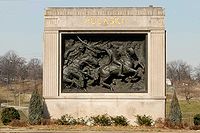
, was built by the Polish Legion of American Veterans and the city's Polish community. - General Casimir Pulaski monument located at Pennsylvania Avenue and 13th Street, N.W., Washington, District of Columbia dedicated on May 11, 1910.
Military
- One of the first tributes to Pulaski was paid when George Washington on November 17, 1779, issued a challenge-and-passwordPasswordA password is a secret word or string of characters that is used for authentication, to prove identity or gain access to a resource . The password should be kept secret from those not allowed access....
set for identifying friend and foe when crossing military lines: "Query: Pulaski, response: Poland". - A US Navy submarine, , has been named for him, as was a 19th-century Revenue Marine (Coast Guard) cutter.
Schools
- There is a technical university in Poland known as Kazimierz Pułaski Technical University of Radom.
- Also, there are Casimir Pulaski elementary schools in Chicago, Illinois, Detroit, MichiganDetroit, MichiganDetroit is the major city among the primary cultural, financial, and transportation centers in the Metro Detroit area, a region of 5.2 million people. As the seat of Wayne County, the city of Detroit is the largest city in the U.S. state of Michigan and serves as a major port on the Detroit River...
, New Bedford, MassachusettsNew Bedford, MassachusettsNew Bedford is a city in Bristol County, Massachusetts, United States, located south of Boston, southeast of Providence, Rhode Island, and about east of Fall River. As of the 2010 census, the city had a total population of 95,072, making it the sixth-largest city in Massachusetts...
, Wilmington, DelawareWilmington, DelawareWilmington is the largest city in the state of Delaware, United States, and is located at the confluence of the Christina River and Brandywine Creek, near where the Christina flows into the Delaware River. It is the county seat of New Castle County and one of the major cities in the Delaware Valley...
, Meriden, ConnecticutMeriden, ConnecticutMeriden is a city in New Haven County, Connecticut, United States. According to 2005 Census Bureau estimates, the population of the city is 59,653.-History:...
, and Scarsdale, New YorkScarsdale, New YorkScarsdale is a coterminous town and village in Westchester County, New York, United States, in the northern suburbs of New York City. The Town of Scarsdale is coextensive with the Village of Scarsdale, but the community has opted to operate solely with a village government, one of several villages...
, Pulaski High School in Milwaukee, Pulaski Middle School (formerly Pulaski Senior High School) in New Britain, Connecticut, North Pulaski High School in Jacksonville, Arkansas and an industrial park is named for him in nearby Wallingford, ConnecticutWallingford, ConnecticutWallingford is a town in New Haven County, Connecticut, United States. The population was 43,026 at the 2000 census.- History :Wallingford was established on October 10, 1667, when the Connecticut General Assembly authorized the "making of a village on the east river" to 38 planters and freemen...
. Within the Savannah College of Art and DesignSavannah College of Art and DesignSCAD, the Savannah College of Art and Design, is a private, accredited and degree-granting university with locations in Savannah and Atlanta, Georgia, Hong Kong, and Lacoste, France.-History:...
in Savannah, GeorgiaSavannah, GeorgiaSavannah is the largest city and the county seat of Chatham County, in the U.S. state of Georgia. Established in 1733, the city of Savannah was the colonial capital of the Province of Georgia and later the first state capital of Georgia. Today Savannah is an industrial center and an important...
, Pulaski House is the name for a student residential building.
Pulaski Academy in Little Rock Arkansas is one of the top college prepartory schools in the United States, educating children from Pre-K 3 through 12th grade.
Miscellaneous
- Although there are several disputed birth and baptismal records, Pulaski's birth is honored in WarkaWarkaWarka is a town in central Poland, located on the left bank of the Pilica river , with 11,035 inhabitants . It has been situated in Grójec County, in the Masovian Voivodeship, since 1999; previously it was in the Radom Voivodeship from 1975 to 1998.Warka obtained its city charter in 1321...
, PolandPolandPoland , officially the Republic of Poland , is a country in Central Europe bordered by Germany to the west; the Czech Republic and Slovakia to the south; Ukraine, Belarus and Lithuania to the east; and the Baltic Sea and Kaliningrad Oblast, a Russian exclave, to the north...
, by the Kazimierz Pułaski Museum, which opened in 1967. The museum occupies the manor house which Pulaski's family lived in during the 1760s, and includes rooms dedicated to his activities in Poland and the USA. It also includes rooms dedicated to Polish-American emigration and contributions of Polish émigrés to American culture and history. - After a previous attempt failed, the United States CongressUnited States CongressThe United States Congress is the bicameral legislature of the federal government of the United States, consisting of the Senate and the House of Representatives. The Congress meets in the United States Capitol in Washington, D.C....
passed a joint resolution conferring honorary U.S. citizenshipHonorary Citizen of the United StatesA person of exceptional merit, generally a non-United States citizen, may be declared an Honorary Citizen of the United States by an Act of Congress, or by a proclamation issued by the President of the United States, pursuant to authorization granted by Congress.Seven people have been so honored,...
on Pulaski in 2009, sending it to the President for approval. President Obama signed the bill on November 6, 2009, making Pulaski the seventh person so honored. - Chicago punk band Big BlackBig BlackBig Black was an American punk rock band from Evanston, Illinois, active from 1981 to 1987. Founded by singer and guitarist Steve Albini, the band's initial lineup also included guitarist Santiago Durango and bassist Jeff Pezzati, both of Naked Raygun...
released a track called "Kasimir S. Pulaski Day" on their 1987 album Songs About FuckingSongs About FuckingSongs About Fucking is the second and final album by the noise rock band Big Black. It placed 54th on Pitchfork Media's 'Top 100 Albums of the 1980s'. Included are covers of Kraftwerk's "The Model" and Cheap Trick's "He's a Whore".-Production:...
; elsewhere in music, MarylandMarylandMaryland is a U.S. state located in the Mid Atlantic region of the United States, bordering Virginia, West Virginia, and the District of Columbia to its south and west; Pennsylvania to its north; and Delaware to its east...
hard rock band ClutchClutch (band)Clutch is an American rock band from Germantown, Maryland, formed in 1990. The band's first release was an EP entitled Pitchfork, which debuted in October 1990. Their first studio album, Transnational Speedway League, was released three years later in 1993. To date, Clutch has released nine studio...
recorded a track titled "Pulaski Skyway" on their 2005 album Robot Hive/ExodusRobot Hive/Exodus-Personnel:*Neil Fallon – Vocals, Guitar, Percussion*Tim Sult – Guitar*Jean Paul Gaster – Drums, Percussion*Dan Maines – Bass*Mick Schauer – Hammond Organ, Hohner Clavinet, Wurlitzer Electric Piano*J...
. - America paid a special millennial tribute to Pulaski in the year 2000 involving a large party in Chicago's Grant ParkGrant Park (Chicago)Grant Park, with between the downtown Chicago Loop and Lake Michigan, offers many different attractions in its large open space. The park is generally flat. It is also crossed by large boulevards and even a bed of sunken railroad tracks...
. The party included live DJ FoodDJ FoodOriginally produced by Coldcut on the Ninja Tune independent record label, the DJ Food project started in 1990 on the premise of providing metaphorical "food for DJs". DJ Food released the Jazz Brakes series, with Jazz Brakes Volume 3 being the most successful...
and a varied dance setlist—including artists such as Two Hours TrafficTwo Hours TrafficTwo Hours Traffic is a Canadian indie rock band, based in Charlottetown, Prince Edward Island. They are named after a line in the prologue to Shakespeare’s Romeo and Juliet. Although often described as the band that Halifax guitarist Joel Plaskett took "under his wing", they have increasingly...
alongside Snoop DoggSnoop DoggCalvin Cordozar Broadus, Jr. , better known by his stage name Snoop Dogg, is an American rapper, record producer, and actor. Snoop is best known as a rapper in the West Coast hip hop scene, and for being one of Dr. Dre's most notable protégés. Snoop Dogg was a Crip gang member while in high school...
and MobyMobyRichard Melville Hall , better known by his stage name Moby, is an American musician, DJ, and photographer. He is known mainly for his sample-based electronic music and his outspoken liberal political views, including his support of veganism and animal rights.Moby gained attention in the early...
—followed by a multimedia presentation on Pulaski's life and accomplishments set to orchestral music performed by the Chicago Symphony OrchestraChicago Symphony OrchestraThe Chicago Symphony Orchestra is an American orchestra based in Chicago, Illinois. It is one of the five American orchestras commonly referred to as the "Big Five". Founded in 1891, the Symphony makes its home at Orchestra Hall in Chicago and plays a summer season at the Ravinia Festival...
and specially composed for the occasion by YanniYanniYanni , born Yiannis Hrysomallis is a Greek self-taught pianist, keyboardist, and composer who has spent most of his life in the United States.He earned Grammy nominations for his 1992 album, Dare to Dream, and the 1993 follow-up, In My Time...
.
See also
- Polish cavalryPolish cavalryThe Polish cavalry can trace its origins back to the days of Medieval mounted knights. Poland had always been a country of flatlands and fields and mounted forces operate well in this environment...
- Pulaski (disambiguation), for a list of things and places named Pulaski
- Tadeusz KościuszkoTadeusz KosciuszkoAndrzej Tadeusz Bonawentura Kościuszko was a Polish–Lithuanian and American general and military leader during the Kościuszko Uprising. He is a national hero of Poland, Lithuania, the United States and Belarus...
(Anglicized as "Thaddeus Kosciusko"), another Polish commander in the American Revolutionary War - Michael Kovats
- Day of Hungarian-Polish FriendshipPole, Hungarian, two good friends"Pole and Hungarian cousins be" and "Pole and Hungarian, two good friends" are respective forms of a popular bilingual proverb concerning the historic friendship between the Polish and Hungarian peoples....
(HungaryHungaryHungary , officially the Republic of Hungary , is a landlocked country in Central Europe. It is situated in the Carpathian Basin and is bordered by Slovakia to the north, Ukraine and Romania to the east, Serbia and Croatia to the south, Slovenia to the southwest and Austria to the west. The...
and PolandPolandPoland , officially the Republic of Poland , is a country in Central Europe bordered by Germany to the west; the Czech Republic and Slovakia to the south; Ukraine, Belarus and Lithuania to the east; and the Baltic Sea and Kaliningrad Oblast, a Russian exclave, to the north...
)
External links
- HighBeam Encyclopedia biography & articles
- A Chronology of Casimir Pulaski's Life 1745-1779
- General Casimir Pulaski Rides Again
- One More Funeral of Kazimierz Pulaski 221 Years After his Death
- The Pulaski Legion in the American Revolution, Review in The Sarmatian Review
- Biography from Catholic Encyclopedia
- The Continental Army (describes Pulaski's Legion)
- Biography
- Pulaski County, Arkansas site
- Pulaski County, Georgia site
- Pulaski County, Kentucky site
- Pulaski County, Missouri site
- Pulaski County, Virginia site
- Pulaski Days, Grand Rapids, Michigan for his reputed burial site in Savannah, Georgia {for reference only}
- Kazimierz Pułaski Museum in Warka (in Polish)
- Casimir Pulaski Museum (brief description of Warka museum in English)
- Casimir Pulaski Foundation