

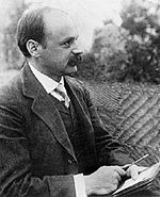
Karl Schwarzschild

Encyclopedia
Karl Schwarzschild was a German
physicist
. He is also the father of astrophysicist Martin Schwarzschild
.
He is best known for providing the first exact solution to the Einstein field equations
of general relativity
, for the limited case of a single spherical non-rotating mass, which he accomplished in 1915, the same year that Einstein first introduced general relativity. The Schwarzschild solution
, which makes use of Schwarzschild coordinates
and the Schwarzschild metric
, leads to the well-known Schwarzschild radius
, which is the size of the event horizon
of a non-rotating black hole
.
Schwarzschild accomplished this triumph while serving in the German army during World War I
. He died the following year from pemphigus
, a painful autoimmune disease
which he developed while at the Russian front
.
Asteroid
837 Schwarzschilda
is named in his honour.
published when he was only sixteen. He studied at Strasbourg
and Munich
, obtaining his doctorate in 1896 for a work on Jules Henri Poincaré's theories.
From 1897, he worked as assistant at the Kuffner observatory
in Vienna.
From 1901 until 1909 he was a professor at the prestigious institute at Göttingen
, where he had the opportunity to work with some significant figures including David Hilbert
and Hermann Minkowski
. Schwarzschild became the director of the observatory in Göttingen
.
He moved to a post at the Astrophysical Observatory in Potsdam
in 1909.
From 1912, Schwarzschild was a member of the Prussian Academy of Sciences
.
At the outbreak of World War I
in 1914 he joined the German army despite being over 40 years old. He served on both the western and eastern fronts, rising to the rank of lieutenant in the artillery.
While serving on the front in Russia in 1915, he began to suffer from a rare and painful skin disease called pemphigus
. Nevertheless, he managed to write three outstanding papers, two on relativity theory and one on quantum theory
. His papers on relativity produced the first exact solutions to the Einstein field equations
, and a minor modification of these results gives the well-known solution that now bears his name: the Schwarzschild metric
.
Schwarzschild's struggle with pemphigus
may have eventually led to his death. He died on May 11, 1916.
. However, although Schwarzschild's best known work lies in the area of general relativity
, his research interests were extremely broad, including work in celestial mechanics
, observational stellar photometry
, quantum mechanics
, instrumental astronomy
, stellar structure, stellar statistics
, Halley's comet, and spectroscopy
.
Some of his particular achievements include measurements of variable star
s, using photography, and the improvement of optical systems, through the perturbative investigation of geometrical aberrations.
 in the formula:

(where is optical density of exposed photographic emulsion, a function of
  , the intensity of the source being observed, and
  , the exposure time, with
  a constant). This formula was important for enabling more accurate photographic measurements of the intensities of faint astronomical sources.
formalism of the electromagnetic field as

where are the electric and magnetic field,
  is the vector potential and
  is the electric potential.
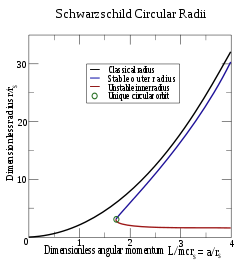
Einstein himself was pleasantly surprised to learn that the field equations
admitted exact solutions, because of their prima facie complexity, and because he himself had only produced an approximate solution. Einstein's approximate solution was given in his famous 1915 article on the advance of the perihelion of Mercury. There, Einstein used rectangular coordinates to approximate the gravitational field around a spherically symmetric, non-rotating, non-charged mass. Schwarzschild, in contrast, chose a more elegant "polar-like" coordinate system and was able to produce an exact solution which he first set down in a letter to Einstein of 22 December 1915, written while Schwarzschild was serving in the war stationed on the Russian front. Schwarzschild concluded the letter by writing: "As you see, the war treated me kindly enough, in spite of the heavy gunfire, to allow me to get away from it all and take this walk in the land of your ideas." In 1916, Einstein wrote to Schwarzschild on this result:
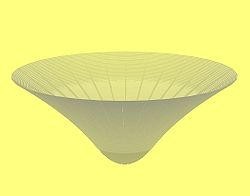 Schwarzschild's second paper, which gives what is now known as the "Inner Schwarzschild solution" (in German: "innere Schwarzschild-Lösung"), is valid within a sphere of homogeneous and isotropic distributed molecules within a shell of radius r=R. It is applicable to solids; incompressible fluids; the sun and stars viewed as a quasi-isotropic heated gas; and any homogeneous and isotropic distributed gas.
Schwarzschild's first (spherically symmetric) solution contains a coordinate singularity
on a surface that is now named after him. In Schwarzschild coordinates, this singularity lies on the sphere of points at a particular radius, called the Schwarzschild radius
:

where G is the gravitational constant
, M is the mass of the central body, and c is the speed of light
in a vacuum. In cases where the radius of the central body is less than the Schwarzschild radius, represents the radius within which all massive bodies, and even photons, must inevitably fall into the central body (ignoring quantum tunnelling
effects near the boundary). When the mass density of this central body exceeds a particular limit, it triggers a gravitational collapse which, if it occurs with spherical symmetry, produces what is known as a Schwarzschild black hole
. This occurs, for example, when the mass of a neutron star
exceeds the Tolman-Oppenheimer-Volkoff limit
(about three solar masses).
Other papers
English translations
Germany
Germany , officially the Federal Republic of Germany , is a federal parliamentary republic in Europe. The country consists of 16 states while the capital and largest city is Berlin. Germany covers an area of 357,021 km2 and has a largely temperate seasonal climate...
physicist
Physicist
A physicist is a scientist who studies or practices physics. Physicists study a wide range of physical phenomena in many branches of physics spanning all length scales: from sub-atomic particles of which all ordinary matter is made to the behavior of the material Universe as a whole...
. He is also the father of astrophysicist Martin Schwarzschild
Martin Schwarzschild
Martin Schwarzschild was a German American astronomer. He was the son of famed astrophysicist Karl Schwarzschild and the nephew of the Swiss astrophysicist Robert Emden.-Biography:...
.
He is best known for providing the first exact solution to the Einstein field equations
Einstein field equations
The Einstein field equations or Einstein's equations are a set of ten equations in Albert Einstein's general theory of relativity which describe the fundamental interaction of gravitation as a result of spacetime being curved by matter and energy...
of general relativity
General relativity
General relativity or the general theory of relativity is the geometric theory of gravitation published by Albert Einstein in 1916. It is the current description of gravitation in modern physics...
, for the limited case of a single spherical non-rotating mass, which he accomplished in 1915, the same year that Einstein first introduced general relativity. The Schwarzschild solution
Deriving the Schwarzschild solution
The Schwarzschild solution is one of the simplest and most useful solutions of theEinstein field equations . It describes spacetime in the vicinity of a non-rotating massive spherically-symmetric object...
, which makes use of Schwarzschild coordinates
Schwarzschild coordinates
In the theory of Lorentzian manifolds, spherically symmetric spacetimes admit a family of nested round spheres. In such a spacetime, a particularly important kind of coordinate chart is the Schwarzschild chart, a kind of polar spherical coordinate chart on a static and spherically symmetric...
and the Schwarzschild metric
Schwarzschild metric
In Einstein's theory of general relativity, the Schwarzschild solution describes the gravitational field outside a spherical, uncharged, non-rotating mass such as a star, planet, or black hole. It is also a good approximation to the gravitational field of a slowly rotating body like the Earth or...
, leads to the well-known Schwarzschild radius
Schwarzschild radius
The Schwarzschild radius is the distance from the center of an object such that, if all the mass of the object were compressed within that sphere, the escape speed from the surface would equal the speed of light...
, which is the size of the event horizon
Event horizon
In general relativity, an event horizon is a boundary in spacetime beyond which events cannot affect an outside observer. In layman's terms it is defined as "the point of no return" i.e. the point at which the gravitational pull becomes so great as to make escape impossible. The most common case...
of a non-rotating black hole
Black hole
A black hole is a region of spacetime from which nothing, not even light, can escape. The theory of general relativity predicts that a sufficiently compact mass will deform spacetime to form a black hole. Around a black hole there is a mathematically defined surface called an event horizon that...
.
Schwarzschild accomplished this triumph while serving in the German army during World War I
World War I
World War I , which was predominantly called the World War or the Great War from its occurrence until 1939, and the First World War or World War I thereafter, was a major war centred in Europe that began on 28 July 1914 and lasted until 11 November 1918...
. He died the following year from pemphigus
Pemphigus
Pemphigus is a rare group of blistering autoimmune diseases that affect the skin and mucous membranes.In pemphigus, autoantibodies form against desmoglein. Desmoglein forms the "glue" that attaches adjacent epidermal cells via attachment points called desmosomes...
, a painful autoimmune disease
Autoimmunity
Autoimmunity is the failure of an organism to recognize its own constituent parts as self, which allows an immune response against its own cells and tissues. Any disease that results from such an aberrant immune response is termed an autoimmune disease...
which he developed while at the Russian front
Eastern Front (World War I)
The Eastern Front was a theatre of war during World War I in Central and, primarily, Eastern Europe. The term is in contrast to the Western Front. Despite the geographical separation, the events in the two theatres strongly influenced each other...
.
Asteroid
Asteroid
Asteroids are a class of small Solar System bodies in orbit around the Sun. They have also been called planetoids, especially the larger ones...
837 Schwarzschilda
837 Schwarzschilda
837 Schwarzschilda is a minor planet orbiting the Sun. it is named after Karl Schwarzschild, a physicist and astronomer who had died earlier that year....
is named in his honour.
Life
Schwarzschild was born in Frankfurt am Main to Jewish parents. He was something of a child prodigy, having a paper on celestial mechanicsCelestial mechanics
Celestial mechanics is the branch of astronomy that deals with the motions of celestial objects. The field applies principles of physics, historically classical mechanics, to astronomical objects such as stars and planets to produce ephemeris data. Orbital mechanics is a subfield which focuses on...
published when he was only sixteen. He studied at Strasbourg
Strasbourg
Strasbourg is the capital and principal city of the Alsace region in eastern France and is the official seat of the European Parliament. Located close to the border with Germany, it is the capital of the Bas-Rhin département. The city and the region of Alsace are historically German-speaking,...
and Munich
Munich
Munich The city's motto is "" . Before 2006, it was "Weltstadt mit Herz" . Its native name, , is derived from the Old High German Munichen, meaning "by the monks' place". The city's name derives from the monks of the Benedictine order who founded the city; hence the monk depicted on the city's coat...
, obtaining his doctorate in 1896 for a work on Jules Henri Poincaré's theories.
From 1897, he worked as assistant at the Kuffner observatory
Kuffner observatory
The Kuffner observatory is one of two telescope-equipped public observatories situated in Austria's capital, Vienna. It is situated in the West of the city's Ottakring district, on the slope of the Gallitzinberg at 302 m altitude...
in Vienna.
From 1901 until 1909 he was a professor at the prestigious institute at Göttingen
Göttingen
Göttingen is a university town in Lower Saxony, Germany. It is the capital of the district of Göttingen. The Leine river runs through the town. In 2006 the population was 129,686.-General information:...
, where he had the opportunity to work with some significant figures including David Hilbert
David Hilbert
David Hilbert was a German mathematician. He is recognized as one of the most influential and universal mathematicians of the 19th and early 20th centuries. Hilbert discovered and developed a broad range of fundamental ideas in many areas, including invariant theory and the axiomatization of...
and Hermann Minkowski
Hermann Minkowski
Hermann Minkowski was a German mathematician of Ashkenazi Jewish descent, who created and developed the geometry of numbers and who used geometrical methods to solve difficult problems in number theory, mathematical physics, and the theory of relativity.- Life and work :Hermann Minkowski was born...
. Schwarzschild became the director of the observatory in Göttingen
Göttingen Observatory
Göttingen Observatory is a German astronomical observatory located in Göttingen, Lower Saxony, Germany.-History:...
.
He moved to a post at the Astrophysical Observatory in Potsdam
Potsdam
Potsdam is the capital city of the German federal state of Brandenburg and part of the Berlin/Brandenburg Metropolitan Region. It is situated on the River Havel, southwest of Berlin city centre....
in 1909.
From 1912, Schwarzschild was a member of the Prussian Academy of Sciences
Prussian Academy of Sciences
The Prussian Academy of Sciences was an academy established in Berlin on 11 July 1700, four years after the Akademie der Künste or "Arts Academy", to which "Berlin Academy" may also refer.-Origins:...
.
At the outbreak of World War I
World War I
World War I , which was predominantly called the World War or the Great War from its occurrence until 1939, and the First World War or World War I thereafter, was a major war centred in Europe that began on 28 July 1914 and lasted until 11 November 1918...
in 1914 he joined the German army despite being over 40 years old. He served on both the western and eastern fronts, rising to the rank of lieutenant in the artillery.
While serving on the front in Russia in 1915, he began to suffer from a rare and painful skin disease called pemphigus
Pemphigus
Pemphigus is a rare group of blistering autoimmune diseases that affect the skin and mucous membranes.In pemphigus, autoantibodies form against desmoglein. Desmoglein forms the "glue" that attaches adjacent epidermal cells via attachment points called desmosomes...
. Nevertheless, he managed to write three outstanding papers, two on relativity theory and one on quantum theory
Quantum mechanics
Quantum mechanics, also known as quantum physics or quantum theory, is a branch of physics providing a mathematical description of much of the dual particle-like and wave-like behavior and interactions of energy and matter. It departs from classical mechanics primarily at the atomic and subatomic...
. His papers on relativity produced the first exact solutions to the Einstein field equations
Einstein field equations
The Einstein field equations or Einstein's equations are a set of ten equations in Albert Einstein's general theory of relativity which describe the fundamental interaction of gravitation as a result of spacetime being curved by matter and energy...
, and a minor modification of these results gives the well-known solution that now bears his name: the Schwarzschild metric
Schwarzschild metric
In Einstein's theory of general relativity, the Schwarzschild solution describes the gravitational field outside a spherical, uncharged, non-rotating mass such as a star, planet, or black hole. It is also a good approximation to the gravitational field of a slowly rotating body like the Earth or...
.
Schwarzschild's struggle with pemphigus
Pemphigus
Pemphigus is a rare group of blistering autoimmune diseases that affect the skin and mucous membranes.In pemphigus, autoantibodies form against desmoglein. Desmoglein forms the "glue" that attaches adjacent epidermal cells via attachment points called desmosomes...
may have eventually led to his death. He died on May 11, 1916.
Work
Thousands of dissertations, articles, and books have since been devoted to the study of Schwarzschild's solutions to the Einstein field equationsEinstein field equations
The Einstein field equations or Einstein's equations are a set of ten equations in Albert Einstein's general theory of relativity which describe the fundamental interaction of gravitation as a result of spacetime being curved by matter and energy...
. However, although Schwarzschild's best known work lies in the area of general relativity
General relativity
General relativity or the general theory of relativity is the geometric theory of gravitation published by Albert Einstein in 1916. It is the current description of gravitation in modern physics...
, his research interests were extremely broad, including work in celestial mechanics
Celestial mechanics
Celestial mechanics is the branch of astronomy that deals with the motions of celestial objects. The field applies principles of physics, historically classical mechanics, to astronomical objects such as stars and planets to produce ephemeris data. Orbital mechanics is a subfield which focuses on...
, observational stellar photometry
Photometry (astronomy)
Photometry is a technique of astronomy concerned with measuring the flux, or intensity of an astronomical object's electromagnetic radiation...
, quantum mechanics
Quantum mechanics
Quantum mechanics, also known as quantum physics or quantum theory, is a branch of physics providing a mathematical description of much of the dual particle-like and wave-like behavior and interactions of energy and matter. It departs from classical mechanics primarily at the atomic and subatomic...
, instrumental astronomy
Astronomy
Astronomy is a natural science that deals with the study of celestial objects and phenomena that originate outside the atmosphere of Earth...
, stellar structure, stellar statistics
Statistics
Statistics is the study of the collection, organization, analysis, and interpretation of data. It deals with all aspects of this, including the planning of data collection in terms of the design of surveys and experiments....
, Halley's comet, and spectroscopy
Spectroscopy
Spectroscopy is the study of the interaction between matter and radiated energy. Historically, spectroscopy originated through the study of visible light dispersed according to its wavelength, e.g., by a prism. Later the concept was expanded greatly to comprise any interaction with radiative...
.
Some of his particular achievements include measurements of variable star
Variable star
A star is classified as variable if its apparent magnitude as seen from Earth changes over time, whether the changes are due to variations in the star's actual luminosity, or to variations in the amount of the star's light that is blocked from reaching Earth...
s, using photography, and the improvement of optical systems, through the perturbative investigation of geometrical aberrations.
Physics of photography
While at Vienna in 1897, Schwarzschild developed a formula to calculate the optical density of photographic material. It involved an exponent now known as the Schwarzschild exponent, which is the in the formula:(where
is optical density of exposed photographic emulsion, a function of , the intensity of the source being observed, and , the exposure time, with a constant). This formula was important for enabling more accurate photographic measurements of the intensities of faint astronomical sources.Electrodynamics
According to W. Pauli (Theory of relativity), Schwarzschild is the first to introduce the correct LagrangianLagrangian
The Lagrangian, L, of a dynamical system is a function that summarizes the dynamics of the system. It is named after Joseph Louis Lagrange. The concept of a Lagrangian was originally introduced in a reformulation of classical mechanics by Irish mathematician William Rowan Hamilton known as...
formalism of the electromagnetic field as
where
are the electric and magnetic field, is the vector potential and is the electric potential.Relativity
Einstein himself was pleasantly surprised to learn that the field equations
Einstein field equations
The Einstein field equations or Einstein's equations are a set of ten equations in Albert Einstein's general theory of relativity which describe the fundamental interaction of gravitation as a result of spacetime being curved by matter and energy...
admitted exact solutions, because of their prima facie complexity, and because he himself had only produced an approximate solution. Einstein's approximate solution was given in his famous 1915 article on the advance of the perihelion of Mercury. There, Einstein used rectangular coordinates to approximate the gravitational field around a spherically symmetric, non-rotating, non-charged mass. Schwarzschild, in contrast, chose a more elegant "polar-like" coordinate system and was able to produce an exact solution which he first set down in a letter to Einstein of 22 December 1915, written while Schwarzschild was serving in the war stationed on the Russian front. Schwarzschild concluded the letter by writing: "As you see, the war treated me kindly enough, in spite of the heavy gunfire, to allow me to get away from it all and take this walk in the land of your ideas." In 1916, Einstein wrote to Schwarzschild on this result:
Schwarzschild's first (spherically symmetric) solution contains a coordinate singularity
Mathematical singularity
In mathematics, a singularity is in general a point at which a given mathematical object is not defined, or a point of an exceptional set where it fails to be well-behaved in some particular way, such as differentiability...
on a surface that is now named after him. In Schwarzschild coordinates, this singularity lies on the sphere of points at a particular radius, called the Schwarzschild radius
Schwarzschild radius
The Schwarzschild radius is the distance from the center of an object such that, if all the mass of the object were compressed within that sphere, the escape speed from the surface would equal the speed of light...
:
where G is the gravitational constant
Gravitational constant
The gravitational constant, denoted G, is an empirical physical constant involved in the calculation of the gravitational attraction between objects with mass. It appears in Newton's law of universal gravitation and in Einstein's theory of general relativity. It is also known as the universal...
, M is the mass of the central body, and c is the speed of light
Speed of light
The speed of light in vacuum, usually denoted by c, is a physical constant important in many areas of physics. Its value is 299,792,458 metres per second, a figure that is exact since the length of the metre is defined from this constant and the international standard for time...
in a vacuum. In cases where the radius of the central body is less than the Schwarzschild radius,
represents the radius within which all massive bodies, and even photons, must inevitably fall into the central body (ignoring quantum tunnellingQuantum tunnelling
Quantum tunnelling refers to the quantum mechanical phenomenon where a particle tunnels through a barrier that it classically could not surmount. This plays an essential role in several physical phenomena, such as the nuclear fusion that occurs in main sequence stars like the sun, and has important...
effects near the boundary). When the mass density of this central body exceeds a particular limit, it triggers a gravitational collapse which, if it occurs with spherical symmetry, produces what is known as a Schwarzschild black hole
Black hole
A black hole is a region of spacetime from which nothing, not even light, can escape. The theory of general relativity predicts that a sufficiently compact mass will deform spacetime to form a black hole. Around a black hole there is a mathematically defined surface called an event horizon that...
. This occurs, for example, when the mass of a neutron star
Neutron star
A neutron star is a type of stellar remnant that can result from the gravitational collapse of a massive star during a Type II, Type Ib or Type Ic supernova event. Such stars are composed almost entirely of neutrons, which are subatomic particles without electrical charge and with a slightly larger...
exceeds the Tolman-Oppenheimer-Volkoff limit
Tolman-Oppenheimer-Volkoff limit
The Tolman–Oppenheimer–Volkoff limit is an upper bound to the mass of stars composed of neutron-degenerate matter . The TOV limit is analogous to the Chandrasekhar limit for white dwarf stars.-History:...
(about three solar masses).
See also
- SchwarzschildSchwarzschildSchwarzschild is a German surname meaning "black sign" or "black shield" and may refer to:* Henry Schwarzschild, , founder of NCADP, LCDC, and head of ACLU's Capital Punishment project in America...
, items named after Karl Schwarzschild - Martin SchwarzschildMartin SchwarzschildMartin Schwarzschild was a German American astronomer. He was the son of famed astrophysicist Karl Schwarzschild and the nephew of the Swiss astrophysicist Robert Emden.-Biography:...
, son of Karl Schwarzchild, and renowned astronomer
Works
Relativity- Über das Gravitationsfeld eines Massenpunktes nach der Einstein’schen Theorie. Reimer, Berlin 1916, S. 189 ff. (Sitzungsberichte der Königlich-Preussischen Akademie der Wissenschaften; 1916)
- Über das Gravitationsfeld einer Kugel aus inkompressibler Flüssigkeit. Reimer, Berlin 1916, S. 424-434 (Sitzungsberichte der Königlich-Preussischen Akademie der Wissenschaften; 1916)
Other papers
- Untersuchungen zur geometrischen Optik I. Einleitung in die Fehlertheorie optischer Instrumente auf Grund des Eikonalbegriffs, 1906, Abhandlungen der Gesellschaft der Wissenschaften in Göttingen, Band 4, Nummero 1, S. 1-31
- Untersuchungen zur geometrischen Optik II. Theorie der Spiegelteleskope, 1906, Abhandlungen der Gesellschaft der Wissenschaften in Göttingen, Band 4, Nummero 2, S. 1-28
- Untersuchungen zur geometrischen Optik III. Über die astrophotographischen Objektive, 1906, Abhandlungen der Gesellschaft der Wissenschaften in Göttingen, Band 4, Nummero 3, S. 1-54
- Über Differenzformeln zur Durchrechnung optischer Systeme, 1907, Nachrichten von der Gesellschaft der Wissenschaften zu Göttingen, S. 551-570
- Aktinometrie der Sterne der B. D. bis zur Größe 7.5 in der Zone 0° bis +20° Deklination. Teil A. Unter Mitwirkung von Br. Meyermann, A. Kohlschütter und O. Birck, 1910, Abhandlungen der Gesellschaft der Wissenschaften in Göttingen, Band 6, Numero 6, S. 1-117
- Über das Gleichgewicht der Sonnenatmosphäre, 1906, Nachrichten von der Gesellschaft der Wissenschaften zu Göttingen, S. 41-53
- Die Beugung und Polarisation des Lichts durch einen Spalt. I., 1902, Mathematische Annalen, Band 55, S. 177-247
- Zur Elektrodynamik. I. Zwei Formen des Princips der Action in der Elektronentheorie, 1903, Nachrichten von der Gesellschaft der Wissenschaften zu Göttingen, S. 126-131
- Zur Elektrodynamik. II. Die elementare elektrodynamische Kraft, 1903, Nachrichten von der Gesellschaft der Wissenschaften zu Göttingen, S. 132-141
- Zur Elektrodynamik. III. Ueber die Bewegung des Elektrons, 1903, Nachrichten von der Gesellschaft der Wissenschaften zu Göttingen, S. 245-278
- Ueber die Eigenbewegungen der Fixsterne, 1907, Nachrichten von der Gesellschaft der Wissenschaften zu Göttingen, S. 614-632
- Ueber die Bestimmung von Vertex und Apex nach der Ellipsoidhypothese aus einer geringeren Anzahl beobachteter Eigenbewegungen, 1908, Nachrichten von der Gesellschaft der Wissenschaften zu Göttingen, S. 191-200
- K. Schwarzschild, E. Kron: Ueber die Helligkeitsverteilung im Schweif des Halley´schen Kometen, 1911, Nachrichten von der Gesellschaft der Wissenschaften zu Göttingen, S. 197-208
- Die naturwissenschaftlichen Ergebnisse und Ziele der neueren Mechanik., 1904, Jahresbericht der Deutschen Mathematiker-Vereinigung, Band 13, S. 145-156
- Über die astronomische Ausbildung der Lehramtskandidaten., 1907, Jahresbericht der Deutschen Mathematiker-Vereinigung, Band 16, S. 519-522
English translations
- On the Gravitational Field of a Point-Mass, According to Einstein's Theory, The Abraham Zelmanov Journal, 2008, Volume 1, P. 10-19
- On the Gravitational Field of a Sphere of Incompressible Liquid, According to Einstein's Theory, The Abraham Zelmanov Journal, 2008, Volume 1, P. 20-32
- On the Permissible Numerical Value of the Curvature of Space, The Abraham Zelmanov Journal, 2008, Volume 1, P. 64-73
External links
- Roberto B. Salgado The Light Cone: The Schwarzschild Black Hole
- Obituary in the Astrophysical Journal, written by Ejnar HertzsprungEjnar HertzsprungEjnar Hertzsprung was a Danish chemist and astronomer.Hertzsprung was born in Copenhagen. In the period 1911–1913, together with Henry Norris Russell, he developed the Hertzsprung–Russell diagram....