
All Topics  
Event horizon


   Email Print
   Bookmark   Link


Event horizon


In general relativity
General relativity

General relativity or the general theory of relativity is the Geometry Theoretical physics of gravitation published by Albert Einstein in 1916....
, an event horizon is a boundary in spacetime
Spacetime

In physics, spacetime is any mathematical model that combines space and Time in physics into a single continuum . Spacetime is usually interpreted with space being Three-dimensional space and time playing the role of a fourth dimension that is of a different sort than the spatial dimensions....
, most often an area surrounding a black hole
Black hole

In general relativity, a black hole is a region of space in which the gravitational field is so powerful that nothing, including electromagnetic radiation , can escape its pull after having fallen past its event horizon....
, beyond which events cannot affect an outside observer. Light emitted from beyond the horizon can never reach the observer, and anything that passes through the horizon from the observer's side appears to freeze in place, with its image becoming more redshifted
Redshift

In physics and astronomy, redshift occurs when electromagnetic radiation?usually visible light?emitted or reflected by an object is shifted towards the red end of the electromagnetic spectrum due to the Doppler effect....
 as time proceeds.

More specific types of horizon include the related but distinct absolute
Absolute horizon

In general relativity, an absolute horizon is a boundary in spacetime, defined with respect to the external universe, inside of which events cannot affect an external observer....
 and apparent horizon
Apparent horizon

An apparent horizon is a surface defined in general relativity as the Boundary between light rays which are directed outwards and moving outwards, and those which are directed outwards but moving inwards....
s found around a black hole.


Discussion
Ask a question about 'Event horizon'
Start a new discussion about 'Event horizon'
Answer questions from other users
Full Discussion Forum


Recent Posts


Encyclopedia


In general relativity
General relativity

General relativity or the general theory of relativity is the Geometry Theoretical physics of gravitation published by Albert Einstein in 1916....
, an event horizon is a boundary in spacetime
Spacetime

In physics, spacetime is any mathematical model that combines space and Time in physics into a single continuum . Spacetime is usually interpreted with space being Three-dimensional space and time playing the role of a fourth dimension that is of a different sort than the spatial dimensions....
, most often an area surrounding a black hole
Black hole

In general relativity, a black hole is a region of space in which the gravitational field is so powerful that nothing, including electromagnetic radiation , can escape its pull after having fallen past its event horizon....
, beyond which events cannot affect an outside observer. Light emitted from beyond the horizon can never reach the observer, and anything that passes through the horizon from the observer's side appears to freeze in place, with its image becoming more redshifted
Redshift

In physics and astronomy, redshift occurs when electromagnetic radiation?usually visible light?emitted or reflected by an object is shifted towards the red end of the electromagnetic spectrum due to the Doppler effect....
 as time proceeds.

More specific types of horizon include the related but distinct absolute
Absolute horizon

In general relativity, an absolute horizon is a boundary in spacetime, defined with respect to the external universe, inside of which events cannot affect an external observer....
 and apparent horizon
Apparent horizon

An apparent horizon is a surface defined in general relativity as the Boundary between light rays which are directed outwards and moving outwards, and those which are directed outwards but moving inwards....
s found around a black hole. Still other distinct notions include the Cauchy
Cauchy horizon

In physics, a Cauchy horizon is a light-like boundary of the domain of validity of a Cauchy problem . One side of the horizon contains closed space-like geodesics and the other side contains closed time-like geodesics....
 and Killing horizon
Killing horizon

A Killing horizon is a null hypersurface on which there is a null Killing vector field.Associated to a Killing horizon is a geometrical quantity known as surface gravity, ....
; the photon sphere
Photon sphere

A photon sphere is a spherical region of space where gravity is strong enough that photons are forced to travel in orbits. The formula to find the radius for a circular photon orbit is: r=3GM/C2....
s and ergosphere
Ergosphere

The ergosphere is a region located outside a rotating black hole. Its name is derived from the Greek word ergon, which means ?work?. It received this name because it is theoretically possible to extract energy and mass from the black hole in this region....
s of the Reissner-Nordström solution; particle
Particle horizon

In physical cosmology, particle horizon is the maximum distance from which Elementary particles could have traveled to the observation in the age of the universe....
 and cosmological horizon
Cosmological horizon

In physical cosmology, a cosmological horizon marks a limit to observability, and marks the Border of a region that an observation cannot see into directly due to cosmological effects....
s relevant to cosmology
Cosmology

Cosmology is study of the Universe in its totality, and by extension, humanity's place in it. Though the word cosmology is recent , study of the Universe has a long history involving science, philosophy, esotericism, and religion....
; and isolated and dynamical horizons important in current black hole research.

Event horizon of a black hole


The most commonly known example of an event horizon is defined around general relativity's description of a black hole
Black hole

In general relativity, a black hole is a region of space in which the gravitational field is so powerful that nothing, including electromagnetic radiation , can escape its pull after having fallen past its event horizon....
, a celestial object so dense that no matter or radiation can escape its gravitational field
Gravitational field

A gravitational field is a scientific model used within physics to explain how gravitation exists in the universe. In its original concept, gravity was a force between point masses....
. This is sometimes described as the boundary within which the black hole's escape velocity
Escape velocity

In physics, escape velocity is the speed where the kinetic energy of an object is equal to the magnitude of its gravitational potential energy, as calculated by the equation,...
 is greater than the speed of light
Speed of light

The speed of light in an free space is an important physical constant usually written as c, with a value of 299,792,458 metres per second....
. An alternate description is that within this horizon, all lightlike paths (paths that light could take), and hence all paths in the forward light cone
Light cone

In special relativity, a light cone is the surface describing the temporal evolution of a flash of light in Minkowski spacetime. This can be visualized in 3-space if the two horizontal axes are chosen to be spatial dimensions, while the vertical axis is time....
s of particles within the horizon, are warped so as to fall further into the hole. Once a particle is inside the horizon, moving into the hole is as inevitable as moving forward in time (and can actually be thought of as equivalent to doing so, depending on the spacetime coordinate system used).

The surface at the Schwarzschild radius
Schwarzschild radius

The Schwarzschild radius is a characteristic radius associated with every mass. It is the radius for a given mass where, if that mass could be compressed to fit within that radius, no known force or Degenerate matter could stop it from continuing to collapse into a gravitational singularity....
 acts as an event horizon in a non-rotating body that fits inside this radius. (A rotating black hole
Rotating black hole

A rotating black hole is a black hole that possesses angular momentum....
 operates slightly differently.) The Schwarzschild radius of an object is proportional to the mass. For the mass of the Sun
Sun

The Sun , a G V star, is the star at the center of the Solar System. The Earth and other matter orbit the Sun, which by itself accounts for about 98.6% of the Solar System's mass....
 it is approximately 3 km, and for that of the Earth
Earth

Earth is the third planet from the Sun. Earth is the largest of the terrestrial planets in the Solar System in diameter, mass and density. It is also referred to as the World and Wiktionary:Terra.Note that by International Astronomical Union convention, the term "Terra" is used for naming extensive land masses, rather...
 about 9 mm. For a black hole created by the collapse of a star (which has a mass above the Chandrasekhar limit
Chandrasekhar limit

The Chandrasekhar limit limits the mass of bodies made from electron-degenerate matter, a dense form of matter which consists of atomic nucleus immersed in a gas of electrons....
) the lower limit is about 4 km.

Black hole event horizons are especially noteworthy for three reasons. First, there are many examples near enough to study. Second, black holes tend to pull in matter from their environment, which provides examples where matter about to pass through an event horizon is expected to be observable. Third, the description of black holes given by general relativity is known to be an approximation, and it is expected that quantum gravity
Quantum gravity

Quantum gravity is the field of theoretical physics attempting to unify quantum mechanics, which describes three of the Fundamental interaction , with general relativity, the theory of the fourth fundamental force: Gravitation....
 effects become significant near the vicinity of the event horizon. This allows observations of matter in the vicinity of a black hole's event horizon to be used to indirectly study general relativity
General relativity

General relativity or the general theory of relativity is the Geometry Theoretical physics of gravitation published by Albert Einstein in 1916....
 and proposed extensions to it.

The definition of "event horizon" given by Hawking & Ellis, Misner, Thorne & Wheeler, and Wald differs from the one presented here. Their definition rules out the cosmological and particle horizons presented below (as well as the apparent horizon
Apparent horizon

An apparent horizon is a surface defined in general relativity as the Boundary between light rays which are directed outwards and moving outwards, and those which are directed outwards but moving inwards....
). However, modern usage has brought those ideas under the umbrella of the term "event horizon". (See, e.g.,.) To make the distinction clearer, some authors refer to their more specific notion of a horizon as an "absolute horizon
Absolute horizon

In general relativity, an absolute horizon is a boundary in spacetime, defined with respect to the external universe, inside of which events cannot affect an external observer....
". In the context of black holes, event horizon almost always refers to the absolute horizon, as distinct from the apparent horizon.

Event horizon of the observable universe


The particle horizon
Particle horizon

In physical cosmology, particle horizon is the maximum distance from which Elementary particles could have traveled to the observation in the age of the universe....
 of the observable universe
Observable universe

In Big Bang cosmology, the observable universe consists of the galaxies and other matter that we can in principle observe from Earth in the present day, because light from those objects has had time to reach us since the beginning of the cosmological expansion....
 is the boundary that represents the maximum distance at which events can currently be observed. For events beyond that distance, light hasn't had time to reach our location, even if it were emitted at the time the universe began. How the particle horizon changes with time depends on the nature of the expansion of the universe. If the expansion has certain characteristics, there are parts of the universe that will never be observable, no matter how long the observer waits for light from those regions to arrive. The boundary past which events can't ever be observed is an event horizon, and it represents the maximum extent of the particle horizon.

The criterion for determining whether an event horizon for the universe exists is as follows. Define a comoving distance
Comoving distance

In Big Bang, 'comoving' distance and 'proper distance' are two closely related distance measures used by cosmologists to define distances between objects....
  by


In this equation, a is the scale factor
Scale factor (Universe)

The scale factor or cosmic scale factor parameter of the Friedmann equations is a function of time which represents the metric expansion of space of the universe....
, c is the speed of light
Speed of light

The speed of light in an free space is an important physical constant usually written as c, with a value of 299,792,458 metres per second....
, and t0 is the age of the universe. If , (i.e. points arbitrarily as far away as can be observed), then no event horizon exists. If , a horizon is present.

Examples of cosmological models without an event horizon are universes dominated by matter
Matter

In common usage, matter is anything that has both mass and volume . A more rigorous definition is used in science: matter is what atoms and molecules are made of....
 or by radiation
Light

Light, or visible light, is electromagnetic radiation of a wavelength that is Visible spectrum to the human eye , or up to 380?750 nm. In the broader field of physics, light is sometimes used to refer to electromagnetic radiation of all wavelengths, whether visible or not....
. An example of a cosmological model with an event horizon is a universe dominated by the cosmological constant
Cosmological constant

In physical cosmology, the cosmological constant was proposed by Albert Einstein as a modification of his original theory of general relativity to achieve a Einstein's universe....
 (a de Sitter universe
De Sitter universe

A de Sitter universe is a solution to Albert Einstein's field equations of General Relativity which is named after Willem de Sitter. It models the universe as spatially flat and neglects ordinary matter, so the dynamics of the universe are dominated by the cosmological constant, thought to correspond to dark energy....
).

Event horizon of an accelerated particle


If a particle is moving at a constant velocity in a non-expanding universe free of gravitational fields, any event that occurs in that universe will eventually be observable by the particle, because the forward light cone
Light cone

In special relativity, a light cone is the surface describing the temporal evolution of a flash of light in Minkowski spacetime. This can be visualized in 3-space if the two horizontal axes are chosen to be spatial dimensions, while the vertical axis is time....
s from these events intersect the particle's world line
World line

In physics, the world line of an object is the unique path of that object as it travels through 4-dimensional spacetime.The concept of "world line" is distinguished from the concept of "orbit" or "trajectory" by the time dimension, and typically encompasses a large area of spacetime wherein perception straight paths are recalculated to...
. On the other hand, if the particle is accelerating, in some situations light cones from some events never intersect the particle's world line. Under these conditions, an event horizon is present in the particle's (accelerating) reference frame, representing a boundary beyond which events are unobservable.

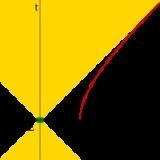
For example, this occurs with a uniformly accelerated particle. A spacetime diagram of this situation is shown in the figure to the right. As the particle accelerates, it approaches, but never reaches, the speed of light with respect to its original reference frame. On the spacetime diagram, its path is a hyperbola
Hyperbola

In mathematics a hyperbola is a smooth function planar curve having two connected components or branches, each a mirror image of the other and resembling two infinite bow aimed at each other....
, which asymptotically approaches
Asymptote

An asymptote of a real-valued function is a curve which describes the behavior of as either or tends to infinity.In other words, as one moves along the graph of in some direction, the distance between it and the asymptote eventually becomes smaller than any distance that one may specify, and as the x or y values approach infinity, the...
 a 45 degree line (the path of a light ray). An event whose light cone's edge is this asymptote or is farther away than this asymptote can never be observed by the accelerating particle. In the particle's reference frame, there appears to be a boundary behind it from which no signals can escape (an event horizon).

While approximations of this type of situation can occur in the real world (in particle accelerator
Particle accelerator

A particle accelerator is a device that uses electric fields to propel electric charge Elementary particles to high speeds and to contain them....
s, for example), a true event horizon is never present, as the particle must be accelerated indefinitely (requiring arbitrarily large amounts of energy and an arbitrarily large apparatus).

Interacting with an event horizon

A misconception concerning event horizons, especially black hole
Black hole

In general relativity, a black hole is a region of space in which the gravitational field is so powerful that nothing, including electromagnetic radiation , can escape its pull after having fallen past its event horizon....
 event horizons, is that they represent an immutable surface that destroys objects that approach them. In practice, all event horizons appear to be some distance away from any observer, and objects sent towards an event horizon never appear to cross it from the sending observer's point of view (as the horizon-crossing event's light cone
Light cone

In special relativity, a light cone is the surface describing the temporal evolution of a flash of light in Minkowski spacetime. This can be visualized in 3-space if the two horizontal axes are chosen to be spatial dimensions, while the vertical axis is time....
 never intersects the observer's world line
World line

In physics, the world line of an object is the unique path of that object as it travels through 4-dimensional spacetime.The concept of "world line" is distinguished from the concept of "orbit" or "trajectory" by the time dimension, and typically encompasses a large area of spacetime wherein perception straight paths are recalculated to...
). Attempting to make an object approaching the horizon remain stationary with respect to an observer requires applying a force whose magnitude becomes unbounded (becoming infinite) the closer it gets.

For the case of a horizon perceived by a uniformly accelerating observer in empty space, the horizon seems to remain a fixed distance from the observer no matter how its surroundings move. Varying the observer's acceleration may cause the horizon to appear to move over time, or may prevent an event horizon from existing, depending on the acceleration function chosen. The observer never touches the horizon, and never passes a location where it appeared to be.

For the case of a horizon perceived by an occupant of a De Sitter Universe
De Sitter universe

A de Sitter universe is a solution to Albert Einstein's field equations of General Relativity which is named after Willem de Sitter. It models the universe as spatially flat and neglects ordinary matter, so the dynamics of the universe are dominated by the cosmological constant, thought to correspond to dark energy....
, the horizon always appears to be a fixed distance away for a non-accelerating
Inertial frame of reference

In physics, an inertial frame of reference is a frame of reference, tied to the state of motion of an Observer , with the property that each physical law portrays itself in the same form in every inertial frame....
 observer. It is never contacted, even by an accelerating observer.

For the case of the horizon around a black hole, observers stationary with respect to a distant object will all agree on where the horizon is. While this seems to allow an observer lowered towards the hole on a rope to contact the horizon, in practice this cannot be done. If the observer is lowered very slowly, then, in the observer's frame of reference, the horizon appears to be very far away, and ever more rope needs to be paid out to reach the horizon. If the observer is quickly lowered by another observer, then indeed the first observer, and some of the rope can touch and even cross the (second observer's) event horizon. If the rope is pulled taut to fish the first observer back out, then the forces along the rope increase without bound as they approach the event horizon, and at some point the rope must break. Furthermore, the break must occur not at the event horizon, but at a point where the second observer can observe it.

Attempting to stick a rigid rod through the hole's horizon cannot be done: if the rod is lowered extremely slowly, then it is always too short to touch the event horizon, as the coordinate frames near the tip of the rod are extremely compressed. From the point of view of an observer at the end of the rod, the event horizon remains hopelessly out of reach. If the rod is lowered quickly, then the same problems as with the rope are encountered: the rod must break and the broken-off pieces inevitably fall in.

These peculiarities only occur because of the supposition that the observers be stationary with respect to some other distant observer. Observers who fall into the hole are moving with respect to the distant observer, and so perceive the horizon as being in a different location, seeming to recede in front of them so that they never contact it. Increasing tidal force
Tidal force

The tidal force is a secondary effect of the force of gravity and is responsible for the tides. It arises because the gravitational force exerted on one body by a second body is not constant across its diameter....
s (and eventual impact with the hole's gravitational singularity
Gravitational singularity

A gravitational singularity is, approximately, a place where quantities which are used to measure the gravitational field become infinity. Such quantities include the Curvature of Riemannian manifolds of spacetime or the density of matter....
) are the only locally noticeable effects. While this seems to allow an infalling observer to relay information from objects outside their perceived horizon but inside the distant observer's perceived horizon, in practice the horizon recedes by an amount small enough that by the time the infalling observer receives any signal from farther into the hole, they've already crossed what the distant observer perceived to be the horizon, and this reception event (and any retransmission) can't be seen by the distant observer.

Beyond general relativity


The description of event horizons given by general relativity
General relativity

General relativity or the general theory of relativity is the Geometry Theoretical physics of gravitation published by Albert Einstein in 1916....
 is thought to be incomplete. When the conditions under which event horizons occur are modelled using a more complete picture of the way the universe works, that includes both relativity and quantum mechanics
Quantum mechanics

Quantum mechanics is a set of principles underlying the most fundamental known description of all physical systems at the microscopic scale . Notable amongst these principles are both a dual wave-like and particle-like behavior of matter and radiation, and prediction of probabilities in situations where classical physics predicts certaintie...
, event horizons are expected to have properties that are different from those predicted using general relativity alone.

At present, it is expected that the primary impact of quantum effects is for event horizons to possess a temperature
Temperature

In physics, temperature is a physical property of a Physical system that underlies the common notions of hot and cold; something that feels hotter generally has the greater temperature....
 and so emit radiation. For black hole
Black hole

In general relativity, a black hole is a region of space in which the gravitational field is so powerful that nothing, including electromagnetic radiation , can escape its pull after having fallen past its event horizon....
s, this manifests as Hawking radiation
Hawking radiation

Hawking radiation is a thermal radiation with a black body predicted to be emitted by black holes due to quantum physics effects. It is named after the physicist Stephen Hawking who provided the theoretical argument for its existence in 1974, and sometimes also after the physicist Jacob Bekenstein who predicted that black holes should have a...
, and the larger question of how the black hole possesses a temperature is part of the topic of black hole thermodynamics
Black hole thermodynamics

In physics, black hole thermodynamics is the area of study that seeks to reconcile the laws of thermodynamics with the existence of black hole event horizons....
. For accelerating particles, this manifests as the Unruh effect
Unruh effect

The Unruh effect, described in 1976 by Bill Unruh of the University of British Columbia, is the prediction that an accelerating observer will observe black-body radiation where an inertial observer would observe none....
, which causes space around the particle to appear to be filled with matter and radiation.

A complete description of event horizons is expected to at minimum require a theory of quantum gravity
Quantum gravity

Quantum gravity is the field of theoretical physics attempting to unify quantum mechanics, which describes three of the Fundamental interaction , with general relativity, the theory of the fourth fundamental force: Gravitation....
. One such candidate theory is M-theory
M-theory

In theoretical physics, M-theory is a new limit of string theory in which 11 dimensions of spacetime may be identified. Because the dimensionality exceeds the dimensionality of five superstring theories in 10 dimensions, it was originally believed that the 11-dimensional theory is more fundamental and unifies all string theories ....
.

See also


  • Acoustic horizon
  • Hawking radiation
    Hawking radiation

    Hawking radiation is a thermal radiation with a black body predicted to be emitted by black holes due to quantum physics effects. It is named after the physicist Stephen Hawking who provided the theoretical argument for its existence in 1974, and sometimes also after the physicist Jacob Bekenstein who predicted that black holes should have a...
  • Cosmic censorship
  • Rindler coordinates
    Rindler coordinates

    In relativistic physics, the Rindler coordinate chart is an important and useful coordinate chart representing part of flat spacetime, also called the Minkowski spacetime....


More technical references