

Cold fusion

Encyclopedia

Hypothesis
A hypothesis is a proposed explanation for a phenomenon. The term derives from the Greek, ὑποτιθέναι – hypotithenai meaning "to put under" or "to suppose". For a hypothesis to be put forward as a scientific hypothesis, the scientific method requires that one can test it...
that nuclear fusion
Nuclear fusion
Nuclear fusion is the process by which two or more atomic nuclei join together, or "fuse", to form a single heavier nucleus. This is usually accompanied by the release or absorption of large quantities of energy...
might explain the results of a group of experiments conducted at ordinary temperatures (e.g., room temperature
Room temperature
-Comfort levels:The American Society of Heating, Refrigerating and Air-Conditioning Engineers has listings for suggested temperatures and air flow rates in different types of buildings and different environmental circumstances. For example, a single office in a building has an occupancy ratio per...
). Both the experimental results and the hypothesis are disputed. The ideas gained attention after the reports of Martin Fleischmann
Martin Fleischmann
Martin Fleischmann is a British chemist noted for his work in electrochemistry. He came to wider public prominence following his controversial publication of work with colleague Stanley Pons on cold fusion using palladium in the 1980s and '90s.-Early life:Born in Karlovy Vary, Czechoslovakia,...
, then one of the world's leading electrochemists
Electrochemistry
Electrochemistry is a branch of chemistry that studies chemical reactions which take place in a solution at the interface of an electron conductor and an ionic conductor , and which involve electron transfer between the electrode and the electrolyte or species in solution.If a chemical reaction is...
, and Stanley Pons
Stanley Pons
Bobby Stanley Pons is an American-French electrochemist known for his work with Martin Fleischmann on cold fusion in the 1980s and '90s.-Early life:...
in 1989 that they had produced anomalous heat ("excess heat") of a magnitude they asserted would defy explanation except in terms of nuclear processes. They further reported measuring small amounts of nuclear reaction byproducts, including neutrons and tritium
Tritium
Tritium is a radioactive isotope of hydrogen. The nucleus of tritium contains one proton and two neutrons, whereas the nucleus of protium contains one proton and no neutrons...
. The small tabletop experiment involved electrolysis
Electrolysis
In chemistry and manufacturing, electrolysis is a method of using a direct electric current to drive an otherwise non-spontaneous chemical reaction...
of heavy water
Heavy water
Heavy water is water highly enriched in the hydrogen isotope deuterium; e.g., heavy water used in CANDU reactors is 99.75% enriched by hydrogen atom-fraction...
on the surface of a palladium
Palladium
Palladium is a chemical element with the chemical symbol Pd and an atomic number of 46. It is a rare and lustrous silvery-white metal discovered in 1803 by William Hyde Wollaston. He named it after the asteroid Pallas, which was itself named after the epithet of the Greek goddess Athena, acquired...
(Pd) electrode.
The reported results received wide media attention, and raised hopes of a cheap and abundant source of energy. Many scientists tried to replicate the experiment with the few details available, some to prove it wrong, and some because they wanted to be part of this new exciting discovery. Hopes fell with the big number of negative replications, the withdrawal of many positive replications, the discovery of flaws and sources of experimental error in the original experiment, and finally the discovery that Fleischmann and Pons had not actually detected nuclear reaction byproducts.
By late 1989, most scientists considered cold fusion claims dead, and cold fusion subsequently gained a reputation as pathological science
Pathological science
Pathological science is the process in science in which "people are tricked into false results ... by subjective effects, wishful thinking or threshold interactions". The term was first used by Irving Langmuir, Nobel Prize-winning chemist, during a 1953 colloquium at the Knolls Research Laboratory...
.
In 1989, the majority of a review panel organized by the US Department of Energy (DOE) found that the evidence for the discovery of a new nuclear process was not persuasive enough to start a special program, but was "sympathetic toward modest support" for experiments "within the present funding system." A second DOE review, convened in 2004 to look at new research, reached conclusions similar to the first.
A small community of researchers continues to investigate cold fusion, claiming to replicate Fleischmann and Pons' results including nuclear reaction byproducts. Since cold fusion articles are rarely published in refereed scientific journals, the results do not receive as much scrutiny as more mainstream topics, and many scientists aren't even aware that there is new research. Mainstream scientists perceive the field as the remains of the controversy of the early 1990s. However, at some research institutions the view is different and for instance the Italian national research agency ENEA
ENEA (Italy)
The L'Agenzia nazionale per le nuove tecnologie, l'energia e lo sviluppo economico sostenibile is an Italian Government sponsored research and development agency...
express belief in the existence of a cold fusion phenomenon.
Before the Fleischmann–Pons experiment
The ability of palladium to absorb hydrogen was recognized as early as the nineteenth century by Thomas GrahamThomas Graham (chemist)
Thomas Graham FRS was a nineteenth-century Scottish chemist who is best-remembered today for his pioneering work in dialysis and the diffusion of gases.- Life and work :...
. In the late 1920s, two Austrian born scientists, Friedrich Paneth
Friedrich Paneth
Friedrich Adolf Paneth was an Austrian-born British chemist. Fleeing the Nazis, he escaped to Britain and became a British citizen in 1939 but returned as director of the Max Planck Institute for Chemistry in 1953....
and Kurt Peters
Kurt Peters (chemist)
Kurt Karl Gustav Peters was an Austrian chemist. His work focused on the area of fuel technology, physical chemistry and catalytic reactions as well as the separation of rare gases and hydrocarbons.- History :...
, originally reported the transformation of hydrogen into helium by spontaneous nuclear catalysis when hydrogen was absorbed by finely divided palladium at room temperature. However, the authors later retracted that report, acknowledging that the helium they measured was due to background from the air.
In 1927, Swedish scientist J. Tandberg stated that he had fused hydrogen into helium in an electrolytic cell
Electrolytic cell
An electrolytic cell decomposes chemical compounds by means of electrical energy, in a process called electrolysis; the Greek word lysis means to break up. The result is that the chemical energy is increased...
with palladium electrodes. On the basis of his work, he applied for a Swedish patent for "a method to produce helium and useful reaction energy". After deuterium
Deuterium
Deuterium, also called heavy hydrogen, is one of two stable isotopes of hydrogen. It has a natural abundance in Earth's oceans of about one atom in of hydrogen . Deuterium accounts for approximately 0.0156% of all naturally occurring hydrogen in Earth's oceans, while the most common isotope ...
was discovered in 1932, Tandberg continued his experiments with heavy water
Heavy water
Heavy water is water highly enriched in the hydrogen isotope deuterium; e.g., heavy water used in CANDU reactors is 99.75% enriched by hydrogen atom-fraction...
. Due to Paneth and Peters' retraction, Tandberg's patent application was eventually denied. His application for a patent in 1927 was denied as he could not explain the physical process.
The term "cold fusion" was used as early as 1956 in a New York Times article about Luis W. Alvarez's work on muon-catalyzed fusion. E. Paul Palmer of Brigham Young University
Brigham Young University
Brigham Young University is a private university located in Provo, Utah. It is owned and operated by The Church of Jesus Christ of Latter-day Saints , and is the United States' largest religious university and third-largest private university.Approximately 98% of the university's 34,000 students...
also used the term "cold fusion" in 1986 in an investigation of "geo-fusion", the possible existence of fusion in a planetary core
Planetary core
The planetary core consists of the innermost layer of a planet.The core may be composed of solid and liquid layers, while the cores of Mars and Venus are thought to be completely solid as they lack an internally generated magnetic field. In our solar system, core size can range from about 20% to...
.
Events preceding announcement
Martin Fleischmann
Martin Fleischmann is a British chemist noted for his work in electrochemistry. He came to wider public prominence following his controversial publication of work with colleague Stanley Pons on cold fusion using palladium in the 1980s and '90s.-Early life:Born in Karlovy Vary, Czechoslovakia,...
of the University of Southampton
University of Southampton
The University of Southampton is a British public university located in the city of Southampton, England, a member of the Russell Group. The origins of the university can be dated back to the founding of the Hartley Institution in 1862 by Henry Robertson Hartley. In 1902, the Institution developed...
and Stanley Pons
Stanley Pons
Bobby Stanley Pons is an American-French electrochemist known for his work with Martin Fleischmann on cold fusion in the 1980s and '90s.-Early life:...
of the University of Utah
University of Utah
The University of Utah, also known as the U or the U of U, is a public, coeducational research university in Salt Lake City, Utah, United States. The university was established in 1850 as the University of Deseret by the General Assembly of the provisional State of Deseret, making it Utah's oldest...
hypothesized that the high compression ratio and mobility of deuterium
Deuterium
Deuterium, also called heavy hydrogen, is one of two stable isotopes of hydrogen. It has a natural abundance in Earth's oceans of about one atom in of hydrogen . Deuterium accounts for approximately 0.0156% of all naturally occurring hydrogen in Earth's oceans, while the most common isotope ...
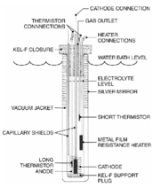
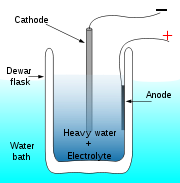
that could be achieved within palladium metal using electrolysis might result in nuclear fusion. To investigate, they conducted electrolysis experiments using a palladium cathode and heavy water within a calorimeter, an insulated vessel designed to measure process heat. Current was applied continuously for many weeks, with the heavy water
Heavy water
Heavy water is water highly enriched in the hydrogen isotope deuterium; e.g., heavy water used in CANDU reactors is 99.75% enriched by hydrogen atom-fraction...
being renewed at intervals. Some deuterium was thought to be accumulating within the cathode, but most was allowed to bubble out of the cell, joining oxygen produced at the anode. For most of the time, the power input to the cell was equal to the calculated power leaving the cell within measurement accuracy, and the cell temperature was stable at around 30 °C. But then, at some point (in some of the experiments), the temperature rose suddenly to about 50 °C without changes in the input power. These high temperature phases would last for two days or more and would repeat several times in any given experiment once they had occurred. The calculated power leaving the cell was significantly higher than the input power during these high temperature phases. Eventually the high temperature phases would no longer occur within a particular cell.
In 1988, Fleischmann and Pons applied to the United States Department of Energy
United States Department of Energy
The United States Department of Energy is a Cabinet-level department of the United States government concerned with the United States' policies regarding energy and safety in handling nuclear material...
for funding towards a larger series of experiments. Up to this point they had been funding their experiments using a small device built with $100,000 out-of-pocket
Out-of-pocket expenses
Out-of-pocket expenses are direct outlays of cash which may or may not be later reimbursed.In operating a vehicle, gasoline, parking fees and tolls are considered out-of-pocket expenses for the trip...
. The grant proposal was turned over for peer review
Peer review
Peer review is a process of self-regulation by a profession or a process of evaluation involving qualified individuals within the relevant field. Peer review methods are employed to maintain standards, improve performance and provide credibility...
, and one of the reviewers was Steven E. Jones
Steven E. Jones
Steven Earl Jones is an American physicist. For most of his career, Jones was known mainly for his work on muon-catalyzed fusion. In the fall of 2006, amid controversy surrounding his work on the collapse of the World Trade Center , he was relieved of his teaching duties...
of Brigham Young University
Brigham Young University
Brigham Young University is a private university located in Provo, Utah. It is owned and operated by The Church of Jesus Christ of Latter-day Saints , and is the United States' largest religious university and third-largest private university.Approximately 98% of the university's 34,000 students...
. Jones had worked for some time on muon-catalyzed fusion
Muon-catalyzed fusion
Muon-catalyzed fusion is a process allowing nuclear fusion to take place at temperatures significantly lower than the temperatures required for thermonuclear fusion, even at room temperature or lower...
, a known method of inducing nuclear fusion without high temperatures, and had written an article on the topic entitled "Cold nuclear fusion" that had been published in Scientific American
Scientific American
Scientific American is a popular science magazine. It is notable for its long history of presenting science monthly to an educated but not necessarily scientific public, through its careful attention to the clarity of its text as well as the quality of its specially commissioned color graphics...
in July 1987. Fleischmann and Pons and co-workers met with Jones and co-workers on occasion in Utah
Utah
Utah is a state in the Western United States. It was the 45th state to join the Union, on January 4, 1896. Approximately 80% of Utah's 2,763,885 people live along the Wasatch Front, centering on Salt Lake City. This leaves vast expanses of the state nearly uninhabited, making the population the...
to share research and techniques. During this time, Fleischmann and Pons described their experiments as generating considerable "excess energy", in the sense that it could not be explained by chemical reaction
Chemical reaction
A chemical reaction is a process that leads to the transformation of one set of chemical substances to another. Chemical reactions can be either spontaneous, requiring no input of energy, or non-spontaneous, typically following the input of some type of energy, such as heat, light or electricity...
s alone. They felt that such a discovery could bear significant commercial value and would be entitled to patent protection
Patent
A patent is a form of intellectual property. It consists of a set of exclusive rights granted by a sovereign state to an inventor or their assignee for a limited period of time in exchange for the public disclosure of an invention....
. Jones, however, was measuring neutron flux, which was not of commercial interest. In order to avoid problems in the future, the teams appeared to agree to simultaneously publish their results, although their accounts of their March 6 meeting differ.
Announcement
In mid-March 1989, both research teams were ready to publish their findings, and Fleischmann and Jones had agreed to meet at an airport on March 24 to send their papers to NatureNature (journal)
Nature, first published on 4 November 1869, is ranked the world's most cited interdisciplinary scientific journal by the Science Edition of the 2010 Journal Citation Reports...
via FedEx
FedEx
FedEx Corporation , originally known as FDX Corporation, is a logistics services company, based in the United States with headquarters in Memphis, Tennessee...
. Fleischmann and Pons, however, pressured by the University of Utah which wanted to establish priority on the discovery, broke their apparent agreement, submitting their paper to the Journal of Electroanalytical Chemistry on March 11, and disclosing their work via a press release and press conference on March 23. Jones, upset, faxed in his paper to Nature
Nature (journal)
Nature, first published on 4 November 1869, is ranked the world's most cited interdisciplinary scientific journal by the Science Edition of the 2010 Journal Citation Reports...
after the press conference.
Fleischmann and Pons' announcement drew wide media attention. The 1986 discovery of high-temperature superconductivity
High-temperature superconductivity
High-temperature superconductors are materials that have a superconducting transition temperature above . From 1960 to 1980, 30 K was thought to be the highest theoretically possible Tc...
had caused the scientific community to be more open to revelations of unexpected scientific results that could have huge economic repercussions and that could be replicated reliably even if they had not been predicted by established conjecture. Cold fusion was proposing the counterintuitive idea that a nuclear reaction could be caused to occur inside a chemically bound crystal structure. Many scientists were reminded of the Mössbauer effect
Mössbauer effect
The Mössbauer effect, or recoilless nuclear resonance fluorescence, is a physical phenomenon discovered by Rudolf Mössbauer in 1958. It involves the resonant and recoil-free emission and absorption of γ radiation by atomic nuclei bound in a solid...
, a process involving nuclear transitions
Isomeric transition
An isomeric transition is a radioactive decay process that involves emission of a gamma ray from an atom where the nucleus is in an excited metastable state, referred to in its excited state, as a nuclear isomer....
in a solid. Its discovery 30 years earlier had also been unexpected, though it was quickly replicated and explained within the existing physics framework.
The announcement of a new clean source of energy came at a crucial time: everyone still remembered the 1973 oil crisis
1973 oil crisis
The 1973 oil crisis started in October 1973, when the members of Organization of Arab Petroleum Exporting Countries or the OAPEC proclaimed an oil embargo. This was "in response to the U.S. decision to re-supply the Israeli military" during the Yom Kippur war. It lasted until March 1974. With the...
and the problems caused by oil dependence, anthropogenic global warming
Global warming
Global warming refers to the rising average temperature of Earth's atmosphere and oceans and its projected continuation. In the last 100 years, Earth's average surface temperature increased by about with about two thirds of the increase occurring over just the last three decades...
was starting to become notorious, the anti-nuclear movement was labeling nuclear power plants as dangerous and getting them closed, people had in mind the consequences of strip mining, acid rain
Acid rain
Acid rain is a rain or any other form of precipitation that is unusually acidic, meaning that it possesses elevated levels of hydrogen ions . It can have harmful effects on plants, aquatic animals, and infrastructure. Acid rain is caused by emissions of carbon dioxide, sulfur dioxide and nitrogen...
and the greenhouse effect
Greenhouse effect
The greenhouse effect is a process by which thermal radiation from a planetary surface is absorbed by atmospheric greenhouse gases, and is re-radiated in all directions. Since part of this re-radiation is back towards the surface, energy is transferred to the surface and the lower atmosphere...
, and, to top it all, the Exxon Valdez oil spill
Exxon Valdez oil spill
The Exxon Valdez oil spill occurred in Prince William Sound, Alaska, on March 24, 1989, when the Exxon Valdez, an oil tanker bound for Long Beach, California, struck Prince William Sound's Bligh Reef and spilled of crude oil. It is considered to be one of the most devastating human-caused...
happened the day after the announcement. In the press conference, Peterson
Chase N. Peterson
Chase Nebeker Peterson was the president of the University of Utah from 1983 to 1991.-Biography:Peterson was born in Logan, Utah where his father, E. G. Peterson was the president of what is now Utah State University. Peterson received both his bachelors degree and MD from Harvard University...
, Fleischmann and Pons, backed by the solidity of their scientific credentials, repeatedly assured the journalists that cold fusion would solve all of these problems, and would provide a limitless inexhaustible source of clean energy, using only seawater as fuel. They said the results had been confirmed dozens of times and they had no doubts about them. In the accompanying press release Fleischmann was quoted saying: "What we have done is to open the door of a new research area, our indications are that the discovery will be relatively easy to make into a usable technology for generating heat and power, but continued work is needed, first, to further understand the science and secondly, to determine its value to energy economics."
Response and fallout
Although the experimental protocol had not been published, physicists in several countries attempted, and failed, to replicate the excess heat phenomenon. The first paper submitted to Nature reproducing excess heat, although it passed peer-review, was rejected because most similar experiments were negative and there were no theories that could explain a positive result; although this paper was later accepted for publication by the journal Fusion Technology. Nathan LewisNathan Lewis
Nathan S. Lewis is the George L. Argyros Professor of Chemistry at the California Institute of Technology. He specializes in functionalization of silicon and other semiconductor surfaces, as well as chemical sensing using chemiresistive sensor arrays. He obtained his B.S. and M.S. degrees also at...
, professor of Chemistry at the California Institute of Technology
California Institute of Technology
The California Institute of Technology is a private research university located in Pasadena, California, United States. Caltech has six academic divisions with strong emphases on science and engineering...
, led one of the most ambitious validation efforts, trying many variations on the experiment without success, while CERN
CERN
The European Organization for Nuclear Research , known as CERN , is an international organization whose purpose is to operate the world's largest particle physics laboratory, which is situated in the northwest suburbs of Geneva on the Franco–Swiss border...
physicist Douglas R. O. Morrison said that "essentially all" attempts in Western Europe had failed. Even those reporting success had difficulty reproducing Fleischmann and Pons' results. On April 10, 1989, a group at Texas A&M University
Texas A&M University
Texas A&M University is a coeducational public research university located in College Station, Texas . It is the flagship institution of the Texas A&M University System. The sixth-largest university in the United States, A&M's enrollment for Fall 2011 was over 50,000 for the first time in school...
published results of excess heat and later that day a group at the Georgia Institute of Technology
Georgia Institute of Technology
The Georgia Institute of Technology is a public research university in Atlanta, Georgia, in the United States...
announced neutron production—the strongest replication announced up to that point due to the detection of neutrons and the reputation of the lab. In 12 April Pons was acclaimed at a ACS meeting. But the Georgia Tech retracted their announcement in 13 April, explaining that their neutron detectors gave false positives when exposed to heat. Another attempt at independent replication, headed by Robert Huggins
Robert Huggins
Robert A. Huggins is Professor Emeritus at the Department of Materials Science and Engineering at the School of Engineering at Stanford University and Chief Scientist at the Center for Solar Energy and Hydrogen Research at the University of Ulm....
at Stanford University
Stanford University
The Leland Stanford Junior University, commonly referred to as Stanford University or Stanford, is a private research university on an campus located near Palo Alto, California. It is situated in the northwestern Santa Clara Valley on the San Francisco Peninsula, approximately northwest of San...
, which also reported early success with a light water control, saved cold fusion almost single-handedly and became the only scientific support for cold fusion in the 26 April US Congress hearings. But, when he finally presented his results, he reported an excess heat of only one celsius
Celsius
Celsius is a scale and unit of measurement for temperature. It is named after the Swedish astronomer Anders Celsius , who developed a similar temperature scale two years before his death...
degree, a result that could be explained by chemical differences between heavy and light water in the presence of lithium, he had not tried to measure any radiation, and his research was derided by scientists who saw it later. For the next six weeks, competing claims, counterclaims, and suggested explanations kept what was referred to as "cold fusion" or "fusion confusion" in the news.
In April 1989, Fleischmann and Pons published a "preliminary note" in the Journal of Electroanalytical Chemistry
Journal of Electroanalytical Chemistry
The Journal of Electroanalytical Chemistry is a peer-reviewed scientific journal on electroanalytical chemistry, published by Elsevier.The journal, which the New York Times describes as "a specialty publication not widely circulated," became more broadly known in 1989 when Martin Fleischmann and...
. This paper notably showed a gamma peak without its corresponding Compton edge
Compton edge
In spectrophotometry, the Compton edge is a feature of the spectrograph that results from the Compton scattering in the scintillator or detector. When a gamma-ray scatters off the scintillator but escapes, only a fraction of its energy is registered by the detector. This leads to a spectrum of...
, which indicated they had made a mistake in claiming evidence of fusion byproducts. Fleischmann and Pons replied to this critique, but the only thing left clear was that no gamma ray had been registered and that Fleischmann refused to recognize any mistakes in the data. A much longer paper published a year later went into details of calorimetry but did not include any nuclear measurements.
Nevertheless, Fleischmann and Pons and a number of other researchers who found positive results remained convinced of their findings. The University of Utah asked Congress to provide $25 million to pursue the research, and Pons was scheduled to meet with representatives of President Bush in early May.
On April 30, 1989, cold fusion was declared dead by the New York Times. The Times called it a circus the same day, and the Boston Herald attacked cold fusion the following day.
On May 1, 1989, the American Physical Society
American Physical Society
The American Physical Society is the world's second largest organization of physicists, behind the Deutsche Physikalische Gesellschaft. The Society publishes more than a dozen scientific journals, including the world renowned Physical Review and Physical Review Letters, and organizes more than 20...
held a session on cold fusion in Baltimore, including many reports of experiments that failed to produce evidence of cold fusion. At the end of the session, eight of the nine leading speakers stated that they considered the initial Fleischmann and Pons claim dead with the ninth, Johann Rafelski
Johann Rafelski
Johann Rafelski is a German-American theoretical physicist and author. He is Professor of Physics at The University of Arizona in Tucson, guest scientist at CERN , and has been LMU-Excellent Guest Professor at the Ludwig Maximilian University of Munich in Munich, Germany.Rafelski’s current...
, abstaining. Steven E. Koonin
Steven E. Koonin
Steven E. Koonin was the Under Secretary of Energy for Science at the United States Department of Energy. He left that post in November 2011 for a position at the Institute for Defense Analyses. He was previously Chief Scientist for BP plc, where he was responsible for guiding the company’s...
of Caltech called the Utah report a result of "the incompetence and delusion of Pons and Fleischmann" which was met with a standing ovation. Douglas R. O. Morrison, a physicist representing CERN
CERN
The European Organization for Nuclear Research , known as CERN , is an international organization whose purpose is to operate the world's largest particle physics laboratory, which is situated in the northwest suburbs of Geneva on the Franco–Swiss border...
, was the first to call the episode an example of pathological science
Pathological science
Pathological science is the process in science in which "people are tricked into false results ... by subjective effects, wishful thinking or threshold interactions". The term was first used by Irving Langmuir, Nobel Prize-winning chemist, during a 1953 colloquium at the Knolls Research Laboratory...
.
On May 4, due to all this new criticism, the meetings with various representatives from Washington were cancelled.
From May 8 only the A&M tritium results kept cold fusion afloat.
In July and November 1989, Nature published papers critical of cold fusion claims. Negative results were also published in several other scientific journal
Scientific journal
In academic publishing, a scientific journal is a periodical publication intended to further the progress of science, usually by reporting new research. There are thousands of scientific journals in publication, and many more have been published at various points in the past...
s including Science
Science (journal)
Science is the academic journal of the American Association for the Advancement of Science and is one of the world's top scientific journals....
, Physical Review Letters
Physical Review Letters
Physical Review Letters , established in 1958, is a peer reviewed, scientific journal that is published 52 times per year by the American Physical Society...
, and Physical Review C
Physical Review
Physical Review is an American scientific journal founded in 1893 by Edward Nichols. It publishes original research and scientific and literature reviews on all aspects of physics. It is published by the American Physical Society. The journal is in its third series, and is split in several...
(nuclear physics).
In August 1989, in spite of this trend, the state of Utah
Utah
Utah is a state in the Western United States. It was the 45th state to join the Union, on January 4, 1896. Approximately 80% of Utah's 2,763,885 people live along the Wasatch Front, centering on Salt Lake City. This leaves vast expanses of the state nearly uninhabited, making the population the...
invested $4.5 million to create the National Cold Fusion Institute.
The United States Department of Energy
United States Department of Energy
The United States Department of Energy is a Cabinet-level department of the United States government concerned with the United States' policies regarding energy and safety in handling nuclear material...
organized a special panel to review cold fusion theory and research. The panel issued its report in November 1989, concluding that results as of that date did not present convincing evidence that useful sources of energy would result from the phenomena attributed to cold fusion. The panel noted the large number of failures to replicate excess heat and the greater inconsistency of reports of nuclear reaction byproducts expected by established conjecture
Conjecture
A conjecture is a proposition that is unproven but is thought to be true and has not been disproven. Karl Popper pioneered the use of the term "conjecture" in scientific philosophy. Conjecture is contrasted by hypothesis , which is a testable statement based on accepted grounds...
. Nuclear fusion of the type postulated would be inconsistent with current understanding and, if verified, would require established conjecture, perhaps even theory itself, to be extended in an unexpected way. The panel was against special funding for cold fusion research, but supported modest funding of "focused experiments within the general funding system." Cold fusion supporters continued to argue that the evidence for excess heat was strong, and in September 1990 the National Cold Fusion Institute listed 92 groups of researchers from 10 different countries that had reported corroborating evidence of excess heat. However no further DOE nor NSF funding resulted from the panel's recommendation. By this point, however, academic consensus had moved decidedly toward labeling cold fusion as a kind of "pathological science".
In early May 1990 one of the two A&M researchers, Kevin Wolf, acknowledged the possibility of spiking, but said that the most likely explanation was tritium contamination in the palladium electrodes or simply contamination due to sloppy work. In June 1990 an article in Science by science writer Gary Taubes
Gary Taubes
Gary Taubes is an American science writer.He is the author of Nobel Dreams , Bad Science: The Short Life and Weird Times of Cold Fusion , and Good Calories, Bad Calories , titled The Diet Delusion in the UK and Australia. His book Why We Get Fat: And What to Do About It was released in December...
destroyed the public credibility of the A&M tritium results when it accused its group leader John Bockris
John Bockris
John O'Mara Bockris is a former professor of Chemistry at Texas A&M University whose unorthodox views have provoked controversy. He has authored, coauthored or edited more than 700 papers and 22 books principally in electrochemistry but also in environmental chemistry, photoelectrochemistry and...
and one of his graduate students of spiking the cells with tritium. In October 1990 Wolf finally said that the results were explained by tritium contamination in the rods. A A&M cold fusion review panel found that the tritium evidence was not convincing and that, while they couldn't rule out spiking, contamination and measurements problems were more likely explanations. and Bockris never got support from his faculty to resume his research.
In 30 June 1991 the National Cold Fusion Institute closed after it ran out of funds; it found no excess heat, and its reports of tritium production were met with indifference.
In 1 January 1991, Pons left his tenure, and both he and Fleischmann quietly left the United States. In 1992 they resumed research with Toyota Motor Corporation
Toyota Motor Corporation
, , , commonly known simply as Toyota and abbreviated as TMC, is a multinational automaker headquartered in Toyota, Aichi, Japan. In 2010, Toyota Motor Corporation employed 317,734 people worldwide, and was the world's largest automobile manufacturer by production.The company was founded by...
's IMRA lab in France. Fleischmann left for England in 1995, and the contract with Pons was not renewed in 1998 after spending $40 million with no tangible results. The IMRA laboratory was closed in 1998 after spending £12 million on cold fusion work.
Pons has made no public declarations since, and only Fleischmann continues giving talks and publishing papers.
Several books came out critical of cold fusion research methods and the conduct of cold fusion researchers while only a few came in their defence. The scientific community
Scientific community
The scientific community consists of the total body of scientists, its relationships and interactions. It is normally divided into "sub-communities" each working on a particular field within science. Objectivity is expected to be achieved by the scientific method...
continues to maintain a skeptical
Scientific skepticism
Scientific skepticism is the practice of questioning the veracity of claims lacking empirical evidence or reproducibility, as part of a methodological norm pursuing "the extension of certified knowledge". For example, Robert K...
consensus
Scientific consensus
Scientific consensus is the collective judgment, position, and opinion of the community of scientists in a particular field of study. Consensus implies general agreement, though not necessarily unanimity. Scientific consensus is not by itself a scientific argument, and it is not part of the...
regarding the subject due to the lack of experimental reproducibility and theoretical implausibility. New experimental claims are routinely dismissed or ignored by mainstream scientists and journals.
Ongoing scientific work
Small but committed groups of cold fusion researchers have continued to conduct experiments using Fleischmann and Pons electrolysis set-ups in spite of the rejection by the mainstream community. Often they prefer to name their field "Low Energy Nuclear Reaction" (LENR) or "Chemically Assisted Nuclear Reaction" (CANR), also "Lattice Assisted Nuclear Reaction" (LANR) and "Condensed Matter Nuclear Science" (CMNS), one of the reasons being to avoid the negative connotations associated with "cold fusion". The new names avoid making bold implications, like implying that fusion is happening on them. However some in the field don't regard it as just an alternative naming of the same field but as a more accurate description of a completely different phenomenon, since they believe the reported effects cannot be explained by nuclear fusion but by other non-fusion nuclear reactions happening at lower energies.Between 1992 and 1997, Japan's Ministry of International Trade and Industry
Ministry of International Trade and Industry
The Ministry of International Trade and Industry was one of the most powerful agencies of the Government of Japan. At the height of its influence, it effectively ran much of Japanese industrial policy, funding research and directing investment...
sponsored a "New Hydrogen Energy (NHE)" program of US$20 million to research cold fusion. Announcing the end of the program in 1997, the director and one-time proponent of cold fusion research Hideo Ikegami stated "We couldn't achieve what was first claimed in terms of cold fusion. (...) We can't find any reason to propose more money for the coming year or for the future." In 1999 the Japan C-F Research Society was established which holds annual meetings. Some researchers have been funded by grants of the Japan Society for the Promotion of Science
Japan Society for the Promotion of Science
The is an independent administrative institution in Japan, established for the purpose of contributing to the advancement of science in all fields of the natural and social sciences and the humanities.-History:...
(JSPS) and private groups like the Thermal and Electric Energy Technology Foundation (TEET)
Also in the 1990s, India stopped its research in cold fusion at the Bhabha Atomic Research Centre
Bhabha Atomic Research Centre
The Bhabha Atomic Research Centre is India's primary nuclear research facility based in Mumbai. It has a number of nuclear reactors, all of which are used for India's nuclear power and research programme.- History :...
because of the lack of consensus among mainstream scientists and the US denunciation of the research. Yet, in 2008, the National Institute of Advanced Studies
National Institute of Advanced Studies
The National Institute of Advanced Studies , is a research institute in India.It is one of the unique institutions in the country conducting research in multidisciplinary areas....
has recommended the Indian government to revive this research. Projects were commenced at the Chennai
Chennai
Chennai , formerly known as Madras or Madarasapatinam , is the capital city of the Indian state of Tamil Nadu, located on the Coromandel Coast off the Bay of Bengal. Chennai is the fourth most populous metropolitan area and the sixth most populous city in India...
's Indian Institute of Technology, the Bhabha Atomic Research Centre and the Indira Gandhi Centre for Atomic Research. However, there is still skepticism among scientists and, for all practical purposes, research is still stopped.
In February 2002, the U.S. Navy revealed that researchers at their Space and Naval Warfare Systems Center in San Diego, California
San Diego, California
San Diego is the eighth-largest city in the United States and second-largest city in California. The city is located on the coast of the Pacific Ocean in Southern California, immediately adjacent to the Mexican border. The birthplace of California, San Diego is known for its mild year-round...
had been quietly studying cold fusion since 1989. They released a two-volume report, "Thermal and nuclear aspects of the Pd/D2O system," with a plea for funding.
In May 2006, Allan Widom and Lewis Larsen published a theory of a four-step process involving weak force beta decay, as a form of Low Energy Nuclear Reaction
. This has become known as the Widom-Larsen theory.
In May 2008 Japanese researcher Yoshiaki Arata
Yoshiaki Arata
is a pioneer of nuclear fusion research in Japan and a former professor at Osaka University. He is reported to be a strong nationalist, speaking only Japanese in public...
(Osaka University) demonstrated an experiment with deuterium gas in a cell containing a mixture of palladium and zirconium oxide. The demonstration revived some interest for cold fusion research in India.
In their 2009 book "COLD FUSION The history of research in Italy" The Italian National agency for new technologies, Energy and sustainable economic development (ENEA
ENEA (Italy)
The L'Agenzia nazionale per le nuove tecnologie, l'energia e lo sviluppo economico sostenibile is an Italian Government sponsored research and development agency...
) present an overview of the research in ENEA departments, CNR
Consiglio Nazionale delle Ricerche
The Consiglio Nazionale delle Ricerche or National Research Council, is an Italian public organization set up to support scientific and technological research. Its headquarters are in Rome.-History:The institution was founded in 1923...
Laboratories, INFN
Istituto Nazionale di Fisica Nucleare
The Istituto Nazionale di Fisica Nucleare is the coordinating institution for nuclear, particle and astroparticle physics in Italy. It was founded on the 8th of August 1951, to further the nuclear physics research tradition initiated by Enrico Fermi in Rome, in the 1930s...
, Universities and Industrial laboratories in Italy. In the foreword of the book Luigi Paganetto, president of ENEA says: "In other words, two government programs – carried out in close interaction and with check of results – have proved the existence of this phenomenon in terms that are not ascribable to a chemical process. This must be considered a starting point. The results achieved so far represent an obligation to continue on the scientific path already started with the aim of achieving a complete definition of the studied phenomenon."
In April 2011 Dennis M. Bushnell
Dennis M. Bushnell
Dennis M. Bushnell is a NASA scientist and lecturer. As Chief Scientist at NASA Langley Research Center, he is responsible for technical oversight and advanced program formulation. His work is focused mainly on new approaches to environmental issues, in particular to climate issues. Bushnell has...
, Chief scientist at NASA Langley Research Center, stated that LENR is a very "interesting and promising" new technology that is likely to advance "fairly rapidly." NASA Langley Research Center has implemented an experimental project consisting of researchers from inside and outside NASA preparing for feasibility tests to begin by summer 2011.
Claims of commercialization
Several entrepreneurs have claimed in the past that a working cold fusion energy generator is near to commercialization, yet so far no working machine is available on the market.In January 2011 researchers from the University of Bologna
University of Bologna
The Alma Mater Studiorum - University of Bologna is the oldest continually operating university in the world, the word 'universitas' being first used by this institution at its foundation. The true date of its founding is uncertain, but believed by most accounts to have been 1088...
, Andrea Rossi
Andrea Rossi (entrepreneur)
Andrea Rossi is an Italian inventor and entrepreneur. He is the inventor of the Energy Catalyzer a supposed cold fusion or Low-Energy Nuclear Reaction thermal power source...
and Sergio Focardi
Sergio Focardi
Sergio Focardi is an Italian physicist, emeritus professor at the University of Bologna.He led the Department of Bologna of the National Institute for Nuclear Physics and the Faculty of Mathematical, Physical and Natural Sciences at the University of Bologna...
, claimed to have successfully demonstrated commercially viable cold fusion in a device called an Energy Catalyzer
Energy Catalyzer
The Energy Catalyzer is a supposed cold fusion or Low-Energy Nuclear Reaction heat source built by inventor Andrea Rossi, with support from physicist Sergio Focardi...
. In March 2011, two Swedish physicists evaluated the device, under the control of Rossi. As the target is immediate commercialization, the inventors say that details of the invention will not be published yet. Peer-reviewed journals have not published papers on this invention, leading Rossi to create his own online "nuclear experiments blog", called the Journal of Nuclear Physics. The international patent application received an unfavorable international preliminary report on patentability because it seemed to "offend against the generally accepted laws of physics and established theories" and to overcome this problem the application should have contained either experimental evidence or a firm theoretical basis in current scientific theories. Swedish evaluators were not allowed to examine the core of the reactor, and there is still uncertainty about the viability of the invention. On October 28, 2011, Rossi claimed that he had completed a successful 5.5 hour test of a self-sustaining heat generator that produced 470 kW, and that he had made a sale to a undisclosed customer. However, the independent observers of the test were not allowed to make their own measurements nor closely scrutinize the company's procedures.
Publications
The ISIInstitute for Scientific Information
The Institute for Scientific Information was founded by Eugene Garfield in 1960. It was acquired by Thomson Scientific & Healthcare in 1992, became known as Thomson ISI and now is part of the Healthcare & Science business of the multi-billion dollar Thomson Reuters Corporation.ISI offered...
identified cold fusion as the scientific topic with the largest number of published papers in 1989, of all scientific disciplines. The number of papers sharply declined after 1990 as scientists abandoned the controversy and journal editors declined to review new papers, and cold fusion fell off the ISI charts. The publication in mainstream journals has continued to decline but has not entirely stopped; this has been interpreted variously as the work of aging proponents who refuse to abandon a dying field, or as the normal publication rate in a small field that has found its natural niche.Britz's survey of publications shows "a decay after 1989/90 down to a minimum in 2004-5, and a subsequent rise since then." Cold fusion papers publications statistics, Dieter Britz, retrieved June 14, 2011. Researchers who got negative results abandoned the field, and mostly only believers kept publishing in the field. A 1993 paper in Physics Letters A was the last paper published by Fleischmann, and "one of the last reports to be formally challenged on technical grounds by a cold fusion skeptic".
The decline of publications in cold fusion has been described as a "failed information epidemics". The sudden surge of supporters until roughly 50% of scientists support the theory, followed by a decline until there is only a very small number of supporters, has been described as a characteristic of pathological science.Sixth criteria of Langmuir: "During the course of the controversy the ratio of supporters to critics rises to near 50% and then falls gradually to oblivion. (Langmuir, 1989, pp. 43-44)", quoted in Simon p. 104, paraphrased in Ball p. 308. It has also been applied to the number of published results, in "The ratio of the worldwide positive results on cold fusion to negative results peaked at approximately 50% (...) qualitatively in agreement with Langmuir's sixth criteria." The lack of a shared set of unifying concepts and techniques has prevented the creation of a dense network of collaboration in the field; researchers perform efforts in their own and in disparate directions, making more difficult the transition of cold fusion into "normal" science.
Cold fusion reports continued to be published in a small cluster of specialized journals like Journal of Electroanalytical Chemistry
Journal of Electroanalytical Chemistry
The Journal of Electroanalytical Chemistry is a peer-reviewed scientific journal on electroanalytical chemistry, published by Elsevier.The journal, which the New York Times describes as "a specialty publication not widely circulated," became more broadly known in 1989 when Martin Fleischmann and...
and Il Nuovo Cimento. Some papers also appeared in Journal of Physical Chemistry, Physics Letters A, International Journal of Hydrogen Energy
International Journal of Hydrogen Energy
The International Journal of Hydrogen Energy is a peer-reviewed scientific journal published for the International Association for Hydrogen Energy by Elsevier. It covers all aspects of hydrogen generation and storage....
, and a number of Japanese and Russian journals of physics, chemistry, and engineering. Since 2005, Naturwissenschaften has published cold fusion papers; in 2009, the journal named a cold fusion researcher to its editorial board.
The Nobel Laureate Julian Schwinger
Julian Schwinger
Julian Seymour Schwinger was an American theoretical physicist. He is best known for his work on the theory of quantum electrodynamics, in particular for developing a relativistically invariant perturbation theory, and for renormalizing QED to one loop order.Schwinger is recognized as one of the...
declared himself a supporter of cold fusion in the fall of 1989, after much of the response to the initial reports had turned negative. He tried to publish theoretical papers supporting the possibility of cold fusion in Physical Review Letters
Physical Review Letters
Physical Review Letters , established in 1958, is a peer reviewed, scientific journal that is published 52 times per year by the American Physical Society...
, but the peer reviewers rejected it so harshly that he felt deeply insulted, and he resigned from the American Physical Society
American Physical Society
The American Physical Society is the world's second largest organization of physicists, behind the Deutsche Physikalische Gesellschaft. The Society publishes more than a dozen scientific journals, including the world renowned Physical Review and Physical Review Letters, and organizes more than 20...
(publisher of PRL) in protest.
The Journal of Fusion Technology (FT) established a permanent feature in 1990 for cold fusion papers, publishing over a dozen papers per year and giving a mainstream outlet for cold fusion researchers. When editor-in-chief George H. Miley
George H. Miley
George H. Miley is a physicist, inventor, and professor emeritus of the University of Illinois at Urbana–Champaign.In 1955 Miley received his B.S. in Chemical Engineering/Physics from Carnegie Mellon University. He obtained his M.Sc. and his Ph.D...
retired in 2001, the journal stopped accepting new cold fusion papers. This has been cited as an example of the importance of sympathetic influential individuals to the publication of cold fusion papers in certain journals.
In the 1990s, the groups that continued to research cold fusion and their supporters established periodicals such as Fusion Facts, Cold Fusion Magazine, Infinite Energy Magazine and New Energy Times to cover developments in cold fusion and other radical claims in energy production that were being ignored in other venues. In 2007 they established their own peer-reviewed journal, the Journal of Condensed Matter Nuclear Science. The internet has also become a major means of communication and self-publication for CF researchers, allowing for revival of the research.
Conferences
Cold fusion researchers were for many years unable to get papers accepted at scientific meetings, prompting the creation of their own conferences. The first International Conference on Cold Fusion (ICCF) was held in 1990, and has met every 12 to 18 months since. By 1994, attendees offered no criticism to papers and presentations for fear of giving ammunition to external critics; according to physicist David GoldsteinDavid Goldstein
David Goldstein is an American blogger and former talk radio host in Seattle, Washington. From 2006 to 2008, he hosted The David Goldstein Show on Saturdays and Sundays on 710 KIRO...
, this allowed for the proliferation of crackpots and prevented the normal processes of serious science. By 2002, critics and skeptics had stopped attending the conferences. With the founding in 2004 of the International Society for Condensed Matter Nuclear Science (ISCMNS), the conference was renamed the International Conference on Condensed Matter Nuclear Science—an example of the approach the cold fusion community has adopted in avoiding the term cold fusion and its negative connotations. Cold fusion research is often referenced by proponents as "low-energy nuclear reactions", or LENR, but according to sociologist Bart Simon the "cold fusion" label continues to serve a social function in creating a collective identity
Collective identity
The term collective identity may refer to a variety of concepts. In general however, these concepts generally pertain to phenomena where an individuals' perceived membership in a social group impacts upon their own identity in some way. The idea of a collective identity has received attention in a...
for the field.
Since 2006, the American Physical Society
American Physical Society
The American Physical Society is the world's second largest organization of physicists, behind the Deutsche Physikalische Gesellschaft. The Society publishes more than a dozen scientific journals, including the world renowned Physical Review and Physical Review Letters, and organizes more than 20...
(APS) has included cold fusion sessions at their semiannual meetings, clarifying that this does not imply a softening of skepticism. Since 2007, the American Chemical Society
American Chemical Society
The American Chemical Society is a scientific society based in the United States that supports scientific inquiry in the field of chemistry. Founded in 1876 at New York University, the ACS currently has more than 161,000 members at all degree-levels and in all fields of chemistry, chemical...
(ACS) meetings also include "invited symposium(s)" on cold fusion. An ACS program chair said that without a proper forum the matter would never be discussed and, "with the world facing an energy crisis, it is worth exploring all possibilities."
On 22–25 March 2009, the American Chemical Society meeting included a four-day symposium in conjunction with the 20th anniversary of the announcement of cold fusion. Researchers working at the U.S. Navy's Space and Naval Warfare Systems Center (SPAWAR) reported detection of energetic neutrons using a heavy water electrolysis set-up and a CR-39
CR-39
CR-39, or allyl diglycol carbonate , is a plastic polymer commonly used in the manufacture of eyeglass lenses. The abbreviation stands for “Columbia Resin #39,” because it was the 39th formula of a thermosetting plastic developed by the Columbia Resins project in 1940.The first commercial use of...
detector, a result previously published in Die Naturwissenschaften
Die Naturwissenschaften
Naturwissenschaften is a monthly peer-reviewed scientific journal published by Springer on behalf of several learned societies.- History :...
. The authors claim that these neutrons are indicative of nuclear reactions; without quantitative analysis of the number, energy, and timing of the neutrons and exclusion of other potential sources, this interpretation is unlikely to be accepted by the wider scientific community.
Further reviews and funding issues
Around 1998 the University of Utah had already dropped its research after spending over $1 million, and in the summer of 1997 Japan cut off research and closed its own lab after spending $20 million. Cold fusion researchers have complained there has been virtually no possibility of obtaining funding for cold fusion research in the United States, and no possibility of getting published. University researchers are unwilling to investigate cold fusion because they would be ridiculed by their colleagues and their professional careers would be at risk. In 1994, David GoodsteinDavid Goodstein
David L. Goodstein is a U.S. physicist and educator. From 1988 to 2007 he served as Vice-provost of the California Institute of Technology , where he is also a professor of physics and applied physics, as well as the Frank J...
, a professor of physics at Caltech, advocated for increased attention from mainstream researchers and described cold fusion as:
Particle physicist Frank Close
Frank Close
Francis Edwin Close OBE is a noted particle physicist who is currently Professor of Physics at the University of Oxford and a Fellow of Exeter College, Oxford.-Early life:...
has gone even further, stating that the problems that plagued the original cold fusion announcement are still happening (as of 2009): results from studies are still not being independently verified and inexplicable phenomena encountered are being labelled as "cold fusion" even if they are not, in order to attract the attention of journalists.
Cold fusion researchers themselves acknowledge that the flaws in the original announcement still cause their field to be marginalized and to suffer a chronic lack of funding, but a small number of old and new researchers have remained interested in investigating cold fusion.
In August 2003, responding to a April 2003 letter from MIT's Peter L. Hagelstein
Peter L. Hagelstein
Peter L. Hagelstein is a principal investigator in the Research Laboratory of Electronics and a professor at the Massachusetts Institute of Technology . He received a bachelor of science and a master of science degree in 1976, then a Doctor of Philosophy degree in electrical engineering in 1981,...
, the energy secretary Spencer Abraham ordered the DOE to organize a second review of the field. Cold fusion researchers were asked to present a review document of all the evidence since the 1989 review. The report was released in 2004. The reviewers were "split approximately evenly" on whether the experiments had produced energy in the form of heat, but they all complained about the lack of proof and the poor documentation of the experiments. In summary, the reviewers were not convinced and they didn't recommend a federal research program, but they did recommend individual well-thought studies. They summarized its conclusions thus:
The mainstream and popular scientific press presented this as a setback for cold fusion researchers, with headlines such as "cold fusion gets chilly encore", but cold fusion researchers placed a "rosier spin" on the report, noting that it also recommended specific areas where research could resolve the controversies in the field. In 2005, Physics Today reported that new reports of excess heat and other cold fusion effects were still no more convincing than 15 years previous.
Experiments and reported results
A cold fusion experiment usually includes:- a metal, such as palladiumPalladiumPalladium is a chemical element with the chemical symbol Pd and an atomic number of 46. It is a rare and lustrous silvery-white metal discovered in 1803 by William Hyde Wollaston. He named it after the asteroid Pallas, which was itself named after the epithet of the Greek goddess Athena, acquired...
or nickelNickelNickel is a chemical element with the chemical symbol Ni and atomic number 28. It is a silvery-white lustrous metal with a slight golden tinge. Nickel belongs to the transition metals and is hard and ductile...
, in bulk, thin films or powder; - deuteriumDeuteriumDeuterium, also called heavy hydrogen, is one of two stable isotopes of hydrogen. It has a natural abundance in Earth's oceans of about one atom in of hydrogen . Deuterium accounts for approximately 0.0156% of all naturally occurring hydrogen in Earth's oceans, while the most common isotope ...
and/or hydrogenHydrogenHydrogen is the chemical element with atomic number 1. It is represented by the symbol H. With an average atomic weight of , hydrogen is the lightest and most abundant chemical element, constituting roughly 75% of the Universe's chemical elemental mass. Stars in the main sequence are mainly...
, in the form of water, gas or plasma; and - an excitation in the form of electricityElectricityElectricity is a general term encompassing a variety of phenomena resulting from the presence and flow of electric charge. These include many easily recognizable phenomena, such as lightning, static electricity, and the flow of electrical current in an electrical wire...
, magnetismMagnetismMagnetism is a property of materials that respond at an atomic or subatomic level to an applied magnetic field. Ferromagnetism is the strongest and most familiar type of magnetism. It is responsible for the behavior of permanent magnets, which produce their own persistent magnetic fields, as well...
, temperatureTemperatureTemperature is a physical property of matter that quantitatively expresses the common notions of hot and cold. Objects of low temperature are cold, while various degrees of higher temperatures are referred to as warm or hot...
, pressurePressurePressure is the force per unit area applied in a direction perpendicular to the surface of an object. Gauge pressure is the pressure relative to the local atmospheric or ambient pressure.- Definition :...
, laserLaserA laser is a device that emits light through a process of optical amplification based on the stimulated emission of photons. The term "laser" originated as an acronym for Light Amplification by Stimulated Emission of Radiation...
beam(s), or of acoustic wavesSoundSound is a mechanical wave that is an oscillation of pressure transmitted through a solid, liquid, or gas, composed of frequencies within the range of hearing and of a level sufficiently strong to be heard, or the sensation stimulated in organs of hearing by such vibrations.-Propagation of...
.
Electrolysis cells can be either open cell or closed cell. In open cell systems, the electrolysis products, which are gaseous, are allowed to leave the cell. In closed cell experiments, the products are captured, for example by catalytically recombining the products in a separate part of the experimental system. These experiments generally strive for a steady state condition, with the electrolyte being replaced periodically. There are also "heat after death" experiments, where the evolution of heat is monitored after the electric current is turned off.
The most basic setup of a cold fusion cell consists of two electrodes submerged in a solution of palladium [sic] and heavy water. The electrodes are then connected to a power source to transmit electricity from one electrode to the other through the solution. Even when anomalous heat is reported, it can take weeks for it to begin to appear - this is known as the "loading time," the time required to saturate the palladium electrode with hydrogen.
The Fleischmann and Pons early findings regarding helium, neutron radiation and tritium were later discredited. Neutron radiation has been reported in cold fusion experiments at very low levels using different kinds of detectors, but levels were too low, close to background, and found too infrequently to provide useful information about possible nuclear processes. Nonetheless, as David Goodstein explains, it was anomalous heat rather than neutron emission that was taken as the primary basis for concluding that a nuclear reaction of some kind underlay the results of Pons and Fleischmann and others.
Excess heat and energy production
An excess heat observation is based on an energy balanceFirst law of thermodynamics
The first law of thermodynamics is an expression of the principle of conservation of work.The law states that energy can be transformed, i.e. changed from one form to another, but cannot be created nor destroyed...
. Various sources of energy input and output are continuously measured. Under normal condition, the energy input can be matched to the energy output to within experimental error. In experiments such as those run by Fleischmann and Pons, a cell operating steadily at one temperature transitions to operating at a higher temperature with no increase in applied current. In other experiments, however, no excess heat was discovered, and, in fact, even the heat from successful experiments was unreliable and could not be replicated independently. If higher temperatures were real, and not experimental artifact, the energy balance would show an unaccounted term. In the Fleischmann and Pons experiments, the rate of inferred excess heat generation was in the range of 10-20% of total input. The high temperature condition would last for an extended period, making the total excess heat appear to be disproportionate to what might be obtained by ordinary chemical reaction of the material contained within the cell at any one time, though this could not be reliably replicated. Subsequent researchers who advocate for cold fusion reported similar results. Nevertheless, as early as 1997, at least one research group was reporting that, with the proper procedure, "...5 samples out of 6 that had undergone the whole procedure showed very clear excess heat production."
One of the main criticisms of cold fusion was that the predictions from deuteron-deuteron fusion into helium should have resulted in the production of gamma rays which were not observed and had not been observed in subsequent cold fusion experiments. Cold fusion researchers have since claimed to find X-rays, helium, neutrons and even nuclear transmutation
Nuclear transmutation
Nuclear transmutation is the conversion of one chemical element or isotope into another. In other words, atoms of one element can be changed into atoms of other element by 'transmutation'...
s. Some of them even claim to have found them using only light water and nickel cathodes.
In 1993, after the initial discrediting, Fleischmann reported "heat-after-death" experiments: where excess heat was measured after the electric current supplied to the electrolytic cell was turned off. This type of report also became part of subsequent cold fusion claims.
Helium, heavy elements, and neutrons

Watt
The watt is a derived unit of power in the International System of Units , named after the Scottish engineer James Watt . The unit, defined as one joule per second, measures the rate of energy conversion.-Definition:...
of power, the production of 1012 neutrons per second, levels that would have been fatal to the researchers. In 2009, Mosier-Boss et al. reported what they called the first scientific report of highly energetic neutrons, using CR-39
CR-39
CR-39, or allyl diglycol carbonate , is a plastic polymer commonly used in the manufacture of eyeglass lenses. The abbreviation stands for “Columbia Resin #39,” because it was the 39th formula of a thermosetting plastic developed by the Columbia Resins project in 1940.The first commercial use of...
plastic radiation detectors, but the claims cannot be validated without a quantitative analysis
Quantitative analysis (chemistry)
In chemistry, quantitative analysis is the determination of the absolute or relative abundance of one, several or all particular substance present in a sample....
of neutrons.
Several medium and heavy elements like calcium, titanium, chromium, manganese, iron, cobalt, copper and zinc have been reported as detected by several researchers, like Tadahiko Mizuno or George Miley; these elemental transmutations are totally unexpected products of nuclear fusion processes and won't be believed by the scientific community until iron-clad reproducible proof has been presented. The report presented to the DOE in 2004 indicated that deuterium loaded foils could be used to detect fusion reaction products and, although the reviewers found the evidence presented to them as inconclusive, they indicated that those experiments didn't use state of the art
State of the art
The state of the art is the highest level of development, as of a device, technique, or scientific field, achieved at a particular time. It also refers to the level of development reached at any particular time as a result of the latest methodologies employed.- Origin :The earliest use of the term...
techniques.
In response to skepticism about the lack of nuclear products, cold fusion researchers have tried to capture and measure nuclear products correlated with excess heat. Considerable attention has been given to measuring 4He production. However, the reported levels are very near to the background, so contamination by trace amounts of helium which are normally present in the air cannot be ruled out. The lack of detection of gamma radiation seen in the fusion of hydrogen or deuterium to 4He was seen as an explanation that the helium detections are due to experimental error. In the report presented to the DOE in 2004, the reviewers' opinion was divided on the evidence for 4He; with the most negative reviews concluding that although the amounts detected were above background levels, they were very close to them and therefore could be caused by contamination from air. The panel also expressed concerns about the poor-quality of the theoretical framework cold fusion proponents presented to account for the lack of gamma rays.
In other experiments where laser beams or deuteron beams were used as excitation the reaction rates of D-D fusion were shown to increase. In a paper from similar experiments the researchers conclude that their "findings also provide a first independent support for the claim in cold fusion ..."
Incompatibilities with conventional fusion
There are many reasons conventional fusion is an unlikely explanation for the experimental results described above.Repulsion forces
Because nuclei are all positively charged, they strongly repel one another. Normally, in the absence of a catalyst such as a muonMuon-catalyzed fusion
Muon-catalyzed fusion is a process allowing nuclear fusion to take place at temperatures significantly lower than the temperatures required for thermonuclear fusion, even at room temperature or lower...
, very high kinetic energies are required to overcome this repulsion. Extrapolating from known fusion rates, the rate for uncatalyzed fusion at room-temperature energy would be 50 orders of magnitude lower than needed to account for the reported excess heat.
In muon-catalyzed fusion there are more fusions because the presence of the muon causes deuterium nuclei to be 207 times closer than in ordinary deuterium gas. But deuterium nuclei inside a palladium lattice are further apart than in deuterium gas, and there should be less fusion reactions, not more.
Paneth and Peters in the 1920s already knew that palladium can absorb up to 900 times its own volume of hydrogen gas, storing it at several thousands of times the atmospheric pressure. This led them to believe that they could increase the nuclear fusion rate by simply loading palladium rods with hydrogen gas. Tandberg then tried the same experiment but used electrolysis to make palladium absorb more deuterium and force the deuterium further together inside the rods, thus anticipating the main elements of Fleischmann and Pons' experiment. They all hoped that pairs of hydrogen nuclei would fuse together to form helium nuclei, which at the time were very needed in Germany to fill zeppelin
Zeppelin
A Zeppelin is a type of rigid airship pioneered by the German Count Ferdinand von Zeppelin in the early 20th century. It was based on designs he had outlined in 1874 and detailed in 1893. His plans were reviewed by committee in 1894 and patented in the United States on 14 March 1899...
s, but no evidence of helium or of increased fusion rate was ever found. This was also the belief of geologist Palmer, who convinced Steve Jones that the helium-3 occurring naturally in Earth came from the fusion of deuterium inside catalysts like palladium. This led Jones to independently make the same experimental setup as Fleischmann and Pons (a palladium cathode submerged in heavy water, absorbing deuterium via electrolysis). Fleischmann and Pons had the same incorrect belief, but they calculated the pressure to be of 1027 atmospheres, when CF experiments only achieve a ratio of one to one, which only has between 10,000 and 20,000 atmospheres.
Lack of expected reaction products
Conventional deuteron fusion is a two-step process, in which an unstable high energy intermediary is formed:- DDeuteriumDeuterium, also called heavy hydrogen, is one of two stable isotopes of hydrogen. It has a natural abundance in Earth's oceans of about one atom in of hydrogen . Deuterium accounts for approximately 0.0156% of all naturally occurring hydrogen in Earth's oceans, while the most common isotope ...
+ D → 4HeAlpha particleAlpha particles consist of two protons and two neutrons bound together into a particle identical to a helium nucleus, which is classically produced in the process of alpha decay, but may be produced also in other ways and given the same name...
*Nuclear isomerA nuclear isomer is a metastable state of an atomic nucleus caused by the excitation of one or more of its nucleons . "Metastable" refers to the fact that these excited states have half-lives more than 100 to 1000 times the half-lives of the other possible excited nuclear states...
+ 24 MeVMEVMeV and meV are multiples and submultiples of the electron volt unit referring to 1,000,000 eV and 0.001 eV, respectively.Mev or MEV may refer to:In entertainment:* Musica Elettronica Viva, an Italian musical group...
Experiments have observed only three decay pathways for this excited-state nucleus, with the branching ratio showing the probability that any given intermediate will follow a particular pathway. The products formed via these decay pathways are:
- 4He* → nNeutronThe neutron is a subatomic hadron particle which has the symbol or , no net electric charge and a mass slightly larger than that of a proton. With the exception of hydrogen, nuclei of atoms consist of protons and neutrons, which are therefore collectively referred to as nucleons. The number of...
+ 3HeHelium-3Helium-3 is a light, non-radioactive isotope of helium with two protons and one neutron. It is rare on Earth, and is sought for use in nuclear fusion research...
+ 3.3 MeV (ratio=50%) - 4He* → pProtonThe proton is a subatomic particle with the symbol or and a positive electric charge of 1 elementary charge. One or more protons are present in the nucleus of each atom, along with neutrons. The number of protons in each atom is its atomic number....
+ 3HTritiumTritium is a radioactive isotope of hydrogen. The nucleus of tritium contains one proton and two neutrons, whereas the nucleus of protium contains one proton and no neutrons...
+ 4.0 MeV (ratio=50%) - 4He* → 4HeIsomeric transitionAn isomeric transition is a radioactive decay process that involves emission of a gamma ray from an atom where the nucleus is in an excited metastable state, referred to in its excited state, as a nuclear isomer....
+ γ + 24 MeV (ratio=10−6)
Only about one in one million of the intermediaries decay along the third pathway, making its products comparatively rare when compared to the other paths. This result is consistent with the predictions of the Bohr model
Bohr model
In atomic physics, the Bohr model, introduced by Niels Bohr in 1913, depicts the atom as a small, positively charged nucleus surrounded by electrons that travel in circular orbits around the nucleus—similar in structure to the solar system, but with electrostatic forces providing attraction,...
. If one watt ( 1 eV = 1.602 x 10⁻¹⁹ joule) of nuclear power were produced from deuteron fusion consistent with known branching ratios, the resulting neutron and tritium (3H) production would be easily measured. Some researchers reported detecting 4He but without the expected neutron or tritium production; such a result would require branching ratios strongly favouring the third pathway, with the actual rates of the first two pathways lower by at least five orders of magnitude than observations from other experiments, directly contradicting both theoretically predicted and observed branching probabilities. Those reports of 4He production did not include detection of gamma ray
Gamma ray
Gamma radiation, also known as gamma rays or hyphenated as gamma-rays and denoted as γ, is electromagnetic radiation of high frequency . Gamma rays are usually naturally produced on Earth by decay of high energy states in atomic nuclei...
s, which would require the third pathway to have been changed somehow so that gamma rays are no longer emitted.
Proponents have proposed that the 24 MeV excess energy is transferred in the form of heat into the host metal lattice prior to the intermediary's
Reaction intermediate
A reaction intermediate or an intermediate is a molecular entity that is formed from the reactants and reacts further to give the directly observed products of a chemical reaction. Most chemical reactions are stepwise, that is they take more than one elementary step to complete...
decay. However, the known rate of the decay process together with the inter-atomic spacing in a metallic crystal makes such a transfer inexplicable in terms of conventional understandings of momentum and energy transfer, and even then we would see measurable levels of radiations. Also, experiments indicate that the ratios of deuterium fusion remain constant at different energies. In general, pressure and chemical environment only cause small changes to fusion ratios. An early explanation invoked the Oppenheimer–Phillips process at low energies, but its magnitude was too small to explain the altered ratios.
Several competing theories
Researchers started proposing alternative explanations for Fleischmann and Pons' results even before various other labs reported null resultNull result
In science, a null result is a result without the expected content: that is, the proposed result is absent. It is an experimental outcome which does not show an otherwise expected effect. This does not imply a result of zero or nothing, simply a result that does not support the hypothesis...
s.
Many years after the 1989 experiment, cold fusion researchers still haven't agreed on a single theoretical explanation or on a single experimental method that can produce replicable results and continue to offer new proposals, which also fail to convince mainstream scientists.
The initial cold fusion explanation was motivated by the high excess heat reported and by the insistence of the initial reviewer, Stephen E. Jones, that nuclear fusion might rationalize the data. Hydrogen and its isotopes
Isotopes of hydrogen
Hydrogen has three naturally occurring isotopes, sometimes denoted 1H, 2H, and 3H. Other, highly unstable nuclei have been synthesized in the laboratory but not observed in nature. The most stable radioisotope is tritium, with a half-life of 12.32 years...
can be absorbed in certain solids, including palladium hydride
Palladium hydride
Palladium hydride is metallic palladium that contains a substantial quantity of hydrogen within its crystal lattice. At room temperature and atmospheric pressure, palladium can absorb up to 900 times its own volume of hydrogen. This process is reversible...
, at high densities. This creates a high partial pressure, reducing the average separation of hydrogen atoms. It was proposed that a higher density of hydrogen inside the palladium and a lower potential barrier could raise the possibility of fusion at lower temperatures than expected from a simple application of Coulomb's law
Coulomb's law
Coulomb's law or Coulomb's inverse-square law, is a law of physics describing the electrostatic interaction between electrically charged particles. It was first published in 1785 by French physicist Charles Augustin de Coulomb and was essential to the development of the theory of electromagnetism...
. However, theoretical calculations show that these effects are too small to increase the rate of fusion by any detectable amount. Electron screening
Effective nuclear charge
The effective nuclear charge is the net positive charge experienced by an electron in a multi-electron atom. The term "effective" is used because the shielding effect of negatively charged electrons prevents higher orbital electrons from experiencing the full nuclear charge by the repelling effect...
of the positive hydrogen nuclei by the negative electrons in the palladium lattice was suggested to the 2004 DOE commission, but the panel found the theoretical explanations (Charge Element 2) to be the weakest part of cold fusion claims.
Skeptics call cold fusion explanations ad hoc
Ad hoc
Ad hoc is a Latin phrase meaning "for this". It generally signifies a solution designed for a specific problem or task, non-generalizable, and not intended to be able to be adapted to other purposes. Compare A priori....
and lacking rigor, and state that they are used by proponents simply to disregard the negative experiments—a symptom of pathological science. Attempts at theoretical justification have either been explicitly rejected by mainstream physicists or lack independent review.
Reproducibility
In 1989, after Fleischmann and Pons had made their claims, many research groups tried to reproduce the Fleischmann-Pons experiment, without success. A few other research groups however reported successful reproductions of cold fusion during this time.In July 1989 an Indian group of BARCBARC
Barc or BARC may refer to:Institutions* Beltsville Agricultural Research Center* Bhabha Atomic Research Centre, an Indian nuclear research facility* Bradford Amateur Rowing Club* British Automobile Racing ClubVessels and vehicles* Barque...
(P. K. Iyengar and M. Srinivasan) and in October 1989 a team from USA (Bockris et al.) reported on creation of tritium. In December 1990 Professor Richard Oriani of Minnesota University reported excess heatIn January 26, 1990, journal Nature rejected Oriani's paper, citing the lack of nuclear ash and the general difficulty that others had in replication. It was later published in Fusion Technology. Oriani stopped after his calorimeter exploded and hurt a student, and he never resumed his research. and .
Reproducibility
Reproducibility
Reproducibility is the ability of an experiment or study to be accurately reproduced, or replicated, by someone else working independently...
is one of the main principles of the scientific method, and its lack led most physicists to believe that the few positive reports could be attributed to experimental error.
But even groups that did report successes found that some of their cells were producing the effect where other cells that were built exactly the same and used the same materials were not producing the effect. Around 1993 scientists found out that the effect had a very low probability of occurrence when the loading of deuterium into the palladium was below 90% and that the experiments performed by the Caltech lab that debunked the Fleischmann and Pons’s results only had had a maximum loading of 80%. Researchers that continued to work on the topic have claimed that over the years many successful replications have been made.
Misinterpretation of data
Some research groups initially reported that they had replicated the Fleischmann and Pons results but later retracted their reports and offered an alternative explanation for their original positive results. A group at Georgia TechGeorgia Institute of Technology
The Georgia Institute of Technology is a public research university in Atlanta, Georgia, in the United States...
found problems with their neutron detector, and Texas A&M discovered bad wiring in their thermometers. These retractions, combined with negative results from some famous laboratories, led most scientists to conclude, as early as 1989, that no positive result should be attributed to cold fusion.
Calorimetry errors
The calculation of excess heat in electrochemical cells involves certain assumptions. Errors in these assumptions have been offered as non-nuclear explanations for excess heat.One assumption made by Fleischmann and Pons is that the efficiency of electrolysis is nearly 100%, meaning nearly all the electricity applied to the cell resulted in electrolysis of water, with negligible resistive heating and substantially all the electrolysis product leaving the cell unchanged. This assumption gives the amount of energy expended converting liquid D2O into gaseous D2 and O2. The efficiency of electrolysis will be less than one if hydrogen and oxygen recombine to a significant extent within the calorimeter. Several researchers have described potential mechanisms by which this process could occur and thereby account for excess heat in electrolysis experiments.
Another assumption is that heat loss from the calorimeter maintains the same relationship with measured temperature as found when calibrating the calorimeter. This assumption ceases to be accurate if the temperature distribution within the cell becomes significantly altered from the condition under which calibration measurements were made. This can happen, for example, if fluid circulation within the cell becomes significantly altered. Recombination of hydrogen and oxygen within the calorimeter would also alter the heat distribution and invalidate the calibration.
John R. Huizenga who co-chaired the DOE 1989 panel stated simply a priori: "Furthermore, if the claimed excess heat exceeds that possible by other conventional processes (chemical, mechanical, etc.), one must conclude that an error has been made in measuring the excess heat."
Small quantities of reaction products
The detected reaction products are barely above background levels. The levels of 4He could have already been present in the surrounding air instead of being created by any nuclear process. Detected neutrons and tritium were often barely above background level.Chemical reaction not nuclear reaction
Another objection offered the explanation that the heat was not the result of a nuclear reaction, but a chemical reaction, namely the recombination of hydrogen and oxygen.See also calorimetry errors
No control experiments were performed
Control experiments are part of the scientific method to prove that the measured effects do not happen by chance, but are direct results of the experiment. One of the points of criticism of Fleischmann and Pons was the lack of control experiments.Patents
Although the details have not surfaced, it appears that the University of Utah forced the 23 March 1989 Fleischmann and Pons announcement in order to establish priority over the discovery and its patents before the joint publication with Jones. The Massachusetts Institute of TechnologyMassachusetts Institute of Technology
The Massachusetts Institute of Technology is a private research university located in Cambridge, Massachusetts. MIT has five schools and one college, containing a total of 32 academic departments, with a strong emphasis on scientific and technological education and research.Founded in 1861 in...
(MIT) announced on 12 April 1989 that it had applied for its own patents based on theoretical work of one of its researchers, Peter L. Hagelstein
Peter L. Hagelstein
Peter L. Hagelstein is a principal investigator in the Research Laboratory of Electronics and a professor at the Massachusetts Institute of Technology . He received a bachelor of science and a master of science degree in 1976, then a Doctor of Philosophy degree in electrical engineering in 1981,...
, who had been sending papers to journals from the 5th to the 12th of April. On 2 December 1993 the University of Utah licensed all its cold fusion patents to ENECO, a new company created to profit from cold fusion discoveries, and on March 1998 it said that it would no longer defend its patents.
The U.S. Patent and Trademark Office (USPTO) now rejects patents claiming cold fusion. Esther Kepplinger, the deputy commissioner of patents in 2004, said that this was done using the same argument as with perpetual motion machines: that they do not work. Patent applications are required to show that the invention is "useful", and this utility
Utility (patent)
In United States patent law, utility is a patentability requirement. As provided by , an invention is "useful" if it provides some identifiable benefit and is capable of use...
is dependent on the invention's ability to function. In general USPTO rejections on the sole grounds of the invention's being "inoperative" are rare, since such rejections need to demonstrate "proof of total incapacity", and cases where those rejections are upheld in a Federal Court are even rarer: nevertheless, in 2000, a rejection of a cold fusion patent was appealed in a Federal Court and it was upheld, in part on the grounds that the inventor was unable to establish the utility of the invention.
U.S. patents might still be granted when they are given a different name in order to disassociate it from cold fusion, although this strategy has had little success in the US: the very same claims that need to be patented can identify it with cold fusion, and most of these patents cannot avoid mentioning Fleischmann and Pons' research due to legal constraints, thus alerting the patent reviewer that it is a cold-fusion-related patent. David Voss said in 1999 that some patents that closely resemble cold fusion processes, and that use materials used in cold fusion, have been granted by the USPTO. The inventor of three such patents had his applications initially rejected when they were reviewed by experts in nuclear science; but then he rewrote the patents to focus more in the electrochemical parts so they would be reviewed instead by experts in electrochemistry, who approved them. When asked about the resemblance to cold fusion, the patent holder said that it used nuclear processes involving "new nuclear physics" unrelated to cold fusion. Melvin Miles was granted in 2004 a patent for a cold fusion device, and in 2007 he described his efforts to remove all instances of "cold fusion" from the patent description to avoid having it rejected outright.
At least one patent related to cold fusion has been granted by the European Patent Office
European Patent Office
The European Patent Office is one of the two organs of the European Patent Organisation , the other being the Administrative Council. The EPO acts as executive body for the Organisation while the Administrative Council acts as its supervisory body as well as, to a limited extent, its legislative...
.
A patent only legally prevents others from using or benefiting from one's invention. However, the general public perceives a patent as a stamp of approval, and a holder of three cold fusion patents said the patents were very valuable and had helped in getting investments.
See also
- Bubble fusionBubble fusionBubble fusion, also known as sonofusion, is the non-technical name for a nuclear fusion reaction hypothesized to occur during a high-pressure version of sonoluminescence, an extreme form of acoustic cavitation...
- Energy Catalyzer/Rossi ReactorEnergy CatalyzerThe Energy Catalyzer is a supposed cold fusion or Low-Energy Nuclear Reaction heat source built by inventor Andrea Rossi, with support from physicist Sergio Focardi...
- CETI Patterson Power CellCETI Patterson Power CellThe CETI Patterson Power Cell is an electrolysis device invented by retired chemist James A. Patterson, which he said created more energy than it used. Promoted by Clean Energy Technologies, Inc...
- Faraday-efficiency effectFaraday-efficiency effectThe Faraday-efficiency effect refers to the potential for misinterpretation of data from experiments in electrochemistry through failure to take into account a Faraday efficiency of less than 100 per cent.-Assumption about efficiency:...
- Muon-catalyzed fusionMuon-catalyzed fusionMuon-catalyzed fusion is a process allowing nuclear fusion to take place at temperatures significantly lower than the temperatures required for thermonuclear fusion, even at room temperature or lower...
- Nuclear transmutationNuclear transmutationNuclear transmutation is the conversion of one chemical element or isotope into another. In other words, atoms of one element can be changed into atoms of other element by 'transmutation'...
- Pyroelectric fusionPyroelectric fusionPyroelectric fusion refers to the technique of using pyroelectric crystals to generate high strength electrostatic fields to accelerate deuterium ions into a metal hydride target also containing deuterium with sufficient kinetic energy to cause these ions to undergo nuclear fusion. It was...
External links
. Lists books, papers and conferences about cold fusion; has graphs of publication rate over time.- Two video press conferences on "Cold Fusion Rebirth" during the 237th National Meeting of the American Chemical SocietyAmerican Chemical SocietyThe American Chemical Society is a scientific society based in the United States that supports scientific inquiry in the field of chemistry. Founded in 1876 at New York University, the ACS currently has more than 161,000 members at all degree-levels and in all fields of chemistry, chemical...
, March 23, 2009, Session 1, Session 2. - International Society for Condensed Matter Nuclear Science, organizes the ICCF conferences and publishes the Journal of Condensed Matter Nuclear Science.