

Judith River Formation

Encyclopedia
The Judith River Formation is a fossil
-bearing geologic formation
in Montana
, and is part of the Judith River Group
. It dates to the upper Cretaceous
, between 80 and 75 million years ago, corresponding to the "Judithian" land vertebrate age. It was laid down during the same time period as the Two Medicine Formation
of Wyoming and the Belly River Group
of Alberta.
It is an historically important formation, explored by early American paleontologists such as Edward Drinker Cope
, who named several dinosaurs from scrappy remains found here on his 1876 expedition (such as Monoclonius
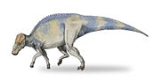
). Modern work has found nearly complete skeletons of the hadrosaurid Brachylophosaurus
.
, siltstone
and sandstone
. Coal
beds, bentonite
and coquina
s are also observed.
family are also known from the formation.
. It is overlain by the Bearpaw Formation
. It is equivalent to the Belly River Formation in the southern Canadian Rockies
foothills, the Lea Park Formation
in central Alberta
and the Wapiti Formation
in the northwestern plains. To the east, it correlates with the sum of Oldman Formation
and Foremost Formation
.
Fossil
Fossils are the preserved remains or traces of animals , plants, and other organisms from the remote past...
-bearing geologic formation
Geologic formation
A formation or geological formation is the fundamental unit of lithostratigraphy. A formation consists of a certain number of rock strata that have a comparable lithology, facies or other similar properties...
in Montana
Montana
Montana is a state in the Western United States. The western third of Montana contains numerous mountain ranges. Smaller, "island ranges" are found in the central third of the state, for a total of 77 named ranges of the Rocky Mountains. This geographical fact is reflected in the state's name,...
, and is part of the Judith River Group
Judith River Group
The Judith River Group is a group of geologic formations in western North America dating from the late Cretaceous and noted as a site for the extensive excavation of dinosaur fossils. The formation is named after the Judith River in Montana. The group is also called the Judith River Wedge...
. It dates to the upper Cretaceous
Cretaceous
The Cretaceous , derived from the Latin "creta" , usually abbreviated K for its German translation Kreide , is a geologic period and system from circa to million years ago. In the geologic timescale, the Cretaceous follows the Jurassic period and is followed by the Paleogene period of the...
, between 80 and 75 million years ago, corresponding to the "Judithian" land vertebrate age. It was laid down during the same time period as the Two Medicine Formation
Two Medicine Formation
The Two Medicine Formation is a geologic formation, or rock body, that was deposited between 83.5 ± 0.7 Ma to 70.6 ± 0.6 Ma , during Campanian time, and is located in northwestern Montana...
of Wyoming and the Belly River Group
Belly River Group
The Belly River Formation is a stratigraphical unit of Late Cretaceous age in the Western Canadian Sedimentary Basin.It takes the name from the Belly River, a tributary of the Oldman River in southern Alberta, and was first described in outcrop on the banks of the Oldman River and Bow River by...
of Alberta.
It is an historically important formation, explored by early American paleontologists such as Edward Drinker Cope
Edward Drinker Cope
Edward Drinker Cope was an American paleontologist and comparative anatomist, as well as a noted herpetologist and ichthyologist. Born to a wealthy Quaker family, Cope distinguished himself as a child prodigy interested in science; he published his first scientific paper at the age of nineteen...
, who named several dinosaurs from scrappy remains found here on his 1876 expedition (such as Monoclonius
Monoclonius
Monoclonius was a ceratopsian dinosaur from the Judith River Formation of Late Cretaceous Montana and Canada. It is often confused with Centrosaurus, a similar genus of ceratopsian . Monoclonius was described by Edward Drinker Cope in 1876...
). Modern work has found nearly complete skeletons of the hadrosaurid Brachylophosaurus
Brachylophosaurus
Brachylophosaurus was a mid-sized member of the hadrosaurid family of dinosaurs. It is known from several skeletons and bonebed material from the Judith River Formation of Montana and the Oldman Formation of Alberta, living about 76.5 million years ago....
.
Lithology
The Judith River Formation is composed of mudstoneMudstone
Mudstone is a fine grained sedimentary rock whose original constituents were clays or muds. Grain size is up to 0.0625 mm with individual grains too small to be distinguished without a microscope. With increased pressure over time the platey clay minerals may become aligned, with the...
, siltstone
Siltstone
Siltstone is a sedimentary rock which has a grain size in the silt range, finer than sandstone and coarser than claystones.- Description :As its name implies, it is primarily composed of silt sized particles, defined as grains 1/16 - 1/256 mm or 4 to 8 on the Krumbein phi scale...
and sandstone
Sandstone
Sandstone is a sedimentary rock composed mainly of sand-sized minerals or rock grains.Most sandstone is composed of quartz and/or feldspar because these are the most common minerals in the Earth's crust. Like sand, sandstone may be any colour, but the most common colours are tan, brown, yellow,...
. Coal
Coal
Coal is a combustible black or brownish-black sedimentary rock usually occurring in rock strata in layers or veins called coal beds or coal seams. The harder forms, such as anthracite coal, can be regarded as metamorphic rock because of later exposure to elevated temperature and pressure...
beds, bentonite
Bentonite
Bentonite is an absorbent aluminium phyllosilicate, essentially impure clay consisting mostly of montmorillonite. There are different types of bentonite, each named after the respective dominant element, such as potassium , sodium , calcium , and aluminum . Experts debate a number of nomenclatorial...
and coquina
Coquina
Coquina is a sedimentary rock that is composed either wholly or almost entirely of the transported, abraded, and mechanically sorted fragments of the shells of either molluscs, trilobites, brachiopods, or other invertebrates. For a sediment to be considered to be a coquina, the average size of the...
s are also observed.
Amphibians
There are three potential species of discoglossid frogs. Hip bones, possibly representing a North American member of the European spadefoot toadEuropean spadefoot toad
The European spadefoot toads are a family of frogs, the Pelobatidae, with only one genus Pelobates, containing four species. They are native to Europe, the Mediterranean, northwestern Africa and western Asia.- Description :...
family are also known from the formation.
| Amphibian Amphibian Amphibians , are a class of vertebrate animals including animals such as toads, frogs, caecilians, and salamanders. They are characterized as non-amniote ectothermic tetrapods... s of the Judith River Formation |
|||||||
|---|---|---|---|---|---|---|---|
| Genus | Species | Location | Stratigraphic position | Abundance | Notes | Images | |
Habrosaurus Habrosaurus Habrosaurus is an extinct genus of prehistoric salamander, and the oldest known member of the family Sirenidae. Two species are known, Habrosaurus prodilatus from the Campanian of Alberta, and Habrosaurus dilatus from the late Maastrichtian and Paleocene of western North America... |
H. dilatus |
A siren Siren (amphibian) Sirenidae, the sirens, is a family of aquatic salamanders. Family members have very small forelimbs, and lack hind limbs altogether. In one species, the skeleton in their forelimbs is made of only cartilage. In contrast to most other salamanders, they have external gills bunched together on the... . |
|||||
Lisserpeton Lisserpeton Lisserpeton is an extinct genus of prehistoric amphibian.-See also:* Prehistoric amphibian* List of prehistoric amphibians... |
L. bairdi |
A scapherpetonid salamander Salamander Salamander is a common name of approximately 500 species of amphibians. They are typically characterized by a superficially lizard-like appearance, with their slender bodies, short noses, and long tails. All known fossils and extinct species fall under the order Caudata, while sometimes the extant... . |
|||||
Opisthotriton Opisthotriton Opisthotriton is an extinct genus of prehistoric salamanders that lived in North America between at least the Upper Cretaceous and the Paleocene.... |
O. kayi |
A possible lungless salamander Lungless salamander The Plethodontidae, or Lungless salamanders, are a family of salamanders. Most species are native to the western hemisphere, from British Columbia to Brazil, although a few species are found in Sardinia, Europe south of the Alps, and South Korea... . |
|||||
Prodesmodon Prodesmodon Prodesmodon is an extinct genus of prehistoric amphibian.-See also:* Prehistoric amphibian* List of prehistoric amphibians... |
P. copei |
A lungless salamander Lungless salamander The Plethodontidae, or Lungless salamanders, are a family of salamanders. Most species are native to the western hemisphere, from British Columbia to Brazil, although a few species are found in Sardinia, Europe south of the Alps, and South Korea... . |
|||||
Scapherpeton Scapherpeton Scapherpeton is an extinct genus of prehistoric amphibian.-See also:* Prehistoric amphibian* List of prehistoric amphibians... |
S. tectum |
A scapherpetonid salamander. |
|||||
Bony fish
| Bony fishes of the Judith River Formation | |||||||
|---|---|---|---|---|---|---|---|
| Genus | Species | Location | Stratigraphic position | Abundance | Notes | Images | |
Belonostomus Belonostomus Belonostomus or Diphyodus is a genus of prehistoric fish that was described by Louis Agassiz in 1844. Fossils range from to Belonostomus (meaning "big long mouth") or Diphyodus (meaning "double tooth") is a genus of prehistoric fish that was described by Louis Agassiz in 1844. Fossils range... |
Belonostomus longirostris |
An aspidorhynchiform Aspidorhynchiformes Aspidorhynchiformes is an extinct order of prehistoric fish that was described by Bleeker in 1859.Aspidorhynchiformes has one family, which is divided into two genuses:... . |
|||||
Kindleia |
K. fragosa |
A bowfin Bowfin The Bowfin, Amia calva, is the last surviving member of the order Amiiformes , and of the family Amiidae... . |
|||||
Lepisosteus Lepisosteus Lepisosteus is a genus of gars in the family Lepisosteidae.There are four species:* Lepisosteus oculatus Winchell, 1864 * Lepisosteus osseus... |
L. occidentalis |
A gar Gar In American English the name gar is strictly applied to members of the Lepisosteidae, a family including seven living species of fish in two genera that inhabit fresh, brackish, and occasionally marine, waters of eastern North America, Central America, and the Caribbean islands.-Etymology:In... . |
|||||
?Paralbula Paralbula Paralbula is an extinct genus of prehistoric bony fish.-See also:* Prehistoric fish* List of prehistoric bony fish... |
?P. sp. |
A bonefish Bonefishes The bonefishes are a family of ray-finned fish that are popular as game fish in Florida, select locations in the South Pacific, and the Bahamas and elsewhere. The family is small, with twelve species in two genera.Presently the bonefishes are in their own order: Albuliformes... . |
|||||
Cartilaginous fish
| Cartilaginous fishes of the Judith River Formation | |||||||
|---|---|---|---|---|---|---|---|
| Genus | Species | Location | Stratigraphic position | Abundance | Notes | Images | |
Myledaphus |
M. bipartitus |
A stingray Stingray The stingrays are a group of rays, which are cartilaginous fishes related to sharks. They are classified in the suborder Myliobatoidei of the order Myliobatiformes, and consist of eight families: Hexatrygonidae , Plesiobatidae , Urolophidae , Urotrygonidae , Dasyatidae , Potamotrygonidae The... . |
|||||
Ornithischian dinosaurs
| Ornithischians reported from the Judith River Formation | |||||||
|---|---|---|---|---|---|---|---|
| Genus | Species | Location | Stratigraphic position | Material | Notes | Images | |
Albertaceratops Albertaceratops Albertaceratops was a genus of centrosaurine horned dinosaur from the middle Campanian-age Upper Cretaceous Oldman Formation of Alberta, Canada.... |
A. nesmoi |
A ceratopsid |
   |
||||
Avaceratops Avaceratops Avaceratops is a genus of small ceratopsian dinosaur which lived during the late Campanian during the Late Cretaceous Period in what are now the Northwest United States.-Discoveries and species:... |
A. lammersi |
"[Two] partial skulls, skeleton, juvenile," type specimen |
A ceratopsid |
||||
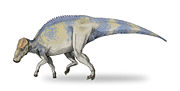
Brachylophosaurus Brachylophosaurus Brachylophosaurus was a mid-sized member of the hadrosaurid family of dinosaurs. It is known from several skeletons and bonebed material from the Judith River Formation of Montana and the Oldman Formation of Alberta, living about 76.5 million years ago.... |
B. canadensis |
A hadrosaurid |
|||||
Ceratops Ceratops Ceratops is a dubious genus of ceratopsian dinosaur which lived during the Late Cretaceous. Its fossils have been found in Montana. Although poorly known, Ceratops is important in the history of dinosaurs, since it is the type species for which both Ceratopsia and Ceratopsidae are named... |
C. montanus |
"Occipital condyle, paired horn cores," type specimen |
A dubious ceratopsid |
||||
Diclonius Diclonius Diclonius is a genus of dinosaur from the Late Cretaceous. It was a hadrosaur based solely on teeth. Its fossils have been found in North America. The name is in reference to the method of tooth replacement, in which newly erupting replacement teeth could be in functional use at the same time as... |
D. calamarius |
"Teeth." |
Nomen dubium |
||||
D. pentagonius |
"Fragmentary dentary with teeth," type specimen |
A dubious hadrosaurid |
|||||
D. perengulatus |
"Teeth." |
Nomen dubium |
|||||
Dysganus Dysganus Dysganus is the name given to a dubious genus of dinosaur from the Late Cretaceous. It was a ceratopsian. Its fossils have been found in Montana.... |
D. bicarinatus |
"Isolated teeth." |
Nomen dubium |
||||
D. encaustus |
"Single tooth and [five] tooth fragments." "Isolated teeth." |
Nomen dubium |
|||||
D. haydenianus |
"Isolated teeth." |
Nomen dubium |
|||||
D. peiganus |
"Tooth." |
Nomen dubium |
|||||
Hadrosaurus Hadrosaurus is a valid genus of hadrosaurid dinosaur. In 1858, a skeleton of a dinosaur from this genus was the first dinosaur skeleton known from more than isolated teeth to be found in North America. In 1868, it became the first ever mounted dinosaur skeleton... |
H. paucidens |
Reclassified as Lambeosaurus? paucidens |
|||||
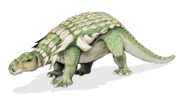
Edmontonia Edmontonia Edmontonia was an armoured dinosaur, a part of the nodosaur family from the Late Cretaceous Period. It is named after the Edmonton Formation , the unit of rock it was found in.-Description:... |
E. longiceps |
Tooth |
Isolated tooth possibly belonging to Edmontonia | ||||
Euoplocephalus Euoplocephalus Euoplocephalus was one of the largest genera of ankylosaurian dinosaurs, at about the size of a small elephant. It is also the ankylosaurian with the best fossil record, so its extensive spiked armor, low-slung body and great club-like tail are well documented.-Description:Among the... |
E. tutus |
||||||
?"Kritosaurus Kritosaurus Kritosaurus is an incompletely known but historically important genus of hadrosaurid dinosaur. It lived about 73 million years ago, in the Late Cretaceous of North America... " |
?"K." breviceps |
A hadrosaurid |
|||||
?Lambeosaurus Lambeosaurus Lambeosaurus is a genus of hadrosaurid dinosaur that lived about 76 to 75 million years ago, in the Late Cretaceous Period of North America. This bipedal/quadrupedal, herbivorous dinosaur is known for its distinctive hollow cranial crest, which in the best-known species resembled a hatchet... |
?L. paucidens |
"Squamosal, maxilla." |
A hadrosaurid |
||||
Medusaceratops Medusaceratops Medusaceratops is a genus of herbivorous ceratopsian dinosaur. It is a chasmosaurine ceratopsian which lived during the Late Cretaceous period in what is now Montana. It is known from two partial parietals, the holotype WDC DJR 001 and the paratype WDC DJR 002... |
M. lokii |
Bonebed |
A ceratopsid |
||||
Monoclonius Monoclonius Monoclonius was a ceratopsian dinosaur from the Judith River Formation of Late Cretaceous Montana and Canada. It is often confused with Centrosaurus, a similar genus of ceratopsian . Monoclonius was described by Edward Drinker Cope in 1876... |
M. crassus |
"[Five] skulls, [one] complete." Type specimen |
A ceratopsid |
||||
"M. fissus" |
"Isolated pterygoid." |
Nomen nudum |
|||||
"M. recurvicornis" |
"Braincase, [three] horns, isolated fragments." |
Nomen nudum |
|||||
"M. sphenocerus" |
"Nasal horn, premaxilla." |
Nomen nudum |
|||||
Paleoscincus |
P. costatus |
"Tooth," type specimen |
A dubious ankylosaur |
||||
Pteropelyx Pteropelyx Pteropelyx is a dubious genus of Late Cretaceous hadrosaurid dinosaur from the Judith River Formation of Montana, named by Edward Drinker Cope in 1889. Historically, several species were assigned to it, all based on extremely fragmentary remains, but there is no evidence to support these assignments... |
P. grallipes |
"Skeleton lacking skull." |
A dubious hadrosaurid |
||||
Stegoceras Stegoceras Stegoceras is a genus of plant-eating pachycephalosaurid dinosaur that lived in what is now North America during the Late Cretaceous period.... |
?S. validum |
Isolated teeth possibly belonging to Stegoceras or another pachycephalosaur |
|||||
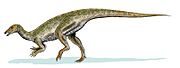
Thescelosaurus Thescelosaurus Thescelosaurus was a genus of small ornithopod dinosaur that appeared at the very end of the Late Cretaceous period in North America. It was a member of the last dinosaurian fauna before the Cretaceous-Tertiary extinction event around 65.5 million years ago... |
Indeterminate |
Isolated teeth possibly belonging to Thescelosaurus. |
|||||
Trachodon Trachodon Trachodon is a dubious genus of hadrosaurid dinosaur based on teeth from the Campanian-age Upper Cretaceous Judith River Formation of Montana, U.S.A... |
T. mirabilis |
Isolated teeth, type specimen |
A dubious hadrosaurid |
||||
Choristoderes
| Choristoderes of the Judith River Formation | |||||||
|---|---|---|---|---|---|---|---|
| Genus | Species | Location | Stratigraphic position | Abundance | Notes | Images | |
Champsosaurus Champsosaurus Champsosaurus is an extinct genus of diapsid reptile belonging to the order Choristodera. It grew to about 1.50 m long.... |
C. sp. |
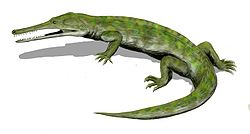 |
|||||
Crocodilians
| Crocodillians of the Judith River Formation | |||||||
|---|---|---|---|---|---|---|---|
| Genus | Species | Location | Stratigraphic position | Abundance | Notes | Images | |
Brachychampsa Brachychampsa Brachychampsa is an extinct genus of alligatoroid. Specimens have been found from New Mexico, Colorado, Wyoming, Montana, North and South Dakota, New Jersey, and Saskatchewan. One specimen has been found from the Darbasa Formation of Kazakhstan, although the species status is indeterminant for the... |
B. montana |
An alligatorid. | |||||
Leidyosuchus Leidyosuchus Leidyosuchus is an extinct genus of alligatoroid from the Late Cretaceous of Alberta. It was named in 1907 by Lawrence Lambe, and the type species is L. canadensis. It is known from a number of specimens from the middle Campanian age Dinosaur Park Formation... |
L. canadensis |
An alligatorid. | |||||
Lizards
| Lizard Lizard Lizards are a widespread group of squamate reptiles, with nearly 3800 species, ranging across all continents except Antarctica as well as most oceanic island chains... s of the Judith River Formation |
|||||||
|---|---|---|---|---|---|---|---|
| Genus | Species | Location | Stratigraphic position | Abundance | Notes | Images | |
Chamops |
C. segnis |
A whiptail Teiidae Teiidae is a family of lizards native to the Americas, generally known as whiptails. The group includes the parthenogenic genera Cnemidophorus and Aspidoscelis, and the non-parthenogenic Tupinambis. It has over 230 member species in ten genera... . |
|||||
Exostinus |
E. lancensis |
A knob-scaled lizard Xenosauridae The Xenosauridae is a family of lizards native to Central America and China. Also known as knob-scaled lizards, they have rounded, bumpy scales and osteoderms. Most species prefer moist or semi-aquatic habitats, although they are widespread within their native regions, with some even inhabiting... . |
|||||
Leptochamops |
L. denticulatus |
A whiptail. |
|||||
Paraderma |
P. bogerti |
A parasaniwid. |
|||||
Parasaniwa |
P. wyomingensis |
A parasaniwid. |
|||||
Theropod dinosaurs
An unnamed tyrannosaurine is known from the formation.| Theropods reported from the Judith River Formation | |||||||
|---|---|---|---|---|---|---|---|
| Genus | Species | Location | Stratigraphic position | Material | Notes | Images | |
Aublysodon Aublysodon Aublysodon is a name given to a large number of carnivorous dinosaur teeth of a certain form found in numerous late Cretaceous period geological formations... |
A. lateralis |
"Isolated teeth," type specimen |
Isolated tyrannosaur teeth assigned to the dubious genus Aublysodon |
||||
A. mirandus |
Teeth, type specimen |
||||||
Coniornis |
C. altus |
Partial tibiotarsus |
One of the only known freshwater occurrences of a hesperornithid. |
||||
Deinodon Deinodon Deinodon is a name assigned to tyrannosaurid teeth of the Late Cretaceous of Montana by paleontologist Joseph Leidy in 1856... |
D. falculus |
Teeth |
Isolated tyrannosaur teeth classified in the dubious genus Deinodon |
||||
D. hazenianus |
Teeth |
Isolated tyrannosaur teeth classified in the dubious genus Deinodon |
|||||
D. horridus |
"Teeth," type specimen |
Isolated tyrannosaur teeth that formed the basis of the dubious genus Deinodon |
|||||
D. incrassatus |
Teeth |
Isolated tyrannosaur teeth classified in the dubious genus Deinodon |
|||||
D. lateralis |
Junior synonym of Aublysodon Aublysodon Aublysodon is a name given to a large number of carnivorous dinosaur teeth of a certain form found in numerous late Cretaceous period geological formations... lateralis |
||||||
Dromaeosaurus Dromaeosaurus Dromaeosaurus was a genus of theropod dinosaur which lived during the Late Cretaceous period , sometime between 76.5 and 74.8 million years ago, in the western United States and Alberta, Canada. The name means 'running lizard'.... |
D. albertensis |
Teeth |
A dromaeosaurid, also found in the Dinosaur Park Dinosaur Park Formation The Dinosaur Park Formation is the uppermost member of the Judith River Group, a major geologic unit in southern Alberta. It was laid down over a period of time between about 76.5 and 75 million years ago. The formation is made up of deposits of a high-sinuosity fluvial system, and is capped... , Mesaverde Mesaverde Formation The Mesaverde Formation is a Late Cretaceous geologic formation.The formation is described by W.G. Pierce as interbedded light gray sandstone and gray shale in upper part; lower part massive, light-buff, ledge-forming sandstone containing thin lenticular coal beds.The formation occurs in various... , and Prince Creek Formation Prince Creek Formation The Prince Creek Formation is a geological formation in Alaska with strata from the early Maastrichtian stage of the Upper Cretaceous, dating to between 70 and 69 million years ago... s |
||||
D. explanatus |
"Tooth." |
||||||
D. falculus |
Junior synonym of Deinodon Deinodon Deinodon is a name assigned to tyrannosaurid teeth of the Late Cretaceous of Montana by paleontologist Joseph Leidy in 1856... falculus |
||||||
D. laevifrons |
"Tooth." |
||||||
Dryptosaurus Dryptosaurus Dryptosaurus was a genus of primitive tyrannosaur that lived in Eastern North America during the middle Maastrichtian stage of the Late Cretaceous period. Although largely unknown now outside of academic circles, a famous painting of the genus by Charles R... |
D. explanatus (formerly Laelaps, preoccupied) |
Reclassified as Dromaeosaurus explanatus |
|||||
D. falculus (formerly Laelaps, preoccupied) |
Junior synonym of Deinodon Deinodon Deinodon is a name assigned to tyrannosaurid teeth of the Late Cretaceous of Montana by paleontologist Joseph Leidy in 1856... falculus |
||||||
D. hazenianus (formerly Laelaps, preoccupied) |
Junior synonym of Deinodon Deinodon Deinodon is a name assigned to tyrannosaurid teeth of the Late Cretaceous of Montana by paleontologist Joseph Leidy in 1856... hazenianus |
||||||
D. incrassatus (formerly Laelaps, preoccupied) |
Junior synonym of Deinodon Deinodon Deinodon is a name assigned to tyrannosaurid teeth of the Late Cretaceous of Montana by paleontologist Joseph Leidy in 1856... incrassatus |
||||||
D. laevifrons (formerly Laelaps, preoccupied) |
Reclassified as Dromaeosaurus laevifrons |
||||||
Gorgosaurus Gorgosaurus Gorgosaurus is a genus of tyrannosaurid theropod dinosaur that lived in western North America during the Late Cretaceous Period, between about 76.5 and 75 million years ago. Fossil remains have been found in the Canadian province of Alberta and possibly the U.S. state of Montana.... |
G. libratus |
Incomplete skeleton |
A tyrannosaurid, also present in the Dinosaur Park Dinosaur Park Formation The Dinosaur Park Formation is the uppermost member of the Judith River Group, a major geologic unit in southern Alberta. It was laid down over a period of time between about 76.5 and 75 million years ago. The formation is made up of deposits of a high-sinuosity fluvial system, and is capped... and Oldman Formation Oldman Formation The Oldman Formation is the middle member of the Judith River Group, a major geologic unit in southern Alberta. The formation is widely recognized as bearing a great number of well preserved dinosaur skeletons, as well as other fossils.-Age:... s |
||||
Ornithomimus Ornithomimus Ornithomimus is a genus of ornithomimid dinosaur from the Late Cretaceous Period of what is now North America.In 1890 Ornithomimus velox was named by Othniel Charles Marsh on the basis of a foot and partial hand from the Maastrichtian Denver Formation. Another seventeen species have been named since... |
O. tenuis |
"Fragmentary metatarsal." |
A possible troodontid or juvenile tyrannosaurid |
||||
Paronychodon Paronychodon Paronychodon was a theropod dinosaur genus. It is a tooth taxon, considered dubious because of the fragmentary nature of the fossils, which include "buckets" of teeth but no other remains... |
P. lacustris |
Teeth, type specimen |
An indeterminate maniraptoran, also found in the Dinosaur Park Dinosaur Park Formation The Dinosaur Park Formation is the uppermost member of the Judith River Group, a major geologic unit in southern Alberta. It was laid down over a period of time between about 76.5 and 75 million years ago. The formation is made up of deposits of a high-sinuosity fluvial system, and is capped... , Milk River Milk River Formation The Milk River Formation is a near- shore to terrestrial sedimentary unit deposited during the Late Cretaceous in southern Alberta... , Frenchman Frenchman Formation The Frenchman Formation is a division of Upper Cretaceous rocks found in Saskatchewan, Canada. More accurately described as Late Maastrichtian, these rocks contain the youngest of dinosaur genera, much like the Hell Creek Formation in the United States.... , Horseshoe Canyon Horseshoe Canyon Formation The Horseshoe Canyon Formation is part of the Edmonton Group and is up to 230m in thickness. It is Late Campanian to Early Maastrichtian in age and is composed of mudstone, sandstone, and carbonaceous shales... , Scollard Scollard Formation -References:* Ryan, M. J., and Russell, A. P., 2001. Dinosaurs of Alberta : In: Mesozoic Vertebrate Life, edited by Tanke, D. H., and Carpenter, K., Indiana University Press, pp. 279-297.... , and Lance Lance Formation The Lance Formation is a division of Late Cretaceous rocks in the western United States. Named after Lance Creek, Wyoming, the microvertebrate fossils and dinosaurs represent important components of the latest Mesozoic vertebrate faunas... and Kirtland Formation Kirtland Formation The Kirtland Formation is a sedimentary geological formation. It is the product of alluvial muds and overbank sand deposits from the many channels draining the coastal plain that existed on the inland seashore of North America, in the late Cretaceous period. It overlies the Fruitland Formation... s |
||||
Troodon Troodon Troodon is a genus of relatively small, bird-like dinosaur from the Late Cretaceous period . Discovered in 1855, it was among the first dinosaurs found in North America... |
T. formosus |
Teeth (type specimen), vertebra, egg |
A troodontid, also found in the Oldman Oldman Formation The Oldman Formation is the middle member of the Judith River Group, a major geologic unit in southern Alberta. The formation is widely recognized as bearing a great number of well preserved dinosaur skeletons, as well as other fossils.-Age:... , Dinosaur Park Dinosaur Park Formation The Dinosaur Park Formation is the uppermost member of the Judith River Group, a major geologic unit in southern Alberta. It was laid down over a period of time between about 76.5 and 75 million years ago. The formation is made up of deposits of a high-sinuosity fluvial system, and is capped... , Lance Lance Formation The Lance Formation is a division of Late Cretaceous rocks in the western United States. Named after Lance Creek, Wyoming, the microvertebrate fossils and dinosaurs represent important components of the latest Mesozoic vertebrate faunas... , and Two Medicine Formation Two Medicine Formation The Two Medicine Formation is a geologic formation, or rock body, that was deposited between 83.5 ± 0.7 Ma to 70.6 ± 0.6 Ma , during Campanian time, and is located in northwestern Montana... s |
||||
Zapsalis |
Z. abradens |
"Teeth," type specimen |
Possible junior synonym of Paronychodon Paronychodon Paronychodon was a theropod dinosaur genus. It is a tooth taxon, considered dubious because of the fragmentary nature of the fossils, which include "buckets" of teeth but no other remains... lacustris |
||||
Turtles
| Turtle Turtle Turtles are reptiles of the order Testudines , characterised by a special bony or cartilaginous shell developed from their ribs that acts as a shield... s of the Judith River Formation |
|||||||
|---|---|---|---|---|---|---|---|
| Genus | Species | Location | Stratigraphic position | Abundance | Notes | Images | |
Basilemys |
B. sp. |
A Mesoamerican river turtle. |
|||||
Relationship with other units
The Judith River Formation conformably overlies the Claggett Formation and Pakowki FormationPakowki Formation
The Pakowki Formation is a stratigraphical unit of Campanian age in the Western Canadian Sedimentary Basin.It takes the name from Pakowki Lake, and was first described in outcrop along the Pakowki Coulee by D.B. Dowling in 1916.-Lithology:...
. It is overlain by the Bearpaw Formation
Bearpaw Formation
The Bearpaw Formation, also called the Bearpaw Shale, is a sedimentary rock formation found in northwestern North America. It is exposed in the U.S. state of Montana, as well as the Canadian provinces of Alberta and Saskatchewan, east of the Rocky Mountains...
. It is equivalent to the Belly River Formation in the southern Canadian Rockies
Canadian Rockies
The Canadian Rockies comprise the Canadian segment of the North American Rocky Mountains range. They are the eastern part of the Canadian Cordillera, extending from the Interior Plains of Alberta to the Rocky Mountain Trench of British Columbia. The southern end borders Idaho and Montana of the USA...
foothills, the Lea Park Formation
Lea Park Formation
The Lea Park Formation is a stratigraphical unit of Late Cretaceous age in the Western Canadian Sedimentary Basin, Canada.It takes the name from the settlement of Lea Park, Alberta, located north-west of Lloydminster on the banks of the North Saskatchewan River. It was first defined in an outcrop...
in central Alberta
Central Alberta
Central Alberta is a region located in the Canadian province of Alberta.Central Alberta is the most densely populated rural area in the province...
and the Wapiti Formation
Wapiti Formation
The Wapiti Formation is a geological formation in Alberta, Canada whose strata date back to the Late Cretaceous. Dinosaur remains are among the fossils that have been recovered from the formation. The Wapiti Formation outcrops in northwestern Wapiti Formation...
in the northwestern plains. To the east, it correlates with the sum of Oldman Formation
Oldman Formation
The Oldman Formation is the middle member of the Judith River Group, a major geologic unit in southern Alberta. The formation is widely recognized as bearing a great number of well preserved dinosaur skeletons, as well as other fossils.-Age:...
and Foremost Formation
Foremost Formation
The Foremost Formation is a geological formation in Alberta, Canada whose strata date back to the Late Cretaceous. Dinosaur remains are among the fossils that have been recovered from the formation.-Dinosaurs:...
.