

Edmontonia

Encyclopedia
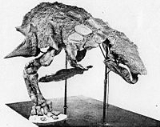
Edmontonia was an armoured
dinosaur
, a part of the nodosaur family from the Late Cretaceous
Period. It is named after the Edmonton Formation (now the Horseshoe Canyon Formation
), the unit of rock it was found in.
 Edmontonia was bulky and tank
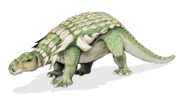
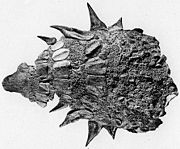
-like at roughly 6.6 m (22 ft) long and 2 m (6 ft) high. It had small, ridged bony plates on its back and head and many sharp spikes along its back and tail. The four largest spikes jutted out from the shoulders on each side, two of which were split into subspines in some specimens. Its skull had a pear
-like shape when viewed from above. (Compare 26 feet long and 8 feet high for the M1 Abrams
army tank.)
 The type species
of Edmontonia, E. longiceps was discovered in 1924 by George Paterson. It wasn't named until 1928 by C. M. Sternberg. E. rugosidens, formally named by Gilmore
in 1930, is reported from the Aguja formation in Texas
. Edmontonia species include:
Usually included in this genus is Denversaurus schlessmani ("Schlessman's Denver lizard
"). This taxon
was erected by Bakker in 1988 for a skull from the Late Maastrichtian
Upper Cretaceous Lance Formation
of South Dakota
, but considered by later workers to belong to Edmontonia rugosidens. The type specimen
of Denversaurus is in the collections of the Denver Museum of Natural History (now the Denver Museum of Nature and Science
), Denver, Colorado
(for which the genus was named).
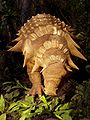
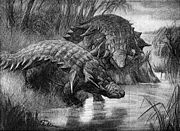 The large spikes were probably used between males in contests of strength to defend territory or gain mates. The spikes would also have been useful for intimidating predators or rival males, protection, or for self-defense. To protect itself from predators, an Edmontonia might have crouched down on the ground to minimize the possibility of attack to its defenseless underbelly.
Rings in the petrified wood of trees contemporary with Edmontonia show evidence of strong seasonal changes in precipitation and temperature; this may hold an explanation for why so many specimens have been found with their armor plating and spikes in the same position they were in life. The Edmontonia could have died due to drought, dried up, and then rapidly became covered in sediment when the rainy season began.
Armour (zoology)
Armour in animals is external or superficial protection against attack by predators, formed as part of the body , usually through the hardening of body tissues, outgrowths or secretions. It has therefore mostly developed in 'prey' species...
dinosaur
Dinosaur
Dinosaurs are a diverse group of animals of the clade and superorder Dinosauria. They were the dominant terrestrial vertebrates for over 160 million years, from the late Triassic period until the end of the Cretaceous , when the Cretaceous–Paleogene extinction event led to the extinction of...
, a part of the nodosaur family from the Late Cretaceous
Cretaceous
The Cretaceous , derived from the Latin "creta" , usually abbreviated K for its German translation Kreide , is a geologic period and system from circa to million years ago. In the geologic timescale, the Cretaceous follows the Jurassic period and is followed by the Paleogene period of the...
Period. It is named after the Edmonton Formation (now the Horseshoe Canyon Formation
Horseshoe Canyon Formation
The Horseshoe Canyon Formation is part of the Edmonton Group and is up to 230m in thickness. It is Late Campanian to Early Maastrichtian in age and is composed of mudstone, sandstone, and carbonaceous shales...
), the unit of rock it was found in.
Description
Tank
A tank is a tracked, armoured fighting vehicle designed for front-line combat which combines operational mobility, tactical offensive, and defensive capabilities...
-like at roughly 6.6 m (22 ft) long and 2 m (6 ft) high. It had small, ridged bony plates on its back and head and many sharp spikes along its back and tail. The four largest spikes jutted out from the shoulders on each side, two of which were split into subspines in some specimens. Its skull had a pear
Pear
The pear is any of several tree species of genus Pyrus and also the name of the pomaceous fruit of these trees. Several species of pear are valued by humans for their edible fruit, but the fruit of other species is small, hard, and astringent....
-like shape when viewed from above. (Compare 26 feet long and 8 feet high for the M1 Abrams
M1 Abrams
The M1 Abrams is a third-generation main battle tank produced in the United States. It is named after General Creighton Abrams, former Army Chief of Staff and Commander of US military forces in Vietnam from 1968 to 1972. The M1 is a well armed, heavily armored, and highly mobile tank designed for...
army tank.)
Discovery and species
Type species
In biological nomenclature, a type species is both a concept and a practical system which is used in the classification and nomenclature of animals and plants. The value of a "type species" lies in the fact that it makes clear what is meant by a particular genus name. A type species is the species...
of Edmontonia, E. longiceps was discovered in 1924 by George Paterson. It wasn't named until 1928 by C. M. Sternberg. E. rugosidens, formally named by Gilmore
Charles W. Gilmore
Charles Whitney Gilmore was an American paleontologist, who named dinosaurs in North America and Mongolia, including the Cretaceous sauropod Alamosaurus, Alectrosaurus, Archaeornithomimus, Bactrosaurus, Brachyceratops, Chirostenotes, Mongolosaurus, Parrosaurus, Pinacosaurus, Styracosaurus and...
in 1930, is reported from the Aguja formation in Texas
Texas
Texas is the second largest U.S. state by both area and population, and the largest state by area in the contiguous United States.The name, based on the Caddo word "Tejas" meaning "friends" or "allies", was applied by the Spanish to the Caddo themselves and to the region of their settlement in...
. Edmontonia species include:
- E. longiceps, the typeType speciesIn biological nomenclature, a type species is both a concept and a practical system which is used in the classification and nomenclature of animals and plants. The value of a "type species" lies in the fact that it makes clear what is meant by a particular genus name. A type species is the species...
), is known from the middle Horseshoe Canyon FormationHorseshoe Canyon FormationThe Horseshoe Canyon Formation is part of the Edmonton Group and is up to 230m in thickness. It is Late Campanian to Early Maastrichtian in age and is composed of mudstone, sandstone, and carbonaceous shales...
(Unit 2) dated to 71.5-71 million years ago. - E. rugosidens, is sometimes given its own genus, Chassternbergia, first coined as a subgenusSubgenusIn biology, a subgenus is a taxonomic rank directly below genus.In zoology, a subgeneric name can be used independently or included in a species name, in parentheses, placed between the generic name and the specific epithet: e.g. the Tiger Cowry of the Indo-Pacific, Cypraea tigris Linnaeus, which...
by Dr. Robert T. BakkerRobert T. BakkerRobert T. Bakker is an American paleontologist who helped reshape modern theories about dinosaurs, particularly by adding support to the theory that some dinosaurs were endothermic...
in 1988 (Edmontonia (Chassternbergia) rugosidens) and based on differences in skull proportion from E. longiceps and its earlier time period. This subgenus or genus is not generally accepted; It is found in the lower Dinosaur Park FormationDinosaur Park FormationThe Dinosaur Park Formation is the uppermost member of the Judith River Group, a major geologic unit in southern Alberta. It was laid down over a period of time between about 76.5 and 75 million years ago. The formation is made up of deposits of a high-sinuosity fluvial system, and is capped...
, dating about 76.5-75 million years ago. - And E. australis, which is known from cervical scutes only, and is considered to be a dubious nameNomen dubiumIn zoological nomenclature, a nomen dubium is a scientific name that is of unknown or doubtful application...
or a synonym of GlyptodontopeltaGlyptodontopeltaGlyptodontopelta is a genus of dinosaur from the Late Cretaceous. It was an ankylosaur, an armored dinosaur....
mimus.
Usually included in this genus is Denversaurus schlessmani ("Schlessman's Denver lizard
Lizard
Lizards are a widespread group of squamate reptiles, with nearly 3800 species, ranging across all continents except Antarctica as well as most oceanic island chains...
"). This taxon
Taxon
|thumb|270px|[[African elephants]] form a widely-accepted taxon, the [[genus]] LoxodontaA taxon is a group of organisms, which a taxonomist adjudges to be a unit. Usually a taxon is given a name and a rank, although neither is a requirement...
was erected by Bakker in 1988 for a skull from the Late Maastrichtian
Maastrichtian
The Maastrichtian is, in the ICS' geologic timescale, the latest age or upper stage of the Late Cretaceous epoch or Upper Cretaceous series, the Cretaceous period or system, and of the Mesozoic era or erathem. It spanned from 70.6 ± 0.6 Ma to 65.5 ± 0.3 Ma...
Upper Cretaceous Lance Formation
Lance Formation
The Lance Formation is a division of Late Cretaceous rocks in the western United States. Named after Lance Creek, Wyoming, the microvertebrate fossils and dinosaurs represent important components of the latest Mesozoic vertebrate faunas...
of South Dakota
South Dakota
South Dakota is a state located in the Midwestern region of the United States. It is named after the Lakota and Dakota Sioux American Indian tribes. Once a part of Dakota Territory, South Dakota became a state on November 2, 1889. The state has an area of and an estimated population of just over...
, but considered by later workers to belong to Edmontonia rugosidens. The type specimen
Holotype
A holotype is a single physical example of an organism, known to have been used when the species was formally described. It is either the single such physical example or one of several such, but explicitly designated as the holotype...
of Denversaurus is in the collections of the Denver Museum of Natural History (now the Denver Museum of Nature and Science
Denver Museum of Nature and Science
The Denver Museum of Nature & Science is a municipal natural history and science museum in Denver, Colorado. It is a resource for informal science education in the Rocky Mountain region. A variety of exhibitions, programs, and activities help museum visitors learn about the natural history of...
), Denver, Colorado
Colorado
Colorado is a U.S. state that encompasses much of the Rocky Mountains as well as the northeastern portion of the Colorado Plateau and the western edge of the Great Plains...
(for which the genus was named).
Paleobiology
Rings in the petrified wood of trees contemporary with Edmontonia show evidence of strong seasonal changes in precipitation and temperature; this may hold an explanation for why so many specimens have been found with their armor plating and spikes in the same position they were in life. The Edmontonia could have died due to drought, dried up, and then rapidly became covered in sediment when the rainy season began.