
All Topics  
Gar

 
Gar

   Email Print
   Bookmark   Link


Gar


In American English
American English

PhonologyIn many ways, compared to English language in England, North American English is conservative in its phonology. Some distinctive accents can be found on the East Coast of the United States , partly because these areas were in contact with England, and imitated prestigious varieties of English English at a time when those varieties we...
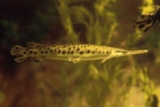
 the name gar (or garpike) is strictly applied to members of the Lepisosteus, a family including seven living species of fish in two genera that inhabit fresh, brackish, and occasionally marine, waters of eastern North America
North America

North America is the northern continent of the Americas, situated in the Earth's northern hemisphere and almost totally in the western hemisphere....
, Central America
Central America

Central America is a central geography region of the Americas. It is the southernmost, isthmus portion of the North American continent, which connects with South America on the southeast....
, and the Caribbean
Caribbean

The Caribbean is a region consisting of the Caribbean Sea, its islands , and the surrounding coasts. The region is located southeast of the Gulf of Mexico and Northern America, east of Central America, and to the north of South America....
 islands.

a class="link1" onMouseover='showByLink("m1147822",this)' onMouseout='hide("m1147822")'href="http://www.absoluteastronomy.com/topics/British_English">British English
British English

British English or UK English is the broad term used to distinguish the forms of the English language used in the United Kingdom from forms used elsewhere....
 the name gar was originally used for a species of needlefish
Needlefish

Needlefish are piscivorous fishes primarily associated with very shallow marine habitats or the surface of the open sea. Some genera include species found in marine, brackish, and freshwater environments while a few genera are confined to freshwater rivers and streams, including Belonion, Potamorrhaphis, and Xenentodon....
, Belone belone, found in the North Atlantic, itself likely named after the Old English word gar meaning "spear".


Discussion
Ask a question about 'Gar'
Start a new discussion about 'Gar'
Answer questions from other users
Full Discussion Forum


Encyclopedia


In American English
American English

PhonologyIn many ways, compared to English language in England, North American English is conservative in its phonology. Some distinctive accents can be found on the East Coast of the United States , partly because these areas were in contact with England, and imitated prestigious varieties of English English at a time when those varieties we...
 the name gar (or garpike) is strictly applied to members of the Lepisosteus, a family including seven living species of fish in two genera that inhabit fresh, brackish, and occasionally marine, waters of eastern North America
North America

North America is the northern continent of the Americas, situated in the Earth's northern hemisphere and almost totally in the western hemisphere....
, Central America
Central America

Central America is a central geography region of the Americas. It is the southernmost, isthmus portion of the North American continent, which connects with South America on the southeast....
, and the Caribbean
Caribbean

The Caribbean is a region consisting of the Caribbean Sea, its islands , and the surrounding coasts. The region is located southeast of the Gulf of Mexico and Northern America, east of Central America, and to the north of South America....
 islands.

Etymology

In British English
British English

British English or UK English is the broad term used to distinguish the forms of the English language used in the United Kingdom from forms used elsewhere....
 the name gar was originally used for a species of needlefish
Needlefish

Needlefish are piscivorous fishes primarily associated with very shallow marine habitats or the surface of the open sea. Some genera include species found in marine, brackish, and freshwater environments while a few genera are confined to freshwater rivers and streams, including Belonion, Potamorrhaphis, and Xenentodon....
, Belone belone, found in the North Atlantic, itself likely named after the Old English word gar meaning "spear". Belone belone is now more commonly referred to as the "garpike" or "gar fish" to avoid confusion with the North American gars of the family Lepisosteidae.

The genus name Lepisosteus comes from the Greek
Greek language

Greek is an Indo-European languages native to the southern Balkan peninsula, the language of the Greek people. It forms an independent branch within Indo-European....
 lepis meaning "scale" and osteon meaning "bone". Atractosteus is similarly derived from Greek, in this case from atraktos, meaning "arrow".

Distribution

The gars are members of the Lepisosteiformes (or Semionotiformes), an ancient order of "primitive" ray-finned fish; fossils from this order are known from the late Permian
Permian

The PermianThe term "Permian" was introduced into geology in 1841 by Sir Roderick Murchison, president of the Geological Society of London, who identified typical strata in extensive Russian explorations undertaken with Edouard de Verneuil; Murchison asserted in 1841 that he named his "Permian system" after the ancient kingdom...
 onwards. Fossil gars are found in Europe, South America, and North America, indicating that in times past these fish had a wider distribution than they do today. Gars are considered to be a remnant of a group of rather primitive bony fish
Osteichthyes

Osteichthyes , also called bony fish, are a taxonomy group of fish that includes the ray-finned fish and lobe finned fish . The split between these two classes occurred around 440 mya ....
 that flourished in the Mesozoic
Mesozoic

The Mesozoic Era is one of three Geologic time scale of the Phanerozoic eon . The division of time into eras dates back to Giovanni Arduino, in the 18th century, although his original name for the era now called the 'Mesozoic' was 'Secondary' ....
, and are most closely related to the bowfin
Bowfin

Bowfins are an order of primitive ray-finned fish. Only one species, the bowfin Amia calva, family Amiidae, exists today, although additional species in six families are known from Jurassic, Cretaceous, and Eocene fossils....
, another archaic fish now found only in North America.

Anatomy and morphology

Gar bodies are elongated, heavily armored with ganoid scale
Scale (zoology)

In most biology nomenclature, a scale is a small rigid plate that grows out of an animal's skin to provide protection. In lepidopteran species, scales are plates on the surface of the insect wing, and provide coloration....
s, and fronted by similarly elongated jaw
Jaw

The jaw is either of the two opposable structures forming, or near the entrance to the mouth.The term jaws is also broadly applied to the whole of the structures constituting the vault of the mouth and serving to open and close it and is part of the body plan of most animals....
s filled with long sharp teeth. Their tails are heterocercal, and the dorsal fin
Dorsal fin

A wikt:dorsal fin is a fin located on the backs of some fish, whales, dolphins, and porpoises, as well as the ichthyosaurs. Its main purpose is to stabilize the animal against rolling and assist in sudden turns....
s are close to the tail. As their vascularised swim bladders can function as lungs, most gar surface periodically to take a gulp of air, doing so more frequently in stagnant or warm water when the concentration of oxygen in the water is low. As a result, they are extremely hardy and able to tolerate conditions that would kill most other fish.

All the gars are relatively big fish, but the alligator gar
Alligator gar

The alligator gar, Atractosteus spatula, is a primitive ray-finned fish. Its also referred to as the gator gar. Unlike other gars, the mature alligator gar possesses a dual row of large teeth in the upper jaw....
 Atractosteus spatula is the biggest, as specimens having been recorded up to in length. Even the smaller species, such as Lepisosteus oculatus, are large, commonly reaching lengths of over , and sometimes much more.

Ecology

Gar tend to be slow moving fish except when striking at their prey. They prefer the shallow and weedy areas of rivers, lakes, and bayou
Bayou

A bayou is a small, slow-moving stream or creek, or a lake or pool that lies in an abandoned channel of a stream. Bayous are usually located in relatively flat, low-lying areas, for example, in the Mississippi River River delta region of the southern United States....
s often congregating in small groups. They are voracious predators, catching their prey with their needle-like teeth, obtaining with a sideways strike of the head. Gar feed extensively on smaller fish and invertebrates such as crabs. Gar are found across eastern North America from Costa Rica
Costa Rica

Costa Rica, officially the Republic of Costa Rica is a country in Central America, bordered by Nicaragua to the north, Panama to the east and south, the Pacific Ocean to the west and south and the Caribbean Sea to the east....
 to southern Quebec
Quebec

Quebec , in French language, Qu?bec , is a Provinces and territories of Canada in the Central Canada and Eastern Canada regions of Canada....
 (for example Lepisosteus osseus). Although gar are primarily found in freshwater habitats several species enter brackish waters and a few, most notably Atractosteus tristoechus, are sometimes found in the sea.

Species

The gar family contains seven species, in two genera:

Family Lepisoteidae
  • Genus Atractosteus
    • Atractosteus spatula - Alligator gar
      Alligator gar

      The alligator gar, Atractosteus spatula, is a primitive ray-finned fish. Its also referred to as the gator gar. Unlike other gars, the mature alligator gar possesses a dual row of large teeth in the upper jaw....
    • Atractosteus tristoechus - Cuban gar
    • Atractosteus tropicus - Tropical gar
      Tropical Gar

      The tropical gar, Atractosteus tropicus, is a fish found in freshwaters from southern Mexico to Costa Rica, reported to reach lengths of up to 1.5 metre in the wild ....
  • Genus Lepisosteus
    Lepisosteus

    Lepisosteus is a genus of gars in the family Lepisosteidae.There are four species:* Lepisosteus oculatus Spotted gar.* Lepisosteus osseus Longnose gar....
    • Lepisosteus oculatus - Spotted gar
      Spotted gar

      The spotted gar is a primitive freshwater fish of the family Lepisosteidae, native to North America from the Lake Erie and southern Lake Michigan drainages south through the Mississippi River basin to Gulf Slope drainages, from lower Apalachicola River in Florida to Nueces River in Texas, USA....
    • Lepisosteus osseus - Longnose gar
      Longnose gar

      The longnose gar, Lepisosteus osseus, is a primitive ray-finned fish of the Lepisosteidae family . It is also known as the needlenose gar....
    • Lepisosteus platostomus - Shortnose gar
      Shortnose gar

      The shortnose gar is a primitive freshwater fish of the family Lepisosteidae. In Greek, Lepisosteus translates to "bony scale," whereas platostomus means "broad mouth."...
    • Lepisosteus platyrhincus - Florida gar
      Florida gar

      The Florida gar is a species of gar that is found in the USA from the Savannah River and Ochlockonee River watersheds of Georgia and throughout peninsular Florida....


Significance to humans

Gar flesh is edible, and sometimes available in markets, but unlike the sturgeon
Sturgeon

Sturgeon is the common name used for some 26 species of fish in the family Acipenseridae, including the genus Acipenser, Huso, Scaphirhynchus and Pseudoscaphirhynchus....
 that they resemble, their eggs (roe)
Roe

Roe or hard roe is the fully ripe internal Ovary or egg masses of fish and certain marine animals, such as shrimp, scallop and sea urchins....
 are poisonous. Several species are traded as aquarium fish.

Gars are of considerable significance to Native American peoples of the southeastern United States where the gar figures prominently in ceremonial life and music.

Alligator Gar have been known to attack humans in some rare cases.

External links