
|
|
|
|
Stingray
|
| |
|
| |
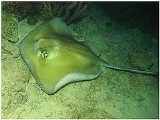
The stingrays are a family, Dasyatidae of rays, cartilaginous fishes related to sharks. They are common in coastal tropical marine waters throughout the world, and several species are known to enter fresh water. Other types of rays also referred to as "stingrays" are the river stingrays (family Potamotrygonidae), the round stingrays (family Urolophidae), the sixgill stingray (family Hexatrygonidae), and the deepwater stingray (family Plesiobatidae).
While most dasyatids are relatively widespread and unlikely to be threatened, there are several species (for example Taeniura meyeni, Dasyatis colarensis, D. garouaensis, and D. laosensis) where the conservation status is more problematic, leading to them being listed as vulnerable or endangered by IUCN.

Discussion
Ask a question about 'Stingray'
Start a new discussion about 'Stingray'
Answer questions from other users
|
Encyclopedia
The stingrays are a family, Dasyatidae of rays, cartilaginous fishes related to sharks. They are common in coastal tropical marine waters throughout the world, and several species are known to enter fresh water. Other types of rays also referred to as "stingrays" are the river stingrays (family Potamotrygonidae), the round stingrays (family Urolophidae), the sixgill stingray (family Hexatrygonidae), and the deepwater stingray (family Plesiobatidae).
While most dasyatids are relatively widespread and unlikely to be threatened, there are several species (for example Taeniura meyeni, Dasyatis colarensis, D. garouaensis, and D. laosensis) where the conservation status is more problematic, leading to them being listed as vulnerable or endangered by IUCN. The status of several other species are poorly known, leading to them being listed as Data Deficient.
A group or collection of stingrays is commonly referred to as a "fever" of stingrays.
Description and biology
Some adult stingrays may be no larger than a human palm, while other species, like the short-tail stingray, may have a body of six feet in diameter and an overall length, including their tail, of fourteen feet. Stingrays range from shades of gray to being brightly colored, and can be plain or patterned. Perhaps the largest stingray ever found weighed almost 1500 kilograms (3300 pounds) and measured over 5 meters (16.5 feet) in width . It was caught by fishermen near Hainan Sanya in China. .
Dasyatids are propelled by motion of their large pectoral fins (commonly mistaken as "wings"). Their stinger is a razor-sharp, barbed, or serrated cartilaginous spine which grows from the ray's whip-like tail (like a fingernail), and can grow as long as 37 cm. On the underside of the spine are two grooves containing venom-secreting glandular tissue. The entire spine is covered with a thin layer of skin called the "integumentary sheath", in which the venom is concentrated. The venom contains the enzymes 5-nucleotidase and phosphodiesterase which break down and kill cells; and the neurotransmitter serotonin which provokes smooth-muscle contractions. This gives them their common name of stingrays (a compound of "sting" and "ray"), but the name can also be used to refer to any poisonous ray. Divers often refer to them as "Sea Devils". Stingrays may also be called the "whip-tailed rays" though this usage is much less common.
Stinging mechanism Stingrays generally do not attack aggressively, or even actively defend themselves. When threatened, their primary reaction is to swim away. However, when attacked by predators or stepped on, the barbed stinger in their tail is whipped up. This attack is normally ineffective against their main predator, sharks.
Depending on the size of the stingray, humans are usually stung in the foot region. It is less likely to be stung by brushing against the stinger. Surfers or those who enter waters with large populations of stingrays have learned to slide their feet through the sand rather than stepping, as the rays detect this and swim away. Stamping hard on the bottom as one treads through murky water will also cause them to swim away. Humans who harass stingrays have been known to be stung elsewhere, sometimes leading to fatalities. The stinger usually breaks off in the wound. This is not fatal to the stingray as it will be regrown at a rate close to that of human fingernails (about .5-.75 inches per month). Contact with the stinger causes local trauma (from the cut itself), pain and swelling from the venom, and possible later infection from bacteria. Immediate injuries to humans include, but are not limited to: poisoning, punctures, severed arteries, and possibly death. Fatal stings are very rare.
On September 4, 2006, television personality Steve Irwin was pierced in the chest by a stingray barb while snorkeling in Australia and died shortly after.
Treatment for stings includes application of near-scalding water, which helps ease pain by denaturing the complex venom protein, and antibiotics. Immediate injection of a local anesthetic in and around the wound is very helpful, as is the use of opiates such as intramuscular pethidine. Local anesthetic brings almost instant relief for several hours. Any warm to hot fluid, including urine, may provide some relief. Vinegar and papain are ineffective. Pain normally lasts up to 48 hours, but is most severe in the first 30–60 minutes and may be accompanied by nausea, fatigue, headaches, fever, and chills. All stingray injuries should be medically assessed; the wound needs to be thoroughly cleaned, and surgical exploration is often required to remove any barb fragments remaining in the wound. Following cleaning, an ultrasound is helpful to confirm removal of all the fragments. Not all remnants are radio-opaque; but x-ray radiography imaging may be helpful where ultrasound is not available.
Reproduction
The mating season occurs in the winter. When a male is courting a female, he will follow her closely, biting at her pectoral disc.
Most rays are ovoviviparous, bearing live young in "litters" of five to thirteen. The female holds the embryos in the womb without a placenta. Instead, the embryos absorb nutrients from a yolk sac, and after the sac is depleted, the mother provides uterine "milk".
As food
Some rays are considered threatened and listed as vulnerable or endangered by IUCN. This is mostly due to pollution and development of their natural habitat, warm coastal waters. Rays are edible, and may also be caught as food by fishing lines or spears. Stingray recipes abound throughout the world, with dried forms of the wings being most common. For example, in Singapore and Malaysia, stingray is commonly barbecued over charcoal, then served with spicy sambal sauce. In Iceland, eating pickled stingray ("kæst skata") on December 23 is an old tradition. Generally, the most prized parts of the stingray are the wings, the "cheek" (the area surrounding the eyes), and the liver. The rest of the ray is considered too rubbery to have any culinary uses.
While not independently valuable as a food source, the stingray's capacity to damage shell fishing grounds can lead to bounties being placed on their removal.
Viewing
Stingrays are usually very docile, their usual reaction being to flee any disturbance. Nevertheless, certain larger species may be more aggressive and should only be approached with caution by humans, as the stingray's defensive reflex may result in serious injury or death.
Dasyatids are not normally visible to swimmers, but divers and snorkelers may find them in shallow sandy waters, more so when the water is warm. In the Cayman Islands there are several dive sites called Stingray City, Grand Cayman, where divers and snorkelers can swim with large southern stingrays (Dasyatis Americana) and watch while professional scuba instructors feed them by hand. There is also a "Stingray City" in the sea surrounding the Caribbean island of Antigua. It consists of a large, shallow reserve where the rays live, and snorkeling is possible.
In Belize off the island of Ambergris Caye there is a popular marine sanctuary called Hol Chan. Here, divers and snorkelers often gather to watch stingrays and nurse sharks that are drawn to the area by tour operators who feed the animals.
In the Dominican Republic is Sting Ray Point where divers can explore the Stingrays' natural habitat and interact with them. While the spot is being kept as secret as possible to prevent mass tourism heading in their direction there are a few operators offering to take small groups there.
Many Tahitian island resorts regularly offer guests the chance to "feed the stingrays and sharks". This consists of taking a boat to the outer lagoon reefs then standing in waist-high water while habituated stingrays swarm around, pressing right up against tourists seeking food from their hands or that being tossed into the water. The boat owners also "call in" sharks which, when they arrive from the ocean, swoop through the shallow water above the reef and snatch food offered to them.
Other uses
The skin of the ray (same) is used as an under layer for the cord or leather wrap (ito) on Japanese swords (katanas) due to its hard, rough, texture that keeps the braided wrap from sliding on the handle during use.
Species
There are about seventy species in seven genera:
- Genus Dasyatis
- Dasyatis acutirostra (Nishida & Nakaya, 1988).
- Red stingray, Dasyatis akajei (Müller & Henle, 1841).
- Southern stingray, Dasyatis americana (Hildebrand & Schroeder, 1928).
- Bennett's stingray, Dasyatis bennetti (Müller & Henle, 1841).
- Short-tail stingray or bull ray, Dasyatis brevicaudata (Hutton, 1875).
- Whiptail stingray, Dasyatis brevis (Garman, 1880).
- Roughtail stingray, Dasyatis centroura (Mitchill, 1815).
- Blue stingray, Dasyatis chrysonota (Smith, 1828).
- Diamond stingray, Dasyatis dipterura (Jordan & Gilbert, 1880).
- Estuary stingray, Dasyatis fluviorum (Ogilby, 1908).
- Smooth freshwater stingray, Dasyatis garouaensis (Stauch & Blanc, 1962).
- Sharpsnout stingray, Dasyatis geijskesi (Boeseman, 1948).
- Giant stumptail stingray, Dasyatis gigantea (Lindberg, 1930).
- Longnose stingray, Dasyatis guttata (Bloch & Schneider, 1801).
- Dasyatis hastata(DeKay, 1842).
- Groovebelly stingray, Dasyatis hypostigma Santos & Carvalho, 2004
- Izu stingray, Dasyatis izuensis (Nishida & Nakaya, 1988).
- Yantai stingray, Dasyatis laevigata (Chu, 1960).
- Mekong freshwater stingray, Dasyatis laosensis (Roberts & Karnasuta, 1987).
- Brown stingray, Dasyatis latus (Garman, 1880).
- Longtail stingray, Dasyatis longa (Garman, 1880).
- Daisy stingray, Dasyatis margarita (Günther, 1870).
- Pearl stingray, Dasyatis margaritella (Compagno & Roberts, 1984).
- Brazilian large-eyed stingray, Dasyatis marianae (Gomes, Rosa & Gadig, 2000).
- Marbled stingray, Dasyatis marmorata (Steindachner, 1892).
- Pitted stingray, Dasyatis matsubarai (Miyosi, 1939).
- Smalleye stingray, Dasyatis microps (Annandale, 1908).
- Multispine giant stingray, Dasyatis multispinosa (Tokarev, 1959).
- Blackish stingray, Dasyatis navarrae (Steindachner, 1892).
- Common stingray, Dasyatis pastinaca (Linnaeus, 1758).
- Smalltooth stingray, Dasyatis rudis (Günther, 1870).
- Atlantic stingray, Dasyatis sabina (Lesueur, 1824).
- Bluntnose stingray, Dasyatis say (Lesueur, 1817).
- Chinese stingray, Dasyatis sinensis (Steindachner, 1892).
- Thorntail stingray, Dasyatis thetidis (Ogilby, 1899).
- Tortonese's stingray, Dasyatis tortonesei (Capapé, 1975).
- Cow stingray, Dasyatis ushiei (Jordan & Hubbs, 1925).
- Pale-edged stingray, Dasyatis zugei (Müller & Henle, 1841).

- Genus Himantura
- Pale-spot whip ray, Himantura alcockii (Annandale, 1909).
- Bleeker's whipray, Himantura bleekeri (Blyth, 1860).
- Freshwater whipray, Himantura chaophraya (Monkolprasit & Roberts, 1990).
- Dragon stingray, Himantura draco (Compagno & Heemstra, 1984).
- Pink whipray, Himantura fai (Jordan & Seale, 1906).
- Ganges stingray, Himantura fluviatilis (Hamilton, 1822).
- Sharpnose stingray, Himantura gerrardi (Gray, 1851).
- Mangrove whipray, Himantura granulata (Macleay, 1883).
- Himantura hortlei Last, Manjaji-Matsumoto & Kailola, 2006.
- Scaly whipray, Himantura imbricata (Bloch & Schneider, 1801).
- Pointed-nose stingray, Himantura jenkinsii (Annandale, 1909).
- Kittipong's stingray, Himantura kittipongi
- Marbled freshwater whip ray, Himantura krempfi (Chabanaud, 1923).
- Himantura lobistoma Manjaji-Matsumoto & Last, 2006.
- Blackedge whipray, Himantura marginatus (Blyth, 1860).
- Smalleye whip ray, Himantura microphthalma (Chen, 1948).
- Marbled whipray, Himantura oxyrhyncha (Sauvage, 1878).
- Pacific chupare, Himantura pacifica (Beebe & Tee-Van, 1941).
- Himantura pareh (Bleeker, 1852).
- Round whip ray, Himantura pastinacoides (Bleeker, 1852).
- Chupare stingray, Himantura schmardae (Werner, 1904).
- White-edge freshwater whipray, Himantura signifer (Compagno & Roberts, 1982).
- Black-spotted whipray, Himantura toshi (Whitley, 1939).
- Whitenose whip ray, Himantura uarnacoides (Bleeker, 1852).
- Honeycomb stingray, Himantura uarnak (Forsskål, 1775).
- Leopard whipray, Himantura undulata (Bleeker, 1852).
- Dwarf whipray, Himantura walga (Müller & Henle, 1841).
- Genus Makararaja
- Makararaja chindwinensis Roberts, 2007
Bibliography
External links
|
| |
|
|