


Binational solution

Encyclopedia
The one-state solution and the similar binational solution are proposed approaches to resolving the Israeli-Palestinian conflict
. Proponents of a binational solution to the conflict advocate either a single state in Israel
, the West Bank
and Gaza Strip
, or a single state in Israel
and the West Bank
, with citizenship and equal rights in the combined entity for all inhabitants of all three territories, without regard to ethnicity or religion. While some advocate this solution for ideological reasons, others feel simply that, due to the reality on the ground, it is the de facto
situation.
Though increasingly debated in academic circles, this approach has remained outside the range of official efforts to resolve the conflict as well as mainstream analysis, where it is eclipsed by the two-state solution
. The two-state solution was most recently agreed upon in principle by the government of Israel and the Palestinian Authority at the November 2007 Annapolis Conference
and remains the conceptual basis for negotiations proposed by the administration of U.S. President Barack Obama
in 2011. Interest in a one-state solution is growing, however, as the two-state approach fails to accomplish a final agreement. Support among Palestinians for a one-state solution is increasing, especially because the population growth rate of Palestinians would leave Palestinians as a majority in a single state.
, the West Bank
including East Jerusalem and the Gaza Strip.
Depending on various points of view, a one-state solution to the Israeli-Palestinian conflict is presented as a nightmare situation in which Israel would ostensibly lose its character as a Jewish
state and the Palestinians would fail to achieve their national independence within a two-state solution
or, alternatively, as the best, most just, and only way to resolve the Israeli-Palestinian conflict
. This scenario is being discussed not as an intentional political solution – desired or undesired – but as the probable, inevitable outcome of the continuous growth of the Jewish settlements in the West Bank and the apparently irrevocable entrenchment of Israel's presence in the Israeli-occupied territories
.
Although the terms “one-state solution” and “bi-national solution” are often used synonymously, they do not necessarily mean the same thing. In debates about a one-state solution in Israel-Palestine, bi-nationalism refers to a political system in which the two groups, Jews and Palestinians, would retain their legal and political character as separate nations or nationalities, perhaps similar to the situation in Bosnia and Herzegovina
. In most bi-national arguments for a one-state solution, such an arrangement is deemed necessary both to ensure the protection of minorities (whichever group that is) and to reassure both groups that their collective interests would be protected. Counter-arguments are that bi-nationalism would entrench the two identities politically in ways that would foster their continuing rivalry and social divides; these arguments favour a unitary democratic state, or one-person-one-vote arrangement.
A one-state solution is generally endorsed by Israeli Arabs
. Many are becoming nervous that a two-state solution would result in official pressures for them to move into a Palestinian state in the West Bank and/or Gaza Strip and so lose their homes and access to their communities, businesses and cities inside Israel. Some Israeli government spokespeople have also proposed that Palestinian-majority areas of Israel, such as the area around Umm el-Fahm, be annexed to the new Palestinian state. As this measure would cut these areas off permanently from the rest of Israel's territory, including the coastal cities and other Palestinian towns and villages, Palestinians view this with alarm. Palestinian citizens of Israel would therefore greatly prefer a one-state solution because this would allow them to sustain their Israeli citizenship while restoring ties with Palestinians in the West Bank and Gaza from whom they have been separated for over 60 years. The Haifa Declaration is similar, though written by individuals advocating the Two state solution:
A multi-option poll by Near East Consulting (NEC) in November 2007 found the bi-national state to be less popular than either "two states for two people" or "a Palestinian state on all historic Palestine" with only 13.4% of respondents supporting a binational solution. However, in February 2007, NEC found that around 70% of Palestinian respondents backed the idea when given a straight choice of either supporting or opposing "a one-state solution in historic Palestine where Muslims, Christians and Jews have equal rights and responsibilities". In March 2010, a survey by the Palestinian Center for Policy and Survey Research and the Harry S. Truman Research Institute for the Advancement of Peace at the Hebrew University of Jerusalem found that Palestinian support had risen to 29 percent. In April 2010, a poll by the Jerusalem Media and Communication Centre also found that Palestinian support for a "bi-national" solution had jumped from 20.6 percent in June 2009 to 33.8 percent. If this support for a bi-national state is combined with the finding that 9.8 percent of Palestinian respondents favour a "Palestinian state" in "all of historic Palestine", this poll suggested about equal Palestinian support for a two-state and one-state solution in mid-2010. In November 2009, Palestinian negotiator Saeb Erekat
proposed the adoption of the one-state solution if Israel didn't halt settlement construction:
Some Israeli Jews and Palestinians who oppose a one-state solution have nevertheless come to believe that it may come to pass. Israeli Prime Minister Olmert argued, in a 2007 interview with the Israeli daily Ha'aretz, that without a two-state agreement Israel would face "a South African-style struggle for equal voting rights" in which case "Israel [would be] finished". This echoes comments made in 2004 by Palestinian Prime Minister Ahmed Qurei
, who said that if Israel failed to conclude an agreement with the Palestinians, that the Palestinians would pursue a single, bi-national state.
Today, the prominent proponents for the one-state solution include Palestinian author Ali Abunimah
, Palestinian-American producer Jamal Dajani
, Palestinian lawyer Michael Tarazi
, Jeff Halper
, Israeli writer Dan Gavron, Palestinian-American law professor George Bisharat
, and American-Lebanese academic Saree Makdisi
.. Muammar al-Gaddafi
of Libya
was also a prominent proponent (see also Saif Islam Qaddafi Isratin proposal
),. The expansion of the Israeli Settler movement, especially in the West Bank, has been given as one rationale for bi-nationalism and the increased unfeasibility of the two-state alternative:
They advocate a secular and democratic state while still maintaining a Jewish presence and culture in the region. They concede that this alternative will erode the dream of Jewish supremacy in terms of governance in the long run.
and the Jordan River was controlled by various national groups throughout history. A number of groups, including the Canaanites, the Israelites, the Babylonians, Persians, Greeks
, Jews, Romans
, Byzantines
, Umayyads, Abbasids, Turks
, Crusaders
, Mamluks, Ottomans, the British
and now Israelis have controlled the region at one time or another. From 1516 until the conclusion of World War I
, the region was controlled by the Ottoman Empire
.
From 1915 to 1916, the British
High Commissioner in Egypt
, Sir Henry McMahon, corresponded by letters with Sayyid Hussein bin Ali, the father of Pan Arabism. These letters, were later known as the Hussein-McMahon Correspondence
. McMahon promised Hussein and his Arab
followers the territory of the Ottoman Empire
in exchange for assistance in driving out the Ottoman Turks
. Hussein interpreted these letters as promising the region of Palestine to the Arabs. McMahon and the Churchill White Paper maintained that Palestine had been excluded from the territorial promises, but minutes of a Cabinet Eastern Committee meeting held on 5 December 1918 confirmed that Palestine had been part of the area that had been pledged to Hussein in 1915.
In 1916, Britain and France
signed the Sykes-Picot Agreement
, which divided the colonies of the Ottoman Empire between them. Under this agreement, the region of Palestine would be controlled by Britain. In a 1917, letter from Arthur James Balfour to Lord Rothschild
, known as the Balfour Declaration of 1917, the British government promised “the establishment in Palestine of a national home for the Jewish people”, but at the same time required “that nothing shall be done which may prejudice the civil and religious rights of existing non-Jewish communities in Palestine”.
In 1922, the League of Nations
granted Britain a mandate for Palestine. Like all League of Nations Mandate
s, this mandate derived from article 22 of the League of Nations Covenant, which called for the self-determination of former Ottoman Empire colonies after a transitory period administered by a world power. The Palestine Mandate recognized the Balfour Declaration of 1917 and required that the mandatory government “facilitate Jewish immigration” while at the same time “ensuring that the rights and position of other sections of the population are not prejudiced”.
Disagreements over Jewish immigration as well as incitement by Haj Amin Al-Husseini led to an outbreak of Arab-Jewish violence in the Palestine Riots of 1920. Violence erupted again the following year during the Jaffa Riots
. In response to these riots, Britain established the Haycraft Commission of Inquiry
. The British Mandatory authorites put forward proposals for setting up an elected legislative council in Palestine. In 1924 the issue was raised at a conference held by Ahdut Ha'avodah at Ein Harod
. Shlomo Kaplansky
, a veteran leader of Poalei Zion, argued that a Parliament
, even with an Arab majority, was the way forward. David Ben Gurion, the emerging leader of the Yishuv
, succeeded in getting Kaplansky's ideas rejected. Violence erupted again in the form of the 1929 Palestine riots
, the 1929 Hebron massacre
, and the 1929 Safed massacre
. After the violence, the British led another commission of inquiry under Sir Walter Shaw. The report of the Shaw Commission, known as the Shaw Report
or Command Paper No 3530, attributed the violence to “the twofold fear of the Arabs that, by Jewish immigration and land purchase, they might be deprived of their livelihood and, in time, pass under the political domination of the Jews”.
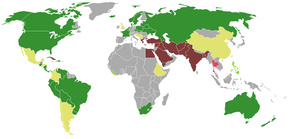 Violence erupted again during the 1936-1939 Arab revolt in Palestine. The British established the Peel Commission of 1936-1937 in order to put an end to the violence. The Peel Commission concluded that only partition could put an end to the violence, and proposed the Peel Partition Plan. While the Jewish community accepted the concept of partition, not all members endorsed the implementation proposed by the Peel Commission. The Arab community entirely rejected the Peel Partition Plan, which included population transfers, primarily of Arabs. The partition plan was abandoned, and in 1939 Britain issued its White Paper of 1939
clarifying its “unequivocal” position that “it is not part of [Britain's] policy that Palestine should become a Jewish State” and that “The independent State [of Palestine] should be one in which Arabs and Jews share government in such a way as to ensure that the essential interests of each community are safeguarded.”
The White Paper of 1939 sought to accommodate Arab demands regarding Jewish immigration by placing a quota of 10,000 Jewish immigrants per year over a five-year period from 1939 to 1944. The White Paper of 1939
also required Arab consent for further Jewish immigration. The White Paper was seen by the Jewish community as a revocation of the Balfour Declaration of 1917, and due to Jewish persecution in the Holocaust
, Jews continued to immigrate illegally in what has become known as Aliyah Bet.
Continued violence and the heavy cost of World War II
prompted Britain to turn the issue of Palestine to the United Nations
in 1947. In its debates, the UN divided its member States into two subcommittees: one to address options for partition and a second to address all other options. The Second Subcommittee, which included all the Arab and Muslim States members, issued a long report arguing that partition was illegal according to the terms of the Mandate and proposing a unitary democratic state that would protect rights of all citizens equally. The General Assembly instead voted for partition and in UN General Assembly Resolution 181 recommended that the Mandate territory of Palestine be partitioned into a Jewish state and an Arab state. The Jewish community accepted the 1947 partition plan, and declared independence as the State of Israel in 1948. The Arab community rejected the partition plan, and army units from five Arab countries – Lebanon
, Syria
, Iraq
, Transjordan
, and Egypt – contributed to a united Arab army that attempted to invade the territory, resulting in the 1948 Arab-Israeli War
.
The war, known to Israelis as the Independence War of 1948 and to Palestinians
as Al-Nakba (meaning “the catastrophe”), resulted in Israel’s establishment as well as the exodus
of over 700,000 Palestinians from the territory which became Israel. At the same time, a huge population of Jews living in Arab nations (close to 800,000) left or were expelled from their homes in what became known as the Modern Jewish Exodus and subsequently resettled in the new State of Israel. The former Canadian Minister of Justice, Irwin Cotler
, noted, "the Arab countries not only rejected a Palestinian state and went to war to extinguish the nascent Jewish state, but also targeted the Jewish nationals living in their respective countries, thereby creating two refugee populations."
By 1948, in the wake of the Holocaust, Jewish support for partition and a Jewish state had become overwhelming. Nevertheless, some Jewish voices still argued for unification. The International Jewish Labor Bund
was against the UN vote on the partition of Palestine and reaffirmed its support for a single binational state that would guarantee equal national rights for Jews and Arabs and would be under the control of superpowers and the UN. The 1948 New York Second world conference of the International Jewish Labor Bund condemned the proclamation of the Jewish state, because the decision exposed the Jews in Palestine to a danger. The conference was in favour of a binational state built on the base of national equality and democratic federalism.
The fifth national council of the Palestine Liberation Organisation in February 1969 passed a resolution confirming that the PLO’s objective was “to establish a free and democratic society in Palestine for all Palestinians whether they are Muslims, Christians or Jews”. The PLO was not successful in building support for the binational solution within Israeli society, however, which lay the groundwork for an eventual re-scoping of the PLO’s aim toward partition into two states.
.png) In the last decade, interest has been renewed in binationalism or a unitary democratic state. In 1999, the Palestinian activist Edward Said
In the last decade, interest has been renewed in binationalism or a unitary democratic state. In 1999, the Palestinian activist Edward Said
wrote:
In October 2003, New York University scholar Tony Judt
broke ground in his article, "Israel: The Alternative" in the New York Review of Books, in which he argued that Israel is an "anachronism" in sustaining an ethnic identity for the state and that the two-state solution is fundamentally doomed and unworkable. The Judt article engendered a frenzied media blitz in the UK and US and The New York Review of Books received more than 1000 letters per week about the essay. A month later, political scientist Virginia Tilley published "The One-State Solution" in the London Review of Books
, arguing that West Bank settlements had made a two-state solution impossible and that the international community must accept a one-state solution as the de facto reality.
Leftist journalists from Israel, such as Haim Hanegbi and Daniel Gavron, are also calling the public to face the facts (as they see them) and accept the binational solution. On the Palestinian side, similar voices were raised. Israeli Prime Minister Olmert argued, in a 2007 interview with the Israeli daily Ha'aretz, that without a two-state agreement Israel would face "a South African-style struggle for equal voting rights" in which case "Israel [would be] finished". This echoes comments made in 2004 by Palestinian Prime Minister Ahmed Qurei
, who said that if Israel failed to conclude an agreement with the Palestinians, that the Palestinians would pursue a single, binational state.
Between 2007 and 2010, a series of conferences have promoted the one-state agenda as an academic concern and a popular movement. On November 29, 2007, the 60th anniversary of the UN decision to partition Palestine, a number of prominent Palestinian, Israeli and other academics and activists issued "The One State Declaration", committing themselves to "a democratic solution that will offer a just, and thus enduring, peace in a single state." The statement called for "the widest possible discussion, research and action to advance a unitary, democratic solution and bring it to fruition". A scholarly conference, "One State for Palestine/Israel", was hosted at the University of Massachusetts-Boston in March 2009. A more activist conference was convened in Haifa in May 2010 by the organisation al-Awda followed in October 2010 by a conference in Dallas, Texas to launch a popular movement for one democratic state. Most of these events have issued declarations and statements supporting the idea of a unified state: for example, the combined statement of the Madrid and London conferences (noted earlier); the "Boston Declaration"; the "Haifa Declaration"; and the "Declaration for One Democratic State in Palestine" issued at the Dallas conference.
Antony Lerman
has written that a de facto
single state already exists, given Israel's complete control of the area. John Mearsheimer
, co-director of the Programme on International Security Policy at the University of Chicago, says the binational solution has become inevitable. He has further argued that by allowing Israel's settlements to prevent the formation of a Palestinian state, the United States has helped Israel commit "national suicide" since Palestinians will be the majority group in the binational state.
A poll conducted in 2010 by Israel Democracy Institute
suggested that 15% of right-wing Jewish Israelis and 16% of left-wing Jewish Israelis support a binational state solution over a two states solution based '67 lines. However, according to the same poll, 66% of Jewish Israelis preferred the two-state solution.
Other arguments for a one-state solution include that it would unite all people of Palestine into a powerful, secular state similar to Turkey
. It would remove the whole Palestine area from the criticism and ostracism of the modern world.
Critics primarily point to the fact that it would make Israeli Jews an ethnic minority in what they consider to be their own nation. The high fertility rate among Palestinians , who already comprise almost half of the population in Israel and the occupied territories , accompanied by a possible return of Palestinian refugee
s, would quickly render Jews a minority.
They have also argued that Jews, like any other nation, have the right to self-determination
, and that due to still existing antisemitism, there is a need for a Jewish national home. Ethnically homogeneous nation-state
s are common around the world , especially in Europe
. They also argue that most of the Arab World
is composed of entirely Arab and Muslim states, with no equality for ethnic or religious minorities.
The Reut Institute expands on these concerns of many Israeli Jews and points out that a one-state scenario without any institutional safeguards would negate Israel's status as a homeland for the Jewish people. When proposed as a political solution by non-Israelis, the assumption is that the idea is probably being put forward by those who are politically motivated to harm Israel and, by extension, Israeli Jews. They argue that the absorption of millions of Palestinians, along with a right of return for Palestinian refugees, and the generally high birthrate among Palestinians would quickly render Jews an ethnic minority and eliminate their rights to self-determination. The destruction of Israel as a Jewish state is seen by some critics as a threat to Jews who live in Israel, as it would require assimilation with what they fear would be an extremely hostile Muslim population, who would become the ruling majority.
Proponents of a one-state solution counter that unification is the only way to preserve a Jewish national home in the territory in the long run, by finally eliminating threats to Israel's security and solving the Scylla and Charybdis
problem of military occupation or apartheid. They as well point to European examples of multinational states like Belgium, Bosnia
and Switzerland
where the institutional layout effectively prevents disfranchisement of an ethnic minority. Israeli Jews would have greater freedom and security in such a state, which would be at peace with its own citizens and its neighbors, than they do now in a state that is eternally at risk of war and facing a domestic situation of apartheid.
Critics argue that a one-state solution would destroy Israel as a Jewish national home, as the Arab population in the Palestinian territories and Israel is already almost equivalent to the Jewish population, and would soon outnumber it due to their higher birthrate.
Some critics argue that unification cannot happen without damaging or destroying Israel's democracy. Most Israeli Jews as well as Israeli Druze
, some Israeli Bedouin
, many Israeli Christan Arabs and even some Israeli Muslim Arabs fear the consequences of amalgamation with the mostly Muslim Palestinian population in the occupied territories, which they perceive as more religious and conservative. (Israeli Druze and Bedouin serve in the Israel Defense Forces
and there are sometimes rifts between these groups and Palestinians.) One poll found that, in a future Palestinian state, 23% of Palestinians want civil law only, 35% want both Islamic and civil law, and 38% want Islamic law only. (Currently Israeli law is a combination of civil and religious, including Islamic, law.) This negative view of Palestinians in the West Bank and Gaza prompts some critics argue that the existing level of rights and equality for all Israeli citizens would be put in jeopardy with unification.
One-state proponents counter that this argument is implicitly or explicitly racist in assuming that Palestinians are not as capable of true democracy as Jews are. They argue that the conservative social values in the occupied territories are partly a result of occupation itself, that Palestinians have always sustained strong democratic values in their politics, and that the collapse of democracy in the Palestinian Authority is one reason it has lost credibility. They also point out that, because real surveys of Palestinian and Arab opinion on the risks of unification are lacking, assertions about such views are mere speculation.
Critics argue that it is racist to deny Jews self-determination as an ethnic and religious group, a right which all peoples are entitled to according to the United Nations Charter
. They argue that Jews have an inherent right to rule themselves in their ancestral homeland, that they would lose a safe haven from anti-Semitism and persecution.
Imagining what might ensue with unification, some critics of the one-state model point to violence during the British Mandate, such as in 1920
, 1921
, 1929
, and 1936-1939. In this view, violence between Palestinian Arabs and Israeli Jews is inevitable and can only be forestalled by partition. These critics also cite the 1937 Peel Commission
which recommended partition as the only means of ending the ongoing conflict. Critics also cite supposedly bi-national arrangements in Yugoslavia
, Lebanon
, and Pakistan
, which failed and resulted in further internal conflicts. Similar criticisms appear in The Case for Peace. Rather than a powerful secular democracy, critics fear that the high Palestinian birthrate and the return of millions of refugees will give the land a majority of religiously observant Muslims, many with deep anti-Semitic feelings.
One-state proponents counter that violence during the Mandate was triggered by Palestinian rejection of partition and Jewish statehood, which re-unification into one state would reverse and resolve. As for comparisons to Yugoslavia, Lebanon and Pakistan, these cases may offer useful lessons but taking them as proof that unification is wrong for Israel-Palestine is simplistic and omits important differences regarding history and politics. Yugoslavia is a very complicated case that warns mostly against creating states by gluing together historically distinct areas to serve great-power geopolitics and allowing continued ethnic supremacy (such as the dominance of Serbia). Pakistan is an example of lasting tensions created by partition, not the dangers of unification. Lebanon is a case of sectarian politics that shows the risks of linking identities mechanically to political representation , and so might warn against creating a binational state in Israel-Palestine rather than unitary state. One-state proponents point instead to the transition of South Africa from apartheid to democracy as a closer and more useful analogy.
Critics, however, point to the highly anti-Semitic sentiment within the Palestinian territories and the Arab and Muslim world in general, as evidence that a joint Arab-Jewish state is not a viable option. They also point out that while initially secular, the binational state could quickly turn into an Islamist one. Both Hamas and the Palestinian Authority base their legal systems on Sharia
, or Islamic law. This, together with constant racial incitement against Jews in the medias of both the Hamas and Palestinian Authority-run territories, suggesting that Jews would be relegated to the status of a beleaguered minority in an Arab-Muslim state.
Students of the Middle East, including former New historian Benny Morris
, have argued that the one-state solution is not viable because of Arab unwillingness to accept a Jewish national presence in the Middle East. In his book One State, Two States, Morris wrote that a one-state solution would probably cause a mass exodus of Israeli Jews to the West, arguing that most would prefer life as a minority in the West, where they would enjoy its relative freedoms and openness, to the "stifling darkness, intolerance, authoritarianism, and insularity of the Arab world and its treatment of minority populations". He argued that most Israelis would flee, leaving behind only those incapable of finding new homes and ultra-Orthodox Jews "bound to the land out of deep religious conviction".
Proponents point to Arab expressions of willingness to share the region with Jews, including the Arab Peace Initiative
of 2002. However, this debate may be confused by different ideas about what is meant by "Jewish national presence". If it simply means a Jewish "home" where Jewish citizens of a unified state can pursue a Jewish cultural life, sustaining the Hebrew-language culture already developed in Israel, most one-state proponents would consider this normal and acceptable. If it involves exclusively "Jewish-national" control of territory and resources, and policies to exclude non-Jewish citizens from residence in Jewish areas, as is the case in Israel today, this is seen as discriminatory and unacceptable.
One-state critics argue that while Israel is, according to its own laws, a Jewish state, Arab citizens of Israel
enjoy greater legal rights and a higher standard of living than anywhere throughout the Arab world, proving that preserving the Jewish state would not necessarily mean that its Arab minority would suffer discrimination. It has also been argued that the Arab Peace Plan of 2002 was meant to destroy Israel, as it demands a withdrawal to borders considered by many Israelis to be dangerous, and demands the return of millions of Palestinian refugees, reversing the Jewish demographic majority within Israel. It has also been argued by some politicians such as Avigdor Lieberman that the majority of Israeli-Arab communities are situated on the Palestinian border, and can easily be transferred to a Palestinian state, which would give Israel a manageable Arab minority which could continue to enjoy what they call full equality without threatening Israel's Jewish character.
Alternatively, a solution similar to the Benelux
model would combine the advantages of both two-state solution
and one-state solution while avoiding their disadvantages and psychological
barriers.
, current Knesset Speaker Reuven Rivlin
, and the Knesset member Tzipi Hotovely
have voiced support for a binational state through the supposition that this is in fact the current nominal situation within Israel-Palestine.
Another prominent supporter is Palestinian-American journalist Ali Abunimah
.
Joe Walsh (Illinois politician)
and 30 co-sponsors have introduced a motion in the United States House of Representatives to merge the Palestinian territories into Israel.
Israeli-Palestinian conflict
The Israeli–Palestinian conflict is the ongoing conflict between Israelis and Palestinians. The conflict is wide-ranging, and the term is also used in reference to the earlier phases of the same conflict, between Jewish and Zionist yishuv and the Arab population living in Palestine under Ottoman or...
. Proponents of a binational solution to the conflict advocate either a single state in Israel
Israel
The State of Israel is a parliamentary republic located in the Middle East, along the eastern shore of the Mediterranean Sea...
, the West Bank
West Bank
The West Bank ) of the Jordan River is the landlocked geographical eastern part of the Palestinian territories located in Western Asia. To the west, north, and south, the West Bank shares borders with the state of Israel. To the east, across the Jordan River, lies the Hashemite Kingdom of Jordan...
and Gaza Strip
Gaza Strip
thumb|Gaza city skylineThe Gaza Strip lies on the Eastern coast of the Mediterranean Sea. The Strip borders Egypt on the southwest and Israel on the south, east and north. It is about long, and between 6 and 12 kilometres wide, with a total area of...
, or a single state in Israel
Israel
The State of Israel is a parliamentary republic located in the Middle East, along the eastern shore of the Mediterranean Sea...
and the West Bank
West Bank
The West Bank ) of the Jordan River is the landlocked geographical eastern part of the Palestinian territories located in Western Asia. To the west, north, and south, the West Bank shares borders with the state of Israel. To the east, across the Jordan River, lies the Hashemite Kingdom of Jordan...
, with citizenship and equal rights in the combined entity for all inhabitants of all three territories, without regard to ethnicity or religion. While some advocate this solution for ideological reasons, others feel simply that, due to the reality on the ground, it is the de facto
De facto
De facto is a Latin expression that means "concerning fact." In law, it often means "in practice but not necessarily ordained by law" or "in practice or actuality, but not officially established." It is commonly used in contrast to de jure when referring to matters of law, governance, or...
situation.
Though increasingly debated in academic circles, this approach has remained outside the range of official efforts to resolve the conflict as well as mainstream analysis, where it is eclipsed by the two-state solution
Two-state solution
The two-state solution to the Israeli-Palestinian conflict is the consensus solution that is currently under discussion by the key parties to the conflict, most recently at the Annapolis Conference in November 2007...
. The two-state solution was most recently agreed upon in principle by the government of Israel and the Palestinian Authority at the November 2007 Annapolis Conference
Annapolis Conference
-Attendees:U.S. Secretary of State Condoleezza Rice organized and hosted the conference. Palestinian President Mahmoud Abbas, Israeli Prime Minister Ehud Olmert, and U.S. President George W. Bush attended the meeting...
and remains the conceptual basis for negotiations proposed by the administration of U.S. President Barack Obama
Barack Obama
Barack Hussein Obama II is the 44th and current President of the United States. He is the first African American to hold the office. Obama previously served as a United States Senator from Illinois, from January 2005 until he resigned following his victory in the 2008 presidential election.Born in...
in 2011. Interest in a one-state solution is growing, however, as the two-state approach fails to accomplish a final agreement. Support among Palestinians for a one-state solution is increasing, especially because the population growth rate of Palestinians would leave Palestinians as a majority in a single state.
Overview
The “one-state solution” refers to a resolution of the Israeli-Palestinian conflict through the creation of a unitary, federal or confederate Israeli-Palestinian state encompassing all of the present territory of IsraelIsrael
The State of Israel is a parliamentary republic located in the Middle East, along the eastern shore of the Mediterranean Sea...
, the West Bank
West Bank
The West Bank ) of the Jordan River is the landlocked geographical eastern part of the Palestinian territories located in Western Asia. To the west, north, and south, the West Bank shares borders with the state of Israel. To the east, across the Jordan River, lies the Hashemite Kingdom of Jordan...
including East Jerusalem and the Gaza Strip.
Depending on various points of view, a one-state solution to the Israeli-Palestinian conflict is presented as a nightmare situation in which Israel would ostensibly lose its character as a Jewish
Jews
The Jews , also known as the Jewish people, are a nation and ethnoreligious group originating in the Israelites or Hebrews of the Ancient Near East. The Jewish ethnicity, nationality, and religion are strongly interrelated, as Judaism is the traditional faith of the Jewish nation...
state and the Palestinians would fail to achieve their national independence within a two-state solution
Two-state solution
The two-state solution to the Israeli-Palestinian conflict is the consensus solution that is currently under discussion by the key parties to the conflict, most recently at the Annapolis Conference in November 2007...
or, alternatively, as the best, most just, and only way to resolve the Israeli-Palestinian conflict
Israeli-Palestinian conflict
The Israeli–Palestinian conflict is the ongoing conflict between Israelis and Palestinians. The conflict is wide-ranging, and the term is also used in reference to the earlier phases of the same conflict, between Jewish and Zionist yishuv and the Arab population living in Palestine under Ottoman or...
. This scenario is being discussed not as an intentional political solution – desired or undesired – but as the probable, inevitable outcome of the continuous growth of the Jewish settlements in the West Bank and the apparently irrevocable entrenchment of Israel's presence in the Israeli-occupied territories
Israeli-occupied territories
The Israeli-occupied territories are the territories which have been designated as occupied territory by the United Nations and other international organizations, governments and others to refer to the territory seized by Israel during the Six-Day War of 1967 from Egypt, Jordan, and Syria...
.
Although the terms “one-state solution” and “bi-national solution” are often used synonymously, they do not necessarily mean the same thing. In debates about a one-state solution in Israel-Palestine, bi-nationalism refers to a political system in which the two groups, Jews and Palestinians, would retain their legal and political character as separate nations or nationalities, perhaps similar to the situation in Bosnia and Herzegovina
Bosnia and Herzegovina
Bosnia and Herzegovina , sometimes called Bosnia-Herzegovina or simply Bosnia, is a country in Southern Europe, on the Balkan Peninsula. Bordered by Croatia to the north, west and south, Serbia to the east, and Montenegro to the southeast, Bosnia and Herzegovina is almost landlocked, except for the...
. In most bi-national arguments for a one-state solution, such an arrangement is deemed necessary both to ensure the protection of minorities (whichever group that is) and to reassure both groups that their collective interests would be protected. Counter-arguments are that bi-nationalism would entrench the two identities politically in ways that would foster their continuing rivalry and social divides; these arguments favour a unitary democratic state, or one-person-one-vote arrangement.
Popular support
Support among Israeli Jews, and Jews generally, for a one-state solution is very low. Israelis see a one-state solution as a demographic threat that would overturn the prevailing Jewish majority within Israel.A one-state solution is generally endorsed by Israeli Arabs
Arab citizens of Israel
Arab citizens of Israel refers to citizens of Israel who are not Jewish, and whose cultural and linguistic heritage or ethnic identity is Arab....
. Many are becoming nervous that a two-state solution would result in official pressures for them to move into a Palestinian state in the West Bank and/or Gaza Strip and so lose their homes and access to their communities, businesses and cities inside Israel. Some Israeli government spokespeople have also proposed that Palestinian-majority areas of Israel, such as the area around Umm el-Fahm, be annexed to the new Palestinian state. As this measure would cut these areas off permanently from the rest of Israel's territory, including the coastal cities and other Palestinian towns and villages, Palestinians view this with alarm. Palestinian citizens of Israel would therefore greatly prefer a one-state solution because this would allow them to sustain their Israeli citizenship while restoring ties with Palestinians in the West Bank and Gaza from whom they have been separated for over 60 years. The Haifa Declaration is similar, though written by individuals advocating the Two state solution:
A multi-option poll by Near East Consulting (NEC) in November 2007 found the bi-national state to be less popular than either "two states for two people" or "a Palestinian state on all historic Palestine" with only 13.4% of respondents supporting a binational solution. However, in February 2007, NEC found that around 70% of Palestinian respondents backed the idea when given a straight choice of either supporting or opposing "a one-state solution in historic Palestine where Muslims, Christians and Jews have equal rights and responsibilities". In March 2010, a survey by the Palestinian Center for Policy and Survey Research and the Harry S. Truman Research Institute for the Advancement of Peace at the Hebrew University of Jerusalem found that Palestinian support had risen to 29 percent. In April 2010, a poll by the Jerusalem Media and Communication Centre also found that Palestinian support for a "bi-national" solution had jumped from 20.6 percent in June 2009 to 33.8 percent. If this support for a bi-national state is combined with the finding that 9.8 percent of Palestinian respondents favour a "Palestinian state" in "all of historic Palestine", this poll suggested about equal Palestinian support for a two-state and one-state solution in mid-2010. In November 2009, Palestinian negotiator Saeb Erekat
Saeb Erekat
Saeb Muhammad Salih Erekat Saeb Muhammad Salih Erekat Saeb Muhammad Salih Erekat (also Erakat; Ṣāʼib ʻUrayqāt or ʻRēqāt, born April 28, 1955 in Jordanian controlled East Jerusalem was the Palestinian chief of the PLO Steering and Monitoring Committee until 12 February 2011...
proposed the adoption of the one-state solution if Israel didn't halt settlement construction:
"[it is time to] (sic) refocus their attention on the one-state solution where Muslims, Christians and Jews can live as equals... It is very serious. This is the moment of truth for us."
Some Israeli Jews and Palestinians who oppose a one-state solution have nevertheless come to believe that it may come to pass. Israeli Prime Minister Olmert argued, in a 2007 interview with the Israeli daily Ha'aretz, that without a two-state agreement Israel would face "a South African-style struggle for equal voting rights" in which case "Israel [would be] finished". This echoes comments made in 2004 by Palestinian Prime Minister Ahmed Qurei
Ahmed Qurei
Ahmed Ali Mohammed Qurei , also known by his Arabic Kunya Abu Alaa is a former prime minister of the Palestinian Authority...
, who said that if Israel failed to conclude an agreement with the Palestinians, that the Palestinians would pursue a single, bi-national state.
Today, the prominent proponents for the one-state solution include Palestinian author Ali Abunimah
Ali Abunimah
Ali Hasan Abunimah is a Palestinian American journalist and co-founder of Electronic Intifada, a not-for-profit, independent online publication about the Israeli-Palestinian Conflict. Born in Washington D.C., he spent his early years in the United Kingdom and Belgium before returning to the...
, Palestinian-American producer Jamal Dajani
Jamal Dajani
Jamal Dajani is a Palestinian-American journalist, and an award-winning producer. He currently holds the position of Vice President for Middle East & North Africa at...
, Palestinian lawyer Michael Tarazi
Michael Tarazi
Michael Tarazi is a Palestinian-American lawyer and former adviser to the Palestine Liberation Organization. Since 2008, Tarazi has worked for the government and policy team of the Consultative Group to Assist the Poor , an organization that promotes microfinance.- Biography :Tarazi was born in the...
, Jeff Halper
Jeff Halper
Jeff Halper is an anthropologist, author, lecturer, political activist, and co-founder and Coordinator of the Israeli Committee Against House Demolitions...
, Israeli writer Dan Gavron, Palestinian-American law professor George Bisharat
George Bisharat
George Bisharat is a Palestinian-American professor of law and frequent commentator on current events in the Middle East, and the Israeli-Palestinian conflict in particular.- Life :...
, and American-Lebanese academic Saree Makdisi
Saree Makdisi
Saree Makdisi is an American literary critic of Palestinian and Lebanese descent, specializing in eighteenth and nineteenth century British literature. He also writes on contemporary Arab politics and culture. Makdisi currently holds the title of Professor of English and Comparative Literature at...
.. Muammar al-Gaddafi
Muammar al-Gaddafi
Muammar Muhammad Abu Minyar Gaddafi or "September 1942" 20 October 2011), commonly known as Muammar Gaddafi or Colonel Gaddafi, was the official ruler of the Libyan Arab Republic from 1969 to 1977 and then the "Brother Leader" of the Libyan Arab Jamahiriya from 1977 to 2011.He seized power in a...
of Libya
Libya
Libya is an African country in the Maghreb region of North Africa bordered by the Mediterranean Sea to the north, Egypt to the east, Sudan to the southeast, Chad and Niger to the south, and Algeria and Tunisia to the west....
was also a prominent proponent (see also Saif Islam Qaddafi Isratin proposal
Saif Islam Qaddafi Isratin proposal
The Gaddafi Isratin proposal is a proposal to permanently resolve the Israeli–Palestinian conflict through a secular, federalist, republican one-state solution, which was first articulated by Saif al-Islam Gaddafi, the son of Muammar Gaddafi of Libya, at the Chatham House in London and later...
),. The expansion of the Israeli Settler movement, especially in the West Bank, has been given as one rationale for bi-nationalism and the increased unfeasibility of the two-state alternative:
"Support for one state is hardly a radical idea; it is simply the recognition of the uncomfortable reality that Israel and the occupied Palestinian territories already function as a single state. They share the same aquifers, the same highway network, the same electricity grid and the same international borders... The one-state solution... neither destroys the Jewish character of the Holy Land nor negates the Jewish historical and religious attachment (although it would destroy the superior status of Jews in that state). Rather, it affirms that the Holy Land has an equal Christian and Muslim character. For those who believe in equality, this is a good thing."-Michael TaraziMichael TaraziMichael Tarazi is a Palestinian-American lawyer and former adviser to the Palestine Liberation Organization. Since 2008, Tarazi has worked for the government and policy team of the Consultative Group to Assist the Poor , an organization that promotes microfinance.- Biography :Tarazi was born in the...
They advocate a secular and democratic state while still maintaining a Jewish presence and culture in the region. They concede that this alternative will erode the dream of Jewish supremacy in terms of governance in the long run.
Historical background
The area between the Mediterranean SeaMediterranean Sea
The Mediterranean Sea is a sea connected to the Atlantic Ocean surrounded by the Mediterranean region and almost completely enclosed by land: on the north by Anatolia and Europe, on the south by North Africa, and on the east by the Levant...
and the Jordan River was controlled by various national groups throughout history. A number of groups, including the Canaanites, the Israelites, the Babylonians, Persians, Greeks
Greeks
The Greeks, also known as the Hellenes , are a nation and ethnic group native to Greece, Cyprus and neighboring regions. They also form a significant diaspora, with Greek communities established around the world....
, Jews, Romans
Ancient Rome
Ancient Rome was a thriving civilization that grew on the Italian Peninsula as early as the 8th century BC. Located along the Mediterranean Sea and centered on the city of Rome, it expanded to one of the largest empires in the ancient world....
, Byzantines
Byzantine Empire
The Byzantine Empire was the Eastern Roman Empire during the periods of Late Antiquity and the Middle Ages, centred on the capital of Constantinople. Known simply as the Roman Empire or Romania to its inhabitants and neighbours, the Empire was the direct continuation of the Ancient Roman State...
, Umayyads, Abbasids, Turks
Turkish people
Turkish people, also known as the "Turks" , are an ethnic group primarily living in Turkey and in the former lands of the Ottoman Empire where Turkish minorities had been established in Bulgaria, Cyprus, Bosnia and Herzegovina, Georgia, Greece, Kosovo, Macedonia, and Romania...
, Crusaders
Crusaders
The Crusaders are a New Zealand professional rugby union team based in Christchurch that competes in the Super Rugby competition. They are the most successful team in Super Rugby history with seven titles...
, Mamluks, Ottomans, the British
United Kingdom
The United Kingdom of Great Britain and Northern IrelandIn the United Kingdom and Dependencies, other languages have been officially recognised as legitimate autochthonous languages under the European Charter for Regional or Minority Languages...
and now Israelis have controlled the region at one time or another. From 1516 until the conclusion of World War I
World War I
World War I , which was predominantly called the World War or the Great War from its occurrence until 1939, and the First World War or World War I thereafter, was a major war centred in Europe that began on 28 July 1914 and lasted until 11 November 1918...
, the region was controlled by the Ottoman Empire
Ottoman Empire
The Ottoman EmpireIt was usually referred to as the "Ottoman Empire", the "Turkish Empire", the "Ottoman Caliphate" or more commonly "Turkey" by its contemporaries...
.
From 1915 to 1916, the British
United Kingdom
The United Kingdom of Great Britain and Northern IrelandIn the United Kingdom and Dependencies, other languages have been officially recognised as legitimate autochthonous languages under the European Charter for Regional or Minority Languages...
High Commissioner in Egypt
Egypt
Egypt , officially the Arab Republic of Egypt, Arabic: , is a country mainly in North Africa, with the Sinai Peninsula forming a land bridge in Southwest Asia. Egypt is thus a transcontinental country, and a major power in Africa, the Mediterranean Basin, the Middle East and the Muslim world...
, Sir Henry McMahon, corresponded by letters with Sayyid Hussein bin Ali, the father of Pan Arabism. These letters, were later known as the Hussein-McMahon Correspondence
Hussein-McMahon Correspondence
The McMahon–Hussein Correspondence, or the Hussein-McMahon Correspondence, was a protracted exchange of letters during World War I, between the Sharif of Mecca, Husayn bin Ali, and Sir Henry McMahon, British High Commissioner in Egypt, concerning the future political status of the lands under the...
. McMahon promised Hussein and his Arab
Arab
Arab people, also known as Arabs , are a panethnicity primarily living in the Arab world, which is located in Western Asia and North Africa. They are identified as such on one or more of genealogical, linguistic, or cultural grounds, with tribal affiliations, and intra-tribal relationships playing...
followers the territory of the Ottoman Empire
Ottoman Empire
The Ottoman EmpireIt was usually referred to as the "Ottoman Empire", the "Turkish Empire", the "Ottoman Caliphate" or more commonly "Turkey" by its contemporaries...
in exchange for assistance in driving out the Ottoman Turks
Ottoman Turks
The Ottoman Turks were the Turkish-speaking population of the Ottoman Empire who formed the base of the state's military and ruling classes. Reliable information about the early history of Ottoman Turks is scarce, but they take their Turkish name, Osmanlı , from the house of Osman I The Ottoman...
. Hussein interpreted these letters as promising the region of Palestine to the Arabs. McMahon and the Churchill White Paper maintained that Palestine had been excluded from the territorial promises, but minutes of a Cabinet Eastern Committee meeting held on 5 December 1918 confirmed that Palestine had been part of the area that had been pledged to Hussein in 1915.
In 1916, Britain and France
France
The French Republic , The French Republic , The French Republic , (commonly known as France , is a unitary semi-presidential republic in Western Europe with several overseas territories and islands located on other continents and in the Indian, Pacific, and Atlantic oceans. Metropolitan France...
signed the Sykes-Picot Agreement
Sykes-Picot Agreement
The Sykes–Picot Agreement of 1916 was a secret agreement between the governments of the United Kingdom and France, with the assent of Imperial Russia, defining their respective spheres of influence and control in Western Asia after the expected downfall of the Ottoman Empire during World War I...
, which divided the colonies of the Ottoman Empire between them. Under this agreement, the region of Palestine would be controlled by Britain. In a 1917, letter from Arthur James Balfour to Lord Rothschild
Walter Rothschild, 2nd Baron Rothschild
Lionel Walter Rothschild, 2nd Baron Rothschild, Baron de Rothschild FRS , a scion of the Rothschild family, was a British banker, politician, and zoologist.-Biography:...
, known as the Balfour Declaration of 1917, the British government promised “the establishment in Palestine of a national home for the Jewish people”, but at the same time required “that nothing shall be done which may prejudice the civil and religious rights of existing non-Jewish communities in Palestine”.
In 1922, the League of Nations
League of Nations
The League of Nations was an intergovernmental organization founded as a result of the Paris Peace Conference that ended the First World War. It was the first permanent international organization whose principal mission was to maintain world peace...
granted Britain a mandate for Palestine. Like all League of Nations Mandate
League of Nations mandate
A League of Nations mandate was a legal status for certain territories transferred from the control of one country to another following World War I, or the legal instruments that contained the internationally agreed-upon terms for administering the territory on behalf of the League...
s, this mandate derived from article 22 of the League of Nations Covenant, which called for the self-determination of former Ottoman Empire colonies after a transitory period administered by a world power. The Palestine Mandate recognized the Balfour Declaration of 1917 and required that the mandatory government “facilitate Jewish immigration” while at the same time “ensuring that the rights and position of other sections of the population are not prejudiced”.
Disagreements over Jewish immigration as well as incitement by Haj Amin Al-Husseini led to an outbreak of Arab-Jewish violence in the Palestine Riots of 1920. Violence erupted again the following year during the Jaffa Riots
Jaffa riots
The Jaffa riots were a series of violent riots in Palestine on May 1–7, 1921, which began as a fight between two Jewish groups but developed into an attack by Arabs on Jews during which many were killed...
. In response to these riots, Britain established the Haycraft Commission of Inquiry
Haycraft Commission of Inquiry
The Haycraft Commission of Inquiry was set up to investigate the Jaffa riots of 1921, but its remit was widened and its report entitled "Palestine: Disturbances in May 1921"...
. The British Mandatory authorites put forward proposals for setting up an elected legislative council in Palestine. In 1924 the issue was raised at a conference held by Ahdut Ha'avodah at Ein Harod
Ein Harod
Ein Harod was a kibbutz in Israel. It was located in northern Israel near Mount Gilboa. It is notable for being built near the battlefield of Ayn Jalut , a battle of huge macro-historical importance where the Mongols were defeated for the first time, in 1260.-History:The kibbutz was founded by...
. Shlomo Kaplansky
Shlomo Kaplansky
Shlomo Kaplansky was a Labour Zionist politician, who served as the Secretary of the World Union of Poalei Zion. During the 1920's he was a leading advocate of a bi-national state in Palestine....
, a veteran leader of Poalei Zion, argued that a Parliament
Parliament
A parliament is a legislature, especially in those countries whose system of government is based on the Westminster system modeled after that of the United Kingdom. The name is derived from the French , the action of parler : a parlement is a discussion. The term came to mean a meeting at which...
, even with an Arab majority, was the way forward. David Ben Gurion, the emerging leader of the Yishuv
Yishuv
The Yishuv or Ha-Yishuv is the term referring to the body of Jewish residents in Palestine before the establishment of the State of Israel...
, succeeded in getting Kaplansky's ideas rejected. Violence erupted again in the form of the 1929 Palestine riots
1929 Palestine riots
The 1929 Palestine riots, also known as the Western Wall Uprising, the 1929 Massacres, , or the Buraq Uprising , refers to a series of demonstrations and riots in late August 1929 when a long-running dispute between Muslims and Jews over access to the Western Wall in Jerusalem escalated into violence...
, the 1929 Hebron massacre
1929 Hebron massacre
The Hebron massacre refers to the killing of sixty-seven Jews on 23 and 24 August 1929 in Hebron, then part of the British Mandate of Palestine, by Arabs incited to violence by rumors that Jews were massacring Arabs in Jerusalem and seizing control of Muslim holy places...
, and the 1929 Safed massacre
1929 Safed massacre
The 1929 Safed pogrom took place on 29 August during the 1929 Palestine riots. Eighteen Jews were killed and eighty wounded. The main Jewish street was looted and burned...
. After the violence, the British led another commission of inquiry under Sir Walter Shaw. The report of the Shaw Commission, known as the Shaw Report
Shaw Report
The Report of the Commission on the Palestine Disturbances of August 1929 or Shaw Report of March 1930 was a British report of a Commission of Inquiry, chaired by Sir Walter Shaw, a distinguished jurist, and consisting of three members of the British parliament, Sir Henry Betterton , R.Hopkin...
or Command Paper No 3530, attributed the violence to “the twofold fear of the Arabs that, by Jewish immigration and land purchase, they might be deprived of their livelihood and, in time, pass under the political domination of the Jews”.
White Paper of 1939
The White Paper of 1939, also known as the MacDonald White Paper after Malcolm MacDonald, the British Colonial Secretary who presided over it, was a policy paper issued by the British government under Neville Chamberlain in which the idea of partitioning the Mandate for Palestine, as recommended in...
clarifying its “unequivocal” position that “it is not part of [Britain's] policy that Palestine should become a Jewish State” and that “The independent State [of Palestine] should be one in which Arabs and Jews share government in such a way as to ensure that the essential interests of each community are safeguarded.”
The White Paper of 1939 sought to accommodate Arab demands regarding Jewish immigration by placing a quota of 10,000 Jewish immigrants per year over a five-year period from 1939 to 1944. The White Paper of 1939
White Paper of 1939
The White Paper of 1939, also known as the MacDonald White Paper after Malcolm MacDonald, the British Colonial Secretary who presided over it, was a policy paper issued by the British government under Neville Chamberlain in which the idea of partitioning the Mandate for Palestine, as recommended in...
also required Arab consent for further Jewish immigration. The White Paper was seen by the Jewish community as a revocation of the Balfour Declaration of 1917, and due to Jewish persecution in the Holocaust
The Holocaust
The Holocaust , also known as the Shoah , was the genocide of approximately six million European Jews and millions of others during World War II, a programme of systematic state-sponsored murder by Nazi...
, Jews continued to immigrate illegally in what has become known as Aliyah Bet.
Continued violence and the heavy cost of World War II
World War II
World War II, or the Second World War , was a global conflict lasting from 1939 to 1945, involving most of the world's nations—including all of the great powers—eventually forming two opposing military alliances: the Allies and the Axis...
prompted Britain to turn the issue of Palestine to the United Nations
United Nations
The United Nations is an international organization whose stated aims are facilitating cooperation in international law, international security, economic development, social progress, human rights, and achievement of world peace...
in 1947. In its debates, the UN divided its member States into two subcommittees: one to address options for partition and a second to address all other options. The Second Subcommittee, which included all the Arab and Muslim States members, issued a long report arguing that partition was illegal according to the terms of the Mandate and proposing a unitary democratic state that would protect rights of all citizens equally. The General Assembly instead voted for partition and in UN General Assembly Resolution 181 recommended that the Mandate territory of Palestine be partitioned into a Jewish state and an Arab state. The Jewish community accepted the 1947 partition plan, and declared independence as the State of Israel in 1948. The Arab community rejected the partition plan, and army units from five Arab countries – Lebanon
Lebanon
Lebanon , officially the Republic of LebanonRepublic of Lebanon is the most common term used by Lebanese government agencies. The term Lebanese Republic, a literal translation of the official Arabic and French names that is not used in today's world. Arabic is the most common language spoken among...
, Syria
Syria
Syria , officially the Syrian Arab Republic , is a country in Western Asia, bordering Lebanon and the Mediterranean Sea to the West, Turkey to the north, Iraq to the east, Jordan to the south, and Israel to the southwest....
, Iraq
Iraq
Iraq ; officially the Republic of Iraq is a country in Western Asia spanning most of the northwestern end of the Zagros mountain range, the eastern part of the Syrian Desert and the northern part of the Arabian Desert....
, Transjordan
Transjordan
The Emirate of Transjordan was a former Ottoman territory in the Southern Levant that was part of the British Mandate of Palestine...
, and Egypt – contributed to a united Arab army that attempted to invade the territory, resulting in the 1948 Arab-Israeli War
1948 Arab-Israeli War
The 1948 Arab–Israeli War, known to Israelis as the War of Independence or War of Liberation The war commenced after the termination of the British Mandate for Palestine and the creation of an independent Israel at midnight on 14 May 1948 when, following a period of civil war, Arab armies invaded...
.
The war, known to Israelis as the Independence War of 1948 and to Palestinians
Palestinian people
The Palestinian people, also referred to as Palestinians or Palestinian Arabs , are an Arabic-speaking people with origins in Palestine. Despite various wars and exoduses, roughly one third of the world's Palestinian population continues to reside in the area encompassing the West Bank, the Gaza...
as Al-Nakba (meaning “the catastrophe”), resulted in Israel’s establishment as well as the exodus
1948 Palestinian exodus
The 1948 Palestinian exodus , also known as the Nakba , occurred when approximately 711,000 to 725,000 Palestinian Arabs left, fled or were expelled from their homes, during the 1948 Arab-Israeli War and the Civil War that preceded it. The exact number of refugees is a matter of dispute...
of over 700,000 Palestinians from the territory which became Israel. At the same time, a huge population of Jews living in Arab nations (close to 800,000) left or were expelled from their homes in what became known as the Modern Jewish Exodus and subsequently resettled in the new State of Israel. The former Canadian Minister of Justice, Irwin Cotler
Irwin Cotler
Irwin Cotler, PC, OC, MP was Canada's Minister of Justice and Attorney General of Canada from 2003 until the Liberal government of Paul Martin lost power following the 2006 federal election. He was first elected to the Canadian House of Commons for the constituency of Mount Royal in a by-election...
, noted, "the Arab countries not only rejected a Palestinian state and went to war to extinguish the nascent Jewish state, but also targeted the Jewish nationals living in their respective countries, thereby creating two refugee populations."
By 1948, in the wake of the Holocaust, Jewish support for partition and a Jewish state had become overwhelming. Nevertheless, some Jewish voices still argued for unification. The International Jewish Labor Bund
International Jewish Labor Bund
The International Jewish Labor Bund is a New York-based international Jewish socialist organization, based on the legacy of the General Jewish Labour Bund founded in the Russian empire in 1897 and the Polish Bund that was active in the interwar years. The IJLB is composed by local Bundist groups...
was against the UN vote on the partition of Palestine and reaffirmed its support for a single binational state that would guarantee equal national rights for Jews and Arabs and would be under the control of superpowers and the UN. The 1948 New York Second world conference of the International Jewish Labor Bund condemned the proclamation of the Jewish state, because the decision exposed the Jews in Palestine to a danger. The conference was in favour of a binational state built on the base of national equality and democratic federalism.
Palestinian support for the binational state
In 1969 the Fatah movement accepted as a fait accompli the presence in Palestine of a large number of Jews. In January 1969 Fatah declared that it was not fighting against Jews, but against Israel as a racist and theocratic entity.The fifth national council of the Palestine Liberation Organisation in February 1969 passed a resolution confirming that the PLO’s objective was “to establish a free and democratic society in Palestine for all Palestinians whether they are Muslims, Christians or Jews”. The PLO was not successful in building support for the binational solution within Israeli society, however, which lay the groundwork for an eventual re-scoping of the PLO’s aim toward partition into two states.
One-state debate since 1999
Edward Said
Edward Wadie Saïd was a Palestinian-American literary theorist and advocate for Palestinian rights. He was University Professor of English and Comparative Literature at Columbia University and a founding figure in postcolonialism...
wrote:
- “…after 50 years of Israeli history, classic Zionism has provided no solution to the Palestinian presence. I therefore see no other way than to begin now to speak about sharing the land that has thrust us together, sharing it in a truly democratic way with equal rights for all citizens.”
In October 2003, New York University scholar Tony Judt
Tony Judt
Tony Robert Judt FBA was a British historian, essayist, and university professor who specialized in European history. Judt moved to New York and served as the Erich Maria Remarque Professor in European Studies at New York University, and Director of NYU's Erich Maria Remarque Institute...
broke ground in his article, "Israel: The Alternative" in the New York Review of Books, in which he argued that Israel is an "anachronism" in sustaining an ethnic identity for the state and that the two-state solution is fundamentally doomed and unworkable. The Judt article engendered a frenzied media blitz in the UK and US and The New York Review of Books received more than 1000 letters per week about the essay. A month later, political scientist Virginia Tilley published "The One-State Solution" in the London Review of Books
London Review of Books
The London Review of Books is a fortnightly British magazine of literary and intellectual essays.-History:The LRB was founded in 1979, during the year-long lock-out at The Times, by publisher A...
, arguing that West Bank settlements had made a two-state solution impossible and that the international community must accept a one-state solution as the de facto reality.
Leftist journalists from Israel, such as Haim Hanegbi and Daniel Gavron, are also calling the public to face the facts (as they see them) and accept the binational solution. On the Palestinian side, similar voices were raised. Israeli Prime Minister Olmert argued, in a 2007 interview with the Israeli daily Ha'aretz, that without a two-state agreement Israel would face "a South African-style struggle for equal voting rights" in which case "Israel [would be] finished". This echoes comments made in 2004 by Palestinian Prime Minister Ahmed Qurei
Ahmed Qurei
Ahmed Ali Mohammed Qurei , also known by his Arabic Kunya Abu Alaa is a former prime minister of the Palestinian Authority...
, who said that if Israel failed to conclude an agreement with the Palestinians, that the Palestinians would pursue a single, binational state.
Between 2007 and 2010, a series of conferences have promoted the one-state agenda as an academic concern and a popular movement. On November 29, 2007, the 60th anniversary of the UN decision to partition Palestine, a number of prominent Palestinian, Israeli and other academics and activists issued "The One State Declaration", committing themselves to "a democratic solution that will offer a just, and thus enduring, peace in a single state." The statement called for "the widest possible discussion, research and action to advance a unitary, democratic solution and bring it to fruition". A scholarly conference, "One State for Palestine/Israel", was hosted at the University of Massachusetts-Boston in March 2009. A more activist conference was convened in Haifa in May 2010 by the organisation al-Awda followed in October 2010 by a conference in Dallas, Texas to launch a popular movement for one democratic state. Most of these events have issued declarations and statements supporting the idea of a unified state: for example, the combined statement of the Madrid and London conferences (noted earlier); the "Boston Declaration"; the "Haifa Declaration"; and the "Declaration for One Democratic State in Palestine" issued at the Dallas conference.
Antony Lerman
Antony Lerman
Antony Lerman is a British writer who specializes in the study of antisemitism, the Israeli-Palestinian conflict, multiculturalism, and the place of religion in society. From 2006 to early 2009, he was Director of the Institute for Jewish Policy Research, a think tank on issues affecting Jewish...
has written that a de facto
De facto
De facto is a Latin expression that means "concerning fact." In law, it often means "in practice but not necessarily ordained by law" or "in practice or actuality, but not officially established." It is commonly used in contrast to de jure when referring to matters of law, governance, or...
single state already exists, given Israel's complete control of the area. John Mearsheimer
John Mearsheimer
John J. Mearsheimer is an American professor of Political Science at the University of Chicago. He is an international relations theorist. Known for his book on offensive realism, The Tragedy of Great Power Politics, more recently Mearsheimer has attracted attention for co-authoring and publishing...
, co-director of the Programme on International Security Policy at the University of Chicago, says the binational solution has become inevitable. He has further argued that by allowing Israel's settlements to prevent the formation of a Palestinian state, the United States has helped Israel commit "national suicide" since Palestinians will be the majority group in the binational state.
A poll conducted in 2010 by Israel Democracy Institute
Israel Democracy Institute
The Israel Democracy Institute , established in 1991, is an independent, nonpartisan, nonprofit think tank in Jerusalem, Israel. -History and goals:...
suggested that 15% of right-wing Jewish Israelis and 16% of left-wing Jewish Israelis support a binational state solution over a two states solution based '67 lines. However, according to the same poll, 66% of Jewish Israelis preferred the two-state solution.
Arguments for and against
Proponents of a one-state solution argue that it ensures the equal rights of all ethnicities in the greater Palestine area (Israel, West Bank, Gaza), by abiding in the rights granted to all people found in the original Israeli Declaration of Independence:Other arguments for a one-state solution include that it would unite all people of Palestine into a powerful, secular state similar to Turkey
Turkey
Turkey , known officially as the Republic of Turkey , is a Eurasian country located in Western Asia and in East Thrace in Southeastern Europe...
. It would remove the whole Palestine area from the criticism and ostracism of the modern world.
Critics primarily point to the fact that it would make Israeli Jews an ethnic minority in what they consider to be their own nation. The high fertility rate among Palestinians , who already comprise almost half of the population in Israel and the occupied territories , accompanied by a possible return of Palestinian refugee
Palestinian refugee
Palestinian refugees or Palestine refugees are the people and their descendants, predominantly Palestinian Arabic-speakers, who fled or were expelled from their homes during and after the 1948 Palestine War, within that part of the British Mandate of Palestine, that after that war became the...
s, would quickly render Jews a minority.
They have also argued that Jews, like any other nation, have the right to self-determination
Self-determination
Self-determination is the principle in international law that nations have the right to freely choose their sovereignty and international political status with no external compulsion or external interference...
, and that due to still existing antisemitism, there is a need for a Jewish national home. Ethnically homogeneous nation-state
Nation-state
The nation state is a state that self-identifies as deriving its political legitimacy from serving as a sovereign entity for a nation as a sovereign territorial unit. The state is a political and geopolitical entity; the nation is a cultural and/or ethnic entity...
s are common around the world , especially in Europe
Europe
Europe is, by convention, one of the world's seven continents. Comprising the westernmost peninsula of Eurasia, Europe is generally 'divided' from Asia to its east by the watershed divides of the Ural and Caucasus Mountains, the Ural River, the Caspian and Black Seas, and the waterways connecting...
. They also argue that most of the Arab World
Arab world
The Arab world refers to Arabic-speaking states, territories and populations in North Africa, Western Asia and elsewhere.The standard definition of the Arab world comprises the 22 states and territories of the Arab League stretching from the Atlantic Ocean in the west to the Arabian Sea in the...
is composed of entirely Arab and Muslim states, with no equality for ethnic or religious minorities.
The Reut Institute expands on these concerns of many Israeli Jews and points out that a one-state scenario without any institutional safeguards would negate Israel's status as a homeland for the Jewish people. When proposed as a political solution by non-Israelis, the assumption is that the idea is probably being put forward by those who are politically motivated to harm Israel and, by extension, Israeli Jews. They argue that the absorption of millions of Palestinians, along with a right of return for Palestinian refugees, and the generally high birthrate among Palestinians would quickly render Jews an ethnic minority and eliminate their rights to self-determination. The destruction of Israel as a Jewish state is seen by some critics as a threat to Jews who live in Israel, as it would require assimilation with what they fear would be an extremely hostile Muslim population, who would become the ruling majority.
Proponents of a one-state solution counter that unification is the only way to preserve a Jewish national home in the territory in the long run, by finally eliminating threats to Israel's security and solving the Scylla and Charybdis
Scylla and Charybdis
Being between Scylla and Charybdis is an idiom deriving from Greek mythology. Several other idioms, such as "on the horns of a dilemma", "between the devil and the deep blue sea", and "between a rock and a hard place" express the same meaning of "having to choose between two evils".-The myth and...
problem of military occupation or apartheid. They as well point to European examples of multinational states like Belgium, Bosnia
Political divisions of Bosnia and Herzegovina
The political divisions of Bosnia and Herzegovina were created by the Dayton Agreement, which recognized a second tier of government in Bosnia and Herzegovina comprising two entities—a joint Federation of Bosnia and Herzegovina and the Republika Srpska -- each presiding over roughly one half of...
and Switzerland
Cantons of Switzerland
The 26 cantons of Switzerland are the member states of the federal state of Switzerland. Each canton was a fully sovereign state with its own borders, army and currency from the Treaty of Westphalia until the establishment of the Swiss federal state in 1848...
where the institutional layout effectively prevents disfranchisement of an ethnic minority. Israeli Jews would have greater freedom and security in such a state, which would be at peace with its own citizens and its neighbors, than they do now in a state that is eternally at risk of war and facing a domestic situation of apartheid.
Critics argue that a one-state solution would destroy Israel as a Jewish national home, as the Arab population in the Palestinian territories and Israel is already almost equivalent to the Jewish population, and would soon outnumber it due to their higher birthrate.
Some critics argue that unification cannot happen without damaging or destroying Israel's democracy. Most Israeli Jews as well as Israeli Druze
Druze
The Druze are an esoteric, monotheistic religious community, found primarily in Syria, Lebanon, Israel, and Jordan, which emerged during the 11th century from Ismailism. The Druze have an eclectic set of beliefs that incorporate several elements from Abrahamic religions, Gnosticism, Neoplatonism...
, some Israeli Bedouin
Bedouin
The Bedouin are a part of a predominantly desert-dwelling Arab ethnic group traditionally divided into tribes or clans, known in Arabic as ..-Etymology:...
, many Israeli Christan Arabs and even some Israeli Muslim Arabs fear the consequences of amalgamation with the mostly Muslim Palestinian population in the occupied territories, which they perceive as more religious and conservative. (Israeli Druze and Bedouin serve in the Israel Defense Forces
Israel Defense Forces
The Israel Defense Forces , commonly known in Israel by the Hebrew acronym Tzahal , are the military forces of the State of Israel. They consist of the ground forces, air force and navy. It is the sole military wing of the Israeli security forces, and has no civilian jurisdiction within Israel...
and there are sometimes rifts between these groups and Palestinians.) One poll found that, in a future Palestinian state, 23% of Palestinians want civil law only, 35% want both Islamic and civil law, and 38% want Islamic law only. (Currently Israeli law is a combination of civil and religious, including Islamic, law.) This negative view of Palestinians in the West Bank and Gaza prompts some critics argue that the existing level of rights and equality for all Israeli citizens would be put in jeopardy with unification.
One-state proponents counter that this argument is implicitly or explicitly racist in assuming that Palestinians are not as capable of true democracy as Jews are. They argue that the conservative social values in the occupied territories are partly a result of occupation itself, that Palestinians have always sustained strong democratic values in their politics, and that the collapse of democracy in the Palestinian Authority is one reason it has lost credibility. They also point out that, because real surveys of Palestinian and Arab opinion on the risks of unification are lacking, assertions about such views are mere speculation.
Critics argue that it is racist to deny Jews self-determination as an ethnic and religious group, a right which all peoples are entitled to according to the United Nations Charter
United Nations Charter
The Charter of the United Nations is the foundational treaty of the international organization called the United Nations. It was signed at the San Francisco War Memorial and Performing Arts Center in San Francisco, United States, on 26 June 1945, by 50 of the 51 original member countries...
. They argue that Jews have an inherent right to rule themselves in their ancestral homeland, that they would lose a safe haven from anti-Semitism and persecution.
Imagining what might ensue with unification, some critics of the one-state model point to violence during the British Mandate, such as in 1920
1920 Palestine riots
The 1920 Palestine riots, or Nabi Musa riots, took place in British Mandate of Palestine April 4–7, 1920 in and around the Old City of Jerusalem....
, 1921
Jaffa riots
The Jaffa riots were a series of violent riots in Palestine on May 1–7, 1921, which began as a fight between two Jewish groups but developed into an attack by Arabs on Jews during which many were killed...
, 1929
1929 Palestine riots
The 1929 Palestine riots, also known as the Western Wall Uprising, the 1929 Massacres, , or the Buraq Uprising , refers to a series of demonstrations and riots in late August 1929 when a long-running dispute between Muslims and Jews over access to the Western Wall in Jerusalem escalated into violence...
, and 1936-1939. In this view, violence between Palestinian Arabs and Israeli Jews is inevitable and can only be forestalled by partition. These critics also cite the 1937 Peel Commission
Peel Commission
The Peel Commission of 1936-1937, formally known as the Palestine Royal Commission, was a British Royal Commission of Inquiry set out to propose changes to the British Mandate of Palestine following the outbreak of the 1936-1939 Arab revolt in Palestine...
which recommended partition as the only means of ending the ongoing conflict. Critics also cite supposedly bi-national arrangements in Yugoslavia
Yugoslavia
Yugoslavia refers to three political entities that existed successively on the western part of the Balkans during most of the 20th century....
, Lebanon
Lebanon
Lebanon , officially the Republic of LebanonRepublic of Lebanon is the most common term used by Lebanese government agencies. The term Lebanese Republic, a literal translation of the official Arabic and French names that is not used in today's world. Arabic is the most common language spoken among...
, and Pakistan
Pakistan
Pakistan , officially the Islamic Republic of Pakistan is a sovereign state in South Asia. It has a coastline along the Arabian Sea and the Gulf of Oman in the south and is bordered by Afghanistan and Iran in the west, India in the east and China in the far northeast. In the north, Tajikistan...
, which failed and resulted in further internal conflicts. Similar criticisms appear in The Case for Peace. Rather than a powerful secular democracy, critics fear that the high Palestinian birthrate and the return of millions of refugees will give the land a majority of religiously observant Muslims, many with deep anti-Semitic feelings.
One-state proponents counter that violence during the Mandate was triggered by Palestinian rejection of partition and Jewish statehood, which re-unification into one state would reverse and resolve. As for comparisons to Yugoslavia, Lebanon and Pakistan, these cases may offer useful lessons but taking them as proof that unification is wrong for Israel-Palestine is simplistic and omits important differences regarding history and politics. Yugoslavia is a very complicated case that warns mostly against creating states by gluing together historically distinct areas to serve great-power geopolitics and allowing continued ethnic supremacy (such as the dominance of Serbia). Pakistan is an example of lasting tensions created by partition, not the dangers of unification. Lebanon is a case of sectarian politics that shows the risks of linking identities mechanically to political representation , and so might warn against creating a binational state in Israel-Palestine rather than unitary state. One-state proponents point instead to the transition of South Africa from apartheid to democracy as a closer and more useful analogy.
Critics, however, point to the highly anti-Semitic sentiment within the Palestinian territories and the Arab and Muslim world in general, as evidence that a joint Arab-Jewish state is not a viable option. They also point out that while initially secular, the binational state could quickly turn into an Islamist one. Both Hamas and the Palestinian Authority base their legal systems on Sharia
Sharia
Sharia law, is the moral code and religious law of Islam. Sharia is derived from two primary sources of Islamic law: the precepts set forth in the Quran, and the example set by the Islamic prophet Muhammad in the Sunnah. Fiqh jurisprudence interprets and extends the application of sharia to...
, or Islamic law. This, together with constant racial incitement against Jews in the medias of both the Hamas and Palestinian Authority-run territories, suggesting that Jews would be relegated to the status of a beleaguered minority in an Arab-Muslim state.
Students of the Middle East, including former New historian Benny Morris
Benny Morris
Benny Morris is professor of History in the Middle East Studies department of Ben-Gurion University of the Negev in the city of Be'er Sheva, Israel...
, have argued that the one-state solution is not viable because of Arab unwillingness to accept a Jewish national presence in the Middle East. In his book One State, Two States, Morris wrote that a one-state solution would probably cause a mass exodus of Israeli Jews to the West, arguing that most would prefer life as a minority in the West, where they would enjoy its relative freedoms and openness, to the "stifling darkness, intolerance, authoritarianism, and insularity of the Arab world and its treatment of minority populations". He argued that most Israelis would flee, leaving behind only those incapable of finding new homes and ultra-Orthodox Jews "bound to the land out of deep religious conviction".
Proponents point to Arab expressions of willingness to share the region with Jews, including the Arab Peace Initiative
Arab Peace Initiative
The Beirut Summit was a meeting of the Arab League in Beirut, Lebanon in March 2002 to discuss the Israeli-Palestinian conflict. The meeting became especially noteworthy for the adoption, by the Arab states attending, of a proposal offering a comprehensive peace between the Arab countries and...
of 2002. However, this debate may be confused by different ideas about what is meant by "Jewish national presence". If it simply means a Jewish "home" where Jewish citizens of a unified state can pursue a Jewish cultural life, sustaining the Hebrew-language culture already developed in Israel, most one-state proponents would consider this normal and acceptable. If it involves exclusively "Jewish-national" control of territory and resources, and policies to exclude non-Jewish citizens from residence in Jewish areas, as is the case in Israel today, this is seen as discriminatory and unacceptable.
One-state critics argue that while Israel is, according to its own laws, a Jewish state, Arab citizens of Israel
Arab citizens of Israel
Arab citizens of Israel refers to citizens of Israel who are not Jewish, and whose cultural and linguistic heritage or ethnic identity is Arab....
enjoy greater legal rights and a higher standard of living than anywhere throughout the Arab world, proving that preserving the Jewish state would not necessarily mean that its Arab minority would suffer discrimination. It has also been argued that the Arab Peace Plan of 2002 was meant to destroy Israel, as it demands a withdrawal to borders considered by many Israelis to be dangerous, and demands the return of millions of Palestinian refugees, reversing the Jewish demographic majority within Israel. It has also been argued by some politicians such as Avigdor Lieberman that the majority of Israeli-Arab communities are situated on the Palestinian border, and can easily be transferred to a Palestinian state, which would give Israel a manageable Arab minority which could continue to enjoy what they call full equality without threatening Israel's Jewish character.
Alternatively, a solution similar to the Benelux
Benelux
The Benelux is an economic union in Western Europe comprising three neighbouring countries, Belgium, the Netherlands, and Luxembourg. These countries are located in northwestern Europe between France and Germany...
model would combine the advantages of both two-state solution
Two-state solution
The two-state solution to the Israeli-Palestinian conflict is the consensus solution that is currently under discussion by the key parties to the conflict, most recently at the Annapolis Conference in November 2007...
and one-state solution while avoiding their disadvantages and psychological
Psychology
Psychology is the study of the mind and behavior. Its immediate goal is to understand individuals and groups by both establishing general principles and researching specific cases. For many, the ultimate goal of psychology is to benefit society...
barriers.
Prominent supporters
Some Israeli politicians, including former defense minister Moshe ArensMoshe Arens
Moshe Arens is an Israeli aeronautical engineer, researcher and former diplomat and politician. A member of the Knesset between 1973 and 1992 and again from 1999 until 2003, he served as Minister of Defense three times and once as Minister of Foreign Affairs. Arens has also served as the Israeli...
, current Knesset Speaker Reuven Rivlin
Reuven Rivlin
Reuven "Rubi" Rivlin is an Israeli lawyer, politician, currently serving as a speaker of the Knesset. He belongs to conservative Likud. A former Speaker of the Knesset, in 2007 he ran in the election for President as the Likud candidate...
, and the Knesset member Tzipi Hotovely
Tzipi Hotovely
Tzipi Hotovely is an Israeli politician, lawyer, and a doctorate student at the Faculty of Law in Tel Aviv University. She practises Orthodox Judaism and is a member of the Knesset as a self-described "religious rightwinger" for the Likud party. When first elected at the age of 30, she was the...
have voiced support for a binational state through the supposition that this is in fact the current nominal situation within Israel-Palestine.
Another prominent supporter is Palestinian-American journalist Ali Abunimah
Ali Abunimah
Ali Hasan Abunimah is a Palestinian American journalist and co-founder of Electronic Intifada, a not-for-profit, independent online publication about the Israeli-Palestinian Conflict. Born in Washington D.C., he spent his early years in the United Kingdom and Belgium before returning to the...
.
Joe Walsh (Illinois politician)
Joe Walsh (Illinois politician)
William Joseph "Joe" Walsh is the Republican U.S. Representative for Chicago, Illinois's northwest suburban . He has served in Congress since January 2011 after defeating three-term incumbent Democrat Melissa Bean by a margin of 291 votes in a surprising upset. He received little Republican Party...
and 30 co-sponsors have introduced a motion in the United States House of Representatives to merge the Palestinian territories into Israel.
See also
- Two-state solutionTwo-state solutionThe two-state solution to the Israeli-Palestinian conflict is the consensus solution that is currently under discussion by the key parties to the conflict, most recently at the Annapolis Conference in November 2007...
- Three-state solution
- MulticulturalismMulticulturalismMulticulturalism is the appreciation, acceptance or promotion of multiple cultures, applied to the demographic make-up of a specific place, usually at the organizational level, e.g...
- Halakhic StateHalachic stateThe concept of a Halachic state refers to a hypothetical Jewish commonwealth in the Land of Israel governed by Halacha. In such a state, Jews would be required to adhere to the laws of the Torah, and non-Jews have the status of ger toshav and would be required to follow Noahide law.-Stances of...
- Judah Leon MagnesJudah Leon MagnesJudah Leon Magnes was a prominent Reform rabbi in both the United States and Palestine. He is best remembered as a leader pacifist movement of the World War I period and as one of the most widely recognized voices of 20th Century American Reform Judaism.-Biography:He was born in San Francisco,...
- Martin BuberMartin BuberMartin Buber was an Austrian-born Jewish philosopher best known for his philosophy of dialogue, a form of religious existentialism centered on the distinction between the I-Thou relationship and the I-It relationship....
- Hannah ArendtHannah ArendtHannah Arendt was a German American political theorist. She has often been described as a philosopher, although she refused that label on the grounds that philosophy is concerned with "man in the singular." She described herself instead as a political theorist because her work centers on the fact...
- Hugo BergmannHugo BergmannSamuel Hugo Bergman, or Samuel Bergman was a German and Israeli Jewish philosopher.-Biography:...
- Seif Islam Qaddafi proposal
- Tony JudtTony JudtTony Robert Judt FBA was a British historian, essayist, and university professor who specialized in European history. Judt moved to New York and served as the Erich Maria Remarque Professor in European Studies at New York University, and Director of NYU's Erich Maria Remarque Institute...
- Ghada KarmiGhada KarmiGhada Karmi is a Palestinian doctor of medicine, author and academic. She writes frequently on Palestinian issues in newspapers and magazines, including The Guardian, The Nation and Journal of Palestine Studies...
- Mahmoud Ahmadinejad and IsraelMahmoud Ahmadinejad and IsraelMahmoud Ahmadinejad and Israel refers to the relations between Mahmoud Ahmadinejad and the State of Israel, characterized by contentious speeches and statements, including what many commentators perceive to be calls to destroy the country....
- Virginia TilleyVirginia TilleyVirginia Tilley is an American political scientist specialising in the comparative study of ethnic and racial conflict.-Background:...
- Gilad AtzmonGilad AtzmonGilad Atzmon is an Israeli-born British jazz saxophonist, novelist, political activist and writer.Atzmon's album Exile was BBC jazz album of the year in 2003. Playing over 100 dates a year, he has been called "surely the hardest-gigging man in British jazz." His albums, of which he has recorded...
- Melting potMelting potThe melting pot is a metaphor for a heterogeneous society becoming more homogeneous, the different elements "melting together" into a harmonious whole with a common culture...
- Brit Shalom
Centralised archive
- Democratic Secular State for Israel/Palestine This is an extensive and up-to-date bibliography on the one-state debate, including articles and books pro and con and links to discussion forums. Citations below suggest sample literature.
Sample articles advocating the one-state solution
- Settlers and Palestinians who prefer a bi-national state HaaretzHaaretzHaaretz is Israel's oldest daily newspaper. It was founded in 1918 and is now published in both Hebrew and English in Berliner format. The English edition is published and sold together with the International Herald Tribune. Both Hebrew and English editions can be read on the Internet...
(Hebrew) - The London One State Group
- The One State Declaration (Madrid and London, 2007)
- Is the Two-State Solution in Danger? on HaaretzHaaretzHaaretz is Israel's oldest daily newspaper. It was founded in 1918 and is now published in both Hebrew and English in Berliner format. The English edition is published and sold together with the International Herald Tribune. Both Hebrew and English editions can be read on the Internet...
- Putting the Pieces Together? on The Boston Review
- Proposal for an Alternative Configuration in Palestine-Israel by Alternative Palestinian Agenda
- One State Israel Group
Sample articles criticizing the one-state solution
- What’s Wrong with the One-State Agenda? by Hussein IbishHussein IbishHussein Yusuf Kamal Ibish is a Senior Fellow at the American Task Force on Palestine. He was born in Beirut, Lebanon in 1963. He has a Ph.D. in Comparative literature from the University of Massachusetts, Amherst and is active in advocacy for Arab causes in the United States...
- One-state solution a pipedream by Ray HananiaRay HananiaRay Hanania is an Arab-American Palestinian Christian journalist also known for his stand-up comedy. Hanania writes a syndicated column with a particular focus on the Middle East, and after the September 11 attacks, created Comedians of Middle East conflict, a comedy act with the hope of defusing...
- A One-State Solution: Advocating Israel's Destruction by Honest ReportingHonest ReportingHonestReporting is a non-governmental organization that monitors the media for what it perceives as bias against Israel. The organization has affiliates in the United States, UK, Canada, Italy, and Brazil...
- Who's in Favor of Annihilating Israel? by Yoel EsteronYoel EsteronYoel Esteron is an Israeli journalist. He is the founder and publisher of Calcalist, a business newspaper and media group owned by Yedioth Ahronoth.-Biography:...
- Why advocating a one-state solution does not help the Palestinians by Dan Fleshler
- Zionist Realities by Yoav Peled, New Left Review (2006)