

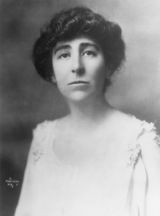
Jeannette Rankin

Encyclopedia
Jeannette Pickering Rankin (June 11, 1880 – May 18, 1973) was the first woman in the US Congress. A Republican
, she was elected statewide in Montana
in 1916 and again in 1940. A lifelong pacifist, she voted against the entry of the United States into both World War I
in 1917 and World War II
in 1941, the only member of Congress to vote against the latter. She is the only woman to be elected to Congress from Montana.
who was a former schoolteacher. Her parents were well-to-do and prominent in Montana affairs. Jeannette Rankin never married. She attended the University of Montana and graduated in 1902 with a bachelor of science degree in biology.
On a visit to Boston in 1904 she was horrified at slum conditions and decided to enter social work. She attended the New York School of Philanthropy (later part of Columbia University
) in the 1908-1909 school year, and worked in Spokane, Washington. She studied social legislation at the University of Washington
, where she became involved in the woman suffrage movement. Agreeing with Jane Addams
, Rankin argued that slum conditions were worsened by women's inability to vote. In 1910 she returned to Montana to work for the Montana Equal Franchise Society. She declared that she was suspicious of governmental priorities set without women's voice and argued that voteless women were being taxed without representation, echoing the famous credo
from the American Revolution. Rankin was hired as an organizer by the New York Women's Suffrage Party and the National American Woman Suffrage Association
(NAWSA). As a field secretary for NAWSA, Rankin directed a suffrage victory in North Dakota in 1913. She quit NAWSA in 1914 to return to Montana to help secure passage of woman suffrage there, which was achieved in 1914.
was a power in the Montana Republican party, and managed her campaign for the party nomination for Congress in 1916 and in the general election. On November 7, 1916 she was elected to the House of Representatives
as a Republican from Montana, becoming the first female member of Congress. The Nineteenth Amendment
(which gave women the right to vote everywhere in the United States) was not ratified until 1920; therefore, during Rankin's first term in Congress (1917–1919), many women throughout the country did not have the right to vote, though they did in her home state of Montana. She supported woman's suffrage, child-protection laws, and prohibition. Wellington Rankin was her chief adviser and financial backer.
On April 6, 1917, only a month into her term, the House voted on the resolution to enter World War I
. Rankin cast one of 50 votes against the resolution, earning her immediate vilification by the press. About her vote, Rankin later said, "I felt the first time the first woman had a chance to say no to war she should say it." Suffrage groups canceled her speaking engagements. Despite her vote against entering the war, she devoted herself to selling Liberty Bonds and voted for the military draft.
In 1918, she ran an unsuccessful campaign for the Republican nomination to represent Montana in the United States Senate
. She then ran an independent candidacy, which also failed. Her term as Representative ended early in 1919. For the next two decades, she worked as a lobbyist in Washington, D.C.
for various causes.
In 1918, and again in 1919, she introduced legislation to provide state and federal funds for health clinics, midwife education, and visiting nurse programs in an effort to reduce the nation's infant mortality
. While serving as a field secretary for the National Consumers' League, she campaigned for legislation to promote maternal and child health care. As a lobbyist, Rankin argued for passage of the Sheppard-Towner Act, an infant and maternal health bill which was the first federal social welfare program created explicitly for women and children. The legislation, however, was not enacted until 1921 and was repealed just eight years later.
She was the founding Vice-President of the American Civil Liberties Union
and a founding member of the Women's International League for Peace and Freedom
.
In 1940, Rankin was again elected to Congress, this time on an anti-war platform. Following the attack on Pearl Harbor
, she once again voted against entering a World War, the only member of Congress to do so, saying "As a woman, I can't go to war and I refuse to send anyone else." Montana Republican leaders demanded that Rankin change her vote, but she refused. However, she did not vote against declaring war on Germany
and Italy
following their declaration of war on the U.S. Instead, she voted merely Present
.
By 1942, Rankin's antiwar stance had become so unpopular that she did not seek re-election. During the remainder of her life, she traveled to India
seven times and was a devotee of Gandhian principles of non-violence and self-determination
.
. During the 1950s, she gave lectures and interviews on women's rights, militarism, and disarmament. She also spoke out against the Korean War
. Later, Rankin was actively opposed to U.S. military action in the Vietnam War
. In 1968 she led a protest demonstration of thousands of women in Washington, D.C. The following year she participated in other antiwar marches in Georgia and South Carolina. Rankin considered running for Congress a final time, but was held back by illness.
at the age of 92 from natural causes. Rankin bequeathed her property in Watkinsville
, Georgia
to help "mature, unemployed women workers." This was the seed money for the Jeannette Rankin Foundation, a 501(c)(3) (non-profit) organization that gives educational scholarships annually to low income women all across the United States. The organization has built capacity since its single $500 scholarship in 1978 to the 80 $2,000 scholarships it awarded in 2007.
In 1985, a statue of her was placed in the United States Capitol
's Statuary Hall
.
In 2004, A Single Woman
, a play based on the life of Rankin, was produced. A film of the same name
was released in 2008.
History of the United States Republican Party
The United States Republican Party is the second oldest currently existing political party in the United States after its great rival, the Democratic Party. It emerged in 1854 to combat the Kansas Nebraska Act which threatened to extend slavery into the territories, and to promote more vigorous...
, she was elected statewide in Montana
Montana
Montana is a state in the Western United States. The western third of Montana contains numerous mountain ranges. Smaller, "island ranges" are found in the central third of the state, for a total of 77 named ranges of the Rocky Mountains. This geographical fact is reflected in the state's name,...
in 1916 and again in 1940. A lifelong pacifist, she voted against the entry of the United States into both World War I
World War I
World War I , which was predominantly called the World War or the Great War from its occurrence until 1939, and the First World War or World War I thereafter, was a major war centred in Europe that began on 28 July 1914 and lasted until 11 November 1918...
in 1917 and World War II
World War II
World War II, or the Second World War , was a global conflict lasting from 1939 to 1945, involving most of the world's nations—including all of the great powers—eventually forming two opposing military alliances: the Allies and the Axis...
in 1941, the only member of Congress to vote against the latter. She is the only woman to be elected to Congress from Montana.
Early life and suffrage movement
Rankin was born on a ranch near Missoula, Montana Territory, the first of eleven children born to John Rankin, a rancher and builder who had immigrated from Canada, and Olive Pickering, a YankeeYankee
The term Yankee has several interrelated and often pejorative meanings, usually referring to people originating in the northeastern United States, or still more narrowly New England, where application of the term is largely restricted to descendants of the English settlers of the region.The...
who was a former schoolteacher. Her parents were well-to-do and prominent in Montana affairs. Jeannette Rankin never married. She attended the University of Montana and graduated in 1902 with a bachelor of science degree in biology.
On a visit to Boston in 1904 she was horrified at slum conditions and decided to enter social work. She attended the New York School of Philanthropy (later part of Columbia University
Columbia University
Columbia University in the City of New York is a private, Ivy League university in Manhattan, New York City. Columbia is the oldest institution of higher learning in the state of New York, the fifth oldest in the United States, and one of the country's nine Colonial Colleges founded before the...
) in the 1908-1909 school year, and worked in Spokane, Washington. She studied social legislation at the University of Washington
University of Washington
University of Washington is a public research university, founded in 1861 in Seattle, Washington, United States. The UW is the largest university in the Northwest and the oldest public university on the West Coast. The university has three campuses, with its largest campus in the University...
, where she became involved in the woman suffrage movement. Agreeing with Jane Addams
Jane Addams
Jane Addams was a pioneer settlement worker, founder of Hull House in Chicago, public philosopher, sociologist, author, and leader in woman suffrage and world peace...
, Rankin argued that slum conditions were worsened by women's inability to vote. In 1910 she returned to Montana to work for the Montana Equal Franchise Society. She declared that she was suspicious of governmental priorities set without women's voice and argued that voteless women were being taxed without representation, echoing the famous credo
No taxation without representation
"No taxation without representation" is a slogan originating during the 1750s and 1760s that summarized a primary grievance of the British colonists in the Thirteen Colonies, which was one of the major causes of the American Revolution...
from the American Revolution. Rankin was hired as an organizer by the New York Women's Suffrage Party and the National American Woman Suffrage Association
National American Woman Suffrage Association
The National American Woman Suffrage Association was an American women's rights organization formed in May 1890 as a unification of the National Woman Suffrage Association and the American Woman Suffrage Association...
(NAWSA). As a field secretary for NAWSA, Rankin directed a suffrage victory in North Dakota in 1913. She quit NAWSA in 1914 to return to Montana to help secure passage of woman suffrage there, which was achieved in 1914.
Congressional career
Her brother Wellington RankinWellington D. Rankin
Wellington D. Rankin was a Republican public official from the state of Montana.He was born Wellington Duncan Rankin on September 16, 1884 in Missoula, Montana, the son of John and Olive Rankin. He grew up in a political family, with several of his relatives holding public office...
was a power in the Montana Republican party, and managed her campaign for the party nomination for Congress in 1916 and in the general election. On November 7, 1916 she was elected to the House of Representatives
United States House of Representatives
The United States House of Representatives is one of the two Houses of the United States Congress, the bicameral legislature which also includes the Senate.The composition and powers of the House are established in Article One of the Constitution...
as a Republican from Montana, becoming the first female member of Congress. The Nineteenth Amendment
Nineteenth Amendment to the United States Constitution
The Nineteenth Amendment to the United States Constitution prohibits any United States citizen to be denied the right to vote based on sex. It was ratified on August 18, 1920....
(which gave women the right to vote everywhere in the United States) was not ratified until 1920; therefore, during Rankin's first term in Congress (1917–1919), many women throughout the country did not have the right to vote, though they did in her home state of Montana. She supported woman's suffrage, child-protection laws, and prohibition. Wellington Rankin was her chief adviser and financial backer.
On April 6, 1917, only a month into her term, the House voted on the resolution to enter World War I
World War I
World War I , which was predominantly called the World War or the Great War from its occurrence until 1939, and the First World War or World War I thereafter, was a major war centred in Europe that began on 28 July 1914 and lasted until 11 November 1918...
. Rankin cast one of 50 votes against the resolution, earning her immediate vilification by the press. About her vote, Rankin later said, "I felt the first time the first woman had a chance to say no to war she should say it." Suffrage groups canceled her speaking engagements. Despite her vote against entering the war, she devoted herself to selling Liberty Bonds and voted for the military draft.
In 1918, she ran an unsuccessful campaign for the Republican nomination to represent Montana in the United States Senate
United States Senate
The United States Senate is the upper house of the bicameral legislature of the United States, and together with the United States House of Representatives comprises the United States Congress. The composition and powers of the Senate are established in Article One of the U.S. Constitution. Each...
. She then ran an independent candidacy, which also failed. Her term as Representative ended early in 1919. For the next two decades, she worked as a lobbyist in Washington, D.C.
Washington, D.C.
Washington, D.C., formally the District of Columbia and commonly referred to as Washington, "the District", or simply D.C., is the capital of the United States. On July 16, 1790, the United States Congress approved the creation of a permanent national capital as permitted by the U.S. Constitution....
for various causes.
In 1918, and again in 1919, she introduced legislation to provide state and federal funds for health clinics, midwife education, and visiting nurse programs in an effort to reduce the nation's infant mortality
Infant mortality
Infant mortality is defined as the number of infant deaths per 1000 live births. Traditionally, the most common cause worldwide was dehydration from diarrhea. However, the spreading information about Oral Re-hydration Solution to mothers around the world has decreased the rate of children dying...
. While serving as a field secretary for the National Consumers' League, she campaigned for legislation to promote maternal and child health care. As a lobbyist, Rankin argued for passage of the Sheppard-Towner Act, an infant and maternal health bill which was the first federal social welfare program created explicitly for women and children. The legislation, however, was not enacted until 1921 and was repealed just eight years later.
She was the founding Vice-President of the American Civil Liberties Union
American Civil Liberties Union
The American Civil Liberties Union is a U.S. non-profit organization whose stated mission is "to defend and preserve the individual rights and liberties guaranteed to every person in this country by the Constitution and laws of the United States." It works through litigation, legislation, and...
and a founding member of the Women's International League for Peace and Freedom
Women's International League for Peace and Freedom
The Women's International League for Peace and Freedom was established in the United States in January 1915 as the Woman's Peace Party...
.
In 1940, Rankin was again elected to Congress, this time on an anti-war platform. Following the attack on Pearl Harbor
Attack on Pearl Harbor
The attack on Pearl Harbor was a surprise military strike conducted by the Imperial Japanese Navy against the United States naval base at Pearl Harbor, Hawaii, on the morning of December 7, 1941...
, she once again voted against entering a World War, the only member of Congress to do so, saying "As a woman, I can't go to war and I refuse to send anyone else." Montana Republican leaders demanded that Rankin change her vote, but she refused. However, she did not vote against declaring war on Germany
Nazi Germany
Nazi Germany , also known as the Third Reich , but officially called German Reich from 1933 to 1943 and Greater German Reich from 26 June 1943 onward, is the name commonly used to refer to the state of Germany from 1933 to 1945, when it was a totalitarian dictatorship ruled by...
and Italy
Kingdom of Italy (1861–1946)
The Kingdom of Italy was a state forged in 1861 by the unification of Italy under the influence of the Kingdom of Sardinia, which was its legal predecessor state...
following their declaration of war on the U.S. Instead, she voted merely Present
Abstention
Abstention is a term in election procedure for when a participant in a vote either does not go to vote or, in parliamentary procedure, is present during the vote, but does not cast a ballot. Abstention must be contrasted with "blank vote", in which a voter casts a ballot willfully made invalid by...
.
By 1942, Rankin's antiwar stance had become so unpopular that she did not seek re-election. During the remainder of her life, she traveled to India
India
India , officially the Republic of India , is a country in South Asia. It is the seventh-largest country by geographical area, the second-most populous country with over 1.2 billion people, and the most populous democracy in the world...
seven times and was a devotee of Gandhian principles of non-violence and self-determination
Self-determination
Self-determination is the principle in international law that nations have the right to freely choose their sovereignty and international political status with no external compulsion or external interference...
.
Post-congressional activities
Rankin traveled to India seven times from 1947 to 1971 to study the non-violent civil disobedience methods of Mahatma GandhiMahatma Gandhi
Mohandas Karamchand Gandhi , pronounced . 2 October 1869 – 30 January 1948) was the pre-eminent political and ideological leader of India during the Indian independence movement...
. During the 1950s, she gave lectures and interviews on women's rights, militarism, and disarmament. She also spoke out against the Korean War
Korean War
The Korean War was a conventional war between South Korea, supported by the United Nations, and North Korea, supported by the People's Republic of China , with military material aid from the Soviet Union...
. Later, Rankin was actively opposed to U.S. military action in the Vietnam War
Vietnam War
The Vietnam War was a Cold War-era military conflict that occurred in Vietnam, Laos, and Cambodia from 1 November 1955 to the fall of Saigon on 30 April 1975. This war followed the First Indochina War and was fought between North Vietnam, supported by its communist allies, and the government of...
. In 1968 she led a protest demonstration of thousands of women in Washington, D.C. The following year she participated in other antiwar marches in Georgia and South Carolina. Rankin considered running for Congress a final time, but was held back by illness.
Death and legacy
Rankin died in Carmel, CaliforniaCalifornia
California is a state located on the West Coast of the United States. It is by far the most populous U.S. state, and the third-largest by land area...
at the age of 92 from natural causes. Rankin bequeathed her property in Watkinsville
Watkinsville, Georgia
Watkinsville is a town in Oconee County, Georgia, United States. As of the 2000 census, the town had a total population of 2,097. The city is the county seat of Oconee County...
, Georgia
Georgia (U.S. state)
Georgia is a state located in the southeastern United States. It was established in 1732, the last of the original Thirteen Colonies. The state is named after King George II of Great Britain. Georgia was the fourth state to ratify the United States Constitution, on January 2, 1788...
to help "mature, unemployed women workers." This was the seed money for the Jeannette Rankin Foundation, a 501(c)(3) (non-profit) organization that gives educational scholarships annually to low income women all across the United States. The organization has built capacity since its single $500 scholarship in 1978 to the 80 $2,000 scholarships it awarded in 2007.
In 1985, a statue of her was placed in the United States Capitol
United States Capitol
The United States Capitol is the meeting place of the United States Congress, the legislature of the federal government of the United States. Located in Washington, D.C., it sits atop Capitol Hill at the eastern end of the National Mall...
's Statuary Hall
National Statuary Hall Collection
The National Statuary Hall Collection in the United States Capitol comprises statues donated by individual states to honor persons notable in their history...
.
In 2004, A Single Woman
A Single Woman (play)
First drafted as a one-woman show by Nevada Shakespeare Company founding Artistic Director, Jeanmarie Simpson, A Single Woman, based on the life of first female Congressmember Jeannette Rankin, developed into a "duet performance work" by the time it premiered at the Oats Park Art Center in Fallon,...
, a play based on the life of Rankin, was produced. A film of the same name
A Single Woman (film)
A Single Woman is a 2009 film made by Nevada Shakespeare Company and Heroica Films. It was directed by Kamala Lopez and produced by Cameron Crain, Richard Shelgren and Kamala Lopez. The screenplay was by Jeanmarie Simpson based on her play with the same title.-Artists:The film stars Jeanmarie...
was released in 2008.
See also
- Women in the United States House of RepresentativesWomen in the United States House of RepresentativesSince the beginning of the 20th century, a number of women have served in the United States House of Representatives. The first woman to be elected to the United States Congress was Jeanette Rankin, a Republican from Montana elected in 1917. 229 women have served in total as of 2009...
- WILPF
- Jeanmarie SimpsonJeanmarie SimpsonJeanmarie Simpson is an American peace activist and theatre/film artist.- Early life :Simpson was born in Ray, Arizona. Her parents are Maria Luisa Jugo, a Venezuelan immigrant, and Donald Leroy Simpson, an American mining engineer. Jeanmarie Simpson was raised in rural Arizona...
External links
- Women in Congress Biography
- Suffragists Oral History Project at Berkeley - 1971-72 interviews with Rankin
- Jeannette Rankin Foundation
- Jeannette Rankin Peace Center
- http://peaceisawomansjob.comPeace is a Woman's Job, play and film about Rankin by actorActorAn actor is a person who acts in a dramatic production and who works in film, television, theatre, or radio in that capacity...
/playwrightPlaywrightA playwright, also called a dramatist, is a person who writes plays.The term is not a variant spelling of "playwrite", but something quite distinct: the word wright is an archaic English term for a craftsman or builder...
, Allyson Adams]