

Transmutation of species

Encyclopedia
Transmutation of species was a term used by Jean Baptiste Lamarck in 1809 for his theory that described the altering of one species
into another, and the term is often used to describe 19th century evolutionary ideas that preceded Charles Darwin
's theory of natural selection
. Other 19th century proponents of pre-Darwinian evolutionary ideas included Étienne Geoffroy Saint-Hilaire
, Robert Grant, and Robert Chambers who anonymously published the book Vestiges of the Natural History of Creation
. Opposition in the scientific community, led by influential scientists like the anatomists Georges Cuvier
and Richard Owen
and the geologist Charles Lyell
, to these early theories of evolution was intense. The debate over them was an important stage in the history of evolutionary thought
and would influence the subsequent reaction to Darwin's theory
.
published On The Origin of Species (1859). Transmutation had previously been used as a term in alchemy to describe the transformation of base metals into gold. Other names for evolutionary ideas used in this period include the development hypothesis (one of the terms used by Darwin) and the theory of regular gradation, used by William Chilton
in the periodical press such as The Oracle of Reason
. Transformation is another word used quite as often as transmutation in this context. These early 19th century evolutionary ideas played an important role in the history of evolutionary thought
.
The proto-evolutionary thinkers of the 18th and early 19th century had to invent terms to label their ideas, and the terminology did not settle down until some time after the publication of the Origin of Species. The word evolution was quite a late-comer: it can be seen in Herbert Spencer
's Social Statics
of 1851, and there is at least one earlier example, but it was not in general use until about 1865-70.
 Jean-Baptiste Lamarck
proposed a theory on the transmutation of species in Philosophie Zoologique (1809). Lamarck did not believe that all living things shared a common ancestor. Rather he believed that simple forms of life were created continuously by spontaneous generation
. He also believed that an innate life force, which he sometimes described as a nervous fluid, drove species to become more complex over time, advancing up a linear ladder of complexity that was related to the great chain of being. Lamarck also recognized that species were adapted to their environment. He explained this observation by saying that the same nervous fluid driving increasing complexity, also caused the organs of an animal (or a plant) to change based on the use or disuse of that organ, just as muscles are affected by exercise. He argued that these changes would be inherited by the next generation and produce slow adaptation to the environment. It was this secondary mechanism of adaptation through the inheritance of acquired characteristics that became closely associated with his name and would influence discussions of evolution into the 20th century.
A radical British school of comparative anatomy that included the surgeon Robert Knox
and the anatomist Robert Grant was closely in touch with Lamarck's school of French Transformationism, which contained scientists such as Étienne Geoffroy Saint-Hilaire
. Grant developed Lamarck's and Erasmus Darwin
's ideas of transmutation and evolutionism
, investigating homology
to prove common descent
. As a young student Charles Darwin
joined Grant in investigations of the life cycle of marine animals. He also studied geology under professor Robert Jameson
whose journal published an anonymous paper in 1826 praising "Mr. Lamarck" for explaining how the higher animals had "evolved" from the "simplest worms" – this was the first use of the word "evolved" in a modern sense. Jameson's course closed with lectures on the "Origin of the Species of Animals".
The computing pioneer Charles Babbage
published his unofficial Ninth Bridgewater Treatise in 1837, putting forward the thesis that God had the omnipotence and foresight to create as a divine legislator, making laws (or programs) which then produced species at the appropriate times, rather than continually interfering with ad hoc miracles each time a new species was required. In 1844 the Scottish publisher Robert Chambers anonymously published an influential and extremely controversial book of popular science entitled Vestiges of the Natural History of Creation
. This book proposed an evolutionary scenario for the origins of the solar system and life on earth. It claimed that the fossil record showed a progressive ascent of animals with current animals being branches off a main line that leads progressively to humanity. It implied that the transmutations lead to the unfolding of a preordained plan that had been woven into the laws that governed the universe. In this sense it was less completely materialistic than the ideas of radicals like Robert Grant, but its implication that humans were just the last step in the ascent of animal life incensed many conservative thinkers. Both conservatives like Adam Sedgwick, and radical materialists like Thomas Henry Huxley, who disliked Chambers' implications of preordained progress, were able to find scientific inaccuracies in the book that they could disparage. Darwin himself openly deplored the author's "poverty of intellect", and dismissed it as a "literary curiosity." However, the high profile of the public debate over Vestiges, with its depiction of evolution as a progressive process, and its popular success, would greatly influence the perception of Darwin's theory a decade later. It also influenced some younger naturalists, including Alfred Russel Wallace
, to take an interest in the idea of transmutation.
and were greeted with hostility by more conservative thinkers. Cuvier attacked the ideas of Lamarck and Geoffroy Saint-Hilaire
, agreeing with Aristotle that species were immutable. Cuvier believed that the individual parts of an animal were too closely correlated with one another to allow for one part of the anatomy to change in isolation from the others, and argued that the fossil record showed patterns of catastrophic extinctions followed by re-population, rather than gradual change over time. He also noted that drawings of animals and animal mummies from Egypt, which were thousands of years old, showed no signs of change when compared with modern animals. The strength of Cuvier's arguments and his reputation as a leading scientist helped keep transmutational ideas out of the scientific mainstream for decades.
In Britain, where the philosophy of natural theology
remained influential, William Paley
wrote the book Natural Theology with its famous watchmaker analogy
, at least in part as a response to the transmutational ideas of Erasmus Darwin
. Geologists influenced by natural theology, such as Buckland and Sedgwick, made a regular practice of attacking the evolutionary ideas of Lamarck and Grant, and Sedgwick wrote a famously harsh review of The Vestiges of the Natural History of Creation. Although the geologist Charles Lyell
opposed scriptural geology he also believed in the immutability of species, and in his Principles of Geology (1830–1833), criticized and dismissed Lamarck's theories of development. Instead, he advocated a form of progressive creation, in which each species had its "centre of creation" and was designed for this particular habitat, but would go extinct when this habitat changed.
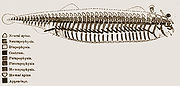 Another source of opposition to transmutation was a school of naturalists who were influenced by the German philosophers and naturalists associated with idealism
, such as Goethe, Hegel and Lorenz Oken
. Idealists such as Louis Agassiz
and Richard Owen
believed that each species was fixed and unchangeable because it represented an idea in the mind of the creator. They believed that relationships between species could be discerned from developmental patterns in embryology
, as well as in the fossil record: but that these relationships represented an underlying pattern of divine thought, with progressive creation leading to increasing complexity and culminating in humanity. Owen developed the idea of "archetypes" in the Divine mind that would produce a sequence of species related by anatomical homologies, such as vertebrate
limbs. Owen was concerned by the political implications of the ideas of transmutationists like Robert Grant, and he led a public campaign by conservatives that successfully marginalized Grant in the scientific community. In his famous 1841 paper, which coined the term dinosaur for the giant reptiles discovered by Buckland and Gideon Mantell
, Owen argued that these reptiles contradicted the transmutational ideas of Lamarck because they were more sophisticated than the reptiles of the modern world. Darwin would make good use of the homologies analyzed by Owen in his own theory, but the harsh treatment of Grant, along with the controversy surrounding Vestiges, would be factors in his decision to ensure that his theory was fully supported by facts and arguments before publishing his ideas.
Species
In biology, a species is one of the basic units of biological classification and a taxonomic rank. A species is often defined as a group of organisms capable of interbreeding and producing fertile offspring. While in many cases this definition is adequate, more precise or differing measures are...
into another, and the term is often used to describe 19th century evolutionary ideas that preceded Charles Darwin
Charles Darwin
Charles Robert Darwin FRS was an English naturalist. He established that all species of life have descended over time from common ancestry, and proposed the scientific theory that this branching pattern of evolution resulted from a process that he called natural selection.He published his theory...
's theory of natural selection
Natural selection
Natural selection is the nonrandom process by which biologic traits become either more or less common in a population as a function of differential reproduction of their bearers. It is a key mechanism of evolution....
. Other 19th century proponents of pre-Darwinian evolutionary ideas included Étienne Geoffroy Saint-Hilaire
Étienne Geoffroy Saint-Hilaire
Étienne Geoffroy Saint-Hilaire was a French naturalist who established the principle of "unity of composition". He was a colleague of Jean-Baptiste Lamarck and expanded and defended Lamarck's evolutionary theories...
, Robert Grant, and Robert Chambers who anonymously published the book Vestiges of the Natural History of Creation
Vestiges of the Natural History of Creation
Vestiges of the Natural History of Creation is a unique work of speculative natural history published anonymously in England in 1844. It brought together various ideas of stellar evolution with the progressive transmutation of species in an accessible narrative which tied together numerous...
. Opposition in the scientific community, led by influential scientists like the anatomists Georges Cuvier
Georges Cuvier
Georges Chrétien Léopold Dagobert Cuvier or Jean Léopold Nicolas Frédéric Cuvier , known as Georges Cuvier, was a French naturalist and zoologist...
and Richard Owen
Richard Owen
Sir Richard Owen, FRS KCB was an English biologist, comparative anatomist and palaeontologist.Owen is probably best remembered today for coining the word Dinosauria and for his outspoken opposition to Charles Darwin's theory of evolution by natural selection...
and the geologist Charles Lyell
Charles Lyell
Sir Charles Lyell, 1st Baronet, Kt FRS was a British lawyer and the foremost geologist of his day. He is best known as the author of Principles of Geology, which popularised James Hutton's concepts of uniformitarianism – the idea that the earth was shaped by slow-moving forces still in operation...
, to these early theories of evolution was intense. The debate over them was an important stage in the history of evolutionary thought
History of evolutionary thought
Evolutionary thought, the conception that species change over time, has roots in antiquity, in the ideas of the ancient Greeks, Romans, and Chinese as well as in medieval Islamic science...
and would influence the subsequent reaction to Darwin's theory
Reaction to Darwin's theory
The immediate reaction to Darwin's theory followed closely on his publication of On the Origin of Species, and Charles Darwin's book sparked off international debate, though the heat of controversy was less than that over earlier works such as Vestiges of Creation...
.
Terminology
Transmutation was one of the names commonly used for evolutionary ideas in the 19th century before Charles DarwinCharles Darwin
Charles Robert Darwin FRS was an English naturalist. He established that all species of life have descended over time from common ancestry, and proposed the scientific theory that this branching pattern of evolution resulted from a process that he called natural selection.He published his theory...
published On The Origin of Species (1859). Transmutation had previously been used as a term in alchemy to describe the transformation of base metals into gold. Other names for evolutionary ideas used in this period include the development hypothesis (one of the terms used by Darwin) and the theory of regular gradation, used by William Chilton
William Chilton (printer)
William Chilton , was a printer, Owenite Socialist, evolutionist, and co-founder with Charles Southwell of The Oracle of Reason, which claimed to be the world's first avowedly atheist journal.-Life:...
in the periodical press such as The Oracle of Reason
The Oracle of Reason
The Oracle of Reason, or Philosophy Vindicated was the first avowedly atheistic periodical to be published in Britain . It was founded by Charles Southwell, William Chilton and John Field in 1841 , and lasted until 1843.-History:...
. Transformation is another word used quite as often as transmutation in this context. These early 19th century evolutionary ideas played an important role in the history of evolutionary thought
History of evolutionary thought
Evolutionary thought, the conception that species change over time, has roots in antiquity, in the ideas of the ancient Greeks, Romans, and Chinese as well as in medieval Islamic science...
.
The proto-evolutionary thinkers of the 18th and early 19th century had to invent terms to label their ideas, and the terminology did not settle down until some time after the publication of the Origin of Species. The word evolution was quite a late-comer: it can be seen in Herbert Spencer
Herbert Spencer
Herbert Spencer was an English philosopher, biologist, sociologist, and prominent classical liberal political theorist of the Victorian era....
's Social Statics
Social Statics
Social Statics, or The Conditions essential to Happiness specified, and the First of them Developed is an 1851 book by the British polymath Herbert Spencer...
of 1851, and there is at least one earlier example, but it was not in general use until about 1865-70.
Historical development
Jean-Baptiste Lamarck
Jean-Baptiste Pierre Antoine de Monet, Chevalier de la Marck , often known simply as Lamarck, was a French naturalist...
proposed a theory on the transmutation of species in Philosophie Zoologique (1809). Lamarck did not believe that all living things shared a common ancestor. Rather he believed that simple forms of life were created continuously by spontaneous generation
Spontaneous generation
Spontaneous generation or Equivocal generation is an obsolete principle regarding the origin of life from inanimate matter, which held that this process was a commonplace and everyday occurrence, as distinguished from univocal generation, or reproduction from parent...
. He also believed that an innate life force, which he sometimes described as a nervous fluid, drove species to become more complex over time, advancing up a linear ladder of complexity that was related to the great chain of being. Lamarck also recognized that species were adapted to their environment. He explained this observation by saying that the same nervous fluid driving increasing complexity, also caused the organs of an animal (or a plant) to change based on the use or disuse of that organ, just as muscles are affected by exercise. He argued that these changes would be inherited by the next generation and produce slow adaptation to the environment. It was this secondary mechanism of adaptation through the inheritance of acquired characteristics that became closely associated with his name and would influence discussions of evolution into the 20th century.
A radical British school of comparative anatomy that included the surgeon Robert Knox
Robert Knox
Robert Knox was a Scottish surgeon, anatomist and zoologist. He was the most popular lecturer in anatomy in Edinburgh before his involvement in the Burke and Hare body-snatching case. This ruined his career, and a later move to London did not improve matters...
and the anatomist Robert Grant was closely in touch with Lamarck's school of French Transformationism, which contained scientists such as Étienne Geoffroy Saint-Hilaire
Étienne Geoffroy Saint-Hilaire
Étienne Geoffroy Saint-Hilaire was a French naturalist who established the principle of "unity of composition". He was a colleague of Jean-Baptiste Lamarck and expanded and defended Lamarck's evolutionary theories...
. Grant developed Lamarck's and Erasmus Darwin
Erasmus Darwin
Erasmus Darwin was an English physician who turned down George III's invitation to be a physician to the King. One of the key thinkers of the Midlands Enlightenment, he was also a natural philosopher, physiologist, slave trade abolitionist,inventor and poet...
's ideas of transmutation and evolutionism
Evolutionism
Evolutionism refers to the biological concept of evolution, specifically to a widely held 19th century belief that organisms are intrinsically bound to increase in complexity. The belief was extended to include cultural evolution and social evolution...
, investigating homology
Homology (biology)
Homology forms the basis of organization for comparative biology. In 1843, Richard Owen defined homology as "the same organ in different animals under every variety of form and function". Organs as different as a bat's wing, a seal's flipper, a cat's paw and a human hand have a common underlying...
to prove common descent
Common descent
In evolutionary biology, a group of organisms share common descent if they have a common ancestor. There is strong quantitative support for the theory that all living organisms on Earth are descended from a common ancestor....
. As a young student Charles Darwin
Charles Darwin
Charles Robert Darwin FRS was an English naturalist. He established that all species of life have descended over time from common ancestry, and proposed the scientific theory that this branching pattern of evolution resulted from a process that he called natural selection.He published his theory...
joined Grant in investigations of the life cycle of marine animals. He also studied geology under professor Robert Jameson
Robert Jameson
thumb|Robert JamesonProfessor Robert Jameson, FRS FRSE was a Scottish naturalist and mineralogist.As Regius Professor at the University of Edinburgh for fifty years, Jameson is notable for his advanced scholarship in natural history, his superb museum collection, and for his tuition of Charles...
whose journal published an anonymous paper in 1826 praising "Mr. Lamarck" for explaining how the higher animals had "evolved" from the "simplest worms" – this was the first use of the word "evolved" in a modern sense. Jameson's course closed with lectures on the "Origin of the Species of Animals".
The computing pioneer Charles Babbage
Charles Babbage
Charles Babbage, FRS was an English mathematician, philosopher, inventor and mechanical engineer who originated the concept of a programmable computer...
published his unofficial Ninth Bridgewater Treatise in 1837, putting forward the thesis that God had the omnipotence and foresight to create as a divine legislator, making laws (or programs) which then produced species at the appropriate times, rather than continually interfering with ad hoc miracles each time a new species was required. In 1844 the Scottish publisher Robert Chambers anonymously published an influential and extremely controversial book of popular science entitled Vestiges of the Natural History of Creation
Vestiges of the Natural History of Creation
Vestiges of the Natural History of Creation is a unique work of speculative natural history published anonymously in England in 1844. It brought together various ideas of stellar evolution with the progressive transmutation of species in an accessible narrative which tied together numerous...
. This book proposed an evolutionary scenario for the origins of the solar system and life on earth. It claimed that the fossil record showed a progressive ascent of animals with current animals being branches off a main line that leads progressively to humanity. It implied that the transmutations lead to the unfolding of a preordained plan that had been woven into the laws that governed the universe. In this sense it was less completely materialistic than the ideas of radicals like Robert Grant, but its implication that humans were just the last step in the ascent of animal life incensed many conservative thinkers. Both conservatives like Adam Sedgwick, and radical materialists like Thomas Henry Huxley, who disliked Chambers' implications of preordained progress, were able to find scientific inaccuracies in the book that they could disparage. Darwin himself openly deplored the author's "poverty of intellect", and dismissed it as a "literary curiosity." However, the high profile of the public debate over Vestiges, with its depiction of evolution as a progressive process, and its popular success, would greatly influence the perception of Darwin's theory a decade later. It also influenced some younger naturalists, including Alfred Russel Wallace
Alfred Russel Wallace
Alfred Russel Wallace, OM, FRS was a British naturalist, explorer, geographer, anthropologist and biologist...
, to take an interest in the idea of transmutation.
Opposition to transmutation
Ideas about the transmutation of species were strongly associated with the radical materialism of the enlightenmentAge of Enlightenment
The Age of Enlightenment was an elite cultural movement of intellectuals in 18th century Europe that sought to mobilize the power of reason in order to reform society and advance knowledge. It promoted intellectual interchange and opposed intolerance and abuses in church and state...
and were greeted with hostility by more conservative thinkers. Cuvier attacked the ideas of Lamarck and Geoffroy Saint-Hilaire
Étienne Geoffroy Saint-Hilaire
Étienne Geoffroy Saint-Hilaire was a French naturalist who established the principle of "unity of composition". He was a colleague of Jean-Baptiste Lamarck and expanded and defended Lamarck's evolutionary theories...
, agreeing with Aristotle that species were immutable. Cuvier believed that the individual parts of an animal were too closely correlated with one another to allow for one part of the anatomy to change in isolation from the others, and argued that the fossil record showed patterns of catastrophic extinctions followed by re-population, rather than gradual change over time. He also noted that drawings of animals and animal mummies from Egypt, which were thousands of years old, showed no signs of change when compared with modern animals. The strength of Cuvier's arguments and his reputation as a leading scientist helped keep transmutational ideas out of the scientific mainstream for decades.
In Britain, where the philosophy of natural theology
Natural theology
Natural theology is a branch of theology based on reason and ordinary experience. Thus it is distinguished from revealed theology which is based on scripture and religious experiences of various kinds; and also from transcendental theology, theology from a priori reasoning.Marcus Terentius Varro ...
remained influential, William Paley
William Paley
William Paley was a British Christian apologist, philosopher, and utilitarian. He is best known for his exposition of the teleological argument for the existence of God in his work Natural Theology, which made use of the watchmaker analogy .-Life:Paley was Born in Peterborough, England, and was...
wrote the book Natural Theology with its famous watchmaker analogy
Watchmaker analogy
The watchmaker analogy, or watchmaker argument, is a teleological argument for the existence of God. By way of an analogy, the argument states that design implies a designer...
, at least in part as a response to the transmutational ideas of Erasmus Darwin
Erasmus Darwin
Erasmus Darwin was an English physician who turned down George III's invitation to be a physician to the King. One of the key thinkers of the Midlands Enlightenment, he was also a natural philosopher, physiologist, slave trade abolitionist,inventor and poet...
. Geologists influenced by natural theology, such as Buckland and Sedgwick, made a regular practice of attacking the evolutionary ideas of Lamarck and Grant, and Sedgwick wrote a famously harsh review of The Vestiges of the Natural History of Creation. Although the geologist Charles Lyell
Charles Lyell
Sir Charles Lyell, 1st Baronet, Kt FRS was a British lawyer and the foremost geologist of his day. He is best known as the author of Principles of Geology, which popularised James Hutton's concepts of uniformitarianism – the idea that the earth was shaped by slow-moving forces still in operation...
opposed scriptural geology he also believed in the immutability of species, and in his Principles of Geology (1830–1833), criticized and dismissed Lamarck's theories of development. Instead, he advocated a form of progressive creation, in which each species had its "centre of creation" and was designed for this particular habitat, but would go extinct when this habitat changed.
Idealism
In philosophy, idealism is the family of views which assert that reality, or reality as we can know it, is fundamentally mental, mentally constructed, or otherwise immaterial. Epistemologically, idealism manifests as a skepticism about the possibility of knowing any mind-independent thing...
, such as Goethe, Hegel and Lorenz Oken
Lorenz Oken
Lorenz Oken was a German naturalist.Oken was born Lorenz Okenfuss in Bohlsbach in Baden and studied natural history and medicine at the universities of Freiburg and Würzburg. He went on to the University of Göttingen, where he became a Privatdozent , and shortened his name to Oken...
. Idealists such as Louis Agassiz
Louis Agassiz
Jean Louis Rodolphe Agassiz was a Swiss paleontologist, glaciologist, geologist and a prominent innovator in the study of the Earth's natural history. He grew up in Switzerland and became a professor of natural history at University of Neuchâtel...
and Richard Owen
Richard Owen
Sir Richard Owen, FRS KCB was an English biologist, comparative anatomist and palaeontologist.Owen is probably best remembered today for coining the word Dinosauria and for his outspoken opposition to Charles Darwin's theory of evolution by natural selection...
believed that each species was fixed and unchangeable because it represented an idea in the mind of the creator. They believed that relationships between species could be discerned from developmental patterns in embryology
Embryology
Embryology is a science which is about the development of an embryo from the fertilization of the ovum to the fetus stage...
, as well as in the fossil record: but that these relationships represented an underlying pattern of divine thought, with progressive creation leading to increasing complexity and culminating in humanity. Owen developed the idea of "archetypes" in the Divine mind that would produce a sequence of species related by anatomical homologies, such as vertebrate
Vertebrate
Vertebrates are animals that are members of the subphylum Vertebrata . Vertebrates are the largest group of chordates, with currently about 58,000 species described. Vertebrates include the jawless fishes, bony fishes, sharks and rays, amphibians, reptiles, mammals, and birds...
limbs. Owen was concerned by the political implications of the ideas of transmutationists like Robert Grant, and he led a public campaign by conservatives that successfully marginalized Grant in the scientific community. In his famous 1841 paper, which coined the term dinosaur for the giant reptiles discovered by Buckland and Gideon Mantell
Gideon Mantell
Gideon Algernon Mantell MRCS FRS was an English obstetrician, geologist and palaeontologist...
, Owen argued that these reptiles contradicted the transmutational ideas of Lamarck because they were more sophisticated than the reptiles of the modern world. Darwin would make good use of the homologies analyzed by Owen in his own theory, but the harsh treatment of Grant, along with the controversy surrounding Vestiges, would be factors in his decision to ensure that his theory was fully supported by facts and arguments before publishing his ideas.
See also
- ChronospeciesChronospeciesA chronospecies describes a group of one or more species derived from a sequential development pattern which involves continual and uniform changes from an extinct ancestral form on an evolutionary scale. This sequence of alterations eventually produces a population which is physically,...
- Edward BlythEdward BlythEdward Blyth was an English zoologist and pharmacist. He was one of the founders of zoology in India....
- Erasmus DarwinErasmus DarwinErasmus Darwin was an English physician who turned down George III's invitation to be a physician to the King. One of the key thinkers of the Midlands Enlightenment, he was also a natural philosopher, physiologist, slave trade abolitionist,inventor and poet...
- Evolutionary ideas of the renaissance and enlightenmentEvolutionary ideas of the renaissance and enlightenmentEvolutionary ideas of the Renaissance and the Enlightenment developed as natural history became more sophisticated during the 17th and 18th centuries, and as the scientific revolution and the rise of mechanical philosophy encouraged viewing the natural world as a machine whose workings were...
- History of evolutionary thoughtHistory of evolutionary thoughtEvolutionary thought, the conception that species change over time, has roots in antiquity, in the ideas of the ancient Greeks, Romans, and Chinese as well as in medieval Islamic science...
- James Burnett, Lord MonboddoJames Burnett, Lord MonboddoJames Burnett, Lord Monboddo was a Scottish judge, scholar of linguistic evolution, philosopher and deist. He is most famous today as a founder of modern comparative historical linguistics . In 1767 he became a judge in the Court of Session. As such, Burnett adopted an honorary title based on his...
- James Cowles PrichardJames Cowles PrichardJames Cowles Prichard MD FRS was an English physician and ethnologist. His influential Researches into the physical history of mankind touched upon the subject of evolution...
- Jean-Baptiste LamarckJean-Baptiste LamarckJean-Baptiste Pierre Antoine de Monet, Chevalier de la Marck , often known simply as Lamarck, was a French naturalist...
- Patrick MatthewPatrick MatthewPatrick Matthew was a Scottish landowner and fruit farmer. He published the principle of natural selection as a mechanism of evolution over a quarter-century earlier than Charles Darwin and Alfred Russel Wallace...
- Vestiges of the Natural History of CreationVestiges of the Natural History of CreationVestiges of the Natural History of Creation is a unique work of speculative natural history published anonymously in England in 1844. It brought together various ideas of stellar evolution with the progressive transmutation of species in an accessible narrative which tied together numerous...
- William Charles WellsWilliam Charles WellsWilliam Charles Wells MD FRS FRSEd , was a Scottish-American physician and printer. He lived a life of extraordinary variety, did some notable medical research, and made the first clear statement about natural selection. He applied the idea to the origin of different skin colours in human races,...
- William Lawrence (biologist)