


Jazz royalty

Encyclopedia
Jazz royalty is a term that reflects the many great jazz
musicians who have been termed as musically gifted, honorific, "aristocratic" or "royal"
and had titles added to their names or nickname
s due to their strong music
al abilities.
at the start of the 20th century, back before the music was commonly known as "jazz". Buddy Bolden
was known as "King Bolden", as the top hot music and hot cornet
ist of the city.
The realization that such titles had commercial or public relations values that increased popularity also dates to this era. Violin
ist and bandleader Alex Watzke, observing Bolden's popularity, started billing himself as "King Watzke
", and paid children coins to publicly point at him as he walked down the street and say "There goes King Watzke". While he succeeded in appending that nickname to himself, some fellow musicians used it more with amusement than with the respect accorded to Bolden. After Bolden was institutionalized in 1907, his "crown" was taken by Freddie Keppard
who, in turn, "ruled" until 1914 when Joe Oliver took over the title.
Joe Oliver left New Orleans in 1919. Some later writers have assumed that the trumpet crown at that time went to Oliver's protégé Louis Armstrong
, but Armstrong and his contemporaries made no such claim. Armstrong had a powerful rival in Buddie Petit
, whom many ranked higher than young Armstrong in the period of 1919-1922. Neither billed themselves as "king". Oliver was known as "King Oliver" in Chicago, and was still regarded as the jazz king as late as 1925, when Louis Armstrong returned to Chicago from New York City
. Armstrong's great respect and affection for Oliver was probably a factor in never claiming Oliver's kingship, although at the urging of his wife Lil Hardin Armstrong
, Louis Armstrong
was billed as the "world's greatest jazz trumpeter", rendering Oliver's title more ceremonial than a claim of supremacy.
Meanwhile in New York City in the 1920s, Paul Whiteman
controversially began billing himself as the "King of Jazz". His nationally popular band with many hit records arguably played more jazz-influenced popular music
than jazz per se, but to the dismay of many later jazz fans, Whiteman's self-conferred moniker stuck, and a motion picture
The King of Jazz starring Whiteman and his band appeared in 1930. The "King of Jazz" title was a publicity stunt in 1923, by a musical instrument manufacturer that Whiteman endorsed, and Whiteman's publicists used it to good measure.
Jelly Roll Morton
wrote an anthem to himself called "Mr. Jelly Lord" though surprisingly didn't bill himself "Mr. Jelly Lord." He was also one of many jazz musicians annoyed by Whiteman's claim, and had enough bravado to challenge it, by billing his band as "The Kings of Jazz" In 1924, the title never caught on.
was regularly called the "King of Swing". His rival, Artie Shaw
, was often called "King of the Clarinet". Goodman's song "King Porter Stomp" was written by Jelly Roll Morton
after a piano player he knew named Porter King. Later a little-known bandleader took the name "King Porter". Nat King Cole
's nickname is partly inspired by the nursery rhyme "Old King Cole
" and partly inspired by his impressive jazz piano
technique.
There was a popular big band
, led by Blue Barron
, a stage name
. Blue Barron once billed himself as competing for the title of "King of the Mickey Mouse
Bands". Pianist Albert Ammons
was referred to both as the "King of Boogie Woogie" and the "Rhythm King" in the 30s and 40s.
billed his band as "Sharkey & His Kings of Dixieland
". What started out as the Assunto Family band acknowledged Sharkey's supremacy but claimed a lesser title for themselves, becoming the Dukes of Dixieland
. Charles Mingus
dubbed himself "Baron Mingus
" for a brief period early in his career. Many of Al Hirt
's records credited him as Al "He's The King" Hirt.
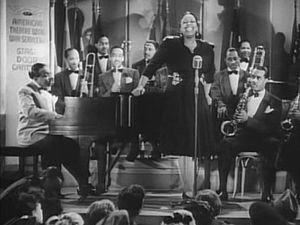
was billed as the "Queen of the Blues"; Bessie Smith
outdid her with the billing "Empress of the Blues". In a later era, Dinah Washington
was also billed as the "Queen of the Blues". B. B. King
always called himself the "Blues Boy" or "Beale Street Blues Boy" and fellow bluesmen Albert King
(born Albert Nelson) and Freddie King
were content to share a last name with him. They are now known as the "Three Kings of the Blues", a partial reference to the Three Magi.
Jazz
Jazz is a musical style that originated at the beginning of the 20th century in African American communities in the Southern United States. It was born out of a mix of African and European music traditions. From its early development until the present, jazz has incorporated music from 19th and 20th...
musicians who have been termed as musically gifted, honorific, "aristocratic" or "royal"
Royal family
A royal family is the extended family of a king or queen regnant. The term imperial family appropriately describes the extended family of an emperor or empress, while the terms "ducal family", "grand ducal family" or "princely family" are more appropriate to describe the relatives of a reigning...
and had titles added to their names or nickname
Nickname
A nickname is "a usually familiar or humorous but sometimes pointed or cruel name given to a person or place, as a supposedly appropriate replacement for or addition to the proper name.", or a name similar in origin and pronunciation from the original name....
s due to their strong music
Music
Music is an art form whose medium is sound and silence. Its common elements are pitch , rhythm , dynamics, and the sonic qualities of timbre and texture...
al abilities.
Earliest jazz "monarchs" in New Orleans
The practice goes back to New OrleansNew Orleans, Louisiana
New Orleans is a major United States port and the largest city and metropolitan area in the state of Louisiana. The New Orleans metropolitan area has a population of 1,235,650 as of 2009, the 46th largest in the USA. The New Orleans – Metairie – Bogalusa combined statistical area has a population...
at the start of the 20th century, back before the music was commonly known as "jazz". Buddy Bolden
Buddy Bolden
Charles "Buddy" Bolden was an African American cornetist and is regarded by contemporaries as a key figure in the development of a New Orleans style of rag-time music which later came to be known as jazz.- Life :...
was known as "King Bolden", as the top hot music and hot cornet
Cornet
The cornet is a brass instrument very similar to the trumpet, distinguished by its conical bore, compact shape, and mellower tone quality. The most common cornet is a transposing instrument in B. It is not related to the renaissance and early baroque cornett or cornetto.-History:The cornet was...
ist of the city.
The realization that such titles had commercial or public relations values that increased popularity also dates to this era. Violin
Violin
The violin is a string instrument, usually with four strings tuned in perfect fifths. It is the smallest, highest-pitched member of the violin family of string instruments, which includes the viola and cello....
ist and bandleader Alex Watzke, observing Bolden's popularity, started billing himself as "King Watzke
King Watzke
Alex "King" Watzke was a violinist and bandleader in New Orleans, Louisiana. His band enjoyed fair popularity ca. 1900-1910. The band played ragtime, popular music, and possibly an early or ancestral version of what later became known as jazz. By 1904 Watzke's band's repertory included an early...
", and paid children coins to publicly point at him as he walked down the street and say "There goes King Watzke". While he succeeded in appending that nickname to himself, some fellow musicians used it more with amusement than with the respect accorded to Bolden. After Bolden was institutionalized in 1907, his "crown" was taken by Freddie Keppard
Freddie Keppard
Freddie Keppard was an early jazz cornetist.Keppard was born in the Creole of Color community of downtown New Orleans, Louisiana. His older brother Louis Keppard was also a professional musician. Freddie played violin, mandolin, and accordion before switching to cornet...
who, in turn, "ruled" until 1914 when Joe Oliver took over the title.
Joe Oliver left New Orleans in 1919. Some later writers have assumed that the trumpet crown at that time went to Oliver's protégé Louis Armstrong
Louis Armstrong
Louis Armstrong , nicknamed Satchmo or Pops, was an American jazz trumpeter and singer from New Orleans, Louisiana....
, but Armstrong and his contemporaries made no such claim. Armstrong had a powerful rival in Buddie Petit
Buddie Petit
Buddie Petit or Buddy Petit was a highly regarded early jazz cornetist.His early life is somewhat mysterious, with dates of his birth given in various sources ranging from 1887 to 1897; if the later date is correct he was evidently a prodigy, regarded as one of the best in New Orleans, Louisiana...
, whom many ranked higher than young Armstrong in the period of 1919-1922. Neither billed themselves as "king". Oliver was known as "King Oliver" in Chicago, and was still regarded as the jazz king as late as 1925, when Louis Armstrong returned to Chicago from New York City
New York City
New York is the most populous city in the United States and the center of the New York Metropolitan Area, one of the most populous metropolitan areas in the world. New York exerts a significant impact upon global commerce, finance, media, art, fashion, research, technology, education, and...
. Armstrong's great respect and affection for Oliver was probably a factor in never claiming Oliver's kingship, although at the urging of his wife Lil Hardin Armstrong
Lil Hardin Armstrong
Lil Hardin Armstrong was a jazz pianist, composer, arranger, singer, and bandleader, and the second wife of Louis Armstrong with whom she collaborated on many recordings in the 1920s....
, Louis Armstrong
Louis Armstrong
Louis Armstrong , nicknamed Satchmo or Pops, was an American jazz trumpeter and singer from New Orleans, Louisiana....
was billed as the "world's greatest jazz trumpeter", rendering Oliver's title more ceremonial than a claim of supremacy.
Meanwhile in New York City in the 1920s, Paul Whiteman
Paul Whiteman
Paul Samuel Whiteman was an American bandleader and orchestral director.Leader of the most popular dance bands in the United States during the 1920s, Whiteman's recordings were immensely successful, and press notices often referred to him as the "King of Jazz"...
controversially began billing himself as the "King of Jazz". His nationally popular band with many hit records arguably played more jazz-influenced popular music
Popular music
Popular music belongs to any of a number of musical genres "having wide appeal" and is typically distributed to large audiences through the music industry. It stands in contrast to both art music and traditional music, which are typically disseminated academically or orally to smaller, local...
than jazz per se, but to the dismay of many later jazz fans, Whiteman's self-conferred moniker stuck, and a motion picture
Film
A film, also called a movie or motion picture, is a series of still or moving images. It is produced by recording photographic images with cameras, or by creating images using animation techniques or visual effects...
The King of Jazz starring Whiteman and his band appeared in 1930. The "King of Jazz" title was a publicity stunt in 1923, by a musical instrument manufacturer that Whiteman endorsed, and Whiteman's publicists used it to good measure.
Jelly Roll Morton
Jelly Roll Morton
Ferdinand Joseph LaMothe , known professionally as Jelly Roll Morton, was an American ragtime and early jazz pianist, bandleader and composer....
wrote an anthem to himself called "Mr. Jelly Lord" though surprisingly didn't bill himself "Mr. Jelly Lord." He was also one of many jazz musicians annoyed by Whiteman's claim, and had enough bravado to challenge it, by billing his band as "The Kings of Jazz" In 1924, the title never caught on.
Swing era
Benny GoodmanBenny Goodman
Benjamin David “Benny” Goodman was an American jazz and swing musician, clarinetist and bandleader; widely known as the "King of Swing".In the mid-1930s, Benny Goodman led one of the most popular musical groups in America...
was regularly called the "King of Swing". His rival, Artie Shaw
Artie Shaw
Arthur Jacob Arshawsky , better known as Artie Shaw, was an American jazz clarinetist, composer, and bandleader. He was also the author of both fiction and non-fiction writings....
, was often called "King of the Clarinet". Goodman's song "King Porter Stomp" was written by Jelly Roll Morton
Jelly Roll Morton
Ferdinand Joseph LaMothe , known professionally as Jelly Roll Morton, was an American ragtime and early jazz pianist, bandleader and composer....
after a piano player he knew named Porter King. Later a little-known bandleader took the name "King Porter". Nat King Cole
Nat King Cole
Nathaniel Adams Coles , known professionally as Nat King Cole, was an American musician who first came to prominence as a leading jazz pianist. Although an accomplished pianist, he owes most of his popular musical fame to his soft baritone voice, which he used to perform in big band and jazz genres...
's nickname is partly inspired by the nursery rhyme "Old King Cole
Old King Cole
"Old King Cole" is an English nursery rhyme. The historical identity of King Cole has been much debated and several candidates have been advanced as possibilities...
" and partly inspired by his impressive jazz piano
Jazz piano
Jazz piano is a collective term for the techniques pianists use when playing jazz. The piano has been an integral part of the jazz idiom since its inception, in both solo and ensemble settings. Its role is multifaceted due largely to the instrument's combined melodic and harmonic capabilities...
technique.
There was a popular big band
Big band
A big band is a type of musical ensemble associated with jazz and the Swing Era typically consisting of rhythm, brass, and woodwind instruments totaling approximately twelve to twenty-five musicians...
, led by Blue Barron
Blue Barron
Blue Barron , born Harry Freidman, was an American orchestra leader in the 1940s and early 1950s during the "Big Band" era....
, a stage name
Stage name
A stage name, also called a showbiz name or screen name, is a pseudonym used by performers and entertainers such as actors, wrestlers, comedians, and musicians.-Motivation to use a stage name:...
. Blue Barron once billed himself as competing for the title of "King of the Mickey Mouse
Mickey Mouse
Mickey Mouse is a cartoon character created in 1928 by Walt Disney and Ub Iwerks at The Walt Disney Studio. Mickey is an anthropomorphic black mouse and typically wears red shorts, large yellow shoes, and white gloves...
Bands". Pianist Albert Ammons
Albert Ammons
Albert Ammons was an American pianist. Ammons was a player of boogie-woogie, a bluesy jazz style popular from the late 1930s into the mid 1940s.-Life and career:...
was referred to both as the "King of Boogie Woogie" and the "Rhythm King" in the 30s and 40s.
Later examples
Sharkey BonanoSharkey Bonano
Joseph "Sharkey" Bonano was a jazz trumpeter, band leader, and vocalist....
billed his band as "Sharkey & His Kings of Dixieland
Dixieland
Dixieland music, sometimes referred to as Hot jazz, Early Jazz or New Orleans jazz, is a style of jazz music which developed in New Orleans at the start of the 20th century, and was spread to Chicago and New York City by New Orleans bands in the 1910s.Well-known jazz standard songs from the...
". What started out as the Assunto Family band acknowledged Sharkey's supremacy but claimed a lesser title for themselves, becoming the Dukes of Dixieland
Dukes of Dixieland
Dukes of Dixieland was a New Orleans dixieland revival band formed in 1948 by brothers Frank Assunto, trumpet; Fred Assunto, trombone; and their father Papa Jac Assunto, trombone and banjo. Their first records featured Jack Maheu, clarinet; Stanley Mendelsohn, piano; Tommy Rundell, drums; and...
. Charles Mingus
Charles Mingus
Charles Mingus Jr. was an American jazz musician, composer, bandleader, and civil rights activist.Mingus's compositions retained the hot and soulful feel of hard bop and drew heavily from black gospel music while sometimes drawing on elements of Third stream, free jazz, and classical music...
dubbed himself "Baron Mingus
Baron
Baron is a title of nobility. The word baron comes from Old French baron, itself from Old High German and Latin baro meaning " man, warrior"; it merged with cognate Old English beorn meaning "nobleman"...
" for a brief period early in his career. Many of Al Hirt
Al Hirt
Al Hirt was an American trumpeter and bandleader. He is best remembered for his million selling recordings of "Java", and the accompanying album, Honey in the Horn . His nicknames included 'Jumbo' and 'The Round Mound of Sound'...
's records credited him as Al "He's The King" Hirt.
Titles
- God: Art TatumArt TatumArthur "Art" Tatum, Jr. was an American jazz pianist and virtuoso who played with phenomenal facility despite being nearly blind.Tatum is widely acknowledged as one of the greatest jazz pianists of all time...
- The King: Joe "King" Oliver, Nat "King" Cole, Paul WhitemanPaul WhitemanPaul Samuel Whiteman was an American bandleader and orchestral director.Leader of the most popular dance bands in the United States during the 1920s, Whiteman's recordings were immensely successful, and press notices often referred to him as the "King of Jazz"...
, Buddy BoldenBuddy BoldenCharles "Buddy" Bolden was an African American cornetist and is regarded by contemporaries as a key figure in the development of a New Orleans style of rag-time music which later came to be known as jazz.- Life :...
, Freddie KeppardFreddie KeppardFreddie Keppard was an early jazz cornetist.Keppard was born in the Creole of Color community of downtown New Orleans, Louisiana. His older brother Louis Keppard was also a professional musician. Freddie played violin, mandolin, and accordion before switching to cornet... - The Mr. Lord: Jelly Roll MortonJelly Roll MortonFerdinand Joseph LaMothe , known professionally as Jelly Roll Morton, was an American ragtime and early jazz pianist, bandleader and composer....
- The King of Swing: Benny GoodmanBenny GoodmanBenjamin David “Benny” Goodman was an American jazz and swing musician, clarinetist and bandleader; widely known as the "King of Swing".In the mid-1930s, Benny Goodman led one of the most popular musical groups in America...
- The King of the Clarinet: Artie ShawArtie ShawArthur Jacob Arshawsky , better known as Artie Shaw, was an American jazz clarinetist, composer, and bandleader. He was also the author of both fiction and non-fiction writings....
- "The King of the Jukebox": Louis JordanLouis JordanLouis Thomas Jordan was a pioneering American jazz, blues and rhythm & blues musician, songwriter and bandleader who enjoyed his greatest popularity from the late 1930s to the early 1950s. Known as "The King of the Jukebox", Jordan was highly popular with both black and white audiences in the...
- The Queen: Peggy LeePeggy LeePeggy Lee was an American jazz and popular music singer, songwriter, composer, and actress in a career spanning six decades. From her beginning as a vocalist on local radio to singing with Benny Goodman's big band, she forged a sophisticated persona, evolving into a multi-faceted artist and...
- The Duke: Duke EllingtonDuke EllingtonEdward Kennedy "Duke" Ellington was an American composer, pianist, and big band leader. Ellington wrote over 1,000 compositions...
- The Count: Count BasieCount BasieWilliam "Count" Basie was an American jazz pianist, organist, bandleader, and composer. Basie led his jazz orchestra almost continuously for nearly 50 years...
- The Earl: Earl HinesEarl HinesEarl Kenneth Hines, universally known as Earl "Fatha" Hines, was an American jazz pianist. Hines was one of the most influential figures in the development of modern jazz piano and, according to one source, is "one of a small number of pianists whose playing shaped the history of jazz".-Early...
, more commonly called "Fatha" - The Court Jester: Ornette ColemanOrnette ColemanOrnette Coleman is an American saxophonist, violinist, trumpeter and composer. He was one of the major innovators of the free jazz movement of the 1960s....
- The Major: Glenn MillerGlenn MillerAlton Glenn Miller was an American jazz musician , arranger, composer, and bandleader in the swing era. He was one of the best-selling recording artists from 1939 to 1943, leading one of the best known "Big Bands"...
, which in fact was his military rankMilitary rankMilitary rank is a system of hierarchical relationships in armed forces or civil institutions organized along military lines. Usually, uniforms denote the bearer's rank by particular insignia affixed to the uniforms...
during World War II - The Prince of Darkness: Miles DavisMiles DavisMiles Dewey Davis III was an American jazz musician, trumpeter, bandleader, and composer. Widely considered one of the most influential musicians of the 20th century, Miles Davis was, with his musical groups, at the forefront of several major developments in jazz music, including bebop, cool jazz,...
- Sir Roland HannaRoland HannaRoland Hanna was an American Jazz pianist.Hanna studied classical piano as a boy, but was strongly interested in jazz. This increased after his time in military service.He studied at Eastman School of Music and Juilliard School...
, knighted by Liberian President William TubmanWilliam TubmanWilliam Vacanarat Shadrach Tubman was a Liberian politician. He was the 19th President of Liberia from 1944 until his death in 1971....
in 1970. - Sir Charles ThompsonCharles Thompson (jazz)Charles Phillip Thompson , is an American swing and bebop pianist, organist and arranger.He was a professional pianist from the age of 10. By the age of twelve Thompson was playing private parties with Bennie Moten and his band in Colorado Springs...
was 'knighted' by Lester YoungLester YoungLester Willis Young , nicknamed "Prez", was an American jazz tenor saxophonist and clarinetist. He also played trumpet, violin, and drums....
. - High Priest of Bop: Thelonious MonkThelonious MonkThelonious Sphere Monk was an American jazz pianist and composer considered "one of the giants of American music". Monk had a unique improvisational style and made numerous contributions to the standard jazz repertoire, including "Epistrophy", "'Round Midnight", "Blue Monk", "Straight, No Chaser"...
- High Priestess of Soul: Nina SimoneNina SimoneEunice Kathleen Waymon , better known by her stage name Nina Simone , was an American singer, songwriter, pianist, arranger, and civil rights activist widely associated with jazz music...
- The Baron: Charles MingusCharles MingusCharles Mingus Jr. was an American jazz musician, composer, bandleader, and civil rights activist.Mingus's compositions retained the hot and soulful feel of hard bop and drew heavily from black gospel music while sometimes drawing on elements of Third stream, free jazz, and classical music...
- The Maharaja: Oscar PetersonOscar PetersonOscar Emmanuel Peterson was a Canadian jazz pianist and composer. He was called the "Maharaja of the keyboard" by Duke Ellington, "O.P." by his friends. He released over 200 recordings, won seven Grammy Awards, and received other numerous awards and honours over the course of his career...
- The First Lady of Song (also Jazz): Ella FitzgeraldElla FitzgeraldElla Jane Fitzgerald , also known as the "First Lady of Song" and "Lady Ella," was an American jazz and song vocalist...
- President (Prez): Lester YoungLester YoungLester Willis Young , nicknamed "Prez", was an American jazz tenor saxophonist and clarinetist. He also played trumpet, violin, and drums....
- Lady Day: Billie HolidayBillie HolidayBillie Holiday was an American jazz singer and songwriter. Nicknamed "Lady Day" by her friend and musical partner Lester Young, Holiday had a seminal influence on jazz and pop singing...
, along with her mother (Sarah Julia "Sadie" Fagan), upon whom Lester YoungLester YoungLester Willis Young , nicknamed "Prez", was an American jazz tenor saxophonist and clarinetist. He also played trumpet, violin, and drums....
bestowed the title of the Duchess - The Divine One: Sarah VaughanSarah VaughanSarah Lois Vaughan was an American jazz singer, described by Scott Yanow as having "one of the most wondrous voices of the 20th century."...
- The Chairman of the Board: Frank SinatraFrank SinatraFrancis Albert "Frank" Sinatra was an American singer and actor.Beginning his musical career in the swing era with Harry James and Tommy Dorsey, Sinatra became an unprecedentedly successful solo artist in the early to mid-1940s, after being signed to Columbia Records in 1943. Being the idol of the...
- The King Of Cool: Dean MartinDean MartinDean Martin was an American singer, film actor, television star and comedian. Martin's hit singles included "Memories Are Made of This", "That's Amore", "Everybody Loves Somebody", "You're Nobody till Somebody Loves You", "Sway", "Volare" and "Ain't That a Kick in the Head?"...
- The Emperor of Easy: Andy WilliamsAndy WilliamsHoward Andrew "Andy" Williams is an American singer who has recorded 18 Gold- and three Platinum-certified albums. He hosted The Andy Williams Show, a TV variety show, from 1962 to 1971, as well as numerous television specials, and owns his own theater, the Moon River Theatre in Branson, Missouri,...
- The Jezebel of Jazz: Anita O'DayAnita O'DayAnita O'Day was an American jazz singer.Born Anita Belle Colton, O'Day was admired for her sense of rhythm and dynamics, and her early big band appearances shattered the traditional image of the "girl singer"...
- King Of Jazz Guitar: Django ReinhardtDjango ReinhardtDjango Reinhardt was a pioneering virtuoso jazz guitarist and composer who invented an entirely new style of jazz guitar technique that has since become a living musical tradition within French gypsy culture...
Blues monarchs
Mamie SmithMamie Smith
-External links:* African American Registry* with photos* with .ram files of her early recordings* NPR special on the selection on "Crazy Blues" to the 2005...
was billed as the "Queen of the Blues"; Bessie Smith
Bessie Smith
Bessie Smith was an American blues singer.Sometimes referred to as The Empress of the Blues, Smith was the most popular female blues singer of the 1920s and 1930s...
outdid her with the billing "Empress of the Blues". In a later era, Dinah Washington
Dinah Washington
Dinah Washington, born Ruth Lee Jones , was an American blues, R&B and jazz singer. She has been cited as "the most popular black female recording artist of the '50s", and called "The Queen of the Blues"...
was also billed as the "Queen of the Blues". B. B. King
B. B. King
Riley B. King , known by the stage name B.B. King, is an American blues guitarist and singer-songwriter.Rolling Stone magazine ranked him at No.3 on its list of the 100 greatest guitarists of all time. According to Edward M...
always called himself the "Blues Boy" or "Beale Street Blues Boy" and fellow bluesmen Albert King
Albert King
Albert King was an American blues guitarist and singer, and a major influence in the world of blues guitar playing.-Career:...
(born Albert Nelson) and Freddie King
Freddie King
Freddie King , thought to have been born as Frederick Christian, originally recording as Freddy King, and nicknamed "the Texas Cannonball", was an influential African-American blues guitarist and singer. He is often mentioned as one of "the Three Kings" of electric blues guitar, along with Albert...
were content to share a last name with him. They are now known as the "Three Kings of the Blues", a partial reference to the Three Magi.
See also
- The related tradition of Calypsonian nicknamesCalypsonianA calypsonian , originally known as the chantwell is a musician, from the Anglophone Caribbean, who sings songs called calypso. Calypsos are musical renditions having their origins in the West African griot tradition...
- List of honorific titles in popular music
- List of nicknames of jazz musicians