


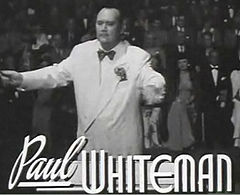
Paul Whiteman

Encyclopedia
Paul Samuel Whiteman was an American
bandleader
and orchestral director.
Leader of the most popular dance bands in the United States during the 1920s, Whiteman's recordings were immensely successful, and press notices often referred to him as the "King of Jazz". Using a large ensemble and exploring many styles of music, Whiteman is perhaps best known for his blending of symphonic music and jazz
, as typified by his 1924 commissioning and debut of George Gershwin
's jazz-influenced "Rhapsody In Blue
". Whiteman recorded many jazz and pop standards during his career, including "Wang Wang Blues", "Mississippi Mud
", "Rhapsody in Blue", "Wonderful One
", "Hot Lips
", "Mississippi Suite
", and "Grand Canyon Suite
". His popularity faded in the swing music era of the 1930s, and by the 1940s Whiteman was semi-retired from music.
Whiteman's place in the history of early jazz is somewhat controversial. Detractors suggest that Whiteman's ornately-orchestrated music was jazz in name only (lacking the genre's improvisational and emotional depth), and co-opted the innovations of black musicians. Defenders note that Whiteman's fondness for jazz was genuine (he worked with black musicians as much as was feasible during an era of racial segregation), that his bands included many of the era's most esteemed white jazz musicians, and argue that Whiteman's groups handled jazz admirably as part of a larger repertoire. In his autobiography, Duke Ellington
declared, "Paul Whiteman was known as the King of Jazz, and no one as yet has come near carrying that title with more certainty and dignity."
. After a start as a classical violin
ist and violist
, he led a jazz-influenced dance band, which became popular locally in San Francisco, California
in 1918. In 1920 he moved with his band to New York City
where they started making recordings for Victor Records
which made the Paul Whiteman Orchestra famous nationally. (In his first five recordings sessions for Victor, Aug 9-Oct 28, 1920, Whiteman used the name "Paul Whiteman and His Ambassador Orchestra," presumably because he had been playing at the Ambassador Hotel in Atlantic City; from Nov. 3, 1920, he started using "Paul Whiteman and His Orchestra.")
Whiteman became the most popular band director of the decade. In a time when most dance bands consisted of six to 10 men, Whiteman directed a much larger and more imposing group of up to 35 musicians. By 1922, Whiteman already controlled some 28 ensembles on the east coast and was earning over a $1,000,000 a year.
He recorded Hoagy Carmichael
singing and playing "Washboard Blues
" to the accompaniment of his orchestra in 1927.
In May 1928 Whiteman signed with Columbia Records
, and stayed with that label until September 1931, when he returned to Victor. He would remain signed with Victor until March 1937.
musicians and fans consider improvisation to be essential to the musical style, Whiteman thought the genre could be improved by orchestrating the best of it, with formal written arrangements. Whiteman's recordings were popular critically and successful commercially, and his style of jazz music was often the first jazz of any form that many Americans heard during the era.
For more than 30 years Whiteman, referred to as "Pops", sought and encouraged musicians, vocalists, composers, arrangers, and entertainers who looked promising. In 1924 Whiteman commissioned George Gershwin
's Rhapsody in Blue
, which was premiered by Whiteman's orchestra with George Gershwin at the piano. Another familiar piece in Whiteman's repertoire was Grand Canyon Suite, by Ferde Grofé
.
Whiteman hired many of the best jazz
musicians for his band, including Bix Beiderbecke
, Frankie Trumbauer
, Joe Venuti, Eddie Lang
, Steve Brown
, Mike Pingitore
, Gussie Mueller
, Wilbur Hall
(billed by Whiteman as "Willie Hall"), Jack Teagarden
, and Bunny Berigan
. He also encouraged upcoming African American musical talents, and initially planned on hiring black musicians, but Whiteman's management eventually persuaded him that doing would be career suicide due to racial tension and America's segregation
of that time. However, Whiteman crossed racial lines behind-the-scenes, hiring black arrangers like Fletcher Henderson
and engaging in mutually-beneficial efforts with recording sessions and scheduling of tours.
In late 1926 Whiteman signed three candidates for his orchestra: Bing Crosby
, Al Rinker
, and Harry Barris
. Whiteman billed the singing trio as The Rhythm Boys
. Crosby's prominence in the Rhythm Boys helped launch his career as one of the most successful singers of the 20th century. Paul Robeson
(1928) and Billie Holiday
(1942) also recorded with the Paul Whiteman Orchestra.
Whiteman had 28 number one records during the 1920s and 32 during his career. At the height of his popularity, eight out of the top ten sheet music sales slots were by the Paul Whiteman Orchestra.
His recording of José Padilla’s Valencia
topped the charts for 11 weeks, beginning 30 March 1926, becoming the #1 record of 1926.
Whiteman signed singer Mildred Bailey
in 1929 to appear on his radio program. She first recorded with the Whiteman Orchestra in 1931.
Jazz musician and leader of the Mound City Blue Blowers Red McKenzie
and cabaret singer Ramona Davies
(billed as "Ramona and her Grand Piano") joined the Whiteman group in 1932. The King's Jesters
were also with Paul Whiteman in 1931.
 In 1933 Whiteman had a #2 hit on the Billboard charts with the song, "Willow Weep for Me
".
In 1934 Paul Whiteman had his last two #1 hits, "Smoke Gets in Your Eyes
", with vocals by Bob Lawrence, which was #1 for six weeks, and "Wagon Wheels", which was #1 for one week, his final hit recording. From 1920 to 1934 Whiteman had 32 #1 recordings, charting 28 of them by 1929. By contrast, during the same period, the 1920s Jazz Age, Louis Armstrong
had none.
In 1942 Whiteman began recording for Capitol Records
, cofounded by songwriters Buddy DeSylva and Johnny Mercer
and music store owner Glenn Wallichs. Whiteman and His Orchestra's recordings of "I Found a New Baby" and "The General Jumped At Dawn" was the label's first single release. (Another notable Capitol record he made is the 1942 "Trav'lin Light" featuring Billie Holiday
(billed as "Lady Day", due to her being under contract with another label).
following his divorce from Vanderhoff that same year. The marriage to Livingston lasted until his death.
Whiteman resided at Walking Horse Farm near the village of Rosemont in Delaware Township
, Hunterdon County
, New Jersey
from 1938 to 1959. After selling the farm to agriculturalist Lloyd Wescott
, Whiteman moved to New Hope, Pennsylvania
for his remaining years.
Whiteman died at the age of 77 in Doylestown, Pennsylvania
on December 29, 1967.
, King of Jazz
. The film was technically ahead of its time, with many dazzling camera effects complementing the Whiteman music. Whiteman appeared as himself, and good-naturedly kidded his weight and his dancing skills. A highlight was a concert rendition of Rhapsody in Blue. Unfortunately, by the time King of Jazz was released to theaters, audiences had seen too many "all-singing, all-dancing" musicals, and much of the moviegoing public stayed away. (It also didn't help that the film was shot as a revue with no story and not particularly imaginative camerawork.) The expensive film didn't show a profit until 1933, when it was successfully reissued to cash in on the popularity of 42nd Street
and its elaborate production numbers.
Whiteman also appeared as himself in the 1945 movie Rhapsody in Blue on the life and career of George Gershwin and also appeared in The Fabulous Dorseys in 1947, a bio-pic starring Jimmy Dorsey
and Tommy Dorsey
. Whiteman also appeared as the baby in Nertz (1929), the bandleader in Thanks a Million (1935), as himself in Strike Up the Band (1940), and in the Paramount Pictures short The Lambertville Story (1949).
, Mildred Bailey
, Jack Teagarden
, Johnny Mercer
, Ramona
, Durelle Alexander
and others.
In the 1940s and 1950s, after he had disbanded his orchestra, Whiteman worked as a music director for the ABC Radio Network
. He also hosted Paul Whiteman's TV Teen Club from Philadelphia on ABC-TV from 1949–1954. The show was seen for an hour the first two years, then as a half hour segment on Saturday evenings. In 1952 a young Dick Clark read the commercials for sponsor Tootsie Roll. He also continued to appear as guest conductor for many concerts. His manner on stage was disarming; he signed off each program with something casual like, "Well, that just about slaps the cap on the old milk bottle for tonight."
movie The Color Purple
(1985), "Mississippi Mud", "From Monday On", co-written and sung by Bing Crosby with Bix Beiderbecke on cornet, "Nuthin' But", "Grand Canyon Suite" and "Mississippi Suite" composed by Ferde Grofe, "Rhapsody in Blue", composed by George Gershwin who played piano on the Paul Whiteman recording in 1924, "Wonderful One" (1923), and "Wang Wang Blues" (1920), covered by Glenn Miller, Duke Ellington
, Benny Goodman
, and Joe "King" Oliver's Dixie Syncopators in 1926 and many of the Big Bands. "Hot Lips" was recorded by Ted Lewis
and His Jazz Band, Horace Heidt
and His Brigadiers Orchestra (1937), Specht's Jazz Outfit, the Cotton Pickers (1922), and Django Reinhardt
Et Le Quintette Du Hot Club De France.
Herb Alpert
and Al Hirt
were influenced by the Paul Whiteman Orchestra, particularly the solo work of trumpeter Henry Busse
, especially his solo on "Rhapsody in Blue".
" in 1922 with Ferde Grofé and Dorothy Terris (also known as Theodora Morse
), based on a theme by film director Marshall Neilan
. The songwriting credit is assigned as music composed by Paul Whiteman, Ferde Grofe, and Marshall Neilan, with lyrics by Dorothy Terriss. The single reached #3 on Billboard in May 1923, staying on the charts for 5 weeks. "(My) Wonderful One" was recorded by Gertrude Moody, Edward Miller, Martha Pryor, Mel Torme
, Doris Day
, Woody Herman
, Helen Moretti, John McCormack; it was released as Victor 961. Jan Garber
and His Orchestra, and Ira Sullivan
with Tony Castellano also recorded the song. Henry Burr
recorded it in 1924 and Glenn Miller
and his Orchestra in 1940. On the sheet music published in 1922 by Leo Feist it is described as a "Waltz Song" and "Paul Whiteman's Sensational Waltz Hit" and is dedicated "To Julie". "Wonderful One" appeared in the following movies: The Chump Champ (1950), Little 'Tinker (1948), Red Hot Riding Hood (1943), Sufferin' Cats (1943), Design for Scandal (1941), Strike Up the Band (1940), and Westward Passage (1932).
In 1924 Whiteman composed "When the One You Love Loves You" with Abel Baer and lyricist Cliff Friend
. Whiteman recorded the song on 24 December 1924 in New York with Franklyn Baur on vocals and released it as Victor 19553-B backed with "I'll See You in My Dreams". The single reached #7 on the Billboard national pop singles charts in April 1925, staying on the charts for 3 weeks. The song is described as "A Sentimental Waltz Ballad" on the 1934 sheet music. Singer and composer Morton Downey, Sr., the father of the talkshow host, recorded the song in 1925 and released it as Brunswick 2887. Eva Shirley sang the song in Ed Wynn
's Grab Bag, a Broadway musical which opened in 1924 at the Globe. Leo Feist published the sheet music for the Shirley version in 1924 featuring Eva Shirley on the cover.
Paul Whiteman composed "Flamin' Mamie
" in 1925 with Fred Rose
, one of the top hits of 1925, which was recorded by the Harry Reser Band, Merritt Brunies and the Friars Inn Orchestra, Billy Jones and Ernest Hare, the Six Black Diamonds in 1926 on Banner, the Toll House Jazz Band, Aileen Stanley
in 1925 with Billy "Uke" Carpenter on the ukulele, Hank Penny
in 1938, Turk Murphy
, the Frisco Syncopators, the Firehouse Five Plus Two
, Bob Schulz and His Frisco Jazz Band, and the Coon-Sanders Nighthawk Orchestra led by Carleton Coon and Joe Sanders
with Joe Sanders on vocals. The lyrics describe Mamie as a Roaring Twenties vamp: "Flamin' Mamie, a sure-fire vamp/When it comes to lovin'/She's a human oven/Come on you futuristic papas/She's the hottest thing he's seen since the Chicago fire."
Paul Whiteman also composed "Charlestonette" in 1925 with Fred Rose which was published by Leo Feist. The song was released as Victor 19785 backed with "Ida-I Do" in 1925. Ben Selvin's Dance Orchestra and Bennie Krueger and His Orchestra also recorded the song in 1925.
Paul Whiteman composed the piano work "Dreaming The Waltz Away" with Fred Rose in 1926. Organist Jesse Crawford
recorded the song on October 4–5, 1926 in Chicago, Illinois and released it as a 78 on Victor Records, 20363 . Crawford played the instrumental on a Wurlitzer organ.
In Louis Armstrong & Paul Whiteman: Two Kings of Jazz (2004), Joshua Berrett wrote that "Whiteman Stomp" was credited to Fats Waller
, Alphonso Trent, and Paul Whiteman. Lyricist Jo Trent is the co-author. The Fletcher Henderson Orchestra first recorded "Whiteman Stomp" on 11 May 1927 and released it as Columbia 1059-D. The Fletcher Henderson recording lists the songwriters as "Fats Waller/Jo Trent/Paul Whiteman". Paul Whiteman recorded the song on 11 August 1927 and released it as Victor 21119.
"Then and Now", recorded on December 7, 1954 and released in 1955 on Coral, was composed by Paul Whiteman with Dick Jacobs
and Bob Merrill
. The song was released as a 45 inch single in 1955 as Coral 61336 backed with "Mississippi Mud" by Paul Whiteman and His New Ambassador Orchestra with the New Rhythm Boys.
Whiteman also co-wrote the popular song "My Fantasy" with Leo Edwards
and Jack Meskill, which is a musical adaptation of the Polovtsian Dances theme from the opera Prince Igor
by Alexander Borodin
. The Paul Whiteman Orchestra recorded "My Fantasy" in 1939.
with Paul Robeson
on vocals was inducted into the Grammy Hall of Fame. The song was recorded on 1 March 1928 in New York and released as Victor 35912-A.)
United States
The United States of America is a federal constitutional republic comprising fifty states and a federal district...
bandleader
Bandleader
A bandleader is the leader of a band of musicians. The term is most commonly, though not exclusively, used with a group that plays popular music as a small combo or a big band, such as one which plays jazz, blues, rhythm and blues or rock and roll music....
and orchestral director.
Leader of the most popular dance bands in the United States during the 1920s, Whiteman's recordings were immensely successful, and press notices often referred to him as the "King of Jazz". Using a large ensemble and exploring many styles of music, Whiteman is perhaps best known for his blending of symphonic music and jazz
Jazz
Jazz is a musical style that originated at the beginning of the 20th century in African American communities in the Southern United States. It was born out of a mix of African and European music traditions. From its early development until the present, jazz has incorporated music from 19th and 20th...
, as typified by his 1924 commissioning and debut of George Gershwin
George Gershwin
George Gershwin was an American composer and pianist. Gershwin's compositions spanned both popular and classical genres, and his most popular melodies are widely known...
's jazz-influenced "Rhapsody In Blue
Rhapsody in Blue
Rhapsody in Blue is a musical composition by George Gershwin for solo piano and jazz band written in 1924, which combines elements of classical music with jazz-influenced effects....
". Whiteman recorded many jazz and pop standards during his career, including "Wang Wang Blues", "Mississippi Mud
Mississippi Mud
Mississippi Mud is a 1927 song written by Harry Barris and James Cavanaugh , first made popular by Bing Crosby when he was still a member of The Rhythm Boys. Bing Crosby recorded the song with The Rhythm Boys on June 20, 1927 for Victor...
", "Rhapsody in Blue", "Wonderful One
Wonderful One
"Wonderful One" is a popular song recorded by the Paul Whiteman Orchestra on January 25, 1923 in New York and was released as Victor 19019-B. The record reached no. 3 on the Billboard chart....
", "Hot Lips
Hot Lips
"Hot Lips" is a popular song written by jazz trumpeter Henry Busse, Henry Lange, and Lou Davis. The song was a #1 hit for Paul Whiteman and His Orchestra...
", "Mississippi Suite
Mississippi Suite
The Mississippi Suite is an orchestral suite in four movements by Ferde Grofé, depicting scenes along a journey down the Mississippi River from its headwaters of Minnesota down to New Orleans.-History:...
", and "Grand Canyon Suite
Grand Canyon Suite
The Grand Canyon Suite is a suite for orchestra by Ferde Grofé, composed during the period from 1929 to 1931. It consists of five parts or movements, each an evocation in tone of a particular scene typical of the Grand Canyon...
". His popularity faded in the swing music era of the 1930s, and by the 1940s Whiteman was semi-retired from music.
Whiteman's place in the history of early jazz is somewhat controversial. Detractors suggest that Whiteman's ornately-orchestrated music was jazz in name only (lacking the genre's improvisational and emotional depth), and co-opted the innovations of black musicians. Defenders note that Whiteman's fondness for jazz was genuine (he worked with black musicians as much as was feasible during an era of racial segregation), that his bands included many of the era's most esteemed white jazz musicians, and argue that Whiteman's groups handled jazz admirably as part of a larger repertoire. In his autobiography, Duke Ellington
Duke Ellington
Edward Kennedy "Duke" Ellington was an American composer, pianist, and big band leader. Ellington wrote over 1,000 compositions...
declared, "Paul Whiteman was known as the King of Jazz, and no one as yet has come near carrying that title with more certainty and dignity."
Early life and career
Whiteman was born in Denver, ColoradoDenver, Colorado
The City and County of Denver is the capital and the most populous city of the U.S. state of Colorado. Denver is a consolidated city-county, located in the South Platte River Valley on the western edge of the High Plains just east of the Front Range of the Rocky Mountains...
. After a start as a classical violin
Violin
The violin is a string instrument, usually with four strings tuned in perfect fifths. It is the smallest, highest-pitched member of the violin family of string instruments, which includes the viola and cello....
ist and violist
Viola
The viola is a bowed string instrument. It is the middle voice of the violin family, between the violin and the cello.- Form :The viola is similar in material and construction to the violin. A full-size viola's body is between and longer than the body of a full-size violin , with an average...
, he led a jazz-influenced dance band, which became popular locally in San Francisco, California
San Francisco, California
San Francisco , officially the City and County of San Francisco, is the financial, cultural, and transportation center of the San Francisco Bay Area, a region of 7.15 million people which includes San Jose and Oakland...
in 1918. In 1920 he moved with his band to New York City
New York City
New York is the most populous city in the United States and the center of the New York Metropolitan Area, one of the most populous metropolitan areas in the world. New York exerts a significant impact upon global commerce, finance, media, art, fashion, research, technology, education, and...
where they started making recordings for Victor Records
Victor Talking Machine Company
The Victor Talking Machine Company was an American corporation, the leading American producer of phonographs and phonograph records and one of the leading phonograph companies in the world at the time. It was headquartered in Camden, New Jersey....
which made the Paul Whiteman Orchestra famous nationally. (In his first five recordings sessions for Victor, Aug 9-Oct 28, 1920, Whiteman used the name "Paul Whiteman and His Ambassador Orchestra," presumably because he had been playing at the Ambassador Hotel in Atlantic City; from Nov. 3, 1920, he started using "Paul Whiteman and His Orchestra.")
Whiteman became the most popular band director of the decade. In a time when most dance bands consisted of six to 10 men, Whiteman directed a much larger and more imposing group of up to 35 musicians. By 1922, Whiteman already controlled some 28 ensembles on the east coast and was earning over a $1,000,000 a year.
He recorded Hoagy Carmichael
Hoagy Carmichael
Howard Hoagland "Hoagy" Carmichael was an American composer, pianist, singer, actor, and bandleader. He is best known for writing "Stardust", "Georgia On My Mind", "The Nearness of You", and "Heart and Soul", four of the most-recorded American songs of all time.Alec Wilder, in his study of the...
singing and playing "Washboard Blues
Washboard Blues
Washboard Blues is a 1926 popular song written by Hoagy Carmichael, Fred B. Callahan and Irving Mills. Paul Whiteman's orchestra recorded it in 1927, featuring piano and lead vocals by Carmichael.The song is an evocative washerwoman's lament...
" to the accompaniment of his orchestra in 1927.
In May 1928 Whiteman signed with Columbia Records
Columbia Records
Columbia Records is an American record label, owned by Japan's Sony Music Entertainment, operating under the Columbia Music Group with Aware Records. It was founded in 1888, evolving from an earlier enterprise, the American Graphophone Company — successor to the Volta Graphophone Company...
, and stayed with that label until September 1931, when he returned to Victor. He would remain signed with Victor until March 1937.
"The King of Jazz"
In the 1920s the media referred to Whiteman as "The King of Jazz". Whiteman emphasized the way he had approached the already well-established style of music, while also organizing its composition and style in his own fashion. While most jazzJazz
Jazz is a musical style that originated at the beginning of the 20th century in African American communities in the Southern United States. It was born out of a mix of African and European music traditions. From its early development until the present, jazz has incorporated music from 19th and 20th...
musicians and fans consider improvisation to be essential to the musical style, Whiteman thought the genre could be improved by orchestrating the best of it, with formal written arrangements. Whiteman's recordings were popular critically and successful commercially, and his style of jazz music was often the first jazz of any form that many Americans heard during the era.
For more than 30 years Whiteman, referred to as "Pops", sought and encouraged musicians, vocalists, composers, arrangers, and entertainers who looked promising. In 1924 Whiteman commissioned George Gershwin
George Gershwin
George Gershwin was an American composer and pianist. Gershwin's compositions spanned both popular and classical genres, and his most popular melodies are widely known...
's Rhapsody in Blue
Rhapsody in Blue
Rhapsody in Blue is a musical composition by George Gershwin for solo piano and jazz band written in 1924, which combines elements of classical music with jazz-influenced effects....
, which was premiered by Whiteman's orchestra with George Gershwin at the piano. Another familiar piece in Whiteman's repertoire was Grand Canyon Suite, by Ferde Grofé
Ferde Grofé
Ferde Grofé was a prominent American composer, arranger and pianist. During the 1920s and 1930s, he went by the name Ferdie Grofé.-Early life:...
.
Whiteman hired many of the best jazz
Jazz
Jazz is a musical style that originated at the beginning of the 20th century in African American communities in the Southern United States. It was born out of a mix of African and European music traditions. From its early development until the present, jazz has incorporated music from 19th and 20th...
musicians for his band, including Bix Beiderbecke
Bix Beiderbecke
Leon Bismark "Bix" Beiderbecke was an American jazz cornetist, jazz pianist, and composer.With Louis Armstrong, Beiderbecke was one of the most influential jazz soloists of the 1920s...
, Frankie Trumbauer
Frankie Trumbauer
Orie Frank Trumbauer was one of the leading jazz saxophonists of the 1920s and 1930s. He played the C-melody saxophone which, in size, is between an alto and tenor saxophone...
, Joe Venuti, Eddie Lang
Eddie Lang
Eddie Lang was an American jazz guitarist, regarded as the Father of Jazz Guitar. He played a Gibson L-4 and L-5 guitar, providing great influence for many guitarists, including Django Reinhardt.-Biography:...
, Steve Brown
Steve Brown (bass player)
Steve Brown was a jazz musician best known for his work on string bass. Like many of his fellow New Orleans, Louisiana bassists, he played both string bass and tuba professionally, as the two instruments fill similar roles in different types of bands.Brown was the younger brother of trombonist...
, Mike Pingitore
Mike Pingitore
Member of Paul Whiteman's Orchestra.He was the elder brother of Eugene Pingitore also a notable banjo player who moved to Australia. Paul Whiteman discovered him playing tenor banjo and he became part of the rhythm section for Paul Whiteman's band....
, Gussie Mueller
Gussie Mueller
Gustave "Gussie" Mueller was an early jazz clarinetist....
, Wilbur Hall
Wilbur Hall (musician)
Wilbur Francis Hall, sometimes billed as Willie Hall , was a United States trombonist and entertainer.Hall was born in Shawnee Mound, Missouri. He was working in vaudeville when in 1924 he was hired by Paul Whiteman...
(billed by Whiteman as "Willie Hall"), Jack Teagarden
Jack Teagarden
Weldon Leo "Jack" Teagarden , known as "Big T" and "The Swingin' Gate", was an influential jazz trombonist, bandleader, composer, and vocalist, regarded as the "Father of Jazz Trombone".-Early life:...
, and Bunny Berigan
Bunny Berigan
Rowland Bernard "Bunny" Berigan was an American jazz trumpeter who rose to fame during the swing era, but whose virtuosity and influence were shortened by a losing battle with alcoholism that ended in his early death at age 33. He composed the jazz instrumentals "Chicken and Waffles" and "Blues"...
. He also encouraged upcoming African American musical talents, and initially planned on hiring black musicians, but Whiteman's management eventually persuaded him that doing would be career suicide due to racial tension and America's segregation
Racial segregation
Racial segregation is the separation of humans into racial groups in daily life. It may apply to activities such as eating in a restaurant, drinking from a water fountain, using a public toilet, attending school, going to the movies, or in the rental or purchase of a home...
of that time. However, Whiteman crossed racial lines behind-the-scenes, hiring black arrangers like Fletcher Henderson
Fletcher Henderson
James Fletcher Hamilton Henderson, Jr. was an American pianist, bandleader, arranger and composer, important in the development of big band jazz and swing music. His was one of the most prolific black orchestras and his influence was vast...
and engaging in mutually-beneficial efforts with recording sessions and scheduling of tours.
In late 1926 Whiteman signed three candidates for his orchestra: Bing Crosby
Bing Crosby
Harry Lillis "Bing" Crosby was an American singer and actor. Crosby's trademark bass-baritone voice made him one of the best-selling recording artists of the 20th century, with over half a billion records in circulation....
, Al Rinker
Al Rinker
Al Rinker began performing as a partner with Bing Crosby in 1925 and the two singers formed the Rhythm Boys, which singer/songwriter/pianist Harry Barris later joined. Barris wrote the songs Mississippi Mud, I Surrender, Dear, and Wrap Your Troubles in Dreams among others...
, and Harry Barris
Harry Barris
Harry Barris was an American popular singer and songwriter.Born in New York City, he was a member of the Rhythm Boys, a late 1920s singing trio which included Al Rinker and Bing Crosby, and was Crosby's entry into show business...
. Whiteman billed the singing trio as The Rhythm Boys
The Rhythm Boys
The Rhythm Boys were a male singing trio consisting of Bing Crosby, Harry Barris and Al Rinker. Crosby and Rinker began performing together in 1925 and were recruited by Paul Whiteman in late 1926. Pianist/singer/songwriter Barris joined the team in 1927. They made a number of recordings with the...
. Crosby's prominence in the Rhythm Boys helped launch his career as one of the most successful singers of the 20th century. Paul Robeson
Paul Robeson
Paul Leroy Robeson was an American concert singer , recording artist, actor, athlete, scholar who was an advocate for the Civil Rights Movement in the first half of the twentieth century...
(1928) and Billie Holiday
Billie Holiday
Billie Holiday was an American jazz singer and songwriter. Nicknamed "Lady Day" by her friend and musical partner Lester Young, Holiday had a seminal influence on jazz and pop singing...
(1942) also recorded with the Paul Whiteman Orchestra.
Whiteman had 28 number one records during the 1920s and 32 during his career. At the height of his popularity, eight out of the top ten sheet music sales slots were by the Paul Whiteman Orchestra.
His recording of José Padilla’s Valencia
Valencia (song)
Valencia is a pasodoble song composed by José Padilla for the 1924 Zarzuela La bien amada and included in the 1926 silent film Valencia, with lyrics translated by Lucien Boyer, Jacques Charles, and Clifford Grey...
topped the charts for 11 weeks, beginning 30 March 1926, becoming the #1 record of 1926.
Whiteman signed singer Mildred Bailey
Mildred Bailey
Mildred Bailey was a popular and influential American jazz singer during the 1930s, known as "The Rockin' Chair Lady" and "Mrs. Swing"...
in 1929 to appear on his radio program. She first recorded with the Whiteman Orchestra in 1931.
Jazz musician and leader of the Mound City Blue Blowers Red McKenzie
Red McKenzie
Red McKenzie was an American jazz musician. He was the best-known, and one of the only, comb players in jazz history....
and cabaret singer Ramona Davies
Ramona (vocalist)
Ramona Davies, usually billed as Ramona and her Grand Piano, was a cabaret singer and pianist, most popular in the 1930s.Born Estrild Raymona Myers on March 11, 1909 in Lockland, Ohio, was vocalist and pianist for Paul Whiteman's Orchestra from 1932-1937. She played mildly jazz-influenced piano...
(billed as "Ramona and her Grand Piano") joined the Whiteman group in 1932. The King's Jesters
King's Jesters
The King's Jesters began as a comic vocal trio that also played instruments along with an accompaniest. They were John Ravencroft - sax and clarinet, Francis "Fritz" Bastow - banjo and guitar, George Howard - drums and vibraphone, along with Ray McDermott - piano, accordion, and arranger. They...
were also with Paul Whiteman in 1931.
Willow Weep for Me
"Willow Weep for Me" is a popular song composed in 1932 by Ann Ronell, who also wrote the lyrics. It is mostly known as a jazz standard, but it was a Top 40 hit for the British duo Chad & Jeremy in 1964.-Notable recordings:...
".
In 1934 Paul Whiteman had his last two #1 hits, "Smoke Gets in Your Eyes
Smoke Gets in Your Eyes
"Smoke Gets in Your Eyes" is a show tune written by American composer Jerome Kern and lyricist Otto Harbach for their 1933 operetta Roberta. It was originally recorded by Gertrude Niesen, on 13 October 1933 on the Victor label 24454. It was performed by Irene Dunne for the 1935 film adaptation,...
", with vocals by Bob Lawrence, which was #1 for six weeks, and "Wagon Wheels", which was #1 for one week, his final hit recording. From 1920 to 1934 Whiteman had 32 #1 recordings, charting 28 of them by 1929. By contrast, during the same period, the 1920s Jazz Age, Louis Armstrong
Louis Armstrong
Louis Armstrong , nicknamed Satchmo or Pops, was an American jazz trumpeter and singer from New Orleans, Louisiana....
had none.
In 1942 Whiteman began recording for Capitol Records
Capitol Records
Capitol Records is a major United States based record label, formerly located in Los Angeles, but operating in New York City as part of Capitol Music Group. Its former headquarters building, the Capitol Tower, is a major landmark near the corner of Hollywood and Vine...
, cofounded by songwriters Buddy DeSylva and Johnny Mercer
Johnny Mercer
John Herndon "Johnny" Mercer was an American lyricist, songwriter and singer. He is best known as a lyricist, but he also composed music. He was also a popular singer who recorded his own songs as well as those written by others...
and music store owner Glenn Wallichs. Whiteman and His Orchestra's recordings of "I Found a New Baby" and "The General Jumped At Dawn" was the label's first single release. (Another notable Capitol record he made is the 1942 "Trav'lin Light" featuring Billie Holiday
Billie Holiday
Billie Holiday was an American jazz singer and songwriter. Nicknamed "Lady Day" by her friend and musical partner Lester Young, Holiday had a seminal influence on jazz and pop singing...
(billed as "Lady Day", due to her being under contract with another label).
Personal life
Whiteman was married four times; to Nellie Stack in 1908; to Miss Jimmy Smith; to Mildred Vanderhoff in 1922. In 1931 Whiteman married motion picture actress Margaret LivingstonMargaret Livingston
Margaret Livingston was an American film actress, most notable for her work during the silent film era....
following his divorce from Vanderhoff that same year. The marriage to Livingston lasted until his death.
Whiteman resided at Walking Horse Farm near the village of Rosemont in Delaware Township
Delaware Township, Hunterdon County, New Jersey
-Demographics:As of the census of 2000, there were 4,478 people, 1,643 households, and 1,302 families residing in the township. The population density was 121.9 people per square mile . There were 1,701 housing units at an average density of 46.3 per square mile...
, Hunterdon County
Hunterdon County, New Jersey
Hunterdon County is a county located in the western section of the U.S. state of New Jersey. As of the 2010 United States Census, the population was 128,349. It is part of the New York Metropolitan Area. Its county seat is Flemington....
, New Jersey
New Jersey
New Jersey is a state in the Northeastern and Middle Atlantic regions of the United States. , its population was 8,791,894. It is bordered on the north and east by the state of New York, on the southeast and south by the Atlantic Ocean, on the west by Pennsylvania and on the southwest by Delaware...
from 1938 to 1959. After selling the farm to agriculturalist Lloyd Wescott
Lloyd Wescott
Lloyd Bruce Wescott was an agriculturalist, civil servant, and philanthropist in New Jersey. Born and educated in Wisconsin, he moved to New York after college before settling in New Jersey where he served as a member of agricultural boards, chairman of the New Jersey State Board of Control of...
, Whiteman moved to New Hope, Pennsylvania
New Hope, Pennsylvania
New Hope, formerly known as Coryell's Ferry, is a borough in Bucks County, Pennsylvania, USA. The population was 2,528 at the 2010 census. The borough lies on the west bank of the Delaware River at its confluence with Aquetong Creek. A two-lane bridge carries automobile and foot traffic across the...
for his remaining years.
Whiteman died at the age of 77 in Doylestown, Pennsylvania
Doylestown, Pennsylvania
Doylestown is a borough in Bucks County, Pennsylvania, north of Philadelphia. As of the 2010 census, the borough population was 8,380. The borough is the county seat of Bucks County.- History :...
on December 29, 1967.
Movie appearances
In 1930 "Paul Whiteman and his Orchestra" starred in the first feature-length movie musical filmed entirely in TechnicolorTechnicolor
Technicolor is a color motion picture process invented in 1916 and improved over several decades.It was the second major process, after Britain's Kinemacolor, and the most widely used color process in Hollywood from 1922 to 1952...
, King of Jazz
King of Jazz
King of Jazz is a 1930 motion picture starring Paul Whiteman and His Orchestra. The film's title was taken from Whiteman's controversial, self-conferred appellation...
. The film was technically ahead of its time, with many dazzling camera effects complementing the Whiteman music. Whiteman appeared as himself, and good-naturedly kidded his weight and his dancing skills. A highlight was a concert rendition of Rhapsody in Blue. Unfortunately, by the time King of Jazz was released to theaters, audiences had seen too many "all-singing, all-dancing" musicals, and much of the moviegoing public stayed away. (It also didn't help that the film was shot as a revue with no story and not particularly imaginative camerawork.) The expensive film didn't show a profit until 1933, when it was successfully reissued to cash in on the popularity of 42nd Street
42nd Street (film)
-Cast:*Warner Baxter as Julian Marsh, director*Bebe Daniels as Dorothy Brock, star*George Brent as Pat Denning, Dorothy's old vaudeville partner*Ruby Keeler as Peggy Sawyer, the newcomer*Guy Kibbee as Abner Dillon, the show's backer...
and its elaborate production numbers.
Whiteman also appeared as himself in the 1945 movie Rhapsody in Blue on the life and career of George Gershwin and also appeared in The Fabulous Dorseys in 1947, a bio-pic starring Jimmy Dorsey
Jimmy Dorsey
James "Jimmy" Dorsey was a prominent American jazz clarinetist, saxophonist, trumpeter, composer, and big band leader. He was known as "JD"...
and Tommy Dorsey
Tommy Dorsey
Thomas Francis "Tommy" Dorsey, Jr. was an American jazz trombonist, trumpeter, composer, and bandleader of the Big Band era. He was known as "The Sentimental Gentleman of Swing", due to his smooth-toned trombone playing. He was the younger brother of bandleader Jimmy Dorsey...
. Whiteman also appeared as the baby in Nertz (1929), the bandleader in Thanks a Million (1935), as himself in Strike Up the Band (1940), and in the Paramount Pictures short The Lambertville Story (1949).
Radio and TV
During the 1930s Whiteman had several radio shows, including Kraft Music Hall and Paul Whiteman's Musical Varieties, which featured the talents of Bing CrosbyBing Crosby
Harry Lillis "Bing" Crosby was an American singer and actor. Crosby's trademark bass-baritone voice made him one of the best-selling recording artists of the 20th century, with over half a billion records in circulation....
, Mildred Bailey
Mildred Bailey
Mildred Bailey was a popular and influential American jazz singer during the 1930s, known as "The Rockin' Chair Lady" and "Mrs. Swing"...
, Jack Teagarden
Jack Teagarden
Weldon Leo "Jack" Teagarden , known as "Big T" and "The Swingin' Gate", was an influential jazz trombonist, bandleader, composer, and vocalist, regarded as the "Father of Jazz Trombone".-Early life:...
, Johnny Mercer
Johnny Mercer
John Herndon "Johnny" Mercer was an American lyricist, songwriter and singer. He is best known as a lyricist, but he also composed music. He was also a popular singer who recorded his own songs as well as those written by others...
, Ramona
Ramona
Ramona is a 1884 United States historical novel written by Helen Hunt Jackson. It is the story of a Scots-Native American orphan girl in Southern California, who suffers racial discrimination and hardship. Originally serialized in the Christian Union on a weekly basis, the novel became immensely...
, Durelle Alexander
Durelle Alexander
Durelle Alexander was a talented child performer, and appeared in "Hollywood Junior Follies" and several silent "Our Gang" comedies throughout the 1920s....
and others.
In the 1940s and 1950s, after he had disbanded his orchestra, Whiteman worked as a music director for the ABC Radio Network
American Broadcasting Company
The American Broadcasting Company is an American commercial broadcasting television network. Created in 1943 from the former NBC Blue radio network, ABC is owned by The Walt Disney Company and is part of Disney-ABC Television Group. Its first broadcast on television was in 1948...
. He also hosted Paul Whiteman's TV Teen Club from Philadelphia on ABC-TV from 1949–1954. The show was seen for an hour the first two years, then as a half hour segment on Saturday evenings. In 1952 a young Dick Clark read the commercials for sponsor Tootsie Roll. He also continued to appear as guest conductor for many concerts. His manner on stage was disarming; he signed off each program with something casual like, "Well, that just about slaps the cap on the old milk bottle for tonight."
Legacy
The Paul Whiteman Orchestra introduced many jazz standards in the 1920s, including "Hot Lips", which was in the Steven SpielbergSteven Spielberg
Steven Allan Spielberg KBE is an American film director, screenwriter, producer, video game designer, and studio entrepreneur. In a career of more than four decades, Spielberg's films have covered many themes and genres. Spielberg's early science-fiction and adventure films were seen as an...
movie The Color Purple
The Color Purple (film)
The Color Purple is a 1985 American period drama film directed by Steven Spielberg, based on the Pulitzer Prize-winning novel of the same name by Alice Walker. It was Spielberg's eighth film as a director , and was a change from the summer blockbusters for which he had become famous...
(1985), "Mississippi Mud", "From Monday On", co-written and sung by Bing Crosby with Bix Beiderbecke on cornet, "Nuthin' But", "Grand Canyon Suite" and "Mississippi Suite" composed by Ferde Grofe, "Rhapsody in Blue", composed by George Gershwin who played piano on the Paul Whiteman recording in 1924, "Wonderful One" (1923), and "Wang Wang Blues" (1920), covered by Glenn Miller, Duke Ellington
Duke Ellington
Edward Kennedy "Duke" Ellington was an American composer, pianist, and big band leader. Ellington wrote over 1,000 compositions...
, Benny Goodman
Benny Goodman
Benjamin David “Benny” Goodman was an American jazz and swing musician, clarinetist and bandleader; widely known as the "King of Swing".In the mid-1930s, Benny Goodman led one of the most popular musical groups in America...
, and Joe "King" Oliver's Dixie Syncopators in 1926 and many of the Big Bands. "Hot Lips" was recorded by Ted Lewis
Ted Lewis (musician)
Theodore Leopold Friedman, better known as Ted Lewis , was an American entertainer, bandleader, singer, and musician. He led a band presenting a combination of jazz, hokey comedy, and schmaltzy sentimentality that was a hit with the American public. He was known by the moniker "Mr...
and His Jazz Band, Horace Heidt
Horace Heidt
Horace Heidt was an American pianist, big band leader, and radio and television personality. His band, Horace Heidt and His Musical Knights, toured vaudeville and performed on radio and television through the 1930s and 1940s.-Biography:Born in Alameda, California, Heidt attended Culver...
and His Brigadiers Orchestra (1937), Specht's Jazz Outfit, the Cotton Pickers (1922), and Django Reinhardt
Django Reinhardt
Django Reinhardt was a pioneering virtuoso jazz guitarist and composer who invented an entirely new style of jazz guitar technique that has since become a living musical tradition within French gypsy culture...
Et Le Quintette Du Hot Club De France.
Herb Alpert
Herb Alpert
Herbert "Herb" Alpert is an American musician most associated with the group variously known as Herb Alpert & the Tijuana Brass, Herb Alpert's Tijuana Brass, or TJB. He is also a recording industry executive — he is the "A" of A&M Records...
and Al Hirt
Al Hirt
Al Hirt was an American trumpeter and bandleader. He is best remembered for his million selling recordings of "Java", and the accompanying album, Honey in the Horn . His nicknames included 'Jumbo' and 'The Round Mound of Sound'...
were influenced by the Paul Whiteman Orchestra, particularly the solo work of trumpeter Henry Busse
Henry Busse
Henry Busse Sr. was a jazz trumpeter known for work with sweet bands and big bands.-Early life:Born May 19, 1894 to a generational German Band family. Henry Busse studied violin and then trumpet under his Oompah Band leader uncle...
, especially his solo on "Rhapsody in Blue".
Compositions
Whiteman composed the standard "Wonderful OneWonderful One
"Wonderful One" is a popular song recorded by the Paul Whiteman Orchestra on January 25, 1923 in New York and was released as Victor 19019-B. The record reached no. 3 on the Billboard chart....
" in 1922 with Ferde Grofé and Dorothy Terris (also known as Theodora Morse
Theodora Morse
Theodora Morse was an American song writer and composer.She was a Tin Pan Alley lyricist who collaborated to produce a number of popular songs.-Background:...
), based on a theme by film director Marshall Neilan
Marshall Neilan
Marshall Ambrose Neilan was an American motion picture actor, screenwriter, film director, and producer.-Early life:...
. The songwriting credit is assigned as music composed by Paul Whiteman, Ferde Grofe, and Marshall Neilan, with lyrics by Dorothy Terriss. The single reached #3 on Billboard in May 1923, staying on the charts for 5 weeks. "(My) Wonderful One" was recorded by Gertrude Moody, Edward Miller, Martha Pryor, Mel Torme
Mel Tormé
Melvin Howard Tormé , nicknamed The Velvet Fog, was an American musician, known for his jazz singing. He was also a jazz composer and arranger, a drummer, an actor in radio, film, and television, and the author of five books...
, Doris Day
Doris Day
Doris Day is an American actress, singer and, since her retirement from show business, an animal rights activist. With an entertainment career that spanned through almost 50 years, Day started her career as a big band singer in 1939, but only began to be noticed after her first hit recording,...
, Woody Herman
Woody Herman
Woodrow Charles Herman , known as Woody Herman, was an American jazz clarinetist, alto and soprano saxophonist, singer, and big band leader. Leading various groups called "The Herd," Herman was one of the most popular of the 1930s and '40s bandleaders...
, Helen Moretti, John McCormack; it was released as Victor 961. Jan Garber
Jan Garber
Jan Garber was an American jazz bandleader.-Biography:Garber was born in Indianapolis, Indiana. He had his own band by the time he was 21 . He became known as "The Idol of the Airwaves" in his heyday of the 1920s and 1930s, playing jazz in the vein of contemporaries such as Paul Whiteman and Guy...
and His Orchestra, and Ira Sullivan
Ira Sullivan
Ira Sullivan is a bop jazz trumpeter, flugelhornist, flautist, saxophonist and composer born in Washington, D.C.. An active musician since the 1950s, he may be best known for his extensive work with Red Rodney and Lin Halliday among others....
with Tony Castellano also recorded the song. Henry Burr
Henry Burr
Henry Burr was a Canadian singer of popular songs from the early 20th century, an early radio performer and producer...
recorded it in 1924 and Glenn Miller
Glenn Miller
Alton Glenn Miller was an American jazz musician , arranger, composer, and bandleader in the swing era. He was one of the best-selling recording artists from 1939 to 1943, leading one of the best known "Big Bands"...
and his Orchestra in 1940. On the sheet music published in 1922 by Leo Feist it is described as a "Waltz Song" and "Paul Whiteman's Sensational Waltz Hit" and is dedicated "To Julie". "Wonderful One" appeared in the following movies: The Chump Champ (1950), Little 'Tinker (1948), Red Hot Riding Hood (1943), Sufferin' Cats (1943), Design for Scandal (1941), Strike Up the Band (1940), and Westward Passage (1932).
In 1924 Whiteman composed "When the One You Love Loves You" with Abel Baer and lyricist Cliff Friend
Cliff Friend
Cliff Friend was an accomplished songwriter and pianist. A member of Tin Pan Alley, Friend co-wrote several hits including "Lovesick Blues," "My Blackbirds Are Bluebirds Now" and "The Merry-Go-Round Broke Down," also known as the theme song to the Looney Tunes cartoon series.-Early life:Friend was...
. Whiteman recorded the song on 24 December 1924 in New York with Franklyn Baur on vocals and released it as Victor 19553-B backed with "I'll See You in My Dreams". The single reached #7 on the Billboard national pop singles charts in April 1925, staying on the charts for 3 weeks. The song is described as "A Sentimental Waltz Ballad" on the 1934 sheet music. Singer and composer Morton Downey, Sr., the father of the talkshow host, recorded the song in 1925 and released it as Brunswick 2887. Eva Shirley sang the song in Ed Wynn
Ed Wynn
Ed Wynn was a popular American comedian and actor noted for his Perfect Fool comedy character, his pioneering radio show of the 1930s, and his later career as a dramatic actor....
's Grab Bag, a Broadway musical which opened in 1924 at the Globe. Leo Feist published the sheet music for the Shirley version in 1924 featuring Eva Shirley on the cover.
Paul Whiteman composed "Flamin' Mamie
Flamin' Mamie
Flamin' Mamie is a 1925 jazz classic composed by Paul Whiteman and Fred Rose.Paul Whiteman wrote "Flamin' Mamie" in 1925 with Fred Rose as a "Fox Trot Song" on Jazz Age themes relying on the 1920s image of the vamp: "A Red Hot Stepper"...
" in 1925 with Fred Rose
Fred Rose (musician)
Fred Rose was an American Hall of Fame songwriter and music publishing executive.-Biography:Born in Evansville, Indiana, Fred Rose started playing piano and singing as a small boy. In his teens, he moved to Chicago, Illinois where he worked in bars busking for tips, and finally vaudeville...
, one of the top hits of 1925, which was recorded by the Harry Reser Band, Merritt Brunies and the Friars Inn Orchestra, Billy Jones and Ernest Hare, the Six Black Diamonds in 1926 on Banner, the Toll House Jazz Band, Aileen Stanley
Aileen Stanley
Aileen Stanley, born Maude Elsie Aileen Muggeridge , was a popular American singer.-Early life:...
in 1925 with Billy "Uke" Carpenter on the ukulele, Hank Penny
Hank Penny
Herbert Clayton Penny was an accomplished banjo player and practitioner of western swing. He worked as a comedian best known for his backwoods character "That Plain Ol' Country Boy" on TV with Spade Cooley...
in 1938, Turk Murphy
Turk Murphy
Melvin Edward Alton “Turk” Murphy was renowned as a trombonist who played traditional and dixieland jazz in San Francisco....
, the Frisco Syncopators, the Firehouse Five Plus Two
Firehouse Five Plus Two
The Firehouse Five Plus Two was a Dixieland jazz band, popular in the 1950s, consisting of members of the Walt Disney Studios animation department;-Members:Danny Alguire — cornetHarper Goff — banjo...
, Bob Schulz and His Frisco Jazz Band, and the Coon-Sanders Nighthawk Orchestra led by Carleton Coon and Joe Sanders
Joe Sanders
Joseph L. "Joe" Sanders was an American jazz pianist, singer, and bandleader associated with Kansas City jazz for most of his career....
with Joe Sanders on vocals. The lyrics describe Mamie as a Roaring Twenties vamp: "Flamin' Mamie, a sure-fire vamp/When it comes to lovin'/She's a human oven/Come on you futuristic papas/She's the hottest thing he's seen since the Chicago fire."
Paul Whiteman also composed "Charlestonette" in 1925 with Fred Rose which was published by Leo Feist. The song was released as Victor 19785 backed with "Ida-I Do" in 1925. Ben Selvin's Dance Orchestra and Bennie Krueger and His Orchestra also recorded the song in 1925.
Paul Whiteman composed the piano work "Dreaming The Waltz Away" with Fred Rose in 1926. Organist Jesse Crawford
Jesse Crawford
Jesse Crawford , was a US pianist and organist. He was well known in the 1920s as a theater organist for silent films and was avery popular gramophone record recording artist. In the 1930s, he switched to the Hammond organ and became a freelancer...
recorded the song on October 4–5, 1926 in Chicago, Illinois and released it as a 78 on Victor Records, 20363 . Crawford played the instrumental on a Wurlitzer organ.
In Louis Armstrong & Paul Whiteman: Two Kings of Jazz (2004), Joshua Berrett wrote that "Whiteman Stomp" was credited to Fats Waller
Fats Waller
Fats Waller , born Thomas Wright Waller, was a jazz pianist, organist, composer, singer, and comedic entertainer...
, Alphonso Trent, and Paul Whiteman. Lyricist Jo Trent is the co-author. The Fletcher Henderson Orchestra first recorded "Whiteman Stomp" on 11 May 1927 and released it as Columbia 1059-D. The Fletcher Henderson recording lists the songwriters as "Fats Waller/Jo Trent/Paul Whiteman". Paul Whiteman recorded the song on 11 August 1927 and released it as Victor 21119.
"Then and Now", recorded on December 7, 1954 and released in 1955 on Coral, was composed by Paul Whiteman with Dick Jacobs
Dick Jacobs
Dick Jacobs was an American musician, conductor, arranger, orchestrator, music director and an artists-and-repertoire director for several record labels who helped Jackie Wilson, Buddy Holly, Bobby Darin and others form their careers in the late 1950s and early 1960s.-Life and career:He was born...
and Bob Merrill
Bob Merrill
Bob Merrill was an American songwriter, theatrical composer, lyricist, and screenwriter.Merrill was born Henry Merrill Levan in Atlantic City, New Jersey and raised in Philadelphia, Pennsylvania. Following a stint with the Army during World War II, he moved to Hollywood, where he worked as a...
. The song was released as a 45 inch single in 1955 as Coral 61336 backed with "Mississippi Mud" by Paul Whiteman and His New Ambassador Orchestra with the New Rhythm Boys.
Whiteman also co-wrote the popular song "My Fantasy" with Leo Edwards
Leo Edwards (composer)
Leo Edwards was a Broadway composer. He was the brother of Gus Edwards,, who was also a Broadway composer....
and Jack Meskill, which is a musical adaptation of the Polovtsian Dances theme from the opera Prince Igor
Prince Igor
Prince Igor is an opera in four acts with a prologue. It was composed by Alexander Borodin. The composer adapted the libretto from the East Slavic epic The Lay of Igor's Host, which recounts the campaign of Russian prince Igor Svyatoslavich against the invading Polovtsian tribes in 1185...
by Alexander Borodin
Alexander Borodin
Alexander Porfiryevich Borodin was a Russian Romantic composer and chemist of Georgian–Russian parentage. He was a member of the group of composers called The Five , who were dedicated to producing a specifically Russian kind of art music...
. The Paul Whiteman Orchestra recorded "My Fantasy" in 1939.
Honors
In 2006 the Paul Whiteman Orchestra's 1928 recording of Ol' Man RiverOl' Man River
"Ol' Man River" is a song in the 1927 musical Show Boat that expresses the African American hardship and struggles of the time with the endless, uncaring flow of the Mississippi River; it is sung from the point-of-view of a dock worker on a showboat, and is the most famous song from the show...
with Paul Robeson
Paul Robeson
Paul Leroy Robeson was an American concert singer , recording artist, actor, athlete, scholar who was an advocate for the Civil Rights Movement in the first half of the twentieth century...
on vocals was inducted into the Grammy Hall of Fame. The song was recorded on 1 March 1928 in New York and released as Victor 35912-A.)
Major recordings
- Whispering (song)Whispering (song)"Whispering" is a popular song with lyrics by John Schoenberger and Richard Coburn, and music by Vincent Rose. It was originally recorded on August 23, 1920 by Paul Whiteman and his Ambassador Orchestra for Victor as 18690-A...
, 1920, #1 for 11 weeks, the no.2 hit of 1920, 1998 Grammy Hall of Fame inductee - The Japanese SandmanThe Japanese SandmanThe Japanese Sandman is a song from 1920, composed by Richard A. Whiting and with lyrics by Raymond B. Egan.-Content:The song is about a sandman from Japan, who exchanges yesterdays for tomorrows...
, 1920, #1 for 2 weeks - Wang Wang Blues, 1921, #1 for 6 weeks, on the soundtrack to the 1996 Academy Award–winning movie The English Patient
- My MammyMy Mammy"My Mammy" is a U.S. popular song with music by Walter Donaldson and lyrics by Joe Young and Sam M. Lewis.Though associated with Al Jolson, who performed the song very successfully, "My Mammy" was performed first by William Frawley as a vaudeville-style act during 1918. Jolson heard the song and...
, 1921, #1 for 5 weeks - Cherie, 1921, #1 for 6 weeks
- Say It With Music, 1921, #1 for 5 weeks
- Grieving For You-Feather Your Nest, #26 hit of 1921
- Play that "Song of India" Again, 1921, #1 for 5 weeks, music adapted by Paul Whiteman from the Chanson Indoue theme by Nikolai Rimski-Korsakov from the opera Sadko (1898) with lyrics by Leo WoodLeo WoodLeo Wood was a songwriter and lyricist for popular songs in the United States. He is best remembered as the songwriter of the 1920’s hit Somebody Stole My Gal. Wood wrote lyrics for many of the top songwriters of the day, including Theodore F. Morse...
and Irving Bibo - Bright Eyes, the #13 hit of 1921
- Hot LipsHot Lips"Hot Lips" is a popular song written by jazz trumpeter Henry Busse, Henry Lange, and Lou Davis. The song was a #1 hit for Paul Whiteman and His Orchestra...
(He's Got Hot Lips When He Plays Jazz), 1922, #1 for 6 weeks, featured in the Oprah Winfrey movie The Color Purple (1985), directed by Steven Spielberg - Do It Again, 1922, #1 for 2 weeks
- Three O'Clock in the Morning, 1922, #1 for 8 weeks
- Stumbling, 1922, #1 for 6 weeks
- Wonderful One, 1922, music composed by Paul Whiteman and Ferde Grofe, with lyrics by Theodora Morse, #3 on Billboard charts in 1923
- I'll Build a Stairway to Paradise, 1923, #1 for 1 week
- Parade of the Wooden SoldiersParade of the Wooden SoldiersParade of the Wooden Soldiers is a 1933 Fleischer Studios animated short film starring Betty Boop. It is now public domain.The instrumental title theme, "Parade of the Wooden Soldiers" , was composed by Leon Jessel.-Synopsis:A large factory complex struggles to produce a single package, which is...
, 1923, #1 for 7 weeks - Bambalina, 1923, #1 for 1 week
- Nuthin' But, 1923, co-written by Ferde Grofe and Henry Busse
- Linger Awhile, 1924, #1 for 4 weeks
- What'll I Do, 1924, #1 for 5 weeks
- Somebody Loves Me, 1924, #1 for 5 weeks
- Rhapsody in Blue, 1924, arranged by Ferde Grofe, with George Gershwin on piano
- When the One You Love Loves You, 1924, composed by Paul Whiteman
- All Alone, 1925, #1 for 3 weeks
- Charlestonette, 1925, composed by Paul Whiteman with Fred Rose
- Birth of the Blues, 1926, #1 for 4 weeks
- Valencia, no.1 for 11 weeks in 1926, the #1 record of 1926
- My Blue Heaven, 1927, #1 for 1 week
- Three Shades of Blue: Indigo/Alice Blue/Heliotrope, 1927, composed and arranged by Ferde Grofe
- In a Little Spanish Town, 1927, #1 for 8 weeks
- I'm Coming, Virginia
- Whiteman Stomp, 1927
- Washboard Blues, 1927, with Hoagy Carmichael on vocals and piano
- Rhapsody in Blue, 1927, "electrical" version, Grammy Hall of Fame inductee
- Chiquita, #36 hit of 1928
- From Monday On, 1928, with Bing Crosby, the Rhythm Boys, and Jack Fulton on vocals and Bix Beiderbecke on cornet, #14 on Billboard
- Mississippi MudMississippi MudMississippi Mud is a 1927 song written by Harry Barris and James Cavanaugh , first made popular by Bing Crosby when he was still a member of The Rhythm Boys. Bing Crosby recorded the song with The Rhythm Boys on June 20, 1927 for Victor...
, 1928, with Bing Crosby and Bix Beiderbecke, #6 on Billboard - Metropolis: A Blue Fantasy, 1928, composed by Ferde Grofe, with Bix Beiderbecke on cornet
- Ol' Man River, 1928, first, fast version, with Bing Crosby on vocals, #1 for 1 week. This recording was Bing Crosby's first #1 record as a vocalist. Crosby would have 41 such hits during his career.
- Ol' Man River, 1928, second, slow version, with Paul Robeson on vocals, Grammy Hall of Fame inductee
- Concerto in F
- Among My Souvenirs, 1928, #1 for 4 weeks
- Ramona, 1928, with Bix Beiderbecke, #1 for 3 weeks
- Together, 1928, with Jack Fulton on vocals, #1 for 2 weeks. Dinah Shore recorded this song in 1944, which became a hit. Connie Francis recorded the song in 1961; it reached #1 on the Billboard Adult Contemporary chart. The song was also recorded by Cliff "Ukelele Ike" Edwards (1928), Dick Haymes and Helen Forrest (1944), and Tony Pasror and His Orchestra on a V-Disc.
- My Angel, 1928, with Bix Beiderbecke, #1 for 6 weeks
- Great Day, 1929, #1 for 2 weeks
- Body and Soul, 1930, #1 for 6 weeks
- New Tiger RagTiger Rag"Tiger Rag" is a jazz standard, originally recorded and copyrighted by the Original Dixieland Jass Band in 1917. It is one of the most recorded jazz compositions of all time.-Origins:...
, 1930, #10 on Billboard - When It's Sleepy Time Down South, 1931, vocal by Mildred Bailey and the King's Jesters
- Grand Canyon Suite, 1932
- Mississippi Suite
- Rise 'N' Shine, 1932, featuring Ramona Davies and her Grand Piano
- All of Me, 1932, #1 for 3 weeks
- Willow Weep for Me, 1933, #2 chart hit
- It's Only a Paper Moon, 1933, with Peggy Healy on vocals. The Whiteman recording, Victor 24400, was used in the 1973 movie Paper Moon
- San
- Sun Spots, 1934, with Frankie Trumbauer
- You're the Top, #21 hit of 1934
- Fare-Thee-Well to Harlem, 1934, with vocals by Johnny Mercer and Jack Teagarden
- Wagon Wheels, 1934
- My Fantasy, 1939, Paul Whiteman co-wrote the song "My Fantasy", an adaptation by Paul Whiteman of the Polovtsian Dances theme from the opera Prince Igor by Alexander Borodin, credited to "Paul Whiteman/Leo Edwards/Jack Meskill". Artie Shaw recorded "My Fantasy" in 1940.
- Trav'lin' Light, 1942, with Billie Holiday on vocals
- Then and Now, 1955
- The Night is Young (And You're So Beautiful), 1956, with Tommy Dorsey
- It's The Dreamer In MeIt's the Dreamer in MeIt's The Dreamer In Me is a 1938 song composed by Jimmy Dorsey and Jimmy Van Heusen and was first recorded by Jimmy Dorsey and His Orchestra with Bob Eberly on vocals. The song is a jazz and pop standard....
, 1956, with Jimmy Dorsey
Quotations
- "Jazz is the folk music of the machine age."
- "Jazz tickles your muscles, symphonies stretch your soul."
- "Jazz came to America three hundred years ago in chains."
External links
- Paul Whiteman at the Red Hot Jazz website: http://www.redhotjazz.com/whiteman.html
- Paul Whiteman at IMDB: http://www.imdb.com/name/nm0925842/
- The King of Jazz (1930) at IMDB: http://www.imdb.com/title/tt0021025/