
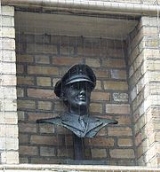
| |
Alton Glenn Miller (March 1, 1904–missing December 15, 1944), was an American jazz musician, arranger, composer, and band leader in the swing era. He was one of the best-selling recording artists from 1939 to 1942, leading one of the best known "Big Bands". Miller's signature recordings include, "In the Mood", "Tuxedo Junction", "Chattanooga Choo Choo", "Moonlight Serenade", "Little Brown Jug", and "Pennsylvania 6-5000". While travelling to entertain U.S. troops in France during World War II, Miller's plane disappeared in bad weather.

Discussion
Ask a question about 'Glenn Miller'
Start a new discussion about 'Glenn Miller'
Answer questions from other users
|
Recent Posts

Quotations
A band ought to have a sound all of its own. It ought to have a personality.
I havent got a great jazz band and I dont want one... A dozen colored bands have a beat better than mine.
The saxophone sound was always intended to be an all-around combination; but when we do play a swing number, we expect and try to make it swing as much as possible.

Encyclopedia
Alton Glenn Miller (March 1, 1904–missing December 15, 1944), was an American jazz musician, arranger, composer, and band leader in the swing era. He was one of the best-selling recording artists from 1939 to 1942, leading one of the best known "Big Bands". Miller's signature recordings include, "In the Mood", "Tuxedo Junction", "Chattanooga Choo Choo", "Moonlight Serenade", "Little Brown Jug", and "Pennsylvania 6-5000". While travelling to entertain U.S. troops in France during World War II, Miller's plane disappeared in bad weather. His body was never found.
Early life and career
Glenn Miller was born in Clarinda, Iowa on March 1, 1904, the son of Mattie Lou (née Cavender) and Lewis Elmer Miller. He went to grade school in North Platte, Nebraska. In 1915, Miller's family moved to Grant City, Missouri. Around this time, Miller was given his first trombone and then played in the town orchestra. In 1918, the Miller family moved again, this time to Fort Morgan, Colorado where Glenn went to high school. During his senior year, Miller became very interested in a new style of music called "dance band music". Miller enjoyed this music so much that he and some classmates decided to start their own band. By the time Miller graduated from high school in 1921, he had decided he wanted to become a professional musician.
In 1923, Miller entered the University of Colorado where he joined Sigma Nu Fraternity, but spent most of his time away from school, attending auditions and playing any gigs he could get, most notably with Boyd Senter's band in Denver. He dropped out of school after failing three out of five classes one semester, and decided to concentrate on making a career as a professional musician. He later studied the Schillinger technique with Joseph Schillinger under whose tutelage he composed what became his signature theme, "Moonlight Serenade."
In 1926, Miller toured with several groups and landed a good spot in Ben Pollack's group in Los Angeles. During his stint with Pollack, Miller had the opportunity to write several musical arrangements of his own. In 1928, when the band arrived in New York City, he sent for and married his college sweetheart, Helen Burger. He was a member of Red Nichols’s orchestra in 1930, and because of Nichols, played in the pit bands of two Broadway shows, Strike Up the Band and Girl Crazy, his bandmates included Benny Goodman and Gene Krupa. "The consensus there was that Miller was no more than an average trombonist." Despite this, during the late 1920s and early 1930s, Miller managed to earn a living working as a freelance trombonist in several bands. In November of 1929, an original vocalist named Red McKenzie hired Glenn to play on two records that are now considered to be jazz classics: "Hello, Lola" and "If I Could Be With You One Hour Tonight". "Not only were [the two songs Miller recorded] considered major musical items, but they also represented one of the major breakthroughs in blacks and whites playing together." Besides Glenn were clarinetist Pee Wee Russell, guitarist Eddie Condon, drummer Gene Krupa and Coleman Hawkins on tenor saxophone.
In the mid-1930s, Miller also worked as a trombonist and arranger in The Dorsey Brothers ill-fated co-led orchestra. Miller composed the song "Annie's Cousin Fanny" and "Dese Dem Dose" for the Dorsey Brothers Band in 1934 and 1935. In 1935, he assembled an American orchestra for British bandleader Ray Noble, developing the arrangement of lead clarinet over four saxophones that eventually became the sonic keynote of his own big band. Members of the Noble band included future bandleaders Claude Thornhill, Bud Freeman and Charlie Spivak. Ray Noble and his American Dance Orchestra recorded and performed a live version of the Glenn Miller composition "Dese Dem Dose" as part of a medley in April, 1935 at the Rainbow Room in New York.
Glenn Miller made his first movie appearance in the 1935 Paramount release The Big Broadcast of 1936 as a member of the Ray Noble Orchestra. The Big Broadcast of 1936 starred Bing Crosby, George Burns and Gracie Allen, Ethel Merman, Jack Oakie, and Bill "Bojangles" Robinson, and featured performances by Dorothy Dandridge and the Nicholas Brothers, who would appear with Miller again in two movies for Twentieth Century Fox in 1941 and 1942.
Glenn Miller compiled several musical arrangements and formed his first band in 1937. The band failed to distinguish itself from the many others of the era, and eventually broke up. Benny Goodman said in 1976, "In late 1937, before his band became popular, we were both playing in Dallas. Glenn was pretty dejected and came to see me. He asked, 'What do you do? How do you make it?' I said, 'I don't know, Glenn. You just stay with it."
Success from 1938 to 1942: public and critical reaction
Discouraged, Miller returned to New York. He realized that he needed to develop a unique sound, and decided to make the clarinet play a melodic line with a tenor saxophone holding the same note, while three other saxophones harmonized within a single octave. George Simon discovered a saxophonist named Wilbur Schwartz for Glenn Miller. Miller hired Schwartz, but instead had him play the lead clarinet. According to Simon, "Willie's tone and way of playing provided a fullness and richness so distinctive that none of the later Miller imitators could ever accurately reproduce the Miller sound." With this new sound combination, the Miller band found success. Miller talked about his style in the May, 1939 issue of Metronome magazine. "You'll notice today some bands use the same trick on every introduction; others repeat the same musical phrase as a modulation into a vocal. [...] We're fortunate in that our style doesn't limit us to stereotyped intros, modulations, first choruses, endings or even trick rhythms. The fifth sax, playing clarinet most of the time, lets you know whose band you're listening to. And that's about all there is to it."
In September 1938, the Miller band began making recordings for the RCA Victor Bluebird Records subsidiary. In the spring of 1939, the band's fortunes improved with a date at the Meadowbrook Ballroom in Cedar Grove, New Jersey, and more dramatically at the Glen Island Casino in New Rochelle, New York. With the Glen Island date, the band began a huge rise in popularity. In 1939, Time magazine noted: "Of the twelve to 24 discs in each of today's 300,000 U.S. jukeboxes, from two to six are usually Glenn Miller's." There were record-breaking recordings such as "Tuxedo Junction", which sold 115,000 copies in the first week. 1939's huge success culminated with the Miller band in concert at Carnegie Hall on October 6, with Paul Whiteman, Benny Goodman, and Fred Waring also the main attractions.
From 1939 to 1942, Miller's band was featured three times a week during a broadcast for Chesterfield cigarettes, originally with the Andrews Sisters and then on its own. On February 10, 1942, RCA Victor presented Miller with the first gold record for "Chattanooga Choo-Choo". "Chattanooga Choo Choo" was performed by the Miller orchestra with his singers Gordon "Tex" Beneke, Paula Kelly and the vocal group, the Modernaires. Other singers with this orchestra included Marion Hutton, Skip Nelson, Ray Eberle and to a smaller extent, Kay Starr, Ernie Caceres, Dorothy Claire and Jack Lathrop. Pat Friday ghost sang with the Miller band in Sun Valley Serenade and Orchestra Wives with Lynn Bari lip synching.
In 2004, Glenn Miller orchestra bassist Herman "Trigger" Alpert explained the band's success: "Miller had America's music pulse[...]. He knew what would please the listeners." Although Miller had massive popularity, many jazz critics of the time had their misgivings, believing that the band's endless rehearsals and "letter-perfect playing" diminished excitement and feeling from performances. They also felt that Miller's brand of swing shifted popular music away from the "hot" jazz bands of Benny Goodman and Count Basie towards commercial novelty instrumentals and vocal numbers. Miller was often criticized for being too commercial. His answer to the criticism was, "I don't want a jazz band". Many modern jazz critics still harbour similar antipathy toward Miller. In an article written by Gary Giddins for The New Yorker in 2004, Giddins felt that these early critics erred in denigrating Glenn Miller's music, and that the popular opinion of the time should hold greater sway. The article states: "Miller exuded little warmth on or off the bandstand, but once the band struck up its theme, audiences were done for: throats clutched, eyes softened. Can any other record match "Moonlight Serenade" for its ability to induce a Pavlovian slaver in so many for so long?"
Louis Armstrong thought enough of Miller to carry around his recordings transferred to seven inch tape reels when he went on tour. "[Armstrong] liked musicians who prized melody, and his selections ranged from Glenn Miller to Jelly Roll Morton to Tchaikovsky." George Shearing's quintet was influenced by Glenn Miller: "with Shearing's 'locked hand' piano (influenced by the voicing of Glenn Miller's saxophone section) in the middle [of the quintet's harmonies]." Frank Sinatra and Mel Torme held the orchestra in high regard. Torme credited Miller with giving him helpful advice when he first started his singing and song writing career in the 1940s. Mel Torme met Glenn Miller in 1942, the meeting facilitated by Torme's father and Ben Pollack. Torme and Miller
discussed "That Old Black Magic" which was just emerging as a new song by Johnny Mercer and Harold Arlen. Miller told Torme to pick up every song by Mercer and study it and to become a voracious reader of anything he could find, because "all good lyric writers are great readers". In an interview with George T. Simon in 1948, Frank Sinatra lamented the inferior quality of music he was recording in the late forties and in comparison, "those great Glenn Miller things"from eight years earlier. With the opposite opinion, fellow bandleader Artie Shaw frequently disparaged the band after Miller's death: "All I can say is that Glenn should have lived, and 'Chattanooga Choo Choo' should have died."
Buddy DeFranco surprised many people when he led the Glenn Miller orchestra in the late sixties and early seventies. De Franco was already the veteran of bands like Gene Krupa and Tommy Dorsey and also a major exponent of bop in the nineteen fifties. But De Franco loved certain aspects of the Glenn Miller sound and according to him, never saw Miller as leading a swinging jazz band anyways. "I found that when I opened with the sound of "Moonlight Serenade", I could look around and see men and women weeping as the music carried them back to years gone by." De Franco's favorite Miller recordings are "Skylark" and "Indian Summer". Simply put, De Franco says, "the beauty of Glenn Miller's ballads [...] caused people to dance together".
Miller and his band appeared in two Twentieth Century Fox films, 1941's, Sun Valley Serenade which also featured Milton Berle. The Miller band returned to Hollywood to film 1942's Orchestra Wives, featuring Jackie Gleason playing a part as the group's bassist, Ben Beck. Glenn Miller had an ailment that made laughter extremely painful. Since Jackie Gleason was a comedian, Miller had a difficult time watching Gleason more than once, because Miller would start laughing. Harry Morgan appeared as the unrequited love interest of the Ann Rutherford character. Years later, Morgan appeared in The Glenn Miller Story as Miller's pianist, Chummy MacGregor. Miller was contracted to do a third movie for Fox, Blind Date, but as he entered the army, this never panned out.
The Army Air Force Band 1942-1944
In 1942, at the peak of his civilian career, Miller decided he could better serve those in uniform by joining the war effort. At 38 years old, Miller was too old to be drafted, and first volunteered for the Navy but was told that they did not need his services. Miller then wrote to Army Brigadier General Charles Young on August 12 1942. Miller persuaded the United States Army Air Forces to accept him so he could in his own words, "be placed in charge of a modernized army band." After being accepted in the Army, Glenn’s civilian band played their last concert in Passaic, New Jersey on September 27, 1942.
Captain Glenn Miller served initially as assistant special services officer for the Army Air Forces Southeast Training Center at Maxwell Field, Montgomery, Alabama, in December 1942. He played trombone with the Rhythmaires, a 15-piece dance band, in both Montgomery and in service clubs and recreation halls on Maxwell. Miller also appeared on both WAPI (Birmingham, Alabama) and WSFA radio (Montgomery), promoting the activities of civil service women aircraft mechanics employed at Maxwell.
Glenn Miller was transferred. The band he was most noted for while in the military was stationed at Yale University in New Haven, Connecticut March 27, 1943 to June 19, 1944. "Through Miller, band members and vocalists like Tony Martin, Johnny Desmond and Ray McKinley became familiar names." Miller initially formed a large marching band that was to be the core of a network of service orchestras. Miller's attempts at modernizing military music were met with some resistance from tradition-minded career officers. An example is the arrangement of "St. Louis Blues March", combining blues and jazz with the traditional military march. This was recorded on October 29, 1943 at the Victor studios in New York City. "Miller's striking innovations and his adaptations of Sousa marches for the AAF band prompted Time magazine to claim that he had rankled traditionalists in the field of Army music and had desecrated the March King. The magazine also criticized Miller's injection of casual enjoyment into the disciplined cadences of military music, stating that the Army was 'swinging its hips instead of its feet.'" Miller's weekly radio broadcast "I Sustain the Wings" moved from New Haven to New York City and was very popular. This led to permission for Miller to form his 50-piece Army Air Force Band and take it to England in the summer of 1944, where he gave 800 performances. While in England, now Major Glenn Miller recorded a series of records at HMV (now EMI) owned Abbey Road Studios. HMV at this time was the British and sometime European distributor for the American record company that handled and originated Glenn Miller's recordings, RCA Victor. The recordings the AAF band made in 1944 at Abbey Road were propaganda broadcasts for the Office of War Information. Many songs were sung in German by Johnny Desmond and Glenn Miller spoke in German about the war effort. Also, the Miller-led AAF Orchestra recorded songs with the American singer Dinah Shore. These were done at the Abbey Road studios and were the last recorded songs made by the band while being led by Miller. They were stored with HMV/EMI for fifty years, never being released until their copyright expired in Europe in 1994.
Disappearance
On December 15, 1944, Miller, now a major, was to fly from the United Kingdom to Paris, France, to play for the soldiers who recently had liberated Paris. His plane (a single-engined UC-64 Norseman, USAAF serial 44-70285) departed from RAF Twinwood Farm, in Clapham, Bedfordshire and disappeared whilst flying over the English Channel. No trace of the aircrew, passengers or plane has ever been found. As an officer in the armed forces, Miller's status is missing in action.
Since Miller's disappearance, there have been many theories about what happened. Buddy DeFranco told biographer George T. Simon of the many theories of Miller's disappearance that were told to him while he was leading the band in the 1970s. DeFranco said "If I were to believe all those stories, there would have been about twelve thousand four hundred and fifty eight people there at the field in England seeing him off on that last flight!"
Miller's plane may have been bombed accidentally by Royal Air Force aircraft over the English Channel after an abortive air raid on Siegen, Germany. One hundred and thirty-eight Lancaster bombers, short on fuel, jettisoned approximately 100,000 incendiaries in a designated area before landing, per standing orders. The logbooks of Royal Air Force navigator Fred Shaw recorded that he saw a small single-engined monoplane spiraling out of control and crashing into the water. If this was indeed Miller's plane, the RAF crews were not culpable for the plane carrying Miller straying off course into their designated drop area. However, a second source, while acknowledging the possibility, casts doubt on the version, citing other RAF crew members flying the same mission who state the drop area was in the North Sea, a more likely location. Bruce Barrymore Halpenny has also discredited Shaw's claims and shown that the RAF were not to blame and Shaw was just a fraud or else would, along with the rest of the crew, been guilty of murder for not issuing a HOT NEWS REPORT, which it was their duty to do on seeing a downed Allied plane. In 2001, Mike Rossiter who worked for the BBC announced he was going to try find Miller's aircraft and body. Glenn Miller's sister-in-law Ann Miller said, "Nobody has ever found him and each time they try it is mentally upsetting for us."
Miller's surname resides on the 'Wall of Missing' at the Cambridge American Cemetery and Memorial. A monument stone was also placed in Grove Street Cemetery in New Haven, Connecticut next to the campus of Yale University. General Jimmy Doolittle said, “[...]next to a letter from home, that organization was the greatest morale builder in the European Theater of Operations.”
Civilian band legacy
The Miller estate authorized an official Glenn Miller "ghost band" in 1946. This band was led by Tex Beneke, former lead saxophonist and singer for the civilian band. It had a make up similar to the Army Air Force Band: it had a large string section. The orchestra's official public début was at the Capitol Theatre on Broadway where it opened for a three week engagement on January 24, 1946. Henry Mancini was the band's pianist and one of the arrangers. This ghost band played to very large audiences all across the United States, including a few dates at the Hollywood Palladium in 1947, where the original Miller band played in 1941. In a website concerning the history of the Hollywood Palladium, it is noted "[e]ven as the big band era faded, the Tex Beneke and Glenn Miller Orchestra concert at the Palladium resulted in a record-breaking crowd of 6,750 dancers." By 1949, economics dictated that the string section be dropped.
This band recorded for RCA Victor, just as the original Miller band did. Beneke was struggling with how to expand the Miller sound and also how to achieve success under his own name. What began as the "Glenn Miller Orchestra Under the Direction of Tex Beneke" finally became "The Tex Beneke Orchestra". By 1950, Beneke and the Miller estate parted ways. The break was acrimonious and Beneke is not currently listed by the Miller estate as a former leader of the Glenn Miller orchestra.
When Glenn Miller was alive, various bandleaders like Bob Chester imitated his style. By the early 1950s, various bands were again copying the Miller style of clarinet-led reeds and muted trumpets, notably Ralph Flanagan, Jerry Gray, and Ray Anthony. This, coupled with the success of The Glenn Miller Story (1953), led the Miller estate to ask Ray McKinley to lead a new ghost band. This 1956 band which included musicians such as pianist Don Wilhite among others, is the original version of the current ghost band that still tours the United States today. The official Glenn Miller orchestra for the United States is currently under the direction of Larry O'Brien. The officially sanctioned Glenn Miller Orchestra for the United Kingdom has toured and recorded with great success under the leadership of Ray McVay. The official Glenn Miller Orchestra for Europe has been led by Wil Salden since 1990.
Air Force band legacy
In the mid-1940s, after Miller's death, the Miller led Army Air Force band was decommissioned and sent back to the United States. "[T]he chief of the European theater asked [Warrant Officer Harold Lindsay] Lin [Arinson] to put together another band to take its place, and that's when the 314 was formed." According to singer Tony Bennett who sang with it while in the service, the 314 was the immediate successor to the Glenn Miller led AAF orchestra. The Glenn Miller Army Air Force Band's long term legacy has carried on with the Airmen of Note, a band within The United States Air Force Band. This band was created in 1950 from smaller groups within the Bolling Air Force Base in Washington D.C. and continues to play jazz music for the Air Force community and the general public.
Postscript Even after Miller broke up his civilian orchestra in 1942, the band had two hits in 1943 for RCA Victor. (These were recorded before the band broke up and before the recording ban imposed by the musicians union in the fall of 1942. One of the hits was "That Old Black Magic" which was one recording from three sessions that happened between July 14 and July 16, 1942. The musicians union ban on new recordings went into effect August 1, 1942. Two years later, "Glenn Miller, an album of 78 rpm records, topped the newly instituted album charts in May 1945 and became the most successful album of the year."
In 1953, Anthony Mann directed The Glenn Miller Story for Universal-International Pictures starring James Stewart and June Allyson. The partly fictionalized biographical film was a popular success, receiving three Academy Award nominations and winning an Academy Award for Best Sound Recording. James Stewart also received a British Academy of Film and Television Arts (BAFTA) nomination as Best Foreign Actor in 1954. The movie soundtrack album Glenn Miller Plays Selections From The Glenn Miller Story reached number one on the Billboard album chart in May, 1954. Miller's mother said of the movie that actor James Stewart "wasn't as good-looking as my son".
In 1959, RCA Victor released a triple LP of previously unissued performances, For the First Time ..., which earned a Grammy nomination for Best Performance by a Dance Band. The number one 1967 single "All You Need is Love" by The Beatles quotes "In the Mood" in the closing fade-out. Harpers Bizarre, a 1960s rock band with a penchant for camp, recorded "Chattanooga Choo Choo", making it a minor "easy listening" hit in the late 1960s. In the late 1970s, taking advantage of the popularity of disco, "Tuxedo Junction" released disco versions of "Moonlight Serenade" and "Chattanooga Choo Choo". "Chattanooga Choo Choo" actually placed as a best selling record almost forty years after the original Miller recording. "In 1989, Jive Bunny and the Mastermixers sampled Miller's recording of "In the Mood" on their gold single 'Swing the Mood'."
Glenn Miller's widow, Helen, died in 1966. Herb Miller, Glenn Miller's brother, led his own band in the United States and England until the late 1980s. Herb's son, John continues the tradition leading a band playing mainly Glenn Miller style music. In 1989, Glenn Miller's daughter Jonnie purchased her father's house where he was born. The Glenn Miller Foundation was created to oversee the subsequent restoration.
In 1978, Glenn Miller was a charter inductee into the Big Band and Jazz Hall of Fame. In the United States and England, there are a few archives that are devoted to Glenn Miller. The Glenn Miller archive, at the University of Colorado at Boulder, includes the original manuscript to Miller's theme song, "Moonlight Serenade", among other items of interest. In 2002, the Glenn Miller Museum opened to the public at the former RAF Twinwood Farm, in Clapham, Bedfordshire, England.
In 1996, the U.S. Postal Service issued a Glenn Miller postage stamp. The National Academy of Recording Arts and Sciences (Grammys), honored Glenn Miller by including three of his recordings in their Hall of Fame: In 1983, "In The Mood", Bluebird B-10416-A, was inducted. The recording of "Moonlight Serenade", Bluebird B-10214-B, was also honored by the Grammys in similar fashion in 1991. "Chattanooga Choo Choo", Bluebird B-11230-B, was inducted in 1996. In 2003, Miller received the Grammy Lifetime Achievement Award.
The entire output of cigarette sponsored radio programs Glenn Miller did between 1939 and 1942 were recorded by the Glenn Miller organization on acetate discs. In the 1950s and afterwards, RCA-Victor distributed many of these on long playing albums and compact discs. A sizeable representation of the recording output by the various Glenn Miller led bands are almost always in circulation by Sony Music Entertainment and the Universal Music Group, the successor conglomerates to RCA-Victor, Brunswick, Bluebird, Columbia and Decca. Glenn Miller remains one of the most famous and recognizable names of the big band era of 1935 to 1945.
Glenn Miller arranging staff and compositions Miller had a staff of arrangers who wrote originals like "String of Pearls" (written and arranged by Jerry Gray) or took originals like "In The Mood" (writing credit given to Joe Garland and arranged by Eddie Durham) and "Tuxedo Junction" (written by bandleader Erskine Hawkins and arranged by Jerry Gray) and arranged them for the Miller band to either record or broadcast. Glenn Miller's staff of arrangers in his civilian band, that handled the bulk of the work were Jerry Gray, Bill Finegan, Billy May and to a much smaller extent, George Williams, who worked very briefly with the band. According to Norman Leyden, "[s]everal others [besides Leyden] arranged for Miller in the service, including Jerry Gray, Ralph Wilkinson, Mel Powell, and Steve Steck." One problem with authenticating songs written by Miller is that it was extremely common for bandleaders to have a popular recording and add their name to the recording as co-composer after the song became popular.
Discography
Glenn Miller composed individually or in collaboration with others at least fourteen songs that are available on recordings. He added lyrics to an additional tune. These and many other songs were recorded by Miller with his pre-war civilian bands and his Army Air Force band.
Selected band alumni
For the most part, Glenn Miller worked with extremely talented men and women. Many of the Miller musicians went on to studio and touring careers in Hollywood and New York after World War II:
- Billy May, 1916-2004 a trumpeter and an arranger for the civilian band, became a much-coveted arranger and studio orchestra leader after that band broke up, going on to work with Frank Sinatra, Rosemary Clooney, Anita O'Day, and Bing Crosby, among other singers of the post-war era.
- Cornetist Bobby Hackett, 1915-1976 soloed on "A String of Pearls", with Miller in 1941. Hackett already had an excellent reputation with jazz fans when he joined Miller on July 10, 1941 His reputation only ascended in the years after. Hackett went on to work with Jackie Gleason and Dizzy Gillespie.
- Kay Starr, b. 1922 became one of the most popular singers of the post-war period; she got her start with Glenn Miller in 1939 recording two sides, "Baby Me" and "Love With a Capital You".
- Artie Malvin, 1922-2006 Glenn Miller's AAF Band had a vocal group called "The Crew Chiefs". Artie Malvin was the baritone of the four men. After World War Two and Miller's death, Malvin became heavily immersed in the popular music of the forties and fifties, being involved in everything from children's music to the nascent beginnings of rock to jingles for commercials. By the nineteen seventies Artie Malvin was involved with "The Carol Burnett Show" doing special musical material. He won an Emmy for the Burnett show parody of Fred Astaire and Ginger Rogers movies: "Hi-Hat". The Burnett show does a tribute to The Glenn Miller Story which opens with Burnett singing "Moonlight Serenade". [no date available]
Some of the Army Air Force members went on to notable careers in classical music. Two such are:
- Norman Leyden b. 1917 an arranger from the Army Air Force Band later became a noted arranger in New York, composing arrangements for Sarah Vaughan, among other artists. His long career culminated with his highly regarded work for the Oregon Symphony, now as Laureate Associate Conductor.
- Mel Powell, 1923-1998, was the pianist and one of the arrangers in the Glenn Miller Army Air Force Band. Gary Giddins comments on "[Miller's] splendid forty-two-piece Army Air Force Band’s startling performance of 'Mission to Moscow.'” "Mission to Moscow" was arranged by Mel Powell, the former pianist for the Benny Goodman orchestra before he was drafted into the service and subsequently joined the Miller orchestra. "Pearls on Velvet" with the Air Force Band is also one of his compositions."In 1949, he decided on a radical change of direction, setting aside jazz and enrolling as a pupil of the composer and teacher Paul Hindemith at Yale University." Powell started teaching at the California Institute for the Arts in Los Angeles in 1969.
Bibliography
See also
External links
|