

Javanese calendar

Encyclopedia
The Javanese calendar is the calendar
of the Javanese people. It is used concurrently with two other calendars, the Gregorian calendar
and the Islamic calendar
. The Gregorian calendar is the official calendar of the Republic of Indonesia and civil society, while the Islamic calendar is used by Muslims and Indonesian government for religious worship and deciding relevant Islamic holidays.
The Javanese calendar is used by the main ethnicities of Java island: Javanese, Madurese and Sundanese people
- primarily as a cultural icon
, a cultural identifier and as an object and tradition of antiquity to be kept alive. The Javanese calendar is used for cultural and metaphysical purposes of these Javanese peoples
The current system of Javanese calendar was inaugurated by Sultan Agung of Mataram
in the Gregorian year 1633. Prior to that, Javanese had used the Hindu calendar
or Saka calendar which that starts in 78
CE
and uses the solar cycle for calculating time. Sultan Agung's calendar retained the Saka calendar year counting but differs by using the same lunar year measurement system as the Islamic calendar
, rather than using the old solar year. Occasionally it is referred by its Latin name Anno Javanico or AJ (Javanese Year).
. Traditionally Javanese people didn't divide day and night into hour
s, but dividing it into phases. The division of a day and night are:
 Native Javanese system groups days into a five-day week
called Pasaran, unlike many calendar that used seven-days week. The name, pasaran, is derived from the root word pasar ("market
"). Historically, but also still today, Javanese villagers gather communally at local markets to meet socially, engage in commerce, and buy and sell farm produce, cooked foods, home industry crafted items and so on. John Crawfurd
(1820) suggested that the length of the week/cycle is related to the number of fingers on the hand, and that itinerant merchants would rotate their visits to different villages according to a five day "roster".
The days of the cycle have two names each, because the Javanese language
has distinct vocabulary associated with two different registers of politeness: ngoko (informal) and krama (formal). The krama names for the days are much less common, and so are given in parentheses.
The origin of the names is unclear, and their etymology
remains obscure. Possibly, the names may be derived from indigenous gods, like the European and Asian names
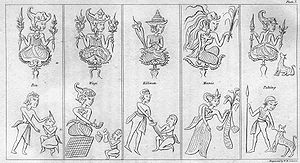
. An ancient Javanese manuscript illustrates the week with five human figures (shown at right below the day names): a man seizing a suppliant by the hair, a woman holding a horn to receive an offering, a man pointing a drawn sword at another, a woman holding agricultural produce, and a man holding a spear leading a bull.
Additionally, Javanese consider these days' names to have a mystical relation to color
s and cardinal direction
:
Market
s no longer operate under this traditional Pasaran cycle, instead pragmatically remaining open every day of the Gregorian
week. However many markets in Java still retain traditional names that indicated that once the markets only operate in certain Pasaran days, such as Pasar Legi, or Pasar Kliwon.
Javanese astrological belief dictates that individual characteristics or future are attributable to the combination of the Pasaran day and the 'common' weekdays of the Islamic calendar of that person's birthday. Javanese people find great interest in their astrological interpretations in this combination, which is called the Wetonan cycle.
, adopted following the spread of Islam in Indonesian archipelago. The names of the days of the week in Javanese
are derived from their Arabic
counterparts, namely:
These two week systems occurred concurrently, thus a certain Friday may fall in a Kliwon day, and thus called Jumat Kliwon. This combonation form the wetonan cycle explained below.
From the example above, the Weton for Tuesday May 6, 2008 would be read as Selasa Wage.
The Wetonan cycle is especially important for divinatory systems, and important celebrations, rites of passage, commemorations and so forth are held on days considered to be auspicious.
An especially prominent example widely still taught at primary schools is the Weton for the Proclamation of Independence of Indonesia
on August 17, 1945, which was at Jumat (Friday) Legi. It was also coinciding with the Weton for the birth and death of Sultan Agung, considered one of the greatest kings of Java history,. Therefore, Jumat Legi is considered an important night for pilgrimage. There are also taboo
s that relate to the cycle; for example, the ritual dance bedhaya
can only be performed on Kemis (Thursday) Kliwon.
The coincidence of the Pasaran day with the common day on the day of birth is considered by Javanese to indicate the personal characteristics of that person, similar to the Western Zodiac
and planetary positioning in Western astrology
.
is a 210-day cycle in Javanese calendar, related to Hindu tradition. Though most associated with Bali
, it is still used in Java for special purposes. The calendar consists of concurrent weeks, and has a set of ten weeks, which have a duration of 1, 2, 3, 4, 5, 6, 7, 8, 9, and 10 days.
The first day of the year is considered the first day of all ten weeks. As 210 is not divisible by 4, 8, or 9, extra days must be added to the 4-, 8-, and 9-day weeks.
On the first day of the month, when the moon is small, it is compared to a newborn baby. The 14th day, called Purnama Sidhi (full moon), represents a married adult. The next day, called Purnama, occurs as the moon begins to wane. The 20th day, Panglong, symbolizes the point at which people begin to lose their memory. The 25th day, Sumurup, represents the point at which the adult requires care like when they were young. The 26th day, Manjing, represents the return of the human to his or her origin.
practice in Java. The names of the first ten months are simply the ordinal number
s from 1 to 10 in Javanese language, although the names of the 11th and 12th months are unclear. The cycle begins near the summer solstice
, around the middle of the dry season in Java.
In the 19th century, the solar month system or pranata mangsa was much better known among Javanese than the civil or religious year. The cycle is clearly of Javanese origin, since the specific application to their climate does not match other territories in the Indonesian archipelago, as well as the usage of Javanese names for the months. Although the cycle matches the weather pattern well, it is still clearly somewhat arbitrary, as can be seen in the lengths of the months.
In astrology
, the pranata mangsa is used to predict personality traits in a similar manner to sun signs in Western astrology. It is not widely used anymore for divination
, but some practitioners use it as well as the other cycles in their divination.
The Solar months are :
Leght of the last month is depending on the length of the tahun.
The cycle of months is considered metaphorically to represent the cycle of human life. The first nine months represent gestation
before birth, while the tenth month represents the human in the world, the eleventh the end of his or her existence, and the twelfth the return to where he or she came from. The cycle thus goes from one spark or conception (rijal) to another, traversing through the void (suwung).
, which started in 78 CE and continues to be used on Bali, was used in Hindu times on Java, and for well over a century after the appearance of Islam on Java.
When Sultan Agung adopted the Islamic lunar calendar in 1633 CE, he did not adopt the Anno Hegirae to designate those years, but instead continued the count of the Shalivahana era, which was 1555 at the time. As a result, the Anno Javanico does not in effect count from any time.
The windu are then grouped into a cycle of four:
The cycles of wulan, tahun, and windu are derived from the Saka calendar
.
Windu are no longer used much in horoscopy, but there is evidence that it was previously used by court officials
to predict trends. The passing of a windu is often seen as a milestone and deserving a slametan
ritual feast).
, the creator of life and the universe. Practitioners of traditional Javanese spiritual teachings have preserved several noble days:
Calendar
A calendar is a system of organizing days for social, religious, commercial, or administrative purposes. This is done by giving names to periods of time, typically days, weeks, months, and years. The name given to each day is known as a date. Periods in a calendar are usually, though not...
of the Javanese people. It is used concurrently with two other calendars, the Gregorian calendar
Gregorian calendar
The Gregorian calendar, also known as the Western calendar, or Christian calendar, is the internationally accepted civil calendar. It was introduced by Pope Gregory XIII, after whom the calendar was named, by a decree signed on 24 February 1582, a papal bull known by its opening words Inter...
and the Islamic calendar
Islamic calendar
The Hijri calendar , also known as the Muslim calendar or Islamic calendar , is a lunar calendar consisting of 12 lunar months in a year of 354 or 355 days. It is used to date events in many Muslim countries , and used by Muslims everywhere to determine the proper day on which to celebrate Islamic...
. The Gregorian calendar is the official calendar of the Republic of Indonesia and civil society, while the Islamic calendar is used by Muslims and Indonesian government for religious worship and deciding relevant Islamic holidays.
The Javanese calendar is used by the main ethnicities of Java island: Javanese, Madurese and Sundanese people
Sundanese people
The Sundanese are an ethnic group native to the western part of the Indonesian island of Java. They number approximately 31 million, and are the second most populous of all the nation's ethncities. The Sundanese are predominantly Muslim...
- primarily as a cultural icon
Cultural icon
A cultural icon can be a symbol, logo, picture, name, face, person, building or other image that is readily recognized and generally represents an object or concept with great cultural significance to a wide cultural group...
, a cultural identifier and as an object and tradition of antiquity to be kept alive. The Javanese calendar is used for cultural and metaphysical purposes of these Javanese peoples
The current system of Javanese calendar was inaugurated by Sultan Agung of Mataram
Sultan Agung of Mataram
Sultan Agung of Mataram or Sultan Agung Anyokrokusumo or Sultan Agung Hanyokrokusumo was the Sultan of Mataram from 1613-1645...
in the Gregorian year 1633. Prior to that, Javanese had used the Hindu calendar
Hindu calendar
The hindu calendar used in ancient times has undergone many changes in the process of regionalization, and today there are several regional Indian calendars, as well as an Indian national calendar. Nepali calendar, Bengali calendar, Malayalam calendar, Tamil calendar, Telugu calendar, Kannada...
or Saka calendar which that starts in 78
78
Year 78 was a common year starting on Thursday of the Julian calendar. At the time, it was known as the Year of the Consulship of Novius and Commodus...
CE
Common Era
Common Era ,abbreviated as CE, is an alternative designation for the calendar era originally introduced by Dionysius Exiguus in the 6th century, traditionally identified with Anno Domini .Dates before the year 1 CE are indicated by the usage of BCE, short for Before the Common Era Common Era...
and uses the solar cycle for calculating time. Sultan Agung's calendar retained the Saka calendar year counting but differs by using the same lunar year measurement system as the Islamic calendar
Islamic calendar
The Hijri calendar , also known as the Muslim calendar or Islamic calendar , is a lunar calendar consisting of 12 lunar months in a year of 354 or 355 days. It is used to date events in many Muslim countries , and used by Muslims everywhere to determine the proper day on which to celebrate Islamic...
, rather than using the old solar year. Occasionally it is referred by its Latin name Anno Javanico or AJ (Javanese Year).
Calendar cycles
The Javanese calendar contains multiple, overlapping but separate measurements of times, called cycles. These include:- the native five-day week, called Pasaran
- the common Gregorian and Islamic seven-day weekWeekA week is a time unit equal to seven days.The English word week continues an Old English wice, ultimately from a Common Germanic , from a root "turn, move, change"...
- the Solar months cycle, called Mangsa
- the Lunar months cycle, called Wulan
- the year-cycles, or Tahun
- and octo-ennia (8 year) cycles, or Windu
Division of time
Days in Javanese calendar, like Islamic calendar, started on sunsetSunset
Sunset or sundown is the daily disappearance of the Sun below the horizon in the west as a result of Earth's rotation.The time of sunset is defined in astronomy as the moment the trailing edge of the Sun's disk disappears below the horizon in the west...
. Traditionally Javanese people didn't divide day and night into hour
Hour
The hour is a unit of measurement of time. In modern usage, an hour comprises 60 minutes, or 3,600 seconds...
s, but dividing it into phases. The division of a day and night are:
| Start | End | Javanese name | Meaning |
|---|---|---|---|
| 6 am | 8 am | esuk | morning |
| 8 am | 12 am | teng'angi | midday |
| 12 am | 1 pm | bedug | time for bedug prayer Dhuhr The dhuhr prayer is the prayer after midday Performed daily by practicing Muslims, it is the second of the five daily prayers... |
| 1 pm | 3 pm | lingsir kulon | (sun) moving west |
| 3 pm | 6 pm | asar | time for asar prayer Asr The Asr prayer is the afternoon daily prayer recited by practising Muslims. It is the third of the five daily prayers . The five daily prayers collectively are one pillar of the Five Pillars of Islam, in Sunni Islam, and one of the ten Practices of the Religion according to Shia Islam... |
| 6 pm | 8 pm | sore | evening |
| 8 pm | 11 pm | sirap | sleepy time |
| 11 pm | 1 am | tengah wengi | midnight |
| 1 am | 3 am | lingsir wengi | late night |
| 3 am | 6 am | bangun | awakening |
Five-day week (Pasaran)
Week
A week is a time unit equal to seven days.The English word week continues an Old English wice, ultimately from a Common Germanic , from a root "turn, move, change"...
called Pasaran, unlike many calendar that used seven-days week. The name, pasaran, is derived from the root word pasar ("market
Market
A market is one of many varieties of systems, institutions, procedures, social relations and infrastructures whereby parties engage in exchange. While parties may exchange goods and services by barter, most markets rely on sellers offering their goods or services in exchange for money from buyers...
"). Historically, but also still today, Javanese villagers gather communally at local markets to meet socially, engage in commerce, and buy and sell farm produce, cooked foods, home industry crafted items and so on. John Crawfurd
John Crawfurd
John Crawfurd , Scottish physician, and colonial administrator and author, was born in the island of Islay, Scotland...
(1820) suggested that the length of the week/cycle is related to the number of fingers on the hand, and that itinerant merchants would rotate their visits to different villages according to a five day "roster".
The days of the cycle have two names each, because the Javanese language
Javanese language
Javanese language is the language of the Javanese people from the central and eastern parts of the island of Java, in Indonesia. In addition, there are also some pockets of Javanese speakers in the northern coast of western Java...
has distinct vocabulary associated with two different registers of politeness: ngoko (informal) and krama (formal). The krama names for the days are much less common, and so are given in parentheses.
- Legi (Manis)
- Pahing (Pait)
- Pon (Petak)
- Wagé (Cemeng)
- Kliwon (Aish)
The origin of the names is unclear, and their etymology
Etymology
Etymology is the study of the history of words, their origins, and how their form and meaning have changed over time.For languages with a long written history, etymologists make use of texts in these languages and texts about the languages to gather knowledge about how words were used during...
remains obscure. Possibly, the names may be derived from indigenous gods, like the European and Asian names
Week-day names
The names of the days of the week from the Roman period have been both named after the seven planets of classical astronomy and numbered, beginning with Monday. In Slavic languages, a numbering system was adopted, but beginning with Monday. There was an even older tradition of names in Ancient...
. An ancient Javanese manuscript illustrates the week with five human figures (shown at right below the day names): a man seizing a suppliant by the hair, a woman holding a horn to receive an offering, a man pointing a drawn sword at another, a woman holding agricultural produce, and a man holding a spear leading a bull.
Additionally, Javanese consider these days' names to have a mystical relation to color
Color
Color or colour is the visual perceptual property corresponding in humans to the categories called red, green, blue and others. Color derives from the spectrum of light interacting in the eye with the spectral sensitivities of the light receptors...
s and cardinal direction
Cardinal direction
The four cardinal directions or cardinal points are the directions of north, east, south, and west, commonly denoted by their initials: N, E, S, W. East and west are at right angles to north and south, with east being in the direction of rotation and west being directly opposite. Intermediate...
:
- Legi : white and East
- Pahing : red and South
- Pon : yellow and West
- Wage : black and North
- Kliwon : blurred colors/focus and 'center'.
Market
Market
A market is one of many varieties of systems, institutions, procedures, social relations and infrastructures whereby parties engage in exchange. While parties may exchange goods and services by barter, most markets rely on sellers offering their goods or services in exchange for money from buyers...
s no longer operate under this traditional Pasaran cycle, instead pragmatically remaining open every day of the Gregorian
Gregorian
Gregorian might refer to:* The thought or ideology of Pope Gregory I or Pope Gregory VII *Things named for Pope Gregory I:**Gregorian chant** Gregorian mass**Brotherhood of Saint Gregory...
week. However many markets in Java still retain traditional names that indicated that once the markets only operate in certain Pasaran days, such as Pasar Legi, or Pasar Kliwon.
Javanese astrological belief dictates that individual characteristics or future are attributable to the combination of the Pasaran day and the 'common' weekdays of the Islamic calendar of that person's birthday. Javanese people find great interest in their astrological interpretations in this combination, which is called the Wetonan cycle.
Seven-day week
The seven-day long week cycle (dina pitu, "seven days") is derived from the Islamic calendarIslamic calendar
The Hijri calendar , also known as the Muslim calendar or Islamic calendar , is a lunar calendar consisting of 12 lunar months in a year of 354 or 355 days. It is used to date events in many Muslim countries , and used by Muslims everywhere to determine the proper day on which to celebrate Islamic...
, adopted following the spread of Islam in Indonesian archipelago. The names of the days of the week in Javanese
Javanese language
Javanese language is the language of the Javanese people from the central and eastern parts of the island of Java, in Indonesia. In addition, there are also some pockets of Javanese speakers in the northern coast of western Java...
are derived from their Arabic
Arabic language
Arabic is a name applied to the descendants of the Classical Arabic language of the 6th century AD, used most prominently in the Quran, the Islamic Holy Book...
counterparts, namely:
| Javanese | Arabic | English |
|---|---|---|
| Senin | yaum al-ithnayn ( يوم الاثنين ) | Monday |
| Selasa | yaum ath-thalatha' ( يوم الثلاثاء ) | Tuesday |
| Rebo | yaum al-arba`a' ( يوم الأربعاء ) | Wednesday |
| Kemis | yaum al-khamis ( يوم الخميس ) | Thursday |
| Jemuwah | yaum al-jum`a ( يوم الجمعة ) | Friday |
| Setu | yaum as-sabt ( يوم السبت ) | Saturday |
| Minggu/Ahad | yaum al-ahad ( يوم الأحد ) | Sunday |
These two week systems occurred concurrently, thus a certain Friday may fall in a Kliwon day, and thus called Jumat Kliwon. This combonation form the wetonan cycle explained below.
Wetonan cycle
The Wetonan cycle superimposes the five-day Pasaran cycle with the seven-day week cycle. Each Wetonan cycle lasts 35 (7x5) days. An example of wetonan cycle:| English | Monday 5 | Tuesday 6 | Wednesday 7 | Thursday 8 | Friday 9 | Saturday 10 | Sunday 11 |
| Javanese seven-day week | Senin 5 | Selasa 6 | Rebo 7 | Kemis 8 | Jumat 9 | Setu 10 | Minggu/ Ahad 11 |
| Javanese Pasaran week | 28 Pon | 29 Wage | 1 Kliwon | 2 Legi | 3 Pahing | 4 Pon | 5 Wage |
From the example above, the Weton for Tuesday May 6, 2008 would be read as Selasa Wage.
The Wetonan cycle is especially important for divinatory systems, and important celebrations, rites of passage, commemorations and so forth are held on days considered to be auspicious.
An especially prominent example widely still taught at primary schools is the Weton for the Proclamation of Independence of Indonesia
Indonesia
Indonesia , officially the Republic of Indonesia , is a country in Southeast Asia and Oceania. Indonesia is an archipelago comprising approximately 13,000 islands. It has 33 provinces with over 238 million people, and is the world's fourth most populous country. Indonesia is a republic, with an...
on August 17, 1945, which was at Jumat (Friday) Legi. It was also coinciding with the Weton for the birth and death of Sultan Agung, considered one of the greatest kings of Java history,. Therefore, Jumat Legi is considered an important night for pilgrimage. There are also taboo
Taboo
A taboo is a strong social prohibition relating to any area of human activity or social custom that is sacred and or forbidden based on moral judgment, religious beliefs and or scientific consensus. Breaking the taboo is usually considered objectionable or abhorrent by society...
s that relate to the cycle; for example, the ritual dance bedhaya
Bedhaya
The bedhaya is a sacred ritualized dance of Java, Indonesia, associated with the royal palaces of Yogyakarta and Surakarta...
can only be performed on Kemis (Thursday) Kliwon.
The coincidence of the Pasaran day with the common day on the day of birth is considered by Javanese to indicate the personal characteristics of that person, similar to the Western Zodiac
Zodiac
In astronomy, the zodiac is a circle of twelve 30° divisions of celestial longitude which are centred upon the ecliptic: the apparent path of the Sun across the celestial sphere over the course of the year...
and planetary positioning in Western astrology
Western astrology
Western astrology is the system of astrology most popular in Western countries. Western astrology is historically based on Ptolemy's Tetrabiblos , which in turn was a continuation of Hellenistic and ultimately Babylonian traditions....
.
Pawukon cycle
PawukonPawukon
The Pawukon is a 210 day calendar that has its origins in the Hindu religion in Bali, Indonesia. The calendar consists of 10 different concurrent weeks of 1, 2, 3, 4, 5, 6, 7, 8, 9, and 10 days. On the first day of the year it is the first day of all the ten weeks...
is a 210-day cycle in Javanese calendar, related to Hindu tradition. Though most associated with Bali
Bali
Bali is an Indonesian island located in the westernmost end of the Lesser Sunda Islands, lying between Java to the west and Lombok to the east...
, it is still used in Java for special purposes. The calendar consists of concurrent weeks, and has a set of ten weeks, which have a duration of 1, 2, 3, 4, 5, 6, 7, 8, 9, and 10 days.
The first day of the year is considered the first day of all ten weeks. As 210 is not divisible by 4, 8, or 9, extra days must be added to the 4-, 8-, and 9-day weeks.
Dates numbering
For timekeeping, days are numbered within the lunar month (wulan) as is common in other calendar systems. The date indicates the change in the moon, and symbolizes the life of a human in the world. This process of revolving life is known as cakra manggilingan or heru cakra.On the first day of the month, when the moon is small, it is compared to a newborn baby. The 14th day, called Purnama Sidhi (full moon), represents a married adult. The next day, called Purnama, occurs as the moon begins to wane. The 20th day, Panglong, symbolizes the point at which people begin to lose their memory. The 25th day, Sumurup, represents the point at which the adult requires care like when they were young. The 26th day, Manjing, represents the return of the human to his or her origin.
Mangsa
The solar year is divided into twelve periods (mangsa) of unequal length. Its origin lies in agricultureAgriculture
Agriculture is the cultivation of animals, plants, fungi and other life forms for food, fiber, and other products used to sustain life. Agriculture was the key implement in the rise of sedentary human civilization, whereby farming of domesticated species created food surpluses that nurtured the...
practice in Java. The names of the first ten months are simply the ordinal number
Ordinal number
In set theory, an ordinal number, or just ordinal, is the order type of a well-ordered set. They are usually identified with hereditarily transitive sets. Ordinals are an extension of the natural numbers different from integers and from cardinals...
s from 1 to 10 in Javanese language, although the names of the 11th and 12th months are unclear. The cycle begins near the summer solstice
Summer solstice
The summer solstice occurs exactly when the axial tilt of a planet's semi-axis in a given hemisphere is most inclined towards the star that it orbits. Earth's maximum axial tilt to our star, the Sun, during a solstice is 23° 26'. Though the summer solstice is an instant in time, the term is also...
, around the middle of the dry season in Java.
In the 19th century, the solar month system or pranata mangsa was much better known among Javanese than the civil or religious year. The cycle is clearly of Javanese origin, since the specific application to their climate does not match other territories in the Indonesian archipelago, as well as the usage of Javanese names for the months. Although the cycle matches the weather pattern well, it is still clearly somewhat arbitrary, as can be seen in the lengths of the months.
In astrology
Astrology
Astrology consists of a number of belief systems which hold that there is a relationship between astronomical phenomena and events in the human world...
, the pranata mangsa is used to predict personality traits in a similar manner to sun signs in Western astrology. It is not widely used anymore for divination
Divination
Divination is the attempt to gain insight into a question or situation by way of an occultic standardized process or ritual...
, but some practitioners use it as well as the other cycles in their divination.
The Solar months are :
| Starting day | Name | Length of days | Description |
|---|---|---|---|
| Jun 23 | Mangsa Kaso | 41 | The dry season; leaves are falling from the trees; the ground is withered and arid, bereft of water "like a jewel that has come free of its setting." |
| Aug 3 | Mangsa Karo | 23 | The dry season; parched earth lies in hard clumps; the mango and cotton trees begin to bloom. |
| Aug 26 | Mangsa Katelu | 24 | The dry season; spice roots are harvested; the gadung tree begins to bear fruit. |
| Sep 19 | Mangsa Kapat | 25 | Rain begins to fall, as "tears well up in the soul", marking the end of the dry season; birds are singing and busily constructing nests. The Labuh Season is at hand. |
| Oct 14 | Mangsa Kalima | 27 | The rainy season, sometimes with fierce winds and flooding; mangoes are ripe; snakes are driven from their nests; "a fountain of gold falls across the earth". |
| Nov 11 | Mangsa Kanem | 43 | The rainy season; lightning strikes and there are landslides; but it is also the season of many fruit. |
| Dec 23 | Mangsa Kapitu | 43 | The rainy season is at its peak; birds are hard pressed to find food, and in many areas there is severe flooding. |
| Feb 4/5 | Mangsa Kawolu | 27 | The rainy season; rice fields are growing and the cat is looking for his mate; grubs and larvae abound. |
| Mar 2 | Mangsa Kasanga | 25 | The rainy season; rice fields are turning yellow; "happy news is spreading"; water is stored within the earth, the wind blows in one direction, and many fruits are ripe. |
| Mar 27 | Mangsa Kasadasa | 24 | Rain yet falls, but is diminishing; the wind rustles and blows hard; the air is still chilly. The Mareng Season is at hand. |
| Apr 20 | Mangsa Desta | 23 | The dry season has begun; farmers are harvesting the rice fields; birds tend their young with affection, as if they were "jewels of the heart". |
| May 13 | Mangsa Saddha | 41 | The dry season; water begins to recede, "vanishing from its many places". |
Wulan
Each lunar year (tahun) is divided into a series of twelve wulan or lunar months. Each consisted of 29 or 30 days. This is adapted from the use of months in the Islamic calendar. The names of the month are given below (in krama, ngoko and Arabic):| Krama (formal) | Ngoko (informal) | Arabic names | Length of days |
|---|---|---|---|
| Warana | Sura | Muharram Muharram Muharram is the first month of the Islamic calendar. It is one of the four sacred months of the year in which fighting is prohibited... ( المحرّم ) |
30 |
| Wadana | Sapar | Safar Safar Safar is the second month in the Islamic calendar.The root of the name, صفر ṣafr, has three basic areas of meaning: 1) whistle, hiss, chirp; 2) be yellow, pale ; 3) to be empty, devoid, vacant... ( صفر ) |
29 |
| Wijanga | Mulud | Rabi al-awwal ( ربيع الأوّل ) | 30 |
| Wiyana | Bakda Mulud | Rabi al-thani ( ربيع الثاني ) | 29 |
| Widada | Jumadil Awal | Jumada al-awwal Jumada al-awwal Jumada al-awwal is the fifth month in the Islamic calendar.We can also find the alternative spelling Jumada al-Ula.The origin of the word is as follows: the word Jumda, from which the name of the month is derived, is used to denote dry parched land: land devoid of rain, and hence denote the dry... ( جمادى الأولى ) |
30 |
| Widarpa | Jumadil Akhir | Jumada al-thani Jumada al-thani Jumada al-Thani is the sixth month in the Islamic Calendar.It is also known as Jumaada al-Akhir and Jumada al-Akhira.This is the sixth month of the Islamic calendar... ( جمادى الآخرة ) |
29 |
| Wilarpa | Rejeb | Rajab Rajab Rajab is the seventh month of the Islamic calendar. The lexical definition of Rajaba is "to respect", of which Rajab is a derivative.This month is regarded as one of the four sacred months in Islam in which battles are prohibited... ( رجب ) |
30 |
| Wahana | Ruwah | Sha'aban Sha'aban Sha'aban is the eighth month of the Islamic calendar.This is the month of ‘separation’, so called because the pagan Arabs used to disperse in search of water... ( شعبان ) |
29 |
| Wanana | Pasa | Ramadhan ( رمضان ) | 30 |
| Wurana | Sawal | Shawwal Shawwal Shawwāl is the tenth month of the lunar Islamic calendar. Shawwāl means to ‘lift or carry’; so named because she-camels normally would be carrying a fetus at this time of year.-Fasting during Shawwāl:... ( شوّال ) |
29 |
| Wujana | Sela | Dhu al-Qi'dah Dhu al-Qi'dah Dhu al-Qa'dah, Dhu'l-Qadah, or Dhu al-Qi'dah is the eleventh month in the Islamic calendar. It is one of the four sacred months in Islam during which warfare is prohibited, hence the name ‘Master of Truce’.- Timing :... ( ذو القعدة ) |
30 |
| Wujala | Besar | Dhu al-Hijjah Dhu al-Hijjah Dhu al-Ḥijjah is the twelfth and final month in the Islamic calendar.This is a very sacred month in the Islamic calendar, marking the end of the year. It is in this month in which the Hajj takes place.... ( ذو الحجّة ) |
29 or 30 |
Leght of the last month is depending on the length of the tahun.
The cycle of months is considered metaphorically to represent the cycle of human life. The first nine months represent gestation
Gestation
Gestation is the carrying of an embryo or fetus inside a female viviparous animal. Mammals during pregnancy can have one or more gestations at the same time ....
before birth, while the tenth month represents the human in the world, the eleventh the end of his or her existence, and the twelfth the return to where he or she came from. The cycle thus goes from one spark or conception (rijal) to another, traversing through the void (suwung).
Year designation
The Shalivahana eraShalivahana era
The Shalivahana era, also known as the Saka era, is used with Hindu calendars, the Indian national calendar, and the Cambodian Buddhist calendar. Its year zero begins near the vernal equinox of the year 78....
, which started in 78 CE and continues to be used on Bali, was used in Hindu times on Java, and for well over a century after the appearance of Islam on Java.
When Sultan Agung adopted the Islamic lunar calendar in 1633 CE, he did not adopt the Anno Hegirae to designate those years, but instead continued the count of the Shalivahana era, which was 1555 at the time. As a result, the Anno Javanico does not in effect count from any time.
Cycles of years
Eight tahun makes up a windu. A single windu lasts for 81 repetitions of the wetonan cycle, or 2,835 days (about 7 years 9 months in the Gregorian calendar). Note that the tahun are lunar years, and of shorter length than Gregorian years. The names of the years in the cycle of windu are as follows (in krama/ngoko):- Purwana/Alip (354 days)
- Karyana/Ehé (354 days)
- Anama/Jemawal (355 days)
- Lalana/Jé (354 days)
- Ngawanga/Dal (355 days)
- Pawaka/Bé (354 days)
- Wasana/Wawu (354 days)
- Swasana/Jimakir (355 days)
The windu are then grouped into a cycle of four:
- Windu Adi
- Windu Kunthara
- Windu Sengara
- Windu Sancaya
The cycles of wulan, tahun, and windu are derived from the Saka calendar
Indian national calendar
The Indian national calendar is the official civil calendar in use in India. It is used, alongside the Gregorian calendar, by The Gazette of India, news broadcasts by All India Radio, and calendars and communications issued by the Government of India.The term may also ambiguously refer to the...
.
Windu are no longer used much in horoscopy, but there is evidence that it was previously used by court officials
Kraton
Kraton or Keraton is the Javanese word for a royal palace. Its name is derived from ratu, which means "ruler" . In Java, the palace of a prince is called puro or dalem...
to predict trends. The passing of a windu is often seen as a milestone and deserving a slametan
Slametan
The slametan is the communal feast from Java, symbolizing the social unity of those participating in it. Clifford Geertz considered it the core ritual in Javanese religion, in particular the abangan variant...
ritual feast).
Dino Mulyo
Dino Mulyo (literally "noble days") are celebrated by worshipping GustiGusti
Gusti may refer to:*Gusti, a Cleveland area folksinger active from the 1970s to present*Dimitrie Gusti was a Romanian sociologist, ethnologist, historian, and philosopher*Gusti Huber , an Austrian theater and film actress...
, the creator of life and the universe. Practitioners of traditional Javanese spiritual teachings have preserved several noble days:
- Satu SuroSatu SuroSatu Suro is the first day of the Javanese calendar year in the month of Sura , corresponding with the Islamic month of Muharram....
, the first of Sura, the New Year - Hanggara Aish : Tuesday Kliwon
- Dino Purnomo: Jemuah Legi/Sukra Manis (Friday Legi)
Further reading
- Pigeaud, Th., Javaans-Nederlands Woordenboek. Groningen–BataviaJakartaJakarta is the capital and largest city of Indonesia. Officially known as the Special Capital Territory of Jakarta, it is located on the northwest coast of Java, has an area of , and a population of 9,580,000. Jakarta is the country's economic, cultural and political centre...
: J.B. Wolters, 1938 - Quinn, George The Javanese science of 'burglary' , RIMA. Review of Indonesian and Malaysian Affairs, IX:1 January–June 1975. pp. 33–54.
- Ricklefs, M.C., Modern Javanese historical tradition: a study of an original Kartasura chronicle and related materials. London: School of Oriental and African Studies, University of London, 1978
- Soebardi. Calendrical traditions in Indonesia Madjalah IIlmu-ilmu Satsra Indonesia, 1965 no.3.