

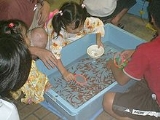
Goldfish scooping

Encyclopedia

Japan
Japan is an island nation in East Asia. Located in the Pacific Ocean, it lies to the east of the Sea of Japan, China, North Korea, South Korea and Russia, stretching from the Sea of Okhotsk in the north to the East China Sea and Taiwan in the south...
ese traditional game in which a player scoops goldfish
Goldfish
The goldfish is a freshwater fish in the family Cyprinidae of order Cypriniformes. It was one of the earliest fish to be domesticated, and is one of the most commonly kept aquarium fish....
with a special scooper. It is also called, "Scooping Goldfish", "Dipping for Goldfish" or "Snatching Goldfish". "Kingyo" means goldfish and "sukui" means scooping. Sometimes bouncy ball
Bouncy ball
A bouncy ball, power ball or super ball is a popular polybutadiene rubber toy ball which rebounds proportionally to the amount of force used when thrown at a hard surface. The first such ball was the proprietary Super Ball. The Sky Ball is an example of another bouncy ball...
s are substituted for goldfish. Japanese summer festivals or ennichi
Ennichi
Ennichi is a day believed to have a special relation with a particular Japanese deity. Often, it is a day when a deity is believed to have been born or left the world. In Shinto, this day is encouraged to be embraced as it is in the "four affirmations" of their religious code...
commonly have a stall. Both children and adults enjoy the game. The game is played for pleasure, but today, there is a National Competition of Goldfish Scooping in Japan.
Rules
Each person plays individually. The basic rule is that the player scoops goldfish from a pool with a paper scooper called a "poi" and brings them to a bowl with it. This game requires carefulness and quickness as the poi can be easily torn. The game is over when the poi is completely broken. Even if one part of the poi is torn, the player can continue the game with the remaining part.At ennichi or summer festival stalls, the game is not a competition. Participation typically costs around 100yen and players can take scooped goldfish home with a special bag. The game is unlimited, so players can scoop until their pois are completely broken. If they cannot scoop even one goldfish, the shopkeeper of the stall may kindly give them two or so. Each stall usually has its own rule. For example, there are some stalls where players can get a stronger poi if they pay more. Other stalls give players special presents if they scoop a lot. In some variations, there are also medaka
Oryzias latipes
Oryzias latipes, also known as Medaka and Japanese killifish, is a member of genus Oryzias , the only genus in the subfamily Oryziinae. This rather small...
(Japanese killfish) that are faster and harder to catch than goldfish. Usually, for every four goldfish, there is one medaka, so in ennichi, if you catch one, it is counted as four goldfish.
At National Championship of Scooping Goldfish, players follow the official rules that are different from above (see National Championship of Scooping Goldfish).
Requirements
The things necessary to play goldfish scooping is a pool which goldfish swim in, a poi, a bowl to keep scooped goldfish, a special bag with which to bring goldfish home, and goldfish themselves.Pool
Usually, the goldfish are placed in a small plastic pool about 1m² and 20 cm (8") depth.Poi consists of a round plastic frame and handgrip, and paper on the frame. Poi’s paper can easily break when it is put into water, so players should not move Poi fast. There are some classes in Poi's paper; is weaker, and is stronger. In some stalls, staff have unbreakable Poi which consist of net instead of paper to scoop goldfish.
Bowl
The bowl is usually made of plastic in a half-sphere shape, the diameter is about 15cm.This is used to store the scooped goldfish.
Goldfish
Varieties of goldfish often used in goldfish scooping are "Koaka", "Demekin", and "Anekin".See Goldfish
Goldfish
The goldfish is a freshwater fish in the family Cyprinidae of order Cypriniformes. It was one of the earliest fish to be domesticated, and is one of the most commonly kept aquarium fish....
.
History
This game started in the late Edo periodEdo period
The , or , is a division of Japanese history which was ruled by the shoguns of the Tokugawa family, running from 1603 to 1868. The political entity of this period was the Tokugawa shogunate....
, around 1810. In those days, pois were made of nets, and it was a game played by children. Pois came to be made of paper and stalls started it in Taishō period
Taisho period
The , or Taishō era, is a period in the history of Japan dating from July 30, 1912 to December 25, 1926, coinciding with the reign of the Taishō Emperor. The health of the new emperor was weak, which prompted the shift in political power from the old oligarchic group of elder statesmen to the Diet...
, around 1910.
The game became more and more popular, and National Championship of Scooping Goldfish began in 1995. Today it is so popular that stalls can be found at many ennichi 縁日 "summer festivals" in Japan.
Variants
Various variants are found, including , , which features small jelly-like rubber balls, , which features bouncy ballBouncy ball
A bouncy ball, power ball or super ball is a popular polybutadiene rubber toy ball which rebounds proportionally to the amount of force used when thrown at a hard surface. The first such ball was the proprietary Super Ball. The Sky Ball is an example of another bouncy ball...
s, and , which features small plastic figurines in the shapes of various cartoon characters, particularly manga
Manga
Manga is the Japanese word for "comics" and consists of comics and print cartoons . In the West, the term "manga" has been appropriated to refer specifically to comics created in Japan, or by Japanese authors, in the Japanese language and conforming to the style developed in Japan in the late 19th...
and anime
Anime
is the Japanese abbreviated pronunciation of "animation". The definition sometimes changes depending on the context. In English-speaking countries, the term most commonly refers to Japanese animated cartoons....
.
National Championship of Goldfish Scooping
is the biggest official competition managed by National Scooping Goldfish Association and YamatokōriyamaYamatokoriyama, Nara
is a city located in Nara, Japan.As of August 31, 2006, the city has an estimated population of 93,280 and the density of 2,185.56 persons per km². The total area is 42.68 km².-Geography:...
city in Nara Prefecture
Nara Prefecture
is a prefecture in the Kansai region on Honshū Island, Japan. The capital is the city of Nara.-History:The present-day Nara Prefecture was created in 1887, making it independent of Osaka Prefecture....
(Yamatokōriyama is famous as a producing district of goldfish.) It is held on the third Saturday and Sunday in August every year. This year (2007), 13th championship was held and 1116 people participated in it. It has three sections:
- Children section: competition by children who are under 15
- General section: competition by people whose age is 15 and up
- Group section: competition for the sum number of the goldfish scooped by a team of three people
There are area trials and the first and second in every section can participate in National Championship. Extraordinarily in Nara trials, 60 people in child section, 80 people in ordinary section and 40 groups in group section can participate in it. The rule is detailed; size of goldfish, poi and pool, the number of umpire and so on. They compete with the number of goldfish scooped in three minutes. If the paper of poi is completely broken, the game is over and the score is the number of goldfish scooped until then.
In the tenth championship (2004) a player scooped 61 goldfish in three minutes in the semifinal. (This is a new high and that comes to the average of one goldfish per three seconds.) However she was the very bottom in the final.