


Jan Pieterszoon Sweelinck

Encyclopedia

Deventer
Deventer is a municipality and city in the Salland region of the Dutch province of Overijssel. Deventer is largely situated on the east bank of the river IJssel, but also has a small part of its territory on the west bank. In 2005 the municipality of Bathmen Deventer is a municipality and city in...
, April or May, 1562 – Amsterdam
Amsterdam
Amsterdam is the largest city and the capital of the Netherlands. The current position of Amsterdam as capital city of the Kingdom of the Netherlands is governed by the constitution of August 24, 1815 and its successors. Amsterdam has a population of 783,364 within city limits, an urban population...
, 16 October 1621) was a Dutch
Netherlands
The Netherlands is a constituent country of the Kingdom of the Netherlands, located mainly in North-West Europe and with several islands in the Caribbean. Mainland Netherlands borders the North Sea to the north and west, Belgium to the south, and Germany to the east, and shares maritime borders...
composer
Composer
A composer is a person who creates music, either by musical notation or oral tradition, for interpretation and performance, or through direct manipulation of sonic material through electronic media...
, organist
Organist
An organist is a musician who plays any type of organ. An organist may play solo organ works, play with an ensemble or orchestra, or accompany one or more singers or instrumental soloists...
, and pedagogue whose work straddled the end of the Renaissance
Renaissance music
Renaissance music is European music written during the Renaissance. Defining the beginning of the musical era is difficult, given that its defining characteristics were adopted only gradually; musicologists have placed its beginnings from as early as 1300 to as late as the 1470s.Literally meaning...
and beginning of the Baroque
Baroque music
Baroque music describes a style of Western Classical music approximately extending from 1600 to 1760. This era follows the Renaissance and was followed in turn by the Classical era...
eras. He was among the first major keyboard
Keyboard instrument
A keyboard instrument is a musical instrument which is played using a musical keyboard. The most common of these is the piano. Other widely used keyboard instruments include organs of various types as well as other mechanical, electromechanical and electronic instruments...
composers of Europe, and his work as a teacher helped establish the north German organ tradition
German organ schools
The 17th century organ composers of Germany can be divided into two primary schools: the north German school and the south German school...
.
Life
Sweelinck was born in DeventerDeventer
Deventer is a municipality and city in the Salland region of the Dutch province of Overijssel. Deventer is largely situated on the east bank of the river IJssel, but also has a small part of its territory on the west bank. In 2005 the municipality of Bathmen Deventer is a municipality and city in...
, Netherlands
Netherlands
The Netherlands is a constituent country of the Kingdom of the Netherlands, located mainly in North-West Europe and with several islands in the Caribbean. Mainland Netherlands borders the North Sea to the north and west, Belgium to the south, and Germany to the east, and shares maritime borders...
, in April or May 1562. He was the eldest son of organist
Organist
An organist is a musician who plays any type of organ. An organist may play solo organ works, play with an ensemble or orchestra, or accompany one or more singers or instrumental soloists...
Peter (or Pieter) Swybbertszoon and Elske Jansdochter Sweeling, daughter of a surgeon. Soon after Sweelinck's birth, the family moved to Amsterdam
Amsterdam
Amsterdam is the largest city and the capital of the Netherlands. The current position of Amsterdam as capital city of the Kingdom of the Netherlands is governed by the constitution of August 24, 1815 and its successors. Amsterdam has a population of 783,364 within city limits, an urban population...
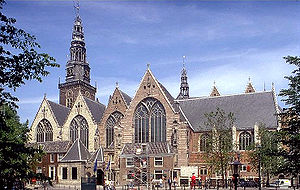
, where from about 1564, Pieter Swybbertszoon served as organist of the Oude Kerk (Sweelinck's paternal grandfather and uncle also were organists). Jan Pieterszoon must have received first lessons in music from his father. Unfortunately, his father died in 1573. He subsequently received general education under Jacob Buyck, Catholic
Catholic
The word catholic comes from the Greek phrase , meaning "on the whole," "according to the whole" or "in general", and is a combination of the Greek words meaning "about" and meaning "whole"...
pastor
Pastor
The word pastor usually refers to an ordained leader of a Christian congregation. When used as an ecclesiastical styling or title, this role may be abbreviated to "Pr." or often "Ps"....
of the Oude Kerk (these lessons stopped in 1578 after the Reformation of Amsterdam and the subsequent conversion to Calvinism
Calvinism
Calvinism is a Protestant theological system and an approach to the Christian life...
; Buyck chose to leave the city). Little is known about his music education after the death of his father; his music teachers may have included Jan Willemszoon Lossy, a little-known countertenor
Countertenor
A countertenor is a male singing voice whose vocal range is equivalent to that of a contralto, mezzo-soprano, or a soprano, usually through use of falsetto, or far more rarely than normal, modal voice. A pre-pubescent male who has this ability is called a treble...
and shawm
Shawm
The shawm was a medieval and Renaissance musical instrument of the woodwind family made in Europe from the 12th century until the 17th century. It was developed from the oriental zurna and is the predecessor of the modern oboe. The body of the shawm was usually turned from a single piece of wood,...
player at Haarlem
Haarlem
Haarlem is a municipality and a city in the Netherlands. It is the capital of the province of North Holland, the northern half of Holland, which at one time was the most powerful of the seven provinces of the Dutch Republic...
, and/or Cornelis Boskoop, Sweelinck's father successor at the Oude Kerk. If Sweelinck indeed studied in Haarlem, he was probably influenced to some degree by the organists of St.-Bavokerk
Sint-Bavokerk
The Grote Kerk or St.-Bavokerk is a Protestant church and former Catholic cathedral located on the central market square in the Dutch city of Haarlem...
, Claas Albrechtszoon van Wieringen and Floris van Adrichem, both of whom improvised daily in the Bavokerk.
Medemblik
Medemblik is a municipality and a town in the Netherlands, in the province of North Holland and the region of West-Frisia.- History :...
. He was also offered the choice between a further 100 guilders and free accommodations in a house belonging to the town, the latter of which he chose. Sweelinck's first published works date from around 1592–94: three volumes of chansons, the last of which is the only remaining volume published in 1594 (for reasons that are not certain, the composer adopted his mother's last name; "Sweelinck" first appears on the title-page of the 1594 publication). Sweelinck then set to publishing psalm settings, aiming to set the entire Psalter. These works appeared in four large volumes published in 1604, 1613, 1614 and 1621. The last volume was published posthumously and, presumably, in unfinished form. Sweelinck died of unknown causes on 16 October 1621 and was buried in the Oude Kerk. He was survived by his wife and five of their six children; the eldest of them, Dirck Janszoon, succeeded his father as organist of the Oude Kerk.
The composer most probably spent his entire life in Amsterdam, only occasionally visiting other cities in connection with his professional activities: he was asked to inspect organs, give opinions and advice on organ building and restoration, etc. These duties resulted in short visits to Delft
Delft
Delft is a city and municipality in the province of South Holland , the Netherlands. It is located between Rotterdam and The Hague....
, Dordrecht
Dordrecht
Dordrecht , colloquially Dordt, historically in English named Dort, is a city and municipality in the western Netherlands, located in the province of South Holland. It is the fourth largest city of the province, having a population of 118,601 in 2009...
(1614), Enkhuizen
Enkhuizen
Enkhuizen is a municipality and a town in the Netherlands, in the province of North Holland and the region of West-Frisia.Enkhuizen was one of the harbour-towns of the VOC, just like Hoorn and Amsterdam, from where overseas trade with the East Indies was conducted. It received city rights in 1355...
, Haarlem
Haarlem
Haarlem is a municipality and a city in the Netherlands. It is the capital of the province of North Holland, the northern half of Holland, which at one time was the most powerful of the seven provinces of the Dutch Republic...
(1594), Harderwijk
Harderwijk
' is a municipality and a small city in the eastern Netherlands.- The history of Harderwijk :Harderwijk received city rights from Count Otto II of Guelders in 1231. A defensive wall surrounding the city was completed by the end of that century. The oldest part of the city is near where the...
(1608), Middelburg (1603), Nijmegen (1605), Rotterdam
Rotterdam
Rotterdam is the second-largest city in the Netherlands and one of the largest ports in the world. Starting as a dam on the Rotte river, Rotterdam has grown into a major international commercial centre...
(1610), Rhenen
Rhenen
Rhenen is a municipality and a city in the central Netherlands.The municipality also includes the villages of Achterberg, Remmerden, Elst and Laareind. The town lies at a geographically interesting location, namely on the southernmost part of the chain of hills known as the Utrecht Hill Ridge ,...
(1616), as well as Deventer
Deventer
Deventer is a municipality and city in the Salland region of the Dutch province of Overijssel. Deventer is largely situated on the east bank of the river IJssel, but also has a small part of its territory on the west bank. In 2005 the municipality of Bathmen Deventer is a municipality and city in...
(1595, 1616) his birthplace. Sweelinck's longest voyage was to Antwerpen in 1604, when he was commissioned by the Amsterdam authorities to buy a harpsichord
Harpsichord
A harpsichord is a musical instrument played by means of a keyboard. It produces sound by plucking a string when a key is pressed.In the narrow sense, "harpsichord" designates only the large wing-shaped instruments in which the strings are perpendicular to the keyboard...
for the city. No documents were found to support a long-standing rumor first recounted by Mattheson
Johann Mattheson
Johann Mattheson was a German composer, writer, lexicographer, diplomat and music theorist.Mattheson was born and died in Hamburg. He was a close friend of George Frideric Handel, although he nearly killed him in a sudden quarrel, during a performance of Mattheson's opera Cleopatra in 1704...
that Sweelinck visited Venice
Venice
Venice is a city in northern Italy which is renowned for the beauty of its setting, its architecture and its artworks. It is the capital of the Veneto region...
-which in stead his brother, the painter Gerrit Pietersz Sweelink
Gerrit Pietersz Sweelink
Gerrit Pietersz Sweelink , was a Dutch Golden Age painter.-Biography:According to Karel van Mander he was taught to paint by Cornelis van Haarlem. He was the brother of the Orpheus of Amsterdam, the organist Jan Pieterszoon Sweelinck, whose portrait he painted...
did - and similarly there is no evidence that he ever crossed the English Channel. His popularity as a composer, performer and teacher increased steadily during his lifetime. Contemporaries nicknamed him Orpheus
Orpheus
Orpheus was a legendary musician, poet, and prophet in ancient Greek religion and myth. The major stories about him are centered on his ability to charm all living things and even stones with his music; his attempt to retrieve his wife from the underworld; and his death at the hands of those who...
of Amsterdam and even the city authorities frequently brought important visitors to hear Sweelinck's improvisations.
Influence
Sweelinck's only duties in AmsterdamAmsterdam
Amsterdam is the largest city and the capital of the Netherlands. The current position of Amsterdam as capital city of the Kingdom of the Netherlands is governed by the constitution of August 24, 1815 and its successors. Amsterdam has a population of 783,364 within city limits, an urban population...
were those of an organist. Contrary to custom, he did not play the carillon
Carillon
A carillon is a musical instrument that is typically housed in a free-standing bell tower, or the belfry of a church or other municipal building. The instrument consists of at least 23 cast bronze, cup-shaped bells, which are played serially to play a melody, or sounded together to play a chord...
or the harpsichord
Harpsichord
A harpsichord is a musical instrument played by means of a keyboard. It produces sound by plucking a string when a key is pressed.In the narrow sense, "harpsichord" designates only the large wing-shaped instruments in which the strings are perpendicular to the keyboard...
on formal occasions; nor was he regularly required to produce compositions. Calvinist services did not typically include organ playing due to the belief in what is now called the Regulative Principle
Regulative principle of worship
The regulative principle of worship is a teaching shared by some Calvinists and Anabaptists on how the Bible orders public worship. The substance of the doctrine regarding worship is that God institutes in the Scriptures everything he requires for worship in the Church and that everything else is...
. The Regulative Principle restricted the elements of worship to only that which was commanded in the New Testament. However, the Consistory
Consistory
-Antiquity:Originally, the Latin word consistorium meant simply 'sitting together', just as the Greek synedrion ....
of Dordrecht of 1598 instructed organists to play variations on the new Genevan psalm tunes before and after the service so that the people would become familiar with them. Sweelinck was employed instead by the city itself. As he worked for Protestant magistrates the remainder of his life, it is likely that he was an adherent of Calvinism. In the 1590s three of his children were baptized in the Oude Kerk. His employment allowed him time for teaching, for which he was to become as famous as for his compositions. Sweelinck's pupils included the core of what was to become the north German organ school
German organ schools
The 17th century organ composers of Germany can be divided into two primary schools: the north German school and the south German school...
: Jacob Praetorius II, Heinrich Scheidemann
Heinrich Scheidemann
Heinrich Scheidemann was a German organist and composer. He was the best-known composer for the organ in north Germany in the early to mid-17th century, and was an important forerunner of Dieterich Buxtehude and J.S. Bach.-Life:...
, Paul Siefert
Paul Siefert
Paul Siefert was a German composer and organist associated with the North German school.-Biography:...
, Melchior Schildt
Melchior Schildt
Melchior Schildt was a German composer and organist of the North German Organ School. He came from a long line of church musicians who had served the town of Hanover for over 125 years...
and Samuel
Samuel Scheidt
Samuel Scheidt was a German composer, organist and teacher of the early Baroque era.-Biography:...
and Gottfried Scheidt
Gottfried Scheidt
Gottfried Scheidt was a German composer and organist.Born in Halle, he moved to Amsterdam in 1611 to study with Jan Pieterszoon Sweelinck, returning home in 1615 to further study with his older brother Samuel Scheidt and others. He was appointed organist to the Altenburg court in 1617, and held...
. Students of Sweelinck were seen as musicians against whom other organists were measured. Sweelinck was known in Germany as the "maker of organists." Sociable and respected, he was in great demand as a teacher. His Dutch pupils were undoubtedly many, but none of them became composers of note. Sweelinck, however, influenced the development of the Dutch organ school, as is shown in the work of later composers such as Anthoni van Noordt
Anthoni van Noordt
Anthoni van Noordt was a Dutch composer and organist.Born in Amsterdam, where he lived throughout his life, he was the brother of Jacobus van Noordt...
. Sweelinck, in the course of his career, had set music to the liturgies of Roman Catholicism, Calvinism and Lutheranism. He was the most important composer of the musically rich "golden era" of the Netherlands.
Sweelinck's influence spread as far as Sweden and England, carried to the former by Andreas Düben
Andreas Düben
Andreas Düben was a Swedish Baroque composer and organist, and father of Gustaf Düben. He was born near Leipzig and was admitted to Leipzig University in 1609. He studied with the renowned Dutch pedagogue Jan Pieterszoon Sweelinck from 1614 until 1620 when he secured a position as organist in the...
and to the latter by English composers such as Peter Philips
Peter Philips
Peter Philips was an eminent English composer, organist, and Catholic priest exiled to Flanders...
, who probably met Sweelinck in 1593. Sweelinck, and Dutch composers in general, had evident links to the English school of composition. Sweelinck's music appears in the Fitzwilliam Virginal Book
Fitzwilliam Virginal Book
The Fitzwilliam Virginal Book is a primary source of keyboard music from the late Elizabethan and early Jacobean periods in England, i.e., the late Renaissance and very early Baroque. It takes its name from Viscount Fitzwilliam who bequeathed this manuscript collection to Cambridge University in 1816...
, which mostly contains the work of English composers. He wrote variations on John Dowland
John Dowland
John Dowland was an English Renaissance composer, singer, and lutenist. He is best known today for his melancholy songs such as "Come, heavy sleep" , "Come again", "Flow my tears", "I saw my Lady weepe" and "In darkness let me dwell", but his instrumental music has undergone a major revival, and has...
's famous Lachrimae Pavane. John Bull
John Bull (composer)
John Bull was an English composer, musician, and organ builder. He was a renowned keyboard performer of the virginalist school and most of his compositions were written for this medium.-Life:...
, who was probably a personal friend, wrote a set of variations on a theme by Sweelinck after the death of the Dutch composer.
Works
Sweelinck represents the highest development of the Dutch keyboard school, and indeed represented a pinnacle in keyboard contrapuntal complexity and refinement before J.S. BachJohann Sebastian Bach
Johann Sebastian Bach was a German composer, organist, harpsichordist, violist, and violinist whose sacred and secular works for choir, orchestra, and solo instruments drew together the strands of the Baroque period and brought it to its ultimate maturity...
. However, he was a skilled composer for voices as well, and composed more than 250 works for voice (chanson
Chanson
A chanson is in general any lyric-driven French song, usually polyphonic and secular. A singer specialising in chansons is known as a "chanteur" or "chanteuse" ; a collection of chansons, especially from the late Middle Ages and Renaissance, is also known as a chansonnier.-Chanson de geste:The...
s, madrigal
Madrigal (music)
A madrigal is a secular vocal music composition, usually a partsong, of the Renaissance and early Baroque eras. Traditionally, polyphonic madrigals are unaccompanied; the number of voices varies from two to eight, and most frequently from three to six....
s, motet
Motet
In classical music, motet is a word that is applied to a number of highly varied choral musical compositions.-Etymology:The name comes either from the Latin movere, or a Latinized version of Old French mot, "word" or "verbal utterance." The Medieval Latin for "motet" is motectum, and the Italian...
s and Psalms).
Some of Sweelinck's innovations were of profound musical importance, including the fugue
Fugue
In music, a fugue is a compositional technique in two or more voices, built on a subject that is introduced at the beginning in imitation and recurs frequently in the course of the composition....
—he was the first to write an organ fugue which began simply, with one subject, successively adding texture and complexity until a final climax and resolution, an idea which was perfected at the end of the Baroque era by Bach. It is also generally thought that many of Sweelinck's keyboard works were intended as studies for his pupils. He was also the first to use the pedal as a real fugal part. Stylistically Sweelinck's music also brings together the richness, complexity and spatial sense of Andrea
Andrea Gabrieli
Andrea Gabrieli was an Italian composer and organist of the late Renaissance. The uncle of the somewhat more famous Giovanni Gabrieli, he was the first internationally renowned member of the Venetian School of composers, and was extremely influential in spreading the Venetian style in Italy as...
and Giovanni Gabrieli
Giovanni Gabrieli
Giovanni Gabrieli was an Italian composer and organist. He was one of the most influential musicians of his time, and represents the culmination of the style of the Venetian School, at the time of the shift from Renaissance to Baroque idioms.-Biography:Gabrieli was born in Venice...
, with whom he was familiar from his time in Venice
Venice
Venice is a city in northern Italy which is renowned for the beauty of its setting, its architecture and its artworks. It is the capital of the Veneto region...
, and the ornamentation and intimate forms of the English keyboard composers. In some of his works Sweelinck appears as a composer of the baroque style, with the exception of his chansons which mostly resemble the French Renaissance tradition. In formal development, especially in the use of countersubject
Countersubject
In music, a countersubject is a melodic or thematic idea which is played against a primary subject of a fugue, ricercar, invention, sinfonia, or other contrapuntal piece of music...
, stretto
Stretto
The term stretto comes from the Italian past participle of stringere, and means "narrow", "tight", or "close".In music the Italian term stretto has two distinct meanings:...
, and organ point (pedal point
Pedal point
In tonal music, a pedal point is a sustained tone, typically in the bass, during which at least one foreign, i.e., dissonant harmony is sounded in the other parts. A pedal point sometimes functions as a "non-chord tone", placing it in the categories alongside suspensions, retardations, and passing...
), his music looks ahead to Bach (who was quite possibly familiar with Sweelinck’s music).
Sweelinck was a master improviser
Musical improvisation
Musical improvisation is the creative activity of immediate musical composition, which combines performance with communication of emotions and instrumental technique as well as spontaneous response to other musicians...
, and acquired the informal title of the "Orpheus
Orpheus
Orpheus was a legendary musician, poet, and prophet in ancient Greek religion and myth. The major stories about him are centered on his ability to charm all living things and even stones with his music; his attempt to retrieve his wife from the underworld; and his death at the hands of those who...
of Amsterdam". More than 70 of his keyboard works have survived, and many of them may be similar to the improvisations that residents of Amsterdam around 1600 were likely to have heard. In the course of his life, Sweelinck was involved with the musical liturgies of three distinctly different church types: the Roman Catholic, the Calvinist, and the Lutheran—all of which are reflected in his work. Even his vocal music, which is more conservative than his keyboard writing, shows a striking rhythmic complexity and an unusual richness of contrapuntal devices.
Scores
- A new scholarly edition of Sweelinck's complete keyboard works (Breitkopf & HärtelBreitkopf & HärtelBreitkopf & Härtel is the world's oldest music publishing house. The firm was founded in 1719 in Leipzig by Bernhard Christoph Breitkopf . The catalogue currently contains over 1000 composers, 8000 works and 15,000 music editions or books on music. The name "Härtel" was added when Gottfried...
, 2004) is edited in 4 volumes by Harald Vogel and Pieter Dirksen.
Recordings
- Complete Keyboard Works. Various organists and harpsichordists. NM Classics 92119 (9 CDs)
- Het Sweelinck Monument, a complete recording of the vocal works of Sweelinck; The Gesualdo Consort conducted by Harry van der KampHarry van der KampHarry van der Kamp is a Dutch bass singer in opera and concert.- Singing career :Van der Kamp studied first law and psychology in Amsterdam...
, Glossa, (17 CDs), 2009-2010. The recordings were simultaneously issued on CD and also available in Dutch language book-CD presentation sets in the Netherlands.
Media
Further reading
- Gustave ReeseGustave ReeseGustave Reese was an American musicologist and teacher. Reese is known mainly for his work on medieval and Renaissance music, particularly with his two publications Music in the Middle Ages and Music in the Renaissance ; these two books remain the standard reference works for these two eras,...
, Music in the Renaissance. New York, W.W. Norton & Co., 1954. ISBN 0-393-09530-4 - Manfred BukofzerManfred BukofzerManfred Bukofzer was a German-American musicologist and humanist. He studied at Heidelberg University and the Stern conservatory in Berlin, but left Germany in 1933, going to Basle, where he received his doctorate. In 1939 he moved to the United States where he remained, becoming a U.S. citizen...
, Music in the Baroque Era. New York, W.W. Norton & Co., 1947. ISBN 0-393-09745-5 - The Concise Edition of Baker's Biographical Dictionary of Musicians, 8th ed. Revised by Nicolas Slonimsky. New York, Schirmer Books, 1993. ISBN 0-02-872416-X
- Pieter Dirksen, The Keyboard Music of Jan Pieterszoon Sweelinck – Its Style, Significance and Influence. (Utrecht, 1997). ISBN 90-6375-159-1
- Sweelinck Studies, Proceedings of the Sweelinck Symposium, Utrecht 1999, (Utrecht 2001) Edited by Pieter Dirksen. ISBN 90-72786-09-2