
|
|
|
|
Paul Samuelson
|
| |
|
| |
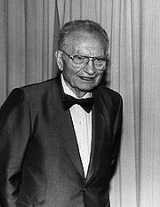
Paul Anthony Samuelson (born May 15, 1915) is an American neoclassical economist known for his contributions to many fields of economics, beginning with his general statement of the comparative statics method in his 1947 book Foundations of Economic Analysis. Samuelson was awarded the John Bates Clark Medal in 1947 and was sole recipient of the Nobel Memorial Prize in Economic Sciences in 1970, the second year of the Prize.
elson was born in Gary, Indiana on May 15, 1915.

Discussion
Ask a question about 'Paul Samuelson'
Start a new discussion about 'Paul Samuelson'
Answer questions from other users
|
Encyclopedia
Paul Anthony Samuelson (born May 15, 1915) is an American neoclassical economist known for his contributions to many fields of economics, beginning with his general statement of the comparative statics method in his 1947 book Foundations of Economic Analysis. Samuelson was awarded the John Bates Clark Medal in 1947 and was sole recipient of the Nobel Memorial Prize in Economic Sciences in 1970, the second year of the Prize.
Biography
Samuelson was born in Gary, Indiana on May 15, 1915. His father was a pharmacist and he was brought up in a Jewish family (although they were not practicing). In 1923 Paul moved to Chicago. He studied at the University of Chicago and received his Bachelor of Arts degree in 1935. He then completed his Master of Arts degree in 1936, and his Doctor of Philosophy in 1941 from Harvard University. As a graduate student at Harvard, Samuelson studied economics under Joseph Schumpeter, Wassily Leontief, Gottfried Haberler, and the "American Keynes" Alvin Hansen.
Professional positions
- Came to M.I.T. in 1940 as an Assistant Professor of Economics and was appointed Associate Professor in 1944.
- Served as a staff member of the Radiation Laboratory from 1944-1945
- Professor of International Economic Relations (part-time) at the Fletcher School of Law and Diplomacy in 1945.
- Professor at M.I.T. in 1947 and now an Institute Professor.
- Guggenheim Fellow from 1948-1949.
Memberships
Fields of interest As professor of economics at the Massachusetts Institute of Technology, Samuelson has worked in many fields including:
- Welfare economics, in which he popularised the Lindahl-Bowen-Samuelson conditions (criteria for deciding whether an action will improve welfare) and demonstrated in 1950 the insufficiency of a national-income index to reveal which of two social options was uniformly outside the other's (feasible) Possibility function (Collected Scientific Papers, v. 2, ch. 77; Fischer, 1987, p. 236).
- Public finance theory, in which he is particularly known for his work on determining the optimal allocation of resources in the presence of both public goods and private goods.
- International economics, where he influenced the development of two important international trade models: the Balassa-Samuelson effect, and the Heckscher-Ohlin model (with the Stolper-Samuelson theorem).
- Macroeconomics, where he popularized the overlapping generations model as a way to analyze economic agents' behavior across multiple periods of time (Collected Scientific Papers, v. 1, ch. 21).
- Consumer theory, he pioneered the Revealed Preference Theory, which is a method by which it is possible to discern the best possible option, and thus define consumer's utility functions, by observing the consumer behaviour.
Publications Samuelson's book Foundations of Economic Analysis (1947, Enlarged ed. 1983), is considered his magnum opus. It is derived from his doctoral dissertation at Harvard University, and makes use of the classical thermodynamic methods of American thermodynamicist Willard Gibbs. The book proposes to:
- examine underlying analogies between central features in theoretical and applied economics and
- study how operationally meaningful theorems can be derived with a small number of analogous methods (p. 3),
in order to derive "a general theory of economic theories" (Samuelson, 1983, p. xxvi). The book showed how these goals could be parsimoniously and fruitfully achieved, using the language of the mathematics applied to diverse subfields of economics. The book proposes two general hypotheses as sufficient for its purposes:
- maximizing behavior of agents (including consumers as to utility and business firms as to profit) and
- economic systems (including a market and an economy) in stable equilibrium.
In the course of analysis, comparative statics, (the analysis of changes in equilibrium of the system that result from a parameter change of the system) is formalized and clearly stated.
The chapter on welfare economics "attempt(s) to give a brief but fairly complete survey of the whole field of welfare economics" (Samuelson, 1947, p. 252). It also exposits on and develops what became commonly called the Bergson-Samuelson social welfare function. It shows how to represent (in the maximization calculus) all real-valued economic measures of any belief system that is required to rank consistently different feasible social configurations in an ethical sense as "better than," "worse than," or "indifferent to" each other (p. 221).
There are 388 papers to date in Samuelson's Collected Scientific Papers. Stanley Fischer (1987, p. 234) writes that taken together they are unique in their verve, breadth of economic and general knowledge, mastery of setting, and generosity of allusions to predecessors.
Samuelson is also author (and since 1985 co-author) of an influential principles textbook, Economics, first published in 1948, now in its 18th edition. The book has been translated into forty-one languages and sold over four million copies. Written in the shadow of the Great Depression and World War II, it helped to popularize the insights of John Maynard Keynes. A main focus was how to avoid, or at least mitigate, the recurring slumps in economic activity. Samuelson wrote: “It is not too much to say that the widespread creation of dictatorships and the resulting World War II stemmed in no small measure from the world’s failure to meet this basic economic problem [the Great Depression] adequately.” This reflected the concern of Keynes himself with the economic causes of war and the importance of economic policy in promoting peace.
Samuelson is co-editor of Inside the Economist's Mind: Conversations with Eminent Economists (Blackwell Publishing, 2007), along with William A. Barnett, a collection of candid interviews with top economists of the 20th century.
Impact Along with Kenneth Arrow, Samuelson is considered one of the founders of modern neoclassical economics. The following is an excerpt on the reasons for awarding him the Nobel Prize:
- More than any other contemporary economist, Samuelson has helped to raise the general analytical and methodological level in economic science. He has simply rewritten considerable parts of economic theory. He has also shown the fundamental unity of both the problems and analytical techniques in economics, partly by a systematic application of the methodology of maximization for a broad set of problems. This means that Samuelson's contributions range over a large number of different fields.
He was also essential to creating the Neoclassical synthesis, which incorporates Keynesian principles with neoclassical principles and dominates current mainstream economics. In 2003, Samuelson was one of the 10 Nobel Prize winning economists signing the Economists' statement opposing the Bush tax cuts.
Thermodynamics and economics
Samuelson was one of the first economists to generalize and apply mathematical methods developed for the study of thermodynamics to economics. As a graduate student at Harvard, he was the sole protegé of the polymath Edwin Bidwell Wilson, who had himself been the sole protegé of Yale's great physicist Willard Gibbs. Gibbs, the founder of chemical thermodynamics, was also mentor to American economist Irving Fisher and he influenced them both in their ideas on the equilibrium of economic systems.
Samuelson’s 1947 magnum opus Foundations of Economic Analysis, from his doctoral dissertation, is based on the classical thermodynamic methods of American thermodynamicist Willard Gibbs, specifically Gibbs' 1876 paper On the Equilibrium of Heterogeneous Substances.
In 1947, based on the Le Chatelier principle of thermodynamics, a principle taught to Samuelson by Wilson in lecture, he established the method of comparative statics in economics. This method explains the changes in the equilibrium solution of a constrained maximization problem (economic or thermodynamic) when one of the constraints is marginally tightened or relaxed. The Le Chatelier principle was developed by French chemist Henri Louis le Chatelier, who is notable for being one of the first to translate Gibbs’ equilibrium papers (in French, 1899). Samuelson’s use of the Le Chatelier principle has proven to be a very powerful tool and found widespread use in modern economics. Attempts at neo-classical equilibrium economics analogies with thermodynamics generally, go back to Guillaume and Samuelson.
Miscellaneous
Stanislaw Ulam once challenged Samuelson to name one theory in all of the social sciences which is both true and nontrivial. Several years later, Samuelson responded with David Ricardo's theory of comparative advantage.
For many years, Samuelson wrote a column for Newsweek. One article included Samuelson's most quoted remark, and a favorite economics joke:
To prove that Wall Street is an early omen of movements still to come in GNP, commentators quote economic studies alleging that market downturns predicted four out of the last five recessions. That is an understatement. Wall Street indexes predicted nine out of the last five recessions! And its mistakes were beauties.
List of publications
- v. I, 1937-mid-1964 (1966). Table-of-Contents preview links for papers [from v. III, pp. -]
- v. II, 1937-mid-1964 (1966). TOC links, pp. -
- v. III, mid-1964-1970 (1970). TOC links, pp. - of 5.
- v. IV, 1971-76 (1977). TOC links [from v. V, pp.-]
- v. V, 1977-1985 (1986). and TOC links, pp. -
- v. VI & VIII, 1986- (in preparation)
- Inside the Economist's Mind: Conversations with Eminent Economists (2007) with William A. Barnett, Blackwell Publishing, ISBN 1405159170
See also
Further reading
- Stanley Fischer, 1987, “Samuelson, Paul Anthony," The New Palgrave: A Dictionary of Economics, v. 4, Macmillan, pp. 234-41
- Leonard Silk, The Economists New York : Basic Books, (1976).
- Robert Sobel, The Worldly Economists New York: Free Press, (1980).
- Daniel R. Fusfeld, 2002, "The Neoclassical Synthesis." "The Age of the Economist", Ed 9, Addison Wesley, pp. 198-201
External links
|
| |
|
|