


IUPAC nomenclature

Encyclopedia
A chemical nomenclature is a set of rules to generate systematic name
s for chemical compound
s. The nomenclature used most frequently worldwide is the one created and developed by the International Union of Pure and Applied Chemistry
(IUPAC).
The IUPAC's rules for naming organic
and inorganic compound
s are contained in two publications, known as the Blue Book
and the Red Book
, respectively. A third publication, known as the Green Book, describes the recommendations for the use of symbol
s for physical quantities
(in association with the IUPAP), while a fourth, the Gold Book, contains the definitions of a large number of technical terms used in chemistry. Similar compendia exist for biochemistry
(the White Book, in association with the IUBMB), analytical chemistry
(the Orange Book
), macromolecular chemistry (the Purple Book) and clinical chemistry (the Silver Book). These "color books" are supplemented by shorter recommendations for specific circumstances that are published from time to time in the journal
Pure and Applied Chemistry
.
Preferably, the name also conveys some information about the structure or chemistry of a compound. CAS numbers form an extreme example of names that do not perform this function: each CAS number refers to a single compound but none contain information about the structure.
The form of nomenclature used depends on the audience to which it is addressed. As such, no single correct form exists, but rather there are different forms that are more or less appropriate in different circumstances.
A common name will often suffice to identify a chemical compound in a particular set of circumstances. To be more generally applicable, the name should indicate at least the chemical formula
. To be more specific still, the three-dimensional arrangement of the atoms may need to be specified.
In a few specific circumstances (such as the construction of large indices), it becomes necessary to ensure that each compound has a unique name: This requires the addition of extra rules to the standard IUPAC system (the CAS system
is the most commonly used in this context), at the expense of having names that are longer and less familiar to most readers. Another system gaining popularity is the International Chemical Identifier
(InChI)—while InChI symbols are not human-readable, they contain complete information about substance structure. That makes them more general than CAS numbers.
The IUPAC system is often criticized for the above failures when they become relevant (for example, in differing reactivity of sulfur allotropes, which IUPAC does not distinguish). While IUPAC has a human-readable advantage over CAS numbering, it would be difficult to claim that the IUPAC names for some larger, relevant molecules (such as rapamycin) are human-readable, and so most researchers simply use the informal names.
versus chemical nomenclature vary and are to an extent at odds. Dictionaries of English words on the web or otherwise collect and report the meanings of words as their uses appear and change over time. Chemical nomenclature on the other hand (with IUPAC nomenclature as the best example) is necessarily more restrictive: It aims to standardize communication and practice so that, when a chemical term is used, it has a fixed meaning relating to chemical structure, thereby giving insights into chemical properties and derived molecular functions. These differing aims can have profound effects on valid understanding in chemistry, especially with regard to chemical classes made popular for perceived health benefits; this is particularly true in the new media age of the Web, where word meanings can rapidly change. A discussion related to the term polyphenol
is a clear example (where various web definitions and common uses of the word are at odds with its chemical nomenclature, which connects polyphenol structure and bioactivity).
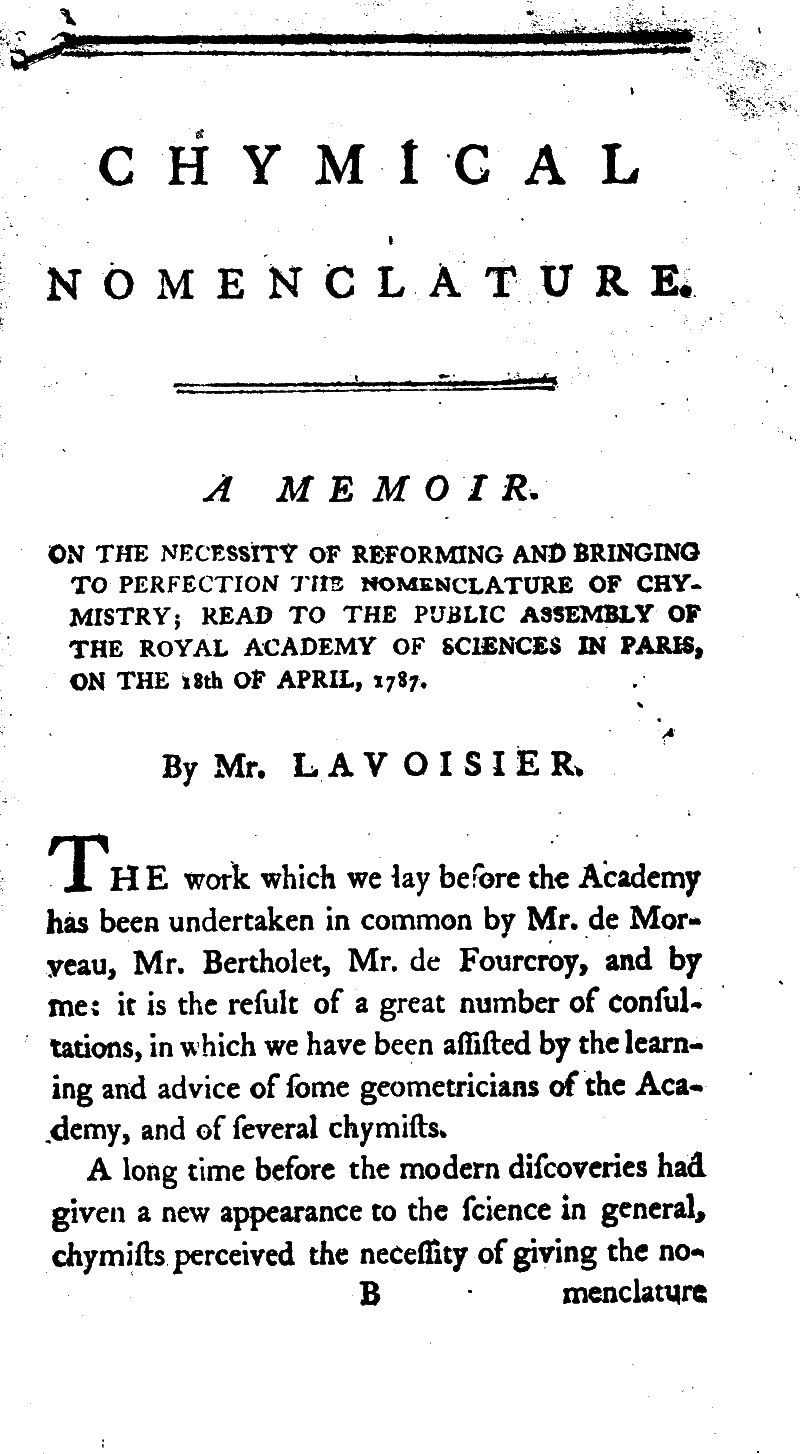 The nomenclature of alchemy
is rich in description, but does not effectively meet the aims outlined above. Opinions differ about whether this was deliberate on the part of the early practitioners of alchemy or whether it was a consequence of the particular (and often esoteric) theoretical framework in which they worked.
While both explanations are probably valid to some extent, it is remarkable that the first "modern" system of chemical nomenclature appeared at the same time as the distinction (by Lavoisier
) between elements
and compounds
, in the late eighteenth century.
The French
chemist Louis-Bernard Guyton de Morveau
published his recommendations in 1782, hoping that his "constant method of denomination" would "help the intelligence and relieve the memory". The system was refined in collaboration with Berthollet, de Fourcroy
and Lavoisier
, and promoted by the latter in a textbook that would survive long after his death at the guillotine
in 1794. The project was also espoused by Jöns Jakob Berzelius
, who adapted the ideas for the German-speaking world.
The recommendations of Guyton covered only what would be today known as inorganic compounds. With the massive expansion of organic chemistry in the mid-nineteenth century and the greater understanding of the structure of organic compounds, the need for a less ad hoc system of nomenclature was felt just as the theoretical tools became available to make this possible. An international conference was convened in Geneva
in 1892 by the national chemical societies, from which the first widely accepted proposals for standardization arose.
A commission was set up in 1913 by the Council of the International Association of Chemical Societies, but its work was interrupted by World War I
. After the war, the task passed to the newly formed International Union of Pure and Applied Chemistry
, which first appointed commissions for organic, inorganic, and biochemical nomenclature in 1921 and continues to do so to this day.
An alternative method uses the oxidation state
on the metal in place of suffices, e.g.:
Generally this system, known as Stock nomenclature
or international nomenclature, is preferred over the prefix system for ionic compounds.
(B
H
3), oxidane (
H
2O
), phosphane (P
H
3) (the name phosphine
is also in common use, but is not recommended by IUPAC). The compound PCl3 would be named substitutively as trichlorophosphane.
Note that ligands such as chloride become chlorido- rather than chloro- as in substitutive naming.
Systematic name
A systematic name is a name given in a systematic way to one unique group, organism, object or chemical substance, out of a specific population or collection...
s for chemical compound
Chemical compound
A chemical compound is a pure chemical substance consisting of two or more different chemical elements that can be separated into simpler substances by chemical reactions. Chemical compounds have a unique and defined chemical structure; they consist of a fixed ratio of atoms that are held together...
s. The nomenclature used most frequently worldwide is the one created and developed by the International Union of Pure and Applied Chemistry
International Union of Pure and Applied Chemistry
The International Union of Pure and Applied Chemistry is an international federation of National Adhering Organizations that represents chemists in individual countries. It is a member of the International Council for Science . The international headquarters of IUPAC is located in Zürich,...
(IUPAC).
The IUPAC's rules for naming organic
Organic compound
An organic compound is any member of a large class of gaseous, liquid, or solid chemical compounds whose molecules contain carbon. For historical reasons discussed below, a few types of carbon-containing compounds such as carbides, carbonates, simple oxides of carbon, and cyanides, as well as the...
and inorganic compound
Inorganic compound
Inorganic compounds have traditionally been considered to be of inanimate, non-biological origin. In contrast, organic compounds have an explicit biological origin. However, over the past century, the classification of inorganic vs organic compounds has become less important to scientists,...
s are contained in two publications, known as the Blue Book
Nomenclature of Organic Chemistry
Nomenclature of Organic Chemistry, commonly referred to by chemists as the Blue Book is a collection of recommendations on organic chemical nomenclature published at irregular intervals by the International Union of Pure and Applied Chemistry...
and the Red Book
Nomenclature of Inorganic Chemistry
Nomenclature of Inorganic Chemistry, by chemists commonly referred to as the Red Book, is a collection of recommendations on inorganic chemical nomenclature. It is published at irregular intervals by the International Union of Pure and Applied Chemistry...
, respectively. A third publication, known as the Green Book, describes the recommendations for the use of symbol
Symbol
A symbol is something which represents an idea, a physical entity or a process but is distinct from it. The purpose of a symbol is to communicate meaning. For example, a red octagon may be a symbol for "STOP". On a map, a picture of a tent might represent a campsite. Numerals are symbols for...
s for physical quantities
Physical quantity
A physical quantity is a physical property of a phenomenon, body, or substance, that can be quantified by measurement.-Definition of a physical quantity:Formally, the International Vocabulary of Metrology, 3rd edition defines quantity as:...
(in association with the IUPAP), while a fourth, the Gold Book, contains the definitions of a large number of technical terms used in chemistry. Similar compendia exist for biochemistry
Biochemistry
Biochemistry, sometimes called biological chemistry, is the study of chemical processes in living organisms, including, but not limited to, living matter. Biochemistry governs all living organisms and living processes...
(the White Book, in association with the IUBMB), analytical chemistry
Analytical chemistry
Analytical chemistry is the study of the separation, identification, and quantification of the chemical components of natural and artificial materials. Qualitative analysis gives an indication of the identity of the chemical species in the sample and quantitative analysis determines the amount of...
(the Orange Book
Compendium of Analytical Nomenclature
The Compendium of Analytical Nomenclature is a book published by the International Union of Pure and Applied Chemistry containing internationally accepted definitions for terms in analytical chemistry...
), macromolecular chemistry (the Purple Book) and clinical chemistry (the Silver Book). These "color books" are supplemented by shorter recommendations for specific circumstances that are published from time to time in the journal
Scientific journal
In academic publishing, a scientific journal is a periodical publication intended to further the progress of science, usually by reporting new research. There are thousands of scientific journals in publication, and many more have been published at various points in the past...
Pure and Applied Chemistry
Pure and Applied Chemistry
Pure and Applied Chemistry is the official journal for the International Union of Pure and Applied Chemistry. It is published monthly and contains recommendations and reports, and lectures from symposia....
.
Aims of chemical nomenclature
The primary function of chemical nomenclature is to ensure that a spoken or written chemical name leaves no ambiguity as to what chemical compound the name refers: each chemical name should refer to a single substance. A less important aim is to ensure that each substance has a single name, although the number of acceptable names is limited.Preferably, the name also conveys some information about the structure or chemistry of a compound. CAS numbers form an extreme example of names that do not perform this function: each CAS number refers to a single compound but none contain information about the structure.
The form of nomenclature used depends on the audience to which it is addressed. As such, no single correct form exists, but rather there are different forms that are more or less appropriate in different circumstances.
A common name will often suffice to identify a chemical compound in a particular set of circumstances. To be more generally applicable, the name should indicate at least the chemical formula
Chemical formula
A chemical formula or molecular formula is a way of expressing information about the atoms that constitute a particular chemical compound....
. To be more specific still, the three-dimensional arrangement of the atoms may need to be specified.
In a few specific circumstances (such as the construction of large indices), it becomes necessary to ensure that each compound has a unique name: This requires the addition of extra rules to the standard IUPAC system (the CAS system
Chemical Abstracts Service
Chemical Abstracts is a periodical index that provides summaries and indexes of disclosures in recently published scientific documents. Approximately 8,000 journals, technical reports, dissertations, conference proceedings, and new books, in any of 50 languages, are monitored yearly, as are patent...
is the most commonly used in this context), at the expense of having names that are longer and less familiar to most readers. Another system gaining popularity is the International Chemical Identifier
International Chemical Identifier
The IUPAC International Chemical Identifier is a textual identifier for chemical substances, designed to provide a standard and human-readable way to encode molecular information and to facilitate the search for such information in databases and on the web...
(InChI)—while InChI symbols are not human-readable, they contain complete information about substance structure. That makes them more general than CAS numbers.
The IUPAC system is often criticized for the above failures when they become relevant (for example, in differing reactivity of sulfur allotropes, which IUPAC does not distinguish). While IUPAC has a human-readable advantage over CAS numbering, it would be difficult to claim that the IUPAC names for some larger, relevant molecules (such as rapamycin) are human-readable, and so most researchers simply use the informal names.
Differing aims of lexicography and chemical nomenclature
It is generally understood that the aims of normal English lexicographyLexicography
Lexicography is divided into two related disciplines:*Practical lexicography is the art or craft of compiling, writing and editing dictionaries....
versus chemical nomenclature vary and are to an extent at odds. Dictionaries of English words on the web or otherwise collect and report the meanings of words as their uses appear and change over time. Chemical nomenclature on the other hand (with IUPAC nomenclature as the best example) is necessarily more restrictive: It aims to standardize communication and practice so that, when a chemical term is used, it has a fixed meaning relating to chemical structure, thereby giving insights into chemical properties and derived molecular functions. These differing aims can have profound effects on valid understanding in chemistry, especially with regard to chemical classes made popular for perceived health benefits; this is particularly true in the new media age of the Web, where word meanings can rapidly change. A discussion related to the term polyphenol
Polyphenol
Polyphenols are a structural class of natural, synthetic, and semisynthetic organic chemicals characterized by the presence of large multiples of phenol structural units...
is a clear example (where various web definitions and common uses of the word are at odds with its chemical nomenclature, which connects polyphenol structure and bioactivity).
History
Alchemy
Alchemy is an influential philosophical tradition whose early practitioners’ claims to profound powers were known from antiquity. The defining objectives of alchemy are varied; these include the creation of the fabled philosopher's stone possessing powers including the capability of turning base...
is rich in description, but does not effectively meet the aims outlined above. Opinions differ about whether this was deliberate on the part of the early practitioners of alchemy or whether it was a consequence of the particular (and often esoteric) theoretical framework in which they worked.
While both explanations are probably valid to some extent, it is remarkable that the first "modern" system of chemical nomenclature appeared at the same time as the distinction (by Lavoisier
Antoine Lavoisier
Antoine-Laurent de Lavoisier , the "father of modern chemistry", was a French nobleman prominent in the histories of chemistry and biology...
) between elements
Chemical element
A chemical element is a pure chemical substance consisting of one type of atom distinguished by its atomic number, which is the number of protons in its nucleus. Familiar examples of elements include carbon, oxygen, aluminum, iron, copper, gold, mercury, and lead.As of November 2011, 118 elements...
and compounds
Chemical compound
A chemical compound is a pure chemical substance consisting of two or more different chemical elements that can be separated into simpler substances by chemical reactions. Chemical compounds have a unique and defined chemical structure; they consist of a fixed ratio of atoms that are held together...
, in the late eighteenth century.
The French
France
The French Republic , The French Republic , The French Republic , (commonly known as France , is a unitary semi-presidential republic in Western Europe with several overseas territories and islands located on other continents and in the Indian, Pacific, and Atlantic oceans. Metropolitan France...
chemist Louis-Bernard Guyton de Morveau
Louis-Bernard Guyton de Morveau
Louis-Bernard Guyton de Morveau was a French chemist and politician...
published his recommendations in 1782, hoping that his "constant method of denomination" would "help the intelligence and relieve the memory". The system was refined in collaboration with Berthollet, de Fourcroy
Antoine François, comte de Fourcroy
Antoine François, comte de Fourcroy was a French chemist and a contemporary of Antoine Lavoisier. Fourcroy collaborated with Lavoisier, Guyton de Morveau, and Claude Berthollet on the Méthode de nomenclature chimique, a work that helped standardize chemical nomenclature.-Life and work:Fourcroy...
and Lavoisier
Antoine Lavoisier
Antoine-Laurent de Lavoisier , the "father of modern chemistry", was a French nobleman prominent in the histories of chemistry and biology...
, and promoted by the latter in a textbook that would survive long after his death at the guillotine
Guillotine
The guillotine is a device used for carrying out :executions by decapitation. It consists of a tall upright frame from which an angled blade is suspended. This blade is raised with a rope and then allowed to drop, severing the head from the body...
in 1794. The project was also espoused by Jöns Jakob Berzelius
Jöns Jakob Berzelius
Jöns Jacob Berzelius was a Swedish chemist. He worked out the modern technique of chemical formula notation, and is together with John Dalton, Antoine Lavoisier, and Robert Boyle considered a father of modern chemistry...
, who adapted the ideas for the German-speaking world.
The recommendations of Guyton covered only what would be today known as inorganic compounds. With the massive expansion of organic chemistry in the mid-nineteenth century and the greater understanding of the structure of organic compounds, the need for a less ad hoc system of nomenclature was felt just as the theoretical tools became available to make this possible. An international conference was convened in Geneva
Geneva
Geneva In the national languages of Switzerland the city is known as Genf , Ginevra and Genevra is the second-most-populous city in Switzerland and is the most populous city of Romandie, the French-speaking part of Switzerland...
in 1892 by the national chemical societies, from which the first widely accepted proposals for standardization arose.
A commission was set up in 1913 by the Council of the International Association of Chemical Societies, but its work was interrupted by World War I
World War I
World War I , which was predominantly called the World War or the Great War from its occurrence until 1939, and the First World War or World War I thereafter, was a major war centred in Europe that began on 28 July 1914 and lasted until 11 November 1918...
. After the war, the task passed to the newly formed International Union of Pure and Applied Chemistry
International Union of Pure and Applied Chemistry
The International Union of Pure and Applied Chemistry is an international federation of National Adhering Organizations that represents chemists in individual countries. It is a member of the International Council for Science . The international headquarters of IUPAC is located in Zürich,...
, which first appointed commissions for organic, inorganic, and biochemical nomenclature in 1921 and continues to do so to this day.
Organic chemistry
- Substitutive name
- Functional class name, also known as a radicofunctional name
- Conjunctive name
- Additive name
- Subtractive name
- Multiplicative name
- Fusion name
- Hantzsch–Widman nameHantzsch–Widman nomenclatureHantzsch–Widman nomenclature, also called the extended Hantzsch–Widman system, is a type of systematic chemical nomenclature used for naming heterocyclic parent hydrides having no more than ten ring members....
- Replacement name
Compositional nomenclature
Examples of compositional names are:- PCl5 phosphorus pentachloride
- N2O4 dinitrogen tetraoxide
An alternative method uses the oxidation state
Oxidation state
In chemistry, the oxidation state is an indicator of the degree of oxidation of an atom in a chemical compound. The formal oxidation state is the hypothetical charge that an atom would have if all bonds to atoms of different elements were 100% ionic. Oxidation states are typically represented by...
on the metal in place of suffices, e.g.:
- SnCl2, tin(II) chlorideTin(II) chlorideTin chloride is a white crystalline solid with the formula 2. It forms a stable dihydrate, but aqueous solutions tend to undergo hydrolysis, particularly if hot. SnCl2 is widely used as a reducing agent , and in electrolytic baths for tin-plating...
as an alternative to tin dichloride.
Generally this system, known as Stock nomenclature
Stock nomenclature
Stock nomenclature for inorganic compounds is a widely used system of chemical nomenclature developed by the German chemist Alfred Stock and first published in 1919...
or international nomenclature, is preferred over the prefix system for ionic compounds.
Substitutive nomenclature
This naming method generally follows established IUPAC organic nomenclature. Hydrides of the main group elements (groups 13–17) are given -ane base names, e.g. boraneBorane
In chemistry, a borane is a chemical compound of boron and hydrogen. The boranes comprise a large group of compounds with the generic formulae of BxHy. These compounds do not occur in nature. Many of the boranes readily oxidise on contact with air, some violently. The parent member BH3 is called...
(B
Boron
Boron is the chemical element with atomic number 5 and the chemical symbol B. Boron is a metalloid. Because boron is not produced by stellar nucleosynthesis, it is a low-abundance element in both the solar system and the Earth's crust. However, boron is concentrated on Earth by the...
H
Hydrogen
Hydrogen is the chemical element with atomic number 1. It is represented by the symbol H. With an average atomic weight of , hydrogen is the lightest and most abundant chemical element, constituting roughly 75% of the Universe's chemical elemental mass. Stars in the main sequence are mainly...
3), oxidane (
H
Hydrogen
Hydrogen is the chemical element with atomic number 1. It is represented by the symbol H. With an average atomic weight of , hydrogen is the lightest and most abundant chemical element, constituting roughly 75% of the Universe's chemical elemental mass. Stars in the main sequence are mainly...
2O
Oxygen
Oxygen is the element with atomic number 8 and represented by the symbol O. Its name derives from the Greek roots ὀξύς and -γενής , because at the time of naming, it was mistakenly thought that all acids required oxygen in their composition...
), phosphane (P
Phosphorus
Phosphorus is the chemical element that has the symbol P and atomic number 15. A multivalent nonmetal of the nitrogen group, phosphorus as a mineral is almost always present in its maximally oxidized state, as inorganic phosphate rocks...
H
Hydrogen
Hydrogen is the chemical element with atomic number 1. It is represented by the symbol H. With an average atomic weight of , hydrogen is the lightest and most abundant chemical element, constituting roughly 75% of the Universe's chemical elemental mass. Stars in the main sequence are mainly...
3) (the name phosphine
Phosphine
Phosphine is the compound with the chemical formula PH3. It is a colorless, flammable, toxic gas. Pure phosphine is odourless, but technical grade samples have a highly unpleasant odor like garlic or rotting fish, due to the presence of substituted phosphine and diphosphine...
is also in common use, but is not recommended by IUPAC). The compound PCl3 would be named substitutively as trichlorophosphane.
Additive nomenclature
This naming method has been developed principally for coordination compounds although it can be more widely applied. An example of its application is:- [CoCl(NH3)5]Cl2 pentaamminechloridocobalt(III) chloride
Note that ligands such as chloride become chlorido- rather than chloro- as in substitutive naming.
See also
- IUPAC nomenclature of inorganic chemistry 2005IUPAC nomenclature of inorganic chemistry 2005The Nomenclature of Inorganic Chemistry, IUPAC Recommendations 2005, commonly known as The Red Book, is a collection of rules for naming inorganic compounds, as recommended by the IUPAC.- Summary :...
- IUPAC nomenclature of organic chemistryIUPAC nomenclature of organic chemistryThe IUPAC nomenclature of organic chemistry is a systematic method of naming organic chemical compounds as recommended by the International Union of Pure and Applied Chemistry . Ideally, every possible organic compound should have a name from which an unambiguous structural formula can be drawn. ...
- Preferred IUPAC namePreferred IUPAC nameIn chemical nomenclature, a preferred IUPAC name is a unique name, assigned to a chemical substance and preferred among the possible names generated by IUPAC nomenclature. The "preferred IUPAC nomenclature" provides a set of rules for choosing between multiple possibilities in situations where it...
- IUPAC numerical multiplierIUPAC numerical multiplierThe numerical multiplier in IUPAC nomenclature indicates how many particular atoms or functional groups are attached at a particular point in a molecule...
- IUPAC nomenclature for organic transformations
- International Chemical IdentifierInternational Chemical IdentifierThe IUPAC International Chemical Identifier is a textual identifier for chemical substances, designed to provide a standard and human-readable way to encode molecular information and to facilitate the search for such information in databases and on the web...
- List of chemical compounds with unusual names
- Wikipedia:Naming conventions (chemistry) - for naming chemical compounds in Wikipedia
External links
- Interactive IUPAC Compendium of Chemical Terminology (interactive "Gold Book")
- IUPAC Nomenclature Books Series (list of all IUPAC nomenclature books, and means of accessing them)
- IUPAC Compendium of Chemical Terminology ("Gold Book")
- Quantities, Units and Symbols in Physical Chemistry ("Green Book")
- IUPAC Nomenclature of Organic Chemistry ("Blue Book")
- Nomenclature of Inorganic Chemistry IUPAC Recommendations 2005 ("Red Book")
- IUPAC Recommendations on Organic & Biochemical Nomenclature, Symbols, Terminology, etc. (includes IUBMB Recommendations for biochemistry)
- chemicalize.org A free web site/service that extracts IUPAC names from web pages and annotates a 'chemicalized' version with structure images. Structures from annotated pages can also be searched.
- ChemAxon Name <> Structure - IUPAC (& traditional) name to structure and structure to IUPAC name software. As used at chemicalize.org
- ACD/Name - Generates IUPAC, INDEX (CAS), InChi, Smiles, etc. for drawn structures in 10 languages and translates names to structures. Also available as batch tool and for Pipeline Pilot. Part of I-Lab 2.0