
See Also

Oxidation state

In chemistry Chemistry

Chemistry is the science [i] of matter [i] at the atom [i]ic to molecular [i] scale, dealing primarily ... 

, the oxidation state is a measure of the degree of oxidation Redox

Redox reactions include all chemical processes [i] in which atoms have their oxidation number [i] ... 

 of an atom Atom

In chemistry [i] and physics [i], an atom is the smallest possible particle of a chemical element [i] t ... 

 in a chemical compound. It is the hypothetical charge that an atom would have if all bonds to atoms of different elements were 100% ionic. Oxidation states are represented by Arabic numerals, and are always associated with a sign unless zero. Thus, a hydrogen ion, which is nothing more than a proton, would have an oxidation state of 1+. The increase in oxidation state of an atom is known as an oxidation: a decrease in oxidation state is known as a reduction Redox

Redox reactions include all chemical processes [i] in which atoms have their oxidation number [i] ... 

.

Discussions

  Discussion Features

   Ask a question about 'Oxidation state'

   Start a new discussion about 'Oxidation state'

   Answer questions about 'Oxidation state'

   'Oxidation state' discussion forum


Encyclopedia

In chemistry Chemistry

Chemistry is the science [i] of matter [i] at the atom [i]ic to molecular [i] scale, dealing primarily ... 

, the oxidation state is a measure of the degree of oxidation Redox

Redox reactions include all chemical processes [i] in which atoms have their oxidation number [i] ... 

 of an atom Atom

In chemistry [i] and physics [i], an atom is the smallest possible particle of a chemical element [i] t ... 

 in a chemical compound. It is the hypothetical charge that an atom would have if all bonds to atoms of different elements were 100% ionic. Oxidation states are represented by Arabic numerals, and are always associated with a sign unless zero. Thus, a hydrogen ion, which is nothing more than a proton, would have an oxidation state of 1+.

The increase in oxidation state of an atom is known as an oxidation: a decrease in oxidation state is known as a reduction Redox

Redox reactions include all chemical processes [i] in which atoms have their oxidation number [i] ... 

. Such reactions involve the transfer of electrons, a net gain in electrons being a reduction and a net loss of electrons being an oxidation.

Calculation of oxidation states


There are two common ways of computing the oxidation state of an atom in a compound. The first one is used for molecules when one has a Lewis structure Lewis structure

Lewis structures, also called electron-dot structures or electron-dot diagrams, are diagrams that show t... 

, as is often the case for organic molecules, while the second one is used for simple compounds and does not require a Lewis structure.

It should be remembered that the oxidation state of an atom does not represent the "real" charge on that atom: this is particularly true of high oxidation states, where the ionization energy required to produce a multiply positive ion are far greater than the energies available in chemical reactions. The assignment of electrons between atoms in calculating an oxidation state is purely a formalism, albeit a useful one for the understanding of many chemical reactions.

For more about issues with calculating atomic charges, see partial charge.

From a Lewis structure


When a Lewis structure Lewis structure

Lewis structures, also called electron-dot structures or electron-dot diagrams, are diagrams that show t... 

 of a molecule is available, the oxidation states may be assigned unambiguously by computing the difference between the number of valence electrons that a neutral atom of that element would have and the number of electrons that "belong" to it in the Lewis structure. For purposes of computing oxidation states, electrons in a bond between atoms of different elements belong to the most electronegative atom; electrons in a bond between atoms of the same element are split equally, and electrons in lone pair belong only to the atom with the lone pair.

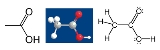
For example, let's consider acetic acid:


The carbon atom on the left has 6 valence electrons from its bonds to the hydrogen atoms, because carbon is more electronegative than hydrogen, and 1 electron from its bond with the other carbon atom, because the electron pair in the C–C bond is split equally, for a total of 7 electrons. A neutral carbon atom would have 4 valence electrons, because carbon is in group 14 of the periodic table. The difference, 4 – 7 = –3, is the oxidation state—that is, the charge that the atom would have if all the bonds were 100% ionic.

Following the same rules, the carbon on the right has an oxidation state of +3 . The oxygen atoms both have an oxidation number of –2; they get 8 electrons each , while a neutral oxygen atom would have 6. The hydrogen atoms all have oxidation state +1, because none of them get any electrons and a neutral hydrogen atom would have one electron.

Without a Lewis structure


The algebraic sum of oxidation states of all atoms in a neutral molecule Molecule

In chemistry, a molecule is an aggregate of two or more atom [i]s in a definite arrangement held togethe ... 

 must be zero, while in ions the algebraic sum of the oxidation states of the constituent atoms must be equal to the charge on the ion. This fact, combined with the fact that some elements almost always have certain oxidation states, allows one to compute the oxidation states for atoms in simple compounds. For example, in most compounds


| Triple point [i] || 13.8033 K, 7.042 kPa
... 

 has an oxidation state of +1
  • fluorine Fluorine

    Fluorine , is the chemical element [i] in the periodic table [i] that has the symbol F and atomic number [i] ... 

     has an oxidation state of −1
  • oxygen Oxygen

    Oxygen is a chemical element [i] with the chemical symbol O and atomic number [i] 8.... 

     has an oxidation state of −2


Exceptions:

  • Hydrogen, fluorine and oxygen have an oxidation state of zero as free elements;
  • hydrogen has an oxidation state of −1 in metal hydrides, e.g. NaH Sodium hydride

    Sodium hydride is the chemical compound [i] with the formula NaH. ... 

    ;
  • oxygen has an oxidation state of −1 in peroxides, −1/2 in superoxide Superoxide

    Superoxide is the anion [i] O2−. ... 

    s, and of +2 in oxygen difluoride Oxygen difluoride

    Oxygen difluoride is the chemical compound [i] with the formula OF2. ... 

    , OF2.


Other elements with common oxidation states include

  • The alkali metals have an oxidation state of +1 in virtually all of their compounds.
  • The alkaline earth metals have an oxidation state of +2 in virtually all of their compounds.
  • The halogen Halogen

    The halogens are a chemical series [i]. ... 

    s have an oxidation state of −1 unless they are directly combined with oxygen or with another halogen.

Example

With the example, Cr3, oxygen has an oxidation state of −2 , and hydrogen
has a state of +1 . So, the triple hydroxide group has a charge of 3 * = −3.
As the compound is neutral, Cr has to have an oxidation state of +3.

Elements with multiple oxidation states

Most elements have more than one possible oxidation state — with carbon having nine, as follows below:

  1. –4: CH4
  2. –3: C2H6
  3. –2: CH3F
  4. –1: C2H2
  5.  0: CH2F2
  6. +1: C2H2F4
  7. +2: CHF3
  8. +3: C2F6
  9. +4: CF4


For an exhaustive list of the possible oxidation states of each element, see the Standard Periodic Table.

See also

  • Electrochemistry Electrochemistry

    Electrochemistry is a branch of chemistry [i] that studies the reactions which take place at the interfa ... 

  • Oxidation number
  • Valence

External links

  • from the IUPAC International Union of Pure and Applied Chemistry

    The International Union of Pure and Applied Chemistry is an international non-governmental organization [i] ... 

     Gold Book


Categories: