


Huesca

Encyclopedia
Huesca (ˈweska; ) is a city in north-eastern Spain
, within the autonomous community
of Aragon
. It is also the capital of the Spanish province of the same name
and the comarca of Hoya de Huesca.
In 2009 it had a population of 52,059, almost a quarter of the total population of the province. That makes it one of the least populated provincial capitals in Spain.
Huesca celebrates its main festivities Fiestas de San Lorenzo from 9 to 15 August.
name was Bolskan
. It was the capital of the Ilergetes
, in the north of Hispania Tarraconensis
, on the road from Tarraco (modern Tarragona
) and Ilerda (modern Lleida
) to Caesaraugusta (modern Zaragoza
) and fell under Caesaraugusta's jurisdiction. Pliny
alone places the Oscenses in Vescitania, a district mentioned nowhere else The city's name was rendered as Osca, and was a Roman colony, Urbs Victrix Osca, during the Roman Empire. Under the impetus of Quintus Sertorius
, the renegade Roman and Iberian hero who made Osca his base, the city minted its own coinage and was the site of a prestigious school founded by Sertorius to educate young Iberians in Latin and Romanitas in general. We learn from Plutarch
that it was a large town, and the place where Sertorius died. It is probably the town called Ileoscan by Strabo
, in an apparently corrupt passage It seems to have possessed silver mines, unless the argentum Oscense here mentioned merely refers to the minted silver of the town.
18th century Spanish historian Enrique Flórez
, however, has pointed out the impossibility of one place supplying such vast quantities of minted silver as we find recorded in ancient writers under the terms argentum Oscense, signatum Oscense; and is of the opinion that "Oscense" in these phrases means "Spanish", being a corruption of "Eus-cara".
 The fully Romanised city, with its forum in the Cathedral square, was made a municipium
by decree of Augustus
in 30 BC. It was renamed Wasqah during the period of Arab domination, when the fortified city was a stronghold defending the frontier against the Christian counts and local kings of the Pyrenees. In 1094 Sancho Ramirez built the nearby Montearagón
castle with the intention of laying siege to Wasqah; here he met his death by a stray arrow as he was reconnoitring the city's walls. It was conquered in 1096 by Peter I of Aragon.
In 1354, King Peter IV of Aragon
chartered the University of Huesca, which initially had a faculty of theology. The school expanded, but by the end of the 16th century was eclipsed by the University of Zaragoza
. The university was abolished in 1845.
During the Spanish Civil War
(1936-39) the "Huesca Front" was the scene of some of the worst fighting between the Republicans and Franco's army. The city was besieged by the Republicans, George Orwell among them (see below) but never fell.
, a native of Huesca martyred in 268 AD. The anniversary of his martyrdom falls on August 10. The fiesta
starts on 9 August and finishes on the 15. Many of the inhabitants dress in green and white for the duration of the fiesta.
San Lorenzo, born in Huesca, was a deacon in Rome and martyred by the Romans, burned on a grille (at least according to legend). Hence the grille is the symbol of San Lorenzo. It can be seen in a number of decorative works in the city.
Huesca is also the birthplace of film director Carlos Saura
and his brother Antonio Saura, contemporary artist. There is an international film festival held annually.
The writer Oscar Sipan, winner of several literary prizes, was born in Huesca in 1974. The celebrated illustrator Isidro Ferrer, though born in Madrid, lives in the city.
, with a height of 2.077 m. The geographical coordinates of the city are: 42° 08´ N, 0° 24´ W.
Its municipal area is 161.02 km ² and borders the municipalities of Almudévar
, Vicién
, Monflorite-Lascasas
Tierz
, Quicena
, Loporzano
, Nueno
, Igriés
, Banastás
, Chimillas
, Alerre
, Barbués
and Albero Bajo
.
The city lies 71 kilometres (44 mi) from Zaragoza
, 160 kilometres (99 mi) from Pamplona
, 118 kilometres (73 mi) from Lérida, 380 kilometres (236 mi) from Madrid
and 273 kilometres (169 mi) from Barcelona
.
(Köppen climate classification
Csa
), with drier summer
s, and wetter springs
and autumn
s, but with some characteristics of a continental climate, such as more extreme temperatures, as the town lies in a wide basin
(the Ebro
basin) entirely surrounded by mountain
s.
The average precipitation
is a scanty 550 mm. There is drought
in summer. The temperatures are high in summer reaching up to 35 °C (95 °F).
In winter
the temperatures are to low (usually -5 to 8 °C). Frost
is common and there is sporadic snow
fall.
Nearby, in the territory of Quicena
, are the ruins of the Monastery-Castle of Montearagón
.
. In February 1937, George Orwell
was stationed near the falangist
-held Huesca as a member of the POUM
militia. In Homage to Catalonia
, Orwell writes about this running joke, originally a naïvely optimistic comment made by one of the Spanish Republican generals:
Orwell never did: but the Indian writer Shashi Tharoor
fulfilled his wish, on his behalf, in 1980, and has written about the experience.
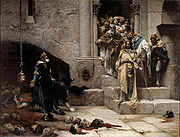
Huesca is also famous for the legend of the Bell of Huesca
.
, France
(since 1964)
Spain
Spain , officially the Kingdom of Spain languages]] under the European Charter for Regional or Minority Languages. In each of these, Spain's official name is as follows:;;;;;;), is a country and member state of the European Union located in southwestern Europe on the Iberian Peninsula...
, within the autonomous community
Autonomous communities of Spain
An autonomous community In other languages of Spain:*Catalan/Valencian .*Galician .*Basque . The second article of the constitution recognizes the rights of "nationalities and regions" to self-government and declares the "indissoluble unity of the Spanish nation".Political power in Spain is...
of Aragon
Aragon
Aragon is a modern autonomous community in Spain, coextensive with the medieval Kingdom of Aragon. Located in northeastern Spain, the Aragonese autonomous community comprises three provinces : Huesca, Zaragoza, and Teruel. Its capital is Zaragoza...
. It is also the capital of the Spanish province of the same name
Huesca (province)
Huesca , officially Huesca/Uesca, is a province of northeastern Spain, in northern Aragon. The capital is Huesca.Positioned just south of the central Pyrenees, Huesca borders France and the French Departments of Pyrénées-Atlantiques and Hautes-Pyrénées...
and the comarca of Hoya de Huesca.
In 2009 it had a population of 52,059, almost a quarter of the total population of the province. That makes it one of the least populated provincial capitals in Spain.
Huesca celebrates its main festivities Fiestas de San Lorenzo from 9 to 15 August.
History
Huesca's pre-Roman IberianIberian language
The Iberian language was the language of a people identified by Greek and Roman sources who lived in the eastern and southeastern regions of the Iberian peninsula. The ancient Iberians can be identified as a rather nebulous local culture between the 7th and 1st century BC...
name was Bolskan
Bolskan
Bolskan was an Iberian Iberian Peninsula city located in the territory of the suessetani Iberians in NE Spain c65km North of the Ebro river and lies upon the site now occupied by the modern city of Huesca....
. It was the capital of the Ilergetes
Ilergetes
The Ilergetes were an ancient Iberian people of the Iberian peninsula who inhabited the area around present-day Lleida. They are believed to be of Iberian language.-External links:*...
, in the north of Hispania Tarraconensis
Hispania Tarraconensis
Hispania Tarraconensis was one of three Roman provinces in Hispania. It encompassed much of the Mediterranean coast of Spain along with the central plateau. Southern Spain, the region now called Andalusia, was the province of Hispania Baetica...
, on the road from Tarraco (modern Tarragona
Tarragona
Tarragona is a city located in the south of Catalonia on the north-east of Spain, by the Mediterranean. It is the capital of the Spanish province of the same name and the capital of the Catalan comarca Tarragonès. In the medieval and modern times it was the capital of the Vegueria of Tarragona...
) and Ilerda (modern Lleida
Lleida
Lleida is a city in the west of Catalonia, Spain. It is the capital city of the province of Lleida, as well as the largest city in the province and it had 137,387 inhabitants , including the contiguous municipalities of Raimat and Sucs. The metro area has about 250,000 inhabitants...
) to Caesaraugusta (modern Zaragoza
Zaragoza
Zaragoza , also called Saragossa in English, is the capital city of the Zaragoza Province and of the autonomous community of Aragon, Spain...
) and fell under Caesaraugusta's jurisdiction. Pliny
Pliny the Elder
Gaius Plinius Secundus , better known as Pliny the Elder, was a Roman author, naturalist, and natural philosopher, as well as naval and army commander of the early Roman Empire, and personal friend of the emperor Vespasian...
alone places the Oscenses in Vescitania, a district mentioned nowhere else The city's name was rendered as Osca, and was a Roman colony, Urbs Victrix Osca, during the Roman Empire. Under the impetus of Quintus Sertorius
Quintus Sertorius
Quintus Sertorius was a Roman statesman and general, born in Nursia, in Sabine territory. His brilliance as a military commander was shown most clearly in his battles against Rome for control of Hispania...
, the renegade Roman and Iberian hero who made Osca his base, the city minted its own coinage and was the site of a prestigious school founded by Sertorius to educate young Iberians in Latin and Romanitas in general. We learn from Plutarch
Plutarch
Plutarch then named, on his becoming a Roman citizen, Lucius Mestrius Plutarchus , c. 46 – 120 AD, was a Greek historian, biographer, essayist, and Middle Platonist known primarily for his Parallel Lives and Moralia...
that it was a large town, and the place where Sertorius died. It is probably the town called Ileoscan by Strabo
Strabo
Strabo, also written Strabon was a Greek historian, geographer and philosopher.-Life:Strabo was born to an affluent family from Amaseia in Pontus , a city which he said was situated the approximate equivalent of 75 km from the Black Sea...
, in an apparently corrupt passage It seems to have possessed silver mines, unless the argentum Oscense here mentioned merely refers to the minted silver of the town.
18th century Spanish historian Enrique Flórez
Enrique Florez
Enrique Flórez de Setién y Huidobro was a Spanish historian.Florez was born in Valladolid. At 15 years old, he entered the order of St Augustine. He subsequently became professor of theology at the University of Alcala, where he published a Cursus theologiae in five volumes...
, however, has pointed out the impossibility of one place supplying such vast quantities of minted silver as we find recorded in ancient writers under the terms argentum Oscense, signatum Oscense; and is of the opinion that "Oscense" in these phrases means "Spanish", being a corruption of "Eus-cara".
Municipium
Municipium , the prototype of English municipality, was the Latin term for a town or city. Etymologically the municipium was a social contract between municipes, the "duty holders," or citizens of the town. The duties, or munera, were a communal obligation assumed by the municipes in exchange for...
by decree of Augustus
Augustus
Augustus ;23 September 63 BC – 19 August AD 14) is considered the first emperor of the Roman Empire, which he ruled alone from 27 BC until his death in 14 AD.The dates of his rule are contemporary dates; Augustus lived under two calendars, the Roman Republican until 45 BC, and the Julian...
in 30 BC. It was renamed Wasqah during the period of Arab domination, when the fortified city was a stronghold defending the frontier against the Christian counts and local kings of the Pyrenees. In 1094 Sancho Ramirez built the nearby Montearagón
Castle of Montearagón
The Castle of Montearagón is a former fortress-monastery in Quicena, near Huesca, Aragon, Spain, built in the Romanesque style. It is presently in ruins....
castle with the intention of laying siege to Wasqah; here he met his death by a stray arrow as he was reconnoitring the city's walls. It was conquered in 1096 by Peter I of Aragon.
In 1354, King Peter IV of Aragon
Peter IV of Aragon
Peter IV, , called el Cerimoniós or el del punyalet , was the King of Aragon, King of Sardinia and Corsica , King of Valencia , and Count of Barcelona Peter IV, (Balaguer, September 5, 1319 – Barcelona, January 6, 1387), called el Cerimoniós ("the Ceremonious") or el del punyalet ("the one...
chartered the University of Huesca, which initially had a faculty of theology. The school expanded, but by the end of the 16th century was eclipsed by the University of Zaragoza
University of Zaragoza
The University of Zaragoza or sometimes Saragossa University is a university located in Zaragoza, in the Aragon region of Spain...
. The university was abolished in 1845.
During the Spanish Civil War
Spanish Civil War
The Spanish Civil WarAlso known as The Crusade among Nationalists, the Fourth Carlist War among Carlists, and The Rebellion or Uprising among Republicans. was a major conflict fought in Spain from 17 July 1936 to 1 April 1939...
(1936-39) the "Huesca Front" was the scene of some of the worst fighting between the Republicans and Franco's army. The city was besieged by the Republicans, George Orwell among them (see below) but never fell.
Modern Huesca
Huesca celebrates its most important annual festival in August: the festival (or fiesta) of San Lorenzo (Lawrence)Saint Lawrence
Lawrence of Rome was one of the seven deacons of ancient Rome who were martyred during the persecution of Valerian in 258.- Holy Chalice :...
, a native of Huesca martyred in 268 AD. The anniversary of his martyrdom falls on August 10. The fiesta
Festival
A festival or gala is an event, usually and ordinarily staged by a local community, which centers on and celebrates some unique aspect of that community and the Festival....
starts on 9 August and finishes on the 15. Many of the inhabitants dress in green and white for the duration of the fiesta.
San Lorenzo, born in Huesca, was a deacon in Rome and martyred by the Romans, burned on a grille (at least according to legend). Hence the grille is the symbol of San Lorenzo. It can be seen in a number of decorative works in the city.
Huesca is also the birthplace of film director Carlos Saura
Carlos Saura
Carlos Saura Atarés is a Spanish film director and photographer.-Early life:Born into a family of artists , he developed his artistic sense in childhood as a photography enthusiast.He obtained his directing diploma in Madrid in 1957 at the Institute of Cinema Research and Studies...
and his brother Antonio Saura, contemporary artist. There is an international film festival held annually.
The writer Oscar Sipan, winner of several literary prizes, was born in Huesca in 1974. The celebrated illustrator Isidro Ferrer, though born in Madrid, lives in the city.
Geography
Huesca is located in the northern region of Aragón, in a depression known as Hoya de Huesca to 488 m (1,601.05 ft) above sea level, close to the city is located the Sierra de GuaraSierra de Guara
The Sierra de Guara is a mountain massif in the province of Huesca, the most northerly province in the autonomous community of Aragon, Spain. Its highest point is Tozal de Guara .It lies around 25km northeast of the city of Huesca itself...
, with a height of 2.077 m. The geographical coordinates of the city are: 42° 08´ N, 0° 24´ W.
Its municipal area is 161.02 km ² and borders the municipalities of Almudévar
Almudévar
Almudévar is a municipality located in the province of Huesca, Aragon, Spain. According to the 2004 census , the municipality has a population of 2,377 inhabitants....
, Vicién
Vicién
Vicién is a municipality located in the province of Huesca, Aragon, Spain. According to the 2004 census , the municipality has a population of 115 inhabitants....
, Monflorite-Lascasas
Monflorite-Lascasas
Monflorite-Lascasas is a village in Aragon, Spain.-External links:*...
Tierz
Tierz
Tierz is a municipality in the province of Huesca, Spain. As of 2010, it has a population of 691 inhabitants.- Main sights :* Church of Nuestra Señora de la Asunción* Hermitage of Nuestra Señora de los Dolores- External links :...
, Quicena
Quicena
Quicena is a municipality in the province of Huesca, Spain. As of 2010, it has a population of 302 inhabitants.- Main sights :* Church of Asunción* Hermitage of San Pedro* Castle of Montearagón* An old bridge over Flumen river* A Roman aqueduct...
, Loporzano
Loporzano
Loporzano is a municipality in the province of Huesca, Spain. As of 2010, it has a population of 540 inhabitants.- Geography :Villages: Aguas, La Almunia del Romeral, Ayera, Bandaliés, Barluenga, Castilsabás, Coscullano, Chibluco, Loscertales, Los Molinos, San Julián de Banzo, Santa Eulalia la...
, Nueno
Nueno
Nueno is a municipality located in the province of Huesca, Aragon, Spain. According to the 2008 census , the municipality has a population of 524 inhabitants....
, Igriés
Igriés
Igriés is a small village located in the Hoya de Huesca, in the province of Aragón in northern Spain.-Geography:Situated south of the Pyrenees, about nine kilometers to the north of Huesca, along the road to Sabiñánigo, in the valley of the river Isuela, and near the Satocobá mountain...
, Banastás
Banastás
Banastás is a municipality in the province of Huesca, Spain. As of 2010, it has a population of 270 inhabitants.- External links :...
, Chimillas
Chimillas
Chimillas is a municipality in the province of Huesca, Spain. As of 2010, it has a population of 359 inhabitants.- External links :...
, Alerre
Alerre
Alerre is a municipality in the province of Huesca, Spain. As of 2010, it has a population of 223 inhabitants.- External links :...
, Barbués
Barbués
Barbués is a municipality located in the province of Huesca, Aragon, Spain. According to the 2004 census , the municipality has a population of 108 inhabitants....
and Albero Bajo
Albero Bajo
Albero Bajo is a municipality located in the province of Huesca, Aragon, Spain. According to the 2004 census , the municipality has a population of 93 inhabitants....
.
The city lies 71 kilometres (44 mi) from Zaragoza
Zaragoza
Zaragoza , also called Saragossa in English, is the capital city of the Zaragoza Province and of the autonomous community of Aragon, Spain...
, 160 kilometres (99 mi) from Pamplona
Pamplona
Pamplona is the historial capital city of Navarre, in Spain, and of the former kingdom of Navarre.The city is famous worldwide for the San Fermín festival, from July 6 to 14, in which the running of the bulls is one of the main attractions...
, 118 kilometres (73 mi) from Lérida, 380 kilometres (236 mi) from Madrid
Madrid
Madrid is the capital and largest city of Spain. The population of the city is roughly 3.3 million and the entire population of the Madrid metropolitan area is calculated to be 6.271 million. It is the third largest city in the European Union, after London and Berlin, and its metropolitan...
and 273 kilometres (169 mi) from Barcelona
Barcelona
Barcelona is the second largest city in Spain after Madrid, and the capital of Catalonia, with a population of 1,621,537 within its administrative limits on a land area of...
.
Climate
Huesca has a mediterranean climateMediterranean climate
A Mediterranean climate is the climate typical of most of the lands in the Mediterranean Basin, and is a particular variety of subtropical climate...
(Köppen climate classification
Köppen climate classification
The Köppen climate classification is one of the most widely used climate classification systems. It was first published by Crimea German climatologist Wladimir Köppen in 1884, with several later modifications by Köppen himself, notably in 1918 and 1936...
Csa
Mediterranean climate
A Mediterranean climate is the climate typical of most of the lands in the Mediterranean Basin, and is a particular variety of subtropical climate...
), with drier summer
Summer
Summer is the warmest of the four temperate seasons, between spring and autumn. At the summer solstice, the days are longest and the nights are shortest, with day-length decreasing as the season progresses after the solstice...
s, and wetter springs
Spring (season)
Spring is one of the four temperate seasons, the transition period between winter and summer. Spring and "springtime" refer to the season, and broadly to ideas of rebirth, renewal and regrowth. The specific definition of the exact timing of "spring" varies according to local climate, cultures and...
and autumn
Autumn
Autumn is one of the four temperate seasons. Autumn marks the transition from summer into winter usually in September or March when the arrival of night becomes noticeably earlier....
s, but with some characteristics of a continental climate, such as more extreme temperatures, as the town lies in a wide basin
Drainage basin
A drainage basin is an extent or an area of land where surface water from rain and melting snow or ice converges to a single point, usually the exit of the basin, where the waters join another waterbody, such as a river, lake, reservoir, estuary, wetland, sea, or ocean...
(the Ebro
Ebro
The Ebro or Ebre is one of the most important rivers in the Iberian Peninsula. It is the biggest river by discharge volume in Spain.The Ebro flows through the following cities:*Reinosa in Cantabria.*Miranda de Ebro in Castile and León....
basin) entirely surrounded by mountain
Mountain
Image:Himalaya_annotated.jpg|thumb|right|The Himalayan mountain range with Mount Everestrect 58 14 160 49 Chomo Lonzorect 200 28 335 52 Makalurect 378 24 566 45 Mount Everestrect 188 581 920 656 Tibetan Plateaurect 250 406 340 427 Rong River...
s.
The average precipitation
Precipitation (meteorology)
In meteorology, precipitation In meteorology, precipitation In meteorology, precipitation (also known as one of the classes of hydrometeors, which are atmospheric water phenomena is any product of the condensation of atmospheric water vapor that falls under gravity. The main forms of precipitation...
is a scanty 550 mm. There is drought
Drought
A drought is an extended period of months or years when a region notes a deficiency in its water supply. Generally, this occurs when a region receives consistently below average precipitation. It can have a substantial impact on the ecosystem and agriculture of the affected region...
in summer. The temperatures are high in summer reaching up to 35 °C (95 °F).
In winter
Winter
Winter is the coldest season of the year in temperate climates, between autumn and spring. At the winter solstice, the days are shortest and the nights are longest, with days lengthening as the season progresses after the solstice.-Meteorology:...
the temperatures are to low (usually -5 to 8 °C). Frost
Frost
Frost is the solid deposition of water vapor from saturated air. It is formed when solid surfaces are cooled to below the dew point of the adjacent air as well as below the freezing point of water. Frost crystals' size differ depending on time and water vapour available. Frost is also usually...
is common and there is sporadic snow
Snow
Snow is a form of precipitation within the Earth's atmosphere in the form of crystalline water ice, consisting of a multitude of snowflakes that fall from clouds. Since snow is composed of small ice particles, it is a granular material. It has an open and therefore soft structure, unless packed by...
fall.
Main sights
A double line of ancient walls can still be seen in present-day Huesca.Nearby, in the territory of Quicena
Quicena
Quicena is a municipality in the province of Huesca, Spain. As of 2010, it has a population of 302 inhabitants.- Main sights :* Church of Asunción* Hermitage of San Pedro* Castle of Montearagón* An old bridge over Flumen river* A Roman aqueduct...
, are the ruins of the Monastery-Castle of Montearagón
Castle of Montearagón
The Castle of Montearagón is a former fortress-monastery in Quicena, near Huesca, Aragon, Spain, built in the Romanesque style. It is presently in ruins....
.
Churches of Huesca
- Huesca CathedralHuesca CathedralThe Holy Cathedral of the Transfiguration of the Lord, also known as the Cathedral of Saint Mary Huesca, is a church in Huesca, north-eastern Spain. It is the seat of the Bishop of Huesca...
(Catedral de la Transfiguración del Señor) in Gothic styleGothic architectureGothic architecture is a style of architecture that flourished during the high and late medieval period. It evolved from Romanesque architecture and was succeeded by Renaissance architecture....
begun by king James IJames I of AragonJames I the Conqueror was the King of Aragon, Count of Barcelona, and Lord of Montpellier from 1213 to 1276...
of AragonKingdom of AragonThe Kingdom of Aragon was a medieval and early modern kingdom in the Iberian Peninsula, corresponding to the modern-day autonomous community of Aragon, in Spain...
around 1273 on the ruined foundations of the mosque. Work continued until the fifteenth century, creating one of the architectural landmarks of northern Spain. The doorway of 1300-1313 has carvings depicting the Apostles. The interior contains a triple nave and lateral chapels. It includes a magnificent high altar of alabaster carved to represent the Passion, made in 1520-1533 by Damián FormentDamián FormentDamià Forment was a Spanish architect and sculptor, considered the most important Spanish sculptor of the 16th century.Forment studied in Rome and Florence before returning to his native town of Valencia...
. The cloister and the bell-tower are from the fifteenth century. - Monastery of San Pedro el Viejo, erected between 1100 and 1241, is one of the oldest RomanesqueRomanesque architectureRomanesque architecture is an architectural style of Medieval Europe characterised by semi-circular arches. There is no consensus for the beginning date of the Romanesque architecture, with proposals ranging from the 6th to the 10th century. It developed in the 12th century into the Gothic style,...
structures in the Peninsula. It was rebuilt in the seventeenth century, but retains its cloisterCloisterA cloister is a rectangular open space surrounded by covered walks or open galleries, with open arcades on the inner side, running along the walls of buildings and forming a quadrangle or garth...
of 1140. - Church of St. Lawrence (Iglesia de San Lorenzo), seventeenth and eighteenth centuries.
- Iglesia de Santo Domingo, in BaroqueBaroqueThe Baroque is a period and the style that used exaggerated motion and clear, easily interpreted detail to produce drama, tension, exuberance, and grandeur in sculpture, painting, literature, dance, and music...
style. - Iglesia de la Compañía San Vicente (17th century)
- Ermita de Ntr. Sra. de Salas, Romanesque and Baroque
- Ermita de Loreto, San Lorenzo's cradle according to tradition.
- Ermita de San Jorge, in memory of the Battle of Alcoraz
- Ermita de las Mártires
- Ermita de Santa Lucía
- Ermita de Jara, in ruins
- San Miguel, Romanesque tower
- Santa María de Foris, in transition Romanesque style
- Santa Cruz, Seminary, on Romanesque foundations.
- There are several old monasteries in the immediate neighbourhood. The one in Castle of MontearagónCastle of MontearagónThe Castle of Montearagón is a former fortress-monastery in Quicena, near Huesca, Aragon, Spain, built in the Romanesque style. It is presently in ruins....
contains in its crypt the tomb of king Alfonso I of Aragon.
- The institute for secondary education occupies the building formerly belonging to the old university. In one of its vaults is the famous "Bell of Huesca", said to have been constructed from the heads of insurgent nobles who were executed by King Ramiro IIRamiro II of AragonRamiro II , called the Monk, was King of Aragon from 1134 until withdrawing from public life in 1137...
of AragonKingdom of AragonThe Kingdom of Aragon was a medieval and early modern kingdom in the Iberian Peninsula, corresponding to the modern-day autonomous community of Aragon, in Spain...
.
Popular references
Huesca is notable for the saying "Tomorrow we'll have coffee in Huesca", a running joke among militiamen of the Spanish Civil WarSpanish Civil War
The Spanish Civil WarAlso known as The Crusade among Nationalists, the Fourth Carlist War among Carlists, and The Rebellion or Uprising among Republicans. was a major conflict fought in Spain from 17 July 1936 to 1 April 1939...
. In February 1937, George Orwell
George Orwell
Eric Arthur Blair , better known by his pen name George Orwell, was an English author and journalist...
was stationed near the falangist
Falange
The Spanish Phalanx of the Assemblies of the National Syndicalist Offensive , known simply as the Falange, is the name assigned to several political movements and parties dating from the 1930s, most particularly the original fascist movement in Spain. The word means phalanx formation in Spanish....
-held Huesca as a member of the POUM
Workers' Party of Marxist Unification
The Workers' Party of Marxist Unification was a Spanish communist political party formed during the Second Republic and mainly active around the Spanish Civil War...
militia. In Homage to Catalonia
Homage to Catalonia
Homage to Catalonia is political journalist and novelist George Orwell's personal account of his experiences and observations in the Spanish Civil War. The first edition was published in 1938. The book was not published in the United States until February 1952. The American edition had a preface...
, Orwell writes about this running joke, originally a naïvely optimistic comment made by one of the Spanish Republican generals:
Orwell never did: but the Indian writer Shashi Tharoor
Shashi Tharoor
Shashi Tharoor is an Indian politician and a Member of Parliament from the Thiruvananthapuram constituency in Kerala...
fulfilled his wish, on his behalf, in 1980, and has written about the experience.
Huesca is also famous for the legend of the Bell of Huesca
The Huesca Bell Legend
The Bell of Huesca is a legend describing how Ramiro II of Aragon, the Monk, cut off the heads of twelve nobles who did not obey him. The legend is told in the thirteenth-century anonymous Aragonese work the Cantar de la campana de Huesca....
.
Twin towns - sister cities
The following are Sister cities of Huesca: TarbesTarbes
Tarbes is a commune in the Hautes-Pyrénées department in south-western France.It is part of the historical region of Gascony. It is the second largest metropolitan area of Midi-Pyrénées, with 110,000 inhabitants....
, France
France
The French Republic , The French Republic , The French Republic , (commonly known as France , is a unitary semi-presidential republic in Western Europe with several overseas territories and islands located on other continents and in the Indian, Pacific, and Atlantic oceans. Metropolitan France...
(since 1964)
See also
- Diocese of HuescaDiocese of HuescaThe Diocese of Huesca is located in north-eastern Spain, in the province of Huesca, part of the autonomous community of Aragón...
- SD HuescaSD HuescaSociedad Deportiva Huesca, S.A.D., is a Spanish football club based in Huesca, in the autonomous community of Aragon. Founded in 1960, it currently plays in Segunda División, holding home games at Estadio El Alcoraz, which seats 8,000 spectators....
Sources
- Michael H. Crawford, 1985. Coinage and Money Under the Roman Republic in series Library of Numismatics (London: Methuen and Co. Ltd.), pages 84 - 102.