


Horror comics

Encyclopedia
Horror comics are comic book
s, graphic novel
s, black-and-white comics magazines, and manga
focusing on horror fiction
. Horror comic books reached a peak in the late 1940s through the mid-1950s, when concern over content and the imposition of the self-censorship Comics Code Authority
contributed to the demise of many titles and the toning down of others. Black-and-white horror-comics magazines, which did not fall under the Code, flourished from the mid-1960s through the early 1980s from a variety of publishers. Mainstream American color comic books experienced a horror resurgence in the 1970s, following a loosening of the Code. While the genre has had greater and lesser periods of popularity, it occupies a firm niche in comics as of the 2010s.
Precursors to horror comics include detective and crime comics that incorporated horror motifs into their graphics, and early superhero stories that sometimes included the likes of ghouls and vampires. Individual horror stories appeared as early as 1940. The first dedicated horror comic books appear to be Gilberton Publications
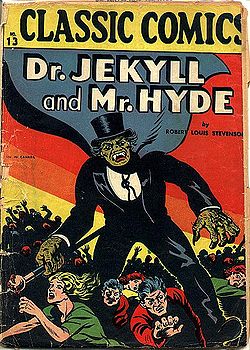
' Classic Comics #13 (Aug. 1943), with its full-length adaptation of Robert Louis Stevenson
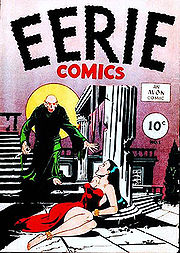
's Strange Case of Dr Jekyll and Mr Hyde, and Avon Publications' anthology Eerie Comics
#1 (Jan. 1947), the first horror comic with original content. B&I Publishing
's anthology Adventures into the Unknown
is the first regularly published horror comic-book series, premiering in 1948.
tradition in sequential-art narrative traces back to at least the 12th-century Heian period
Japanese scroll
"Gaki Zoshi", or the scroll of hungry ghosts (紙本著色餓鬼草紙) and the 16th-century Mixtec codices.
In the early 20th century, pulp magazine
s developed the horror sub-genre
"weird menace
", which featured sadistic villains and graphic scenes of torture
and brutality. The first such title, Popular Publications' Dime Mystery, began as a straight crime fiction
magazine but evolved by 1933 under the influence of Grand Guignol
theater. Other publishers eventually joined in, though Popular dominated the field of with Dime Mystery, Horror Stories, and Terror Tales. While most weird-menace stories were resolved with rational explanations, some involved the supernatural.
 After the fledgling medium of comic books became established by the late 1930s, horror-fiction elements began appearing in superhero
stories, with vampires, misshapen creatures, mad scientists and other tropes that bore the influence of 1930s' Universal
horror film
s and other sources. By the mid-1940s, some detective and crime comics had incorporated horror motifs such as spiders and eyeballs into their graphics, and occasionally featured stories adapted from the literary horror tales of Edgar Allan Poe
or other writers, or stories from the pulps and radio programs. The single-issue Harvey Comics
anthologies Front Page Comic Book (1945), bearing a cover with a knife-wielding, skeletal ghoul, and Strange Story (July 1946), introduced writer-artist Bob Powell
's character the Man in Black, an early comic-book example of the type of omniscient-observer host used in such contemporary supernatural
and suspense radio drama
s as Inner Sanctum
, Suspense
and The Whistler
.
As cultural historian David Hajdu
notes, comic-book horror
 Issue #7 (Dec. 1940) of publisher Prize Comics' flagship title, Prize Comics, introduced writer-artist Dick Briefer
's eight-page feature "New Adventures of Frankenstein
", an updated version of novelist Mary Shelley
's much-adapted Frankenstein monster. Called "America's first ongoing comic book series to fall squarely within the horror
genre" by historian Don Markstein, and "[t]he first real horror series" by horror-comics historian Lawrence Watt-Evans, the feature ran through Prize Comics # 52 (April 1945) before becoming a humor series and then being revived in horrific form in the series Frankenstein #18-33 (March 1952 - Nov. 1954).
Gilberton Publications
' 60-page Classic Comics #12 (June 1943) adapted Washington Irving
's short story
"The Legend of Sleepy Hollow
" as a backup feature to Irving's "Rip Van Winkle
" in a package titled Rip Van Winkle and the Headless Horseman. The next issue, Classic Comics #13 (Aug. 1943), adapted Robert Louis Stevenson
's horror novella
Strange Case of Dr Jekyll and Mr Hyde as the full-length story Dr. Jekyll and Mr. Hyde, making it the earliest known dedicated horror comic book.
Historian Ron Goulart
, making no mention of those earlier literary adaptations, identifies Avon Publications' Eerie Comics
#1, dated January 1947 and sold in late 1946, as "the first out-and-out horror comic book". Its cover featured a red-eyed, pointy-eared fiend threatening a rope-bound
, beautiful young woman in a scanty red evening gown, set amid a moonlit ruin. The anthology offered six primarily occult stories involving the likes of a ghost and a zombie. While all but one writer are unknown — Edward Bellin, who teamed with young artist Joe Kubert
on the nine-page "The Man-Eating Lizards" — the artists include George Roussos
and Fred Kida
. After this first issue, the title went dormant, but reappeared in 1951 as Eerie, beginning with a new #1 and running 17 issues (1951 - Sept. 1954).
Goulart identifies the long-running Adventures into the Unknown
(Fall 1948- Aug. 1967), from American Comics Group
, as "the first continuing-series horror comic". The first two issues, which included art by Fred Guardineer
and others, featured horror stories of ghosts, werewolves, haunted houses, killer puppets and other supernatural beings and locales. The premiere included a seven-page, abridged adaptation of Horace Walpole's seminal gothic novel The Castle of Otranto
, by an unknown writer and artist Al Ulmer
.
Following the postwar crime comics
vogue spearheaded by publisher Lev Gleason's Crime Does Not Pay, which by 1948 was selling over a million copies of a month, came romance comics
, which by 1949 outsold all other genres, and horror comics. The same month in which Adventures into the Unknown
premiered, the comic-book company EC, which would become the most prominent horror-comics publisher of the 1950s, published its first horror story, "Zombie Terror", by an unknown writer and artist Johnny Craig, in the superhero comics Moon Girl #5 Almost simultaneously,Trans-World Publications issued its one-and-only comic, the one-shot Mysterious Traveler Comics #1 (Nov. 1948), based on the Mutual Broadcasting Network's radio show of that name
and including amid its crime and science-fiction stories a reprint of the Edgar Allen Poe adaptation "The Tell Tale Heart", reprinted from Charlton Comics
' Yellowjacket Comics #6.
The floodgates began to open the following year with the first horror comic from the 1950s' most prolific horror-comics publisher, Atlas Comics
, the decade's forerunner of Marvel Comics
. While horror had been an element in 1940s superhero
stories from the original predecessor company, Timely Comics
, through the war years, "when zombies, vampires, werewolves, and even pythonmen were to be found working for the Nazis and the Japanese." the publisher entered the horror arena full-tilt with Amazing Mysteries #32 (May 1949), continuing the numbering of the defunct superhero series Sub-Mariner Comics, followed by the superhero anthology Marvel Mystery Comics
becoming the horror series Marvel Tales
with #93 (Aug. 1949) and the final two issues of Captain America Comics
becoming the mostly horror-fiction Captain America's Weird Tales #74-75 (Oct. 1949 & Feb. 1950) — the latter of which did not contain Captain America at all. Harvey Comics followed suit with its costumed-crimefighter comic Black Cat
by reformatting it as the horror comic Black Cat Mystery with issue #30 (Aug. 1951).
, was instituted in late 1954.
The most influential and enduring horror-comics anthologies of this period, beginning 1950, were the 91 issues of EC Comics
' three series: The Haunt of Fear
, The Vault of Horror and Crypt of Terror, renamed Tales from the Crypt. In 1947, publisher William Gaines
had inherited what was then Educational Comics upon the death of his father, Maxwell Gaines. Three years later, Gaines and editor Al Feldstein
introduced horror in two of the company's crime comics
to test the waters. Finding them successful, the publisher quickly turned them and a Western
series into EC's triumvirate of horror. Additionally, the superhero comic Moon Girl
, which had become the romance comic A Moon ... a Girl ... A Romance, became the primarily science fiction
anthology Weird Fantasy. For the next four years, sardonic horror hosts the Old Witch, the Vault Keeper
and the Crypt Keeper introduced stories drawn by such top artists and soon-to-be-famous newcomers as Johnny Craig, Reed Crandall
, Jack Davis
, Graham Ingels
(who signed his work "Ghastly"), Jack Kamen
, Bernard Krigstein
, Harvey Kurtzman
, and Wally Wood
. Feldstein did most of the early scripting, writing a story a day with twist endings and poetic justice taken to absurd extremes.
EC's success immediately spawned a host of imitators, such as Ziff-Davis' and P.L. Publishing's Weird Adventures, St. John Publications
' Weird Horrors, Key Publications
' Weird Chills, Weird Mysteries and Weird Tales of the Future, Comic Media
's Weird Terror, Ziff-Davis' Weird Thrillers, Atlas Comics
' Adventures into Weird Worlds, and Star Publications
' Ghostly Weird Stories. Others included Quality Comics
' Web of Evil, Ace Comics
' Web of Mystery, Premier Magazines' Horror from the Tomb Harvey Comics
' Tomb of Terror and Witches Tales, Avon Comics', Witchcraft, Ajax-Farrell Publications' Fantastic Fears, Fawcett Comics
' Worlds of Fear, Charlton Comics
' The Thing, and a slew from Atlas Comics
, including Adventures into Terror, Menace
, Journey into Mystery
, and Strange Tales
.
From 1949 through comics cover-dated March 1955, Atlas Comics]released 399 issues of 18 horror titles, AGC
released 123 issues of five horror titles, and Ace Comics, 98 issues of five titles — each more than EC's output.
– had become the target of mounting public criticism for their content and their potentially harmful effects on children, with "accusations from several fronts [that] charged comic books with contributing to the rising rates of juvenile delinquency
", Many city and county ordinances had banned some publications, though these were effectively overturned with a March 29, 1948, United States Supreme Court ruling that a 64-year-old New York State law outlawing publications with "pictures and stories of deeds of bloodshed, lust or crime" was unconstitutional. Regardless, the uproar increased upon the publication of two articles: "Horror in the Nursery", by Judith Crist
, in the March 25, 1948, issue Collier's Weekly
, based upon the symposium "Psychopathology of Comic Books" held a week earlier by psychiatrist
Fredric Wertham
; and Wertham's own features "The Comics ... Very Funny!" in the May 29, 1948, issue of The Saturday Review of Literature. and a March 19, 1948 symposium called "Psychopathology of Comic Books" which stated that comic books were "abnormally sexually aggressive" and led to crime.
In response to public pressure and bad press, an industry trade group
, the Association of Comics Magazine Publishers
(ACMP) was formed with the intent of prodding the industry to police itself. The Association proved ineffective as few publishers joined and those who did exercised little restraint over the content of their titles.
, a tome that claimed horror, crime and other comics were a direct cause of juvenile delinquency
. Wertham asserted, largely based on undocumented anecdotes, that reading violent comic books encouraged violent behavior in children. Wertham painted a picture of a large and pervasive industry, shrouded in secrecy and masterminded by a few, that operated upon the innocent and defenseless minds of the young. He further suggested the industry strong-armed vendors into accepting their publications and forced artists and writers into producing the content against their will.
Wertham alleged comics stimulated deviant sexual behavior. He noted female breasts in comics protruded in a provocative way and special attention was lavished upon the female genital region. A cover by Matt Baker from Phantom Lady
was reprinted in the book with the caption, "Sexual stimulation by combining 'headlights'
with the sadist's dream of tying up a woman". Boys interviewed by Wertham said they used comic book images for masturbation purposes, and one young comics reader confessed he wanted to be a sex maniac. Wertham contended comics promoted homosexuality
by pointing to the Batman–Robin relationship and calling it a homosexual wish dream of two men living together. He observed that Robin was often pictured standing with his legs spread and the genital region evident.
Most alarming, Wertham contended that comic books turned children into deceitful little beings, reading funny-animal comics in front of their parents but turning to horror comics the moment their parents left the room. Wertham warned of suspicious stores and their clandestine back rooms where second hand comics of the worst sort were peddled to children. The language used evoked images of children prowling about gambling dens and whorehouses, and anxious parents felt helpless in the face of such a powerful force as the comics industry. Excerpts from the book were published in Ladies' Home Journal and Reader's Digest, lending respectability and credibility to Wertham's arguments.
A 14-page portfolio of panels and covers from across the entire comic book industry displayed murder, torture and sexual titillation for the reader's consideration. The most widely discussed art was that from "Foul Play", a horror story from EC about a dishonest baseball player whose head and intestines are used by his teammates in a game. Seduction of the Innocent sparked a firestorm of controversy and created alarm in parents, teachers and others interested in the welfare of children; the concerned were galvanized into campaigning for censorship.
led the Senate Subcommittee on Juvenile Delinquency
. Dr. Wertham insisted upon appearing before the committee. He first presented a long list of his credentials, and then, in his clipped German accent, spoke with authority on the pernicious influence of comic books upon children. His passionate testimony at the hearings impressed the gathering. Kefauver suggested crime comics indoctrinated children in a way similar to Nazi propaganda. Wertham noted Hitler was a beginner compared to the comics industry.
Publisher William Gaines appeared before the committee and vigorously defended his product and the industry. He took full responsibility for the horror genre, claiming he was the first to publish such comics. He insisted that delinquency was the result of the real environment and not fictional reading materials. His defiant demeanor left the committee (which felt the industry was indefensible), astonished. He had prepared a statement that read in part, "It would be just as difficult to explain the harmless thrill of a horror story to Dr. Wertham as it would be to explain the sublimity of love to a frigid old maid."
Crime Suspenstories
, issue 22, April/May 1954, was entered into evidence. The exchange between Gaines and Kefauver led to a front-page story in The New York Times
:
Though the committee's final report did not blame comics for crime, it recommended that the comics industry tone down its content voluntarily.
In September 1954, the Comics Magazine Association of America (CMAA) and its Comics Code Authority
(CCA) was formed. The Code had many stipulations that made it difficult for horror comics to continue publication, since any that didn't adhere to the Code's guidelines would likely not find distribution. The Code forbade the explicit presentation of "unique details and methods of crime...Scenes of excessive violence...brutal torture, excessive and unnecessary knife and gun play, physical agony, gory and gruesome crime...all scenes of horror, excessive bloodshed, gory or gruesome crimes, depravity, lust, sadism, masochism...Scenes dealing with, or instruments associated with walking dead, or torture".
shifted its ongoing horror titles, House of Mystery
(1951–1987) and House of Secrets (1956–1966), toward the suspense and mystery genres, often with a science fiction bent. In fact, from 1964–1968, House of Mystery became a mostly superhero title, featuring J'onn J'onzz, the Manhunter from Mars and, later, Dial H for Hero
. Similarly, during this period Marvel Comics
produced the titles Strange Tales
(1951–1968) and Journey into Mystery
(1952–1966).
The publishers Gilberton
, Dell Comics
, and Gold Key Comics
did not become signatories to the Comics Code, relying on their reputations as publishers of wholesome comic books. Classics Illustrated
had adapted such horror novels as Frankenstein and Dr Jekyll and Mr Hyde in comic book form, and quickly issued reprints with new, less gruesome covers. Dell began publishing the licensed TV series comic book Twilight Zone in 1961 and publishing a Dracula title in 1962. Gold Key, in addition to releasing Boris Karloff Thriller, based on the TV series Thriller (and retitled Boris Karloff Tales of Mystery after the show went off the air), bought the Twilight Zone license from Dell in 1962.
In 1965 Gold Key put out three licensed horror-themed comics, two based on the TV horror-comedies The Addams Family
and The Munsters
, and the other titled Ripley's Believe it or Not!, which had three different subtitles: "True Ghost Stories," "True War Stories" (#1 and #5), and "True Demons & Monsters" (#7, #10, #19, #22, #25, #26, and #29).
Warren Publishing
continued the horror tradition in the mid-1960s, bypassing the Comics Code Authority restrictions by publishing magazine-sized black-and-white horror comics. Under the direction of line editor Archie Goodwin
, Warren debuted the horror anthologies Creepy
(1964–1983) and Eerie
(1966–1983), followed by Vampirella
, an anthology with a lead feature starring a sexy young female vampire.
The low-rent Warren imitator Eerie Publications
also jumped onto the black-and-white horror magazine business, mixing new material with reprints from pre-Comics Code horror comics, most notably in its flagship title Weird (1966 – 1981), as well as the magazines Tales of Voodoo (1968 - 1974), Horror Tales (1969 – 1979), Tales from the Tomb (1969 – 1975), and Terror Tales
(1969 – 1979). Stanley Publications also published a line of black-and-white horror magazines from 1966 – 1971, including the titles Shock and Chilling Tales of Horror.
relaxation of the Comics Code — and lasting until about 1975, the horror genre again became a force in the comics industry. Charlton Comics
jumped into the horror/suspense genre with titles like Ghostly Tales
(1966–1984), The Many Ghosts of Doctor Graves
(1967–1986), and Ghost Manor
(1968–1984); DC introduced The Unexpected
(1968–1982) and The Witching Hour
(1969–1978), and revived House of Secrets as a horror title (1969–1978); while Marvel debuted such titles as Chamber of Darkness
/Monsters on the Prowl (1969–1974), Tower of Shadows/Creatures on the Loose
(1969–1975), and Adventure Into Fear
(1970–1975).
In 1971, the Comics Code Authority relaxed some of its longstanding rules regarding horror comics, which opened the door to more possibilities in the genre:
Following the change in the rules, in 1971 Marvel
returned to publishing true horror with Morbius, the Living Vampire
, followed by the introduction of Dracula
(1972) and Blade
(1973) in the pages of Tomb of Dracula
(1972–1979). This opened the floodgates for more horror titles, such as Supernatural Thrillers
(1972–1975), Werewolf by Night
(1972–1977), Ghost Rider
(1973–1983), Dead of Night (1973–1975), and Man-Thing
(1974–1975). In addition, following Warren's lead, in 1971 Marvel launched a black-and-white magazine imprint, Curtis Magazines
, which published a number of horror titles from 1971 to 1975, including Dracula Lives! (1973–1975), Monsters Unleashed
(1973–1975), Vampire Tales
(1973–1975), Tales of the Zombie (1973–1975), Haunt of Horror (1974–1975), and Masters of Terror (1975). Ralph Reese
drew notable stories for Monsters Unleashed and Haunt of Horror, while writer Steve Gerber
had notable mid-1970s runs in Marvel titles, including Man-Thing
(1974–1975), Son of Satan
and Tales of the Zombie.
DC began releasing more horror titles in the early 1970s, like Ghosts
(1971–1982), Weird War Tales
(1971–1983), The Dark Mansion Of Forbidden Love (later titled Forbidden Tales of Dark Mansion) (1971–1974), Secrets of Sinister House
(1972–1974), Swamp Thing
(1972–1974), Weird Mystery Tales
(1972–1975), Secrets of Haunted House
(1975–1982), Tales of Ghost Castle
and the horror/humor title Plop!
(1973–1976).
Charlton continued its horror publishing as well, with the titles Ghostly Haunts
(1971–1977), Haunted
(1971–1984), Midnight Tales
(1972–1976), Haunted Love
(1973–1975), and Scary Tales
(1975–1984).
Underground cartoonist
s, many of them strongly influenced by 1950s EC Comics
like Tales from the Crypt, also tried their hands at the horror genre. Titles like Skull (Rip Off Press
, 1970), Bogeyman (San Francisco Comic Book Company, 1969), Fantagor (Richard Corben
, 1970), Insect Fear (Print Mint
, 1970), Up From The Deep (Rip Off Press, 1971), Death Rattle (Kitchen Sink Press
, 1972), Gory Stories (Shroud, 1972), Deviant Slice (Print Mint, 1972) and Two Fisted Zombies (Last Gasp, 1973) appeared in the early 1970s.
Skywald Publications
, with its black-and-white comics magazines Nightmare, Psycho, and Scream, was also a player in the horror comics resurgence of the early 1970s.
By the mid-seventies, however, the horror comics boomlet had faded and only a few titles persevered. DC, Warren, and Charlton canceled the last of their horror anthologies by the mid-1980s, and other than DC's Swamp Thing
and FantaCo's Gore Shriek (see below) — for the rest of the decade the genre lay dormant.
and Millennium Publications
boasted lineups almost exclusively devoted to horror, vampire, and zombie comics. For instance, 1986 saw the debut of Fantaco's horror anthology Gore Shriek, edited by Stephen R. Bissette
, who also contributed stories to each issue. Bissette also edited the acclaimed anthology Taboo, which ran from 1988–1995. In the mid-1990s Harris Publications
also revived Vampirella
. At Image Comics
, Robert Kirkman
has created The Walking Dead
, which helped to revitalize the zombie genre. Steve Niles
predominantly writes horror comics, and his 30 Days of Night
has spawned a range of mini-series released by IDW Publishing
. At Dark Horse
Mike Mignola
has been working on Hellboy
, and has created a large fictional universe
with spin-off titles like BPRD
and Lobster Johnson
.
In 1982, Pacific Comics produced two series that, while admittedly inspired by the E.C. Comics of the 1950s, foresaw the form that horror comics would take in the coming decades. Printed in color on high-quality paper stock despite a higher cover price, the series "Twisted Tales" and "Alien Worlds" were short-lived and hard-pressed to keep to a regular production schedule, but offered some of the most explicitly brutal and sexual stories yet to be widely distributed in a mainstream ("non-underground") format. The series soon shifted to Eclipse Comics production, which also produced very similar titles such as "The Twisted Tales of Bruce Jones" and "Alien Encounters." Later horror titles from DC's Vertigo line had more in common with these Pacific/Eclipse efforts, and more success, than DC's sporadic efforts to revive or maintain the traditional comic horror title (e.g. Elvira's House of Mystery).
In 1982, DC Comics revived the Swamp Thing series, attempting to capitalize on the summer 1982
release of the Wes Craven
film of the same name
. (The revival had actually been originally planned for 1978
, but was a victim of the DC Implosion
.) In 1984, British writer Alan Moore
took over the writing chores the title, and when Karen Berger
took over as editor, she gave Moore free rein to revamp the title and the character as he saw fit. Moore reconfigured Swamp Thing's origin to make him a true monster as opposed to a human transformed into a monster.
Moore's (and artists Stephen R. Bissette
and John Totleben
's) Swamp Thing was a critical and commercial success, and in 1988 spun off the ongoing series Hellblazer
, starring occult detective
John Constantine
. In 1993
DC introduced its mature-readers Vertigo line, which folded in a number of popular horror titles, including Hellblazer and Swamp Thing. One of Vertigo's early successes was Neil Gaiman
's Sandman
, which reworked a number of DC's old horror characters and added fantasy to the mix. A number of other horror titles carried on at Vertigo, like Deadman
, House of Mystery
and Haunted Tank, or were given a horror spin or an update like Kid Eternity
and Jonah Hex
.
Vertigo also published more conventional horror, like vampires in Bite Club
(beginning in 2004
), and Vamps. In addition, from 1999–2001 they published their own horror anthology
, Flinch.
Other than a Ghost Rider
revival from 1990–1998, Marvel Comics
basically sat out the 1990s horror comics resurgence. But in the 2000s the company produced a large stable of ongoing horror comics titles, like Ghost Rider and Blade
, which have been drawn together in the Midnight Sons
, a group that crossed over with the Marvel Zombies series
in Marvel Zombies 4
. Marvel's adult imprint MAX
, introduced in 2001
, has also provided a venue for reinterpretations of Marvel horror characters where more violence can be used, leading to the Dead of Night mini-series based on Devil-Slayer, Werewolf by Night
and Man-Thing
, as well as a reworking of Zombie and Hellstorm: Son of Satan. Richard Corben
has also been writing Haunt of Horror, a number of series based on the work of Edgar Allan Poe
and H.P. Lovecraft.
was introduced, which saw the horror reprints disappear from the news agents' shelves.
In the early seventies there were a couple of horror comics, Shiver and Shake
and Monster Fun
, but these were also humour titles pitched at younger children. It was only during the boom in British comics in the late seventies and early eighties that there were horror comics pitched at older boys and girls, Scream!
and Misty
, respectively. Whether it was fears over the content, or the difficult financial times in the mid-eighties, Scream! stopped publishing in 1985, with only two of its stories being merged with the Eagle
.
After the collapse in comics the only mainstream venue was 2000 AD, which has featured stories like Chiaroscuro
and Cradlegrave, as well as those drawing on the Cthulhu Mythos
for Necronauts
and Caballistics, Inc.
.
The British small press
also publishes horror comics, like the anthology
Something Wicked.
In 2008, the London Horror Comic
launched, becoming the first dedicated full-colour UK horror comic to be shipped worldwide through Diamond Comic Distributors
.
, horror manga started to appear in the lending libraries (Kashihonya) of the late 1950s and early 1960s and expanded into the mainstream through the works of artists like Shigeru Mizuki
(GeGeGe no Kitaro), Jirō Tsunoda (Kyōfu Shimbun), Kazuo Umezu
(The Drifting Classroom
) and Shin'ichi Koga (Eko Eko Azarak
). While most of them published in shōnen
magazines and often with scary, yet sympathetic protagonists leading through tales about ghosts and demons, Umezu for instance got his start in shōjo
magazines, where psychological depth was the main focus, a famous title being Hebi Shōjo.
The subculture also continued publishing horror manga. Hideshi Hino
created lots of stories for the alternative magazine Garo
and for the publisher Hibari Shobō, which specialized in horror manga in the 1970s. Suehiro Maruo
followed the traditions of the Ero guro movement of the 1920s and included extreme depictions of gore in his works.
Horror stayed a niche in mainstream manga. There was no magazine specialized solely on horror comics until the 1980s, when Asahi Sonorama
founded Halloween magazine in 1986 due to the recent success of artists like Ryōko Takashina in mainstream shōjo magazines like Ribon
. Junji Itō
became the most famous contributor to the magazine with his Tomie
series. Similar publications like Horror M (Bunkasha), also mainly targeted at women, started to appear. Magazines like Nemuki (Asahi Sonorama), Susperia Mystery (Akita Shoten
) and Apple Mystery (Shufu to Seikatsusha) were also founded as part of this movement, but concentrated on more subtle and less graphic depictions of horror. Artists drawing for those magazine like Ichiko Ima (Hyakkiyakō Shō), Matsuri Akino
(Pet Shop of Horrors
) and Narumi Kakinouchi
(Vampire Princess Miyu
) became famous.
and Eric Monster Millikin
.
Comics have formed part of the media franchise for popular horror movies like Texas Chainsaw Massacre
, Friday the 13th, Halloween and Army of Darkness
. They have also been adapted horror video games, like Silent Hill
.
Horror comics have also been sources for horror films like 30 Days of Night
, Hellboy
and Blade. Horror manga, like other manga, have been the basis for adaptations into films and TV, especially the work of Junji Ito which led to the film Uzumaki
. Kirkman's The Walking Dead has been adapted into an ongoing TV series
by showrunner Frank Darabont
. It debuted on October 31, 2010 on the AMC cable network, to universal acclaim.
They have also been a venue for failed horror films, including the horror film crossover Freddy vs. Jason vs. Ash
, they have allowed series to continue as happened with Buffy Season Eight and offered a chance to provide prequel
s or fill in gaps between films, like Saw: Rebirth and 28 Days Later: The Aftermath
, respectively.
, Quiet, Please
, The Whistler
, and Inner Sanctum Mysteries
, had more or less sinister "hosts" who introduced and wrapped up the stories. This tradition was introduced into horror comics, many of which were also anthology titles, with many stories in each issue.
EC Comics
utilized the conceit of a character who "hosted" the book, often starring in a framing sequence at the beginning of each issue. The most notorious EC hosts were the "GhouLunatics": The Crypt Keeper, The Old Witch, and The Vault-Keeper. In the 1960s, Warren came up with the hosts Uncle Creepy and Cousin Eerie, and DC followed suit with their hosts Cain and Abel
(as well as such minor hosts as Eve, Destiny
, Lucien, and the Mad Mod Witch). Charlton had a large cast of hosts for their various horror/suspense titles. Marvel Comics never really embraced the host character for their various titles, though for a short time they did use Digger
and Headstone P. Gravely.
The following is a list of hosts from various horror comics titles from over the years.
Comic book
A comic book or comicbook is a magazine made up of comics, narrative artwork in the form of separate panels that represent individual scenes, often accompanied by dialog as well as including...
s, graphic novel
Graphic novel
A graphic novel is a narrative work in which the story is conveyed to the reader using sequential art in either an experimental design or in a traditional comics format...
s, black-and-white comics magazines, and manga
Manga
Manga is the Japanese word for "comics" and consists of comics and print cartoons . In the West, the term "manga" has been appropriated to refer specifically to comics created in Japan, or by Japanese authors, in the Japanese language and conforming to the style developed in Japan in the late 19th...
focusing on horror fiction
Horror fiction
Horror fiction also Horror fantasy is a philosophy of literature, which is intended to, or has the capacity to frighten its readers, inducing feelings of horror and terror. It creates an eerie atmosphere. Horror can be either supernatural or non-supernatural...
. Horror comic books reached a peak in the late 1940s through the mid-1950s, when concern over content and the imposition of the self-censorship Comics Code Authority
Comics Code Authority
The Comics Code Authority was a body created as part of the Comics Magazine Association of America, as a tool for the comics-publishing industry to self-regulate the content of comic books in the United States. Member publishers submitted comic books to the CCA, which screened them for adherence to...
contributed to the demise of many titles and the toning down of others. Black-and-white horror-comics magazines, which did not fall under the Code, flourished from the mid-1960s through the early 1980s from a variety of publishers. Mainstream American color comic books experienced a horror resurgence in the 1970s, following a loosening of the Code. While the genre has had greater and lesser periods of popularity, it occupies a firm niche in comics as of the 2010s.
Precursors to horror comics include detective and crime comics that incorporated horror motifs into their graphics, and early superhero stories that sometimes included the likes of ghouls and vampires. Individual horror stories appeared as early as 1940. The first dedicated horror comic books appear to be Gilberton Publications
Gilberton (publisher)
The Gilberton Company, Inc. was an American publisher best known for the comic book series Classics Illustrated. Beginning life as an imprint of the Elliot Publishing Company, the company became independent in 1942, before being sold to the Frawley Corporation in 1967...
' Classic Comics #13 (Aug. 1943), with its full-length adaptation of Robert Louis Stevenson
Robert Louis Stevenson
Robert Louis Balfour Stevenson was a Scottish novelist, poet, essayist and travel writer. His best-known books include Treasure Island, Kidnapped, and Strange Case of Dr Jekyll and Mr Hyde....
's Strange Case of Dr Jekyll and Mr Hyde, and Avon Publications' anthology Eerie Comics
Eerie Comics
Eerie is a one-shot horror comic book cover-dated January 1947 and published by Avon Periodicals as Eerie #1. Its creative team includes Joe Kubert and Fred Kida. The book's contents comprise six full-length horror feature stories and a 2-page humorous tale. The title went dormant for a number of...
#1 (Jan. 1947), the first horror comic with original content. B&I Publishing
American Comics Group
American Comics Group was a New York City-based comic book publisher which operated during the Golden and Silver Age of comic books. ACG published one of the first horror comics titles, Adventures into the Unknown. Another of ACG's claims to fame was the character of Herbie Popnecker, who starred...
's anthology Adventures into the Unknown
Adventures Into the Unknown
Adventures Into the Unknown was a horror and supernatural comic series from the Golden Age of Comic Books. The title was released in the fall of 1948 by B&I Publishing and enjoyed a run of 174 issues for nearly two decades, ceasing publication in August 1967...
is the first regularly published horror comic-book series, premiering in 1948.
Precursors
The horrorHorror fiction
Horror fiction also Horror fantasy is a philosophy of literature, which is intended to, or has the capacity to frighten its readers, inducing feelings of horror and terror. It creates an eerie atmosphere. Horror can be either supernatural or non-supernatural...
tradition in sequential-art narrative traces back to at least the 12th-century Heian period
Heian period
The is the last division of classical Japanese history, running from 794 to 1185. The period is named after the capital city of Heian-kyō, or modern Kyōto. It is the period in Japanese history when Buddhism, Taoism and other Chinese influences were at their height...
Japanese scroll
Emakimono
, often simply called , is a horizontal, illustrated narrative form created during the 11th to 16th centuries in Japan. Emakimono combines both text and pictures, and is drawn, painted, or stamped on a handscroll...
"Gaki Zoshi", or the scroll of hungry ghosts (紙本著色餓鬼草紙) and the 16th-century Mixtec codices.
In the early 20th century, pulp magazine
Pulp magazine
Pulp magazines , also collectively known as pulp fiction, refers to inexpensive fiction magazines published from 1896 through the 1950s. The typical pulp magazine was seven inches wide by ten inches high, half an inch thick, and 128 pages long...
s developed the horror sub-genre
Genre
Genre , Greek: genos, γένος) is the term for any category of literature or other forms of art or culture, e.g. music, and in general, any type of discourse, whether written or spoken, audial or visual, based on some set of stylistic criteria. Genres are formed by conventions that change over time...
"weird menace
Weird menace
Weird menace is the name given to a sub-genre of horror fiction that was popular in the pulp magazines of the 1930s and early 1940s. The weird menace pulps, also known as "shudder pulps", generally featured stories in which the hero was pitted against sadistic villains, with graphic scenes of...
", which featured sadistic villains and graphic scenes of torture
Torture
Torture is the act of inflicting severe pain as a means of punishment, revenge, forcing information or a confession, or simply as an act of cruelty. Throughout history, torture has often been used as a method of political re-education, interrogation, punishment, and coercion...
and brutality. The first such title, Popular Publications' Dime Mystery, began as a straight crime fiction
Crime fiction
Crime fiction is the literary genre that fictionalizes crimes, their detection, criminals and their motives. It is usually distinguished from mainstream fiction and other genres such as science fiction or historical fiction, but boundaries can be, and indeed are, blurred...
magazine but evolved by 1933 under the influence of Grand Guignol
Grand Guignol
Le Théâtre du Grand-Guignol — known as the Grand Guignol — was a theatre in the Pigalle area of Paris . From its opening in 1897 until its closing in 1962 it specialized in naturalistic horror shows...
theater. Other publishers eventually joined in, though Popular dominated the field of with Dime Mystery, Horror Stories, and Terror Tales. While most weird-menace stories were resolved with rational explanations, some involved the supernatural.
Superhero
A superhero is a type of stock character, possessing "extraordinary or superhuman powers", dedicated to protecting the public. Since the debut of the prototypical superhero Superman in 1938, stories of superheroes — ranging from brief episodic adventures to continuing years-long sagas —...
stories, with vampires, misshapen creatures, mad scientists and other tropes that bore the influence of 1930s' Universal
Universal Pictures
-1920:* White Youth* The Flaming Disc* Am I Dreaming?* The Dragon's Net* The Adorable Savage* Putting It Over* The Line Runners-1921:* The Fire Eater* A Battle of Wits* Dream Girl* The Millionaire...
horror film
Horror film
Horror films seek to elicit a negative emotional reaction from viewers by playing on the audience's most primal fears. They often feature scenes that startle the viewer through the means of macabre and the supernatural, thus frequently overlapping with the fantasy and science fiction genres...
s and other sources. By the mid-1940s, some detective and crime comics had incorporated horror motifs such as spiders and eyeballs into their graphics, and occasionally featured stories adapted from the literary horror tales of Edgar Allan Poe
Edgar Allan Poe
Edgar Allan Poe was an American author, poet, editor and literary critic, considered part of the American Romantic Movement. Best known for his tales of mystery and the macabre, Poe was one of the earliest American practitioners of the short story and is considered the inventor of the detective...
or other writers, or stories from the pulps and radio programs. The single-issue Harvey Comics
Harvey Comics
Harvey Comics was an American comic book publisher, founded in New York City by Alfred Harvey in 1941, after buying out the small publisher Brookwood Publications. His brothers Robert B...
anthologies Front Page Comic Book (1945), bearing a cover with a knife-wielding, skeletal ghoul, and Strange Story (July 1946), introduced writer-artist Bob Powell
Bob Powell (comics)
Bob Powell né Stanislav Robert Pawlowski was an American comic book artist known for his work during the 1930-40s Golden Age of comic books, including on the features "Sheena, Queen of the Jungle" and "Mr. Mystic". He received a belated credit in 1999 for co-writing the debut of the popular...
's character the Man in Black, an early comic-book example of the type of omniscient-observer host used in such contemporary supernatural
Supernatural
The supernatural or is that which is not subject to the laws of nature, or more figuratively, that which is said to exist above and beyond nature...
and suspense radio drama
Radio drama
Radio drama is a dramatized, purely acoustic performance, broadcast on radio or published on audio media, such as tape or CD. With no visual component, radio drama depends on dialogue, music and sound effects to help the listener imagine the characters and story...
s as Inner Sanctum
Inner Sanctum Mysteries
Inner Sanctum Mysteries, a popular old-time radio program that aired from January 7, 1941 to October 5, 1952, was created by producer Himan Brown. A total of 526 episodes were broadcast.-Horror hosts:...
, Suspense
Suspense (radio program)
-Production background:One of the premier drama programs of the Golden Age of Radio, was subtitled "radio's outstanding theater of thrills" and focused on suspense thriller-type scripts, usually featuring leading Hollywood actors of the era...
and The Whistler
The Whistler
The Whistler was an American radio mystery drama which ran from May 16, 1942 until September 22, 1955. It was sponsored by the Signal Oil Company: "That whistle is your signal for the Signal Oil program, The Whistler." The program was adapted into a film noir series by Columbia Pictures in...
.
As cultural historian David Hajdu
David Hajdu
David Hajdu is an American columnist, author and professor at Columbia University Graduate School of Journalism. He is the music critic for The New Republic....
notes, comic-book horror
Early American horror comics
Dick Briefer
Richard "Dick" Briefer was an American comic-book artist best known for his various adaptations, including humorous ones, of the Frankenstein monster...
's eight-page feature "New Adventures of Frankenstein
Frankenstein (Prize Comics)
There have been many comic book adaptations of the Frankenstein monster story created by Mary Shelley in her 1818 novel Frankenstein. Writer-artist Dick Briefer presented two loose adaptations of the story in the Prize Comics series Prize Comics and Frankenstein from 1940 to 1954...
", an updated version of novelist Mary Shelley
Mary Shelley
Mary Shelley was a British novelist, short story writer, dramatist, essayist, biographer, and travel writer, best known for her Gothic novel Frankenstein: or, The Modern Prometheus . She also edited and promoted the works of her husband, the Romantic poet and philosopher Percy Bysshe Shelley...
's much-adapted Frankenstein monster. Called "America's first ongoing comic book series to fall squarely within the horror
Horror fiction
Horror fiction also Horror fantasy is a philosophy of literature, which is intended to, or has the capacity to frighten its readers, inducing feelings of horror and terror. It creates an eerie atmosphere. Horror can be either supernatural or non-supernatural...
genre" by historian Don Markstein, and "[t]he first real horror series" by horror-comics historian Lawrence Watt-Evans, the feature ran through Prize Comics # 52 (April 1945) before becoming a humor series and then being revived in horrific form in the series Frankenstein #18-33 (March 1952 - Nov. 1954).
Gilberton Publications
Gilberton (publisher)
The Gilberton Company, Inc. was an American publisher best known for the comic book series Classics Illustrated. Beginning life as an imprint of the Elliot Publishing Company, the company became independent in 1942, before being sold to the Frawley Corporation in 1967...
' 60-page Classic Comics #12 (June 1943) adapted Washington Irving
Washington Irving
Washington Irving was an American author, essayist, biographer and historian of the early 19th century. He was best known for his short stories "The Legend of Sleepy Hollow" and "Rip Van Winkle", both of which appear in his book The Sketch Book of Geoffrey Crayon, Gent. His historical works...
's short story
Short story
A short story is a work of fiction that is usually written in prose, often in narrative format. This format tends to be more pointed than longer works of fiction, such as novellas and novels. Short story definitions based on length differ somewhat, even among professional writers, in part because...
"The Legend of Sleepy Hollow
The Legend of Sleepy Hollow
"The Legend of Sleepy Hollow" is a short story by Washington Irving contained in his collection The Sketch Book of Geoffrey Crayon, Gent., written while he was living in Birmingham, England, and first published in 1820...
" as a backup feature to Irving's "Rip Van Winkle
Rip Van Winkle
"Rip Van Winkle" is a short story by the American author Washington Irving published in 1819, as well as the name of the story's fictional protagonist. Written while Irving was living in Birmingham, England, it was part of a collection entitled The Sketch Book of Geoffrey Crayon...
" in a package titled Rip Van Winkle and the Headless Horseman. The next issue, Classic Comics #13 (Aug. 1943), adapted Robert Louis Stevenson
Robert Louis Stevenson
Robert Louis Balfour Stevenson was a Scottish novelist, poet, essayist and travel writer. His best-known books include Treasure Island, Kidnapped, and Strange Case of Dr Jekyll and Mr Hyde....
's horror novella
Novella
A novella is a written, fictional, prose narrative usually longer than a novelette but shorter than a novel. The Science Fiction and Fantasy Writers of America Nebula Awards for science fiction define the novella as having a word count between 17,500 and 40,000...
Strange Case of Dr Jekyll and Mr Hyde as the full-length story Dr. Jekyll and Mr. Hyde, making it the earliest known dedicated horror comic book.
Historian Ron Goulart
Ron Goulart
Ron Goulart is an American popular culture historian and mystery, fantasy and science fiction author.The prolific Goulart wrote many novelizations and other routine work under various pseudonyms: Kenneth Robeson , Con Steffanson , Chad Calhoun, R.T...
, making no mention of those earlier literary adaptations, identifies Avon Publications' Eerie Comics
Eerie Comics
Eerie is a one-shot horror comic book cover-dated January 1947 and published by Avon Periodicals as Eerie #1. Its creative team includes Joe Kubert and Fred Kida. The book's contents comprise six full-length horror feature stories and a 2-page humorous tale. The title went dormant for a number of...
#1, dated January 1947 and sold in late 1946, as "the first out-and-out horror comic book". Its cover featured a red-eyed, pointy-eared fiend threatening a rope-bound
Bondage (BDSM)
Bondage is the use of restraints for the sexual pleasure of the parties involved. It may be used in its own right, as in the case of rope bondage and breast bondage, or as part of sexual activity or BDSM activity.- Private bondage :...
, beautiful young woman in a scanty red evening gown, set amid a moonlit ruin. The anthology offered six primarily occult stories involving the likes of a ghost and a zombie. While all but one writer are unknown — Edward Bellin, who teamed with young artist Joe Kubert
Joe Kubert
Joe Kubert is an American comic book artist who went on to found The Kubert School. He is best known for his work on the DC Comics characters Sgt. Rock and Hawkman...
on the nine-page "The Man-Eating Lizards" — the artists include George Roussos
George Roussos
George Roussos , also known under the pseudonym George Bell, was an American comic book artist best known as one of Jack Kirby's Silver Age inkers, including on landmark early issues of Marvel Comics' Fantastic Four.-Early life and career:George Roussos was born in Washington, D.C., the son of...
and Fred Kida
Fred Kida
Fred Kida is an American comic book and comic strip artist best known for the characters Airboy and Valkyrie.-Early life and career:...
. After this first issue, the title went dormant, but reappeared in 1951 as Eerie, beginning with a new #1 and running 17 issues (1951 - Sept. 1954).
Goulart identifies the long-running Adventures into the Unknown
Adventures Into the Unknown
Adventures Into the Unknown was a horror and supernatural comic series from the Golden Age of Comic Books. The title was released in the fall of 1948 by B&I Publishing and enjoyed a run of 174 issues for nearly two decades, ceasing publication in August 1967...
(Fall 1948- Aug. 1967), from American Comics Group
American Comics Group
American Comics Group was a New York City-based comic book publisher which operated during the Golden and Silver Age of comic books. ACG published one of the first horror comics titles, Adventures into the Unknown. Another of ACG's claims to fame was the character of Herbie Popnecker, who starred...
, as "the first continuing-series horror comic". The first two issues, which included art by Fred Guardineer
Fred Guardineer
Frederick B. Guardineer was an American illustrator and comic book writer-artist best known for his work in the 1930s and 1940s during what historians and fans call the Golden Age of Comic Books, and for his 1950s art on the Western comic-book series The Durango Kid.A pioneer of the medium...
and others, featured horror stories of ghosts, werewolves, haunted houses, killer puppets and other supernatural beings and locales. The premiere included a seven-page, abridged adaptation of Horace Walpole's seminal gothic novel The Castle of Otranto
The Castle of Otranto
The Castle of Otranto is a 1764 novel by Horace Walpole. It is generally regarded as the first gothic novel, initiating a literary genre which would become extremely popular in the later 18th century and early 19th century...
, by an unknown writer and artist Al Ulmer
Al Ulmer
Alfred Ulmer was born in Jacksonville, Florida in August 1916. He was of Swiss extraction on his father's side, his father having been born in Zurich. Ulmer graduated from Princeton University in 1939 and joined the United States Navy prior to the start of World War II, ultimately becoming a major...
.
Following the postwar crime comics
Crime comics
Crime comics is a genre of American comic books and format of crime fiction. The genre was originally popular in the 1940s and 1950s and is marked by a moralistic editorial tone and graphic depictions of violence and criminal activity. Crime comics began in 1942 with the publication of Crime Does...
vogue spearheaded by publisher Lev Gleason's Crime Does Not Pay, which by 1948 was selling over a million copies of a month, came romance comics
Romance comics
Romance comics is a comics genre depicting romantic love and its attendant complications such as jealousy, marriage, divorce, betrayal, and heartache. The term is generally associated with an American comic books genre published through the first three decades of the Cold War...
, which by 1949 outsold all other genres, and horror comics. The same month in which Adventures into the Unknown
Adventures Into the Unknown
Adventures Into the Unknown was a horror and supernatural comic series from the Golden Age of Comic Books. The title was released in the fall of 1948 by B&I Publishing and enjoyed a run of 174 issues for nearly two decades, ceasing publication in August 1967...
premiered, the comic-book company EC, which would become the most prominent horror-comics publisher of the 1950s, published its first horror story, "Zombie Terror", by an unknown writer and artist Johnny Craig, in the superhero comics Moon Girl #5 Almost simultaneously,Trans-World Publications issued its one-and-only comic, the one-shot Mysterious Traveler Comics #1 (Nov. 1948), based on the Mutual Broadcasting Network's radio show of that name
The Mysterious Traveler
The Mysterious Traveler was an anthology radio series, a magazine and a comic book. All three featured stories which ran the gamut from fantasy and science fiction to straight crime dramas of mystery and suspense.-Radio:...
and including amid its crime and science-fiction stories a reprint of the Edgar Allen Poe adaptation "The Tell Tale Heart", reprinted from Charlton Comics
Charlton Comics
Charlton Comics was an American comic book publishing company that existed from 1946 to 1985, having begun under a different name in 1944. It was based in Derby, Connecticut...
' Yellowjacket Comics #6.
The floodgates began to open the following year with the first horror comic from the 1950s' most prolific horror-comics publisher, Atlas Comics
Atlas Comics (1950s)
Atlas Comics is the term used to describe the 1950s comic book publishing company that would evolve into Marvel Comics. Magazine and paperback novel publisher Martin Goodman, whose business strategy involved having a multitude of corporate entities, used Atlas as the umbrella name for his comic...
, the decade's forerunner of Marvel Comics
Marvel Comics
Marvel Worldwide, Inc., commonly referred to as Marvel Comics and formerly Marvel Publishing, Inc. and Marvel Comics Group, is an American company that publishes comic books and related media...
. While horror had been an element in 1940s superhero
Superhero
A superhero is a type of stock character, possessing "extraordinary or superhuman powers", dedicated to protecting the public. Since the debut of the prototypical superhero Superman in 1938, stories of superheroes — ranging from brief episodic adventures to continuing years-long sagas —...
stories from the original predecessor company, Timely Comics
Timely Comics
Timely Comics, an imprint of Timely Publications, was the earliest comic book arm of American publisher Martin Goodman, and the entity that would evolve by the 1960s to become Marvel Comics....
, through the war years, "when zombies, vampires, werewolves, and even pythonmen were to be found working for the Nazis and the Japanese." the publisher entered the horror arena full-tilt with Amazing Mysteries #32 (May 1949), continuing the numbering of the defunct superhero series Sub-Mariner Comics, followed by the superhero anthology Marvel Mystery Comics
Marvel Mystery Comics
Marvel Mystery Comics is an American comic book series published during the 1930s-1940s period known to fans and historians as the Golden Age of Comic Books...
becoming the horror series Marvel Tales
Marvel Tales
Marvel Tales is the title of three American comic-book series published by Marvel Comics, the first of them from the company's 1950s predecessor, Atlas Comics...
with #93 (Aug. 1949) and the final two issues of Captain America Comics
Captain America
Captain America is a fictional character, a superhero that appears in comic books published by Marvel Comics. The character first appeared in Captain America Comics #1 , from Marvel Comics' 1940s predecessor, Timely Comics, and was created by Joe Simon and Jack Kirby...
becoming the mostly horror-fiction Captain America's Weird Tales #74-75 (Oct. 1949 & Feb. 1950) — the latter of which did not contain Captain America at all. Harvey Comics followed suit with its costumed-crimefighter comic Black Cat
Black Cat (Harvey Comics)
The Black Cat is a comic book adventure heroine published by Harvey Comics from 1941 to 1951. Harvey also published reprints of the character in both the mid fifties and the early sixties...
by reformatting it as the horror comic Black Cat Mystery with issue #30 (Aug. 1951).
EC Comics and the horror boom
Horror comics briefly flourished from this point until the industry's self-imposed censorship board, the Comics Code AuthorityComics Code Authority
The Comics Code Authority was a body created as part of the Comics Magazine Association of America, as a tool for the comics-publishing industry to self-regulate the content of comic books in the United States. Member publishers submitted comic books to the CCA, which screened them for adherence to...
, was instituted in late 1954.
The most influential and enduring horror-comics anthologies of this period, beginning 1950, were the 91 issues of EC Comics
EC Comics
Entertaining Comics, more commonly known as EC Comics, was an American publisher of comic books specializing in horror fiction, crime fiction, satire, military fiction and science fiction from the 1940s through the mid-1950s, notably the Tales from the Crypt series...
' three series: The Haunt of Fear
The Haunt of Fear
The Haunt of Fear was a bi-monthly horror comic anthology series published by EC Comics in 1950. Along with Tales from the Crypt and The Vault of Horror, it formed a trifecta of popular EC horror anthologies. The Haunt of Fear was sold at newsstands beginning with its May/June 1950 issue...
, The Vault of Horror and Crypt of Terror, renamed Tales from the Crypt. In 1947, publisher William Gaines
William Gaines
William Maxwell Gaines , better known as Bill Gaines, was an American publisher and co-editor of EC Comics. Following a shift in EC's direction in 1950, Gaines presided over what became an artistically influential and historically important line of mature-audience comics...
had inherited what was then Educational Comics upon the death of his father, Maxwell Gaines. Three years later, Gaines and editor Al Feldstein
Al Feldstein
Albert B. Feldstein is an American writer, editor, and artist, best known for his work at EC Comics and, from 1956 to 1985, as the editor of the satirical magazine Mad. Since retiring from Mad, Feldstein has concentrated on American paintings of Western wildlife...
introduced horror in two of the company's crime comics
Crime comics
Crime comics is a genre of American comic books and format of crime fiction. The genre was originally popular in the 1940s and 1950s and is marked by a moralistic editorial tone and graphic depictions of violence and criminal activity. Crime comics began in 1942 with the publication of Crime Does...
to test the waters. Finding them successful, the publisher quickly turned them and a Western
Western comics
Western comics is a comics genre usually depicting the American Old West frontier and typically set during the late nineteenth century...
series into EC's triumvirate of horror. Additionally, the superhero comic Moon Girl
Moon Girl
Moon Girl is a fictional character published by EC Comics. Created by Max Gaines, Gardner Fox and Sheldon Moldoff. Moon Girl is a character from the Golden Age of Comic Books and has since slipped into the public domain...
, which had become the romance comic A Moon ... a Girl ... A Romance, became the primarily science fiction
Science fiction
Science fiction is a genre of fiction dealing with imaginary but more or less plausible content such as future settings, futuristic science and technology, space travel, aliens, and paranormal abilities...
anthology Weird Fantasy. For the next four years, sardonic horror hosts the Old Witch, the Vault Keeper
Vault Keeper
The Vault-Keeper was the host for The Vault of Horror, a horror comic published by EC Comics from 1950 until 1954. The Vault-Keeper was one of three hosts for EC's horror comics , along with the Crypt-Keeper and the Old Witch...
and the Crypt Keeper introduced stories drawn by such top artists and soon-to-be-famous newcomers as Johnny Craig, Reed Crandall
Reed Crandall
Reed Crandall was an American illustrator and penciller of comic books and magazines. He was best known for the Quality Comics character Blackhawk and for stories in the critically acclaimed EC Comics of the 1950s.Crandall was inducted into the Will Eisner Comic Book Hall of Fame in 2009.-Early...
, Jack Davis
Jack Davis
Jack Davis may refer to:* Jack Davis * Jack Davis * Jack Davis , Olympic hurdler* Jack Davis * Jack Davis...
, Graham Ingels
Graham Ingels
Graham Ingels was a comic book and magazine illustrator best known for his work in EC Comics during the 1950s, notably on The Haunt of Fear and Tales from the Crypt, horror titles written and edited by Al Feldstein, and The Vault of Horror, written and edited by Feldstein and Johnny Craig...
(who signed his work "Ghastly"), Jack Kamen
Jack Kamen
Jack Kamen was an illustrator from Brooklyn, New York. His first professional job was as an assistant to a sculptor working for the Texas Centennial. He studied sculpture with Agop Agopoff and was a student of Harvey Dunn, George Brandt Bridgman and William C. McNulty...
, Bernard Krigstein
Bernard Krigstein
Bernard Krigstein , was an American illustrator and gallery artist who received acclaim for his innovative and influential approach to comic book art, notably in EC Comics. He was known as Bernie Krigstein, and his artwork usually displayed the signature B...
, Harvey Kurtzman
Harvey Kurtzman
Harvey Kurtzman was an American cartoonist and the editor of several comic books and magazines. Kurtzman often signed his name H. Kurtz, followed by a stick figure Harvey Kurtzman (October 3, 1924, Brooklyn, New York – February 21, 1993) was an American cartoonist and the editor of several comic...
, and Wally Wood
Wally Wood
Wallace Allan Wood was an American comic book writer, artist and independent publisher, best known for his work in EC Comics and Mad. He was one of Mads founding cartoonists in 1952. Although much of his early professional artwork is signed Wallace Wood, he became known as Wally Wood, a name he...
. Feldstein did most of the early scripting, writing a story a day with twist endings and poetic justice taken to absurd extremes.
EC's success immediately spawned a host of imitators, such as Ziff-Davis' and P.L. Publishing's Weird Adventures, St. John Publications
St. John Publications
St. John Publications was an American publisher of magazines and comic books. During its short existence , St. John's comic books established several industry firsts. Founded by Archer St. John , the firm was located in Manhattan at 545 Fifth Avenue. After the St...
' Weird Horrors, Key Publications
Key Publications
Key Publications was an American comic-book company founded by Stanley P. Morse that published under the imprints Aragon Magazines, Gillmor Magazines, Medal Comics, Media Publications, S. P. M. Publications, Stanmor Publications, and Timor Publications.- History :Stanley P...
' Weird Chills, Weird Mysteries and Weird Tales of the Future, Comic Media
Comic Media
Comic Media was a short-lived comic book company owned by Allen Hardy that existed in the 1950s. Its titles were mainly action/adventure, western, and horror. Their only memorable character was Johnny Dynamite, created by Pete Morisi....
's Weird Terror, Ziff-Davis' Weird Thrillers, Atlas Comics
Atlas Comics (1950s)
Atlas Comics is the term used to describe the 1950s comic book publishing company that would evolve into Marvel Comics. Magazine and paperback novel publisher Martin Goodman, whose business strategy involved having a multitude of corporate entities, used Atlas as the umbrella name for his comic...
' Adventures into Weird Worlds, and Star Publications
Star Publications
Star Publications, Inc. was a Golden Age American comic book publisher, operating during the years 1949–1954. Founded by artist/editor L.B. Cole and lawyer Gerhard Kramer, Star specialized in horror comics, crime, and romance comics — but also published funny animal stories...
' Ghostly Weird Stories. Others included Quality Comics
Quality Comics
Quality Comics was an American comic book publishing company that operated from 1939 to 1956 and was an influential creative force in what historians and fans call the Golden Age of comic books....
' Web of Evil, Ace Comics
Ace Comics
Ace Comics was a comic book series published by David McKay Publications between 1937 and 1949 — starting just before the Golden Age era of comics...
' Web of Mystery, Premier Magazines' Horror from the Tomb Harvey Comics
Harvey Comics
Harvey Comics was an American comic book publisher, founded in New York City by Alfred Harvey in 1941, after buying out the small publisher Brookwood Publications. His brothers Robert B...
' Tomb of Terror and Witches Tales, Avon Comics', Witchcraft, Ajax-Farrell Publications' Fantastic Fears, Fawcett Comics
Fawcett Comics
Fawcett Comics, a division of Fawcett Publications, was one of several successful comic book publishers during the Golden Age of Comic Books in the 1940s...
' Worlds of Fear, Charlton Comics
Charlton Comics
Charlton Comics was an American comic book publishing company that existed from 1946 to 1985, having begun under a different name in 1944. It was based in Derby, Connecticut...
' The Thing, and a slew from Atlas Comics
Atlas Comics (1950s)
Atlas Comics is the term used to describe the 1950s comic book publishing company that would evolve into Marvel Comics. Magazine and paperback novel publisher Martin Goodman, whose business strategy involved having a multitude of corporate entities, used Atlas as the umbrella name for his comic...
, including Adventures into Terror, Menace
Menace (Atlas Comics)
Menace was a 1953 to 1954 American crime/horror anthology comic book series published by Atlas Comics, the 1950s precursor of Marvel Comics. It is best known for the first appearance of the supernatural Marvel character the Zombie, in a standalone story that became the basis for the 1970s...
, Journey into Mystery
Journey into Mystery
Journey into Mystery was an American comic book series published by Atlas Comics, and later its successor Marvel Comics. It featured horror, monster, and science fiction stories...
, and Strange Tales
Strange Tales
Strange Tales is the name of several comic book anthology series published by Marvel Comics. It introduced the features "Doctor Strange" and "Nick Fury, Agent of S.H.I.E.L.D.", and was a showcase for the science fiction/suspense stories of artists Jack Kirby and Steve Ditko, and for the...
.
From 1949 through comics cover-dated March 1955, Atlas Comics]released 399 issues of 18 horror titles, AGC
American Comics Group
American Comics Group was a New York City-based comic book publisher which operated during the Golden and Silver Age of comic books. ACG published one of the first horror comics titles, Adventures into the Unknown. Another of ACG's claims to fame was the character of Herbie Popnecker, who starred...
released 123 issues of five horror titles, and Ace Comics, 98 issues of five titles — each more than EC's output.
Backlash
In the late 1940s, comic books – particularly crime comicsCrime comics
Crime comics is a genre of American comic books and format of crime fiction. The genre was originally popular in the 1940s and 1950s and is marked by a moralistic editorial tone and graphic depictions of violence and criminal activity. Crime comics began in 1942 with the publication of Crime Does...
– had become the target of mounting public criticism for their content and their potentially harmful effects on children, with "accusations from several fronts [that] charged comic books with contributing to the rising rates of juvenile delinquency
Juvenile delinquency
Juvenile delinquency is participation in illegal behavior by minors who fall under a statutory age limit. Most legal systems prescribe specific procedures for dealing with juveniles, such as juvenile detention centers. There are a multitude of different theories on the causes of crime, most if not...
", Many city and county ordinances had banned some publications, though these were effectively overturned with a March 29, 1948, United States Supreme Court ruling that a 64-year-old New York State law outlawing publications with "pictures and stories of deeds of bloodshed, lust or crime" was unconstitutional. Regardless, the uproar increased upon the publication of two articles: "Horror in the Nursery", by Judith Crist
Judith Crist
Judith Crist is an American film critic. She appeared regularly on the Today show from 1964-1973 and has appeared in one film, Woody Allen's Stardust Memories...
, in the March 25, 1948, issue Collier's Weekly
Collier's Weekly
Collier's Weekly was an American magazine founded by Peter Fenelon Collier and published from 1888 to 1957. With the passage of decades, the title was shortened to Collier's....
, based upon the symposium "Psychopathology of Comic Books" held a week earlier by psychiatrist
Psychiatrist
A psychiatrist is a physician who specializes in the diagnosis and treatment of mental disorders. All psychiatrists are trained in diagnostic evaluation and in psychotherapy...
Fredric Wertham
Fredric Wertham
Fredric Wertham was a Jewish German-American psychiatrist and crusading author who protested the purportedly harmful effects of violent imagery in mass media and comic books on the development of children. His best-known book was Seduction of the Innocent , which purported that comic books are...
; and Wertham's own features "The Comics ... Very Funny!" in the May 29, 1948, issue of The Saturday Review of Literature. and a March 19, 1948 symposium called "Psychopathology of Comic Books" which stated that comic books were "abnormally sexually aggressive" and led to crime.
In response to public pressure and bad press, an industry trade group
Industry trade group
A trade association, also known as an industry trade group, business association or sector association, is an organization founded and funded by businesses that operate in a specific industry...
, the Association of Comics Magazine Publishers
Association of Comics Magazine Publishers
The Association of Comics Magazine Publishers was an American industry trade group formed in May 1947 and publicly announced on July 1, 1948, to regulate the content of comic books in the face of public criticism during this time...
(ACMP) was formed with the intent of prodding the industry to police itself. The Association proved ineffective as few publishers joined and those who did exercised little restraint over the content of their titles.
Seduction of the Innocent
In 1954, Dr. Fredric Wertham published Seduction of the InnocentSeduction of the Innocent
Seduction of the Innocent is a book by German-American psychiatrist Fredric Wertham, published in 1954, that warned that comic books were a negative form of popular literature and a serious cause of juvenile delinquency. The book was a minor bestseller that created alarm in parents and galvanized...
, a tome that claimed horror, crime and other comics were a direct cause of juvenile delinquency
Juvenile delinquency
Juvenile delinquency is participation in illegal behavior by minors who fall under a statutory age limit. Most legal systems prescribe specific procedures for dealing with juveniles, such as juvenile detention centers. There are a multitude of different theories on the causes of crime, most if not...
. Wertham asserted, largely based on undocumented anecdotes, that reading violent comic books encouraged violent behavior in children. Wertham painted a picture of a large and pervasive industry, shrouded in secrecy and masterminded by a few, that operated upon the innocent and defenseless minds of the young. He further suggested the industry strong-armed vendors into accepting their publications and forced artists and writers into producing the content against their will.
Wertham alleged comics stimulated deviant sexual behavior. He noted female breasts in comics protruded in a provocative way and special attention was lavished upon the female genital region. A cover by Matt Baker from Phantom Lady
Phantom Lady
Phantom Lady is a fictional superheroine, one of the first female superhero characters to debut in the 1940s Golden Age of Comic Books. Originally published by Quality Comics, the character was subsequently published by a series of now-defunct comic book companies, and a new version of the...
was reprinted in the book with the caption, "Sexual stimulation by combining 'headlights'
Headlights (comics)
Headlights is a slang comic book term used in the comics trade for "protruding breasts". According to Fredric Wertham, whose book Seduction of the Innocent led to a U.S. Congressional inquiry into the comic book industry and the creation of the Comics Code, his report on a group of boys said they...
with the sadist's dream of tying up a woman". Boys interviewed by Wertham said they used comic book images for masturbation purposes, and one young comics reader confessed he wanted to be a sex maniac. Wertham contended comics promoted homosexuality
Homosexuality
Homosexuality is romantic or sexual attraction or behavior between members of the same sex or gender. As a sexual orientation, homosexuality refers to "an enduring pattern of or disposition to experience sexual, affectional, or romantic attractions" primarily or exclusively to people of the same...
by pointing to the Batman–Robin relationship and calling it a homosexual wish dream of two men living together. He observed that Robin was often pictured standing with his legs spread and the genital region evident.
Most alarming, Wertham contended that comic books turned children into deceitful little beings, reading funny-animal comics in front of their parents but turning to horror comics the moment their parents left the room. Wertham warned of suspicious stores and their clandestine back rooms where second hand comics of the worst sort were peddled to children. The language used evoked images of children prowling about gambling dens and whorehouses, and anxious parents felt helpless in the face of such a powerful force as the comics industry. Excerpts from the book were published in Ladies' Home Journal and Reader's Digest, lending respectability and credibility to Wertham's arguments.
A 14-page portfolio of panels and covers from across the entire comic book industry displayed murder, torture and sexual titillation for the reader's consideration. The most widely discussed art was that from "Foul Play", a horror story from EC about a dishonest baseball player whose head and intestines are used by his teammates in a game. Seduction of the Innocent sparked a firestorm of controversy and created alarm in parents, teachers and others interested in the welfare of children; the concerned were galvanized into campaigning for censorship.
Senate Subcommittee on Juvenile Delinquency
Public criticism brought matters to a head. In 1954, anti-crime crusader Estes KefauverEstes Kefauver
Carey Estes Kefauver July 26, 1903 – August 10, 1963) was an American politician from Tennessee. A member of the Democratic Party, he served in the U.S...
led the Senate Subcommittee on Juvenile Delinquency
Senate Subcommittee on Juvenile Delinquency
The United States Senate Subcommittee on Juvenile Delinquency was established by the United States Senate in 1953 to investigate the problem of juvenile delinquency.- Background :...
. Dr. Wertham insisted upon appearing before the committee. He first presented a long list of his credentials, and then, in his clipped German accent, spoke with authority on the pernicious influence of comic books upon children. His passionate testimony at the hearings impressed the gathering. Kefauver suggested crime comics indoctrinated children in a way similar to Nazi propaganda. Wertham noted Hitler was a beginner compared to the comics industry.
Publisher William Gaines appeared before the committee and vigorously defended his product and the industry. He took full responsibility for the horror genre, claiming he was the first to publish such comics. He insisted that delinquency was the result of the real environment and not fictional reading materials. His defiant demeanor left the committee (which felt the industry was indefensible), astonished. He had prepared a statement that read in part, "It would be just as difficult to explain the harmless thrill of a horror story to Dr. Wertham as it would be to explain the sublimity of love to a frigid old maid."
Crime Suspenstories
Crime SuspenStories
Crime SuspenStories was a bi-monthly anthology crime comic published by EC Comics in the early 1950s. The title first arrived on newsstands with its October/November 1950 issue and ceased publication with its February/March 1955 issue, producing a total of 27 issues...
, issue 22, April/May 1954, was entered into evidence. The exchange between Gaines and Kefauver led to a front-page story in The New York Times
The New York Times
The New York Times is an American daily newspaper founded and continuously published in New York City since 1851. The New York Times has won 106 Pulitzer Prizes, the most of any news organization...
:
"He was asked by Senator Estes Kefauver, Democrat of Tennessee, if he considered in "good taste" the cover of his Shock SuspensStories, which depicted an axe-wielding man holding aloft the severed head of a blond woman. Mr. Gaines replied: "Yes, I do — for the cover of a horror comic.""
Though the committee's final report did not blame comics for crime, it recommended that the comics industry tone down its content voluntarily.
The creation of the Comics Code
By 1953, nearly a quarter of all comic books published were horror titles. In the immediate aftermath of the hearings, however, several publishers were forced to revamp their schedules and drastically censor or even cancel many long-standing comic series.In September 1954, the Comics Magazine Association of America (CMAA) and its Comics Code Authority
Comics Code Authority
The Comics Code Authority was a body created as part of the Comics Magazine Association of America, as a tool for the comics-publishing industry to self-regulate the content of comic books in the United States. Member publishers submitted comic books to the CCA, which screened them for adherence to...
(CCA) was formed. The Code had many stipulations that made it difficult for horror comics to continue publication, since any that didn't adhere to the Code's guidelines would likely not find distribution. The Code forbade the explicit presentation of "unique details and methods of crime...Scenes of excessive violence...brutal torture, excessive and unnecessary knife and gun play, physical agony, gory and gruesome crime...all scenes of horror, excessive bloodshed, gory or gruesome crimes, depravity, lust, sadism, masochism...Scenes dealing with, or instruments associated with walking dead, or torture".
Perseverance
As a result of the Congressional hearings, DC ComicsDC Comics
DC Comics, Inc. is one of the largest and most successful companies operating in the market for American comic books and related media. It is the publishing unit of DC Entertainment a company of Warner Bros. Entertainment, which itself is owned by Time Warner...
shifted its ongoing horror titles, House of Mystery
House of Mystery
The House of Mystery is the name of several horror-mystery-suspense anthology comic book series. It had a companion series, House of Secrets.-Genesis:...
(1951–1987) and House of Secrets (1956–1966), toward the suspense and mystery genres, often with a science fiction bent. In fact, from 1964–1968, House of Mystery became a mostly superhero title, featuring J'onn J'onzz, the Manhunter from Mars and, later, Dial H for Hero
Dial H for Hero
Dial H for Hero is a comic book feature published by DC Comics about a mysterious dial that enables an ordinary person to become a superhero for a short time, by selecting the letters H-E-R-O in order. Each time it is used, the dial causes its possessor to become a superhero with a different name,...
. Similarly, during this period Marvel Comics
Marvel Comics
Marvel Worldwide, Inc., commonly referred to as Marvel Comics and formerly Marvel Publishing, Inc. and Marvel Comics Group, is an American company that publishes comic books and related media...
produced the titles Strange Tales
Strange Tales
Strange Tales is the name of several comic book anthology series published by Marvel Comics. It introduced the features "Doctor Strange" and "Nick Fury, Agent of S.H.I.E.L.D.", and was a showcase for the science fiction/suspense stories of artists Jack Kirby and Steve Ditko, and for the...
(1951–1968) and Journey into Mystery
Journey into Mystery
Journey into Mystery was an American comic book series published by Atlas Comics, and later its successor Marvel Comics. It featured horror, monster, and science fiction stories...
(1952–1966).
The publishers Gilberton
Gilberton (publisher)
The Gilberton Company, Inc. was an American publisher best known for the comic book series Classics Illustrated. Beginning life as an imprint of the Elliot Publishing Company, the company became independent in 1942, before being sold to the Frawley Corporation in 1967...
, Dell Comics
Dell Comics
Dell Comics was the comic book publishing arm of Dell Publishing, which got its start in pulp magazines. It published comics from 1929 to 1973. At its peak, it was the most prominent and successful American company in the medium...
, and Gold Key Comics
Gold Key Comics
Gold Key Comics was an imprint of Western Publishing created for comic books distributed to newsstands. Also known as Whitman Comics, Gold Key operated from 1962 to 1984.-History:...
did not become signatories to the Comics Code, relying on their reputations as publishers of wholesome comic books. Classics Illustrated
Classics Illustrated
Classics Illustrated is a comic book series featuring adaptations of literary classics such as Moby Dick, Hamlet, and The Iliad. Created by Albert Kanter, the series began publication in 1941 and finished its first run in 1971, producing 169 issues. Following the series' demise, various companies...
had adapted such horror novels as Frankenstein and Dr Jekyll and Mr Hyde in comic book form, and quickly issued reprints with new, less gruesome covers. Dell began publishing the licensed TV series comic book Twilight Zone in 1961 and publishing a Dracula title in 1962. Gold Key, in addition to releasing Boris Karloff Thriller, based on the TV series Thriller (and retitled Boris Karloff Tales of Mystery after the show went off the air), bought the Twilight Zone license from Dell in 1962.
In 1965 Gold Key put out three licensed horror-themed comics, two based on the TV horror-comedies The Addams Family
The Addams Family
The Addams Family is a group of fictional characters created by American cartoonist Charles Addams. As named by Charles Addams, the Addams Family characters include Gomez, Morticia, Uncle Fester, Lurch, Grandmama, Wednesday, Pugsley, and Thing....
and The Munsters
The Munsters
The Munsters is a 1960s American family television sitcom depicting the home life of a family of monsters. It starred Fred Gwynne as Herman Munster and Yvonne De Carlo as his wife, Lily Munster. The series was a satire of both traditional monster movies and popular family entertainment of the era,...
, and the other titled Ripley's Believe it or Not!, which had three different subtitles: "True Ghost Stories," "True War Stories" (#1 and #5), and "True Demons & Monsters" (#7, #10, #19, #22, #25, #26, and #29).
Warren Publishing
Warren Publishing
Warren Publishing was an American magazine company founded by James Warren, who published his first magazines in 1957 and continued in the business for decades...
continued the horror tradition in the mid-1960s, bypassing the Comics Code Authority restrictions by publishing magazine-sized black-and-white horror comics. Under the direction of line editor Archie Goodwin
Archie Goodwin (comics)
Archie Goodwin was an American comic book writer, editor, and artist. He worked on a number of comic strips in addition to comic books, and is best known for his Warren and Marvel Comics work...
, Warren debuted the horror anthologies Creepy
Creepy
Creepy was an American horror-comics magazine launched by Warren Publishing in 1964. Like Mad, it was a black-and-white newsstand publication in a magazine format and thus did not require the approval or seal of the Comics Code Authority. The anthology magazine was initially published quarterly but...
(1964–1983) and Eerie
Eerie
Eerie was an American magazine of horror comics introduced in 1966 by Warren Publishing. Like Mad, it was a black-and-white newsstand publication in a magazine format and thus did not require the approval or seal of the Comics Code Authority. Each issue's stories were introduced by the host...
(1966–1983), followed by Vampirella
Vampirella
Vampirella is a fictional character, a comic book vampire heroine created by Forrest J Ackerman and costume designer Trina Robbins in Warren Publishing's black-and-white horror comics magazine Vampirella #1 . Writer-editor Archie Goodwin later developed the character from horror-story hostess, in...
, an anthology with a lead feature starring a sexy young female vampire.
The low-rent Warren imitator Eerie Publications
Eerie Publications
Eerie Publications was a publisher of black-and-white horror-anthology comics magazines. Less well-known and more downscale than the field's leader, Warren Publishing , the New York City-based company was one of several related publishing ventures run by comic-book artist and 1970s magazine...
also jumped onto the black-and-white horror magazine business, mixing new material with reprints from pre-Comics Code horror comics, most notably in its flagship title Weird (1966 – 1981), as well as the magazines Tales of Voodoo (1968 - 1974), Horror Tales (1969 – 1979), Tales from the Tomb (1969 – 1975), and Terror Tales
Terror Tales
Terror Tales was a long-running American pulp magazine of the horror comics and weird menace genres. It was originally published by Popular Publications. The first issue was published in September 1934...
(1969 – 1979). Stanley Publications also published a line of black-and-white horror magazines from 1966 – 1971, including the titles Shock and Chilling Tales of Horror.
Resurgence
Beginning in the late 1960s — really taking root after the 19711971 in comics
This is a list of comics-related events in 1971.-Year overall:* The Comics Code Authority revises the Code a number of times during the year. Initially "liberalized" on January 28, 1971, to allow for the sometimes "sympathetic depiction of criminal behavior . ....
relaxation of the Comics Code — and lasting until about 1975, the horror genre again became a force in the comics industry. Charlton Comics
Charlton Comics
Charlton Comics was an American comic book publishing company that existed from 1946 to 1985, having begun under a different name in 1944. It was based in Derby, Connecticut...
jumped into the horror/suspense genre with titles like Ghostly Tales
Ghostly Tales
Ghostly Tales was a horror-suspense anthology comic book series published by Charlton Comics from 1966 to 1984 . The book was "hosted" by Mr. L. Dedd , a middle-aged gentleman with purplish skin and horns who dressed like a vampire. Mr...
(1966–1984), The Many Ghosts of Doctor Graves
The Many Ghosts of Doctor Graves
The Many Ghosts of Doctor Graves was an American supernatural-anthology comic book published by Charlton Comics and best known as a showcase for the popular writer-artist Steve Ditko, the co-creator of Marvel Comics' Spider-Man. The eponymous Dr. M. T...
(1967–1986), and Ghost Manor
Ghost Manor (comics)
Ghost Manor was a horror-suspense anthology comic book series published by Charlton Comics from 1968 to 1984 . Volume one was "hosted" by the Old Witch , while volume two was hosted by Mr...
(1968–1984); DC introduced The Unexpected
The Unexpected
The Unexpected was a DC Comics horror comic book, a continuation of Tales of the Unexpected. It ran 117 issues, #105-222, from 1968 to 1982.-Publication history:...
(1968–1982) and The Witching Hour
The Witching Hour (DC Comics)
The Witching Hour was a DC comic book horror anthology that ran from 1969 to 1978. Its tagline was "It's 12 o'clock... The Witching Hour!"...
(1969–1978), and revived House of Secrets as a horror title (1969–1978); while Marvel debuted such titles as Chamber of Darkness
Chamber of Darkness
Chamber of Darkness was a horror/fantasy anthology comic book published bi-monthly by Marvel Comics that under this and a subsequent name ran from 1969-1974...
/Monsters on the Prowl (1969–1974), Tower of Shadows/Creatures on the Loose
Tower of Shadows
Tower of Shadows was a horror/fantasy anthology comic book published by Marvel Comics under this and a subsequent name from 1969-1975. It featured work by such notable creators as writer-artists Neal Adams, Jim Steranko, Johnny Craig, and Wally Wood, writer-editor Stan Lee, and artists including...
(1969–1975), and Adventure Into Fear
Adventure into Fear
Adventure into Fear is an American horror comic book series published by Marvel Comics from cover dates November 1970 through December 1975, for 31 issues...
(1970–1975).
In 1971, the Comics Code Authority relaxed some of its longstanding rules regarding horror comics, which opened the door to more possibilities in the genre:
Following the change in the rules, in 1971 Marvel
Marvel Comics
Marvel Worldwide, Inc., commonly referred to as Marvel Comics and formerly Marvel Publishing, Inc. and Marvel Comics Group, is an American company that publishes comic books and related media...
returned to publishing true horror with Morbius, the Living Vampire
Morbius, the Living Vampire
Morbius, the Living Vampire, is a fictional character appearing in comic books published by Marvel Comics. Created by writer Roy Thomas and penciler Gil Kane, the character, a living human suffering from vampiric abilities resulting from scientific rather than supernatural means, first appeared as...
, followed by the introduction of Dracula
Dracula (Marvel Comics)
Dracula is a fictional character, a comic book supervillain appearing in books published by Marvel Comics. He is based on the vampire Count Dracula from the novel of the same name by author Bram Stoker, and is also influenced by Universal Studios' version of the character.-Publication history:A...
(1972) and Blade
Blade (comics)
Blade is a fictional character, a superhero/vampire hunter in the Marvel Comics universe. Created by writer Marv Wolfman and penciller Gene Colan, his first appearance was in the comic book The Tomb of Dracula #10 as a supporting character.The character went on to alternatively star and co-star...
(1973) in the pages of Tomb of Dracula
Tomb of Dracula
The Tomb of Dracula is a horror comic book series published by Marvel Comics from April 1972 to August 1979. The 70-issue series featured a group of vampire hunters who fought Count Dracula and other supernatural menaces...
(1972–1979). This opened the floodgates for more horror titles, such as Supernatural Thrillers
Supernatural Thrillers
Supernatural Thrillers was a horror fiction comic book published by Marvel Comics in the 1970s that adapted classic stories of that genre, including works by Robert Louis Stevenson and H.G. Wells, before becoming a vehicle for a supernatural action series starring an original character, The Living...
(1972–1975), Werewolf by Night
Werewolf by Night
Werewolf by Night is a fictional character, an antiheroic werewolf in the Marvel Comics universe. The Werewolf by Night first appeared in Marvel Spotlight vol...
(1972–1977), Ghost Rider
Ghost Rider (Johnny Blaze)
Ghost Rider is a fictional character, an antihero in the Marvel Comics Universe. He is the second Marvel character to use the name Ghost Rider, following the Western hero later known as the Phantom Rider, and preceding Daniel Ketch.Johnny Blaze was portrayed both in the 2007 film Ghost Rider and...
(1973–1983), Dead of Night (1973–1975), and Man-Thing
Man-Thing
The Man-Thing is a fictional character, a monster in publications from Marvel Comics. Created by writers Stan Lee, Roy Thomas, and Gerry Conway and artist Gray Morrow, the character first appeared in Savage Tales #1 , and went on to be featured in various titles and in his own series, including...
(1974–1975). In addition, following Warren's lead, in 1971 Marvel launched a black-and-white magazine imprint, Curtis Magazines
Curtis Magazines
Curtis Magazines was an imprint of Marvel Comics that existed from 1971 to 1980. The imprint published black-and-white magazines that did not carry the Comics Code Authority seal. Initially, page counts varied between 68,76, and 84 pages....
, which published a number of horror titles from 1971 to 1975, including Dracula Lives! (1973–1975), Monsters Unleashed
Monsters Unleashed
Monsters Unleashed was a black-and-white magazine published by Curtis Magazines from 1973-1975. The focus of Monsters Unleashed was on Marvel's own monsters: Man-Thing, Werewolf by Night, and Frankenstein's monster...
(1973–1975), Vampire Tales
Vampire Tales
Vampire Tales was a black-and-white horror-comics magazine series published by Curtis Magazines in the 1970s, featuring vampires as both protagonists and antagonists....
(1973–1975), Tales of the Zombie (1973–1975), Haunt of Horror (1974–1975), and Masters of Terror (1975). Ralph Reese
Ralph Reese
Ralph Reese is an American artist who has illustrated for books, magazines, trading cards, comic books and comic strips, including a year drawing the Flash Gordon strip for King Features...
drew notable stories for Monsters Unleashed and Haunt of Horror, while writer Steve Gerber
Steve Gerber
Stephen Ross "Steve" Gerber was an American comic book writer best known as co-creator of the satiric Marvel Comics character Howard the Duck....
had notable mid-1970s runs in Marvel titles, including Man-Thing
Man-Thing
The Man-Thing is a fictional character, a monster in publications from Marvel Comics. Created by writers Stan Lee, Roy Thomas, and Gerry Conway and artist Gray Morrow, the character first appeared in Savage Tales #1 , and went on to be featured in various titles and in his own series, including...
(1974–1975), Son of Satan
Daimon Hellstrom
Daimon Hellstrom, also known as the Son of Satan and Hellstorm, is a fictional character in the Marvel Comics universe.-Publication history:He first appeared in Ghost Rider Daimon Hellstrom, also known as the Son of Satan and Hellstorm, is a fictional character in the Marvel Comics...
and Tales of the Zombie.
DC began releasing more horror titles in the early 1970s, like Ghosts
Ghosts (DC Comics)
Ghosts is a comic book series published by DC Comics for 112 issues from September-October 1971 to May 1982. Its tagline was "True Tales of the Weird and Supernatural" , changed to "New Tales of the Weird and Supernatural," as of #75 , and dropped after #104...
(1971–1982), Weird War Tales
Weird War Tales
Weird War Tales was a war comic book title with supernatural overtones published by DC Comics which ran from September 1971 to June 1983.-Background:...
(1971–1983), The Dark Mansion Of Forbidden Love (later titled Forbidden Tales of Dark Mansion) (1971–1974), Secrets of Sinister House
Secrets of Sinister House
Secrets of Sinister House was a horror-suspense anthology comic book series published by DC Comics from 1972–1974, a companion to Forbidden Tales of Dark Mansion.-Publication history:...
(1972–1974), Swamp Thing
Swamp Thing
Swamp Thing, a fictional character, is a plant elemental in the created by Len Wein and Berni Wrightson. He first appeared in House of Secrets #92 in a stand-alone horror story set in the early 20th century . The Swamp Thing then returned in his own series, set in the contemporary world and in...
(1972–1974), Weird Mystery Tales
Weird Mystery Tales
Weird Mystery Tales was a mystery anthology from DC Comics, which ran from July/Aug. 1972-November 1975. Like its sister books House of Mystery and The Witching Hour, it was known for its "monstrous stories" with shock endings....
(1972–1975), Secrets of Haunted House
Secrets of Haunted House
Secrets of Haunted House was a horror-suspense anthology comic book series published by DC Comics from 1975 to 1982.-Publication history:...
(1975–1982), Tales of Ghost Castle
Tales of Ghost Castle
Tales of Ghost Castle was a horror-suspense anthology comic book series published by DC Comics in 1975. Tales of Ghost Castle was "hosted" by Lucien, who later became an important supporting character in Neil Gaiman's The Sandman...
and the horror/humor title Plop!
Plop!
Plop!, "The New Magazine of Weird Humor!", was a comic book anthology published by DC Comics in the mid 1970s. It falls into the horror / humor genre. There were 24 issues in all and the series ran from Sept./Oct. 1973 to Nov./Dec. 1976.-Contents:...
(1973–1976).
Charlton continued its horror publishing as well, with the titles Ghostly Haunts
Ghostly Haunts
Ghostly Haunts was a horror-suspense anthology comic book series published by Charlton Comics from 1971 to 1978. The book was "hosted" by Winnie the Witch, a "moddish" blue-skinned witch....
(1971–1977), Haunted
Haunted (comics)
Haunted was a horror-suspense anthology comic book series published by Charlton Comics from 1971 to 1984 . The book was "hosted" by Impy, a pint-sized ghost dressed in an all-white superhero costume...
(1971–1984), Midnight Tales
Midnight Tales
Midnight Tales was a horror-suspense anthology comic book series created by Wayne Howard and published by Charlton Comics from 1972 to 1976. The book was "hosted" by Professor Coffin and his niece Arachne...
(1972–1976), Haunted Love
Haunted Love
Haunted Love was a horror-romance anthology comic book series published by Charlton Comics from 1973 - 1975. It was part of the Gothic Romance comic book mini-trend of the era, which included the short-lived DC Comics series The Dark Mansion Of Forbidden Love and The Sinister House of Secret Love,...
(1973–1975), and Scary Tales
Scary Tales (comics)
Scary Tales was a horror-suspense anthology comic book series published by Charlton Comics from 1975 to 1984. The book was "hosted" by Countess R.H. Von Bludd, an alluring female vampire in a tight-fitting dress...
(1975–1984).
Underground cartoonist
Underground comix
Underground comix are small press or self-published comic books which are often socially relevant or satirical in nature. They differ from mainstream comics in depicting content forbidden to mainstream publications by the Comics Code Authority, including explicit drug use, sexuality and violence...
s, many of them strongly influenced by 1950s EC Comics
EC Comics
Entertaining Comics, more commonly known as EC Comics, was an American publisher of comic books specializing in horror fiction, crime fiction, satire, military fiction and science fiction from the 1940s through the mid-1950s, notably the Tales from the Crypt series...
like Tales from the Crypt, also tried their hands at the horror genre. Titles like Skull (Rip Off Press
Rip Off Press
Rip Off Press, Inc. is a seminal publishing company that specializes in adult-themed literature and graphic novels, mostly in a specific comic book format known as underground comix.-Overview:...
, 1970), Bogeyman (San Francisco Comic Book Company, 1969), Fantagor (Richard Corben
Richard Corben
Richard Corben is an American illustrator and comic book artist best known for his comics featured in Heavy Metal magazine...
, 1970), Insect Fear (Print Mint
Print Mint
The Print Mint was a major publisher of underground comics during the genre's heydey. Starting as retailer of psychedelic posters, it soon evolved into a publisher, printer, and distributor. It was "ground zero" for the psychedelic poster...
, 1970), Up From The Deep (Rip Off Press, 1971), Death Rattle (Kitchen Sink Press
Kitchen Sink Press
Kitchen Sink Press was a comic book publishing company founded by Denis Kitchen in 1970. Kitchen owned and operated Kitchen Sink Press until 1999. Kitchen Sink Press was a pioneering publisher of underground comics, and was also responsible for numerous republications of classic comic strips in...
, 1972), Gory Stories (Shroud, 1972), Deviant Slice (Print Mint, 1972) and Two Fisted Zombies (Last Gasp, 1973) appeared in the early 1970s.
Skywald Publications
Skywald Publications
Skywald Publications is a 1970s publisher of black-and-white comics magazines, primarily the horror anthologies Nightmare, Psycho, and Scream. It also published a small line of comic books and other magazines....
, with its black-and-white comics magazines Nightmare, Psycho, and Scream, was also a player in the horror comics resurgence of the early 1970s.
By the mid-seventies, however, the horror comics boomlet had faded and only a few titles persevered. DC, Warren, and Charlton canceled the last of their horror anthologies by the mid-1980s, and other than DC's Swamp Thing
Swamp Thing
Swamp Thing, a fictional character, is a plant elemental in the created by Len Wein and Berni Wrightson. He first appeared in House of Secrets #92 in a stand-alone horror story set in the early 20th century . The Swamp Thing then returned in his own series, set in the contemporary world and in...
and FantaCo's Gore Shriek (see below) — for the rest of the decade the genre lay dormant.
North America
The smaller American publishers have also published a number of successful horror comics franchises. Beginning in the late 1980s and early 1990s, independent publishers FantaCo EnterprisesFantaCo Enterprises
FantaCo Enterprises was an American comic book store and publishing company founded by Thomas Skulan and based in Albany, New York. As a publisher, FantaCo was known for its idiosyncratic line-up of mostly black-and-white titles, including the humorous Hembeck Series and the horror title Gore Shriek...
and Millennium Publications
Millennium Publications
Millennium Productions was an American independent comic book publishing company founded by Mark Ellis, Melissa Martin and Paul Davis. Initially known as a publisher of licensed properties, Millennium adapted works by Arthur Conan Doyle, Lester Dent, Frank Frazetta, Robert E. Howard, Harlan...
boasted lineups almost exclusively devoted to horror, vampire, and zombie comics. For instance, 1986 saw the debut of Fantaco's horror anthology Gore Shriek, edited by Stephen R. Bissette
Stephen R. Bissette
Stephen R. Bissette is an American comics artist, editor, and publisher with a focus on the horror genre. He is best known for working with writer Alan Moore and inker John Totleben on the DC comic Swamp Thing in the 1980s....
, who also contributed stories to each issue. Bissette also edited the acclaimed anthology Taboo, which ran from 1988–1995. In the mid-1990s Harris Publications
Harris Publications
Harris Publications Inc. is an American consumer-magazine publisher in New York City, New York, that publishes over 75 titles, including Juicy, XXL, King, Dog News, 0-60, Guns & Weapons for Law Enforcement, Small Business Opportunities, Men's Workout, Exercise & Health, Celebrity Hairstyles, and...
also revived Vampirella
Vampirella
Vampirella is a fictional character, a comic book vampire heroine created by Forrest J Ackerman and costume designer Trina Robbins in Warren Publishing's black-and-white horror comics magazine Vampirella #1 . Writer-editor Archie Goodwin later developed the character from horror-story hostess, in...
. At Image Comics
Image Comics
Image Comics is a United States comic book publisher. It was founded in 1992 by high-profile illustrators as a venue where creators could publish their material without giving up the copyrights to the characters they created, as creator-owned properties. It was immediately successful, and remains...
, Robert Kirkman
Robert Kirkman
Robert Kirkman is an American comic book writer best known for his work on The Walking Dead and Invincible for Image Comics, and Ultimate X-Men and Marvel Zombies for Marvel Comics. He has also collaborated with Image Comics co-founder Todd McFarlane on the series Haunt...
has created The Walking Dead
The Walking Dead
The Walking Dead is a monthly black-and-white US comic book series published by Image Comics beginning in 2003. The comic was created by writer Robert Kirkman and artist Tony Moore, who was replaced by Charlie Adlard from issue #7 onward, although Moore continued to do the covers through issue...
, which helped to revitalize the zombie genre. Steve Niles
Steve Niles
Steve Niles is an American comic book author and novelist, known for works such as 30 Days of Night, Criminal Macabre, Simon Dark, Mystery Society and Batman: Gotham County Line....
predominantly writes horror comics, and his 30 Days of Night
30 Days of Night
30 Days of Night is a three-issue horror comic book mini-series written by Steve Niles, illustrated by Ben Templesmith, and published by IDW Publishing in 2002. All three parties co-own the property....
has spawned a range of mini-series released by IDW Publishing
IDW Publishing
IDW Publishing, also known as Idea + Design Works, LLC and IDW, is an American publisher of comic books and comic strip collections. The company was founded in 1999 and has been awarded the title "Publisher of the Year Under 5% Market Share" for the years 2004, 2005 and 2006 by Diamond Comic...
. At Dark Horse
Dark Horse Comics
Dark Horse Comics is the largest independent American comic book and manga publisher.Dark Horse Comics was founded in 1986 by Mike Richardson in Milwaukie, Oregon, with the concept of establishing an ideal atmosphere for creative professionals. Richardson started out by opening his first comic book...
Mike Mignola
Mike Mignola
Michael Joseph "Mike" Mignola is an American comic book artist and writer who created the comic book series Hellboy for Dark Horse Comics. He has worked for animation projects such as Atlantis: The Lost Empire and the adaptation of his one shot comic book, The Amazing Screw-On Head.-Career:Mignola...
has been working on Hellboy
Hellboy
Hellboy is a comic book superhero created by writer-artist Mike Mignola. The character first appeared in San Diego Comic-Con Comics #2 , and has since appeared in various eponymous miniseries, one-shots and intercompany crossovers...
, and has created a large fictional universe
Fictional universe
A fictional universe is a self-consistent fictional setting with elements that differ from the real world. It may also be called an imagined, constructed or fictional realm ....
with spin-off titles like BPRD
Bureau for Paranormal Research and Defense
The Bureau for Paranormal Research and Defense is a fictional organization in the comic book work of Mike Mignola, charged with protecting America and the world from the occult, paranormal and supernatural. It maintains the services of several supernatural persons, including Hellboy. The B.P.R.D...
and Lobster Johnson
Lobster Johnson
Lobster Johnson is a fictional character featured in the Hellboy and Bureau For Paranormal Research and Defense comic books published by Dark Horse Comics. He was created by Mike Mignola....
.
In 1982, Pacific Comics produced two series that, while admittedly inspired by the E.C. Comics of the 1950s, foresaw the form that horror comics would take in the coming decades. Printed in color on high-quality paper stock despite a higher cover price, the series "Twisted Tales" and "Alien Worlds" were short-lived and hard-pressed to keep to a regular production schedule, but offered some of the most explicitly brutal and sexual stories yet to be widely distributed in a mainstream ("non-underground") format. The series soon shifted to Eclipse Comics production, which also produced very similar titles such as "The Twisted Tales of Bruce Jones" and "Alien Encounters." Later horror titles from DC's Vertigo line had more in common with these Pacific/Eclipse efforts, and more success, than DC's sporadic efforts to revive or maintain the traditional comic horror title (e.g. Elvira's House of Mystery).
In 1982, DC Comics revived the Swamp Thing series, attempting to capitalize on the summer 1982
1982 in film
-Events:* March 26 = I Ought to Be in Pictures, starring Walter Matthau, Ann-Margret and Dinah Manoff is released. Manoff would not appear in another movie until 1987's Backfire.* June = PG-rated film E.T...
release of the Wes Craven
Wes Craven
Wesley Earl "Wes" Craven is an American actor, film director, writer, producer, perhaps best known as the director of many horror films, particularly slasher films, including the famed A Nightmare on Elm Street and Wes Craven's New Nightmare, featuring the iconic Freddy Krueger character, the...
film of the same name
Swamp Thing (film)
Swamp Thing is a 1982 horror film written and directed by Wes Craven. It tells the story of scientist Alec Holland who becomes transformed into the monster Swamp Thing through laboratory sabotage orchestrated by the evil Anton Arcane...
. (The revival had actually been originally planned for 1978
1978 in comics
This is a list of comics-related events in 1978.- Year overall :* DC suffers the DC Implosion, the abrupt cancellation of more than two dozen ongoing and planned titles, with the vast majority of the books leaving uncompleted storylines .* Archie Goodwin resigns as Marvel Comics editor-in-chief,...
, but was a victim of the DC Implosion
DC Implosion
The DC Implosion is the popular label for the sudden cancellation of more than two dozen ongoing and planned series by the American comics publisher DC Comics in 1978.-History:...
.) In 1984, British writer Alan Moore
Alan Moore
Alan Oswald Moore is an English writer primarily known for his work in comic books, a medium where he has produced a number of critically acclaimed and popular series, including Watchmen, V for Vendetta, and From Hell...
took over the writing chores the title, and when Karen Berger
Karen Berger
Karen Berger is an American comic book editor. She is best known as the Executive Editor of DC Comics' Vertigo imprint.-Biography:...
took over as editor, she gave Moore free rein to revamp the title and the character as he saw fit. Moore reconfigured Swamp Thing's origin to make him a true monster as opposed to a human transformed into a monster.
Moore's (and artists Stephen R. Bissette
Stephen R. Bissette
Stephen R. Bissette is an American comics artist, editor, and publisher with a focus on the horror genre. He is best known for working with writer Alan Moore and inker John Totleben on the DC comic Swamp Thing in the 1980s....
and John Totleben
John Totleben
John Totleben is an American illustrator working mostly in comics.-Biography:After studying art at a vocational high school in Erie, Totleben attended The Kubert School for one year...
's) Swamp Thing was a critical and commercial success, and in 1988 spun off the ongoing series Hellblazer
Hellblazer
Hellblazer is a contemporary horror comic book series, originally published by DC Comics, and subsequently by the Vertigo imprint since March 1993, the month the imprint was introduced, where it remains to this day...
, starring occult detective
Occult detective
Occult detective stories combine the tropes of the detective story with those of supernatural horror fiction. Unlike the traditional detective the occult detective is employed in cases involving ghosts, curses, and other supernatural elements...
John Constantine
John Constantine
John Constantine is a fictional character, an occult detective anti-hero in comic books published by DC Comics, mostly under the Vertigo imprint. The character first appeared in Swamp Thing #37 , and was created by Alan Moore, Steve Bissette, John Totleben and Rick Veitch...
. In 1993
1993 in comics
-January:* Doom Patrol #63: " The Empire of Chairs," Grant Morrison's final issue as Doom Patrol writer.-February:* Action Comics, with issue #686, suspends publication following "The Death of Superman."...
DC introduced its mature-readers Vertigo line, which folded in a number of popular horror titles, including Hellblazer and Swamp Thing. One of Vertigo's early successes was Neil Gaiman
Neil Gaiman
Neil Richard Gaiman born 10 November 1960)is an English author of short fiction, novels, comic books, graphic novels, audio theatre and films. His notable works include the comic book series The Sandman and novels Stardust, American Gods, Coraline, and The Graveyard Book...
's Sandman
Sandman (Vertigo)
The Sandman is a comic book series written by Neil Gaiman and published by DC Comics. Beginning with issue #47, it was placed under the imprint Vertigo. It chronicles the adventures of Dream , who rules over the world of dreams. It ran for 75 issues from January 1989 until March 1996...
, which reworked a number of DC's old horror characters and added fantasy to the mix. A number of other horror titles carried on at Vertigo, like Deadman
Deadman (Vertigo)
Deadman is a supernatural comic book series written by Bruce Jones and published by the Vertigo imprint of DC Comics. The series was very loosely based on the DC superhero character Deadman, although the similarities between the properties are few. The series lasted for 13 issues.-Plot:Airline...
, House of Mystery
House of Mystery (Vertigo)
House of Mystery is an occult and horror-themed comic book anthology series based on the classic House of Mystery series that ran from 1951 to 1983...
and Haunted Tank, or were given a horror spin or an update like Kid Eternity
Kid Eternity
Kid Eternity is a comic book superhero who first premiered in Hit Comics #25, published by Quality Comics in December, 1942. The character - as well as all of Quality's intellectual properties were sold to DC Comics in 1956...
and Jonah Hex
Jonah Hex
Jonah Woodson Hex is a Western comic book antihero created by writer John Albano and artist Tony DeZuniga and published by DC Comics. Hex is a surly and cynical bounty hunter whose face is horribly scarred on the right side. Despite his poor reputation and personality, Hex is bound by a personal...
.
Vertigo also published more conventional horror, like vampires in Bite Club
Bite Club
Bite Club is a Vertigo comic book mini series created by writers Howard Chaykin and David Tischman. It is essentially a crime story in which all of the protagonists are vampires living in Miami...
(beginning in 2004
2004 in comics
-February:*February 6: Marvel Enterprises and Electronic Arts announce a multi-year agreement in which EA will develop a new generation of fighting video games pitting Marvel superheroes against a new, original set of EA heroes....
), and Vamps. In addition, from 1999–2001 they published their own horror anthology
Comics anthology
Comics anthologies collect works in the medium of comics that are too short for standalone publication.- U.S. :- UK :British comics have a long tradition publishing comics anthologies, often weekly...
, Flinch.
Other than a Ghost Rider
Ghost Rider (comics)
Ghost Rider is the name of several fictional supernatural antiheroes appearing in comic books published by Marvel Comics. Marvel had previously used the name for a Western character whose name was later changed to Night Rider and subsequently to Phantom Rider.The first supernatural Ghost Rider is...
revival from 1990–1998, Marvel Comics
Marvel Comics
Marvel Worldwide, Inc., commonly referred to as Marvel Comics and formerly Marvel Publishing, Inc. and Marvel Comics Group, is an American company that publishes comic books and related media...
basically sat out the 1990s horror comics resurgence. But in the 2000s the company produced a large stable of ongoing horror comics titles, like Ghost Rider and Blade
Blade (comics)
Blade is a fictional character, a superhero/vampire hunter in the Marvel Comics universe. Created by writer Marv Wolfman and penciller Gene Colan, his first appearance was in the comic book The Tomb of Dracula #10 as a supporting character.The character went on to alternatively star and co-star...
, which have been drawn together in the Midnight Sons
Midnight Sons
The Midnight Sons is fictional team of supernatural superheroes in the Marvel Comics Universe. The team first appears in Ghost Rider The Midnight Sons is fictional team of supernatural superheroes in the Marvel Comics Universe. The team first appears in Ghost Rider The Midnight Sons is fictional...
, a group that crossed over with the Marvel Zombies series
Marvel Zombies (series)
Marvel Zombies is a comic book metaseries published by Marvel Comics. The series features zombie versions of Marvel Universe superheroes who have been portrayed as both protagonists and antagonists through the different limited series within the metaseries....
in Marvel Zombies 4
Marvel Zombies 4
Marvel Zombies 4 is a four-issue comic book limited series published by Marvel Comics beginning in April 2009. It is part of the Marvel Zombies series...
. Marvel's adult imprint MAX
MAX (comics)
MAX is an imprint of Marvel Comics aimed at a niche 'adults only' audience, launched in 2001 after Marvel broke with the Comics Code Authority and established its own rating system...
, introduced in 2001
2001 in comics
-Year overall:* Marvel Comics withdraws from the Comics Code Authority and established its own rating system for its publications.- January :* January 23: Fred Ray, Superman's primary cover artist of the 1940s, passes away at age 80.- September :...
, has also provided a venue for reinterpretations of Marvel horror characters where more violence can be used, leading to the Dead of Night mini-series based on Devil-Slayer, Werewolf by Night
Werewolf by Night
Werewolf by Night is a fictional character, an antiheroic werewolf in the Marvel Comics universe. The Werewolf by Night first appeared in Marvel Spotlight vol...
and Man-Thing
Man-Thing
The Man-Thing is a fictional character, a monster in publications from Marvel Comics. Created by writers Stan Lee, Roy Thomas, and Gerry Conway and artist Gray Morrow, the character first appeared in Savage Tales #1 , and went on to be featured in various titles and in his own series, including...
, as well as a reworking of Zombie and Hellstorm: Son of Satan. Richard Corben
Richard Corben
Richard Corben is an American illustrator and comic book artist best known for his comics featured in Heavy Metal magazine...
has also been writing Haunt of Horror, a number of series based on the work of Edgar Allan Poe
Edgar Allan Poe
Edgar Allan Poe was an American author, poet, editor and literary critic, considered part of the American Romantic Movement. Best known for his tales of mystery and the macabre, Poe was one of the earliest American practitioners of the short story and is considered the inventor of the detective...
and H.P. Lovecraft.
Great Britain
In the post-World War II period, horror comics arrived in Britain, largely based on reprints of American material. This led to protests similar to those in the States. In 1955, the Children and Young Persons (Harmful Publications) ActChildren and Young Persons (Harmful Publications) Act 1955
The Children and Young Persons Act 1955 is an Act of Parliament of the United Kingdom Parliament that prohibited comics that were thought to be harmful to children...
was introduced, which saw the horror reprints disappear from the news agents' shelves.
In the early seventies there were a couple of horror comics, Shiver and Shake
Shiver and Shake
Shiver and Shake was a British comic published every Monday by IPC Magazines Ltd. It ran from 10 March 1973 to 5 October 1974, when it merged with Whoopee!. As in the tradition of British comics many names of strips were a play on popular television programmes and films of the time...
and Monster Fun
Monster Fun
Monster Fun was a British comic for young children . It ran for 72 issues from 14 June 1975 to 30 October 1976, when it merged with Buster to form Buster and Monster Fun. Its strips included Mummy's Boy and X-Ray Specs. Artists included Robert Nixon, Tom Williams and Trevor Metcalfe...
, but these were also humour titles pitched at younger children. It was only during the boom in British comics in the late seventies and early eighties that there were horror comics pitched at older boys and girls, Scream!
Scream!
Scream! was a British weekly comic anthology with a horror theme, running from March 24, 1984 until 30 June 1984, published by IPC Magazines....
and Misty
Misty (comics)
Misty was a British comic for girls published by Fleetway in London from 4th Feb 1978 until 1984, after merging with Tammy on 19 January 1980. It consisted of a collection of many small strips, with the stories themselves normally being three or four pages long...
, respectively. Whether it was fears over the content, or the difficult financial times in the mid-eighties, Scream! stopped publishing in 1985, with only two of its stories being merged with the Eagle
Eagle (comic)
Eagle was a seminal British children's comic, first published from 1950 to 1969, and then in a relaunched format from 1982 to 1994. It was founded by Marcus Morris, an Anglican vicar from Lancashire. Morris edited a parish magazine called The Anvil, but felt that the church was not communicating...
.
After the collapse in comics the only mainstream venue was 2000 AD, which has featured stories like Chiaroscuro
Chiaroscuro (2000 AD)
Chiaroscuro was a horror series in the weekly comic 2000 AD. It was written by Simon Spurrier. The art work was done by Smudge.- Characters :...
and Cradlegrave, as well as those drawing on the Cthulhu Mythos
Cthulhu Mythos
The Cthulhu Mythos is a shared fictional universe, based on the work of American horror writer H. P. Lovecraft.The term was first coined by August Derleth, a contemporary correspondent of Lovecraft, who used the name of the creature Cthulhu - a central figure in Lovecraft literature and the focus...
for Necronauts
Necronauts
Necronauts was a story that ran in the comics anthology 2000 AD, and was created by Gordon Rennie and Frazer Irving. It was this series that really brought Irving to public attention as his high contrast black and white artwork complimented Rennie's dark storyline.-Publication history:The outline...
and Caballistics, Inc.
Caballistics, Inc.
Caballistics, Inc is a horror/fantasy comic strip, set in the present day, that has been running in the weekly British anthology comic 2000AD since December 2002...
.
The British small press
British small press comics
British small press comics, once known as stripzines, are comic books self-published by amateur cartoonists and comic book creators, usually in short print runs, in the UK. A "small press comic" is essentially a zine composed predominantly of comic strips. The term emerged in the early 1980s to...
also publishes horror comics, like the anthology
Comics anthology
Comics anthologies collect works in the medium of comics that are too short for standalone publication.- U.S. :- UK :British comics have a long tradition publishing comics anthologies, often weekly...
Something Wicked.
In 2008, the London Horror Comic
London Horror Comic
London Horror Comic is a British horror comic book anthology. The book is written and published by John-Paul Kamath who founded London Horror Comic Ltd...
launched, becoming the first dedicated full-colour UK horror comic to be shipped worldwide through Diamond Comic Distributors
Diamond Comic Distributors
Diamond Comic Distributors, Inc. is the largest comic book distributor serving North America. They transport comic books from both big and small comic book publishers, or suppliers, to the retailers. Diamond dominates the direct market in the United States, and has exclusive arrangements with most...
.
Japan
Just like GekigaGekiga
is Japanese for "dramatic pictures." The term was coined by Yoshihiro Tatsumi and adopted by other more serious Japanese cartoonists who did not want their trade to be known as manga or "irresponsible pictures." It's akin to Will Eisner who started calling his comics "graphic novels" as opposed...
, horror manga started to appear in the lending libraries (Kashihonya) of the late 1950s and early 1960s and expanded into the mainstream through the works of artists like Shigeru Mizuki
Shigeru Mizuki
is a Japanese manga author, most known for his Japanese horror manga GeGeGe no Kitaro . A specialist in stories of yōkai, he is considered a master of the genre...
(GeGeGe no Kitaro), Jirō Tsunoda (Kyōfu Shimbun), Kazuo Umezu
Kazuo Umezu
, is an author of Japanese horror and other manga, as well as a musician and actor.He had his first book of manga published while still in high school and made manga his career immediately upon graduation...
(The Drifting Classroom
The Drifting Classroom
is a horror manga series by Kazuo Umezu. It was awarded the 20th Shogakukan Manga Award in 1975.The story was adapted into a Japanese live action movie in 1987, and given a modern setting at an international school in Kobe. The movie starred Hayashi Yasufumi and Aiko Asano...
) and Shin'ichi Koga (Eko Eko Azarak
Eko Eko Azarak (manga)
is a Japanese manga by Shinichi Koga. This is also known as the Wizard of Darkness. The manga serves as the basis of live-action TV-series and live-action movies.- Plot summary :...
). While most of them published in shōnen
Shonen
The term refers to manga marketed to a male audience aged roughly 10 and up. The Kanji characters literally mean "few" and "year", respectively, where the characters generally mean "comic"...
magazines and often with scary, yet sympathetic protagonists leading through tales about ghosts and demons, Umezu for instance got his start in shōjo
Shojo
The term refers to manga marketed to a female audience roughly between the ages of 10-18. The name romanizes the Japanese 少女 , literally: "little female". Shōjo manga covers many subjects in a variety of narrative and graphic styles, from historical drama to science fiction — often with a strong...
magazines, where psychological depth was the main focus, a famous title being Hebi Shōjo.
The subculture also continued publishing horror manga. Hideshi Hino
Hideshi Hino
Hideshi Hino is a Japanese manga artist who specializes in horror stories. His comics include Hell Baby, Hino Horrors, and Panorama of Hell...
created lots of stories for the alternative magazine Garo
Garo (magazine)
was a monthly manga anthology magazine in Japan, founded in 1964 by Katsuichi Nagai. It specialized in alternative and avant-garde manga.-History:...
and for the publisher Hibari Shobō, which specialized in horror manga in the 1970s. Suehiro Maruo
Suehiro Maruo
, is a Japanese manga artist, illustrator, and painter.-Biography:Maruo graduated from junior high school in March 1972 but dropped out of senior high school. At the age of 15 he moved to Tokyo and began working for a bookbinder...
followed the traditions of the Ero guro movement of the 1920s and included extreme depictions of gore in his works.
Horror stayed a niche in mainstream manga. There was no magazine specialized solely on horror comics until the 1980s, when Asahi Sonorama
Asahi Sonorama
is a Japanese book, magazine, and manga publisher and a division of Asahi Shimbun Publications, which is a subsidiary of the publisher of the Asahi Shimbun. "Sonorama" is a coined word combining sonus, the Latin word for "sound", and horama, the Greek word for "sight"...
founded Halloween magazine in 1986 due to the recent success of artists like Ryōko Takashina in mainstream shōjo magazines like Ribon
Ribon
is a monthly Japanese shōjo manga magazine published by Shueisha. First issued in August 1955, its rivals are Nakayoshi and Ciao. Its target audience is young girls roughly 9–13 years old. In 2009, the magazine's circulation was 274,167, down from the previous year's circulation numbers of 330,000...
. Junji Itō
Junji Ito
is a Japanese horror manga artist best known for his series of short stories about Tomie, an immortal girl who drives her stricken admirers to madness, and Uzumaki, a three-volume series about a town obsessed with spirals.-Biography:...
became the most famous contributor to the magazine with his Tomie
Tomie
is a Japanese horror manga series written and illustrated by Junji Ito. The manga has been adapted into a series of films, with the first coming out in 1997.-Plot:...
series. Similar publications like Horror M (Bunkasha), also mainly targeted at women, started to appear. Magazines like Nemuki (Asahi Sonorama), Susperia Mystery (Akita Shoten
Akita Shoten
is a Japanese publishing company established on August 10, 1948 in Chiyoda, Tokyo. Its main editorial target has always been teenagers , and it currently publishes mostly manga...
) and Apple Mystery (Shufu to Seikatsusha) were also founded as part of this movement, but concentrated on more subtle and less graphic depictions of horror. Artists drawing for those magazine like Ichiko Ima (Hyakkiyakō Shō), Matsuri Akino
Matsuri Akino
, is a Japanese manga artist from Mitaka, Tokyo, now a resident of Yokohama.Her work is a mix of the fantasy, mystery, and horror genres. Her self portrait is usually a kappa, sometimes with braids or an odango hairstyle.-Reikan Shouhou Kabushikigaisha:...
(Pet Shop of Horrors
Pet Shop of Horrors
is a Japanese horror manga created by Matsuri Akino. The series focuses on the eccentric Count D, proprietor of a mysterious pet shop located in the heart of Chinatown, and the numerous patrons who visit his shop....
) and Narumi Kakinouchi
Narumi Kakinouchi
is a female Japanese manga artist, animator, director, character designer, and an animation director. Some of her work has appeared in the adult manga magazine Lemon People....
(Vampire Princess Miyu
Vampire Princess Miyu
is a Japanese horror manga series by Narumi Kakinouchi and Toshiki Hirano, as well as an anime adaptation by the same creators. The anime was originally presented in a 4-episode OVA licenced by AnimEigo in 1988, and was later adapted into a 26-episode television series licensed by Tokyopop and...
) became famous.
Horror webcomics
Horror comics are also published on the web. Successful horror webcomics include High MoonHigh Moon
High Moon is an award-winning werewolf western webcomic series, developed in 2004 with a debut in 2007 as a part of Zuda, DC Comics' webcomic imprint. The first season concluded on July 8, 2008. Season two ran from August 16 to November 25, 2008...
and Eric Monster Millikin
Eric Monster Millikin
Eric Millikin, also known as Eric Monster Millikin, is an award-winning American artist and former human anatomy lab embalmer and dissectionist...
.
Other media
Horror comics have been heavily influenced by other media, especially film, and have in return, more recently influenced films.Comics have formed part of the media franchise for popular horror movies like Texas Chainsaw Massacre
The Texas Chainsaw Massacre (comics)
The popularity of The Texas Chainsaw Massacre film-series and of its main character, Leatherface, led to the publication of several comic books based on the franchise. In 1991, Northstar Comics released a miniseries titled Leatherface — a loose adaptation of Leatherface: The Texas Chainsaw Massacre...
, Friday the 13th, Halloween and Army of Darkness
Army of Darkness (comics)
Army of Darkness comics are based on the film of the same name published originally by Dark Horse Comics, and later by Dynamite Entertainment who initially published them through Devil's Due Publishing....
. They have also been adapted horror video games, like Silent Hill
Silent Hill (comics)
Silent Hill comics are a series of comic books based on the Silent Hill series.Apart from an unreleased graphic novel and Sinner's Reward, they have all been written by Scott Ciencin, with various artists, and published by IDW Publishing....
.
Horror comics have also been sources for horror films like 30 Days of Night
30 Days of Night (film)
30 Days of Night is a 2007 American horror film based on the comic book miniseries of the same name. The film is directed by David Slade and stars Josh Hartnett, Melissa George, and Danny Huston...
, Hellboy
Hellboy (film)
Hellboy is a 2004 supernatural superhero film, starring Ron Perlman, John Hurt and Selma Blair, directed by Guillermo del Toro. The film is based on the Dark Horse Comics work Hellboy: Seed of Destruction by Mike Mignola. It was produced by Revolution Studios, and distributed by Columbia Pictures...
and Blade. Horror manga, like other manga, have been the basis for adaptations into films and TV, especially the work of Junji Ito which led to the film Uzumaki
Uzumaki (film)
is a Japanese horror film directed by Higuchinsky. Uzumaki, released in 2000, is based on Junji Ito's episodic manga of the same name.The plot concerns a town infected with malevolent spirals...
. Kirkman's The Walking Dead has been adapted into an ongoing TV series
The Walking Dead (TV series)
The Walking Dead is an American post-apocalyptic horror television series developed for television by Frank Darabont and based on the ongoing comic book series, The Walking Dead, by Robert Kirkman, Tony Moore and Charlie Adlard...
by showrunner Frank Darabont
Frank Darabont
Frank Darabont is a Hungarian-American film director, screenwriter and producer who has been nominated for three Academy Awards and a Golden Globe. He has directed the films The Shawshank Redemption, The Green Mile, and The Mist, all based on stories by Stephen King...
. It debuted on October 31, 2010 on the AMC cable network, to universal acclaim.
They have also been a venue for failed horror films, including the horror film crossover Freddy vs. Jason vs. Ash
Freddy vs. Jason vs. Ash
Freddy vs. Jason vs. Ash is a six-issue comic book limited series that was released in November 2007 and ran until March 2008. It was published by Wildstorm, Dynamite Entertainment, and DC Comics. Based on the original Freddy vs. Jason vs. Ash film treatment by Jeff Katz, the story serves as a...
, they have allowed series to continue as happened with Buffy Season Eight and offered a chance to provide prequel
Prequel
A prequel is a work that supplements a previously completed one, and has an earlier time setting.The widely recognized term was a 20th-century neologism, and a portmanteau from pre- and sequel...
s or fill in gaps between films, like Saw: Rebirth and 28 Days Later: The Aftermath
28 Days Later: The Aftermath
28 Days Later: The Aftermath is a graphic novel, as a continuation of the hit film 28 Days Later, written by Steve Niles and distributed by Fox Atomic Comics. It was released on April 3, 2007....
, respectively.
Horror hosts
In the 1930s-1950s, radio dramatic anthology series devoted to horror and suspense plays, such as Lights OutLights Out (radio show)
Lights Out is an extremely popular American old-time radio program, an early example of a network series devoted mostly to horror and the supernatural, predating Suspense and Inner Sanctum...
, Quiet, Please
Quiet, Please
Quiet, Please! was a radio fantasy and horror program created by Wyllis Cooper, also known for creating Lights Out. Ernest Chappell was the show's announcer and lead actor. Quiet, Please! debuted June 8, 1947 on the Mutual Broadcasting System, and its last episode was broadcast June 25, 1949, on...
, The Whistler
The Whistler
The Whistler was an American radio mystery drama which ran from May 16, 1942 until September 22, 1955. It was sponsored by the Signal Oil Company: "That whistle is your signal for the Signal Oil program, The Whistler." The program was adapted into a film noir series by Columbia Pictures in...
, and Inner Sanctum Mysteries
Inner Sanctum Mysteries
Inner Sanctum Mysteries, a popular old-time radio program that aired from January 7, 1941 to October 5, 1952, was created by producer Himan Brown. A total of 526 episodes were broadcast.-Horror hosts:...
, had more or less sinister "hosts" who introduced and wrapped up the stories. This tradition was introduced into horror comics, many of which were also anthology titles, with many stories in each issue.
EC Comics
EC Comics
Entertaining Comics, more commonly known as EC Comics, was an American publisher of comic books specializing in horror fiction, crime fiction, satire, military fiction and science fiction from the 1940s through the mid-1950s, notably the Tales from the Crypt series...
utilized the conceit of a character who "hosted" the book, often starring in a framing sequence at the beginning of each issue. The most notorious EC hosts were the "GhouLunatics": The Crypt Keeper, The Old Witch, and The Vault-Keeper. In the 1960s, Warren came up with the hosts Uncle Creepy and Cousin Eerie, and DC followed suit with their hosts Cain and Abel
Cain and Abel (comics)
Cain and Abel are a pair of fictional characters in the DC Comics universe based on the Biblical Cain and Abel. They are key figures in DC's "Mystery" line of the late 1960s and 1970s, which became the mature-readers imprint, Vertigo, in 1993....
(as well as such minor hosts as Eve, Destiny
Destiny (DC Comics)
Destiny is a DC Comics character created by Marv Wolfman and Bernie Wrightson, first appearing in Weird Mystery Tales #1 , and was regular host of that series for the first fourteen issues, after which he hosted Secrets of Haunted House. He is one of the Endless in Neil Gaiman's comic book series,...
, Lucien, and the Mad Mod Witch). Charlton had a large cast of hosts for their various horror/suspense titles. Marvel Comics never really embraced the host character for their various titles, though for a short time they did use Digger
Digger (comics)
Digger is a fictional comic book character in the Marvel Comics universe. He first appeared as a story narrator/host in the horror anthology series Tower of Shadows #1 Digger (Roderick Krupp) is a fictional comic book character in the Marvel Comics universe. He first appeared as a story...
and Headstone P. Gravely.
The following is a list of hosts from various horror comics titles from over the years.
| Title | Host | Publisher | Pub. Dates |
|---|---|---|---|
| Chamber of Darkness Chamber of Darkness Chamber of Darkness was a horror/fantasy anthology comic book published bi-monthly by Marvel Comics that under this and a subsequent name ran from 1969-1974... |
Digger Digger (comics) Digger is a fictional comic book character in the Marvel Comics universe. He first appeared as a story narrator/host in the horror anthology series Tower of Shadows #1 Digger (Roderick Krupp) is a fictional comic book character in the Marvel Comics universe. He first appeared as a story... Headstone P. Gravely |
Marvel | 1969–1971 (retitled as Monsters on the Prowl, with no host) |
| Creepy Creepy Creepy was an American horror-comics magazine launched by Warren Publishing in 1964. Like Mad, it was a black-and-white newsstand publication in a magazine format and thus did not require the approval or seal of the Comics Code Authority. The anthology magazine was initially published quarterly but... |
Uncle Creepy | Warren | 1964–1983 |
| Dr. Spektor Presents Spine-Tingling Tales | Doctor Spektor Doctor Spektor Doctor Spektor is a fictional comic book "occult detective" that appeared in Western Publishing's Gold Key Comics. Created by writer Donald Glut and artist Dan Spiegle, he first appeared in Mystery Comics Digest #5 -Publication history:... |
Gold Key | 1975–1976 |
| Eagle | The Collector The Collector (comic strip) The Collector was a comic strip published in the British comic book Eagle, from issue 1 to issue 48 , and occasionally thereafter in annuals or summer specials.... |
IPC Magazines | 1982–? |
| Eerie Eerie Eerie was an American magazine of horror comics introduced in 1966 by Warren Publishing. Like Mad, it was a black-and-white newsstand publication in a magazine format and thus did not require the approval or seal of the Comics Code Authority. Each issue's stories were introduced by the host... |
Cousin Eerie | Warren | 1966–1983 |
| Elvira, Mistress of the Dark | Elvira, Mistress of the Dark | Claypool Comics | 1993–2007 |
| Forbidden Tales of Dark Mansion Forbidden Tales of Dark Mansion Forbidden Tales of Dark Mansion was a horror-suspense-romance anthology comic book series published by DC Comics from 1971–1974, a companion to Secrets of Sinister House.-Publication history:... |
Charity (1972–1974) | DC | 1971–1974 |
| Ghosts Ghosts (DC Comics) Ghosts is a comic book series published by DC Comics for 112 issues from September-October 1971 to May 1982. Its tagline was "True Tales of the Weird and Supernatural" , changed to "New Tales of the Weird and Supernatural," as of #75 , and dropped after #104... |
Squire Shade (1981–1982) | DC | 1971–1982 |
| Ghost Manor Ghost Manor (comics) Ghost Manor was a horror-suspense anthology comic book series published by Charlton Comics from 1968 to 1984 . Volume one was "hosted" by the Old Witch , while volume two was hosted by Mr... (2 vols.) |
Old Witch (1968–1971) Mr. Bones (1971–1984) |
Charlton | 1968–1971 (vol. 1, retitled as Ghostly Haunts Ghostly Haunts Ghostly Haunts was a horror-suspense anthology comic book series published by Charlton Comics from 1971 to 1978. The book was "hosted" by Winnie the Witch, a "moddish" blue-skinned witch.... ) 1971–1984 (vol. 2) |
| Ghostly Haunts Ghostly Haunts Ghostly Haunts was a horror-suspense anthology comic book series published by Charlton Comics from 1971 to 1978. The book was "hosted" by Winnie the Witch, a "moddish" blue-skinned witch.... |
Winnie the Witch | Charlton | 1971–1978 |
| Ghostly Tales Ghostly Tales Ghostly Tales was a horror-suspense anthology comic book series published by Charlton Comics from 1966 to 1984 . The book was "hosted" by Mr. L. Dedd , a middle-aged gentleman with purplish skin and horns who dressed like a vampire. Mr... |
Mr. L. Dedd/Mr. I.M. Dedd | Charlton | 1966–1984 |
| The Haunt of Fear The Haunt of Fear The Haunt of Fear was a bi-monthly horror comic anthology series published by EC Comics in 1950. Along with Tales from the Crypt and The Vault of Horror, it formed a trifecta of popular EC horror anthologies. The Haunt of Fear was sold at newsstands beginning with its May/June 1950 issue... |
The Old Witch | EC | 1950–1954 |
| Haunted Haunted (comics) Haunted was a horror-suspense anthology comic book series published by Charlton Comics from 1971 to 1984 . The book was "hosted" by Impy, a pint-sized ghost dressed in an all-white superhero costume... |
Impy Baron Weirwulf (1975–1984) |
Charlton | 1971–1984 |
| Judge Dredd Megazine Judge Dredd Megazine Judge Dredd: The Megazine is a monthly British comic magazine, launched in October 1990. It is a sister publication to 2000 AD. Its name is a play on words, formed from "magazine" and Dredd's locale Mega-City One.-Content:... |
Henry Dubble | Rebellion Developments | 2006 |
| The Many Ghosts of Doctor Graves The Many Ghosts of Doctor Graves The Many Ghosts of Doctor Graves was an American supernatural-anthology comic book published by Charlton Comics and best known as a showcase for the popular writer-artist Steve Ditko, the co-creator of Marvel Comics' Spider-Man. The eponymous Dr. M. T... |
Dr. M.T. Graves | Charlton | 1967–1986 |
| House of Mystery House of Mystery The House of Mystery is the name of several horror-mystery-suspense anthology comic book series. It had a companion series, House of Secrets.-Genesis:... |
Cain Cain and Abel (comics) Cain and Abel are a pair of fictional characters in the DC Comics universe based on the Biblical Cain and Abel. They are key figures in DC's "Mystery" line of the late 1960s and 1970s, which became the mature-readers imprint, Vertigo, in 1993.... (1968–1983) Elvira, Mistress of the Dark (1986–1987) |
DC | 1951–1983, 1986–1987 (titled Elvira's House of Mystery), 2008–present |
| House of Secrets | Abel Cain and Abel (comics) Cain and Abel are a pair of fictional characters in the DC Comics universe based on the Biblical Cain and Abel. They are key figures in DC's "Mystery" line of the late 1960s and 1970s, which became the mature-readers imprint, Vertigo, in 1993.... (1969–1978) |
DC | 1956–1978, 1996–1999 |
| Midnight Tales Midnight Tales Midnight Tales was a horror-suspense anthology comic book series created by Wayne Howard and published by Charlton Comics from 1972 to 1976. The book was "hosted" by Professor Coffin and his niece Arachne... |
Professor Coffin (a.k.a. The Midnight Philosopher) Arachne Coffin |
Charlton | 1972–1976 |
| Plop! Plop! Plop!, "The New Magazine of Weird Humor!", was a comic book anthology published by DC Comics in the mid 1970s. It falls into the horror / humor genre. There were 24 issues in all and the series ran from Sept./Oct. 1973 to Nov./Dec. 1976.-Contents:... |
Cain Cain and Abel (comics) Cain and Abel are a pair of fictional characters in the DC Comics universe based on the Biblical Cain and Abel. They are key figures in DC's "Mystery" line of the late 1960s and 1970s, which became the mature-readers imprint, Vertigo, in 1993.... Abel Cain and Abel (comics) Cain and Abel are a pair of fictional characters in the DC Comics universe based on the Biblical Cain and Abel. They are key figures in DC's "Mystery" line of the late 1960s and 1970s, which became the mature-readers imprint, Vertigo, in 1993.... Eve |
DC | 1973–1976 |
| Scary Tales Scary Tales (comics) Scary Tales was a horror-suspense anthology comic book series published by Charlton Comics from 1975 to 1984. The book was "hosted" by Countess R.H. Von Bludd, an alluring female vampire in a tight-fitting dress... |
Countess R.H. Von Bludd | Charlton | 1975–1984 |
| Scream! Scream! Scream! was a British weekly comic anthology with a horror theme, running from March 24, 1984 until 30 June 1984, published by IPC Magazines.... |
Ghastly McNasty The Leper The Night Comer (1986 Scream! Summer Special) Ghoul (1989, Scream! Spinechillers Holiday Special) |
IPC | 1984, various specials until 1989 |
| Secrets of Haunted House Secrets of Haunted House Secrets of Haunted House was a horror-suspense anthology comic book series published by DC Comics from 1975 to 1982.-Publication history:... |
Cain and Abel Cain and Abel (comics) Cain and Abel are a pair of fictional characters in the DC Comics universe based on the Biblical Cain and Abel. They are key figures in DC's "Mystery" line of the late 1960s and 1970s, which became the mature-readers imprint, Vertigo, in 1993.... Eve Destiny Destiny (DC Comics) Destiny is a DC Comics character created by Marv Wolfman and Bernie Wrightson, first appearing in Weird Mystery Tales #1 , and was regular host of that series for the first fourteen issues, after which he hosted Secrets of Haunted House. He is one of the Endless in Neil Gaiman's comic book series,... |
DC | 1975–1982 |
| Secrets of Sinister House Secrets of Sinister House Secrets of Sinister House was a horror-suspense anthology comic book series published by DC Comics from 1972–1974, a companion to Forbidden Tales of Dark Mansion.-Publication history:... |
Eve (issues #6–#16) | DC | 1972–1974 |
| Tales From the Crypt | The Crypt Keeper | EC | 1950–1955 |
| Tales of Ghost Castle Tales of Ghost Castle Tales of Ghost Castle was a horror-suspense anthology comic book series published by DC Comics in 1975. Tales of Ghost Castle was "hosted" by Lucien, who later became an important supporting character in Neil Gaiman's The Sandman... |
Lucien | DC | 1975 |
| This Magazine is Haunted This Magazine Is Haunted This Magazine is Haunted was a horror comic originally published by Fawcett between 1951 and 1953. Running 14 issues, it was the first of Fawcett's supernatural line; a string of titles which included Beware! Terror Tales, Worlds of Fear, Strange Suspense Stories, and Unknown Worlds.After Fawcett... |
Dr. Death Dr. Haunt |
Fawcett, Charlton | 1951–1958 |
| Tower of Shadows Tower of Shadows Tower of Shadows was a horror/fantasy anthology comic book published by Marvel Comics under this and a subsequent name from 1969-1975. It featured work by such notable creators as writer-artists Neal Adams, Jim Steranko, Johnny Craig, and Wally Wood, writer-editor Stan Lee, and artists including... |
Digger Digger (comics) Digger is a fictional comic book character in the Marvel Comics universe. He first appeared as a story narrator/host in the horror anthology series Tower of Shadows #1 Digger (Roderick Krupp) is a fictional comic book character in the Marvel Comics universe. He first appeared as a story... Headstone P. Gravely |
Marvel | 1969–1971 (retitled as Creatures on the Loose, with no host) |
| The Unexpected The Unexpected The Unexpected was a DC Comics horror comic book, a continuation of Tales of the Unexpected. It ran 117 issues, #105-222, from 1968 to 1982.-Publication history:... |
Abel Cain and Abel (comics) Cain and Abel are a pair of fictional characters in the DC Comics universe based on the Biblical Cain and Abel. They are key figures in DC's "Mystery" line of the late 1960s and 1970s, which became the mature-readers imprint, Vertigo, in 1993.... The Three Witches Mad Mod Witch (1969–1974) |
DC | 1968–1982 |
| Vampirella Vampirella Vampirella is a fictional character, a comic book vampire heroine created by Forrest J Ackerman and costume designer Trina Robbins in Warren Publishing's black-and-white horror comics magazine Vampirella #1 . Writer-editor Archie Goodwin later developed the character from horror-story hostess, in... |
Vampirella Vampirella Vampirella is a fictional character, a comic book vampire heroine created by Forrest J Ackerman and costume designer Trina Robbins in Warren Publishing's black-and-white horror comics magazine Vampirella #1 . Writer-editor Archie Goodwin later developed the character from horror-story hostess, in... (1969–1970 as host; afterward as leading character) |
Warren Harris Publications/Dynamite Entertainment |
1969–1983 1991–present |
| The Vault of Horror | The Vault-Keeper Drusilla (1952–1955) |
EC | 1950–1955 |
| Weird Mystery Tales Weird Mystery Tales Weird Mystery Tales was a mystery anthology from DC Comics, which ran from July/Aug. 1972-November 1975. Like its sister books House of Mystery and The Witching Hour, it was known for its "monstrous stories" with shock endings.... |
Dr. E. Leopold Maas (1972) Destiny Destiny (DC Comics) Destiny is a DC Comics character created by Marv Wolfman and Bernie Wrightson, first appearing in Weird Mystery Tales #1 , and was regular host of that series for the first fourteen issues, after which he hosted Secrets of Haunted House. He is one of the Endless in Neil Gaiman's comic book series,... (1972–1974) Eve (1973–1975) |
DC | 1972–1975 |
| Weird War Tales Weird War Tales Weird War Tales was a war comic book title with supernatural overtones published by DC Comics which ran from September 1971 to June 1983.-Background:... |
Death Death (DC Comics) Death is a fictional character from the DC comic book series, The Sandman . The character first appeared in The Sandman vol. 2, #8 , and was created by Neil Gaiman and Mike Dringenberg.... |
DC | 1971–1983 |
| The Witching Hour The Witching Hour (DC Comics) The Witching Hour was a DC comic book horror anthology that ran from 1969 to 1978. Its tagline was "It's 12 o'clock... The Witching Hour!"... |
The Three Witches | DC | 1969–1978 |
See also
- Lovecraftian horror comics
- Vampire comics
- Weird West comics
- Zombie comics
External links
- Sparrow, A. E. "Top 10 Horror/Thriller Manga", IGN.com, October 30, 2007. WebCitation archive.
- 1954 Senate Interim Report: Comic Books and Juvenile Delinquency.
- 1954 Senate Subcommittee Transcripts
Further reading
- Beaty, Bart. Fredric Wertham and the Critique of Mass Culture. University Press of Mississippi, 2005. ISBN 1-57806-819-3.
- Juvenile Delinquency (Comic Books) hearings before the United States Senate Committee on the Judiciary, Subcommittee To Investigate Juvenile Delinquency in the U.S., Eighty-Third Congress, second session, on April 21, 22, June 4, 1954. (OCLC Worldcat link to )
- Nyberg, Ami Kiste. Seal of Approval: The History of the Comics Code, University Press of Mississippi, 1998. ISBN 0-87805-975-X.