
Home      Discussion      Topics      Dictionary      Almanac
Signup       Login
Captain America

Captain America

Overview
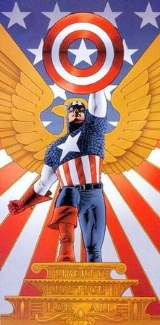
Captain America is a fictional character
Character (arts)
A character is the representation of a person in a narrative work of art . Derived from the ancient Greek word kharaktêr , the earliest use in English, in this sense, dates from the Restoration, although it became widely used after its appearance in Tom Jones in 1749. From this, the sense of...

, a superhero
Superhero
A superhero is a type of stock character, possessing "extraordinary or superhuman powers", dedicated to protecting the public. Since the debut of the prototypical superhero Superman in 1938, stories of superheroes — ranging from brief episodic adventures to continuing years-long sagas —...

 that appears in comic book
Comic book
A comic book or comicbook is a magazine made up of comics, narrative artwork in the form of separate panels that represent individual scenes, often accompanied by dialog as well as including...

s published by Marvel Comics
Marvel Comics
Marvel Worldwide, Inc., commonly referred to as Marvel Comics and formerly Marvel Publishing, Inc. and Marvel Comics Group, is an American company that publishes comic books and related media...

. The character first appeared
First appearance
In comic books and other stories with a long history, first appearance refers to the first occurrence to feature a fictional character.-Monetary value of first appearance issues:...

 in Captain America Comics #1 (cover-dated March 1941), from Marvel Comics' 1940s predecessor, Timely Comics
Timely Comics
Timely Comics, an imprint of Timely Publications, was the earliest comic book arm of American publisher Martin Goodman, and the entity that would evolve by the 1960s to become Marvel Comics....

, and was created by Joe Simon
Joe Simon
Joseph Henry "Joe" Simon is an American comic book writer, artist, editor, and publisher. Simon created or co-created many important characters in the 1930s-1940s Golden Age of Comic Books and served as the first editor of Timely Comics, the company that would evolve into Marvel Comics.With his...

 and Jack Kirby
Jack Kirby
Jack Kirby , born Jacob Kurtzberg, was an American comic book artist, writer and editor regarded by historians and fans as one of the major innovators and most influential creators in the comic book medium....

. Over the years, an estimated 210 million copies of "Captain America" comic books have been sold in a total of 75 countries. For nearly all of the character's publication history, Captain America was the alter ego
Alter ego
An alter ego is a second self, which is believe to be distinct from a person's normal or original personality. The term was coined in the early nineteenth century when dissociative identity disorder was first described by psychologists...

 of Steve Rogers, a frail young man who was enhanced to the peak of human perfection by an experimental serum in order to aid the United States
United States
The United States of America is a federal constitutional republic comprising fifty states and a federal district...

 war effort. Captain America wears a costume that bears an American flag
Flag of the United States
The national flag of the United States of America consists of thirteen equal horizontal stripes of red alternating with white, with a blue rectangle in the canton bearing fifty small, white, five-pointed stars arranged in nine offset horizontal rows of six stars alternating with rows...

 motif, and is armed with an indestructible shield
Captain America's shield
Captain America's shield is a fictional item, the primary defensive and offensive piece of equipment used by the Marvel Comics superhero Captain America; he is seldom seen without it. Over the years, Captain America has had the use of several different shields of varying composition and design...

 that can be thrown as a weapon.
Discussion
Ask a question about 'Captain America'
Start a new discussion about 'Captain America'
Answer questions from other users
Full Discussion Forum
 
Quotations

Keep flying, son. And watch that potty mouth!

Crashing on top of a flying F-15, after the pilot exclaims "Jeezus!" in Civil War 1

Weapons down or I will not be responsible for what comes next.

Facing S.H.I.E.L.D. Cape-Killers in Civil War 1

Ninety percent of the casualties of World War I were soldiers, fraulein. But half the people who died in World War II were civilians... Half of sixty-one million. I know why I'm fighting, fraulein. I don't want to see World War III.

To a German student, Captain America vol. 4 5. Actual WW2 death figures around 72 million.

I'm loyal to nothing, General.. except the Dream.

After an army general confronts him about his loyalty, Daredevil(Marvel Comics)|Daredevil 233

I fought your kind every day of that war, Zemo! You mocked democracy and said that free men were weak! Well feel this grip, Zemo - it's the grip of a man who loves liberty! Look into the eyes of your foe, and know that he will die for his freedoms! The world must never again mistake compassion for weakness! And while I live - it had better not!

Avengers (comics)|Avengers, vol.1 6

Avengers assemble!

Various comics where he appears with the Avengers (comics)|Avengers

Do you actually think the fact that you know how to program a computer makes you more of a human being than me? That I'm out of touch because I don't know what you know? I know what freedom is. I know what it feels like to fight for it and I know what it costs to have it. You know compromise.

To Tony Stark, Director of S.H.I.E.L.D. , Civil War: The Confession
Encyclopedia
Captain America is a fictional character
Character (arts)
A character is the representation of a person in a narrative work of art . Derived from the ancient Greek word kharaktêr , the earliest use in English, in this sense, dates from the Restoration, although it became widely used after its appearance in Tom Jones in 1749. From this, the sense of...

, a superhero
Superhero
A superhero is a type of stock character, possessing "extraordinary or superhuman powers", dedicated to protecting the public. Since the debut of the prototypical superhero Superman in 1938, stories of superheroes — ranging from brief episodic adventures to continuing years-long sagas —...

 that appears in comic book
Comic book
A comic book or comicbook is a magazine made up of comics, narrative artwork in the form of separate panels that represent individual scenes, often accompanied by dialog as well as including...

s published by Marvel Comics
Marvel Comics
Marvel Worldwide, Inc., commonly referred to as Marvel Comics and formerly Marvel Publishing, Inc. and Marvel Comics Group, is an American company that publishes comic books and related media...

. The character first appeared
First appearance
In comic books and other stories with a long history, first appearance refers to the first occurrence to feature a fictional character.-Monetary value of first appearance issues:...

 in Captain America Comics #1 (cover-dated March 1941), from Marvel Comics' 1940s predecessor, Timely Comics
Timely Comics
Timely Comics, an imprint of Timely Publications, was the earliest comic book arm of American publisher Martin Goodman, and the entity that would evolve by the 1960s to become Marvel Comics....

, and was created by Joe Simon
Joe Simon
Joseph Henry "Joe" Simon is an American comic book writer, artist, editor, and publisher. Simon created or co-created many important characters in the 1930s-1940s Golden Age of Comic Books and served as the first editor of Timely Comics, the company that would evolve into Marvel Comics.With his...

 and Jack Kirby
Jack Kirby
Jack Kirby , born Jacob Kurtzberg, was an American comic book artist, writer and editor regarded by historians and fans as one of the major innovators and most influential creators in the comic book medium....

. Over the years, an estimated 210 million copies of "Captain America" comic books have been sold in a total of 75 countries. For nearly all of the character's publication history, Captain America was the alter ego
Alter ego
An alter ego is a second self, which is believe to be distinct from a person's normal or original personality. The term was coined in the early nineteenth century when dissociative identity disorder was first described by psychologists...

 of Steve Rogers, a frail young man who was enhanced to the peak of human perfection by an experimental serum in order to aid the United States
United States
The United States of America is a federal constitutional republic comprising fifty states and a federal district...

 war effort. Captain America wears a costume that bears an American flag
Flag of the United States
The national flag of the United States of America consists of thirteen equal horizontal stripes of red alternating with white, with a blue rectangle in the canton bearing fifty small, white, five-pointed stars arranged in nine offset horizontal rows of six stars alternating with rows...

 motif, and is armed with an indestructible shield
Captain America's shield
Captain America's shield is a fictional item, the primary defensive and offensive piece of equipment used by the Marvel Comics superhero Captain America; he is seldom seen without it. Over the years, Captain America has had the use of several different shields of varying composition and design...

 that can be thrown as a weapon.

An intentionally patriotic creation who was often depicted fighting the Axis powers
Axis Powers
The Axis powers , also known as the Axis alliance, Axis nations, Axis countries, or just the Axis, was an alignment of great powers during the mid-20th century that fought World War II against the Allies. It began in 1936 with treaties of friendship between Germany and Italy and between Germany and...

 of World War II
World War II
World War II, or the Second World War , was a global conflict lasting from 1939 to 1945, involving most of the world's nations—including all of the great powers—eventually forming two opposing military alliances: the Allies and the Axis...

, Captain America was Timely Comics' most popular character during the wartime period. After the war ended, the character's popularity waned and he disappeared by the 1950s aside from an ill-fated revival in 1953. Captain America was reintroduced during the Silver Age of comics
Silver Age of Comic Books
The Silver Age of Comic Books was a period of artistic advancement and commercial success in mainstream American comic books, predominantly those in the superhero genre. Following the Golden Age of Comic Books and an interregnum in the early to mid-1950s, the Silver Age is considered to cover the...

 when he was revived from suspended animation
Suspended animation
Suspended animation is the slowing of life processes by external means without termination. Breathing, heartbeat, and other involuntary functions may still occur, but they can only be detected by artificial means. Extreme cold can be used to precipitate the slowing of an individual's functions; use...

 by the superhero team the Avengers
Avengers (comics)
The Avengers is a fictional team of superheroes, appearing in magazines published by Marvel Comics. The team made its debut in The Avengers #1 The Avengers is a fictional team of superheroes, appearing in magazines published by Marvel Comics. The team made its debut in The Avengers #1 The Avengers...

 in The Avengers #4 (March 1964). Since then, Captain America has often led the team, as well as starring in his own series.

Steve Rogers was purportedly assassinated in Captain America vol. 5, #25 (March 2007), although he was later revealed to be alive. The comic-book series Captain America continued to be published, with Rogers' former sidekick, James "Bucky" Barnes
Bucky
Bucky is the name of several fictional characters, masked superheroes in the Marvel Comics universe. The original, James Buchanan "Bucky" Barnes was created by Joe Simon and Jack Kirby as a sidekick character in Captain America Comics #1 , published by Marvel's 1940s predecessor, Timely Comics...

, having taken up the mantle, and keeping it at the insistence of Rogers, who upon his return began operating as an intelligence agent in the Secret Avengers
Secret Avengers
Secret Avengers is an American comic book series published by Marvel Comics featuring a fictional black ops superhero team of the same name. Written by Ed Brubaker, the series depicts a new version of Marvel's premiere super hero team, the Avengers, which operates under the guidance and leadership...

 title, and in the limited series
Limited series
A limited series is a comic book series with a set number of installments. A limited series differs from an ongoing series in that the number of issues is determined before production and it differs from a one shot in that it is composed of multiple issues....

 Steve Rogers: Super Soldier, before resuming the identity after Bucky was killed in the line of duty.

Captain America was the first Marvel Comics character adapted into another medium with the release of the 1944
1944 in film
The year 1944 in film involved some significant events, including the wholesome, award-winning Going My Way plus popular murder mysteries such as Double Indemnity, Gaslight and Laura.-Events:*July 20 - Since You Went Away is released....

 movie serial
Serial (film)
Serials, more specifically known as Movie serials, Film serials or Chapter plays, were short subjects originally shown in theaters in conjunction with a feature film. They were related to pulp magazine serialized fiction...

 Captain America
Captain America (serial)
Captain America is a Republic black-and-white serial film based on the comic book character Captain America. It was the last Republic serial made about a superhero...

. Since then, the character has been featured in several other films and television series, including Captain America: The First Avenger
Captain America: The First Avenger
Captain America: The First Avenger is a 2011 American superhero film based on the Marvel Comics character Captain America. It is the fifth installment of the Marvel Cinematic Universe...

, released on July 22, 2011. Captain America was ranked 6th on IGN's Top 100 Comic Book Heroes in 2011.

Publication history


In 1940, writer Joe Simon
Joe Simon
Joseph Henry "Joe" Simon is an American comic book writer, artist, editor, and publisher. Simon created or co-created many important characters in the 1930s-1940s Golden Age of Comic Books and served as the first editor of Timely Comics, the company that would evolve into Marvel Comics.With his...

 conceived the idea for Captain America and made a sketch of the character in costume . "I wrote the name 'Super American' at the bottom of the page," Simon said in his autobiography. "No, it didn't work. There were too many 'Supers' around. 'Captain America' had a good sound to it. There weren't a lot of captains in comics. It was as easy as that. The boy companion was simply named Bucky, after my friend Bucky Pierson, a star on our high school basketball team."

Simon recalled in his autobiography that Timely Comics
Timely Comics
Timely Comics, an imprint of Timely Publications, was the earliest comic book arm of American publisher Martin Goodman, and the entity that would evolve by the 1960s to become Marvel Comics....

 publisher Martin Goodman
Martin Goodman (publisher)
Martin Goodman born on was an American publisher of pulp magazines, paperback books, men's adventure magazines, and comic books, launching the company that would become Marvel Comics....

 gave him the go-ahead and directed that a Captain America solo comic book series be published as soon as possible. Needing to fill a full comic with primarily one character's stories, Simon did not believe that his regular creative partner, artist Jack Kirby
Jack Kirby
Jack Kirby , born Jacob Kurtzberg, was an American comic book artist, writer and editor regarded by historians and fans as one of the major innovators and most influential creators in the comic book medium....

, could handle the workload alone:

Al Liederman would ink that first issue, which was lettered by Simon and Kirby's regular letterer, Howard Ferguson.

Simon said Captain America was a consciously political creation; he and Kirby were morally repulsed by the actions of Nazi Germany
Nazi Germany
Nazi Germany , also known as the Third Reich , but officially called German Reich from 1933 to 1943 and Greater German Reich from 26 June 1943 onward, is the name commonly used to refer to the state of Germany from 1933 to 1945, when it was a totalitarian dictatorship ruled by...

 in the years leading up to the United States' involvement in World War II and felt war was inevitable: "The opponents to the war were all quite well organized. We wanted to have our say too."

Captain America Comics #1 — cover-dated March 1941 and on sale in December 1940, a year before the attack on Pearl Harbor
Attack on Pearl Harbor
The attack on Pearl Harbor was a surprise military strike conducted by the Imperial Japanese Navy against the United States naval base at Pearl Harbor, Hawaii, on the morning of December 7, 1941...

, but a full year into World War II — showed the protagonist punching Nazi leader Adolf Hitler
Adolf Hitler
Adolf Hitler was an Austrian-born German politician and the leader of the National Socialist German Workers Party , commonly referred to as the Nazi Party). He was Chancellor of Germany from 1933 to 1945, and head of state from 1934 to 1945...

 in the jaw; it sold nearly one million copies. While most readers responded favorably to the comic, some took objection. Simon noted, "When the first issue came out we got a lot of... threatening letters and hate mail. Some people really opposed what Cap stood for." Though preceded as a "patriotically themed superhero" by MLJ
Archie Comics
Archie Comics is an American comic book publisher headquartered in the Village of Mamaroneck, Town of Mamaroneck, New York, known for its many series featuring the fictional teenagers Archie Andrews, Betty Cooper, Veronica Lodge, Reggie Mantle and Jughead Jones. The characters were created by...

's The Shield
The Shield (Archie)
The Shield is the name of several fictional patriotic superheroes created by MLJ . The Shield has the distinction of being one of the first superheroes with a costume based upon the United States flag, appearing fourteen months before Captain America.The name was used by MLJ/Archie for 3 characters...

, Captain America immediately became the most prominent and enduring of that wave of superheroes introduced in American comic books prior to and during World War II
World War II
World War II, or the Second World War , was a global conflict lasting from 1939 to 1945, involving most of the world's nations—including all of the great powers—eventually forming two opposing military alliances: the Allies and the Axis...

. With his sidekick Bucky, Captain America faced Nazis
Nazism
Nazism, the common short form name of National Socialism was the ideology and practice of the Nazi Party and of Nazi Germany...

, Japan
Japan
Japan is an island nation in East Asia. Located in the Pacific Ocean, it lies to the east of the Sea of Japan, China, North Korea, South Korea and Russia, stretching from the Sea of Okhotsk in the north to the East China Sea and Taiwan in the south...

ese, and other threats to wartime America and the Allies
Allies of World War II
The Allies of World War II were the countries that opposed the Axis powers during the Second World War . Former Axis states contributing to the Allied victory are not considered Allied states...

. Stanley Lieber, now better known by his pen name
Pen name
A pen name, nom de plume, or literary double, is a pseudonym adopted by an author. A pen name may be used to make the author's name more distinctive, to disguise his or her gender, to distance an author from some or all of his or her works, to protect the author from retribution for his or her...

 Stan Lee
Stan Lee
Stan Lee is an American comic book writer, editor, actor, producer, publisher, television personality, and the former president and chairman of Marvel Comics....

, contributed to the character in issue #3 in the filler text story "Captain America Foils the Traitor's Revenge," which introduced the character's use of his shield as a returning throwing weapon. Captain America soon became Timely's most popular character and even had a fan-club called the "Sentinels of Liberty."

Circulation figures remained close to a million copies per month after the debut issue, which outstripped even the circulation of news magazines like Time
Time (magazine)
Time is an American news magazine. A European edition is published from London. Time Europe covers the Middle East, Africa and, since 2003, Latin America. An Asian edition is based in Hong Kong...

 during the period. After the Simon and Kirby team moved to DC in late 1941, having produced Captain America Comics through issue #10 (January 1942), Al Avison
Al Avison
Alfred Avison is an American comic book artist known for his work on the Marvel Comics characters Captain America and the Whizzer during the 1930-1940s period known to fans and historians as the Golden Age of comic books....

 and Syd Shores
Syd Shores
Sydney Shores was an American comic book artist known for his work on Captain America both during the 1940s, in what fans and historians call the Golden Age of comic books, and during the 1960s Silver Age of comic books....

 became regular penciller
Penciller
A penciller is an artist who works in the creation of comic books, graphic novels, and similar visual art forms.The penciller is the first step in rendering the story in visual form and may require several steps of feedback with the writer. These artists are concerned with layout to showcase...

s of the celebrated title, with one generally inking
Inker
The inker is one of the two line artists in a traditional comic book or graphic novel. After a pencilled drawing is given to the inker, the inker uses black ink to produce refined outlines over the pencil lines...

 over the other. The character was also featured in All Winners Comics
All Winners Comics
All Winners Comics was the name of two American comic book series of the 1940s, both published by Marvel Comics' predecessor, Timely Comics, during the period fans and historians call the Golden Age of Comic Books. A superhero anthology comic in both cases, they variously featured such star...

 #1-19 (Summer 1941 – Fall 1946), Marvel Mystery Comics
Marvel Mystery Comics
Marvel Mystery Comics is an American comic book series published during the 1930s-1940s period known to fans and historians as the Golden Age of Comic Books...

 #80-84 and #86-92, USA Comics #6-17 (Dec. 1942 – Fall 1945), and All Select Comics
All Select Comics
All Select Comics is an American comic book series published by Timely Comics, the 1940s predecessor of Marvel Comics, during the period fans and historians call the Golden Age of comic books...

 #1-10 (Fall 1943 – Summer 1946).

In the post-war era, with the popularity of superheroes fading, Captain America led Timely's first superhero team, the All-Winners Squad
All-Winners Squad
The All-Winners Squad is a fictional superhero team in the Marvel Comics universe. The company's first such team, it first appeared in All Winners Comics #19 , published by Marvel predecessor Timely Comics during the period fans and historians call the Golden Age of Comic Books.While the comic-book...

, in its two published adventures, in All Winners Comics
All Winners Comics
All Winners Comics was the name of two American comic book series of the 1940s, both published by Marvel Comics' predecessor, Timely Comics, during the period fans and historians call the Golden Age of Comic Books. A superhero anthology comic in both cases, they variously featured such star...

 #19 and #21 (Fall–Winter 1946; there was no issue #20). After Bucky was shot and wounded in a 1948 Captain America story, he was succeeded by Captain America's girlfriend, Betsy Ross, who became the superheroine Golden Girl
Golden Girl
Golden Girl is the name of two fictional superheroine characters in comic books published by Marvel Comics, the first of them during the 1930-1940s period known to historians and collectors as the Golden Age of Comic Books.-Golden Girl :...

. Captain America Comics ended with issue #75 (Feb. 1950), by which time the series had been titled Captain America's Weird Tales for two issues, with the finale being a horror/suspense anthology issue with no superheroes.

Atlas Comics
Atlas Comics (1950s)
Atlas Comics is the term used to describe the 1950s comic book publishing company that would evolve into Marvel Comics. Magazine and paperback novel publisher Martin Goodman, whose business strategy involved having a multitude of corporate entities, used Atlas as the umbrella name for his comic...

 attempted to revive its superhero titles when it reintroduced Captain America, along with the original Human Torch and the Sub-Mariner, in Young Men #24 (Dec. 1953). Billed as "Captain America, Commie Smasher!" Captain America appeared during the next year in Young Men #24-28 and Men's Adventures #27-28, as well as in issues #76-78 of an eponymous title. Atlas' attempted superhero revival was a commercial failure, and the character's title was canceled with Captain America #78 (Sept. 1954).

Silver Age revival


In the Human Torch
Human Torch
The Human Torch is a fictional character and superhero appearing in comic books published by Marvel Comics. Created by writer Stan Lee and artist Jack Kirby, he is a member of the superhero team the Fantastic Four, debuting in The Fantastic Four #1...

 story titled "Captain America" in Marvel Comics' Strange Tales
Strange Tales
Strange Tales is the name of several comic book anthology series published by Marvel Comics. It introduced the features "Doctor Strange" and "Nick Fury, Agent of S.H.I.E.L.D.", and was a showcase for the science fiction/suspense stories of artists Jack Kirby and Steve Ditko, and for the...

 #114 (Nov. 1963), writer-editor Stan Lee
Stan Lee
Stan Lee is an American comic book writer, editor, actor, producer, publisher, television personality, and the former president and chairman of Marvel Comics....

 and artist and co-plotter Jack Kirby
Jack Kirby
Jack Kirby , born Jacob Kurtzberg, was an American comic book artist, writer and editor regarded by historians and fans as one of the major innovators and most influential creators in the comic book medium....

 depicted the brash young Fantastic Four
Fantastic Four
The Fantastic Four is a fictional superhero team appearing in comic books published by Marvel Comics. The group debuted in The Fantastic Four #1 , which helped to usher in a new level of realism in the medium...

 member Johnny Storm, the Human Torch, in an exhibition performance with Captain America, described as a legendary World War II
World War II
World War II, or the Second World War , was a global conflict lasting from 1939 to 1945, involving most of the world's nations—including all of the great powers—eventually forming two opposing military alliances: the Allies and the Axis...

 and 1950s superhero who has returned after many years of apparent retirement. The 18-page story ends with this Captain America revealed as an impostor: it was actually the villain the Acrobat
Acrobat (comics)
Acrobat is a fictional character in the Marvel Universe, a minor enemy of the Fantastic Four and a former circus performer. As the acrobat, he has often clashed with other heroes like Captain America and sometimes Spider-Man...

, a former circus performer the Torch had defeated in Strange Tales #106, who broke two thieves out of jail, hoping to draw the police away while trying to rob the local bank. Afterward, Storm digs out an old comic book in which Captain America is shown to be Steve Rogers. A caption in the final panel says this story was a test to see if readers would like Captain America to return.

Captain America was then formally reintroduced in The Avengers
Avengers (comics)
The Avengers is a fictional team of superheroes, appearing in magazines published by Marvel Comics. The team made its debut in The Avengers #1 The Avengers is a fictional team of superheroes, appearing in magazines published by Marvel Comics. The team made its debut in The Avengers #1 The Avengers...

 #4 (March 1964), which explained that in the final days of WWII, he had fallen from an experimental drone plane
Unmanned aerial vehicle
An unmanned aerial vehicle , also known as a unmanned aircraft system , remotely piloted aircraft or unmanned aircraft, is a machine which functions either by the remote control of a navigator or pilot or autonomously, that is, as a self-directing entity...

 into the North Atlantic Ocean
Atlantic Ocean
The Atlantic Ocean is the second-largest of the world's oceanic divisions. With a total area of about , it covers approximately 20% of the Earth's surface and about 26% of its water surface area...

 and spent decades frozen in a block of ice in a state of suspended animation
Suspended animation
Suspended animation is the slowing of life processes by external means without termination. Breathing, heartbeat, and other involuntary functions may still occur, but they can only be detected by artificial means. Extreme cold can be used to precipitate the slowing of an individual's functions; use...

. He quickly became leader of that superhero team. Following the success of other Marvel characters introduced during the 1960s, Captain America was recast as a hero "haunted by past memories, and trying to adapt to 1960s society."

After then guest-starring in the feature "Iron Man
Iron Man
Iron Man is a fictional character, a superhero in the . The character was created by writer-editor Stan Lee, developed by scripter Larry Lieber, and designed by artists Don Heck and Jack Kirby, first appearing in Tales of Suspense #39 .A billionaire playboy, industrialist and ingenious engineer,...

" in Tales of Suspense
Tales of Suspense
Tales of Suspense is the name of an American comic book series and two one-shot comics published by Marvel Comics. The first, which ran from 1959 to 1968, began as a science-fiction anthology that served as a showcase for such artists as Jack Kirby, Steve Ditko, and Don Heck, then featured...

 #58 (Oct. 1964), Captain America gained his own solo feature in that "split book," beginning the following issue. Kirby, Captain America's co-creator, was illustrating his hero's solo adventures again for the first time since 1941. Issue #63 (March 1965), which retold Captain America's origin, through issue #71 (Nov. 1965) was a period feature set during World War II and co-starred Captain America's Golden Age sidekick, Bucky.

In the 1970s, the post-war versions of Captain America were retcon
Retcon
Retroactive continuity is the alteration of previously established facts in a fictional work. Retcons are done for many reasons, including the accommodation of sequels or further derivative works in a series, wherein newer authors or creators want to revise the in-story history to allow a course...

ned into separate, successive characters who briefly took up the mantle of Captain America after Steve Rogers went into suspended animation
Suspended animation
Suspended animation is the slowing of life processes by external means without termination. Breathing, heartbeat, and other involuntary functions may still occur, but they can only be detected by artificial means. Extreme cold can be used to precipitate the slowing of an individual's functions; use...

 near the end of World War II. The hero found a new generation of readers as leader of the all-star superhero team the Avengers, and in a new solo feature beginning in Tales of Suspense
Tales of Suspense
Tales of Suspense is the name of an American comic book series and two one-shot comics published by Marvel Comics. The first, which ran from 1959 to 1968, began as a science-fiction anthology that served as a showcase for such artists as Jack Kirby, Steve Ditko, and Don Heck, then featured...

 #59 (Nov. 1964), a "split book" shared with the feature "Iron Man
Iron Man
Iron Man is a fictional character, a superhero in the . The character was created by writer-editor Stan Lee, developed by scripter Larry Lieber, and designed by artists Don Heck and Jack Kirby, first appearing in Tales of Suspense #39 .A billionaire playboy, industrialist and ingenious engineer,...

". Kirby drew all but two of the stories in Tales of Suspense, which became Captain America with #100 (April 1968); Gil Kane
Gil Kane
Eli Katz who worked under the name Gil Kane and in one instance Scott Edward, was a comic book artist whose career spanned the 1940s to 1990s and every major comics company and character.Kane co-created the modern-day versions of the superheroes Green Lantern and the Atom for DC Comics, and...

 and John Romita, Sr.
John Romita, Sr.
John V. Romita, Sr. is an Italian-American comic-book artist best known for his work on Marvel Comics' The Amazing Spider-Man...

, each filled in once. Several stories were finished by penciller-inker George Tuska
George Tuska
George Tuska , who early in his career used a variety of pen names including Carl Larson, was an American comic book and newspaper comic strip artist best known for his 1940s work on various Captain Marvel titles and the crime fiction series Crime Does Not Pay, for and his 1960s work illustrating...

 over Kirby layouts, with one finished by Romita Sr. and another by penciller Dick Ayers
Dick Ayers
Richard "Dick" Ayers is an American comic book artist and cartoonist best known for his work as one of Jack Kirby's inkers during the late-1950s and 1960s period known as the Silver Age of Comics, including on some of the earliest issues of Marvel Comics' The Fantastic Four, and as the signature...

 and inker John Tartaglione
John Tartaglione
John Tartaglione , a.k.a. '"John Tartag." and other pseudonyms, was an American comic book artist best known as a 1950s romance-comics artist; a Marvel Comics inker during the Silver Age of comic books; and the illustrator of the Marvel biographies The Life of Pope John Paul II, and Mother Teresa...

. Kirby's regular inkers on the series were Frank Giacoia
Frank Giacoia
Frank Giacoia was an American comic book artist known primarily as an inker. He sometimes worked under the name Frank Ray, and to a lesser extent Phil Zupa, and the single moniker Espoia .-Early life and career:Frank Giacoia studied at Manhattan's School of...

 (as "Frank Ray") and Joe Sinnott
Joe Sinnott
Joe Sinnott is an American comic book artist. Working primarily as an inker, Sinnott is best-known for his long stint on Marvel Comics' Fantastic Four, from 1965 to 1981 , initially over the pencils of industry legend Jack Kirby...

, though Don Heck
Don Heck
Don Heck was an American comic book artist best known for co-creating the Marvel Comics character Iron Man, and for his long run penciling the Marvel superhero-team series The Avengers during the 1960s Silver Age of comic books.-Early life and career:Born in the Jamaica neighborhood of Queens, New...

 and Golden Age Captain America artist Syd Shores
Syd Shores
Sydney Shores was an American comic book artist known for his work on Captain America both during the 1940s, in what fans and historians call the Golden Age of comic books, and during the 1960s Silver Age of comic books....

 inked one story each. The new title Captain America continued to feature artwork by Kirby, as well as a short run by Jim Steranko
Jim Steranko
James F. Steranko is an American graphic artist, comic book writer-artist-historian, magician, publisher and film production illustrator....

, and work by many of the industry's top artists and writers. It was called Captain America and the Falcon from #134-222 (although the Falcon's name was not on the cover for issues #193, 200, and 216).

This series — considered Captain America volume one by comics researchers and historians, following the 1940s Captain America Comics and its 1950s numbering continuation — ended with #454 (Aug. 1996).

After the Silver Age


This series was almost immediately followed by the 13-issue Captain America vol. 2 (Nov. 1996 – Nov. 1997), the 50-issue Captain America vol. 3 (Jan. 1998 – Feb. 2002), the 32-issue Captain America vol. 4 (June 2002 – Dec. 2004), and Captain America vol. 5 (Jan. 2005 – July 2009). Beginning with the 600th overall issue counting these series, Captain America resumed its original numbering with issue #600, as if the series numbering had continued uninterrupted after #454.

As part of the aftermath of Marvel Comics' company-crossover storyline "Civil War
Civil War (comics)
Civil War is a 2006-2007 Marvel Comics crossover storyline built around a self-titled seven-issue limited series written by Mark Millar and penciled by Steve McNiven, which ran through various other titles published by Marvel at the time...

", Steve Rogers was ostensibly killed in Captain America vol. 5, #25 (March 2007). Series writer Ed Brubaker
Ed Brubaker
Ed Brubaker is an Eisner Award-winning comic book writer and cartoonist. Brubaker first early comics work was primarily in the crime fiction genre with works such as Lowlife, The Fall, Sandman Presents: Dead Boy Detectives and Scene of the Crime...

 remarked, "What I found is that all the really hard-core left-wing fans want Cap to be standing out on and giving speeches on the street corner against the George W. Bush
George W. Bush
George Walker Bush is an American politician who served as the 43rd President of the United States, from 2001 to 2009. Before that, he was the 46th Governor of Texas, having served from 1995 to 2000....

 administration, and all the really right-wing fans all want him to be over in the streets of Baghdad
Baghdad
Baghdad is the capital of Iraq, as well as the coterminous Baghdad Governorate. The population of Baghdad in 2011 is approximately 7,216,040...

, punching out Saddam Hussein
Saddam Hussein
Saddam Hussein Abd al-Majid al-Tikriti was the fifth President of Iraq, serving in this capacity from 16 July 1979 until 9 April 2003...

." The character's co-creator, Joe Simon
Joe Simon
Joseph Henry "Joe" Simon is an American comic book writer, artist, editor, and publisher. Simon created or co-created many important characters in the 1930s-1940s Golden Age of Comic Books and served as the first editor of Timely Comics, the company that would evolve into Marvel Comics.With his...

, remarked, "It's a hell of a time for him to go. We really need him now." Artist Alex Ross
Alex Ross
Nelson Alexander "Alex" Ross is an American comic book painter, illustrator, and plotter. He is praised for his realistic, human depictions of classic comic book characters. Since the 1990s he has done work for Marvel Comics and DC Comics Nelson Alexander "Alex" Ross (born January 22, 1970) is an...

 designed a slightly revised Captain America costume that former sidekick Bucky Barnes began to wear as the new Captain America in vol. 5, #34 (March 2008)

The storyline of Rogers' return began in issue #600. Rogers, who was not dead but caroming through time, returned to the present day in the six-issue miniseries Captain America: Reborn
Captain America: Reborn
Captain America: Reborn is a six-issue monthly comic book limited series published by Marvel Comics between July 2009 and January 2010...

 (Sept. 2009 – March 2010).

After Rogers' return, Barnes, at Rogers' insistence, continued as Captain America, beginning in the one-shot comic Captain America: Who Will Wield the Shield? (Feb. 2010). While Bucky Barnes continued adventuring in the pages of Captain America, Steve Rogers received his own miniseries (Steve Rogers: Super-Soldier) as well as taking on the leadership position in a new Secret Avengers ongoing series.

Spinoff series included Captain America Sentinel of Liberty (Sept. 1998 – Aug. 1999) and Captain America and the Falcon
Captain America and the Falcon
Captain America and the Falcon was a comic book series published for fifteen issues in 2004 and 2005 by Marvel Comics. The series' title is a reuse of the cover title of Captain America's solo series during a period in which the Falcon was given second billing on the front cover...

 (May 2004 – June 2005). The 1940s Captain America appeared alongside the 1940s Human Torch and Sub-Mariner in the 12-issue miniseries
Miniseries
A miniseries , in a serial storytelling medium, is a television show production which tells a story in a limited number of episodes. The exact number is open to interpretation; however, they are usually limited to fewer than a whole season. The term "miniseries" is generally a North American term...

 Avengers/Invaders. The 2007 mini-series
Limited series
A limited series is a comic book series with a set number of installments. A limited series differs from an ongoing series in that the number of issues is determined before production and it differs from a one shot in that it is composed of multiple issues....

 Captain America: The Chosen, written by David Morrell
David Morrell
David Morrell is a Canadian-American novelist, best known for his debut 1972 novel First Blood, which would later become the successful Rambo film franchise starring Sylvester Stallone. He has written 28 novels, and his work has been translated into 26 languages...

 and penciled by Mitchell Breitweiser, depicts a dying Steve Rogers' final minutes, at S.H.I.E.L.D.
S.H.I.E.L.D.
S.H.I.E.L.D. is a fictional espionage and a secret military law-enforcement agency in the Marvel Comics Universe. Created by Stan Lee and Jack Kirby in Strange Tales #135 , it often deals with superhuman threats....

 headquarters, as his spirit guides James Newman, a young American marine fighting in Afghanistan
Afghanistan
Afghanistan , officially the Islamic Republic of Afghanistan, is a landlocked country located in the centre of Asia, forming South Asia, Central Asia and the Middle East. With a population of about 29 million, it has an area of , making it the 42nd most populous and 41st largest nation in the world...

. The Chosen is not part of the main Marvel Universe continuity.

Marvel stated in May 2011 that Rogers, following the public death of Bucky Barnes in the Fear Itself
Fear Itself (comics)
"Fear Itself" is a 2011 crossover comic book storyline published by Marvel Comics, consisting of a seven-issue, eponymous miniseries written by Matt Fraction and illustrated by Stuart Immonen, Wade Von Grawbadger, and Laura Martin, a prologue book by writer Ed Brubaker and artist Scott Eaton, and...

 miniseries, would resume his Captain America identity in a sixth volume of Captain America, by writer Ed Brubaker and artist Steve McNiven
Steve McNiven
Steven "Steve" McNiven is a Canadian comic book artist. He first gained prominence on CrossGen's Meridian, before moving onto books such as Ultimate Secret, New Avengers and Civil War.-Career:...

.

1940s


Steve Rogers was born July 4, 1917, in the Lower East Side
Lower East Side
The Lower East Side, LES, is a neighborhood in the southeastern part of the New York City borough of Manhattan. It is roughly bounded by Allen Street, East Houston Street, Essex Street, Canal Street, Eldridge Street, East Broadway, and Grand Street....

 of Manhattan
Manhattan
Manhattan is the oldest and the most densely populated of the five boroughs of New York City. Located primarily on the island of Manhattan at the mouth of the Hudson River, the boundaries of the borough are identical to those of New York County, an original county of the state of New York...

, New York City
New York City
New York is the most populous city in the United States and the center of the New York Metropolitan Area, one of the most populous metropolitan areas in the world. New York exerts a significant impact upon global commerce, finance, media, art, fashion, research, technology, education, and...

, to Irish
Irish people
The Irish people are an ethnic group who originate in Ireland, an island in northwestern Europe. Ireland has been populated for around 9,000 years , with the Irish people's earliest ancestors recorded having legends of being descended from groups such as the Nemedians, Fomorians, Fir Bolg, Tuatha...

 immigrants Sarah and Joseph Rogers. Joseph Rogers died when Steve was only a child and his mother, Sarah, died of pneumonia while Steve was a teen. By early 1940, before America's entry into World War II
World War II
World War II, or the Second World War , was a global conflict lasting from 1939 to 1945, involving most of the world's nations—including all of the great powers—eventually forming two opposing military alliances: the Allies and the Axis...

, Rogers is a tall but scrawny fine art
Fine art
Fine art or the fine arts encompass art forms developed primarily for aesthetics and/or concept rather than practical application. Art is often a synonym for fine art, as employed in the term "art gallery"....

s student specializing in illustration. Disturbed by the rise of the Third Reich, Rogers attempts to enlist, only to be rejected due to being in poor shape. U.S. Army General Chester Phillips, looking for test subjects, offers Rogers the chance to serve his country by taking part in a top-secret defense project — Operation: Rebirth, which seeks to develop a means of creating physically superior soldiers. Rogers volunteers for the research and, after a rigorous selection process, is chosen as the first human test subject for the Super-Soldier
Supersoldier
Supersoldier is a term often used to describe a soldier that operates beyond normal human limits or abilities. Supersoldiers are common in science fiction literature, films, TV programs, computer, conspiracy theories, and video games, but have also made appearances in other related genres, such as...

 serum developed by the scientist "Dr. Josef Reinstein", later retroactively changed
Retcon
Retroactive continuity is the alteration of previously established facts in a fictional work. Retcons are done for many reasons, including the accommodation of sequels or further derivative works in a series, wherein newer authors or creators want to revise the in-story history to allow a course...

 to a code name for the scientist Abraham Erskine.

That night, Operation: Rebirth is implemented and Rogers receives injections and oral doses of the Super-Soldier Serum. He is then exposed to a controlled burst of "Vita-Rays" that activate and stabilize the chemicals in his system. Although the process is arduous physically, it successfully alters his physiology almost instantly from its relatively frail form to the maximum of human efficiency, greatly enhancing his musculature, reflexes, agility, stamina and intelligence. Erskine declares Rogers to be the first of a new breed of man, a "nearly perfect human being."

The process he underwent has varied from account to account. In the original 1941 story, he was injected with the formula. When the origin was retold in Tales of Suspense #63, the Comics Code Authority and its prohibitions on demonstrations of drug use were in force, and the injection was replaced with drinking a formula. In Captain America #109, the Vita-Rays were first introduced, although a dialogue comment preserved continuity by mentioning that he had also drunk the formula beforehand. The retelling of the story in Captain America #255, however, stated that all three were used in combination. In addition, the limited series, The Adventures of Captain America reveals that Rogers also underwent rigorous physical training in combat prior to his enhancement.

After the physical transformation, Nazi spy
Secret Agent
Secret Agent is a British film directed by Alfred Hitchcock, loosely based on two stories in Ashenden: Or the British Agent by W. Somerset Maugham. The film starred John Gielgud, Peter Lorre, Madeleine Carroll, and Robert Young...

 Heinz Kruger reveals himself and shoots Erskine. Because the scientist had committed crucial portions of the Super-Soldier formula to memory, duplicating it perfectly would be unlikely. The spy dies, killed either while running away to escape Rogers or because Rogers threw him into live machinery. In the 1941 origin story and the Tales of Suspense #63 version, he dies when running into the machinery but is not killed by Rogers; in the Captain America #109 and #255 revision, however, Rogers causes the spy's death by punching him into the machinery.

The United States
United States
The United States of America is a federal constitutional republic comprising fifty states and a federal district...

 government, making the most of its one super-soldier and to hide all information about Operation: Rebirth and its failure, re-imagines him as a superhero who serves as both a counter-intelligence
Counter-intelligence
Counterintelligence or counter-intelligence refers to efforts made by intelligence organizations to prevent hostile or enemy intelligence organizations from successfully gathering and collecting intelligence against them. National intelligence programs, and, by extension, the overall defenses of...

 agent and a propaganda
Propaganda
Propaganda is a form of communication that is aimed at influencing the attitude of a community toward some cause or position so as to benefit oneself or one's group....

 symbol to counter Nazi Germany
Germany
Germany , officially the Federal Republic of Germany , is a federal parliamentary republic in Europe. The country consists of 16 states while the capital and largest city is Berlin. Germany covers an area of 357,021 km2 and has a largely temperate seasonal climate...

's head of terrorist operations, the Red Skull
Red Skull
The Red Skull is a name shared by several fictional characters, all supervillains from the Marvel Comics universe. All incarnations of the character are enemies of Captain America, other superheroes, and the United States in general....

. To that end, Rogers is given a uniform modeled after the American flag (based on Rogers' own sketches) a bulletproof shield, a personal side arm
Side arm
A side arm is a weapon, usually a pistol but can be a dagger, as used in pre-modern times, which is worn on the body in a holster to permit immediate access and use. A side arm is typically required equipment for military personnel and sometimes carried by law enforcement personnel...

, and the codename Captain America. He is also given a cover identity as a clumsy infantry
Infantry
Infantrymen are soldiers who are specifically trained for the role of fighting on foot to engage the enemy face to face and have historically borne the brunt of the casualties of combat in wars. As the oldest branch of combat arms, they are the backbone of armies...

 private at Camp Lehigh in Virginia. Barely out of his teens himself, Rogers makes friends with the camp's teenage mascot
Mascot
The term mascot – defined as a term for any person, animal, or object thought to bring luck – colloquially includes anything used to represent a group with a common public identity, such as a school, professional sports team, society, military unit, or brand name...

, James Buchanan "Bucky" Barnes.

Barnes accidentally learns of Rogers' dual identity
Secret identity
A secret identity is an element of fiction wherein a character develops a separate persona , while keeping their true identity hidden. The character also may wear a disguise...

 and offers to keep the secret if he can become Captain America's sidekick
Sidekick
A sidekick is a close companion who is generally regarded as subordinate to the one he accompanies. Some well-known fictional sidekicks are Don Quixote's Sancho Panza, Sherlock Holmes' Doctor Watson, The Lone Ranger's Tonto, The Green Hornet's Kato and Batman's Robin.-Origins:The origin of the...

. Rogers agrees and trains Barnes. Rogers meets President Franklin D. Roosevelt
Franklin D. Roosevelt
Franklin Delano Roosevelt , also known by his initials, FDR, was the 32nd President of the United States and a central figure in world events during the mid-20th century, leading the United States during a time of worldwide economic crisis and world war...

, who presents him with a new shield
Captain America's shield
Captain America's shield is a fictional item, the primary defensive and offensive piece of equipment used by the Marvel Comics superhero Captain America; he is seldom seen without it. Over the years, Captain America has had the use of several different shields of varying composition and design...

, forged from an alloy of steel
Steel
Steel is an alloy that consists mostly of iron and has a carbon content between 0.2% and 2.1% by weight, depending on the grade. Carbon is the most common alloying material for iron, but various other alloying elements are used, such as manganese, chromium, vanadium, and tungsten...

 and vibranium
Vibranium
Vibranium is a fictional metal that appears in the Marvel Universe. It is most commonly known as one of the materials used to construct Captain America's shield, but it is also noted for its connection to the Black Panther and his native homeland of Wakanda .-Publication history:Vibranium first...

, fused by an unknown catalyst. The alloy is indestructible, yet the shield is light enough to use as a discus
Discus
Discus, "disk" in Latin, may refer to:* Discus , a progressive rock band from Indonesia* Discus , a fictional character from the Marvel Comics Universe and enemy of Luke Cage* Discus , a freshwater fish popular with aquarium keepers...

-like weapon that can be angled to return to him. It proves so effective that Captain America forgoes the sidearm. Throughout World War II, Captain America and Bucky fight the Nazi menace both on their own and as members of the superhero team the Invaders
Invaders (comics)
The Invaders is the name of two fictional superhero teams in the . The original team was created by writer Roy Thomas and artist Sal Buscema in The Avengers #71 . A present-day incarnation was introduced by writer Chuck Austen and artist Scott Kolins in The Avengers vol...

 (as seen in the 1970s comic of the same name). Captain America also battles a number of criminal menaces on American soil, including a wide variety of costumed villains: the Wax Man, the Hangman, the Fang, the Black Talon, and the White Death, among many others.

In late April 1945, during the closing days of World War II, Captain America and Bucky try to stop the villainous Baron Zemo from destroying an experimental drone plane. Zemo launches the plane with an armed explosive on it, with Rogers and Barnes in hot pursuit. They reach the plane just before it takes off, but when Bucky tries to defuse the bomb, it explodes in mid-air. The young man is believed killed, and Rogers is hurled into the freezing waters of the North Atlantic. Neither body is found, and both are presumed dead. It is later revealed that neither character actually died.

Late 1940s to 1950s


Captain America continued to appear in comics for the next few years changing from World War II-era hero fighting against the Nazis to trying to defeat the United States' newest enemy, Communism
Communism
Communism is a social, political and economic ideology that aims at the establishment of a classless, moneyless, revolutionary and stateless socialist society structured upon common ownership of the means of production...

. The revival of the character in the mid-1950s is short-lived, and events during that time period are later retcon
Retcon
Retroactive continuity is the alteration of previously established facts in a fictional work. Retcons are done for many reasons, including the accommodation of sequels or further derivative works in a series, wherein newer authors or creators want to revise the in-story history to allow a course...

ned to show that multiple people operated using the code name in order to explain the changes in the character. These Post World War II successors are listed as William Naslund and Jeffrey Mace
Jeffrey Mace
Jeffrey Solomon "Jeff" Mace, also known as the Patriot and Captain America, is a fictional character, a superhero in the Marvel Comics universe, created during the 1940s period which fans and historians call the Golden Age of Comic Books...

.

The last of these other official Captains was a man who was so devoted to emulating Captain America that he had had his appearance surgically altered to resemble Rogers. His tenure and distinctive modified costume would result in him being later formally addressed as the "1950s Captain America". Furthermore, he also treated himself and a protege to an acquired Nazi copy of the Super-Soldier serum to become the new Captain America and Bucky, but were unaware of the necessary Vita-Ray component. As a result, the raw chemicals administered began to have serious detrimental effects on the pair's minds, rendering them both violently paranoid and regarding even innocent people as communist sympathizers during the height of the Red Scare
Red Scare
Durrell Blackwell Durrell Blackwell The term Red Scare denotes two distinct periods of strong Anti-Communism in the United States: the First Red Scare, from 1919 to 1920, and the Second Red Scare, from 1947 to 1957. The First Red Scare was about worker revolution and...

 of the 1950s. After it became evident that the two were insane, they were captured and placed in indefinite cryogenic storage by the US Government until they could be cured of their mental illness. The 1950s Bucky would be cured and go on to be the original Cap partner for a time under the Nomad identity.

1960s to 1970s


Years later, the superhero team the Avengers
Avengers (comics)
The Avengers is a fictional team of superheroes, appearing in magazines published by Marvel Comics. The team made its debut in The Avengers #1 The Avengers is a fictional team of superheroes, appearing in magazines published by Marvel Comics. The team made its debut in The Avengers #1 The Avengers...

 discovers Steve Rogers' body in the North Atlantic, the Captain's uniform under his soldier's fatigues and still carrying his shield. After he revives, they piece together that Rogers had been preserved in a block of ice since 1945, surviving in such a state only because of his enhancements from Operation: Rebirth. The block had begun to melt after the Sub-Mariner, enraged that an Arctic
Arctic
The Arctic is a region located at the northern-most part of the Earth. The Arctic consists of the Arctic Ocean and parts of Canada, Russia, Greenland, the United States, Norway, Sweden, Finland, and Iceland. The Arctic region consists of a vast, ice-covered ocean, surrounded by treeless permafrost...

 Inuit
Inuit
The Inuit are a group of culturally similar indigenous peoples inhabiting the Arctic regions of Canada , Denmark , Russia and the United States . Inuit means “the people” in the Inuktitut language...

 tribe is worshiping the frozen figure, throws it into the ocean. Rogers accepts membership in the Avengers, and although long out of his time, his considerable combat experience makes him a valuable asset to the team. He quickly assumes leadership, and has typically returned to that position throughout the team's history.

Captain America is plagued by guilt for having been unable to prevent Bucky's death—a feeling that does not ease for some time. Although he takes the young Rick Jones
Rick Jones (comics)
Richard Milhouse "Rick" Jones is a fictional comic book character in the .-Publication history:Rick Jones first appeared in The Incredible Hulk #1, as a sidekick to the Incredible Hulk...

 (who closely resembles Bucky) under his tutelage, he refuses for some time to allow Jones to take up the Bucky identity, not wishing to be responsible for another youth's death. Insisting that his hero finally move on from that loss, Jones eventually convinces Rogers to let him don the Bucky costume, but this partnership lasts only a short time; a disguised Red Skull
Red Skull
The Red Skull is a name shared by several fictional characters, all supervillains from the Marvel Comics universe. All incarnations of the character are enemies of Captain America, other superheroes, and the United States in general....

, impersonating Rogers with the help of the Cosmic Cube
Cosmic Cube
The Cosmic Cube, called the Tesseract in the film Captain America: The First Avenger, is the name of a fictional object that appears in the Marvel Universe. The concept was created by Stan Lee and Jack Kirby and first appeared in Tales of Suspense #79 .-Publication history:The first Cosmic Cube...

, drives Jones away.

Rogers also reunites with his old war comrade Nick Fury
Nick Fury
Colonel Nicholas Joseph "Nick" Fury is a fictional World War II army hero and present-day super-spy in the Marvel Comics universe. Created by artist Jack Kirby and writer Stan Lee, Fury first appeared in Sgt. Fury and his Howling Commandos #1 , a World War II combat series that portrayed the...

, who is similarly well-preserved due to the "Infinity Formula." As a result, Rogers regularly undertakes missions for the security agency S.H.I.E.L.D.
S.H.I.E.L.D.
S.H.I.E.L.D. is a fictional espionage and a secret military law-enforcement agency in the Marvel Comics Universe. Created by Stan Lee and Jack Kirby in Strange Tales #135 , it often deals with superhuman threats....

 for which Fury is public director. Through Fury, Rogers befriends Sharon Carter
Sharon Carter
Sharon Carter, alias Agent 13, is a fictional character, a secret agent in the Marvel Comics universe. She is an ex-field agent of S.H.I.E.L.D...

, a S.H.I.E.L.D. agent, with whom he eventually begins a romantic relationship.

Rogers later meets and trains Sam Wilson, who becomes the superhero the Falcon
Falcon (comics)
The Falcon is a fictional comic book superhero in comic books published by Marvel Comics.Created by writer-editor Stan Lee and artist Gene Colan, and introduced in Captain America #117 , the character is mainstream comics' first African-American superhero...

, the first African-American superhero in mainstream comic books. The characters established an enduring friendship and adventuring partnership, sharing the series title for some time as Captain America and the Falcon. The two later encounter the revived but still insane 1950s Captain America
Grand Director
The Grand Director , also known as the Captain America of the 1950s is a fictional character in the Marvel Comics Universe...

. Although Rogers and the Falcon defeat the faux Rogers and Jack Monroe, Rogers becomes deeply disturbed that he could have suffered his counterpart's fate.

The series also dealt with the Marvel Universe
Marvel Universe
The Marvel Universe is the shared fictional universe where most comic book titles and other media published by Marvel Entertainment take place, including those featuring Marvel's most familiar characters, such as Spider-Man, the Hulk, the X-Men, and the Avengers.The Marvel Universe is further...

's version of the Watergate scandal
Watergate scandal
The Watergate scandal was a political scandal during the 1970s in the United States resulting from the break-in of the Democratic National Committee headquarters at the Watergate office complex in Washington, D.C., and the Nixon administration's attempted cover-up of its involvement...

, making Rogers so uncertain about his role that he abandons his Captain America identity in favor of one called Nomad
Nomad (comics)
Nomad is the name of a number of superhero characters who have appeared in comic books published by Marvel Comics. The Nomad name and costume was created by writer Steve Englehart and artist Sal Buscema as an alternate identity for the original Captain America, Steve Rogers, in Captain America #180...

, emphasizing the word's meaning as "man without a country". During this time, several men unsuccessfully assume the Captain America identity. Rogers eventually re-assumes it after coming to consider that the identity could be a symbol of American ideals and not its government; it's a personal conviction epitomized when he later confronted a corrupt Army officer attempting to manipulate him by appealing to his loyalty, "I'm loyal to nothing, General... except the [American] Dream." Jack Monroe, cured of his mental instability, later takes up the Nomad alias. During this period, Rogers also temporarily gains super strength. Immediately after witnessing Number One's suicide, he is summoned to the future to participate in the Destiny War
Avengers Forever
Avengers Forever is a twelve-issue comic book limited series published from December 1998 to November 1999 by Marvel Comics. The series was written by Kurt Busiek and Roger Stern and drawn by Carlos Pacheco and Jesus Merino.-Publication history:...

 between Kang the Conqueror
Kang the Conqueror
Kang the Conqueror is a fictional character that appears in comic books published by Marvel Comics. The character first appears in Avengers #8 , and was created by writer Stan Lee and artist Jack Kirby...

 and Immortus
Immortus
Immortus is a fictional character in the Marvel Universe. He is the future self of Kang the Conqueror, and first appeared in Avengers #10, and was created by Stan Lee and Jack Kirby....

 (it is revealed over the course of the story that Rogers was selected from this time frame as, had he been taken from any other time period, his strong personality- shaken at this point by the events he had just witnessed- would have dominated the team and deprived them of the flexibility required to succeed in their mission, although his presence alone still brought cohesion to the group). He also learns of the apparent death of Sharon Carter.

1980s to 1990s


The early 1980s included runs from such creators as Roger Stern, John Byrne, and J. M. DeMatteis. Stern had Steve Rogers considers a run for President of the United States in Captain America #250 (June 1980), and introduced a new love interest, law student Bernie Rosenthal, in Captain America #248 (Aug. 1980). Stern also revisited and expanded Captain America's origin story.

DeMatteis revealed the true face and full origin of the Red Skull
Red Skull
The Red Skull is a name shared by several fictional characters, all supervillains from the Marvel Comics universe. All incarnations of the character are enemies of Captain America, other superheroes, and the United States in general....

 in Captain America #298-300, and had Captain America take on Jack Monroe, Nomad, as a partner for a time. It is also around this time that the heroes gathered by the Beyonder
Beyonder
The Beyonder is a fictional character in . Created by Jim Shooter and Mike Zeck, the immensely powerful Beyonder first appeared in Secret Wars vol. 1 #1 as an unseen force. He reappears in Secret Wars II #1 , which was created by Jim Shooter and Al Milgrom.-Publication history:The Beyonder was a...

 elect Rogers as leader during their stay on Battleworld in the 1984 miniseries Secret Wars
Secret Wars
Marvel Super Heroes Secret Wars is a twelve-issue comic book crossover limited series published from May 1984 to April 1985 by Marvel Comics. The series was written by Jim Shooter with art by Mike Zeck and Bob Layton...


Also during the 1980s, Mark Gruenwald
Mark Gruenwald
Mark E. Gruenwald was an American comic book writer, editor, and occasional penciler. Gruenwald got his start in comics fandom, publishing his own fanzine, Omniverse, which explored the concept of continuity...

 wrote 137 issues of the book for 10 consecutive years from 1985 to 1995, the most issues by any single author in the character's history. Gruenwald created several new foes, including Crossbones and the Serpent Society. Other Gruenwald characters included new love interest Diamondback
Diamondback (comics)
Diamondback is the name of four fictional characters appearing in comic books published by Marvel Comics.-Publication history:Diamondback first appeared in Captain America #310 , written by Mark Gruenwald and illustrated by Paul Neary.-Willis Stryker:The first Diamondback was a foe of Luke Cage...

., Super Patriot (who would go on to become a replacement Captain America in a two-year story arc and became USAgent at that arc's conclusion), and some short-lived new partners that included Demolition Man
Demolition Man (comics)
Demolition Man , also known as D-Man, is a fictional character in the .-Publication history:Dennis Dunphy first appeared in The Thing #28 , written by Mike Carlin and illustrated by Ron Wilson...

.

Gruenwald explores numerous political and social themes as well, such as extreme idealism when Captain America fights the anti-nationalist terrorist Flag-Smasher
Flag-Smasher
The Flag-Smasher is the name used by two fictional supervillains appearing in the Marvel Comics universe. The original was most often a foe of Captain America while other adversaries of the Flag-Smasher include The Punisher, Moon Knight, Ghost Rider, The Runaways, and The Liberteens.-Fictional...

; and vigilantism
Vigilante
A vigilante is a private individual who legally or illegally punishes an alleged lawbreaker, or participates in a group which metes out extralegal punishment to an alleged lawbreaker....

 when he hunts the murderous Scourge of the Underworld
Scourge of the Underworld
The Scourge of the Underworld is the name of a series of fictional characters that have appeared in various series set in the Marvel Comics universe....

. Homophobia
Homophobia
Homophobia is a term used to refer to a range of negative attitudes and feelings towards lesbian, gay and in some cases bisexual, transgender people and behavior, although these are usually covered under other terms such as biphobia and transphobia. Definitions refer to irrational fear, with the...

 was also dealt with as Steve Rogers runs into a childhood friend named Arnold Roth who is gay.

Rogers receives a large back-pay reimbursement dating back to his disappearance at the end of World War II, and a government commission
Commission on Superhuman Activities
The Commission on Superhuman Activities is a fictional government group from the Marvel Universe.-Publication history:...

 orders him to work directly for the U.S. government. Already troubled by the corruption he had encountered with the Nuke incident in New York City
New York City
New York is the most populous city in the United States and the center of the New York Metropolitan Area, one of the most populous metropolitan areas in the world. New York exerts a significant impact upon global commerce, finance, media, art, fashion, research, technology, education, and...

, Rogers chooses instead to resign his identity, and then takes the alias of "the Captain". A replacement Captain America, John Walker, struggles to emulate Rogers' ideals until pressure from hidden enemies helps to drive Walker insane. Rogers returns to the Captain America identity while a recovered Walker becomes the U.S. Agent
U.S. Agent
U.S. Agent is a fictional comic book superhero appearing in books published by Marvel Comics, usually those starring Captain America and the Avengers. He was created by Mark Gruenwald and Paul Neary in Captain America vol...

.

Sometime afterward, Rogers avoids the explosion of a methamphetamine
Methamphetamine
Methamphetamine is a psychostimulant of the phenethylamine and amphetamine class of psychoactive drugs...

 lab, but the drug triggers a chemical reaction in the Super-Soldier serum in his system. To combat the reaction, Rogers has the serum removed from his body, and trains constantly to maintain his physical condition.

A retcon
Retcon
Retroactive continuity is the alteration of previously established facts in a fictional work. Retcons are done for many reasons, including the accommodation of sequels or further derivative works in a series, wherein newer authors or creators want to revise the in-story history to allow a course...

 later establishes that the serum was not a drug per se, which would have metabolized out of his system, but in fact a virus-like organism that effected a biochemical and genetic change. This additionally explained how arch-nemesis Red Skull
Red Skull
The Red Skull is a name shared by several fictional characters, all supervillains from the Marvel Comics universe. All incarnations of the character are enemies of Captain America, other superheroes, and the United States in general....

, who at the time inhabited a body cloned
Cloning
Cloning in biology is the process of producing similar populations of genetically identical individuals that occurs in nature when organisms such as bacteria, insects or plants reproduce asexually. Cloning in biotechnology refers to processes used to create copies of DNA fragments , cells , or...

 from Rogers' cells, also has the formula in his body.

Because of his altered biochemistry, Rogers' body begins to deteriorate, and for a time he must wear a powered exoskeleton
Exoskeleton
An exoskeleton is the external skeleton that supports and protects an animal's body, in contrast to the internal skeleton of, for example, a human. In popular usage, some of the larger kinds of exoskeletons are known as "shells". Examples of exoskeleton animals include insects such as grasshoppers...

 and is eventually placed again in suspended animation. During this time, he is given a transfusion of blood from the Red Skull
Red Skull
The Red Skull is a name shared by several fictional characters, all supervillains from the Marvel Comics universe. All incarnations of the character are enemies of Captain America, other superheroes, and the United States in general....

, which cures his condition and stabilizes the Super-Soldier virus in his system. Captain America returns both to crime fighting and the Avengers.

Following Gruenwald's departure on the book, Mark Waid took over and resurrected Sharon Carter as Cap's love interest. The book was then relaunched under Rob Liefeld as Cap became part of the Heroes Reborn universe for 13 issues before another relaunch restored Waid to the title in an arc that saw Cap lose his shield for a time using an energy based shield as a temporary replacement. Following Waid's run, Dan Jurgens took over and introduced new foe Protocide, a failed recipient of the Super Soldier serum prior to the experiment that successfully created Rogers.

2000s


In the aftermath of the September 11 terrorist attacks, Rogers reveals his identity to the world and establishes a residence in the Red Hook
Red Hook, Brooklyn
Red Hook is a neighborhood in the New York City borough of Brooklyn, USA. The neighborhood is part of Brooklyn Community Board 6. It is also the location where the transatlantic liner, the , docks in New York City.- History :...

 neighborhood of Brooklyn
Brooklyn
Brooklyn is the most populous of New York City's five boroughs, with nearly 2.6 million residents, and the second-largest in area. Since 1896, Brooklyn has had the same boundaries as Kings County, which is now the most populous county in New York State and the second-most densely populated...

, New York
New York
New York is a state in the Northeastern region of the United States. It is the nation's third most populous state. New York is bordered by New Jersey and Pennsylvania to the south, and by Connecticut, Massachusetts and Vermont to the east...

, as seen in Captain America vol. 4, #1-7 (June 2002 – Feb. 2003). Following the disbandment of the Avengers in the "Avengers Disassembled
Avengers Disassembled
"Avengers Disassembled", referred to in some participating series as "Disassembled", is a crossover event between several Marvel Comics series. The general idea is that the major heroes are assaulted, not just physically, but emotionally...

" story arc, Rogers, now employed by S.H.I.E.L.D.
S.H.I.E.L.D.
S.H.I.E.L.D. is a fictional espionage and a secret military law-enforcement agency in the Marvel Comics Universe. Created by Stan Lee and Jack Kirby in Strange Tales #135 , it often deals with superhuman threats....

, discovers Bucky is alive, having been saved and deployed by the Soviets as the Winter Soldier. Rogers also resumes his on-again, off-again relationship with S.H.I.E.L.D. agent Sharon Carter
Sharon Carter
Sharon Carter, alias Agent 13, is a fictional character, a secret agent in the Marvel Comics universe. She is an ex-field agent of S.H.I.E.L.D...

.

In the 2006-2007 company-wide story arc "Civil War
Civil War (comics)
Civil War is a 2006-2007 Marvel Comics crossover storyline built around a self-titled seven-issue limited series written by Mark Millar and penciled by Steve McNiven, which ran through various other titles published by Marvel at the time...

", and its anchoring, seven-issue miniseries, Civil War (July 2006 - Jan. 2007), Rogers opposes the new mandatory federal registration of super-powered beings, and leads the underground anti-registration movement. He adopts the alias "Brett Hendrick", a mall
Shopping mall
A shopping mall, shopping centre, shopping arcade, shopping precinct or simply mall is one or more buildings forming a complex of shops representing merchandisers, with interconnecting walkways enabling visitors to easily walk from unit to unit, along with a parking area — a modern, indoor version...

 security guard
Security guard
A security guard is a person who is paid to protect property, assets, or people. Security guards are usually privately and formally employed personnel...

. After significant rancor and danger to the public as the two sides clash, Captain America voluntarily surrenders and orders the Anti-Registration forces to stand down.

In the story arc "The Death of Captain America
The Death of Captain America
"The Death of Captain America" is an eighteen-issue Captain America story arc written by Ed Brubaker with art by Steve Epting and published by Marvel Comics. The arc first appears in Captain America #25-#42. The first issue of the story arc, Captain America #25, was the highest selling comic for...

", Rogers is indicted on criminal charges for his anti-registration efforts, and in Captain America vol. 5, #25 (April 2007) is shot outside a federal courthouse; taken to a hospital, he is pronounced dead. The assassination, orchestrated by the Red Skull, involves Crossbones
Crossbones (comics)
Crossbones is a fictional character, a supervillain in the Marvel Comics universe. He was created by writer Mark Gruenwald and artist Kieron Dwyer in Captain America #359-360 . Crossbones usually appears as a henchman of the Red Skull...

 as a sniper and Dr. Faustus
Doctor Faustus (comics)
Doctor Faustus is a fictional character, a Marvel Comics supervillain.An Austrian by birth, he is most commonly associated with Captain America, first appearing in issue #107 of his first series.-Creative origins:...

, who poses as a S.H.I.E.L.D.
S.H.I.E.L.D.
S.H.I.E.L.D. is a fictional espionage and a secret military law-enforcement agency in the Marvel Comics Universe. Created by Stan Lee and Jack Kirby in Strange Tales #135 , it often deals with superhuman threats....

 psychiatrist and gives Carter a hypnotic suggestion to surreptitiously shoot Rogers at close range during the chaos surrounding the sniper shot.

The miniseries Fallen Son: The Death of Captain America
Fallen Son: The Death of Captain America
Fallen Son: The Death of Captain America is a comic book limited series dealing with various superheroes' reactions to death of Captain America in the Marvel comics universe after the Civil War....

 #1-5 (June–Aug. 2007) follows the stunned superhero community after the apparent assassination. Captain America is purportedly laid to rest in Arlington National Cemetery
Arlington National Cemetery
Arlington National Cemetery in Arlington County, Virginia, is a military cemetery in the United States of America, established during the American Civil War on the grounds of Arlington House, formerly the estate of the family of Confederate general Robert E. Lee's wife Mary Anna Lee, a great...

, but Tony Stark (Iron Man) and others have actually returned Rogers' body to the Arctic
Arctic
The Arctic is a region located at the northern-most part of the Earth. The Arctic consists of the Arctic Ocean and parts of Canada, Russia, Greenland, the United States, Norway, Sweden, Finland, and Iceland. The Arctic region consists of a vast, ice-covered ocean, surrounded by treeless permafrost...

 where Rogers had been found years before.

In vol. 5, #30 (Sept. 2007), Stark receives a letter containing Rogers' request that Bucky become the next Captain America, which Bucky agrees to do four issues later. Adopting the original shield, the dons a new costume incorporating a pistol and a knife. The Norse god superhero Thor
Thor (Marvel Comics)
Thor is a fictional superhero who appears in publications published by Marvel Comics. The character first appeared in Journey into Mystery #83 and was created by editor-plotter Stan Lee, scripter Larry Lieber, and penciller Jack Kirby....

 communicates with what appears to be Rogers' spirit on the first anniversary of Rogers' death, in Thor vol. 3, #11 (Oct. 2008).

Captain America: Reborn
Captain America: Reborn is a six-issue monthly comic book limited series published by Marvel Comics between July 2009 and January 2010...

 #1 (Aug. 2009) reveals that Rogers did not die, and that the gun Sharon Carter had been hypnotized to use had actually caused Rogers to phase in and out of space and time, appearing at events in his lifetime and fighting battles. The Skull returns Rogers to the present, where he takes control of Rogers' mind and body. Rogers eventually regains control, and with help from his allies, defeats the Skull in the fourth and final issues of this miniseries. In the subsequent one-shot comic Captain America: Who Will Wield the Shield?, Rogers formally grants Bucky his Captain America shield and asks his former sidekick to continue as Captain America. The American President grants Rogers a full pardon
Pardon
Clemency means the forgiveness of a crime or the cancellation of the penalty associated with it. It is a general concept that encompasses several related procedures: pardoning, commutation, remission and reprieves...

 for his anti-registration actions.

2010s


Following the company-wide "Dark Reign
Dark Reign (comics)
"Dark Reign" is a 2008–2009 crossover comic book storyline published by Marvel Comics. It deals with the aftermath of the "Secret Invasion" storyline, which led to a shift of power in the Marvel Universe toward Norman Osborn. The title "Dark Reign" refers to Osborn's rise to national power and the...

" and "Siege
Siege (comics)
Siege is a fictional character, owned by Marvel Comics, who exists in the Marvel Universe.-Creative origins:John Kelly was initially created by Dwayne McDuffie and Gregory Wright as a pseudo-preview of their then-upcoming relaunch of Deathlok as well as to provide existing in-continuity backstory...

" story arcs, the Steve Rogers character became part of the "Heroic Age
Heroic Age (comics)
"The Heroic Age" is a 2010 comic book branding that ran through a number of books published by Marvel Comics. It began in May 2010, marking a major change in the status quo of the Marvel Universe after the events of the "Siege" crossover event, much as "The Initiative" and "Dark Reign" dealt with...

" arc. The U.S. president appoints Rogers, in his civilian identity, as head of the nation's security, replacing Norman Osborn. The Superhuman Registration Act is repealed and Rogers reestablishes the superhero
Superhero
A superhero is a type of stock character, possessing "extraordinary or superhuman powers", dedicated to protecting the public. Since the debut of the prototypical superhero Superman in 1938, stories of superheroes — ranging from brief episodic adventures to continuing years-long sagas —...

 team the Avengers
Avengers (comics)
The Avengers is a fictional team of superheroes, appearing in magazines published by Marvel Comics. The team made its debut in The Avengers #1 The Avengers is a fictional team of superheroes, appearing in magazines published by Marvel Comics. The team made its debut in The Avengers #1 The Avengers...

. In the miniseries
Miniseries
A miniseries , in a serial storytelling medium, is a television show production which tells a story in a limited number of episodes. The exact number is open to interpretation; however, they are usually limited to fewer than a whole season. The term "miniseries" is generally a North American term...

 Steve Rogers: Super Soldier, he encounters Jacob Erskine, the grandson of Professor Abraham Erskine and the son of Tyler Paxton, one of Rogers' fellow volunteers in the Super-Soldier program. Shortly afterward, Rogers becomes leader of the Secret Avengers
Secret Avengers
Secret Avengers is an American comic book series published by Marvel Comics featuring a fictional black ops superhero team of the same name. Written by Ed Brubaker, the series depicts a new version of Marvel's premiere super hero team, the Avengers, which operates under the guidance and leadership...

, a black-ops superhero team.

During the Fear Itself
Fear Itself (comics)
"Fear Itself" is a 2011 crossover comic book storyline published by Marvel Comics, consisting of a seven-issue, eponymous miniseries written by Matt Fraction and illustrated by Stuart Immonen, Wade Von Grawbadger, and Laura Martin, a prologue book by writer Ed Brubaker and artist Scott Eaton, and...

 storyline, Steve Rogers is present when the threat of the Serpent is known. Following the death of Bucky at the hands of Sin (in the form of Skadi), Steve Rogers ends up changing into his Captain America outfit. When the Avengers and the New Avengers are fighting Skadi, the Serpent ends up joining the battle and uses his fists to break Captain America's shield Captain America and the Avengers teams end up forming a militia for a last stand against the forces of the Serpent. When it comes to the final battle, Captain America uses Thor's hammer to fight Skadi until Thor manages to kill the Serpent. In the aftermath of the battle, Iron Man presents Captain with his reforged shield now stronger for its uru-infused enhancements despite the scar it bears. It is then revealed that Captain America, Nick Fury, and Black Widow are the only ones who know that Bucky actually survived the fight with Skadi as Bucky resumes his identity as Winter Soldier.

Powers and abilities


Captain America has no superhuman powers, although as a result of the Super-Soldier Serum and "Vita-Ray" treatment, he is transformed from a frail young man into a "perfect" specimen of human development and conditioning. Captain America's strength, endurance, agility, speed, reflexes, durability, and healing are at the zenith of natural human potential. Rogers' body regularly replenishes the super-soldier serum; it does not wear off.

The formula enhances all of his metabolic functions and prevents the build-up of fatigue poisons
Lactic acid
Lactic acid, also known as milk acid, is a chemical compound that plays a role in various biochemical processes and was first isolated in 1780 by the Swedish chemist Carl Wilhelm Scheele. Lactic acid is a carboxylic acid with the chemical formula C3H6O3...

 in his muscles, giving him endurance far in excess of an ordinary human being. This accounts for many of his extraordinary feats, including bench pressing 1200 pounds (545 kg) and running a mile (1.6 km) in approximately 73 seconds. Furthermore, his enhancements are the reason why he was able to survive being frozen in suspended animation for decades. Rogers cannot become intoxicated by alcohol, drugs, or impurities in the air and is immune to terrestrial diseases. He is also highly resistant to hypnosis or gases that could limit his focus.
The secrets of creating a super-soldier were lost with the death of its creator, Dr. Abraham Erskine. However, in the ensuing decades there have been numerous secret attempts to recreate Erskine's treatment, only to have them predominantly all end in failure. Even worse, the attempts have instead often created psychopathic supervillains of which Captain America's 1950s imitator
Grand Director
The Grand Director , also known as the Captain America of the 1950s is a fictional character in the Marvel Comics Universe...

 and Nuke are the most notorious examples.

Rogers' battle experience and training make him an expert tactician
Military tactics
Military tactics, the science and art of organizing an army or an air force, are the techniques for using weapons or military units in combination for engaging and defeating an enemy in battle. Changes in philosophy and technology over time have been reflected in changes to military tactics. In...

 and an excellent field commander, with his teammates frequently deferring to his orders in battle. Rogers' reflexes and senses are also extraordinarily keen. He has blended judo
Judo
is a modern martial art and combat sport created in Japan in 1882 by Jigoro Kano. Its most prominent feature is its competitive element, where the object is to either throw or takedown one's opponent to the ground, immobilize or otherwise subdue one's opponent with a grappling maneuver, or force an...

, western boxing
Boxing
Boxing, also called pugilism, is a combat sport in which two people fight each other using their fists. Boxing is supervised by a referee over a series of between one to three minute intervals called rounds...

, kickboxing
Kickboxing
Kickboxing refers to a group of martial arts and stand-up combat sports based on kicking and punching, historically developed from karate, Muay Thai and western boxing....

, and gymnastics into his own unique fighting style and is a master of multiple martial arts. Years of practice with his indestructible shield make him able to aim and throw it with almost unerring accuracy. His skill with his shield is such that he can attack multiple targets in succession with a single throw or even cause a boomerang
Boomerang
A boomerang is a flying tool with a curved shape used as a weapon or for sport.-Description:A boomerang is usually thought of as a wooden device, although historically boomerang-like devices have also been made from bones. Modern boomerangs used for sport are often made from carbon fibre-reinforced...

-like return from a throw to attack an enemy from behind. In canon, he is regarded by other skilled fighters as one of the best hand-to-hand combatants in the Marvel Universe. Although the super-soldier serum is an important part of his strength, Rogers has shown himself still sufficiently capable against stronger opponents, even when the serum has been deactivated reverting him to his pre-Captain America physique.

Rogers has vast U.S. military knowledge and is often shown to be familiar with ongoing, classified Defense Department operations. He is an expert in combat strategy, survival, acrobatics, military strategy, piloting, and demolitions. Despite his high profile as one of the world's most popular and recognizable superheroes, Rogers also has a broad understanding of the espionage community, largely through his ongoing relationship with S.H.I.E.L.D.
S.H.I.E.L.D.
S.H.I.E.L.D. is a fictional espionage and a secret military law-enforcement agency in the Marvel Comics Universe. Created by Stan Lee and Jack Kirby in Strange Tales #135 , it often deals with superhuman threats....

 He occasionally makes forays into relatively mundane career fields, including commercial arts, comic book artistry, education (high school history), and law enforcement.

Although he lacks superhuman strength, Captain America is one of the few mortal beings who has been deemed worthy enough to wield Thor's hammer.

Weapons and equipment


Captain America uses several shields throughout his history, the most prevalent of which is a nigh-indestructible disc-shaped shield made from an experimental alloy
Alloy
An alloy is a mixture or metallic solid solution composed of two or more elements. Complete solid solution alloys give single solid phase microstructure, while partial solutions give two or more phases that may or may not be homogeneous in distribution, depending on thermal history...

 of steel and the fictional vibranium
Vibranium
Vibranium is a fictional metal that appears in the Marvel Universe. It is most commonly known as one of the materials used to construct Captain America's shield, but it is also noted for its connection to the Black Panther and his native homeland of Wakanda .-Publication history:Vibranium first...

. The shield was cast by American metallurgist Dr. Myron MacLain
Dr. Myron MacLain
Myron MacLain is a fictional character in the Marvel Comics Universe. He is generally credited as the creator of the vibranium-iron alloy that was used to create Captain America's shield and as the creator of adamantium in an effort to re-create the shield. MacLain is a gifted metallurgist whose...

, who was contracted by the U.S. government, from orders of President
President
A president is a leader of an organization, company, trade union, university, or country.Etymologically, a president is one who presides, who sits in leadership...

 Franklin Delano Roosevelt, to create an impenetrable substance to use for tanks during World War II. This alloy was created by accident and never duplicated, although efforts to reverse-engineer it resulted in the discovery of adamantium.

Captain America often uses his shield as an offensive throwing weapon. The first instance of Captain America's trademark ricocheting shield-toss occurs in Stan Lee
Stan Lee
Stan Lee is an American comic book writer, editor, actor, producer, publisher, television personality, and the former president and chairman of Marvel Comics....

's first comics writing, the two-page text story "Captain America Foils the Traitor's Revenge" in Captain America Comics #3 (May 1941).

The legacy of the shield among other comics characters includes the time-traveling mutant superhero Cable
Cable (comics)
Cable is a fictional character appearing in comic books published by Marvel Comics. The character first appeared as an infant in Uncanny X-Men #201...

 telling Captain America that his shield still exists in one of the possible futures; Cable carries it into battle and brandishes it as a symbol.

When without his trademark shield, Captain America sometimes uses other shields made from less durable metals such as steel, or even a photonic energy shield designed to mimic a vibranium matrix. Rogers, having relinquished his regular shield to Barnes, carried a variant of the energy shield which can be used with either arm, and used to either block attacks or as an improvised offensive weapon able to cut through metal with relative ease. Much like his vibranium shield, the energy shield can also be thrown, including ricocheting off multiple surfaces and returning to his hand.

Captain America's uniform is made of a fire-retardant material, and he wears a lightweight, bulletproof "duralumin" scale armor
Mail (armour)
Mail is a type of armour consisting of small metal rings linked together in a pattern to form a mesh.-History:Mail was a highly successful type of armour and was used by nearly every metalworking culture....

 beneath his uniform for added protection. Originally, Rogers' mask was a separate piece of material, but an early engagement had it dislodged, thus almost exposing his identity. To prevent a recurrence of the situation, Rogers modified the mask with connecting material to his uniform, an added benefit of which was extending his armor to cover his previously exposed neck. As a member of the Avengers, Rogers has an Avengers priority card, which serves as a communications device.

Captain America has also used a custom specialized motorcycle, modified by the S.H.I.E.L.D.
S.H.I.E.L.D.
S.H.I.E.L.D. is a fictional espionage and a secret military law-enforcement agency in the Marvel Comics Universe. Created by Stan Lee and Jack Kirby in Strange Tales #135 , it often deals with superhuman threats....

 weapons laboratory, as well as a custom-built battle van, constructed by the Wakanda
Wakanda (comics)
Wakanda is a fictional nation in the Marvel Universe. It is the most prominent of several fictional African nations in the Marvel Universe. Wakanda is located in Northeastern Africa, although its exact location has varied throughout the nation's publication history: some sources place Wakanda in...

 Design Group with the ability to change its color for disguise purposes (red, white and blue), and fitted to store and conceal the custom motorcycle in its rear section with a frame that allows Rogers to launch from the vehicle riding it.

Enemies


Captain America has faced numerous foes in over 60 years of published adventures. Many of his recurring foes embody ideals contrary to the American values Captain America is shown to strive for and believe. Some examples of these opposing values are Nazism (Red Skull
Red Skull
The Red Skull is a name shared by several fictional characters, all supervillains from the Marvel Comics universe. All incarnations of the character are enemies of Captain America, other superheroes, and the United States in general....

, Baron Zemo
Baron Zemo
Baron Zemo is the name of two fictional characters, both supervillains, in various Marvel Comics comic books, notably Captain America and the Avengers...

), Neo-Nazism
Neo-Nazism
Neo-Nazism consists of post-World War II social or political movements seeking to revive Nazism or some variant thereof.The term neo-Nazism can also refer to the ideology of these movements....

 (Crossbones
Crossbones (comics)
Crossbones is a fictional character, a supervillain in the Marvel Comics universe. He was created by writer Mark Gruenwald and artist Kieron Dwyer in Captain America #359-360 . Crossbones usually appears as a henchman of the Red Skull...

, Doctor Faustus
Doctor Faustus (comics)
Doctor Faustus is a fictional character, a Marvel Comics supervillain.An Austrian by birth, he is most commonly associated with Captain America, first appearing in issue #107 of his first series.-Creative origins:...

), technocratic fascism (AIM
Advanced Idea Mechanics
A.I.M. is a fictional terrorist organization in the . The organization first appeared in Strange Tales #146 and was created by Stan Lee and Jack Kirby.-Publication history:...

, Arnim Zola
Arnim Zola
Arnim Zola is a fictional character a supervillain appearing in the Marvel Comics universe. He is a master of biochemistry, and frequent foe of Captain America and the Avengers.-Publication history:...

), Communism (Aleksander Lukin
Aleksander Lukin
Aleksander Lukin is a fictional character, owned by Marvel Comics who exists in the Marvel Universe. He first appeared in Captain America #1, and was created by Ed Brubaker and Steve Epting.-Fictional character biography:...

), anarchism (Flag Smasher and Viper), and international and domestic terrorism (HYDRA
HYDRA
HYDRA is a fictional terrorist organization in the Marvel Universe.Despite the name's capitalization per Marvel's official spelling, the name is not an acronym but rather a reference to the mythical Lernaean Hydra...

).

Collected editions


The contents of Captain America Comics #1-10 were previously published as Captain America: The Classic Years two hardcover slipcase set in 1990. These were later re-issued as trade paperbacks in the late 1990s once again under the title Captain America: The Classic Years featuring new cover art by Kevin Maguire re-creating classic covers. Previous editions of War and Remembrance, The Bloodstone Hunt, Operation Rebirth, Man Without a Country, and To Serve and Protect were released prior to 2010 editions leading up to the Captain America: The First Avenger
Captain America: The First Avenger
Captain America: The First Avenger is a 2011 American superhero film based on the Marvel Comics character Captain America. It is the fifth installment of the Marvel Cinematic Universe...

feature film.
Title Material collected ISBN
Marvel Masterworks Golden Age Captain America Comics, Vol. 1 Captain America Comics #1-4
Marvel Masterworks Golden Age Captain America Comics, Vol. 2 Captain America Comics #5-8
Marvel Masterworks Golden Age Captain America Comics, Vol. 3 Captain America Comics #9-12
Marvel Masterworks Atlas Era Heroes, Vol. 1 Includes Captain America stories from Astonishing #3-6, Young Men #24-28
Marvel Masterworks Atlas Era Heroes, Vol. 2 Includes Captain America stories from Men's Adventures #27-28, Captain America Comics #76-78
Essential Captain America, Vol. 1 Tales of Suspense #59-99; Captain America #100-102
Essential Captain America, Vol. 2 Captain America #103-126
Essential Captain America, Vol. 3 Captain America #127-156
Essential Captain America, Vol. 4 Captain America #157-186
Essential Captain America, Vol. 5 Captain America #187-205, Annual #3, Marvel Treasury Special: Captain America's Bicentennial Battles
Essential Captain America, Vol. 6 Captain America #206-230, Annual #4; Incredible Hulk #232
Captain America and the Falcon: Secret Empire Captain America #169-176
Captain America and the Falcon: Nomad Captain America #177-186
Captain America and the Falcon: Madbomb Captain America #193-200
Captain America: Bicentennial Battles Captain America #201-205; Bicentennial Battles #1
Captain America and the Falcon: The Swine Captain America #206-214, Annual #3-4
Captain America: War and Remembrance Captain America #247-255
Captain America: Deathlok Lives Captain America #286-288
Captain America: Scourge of the Underworld Captain America #318-320, back-up stories from #358-362; USAgent #1-4;
Captain America: The Captain Captain America #332-350; Iron Man #228
Captain America: The Bloodstone Hunt Captain America #357-364
Captain America: Streets of Poison Captain America #372-378
Avengers: Galactic Storm, Book 1 Captain America #398-399, Avengers West Coast #80-81, Quasar #32-33, Wonder Man #7-8, Avengers #345-346, Iron Man #278 and Thor #445
Avengers: Galactic Storm, Book 2 Iron Man #279, Thor #446, Captain America #400-401, Avengers West Coast #82, Quasar #34-35, Wonder Man #9, Avengers #347, What If? #55-56
Captain America: Man and Wolf Captain America #402-408
Captain America: Fighting Chance: Denial Captain America #425-430
Captain America: Fighting Chance: Acceptance Captain America #431-437
Captain America: Operation Rebirth Captain America #444-448
Captain America: Man Without a Country Captain America #450-453
Heroes Reborn: Captain America Captain America vol. 2, #1-12
Captain America: To Serve and Protect Captain America vol. 3, #1-7
Captain America: American Nightmare Captain America vol. 3, #8-13, Annual 1998
Captain America: Red Glare Captain America vol. 3, #14-19, Captain America Spotlight
Captain America: Sentinel of Liberty Captain America: Sentinel of Liberty #1-12
Captain America: The New Deal Captain America vol. 4, #1-6
Captain America: The Extremists Captain America vol. 4, #7-11
Captain America: Ice Captain America vol. 4, #12-16
Captain America: Cap Lives Captain America vol. 4, #17-20; Tales of Suspense #66
Captain America: Homeland Captain America vol. 4, #21-28
Captain America and the Falcon: Two Americas Captain America and the Falcon #1-4
Avengers Disassembled: Captain America Captain America vol. 4, #29-32; Captain America and the Falcon #5-7
Captain America and the Falcon: Brothers and Keepers Captain America and the Falcon #8-14
Captain America: Winter Soldier, Book One Captain America vol. 5, #1-7
Captain America: Winter Soldier, Book Two Captain America vol. 5, #8-9, #11-14
Captain America: Red Menace, Book One Captain America vol. 5, #15-17; Captain America 65th Anniversary Special
Captain America: Red Menace, Book Two Captain America vol. 5, #18-21
Captain America: Civil War Captain America vol. 5, #22-24; Winter Soldier: Winter Kills
The Death of Captain America, Vol. 1: The Death of the Dream Captain America vol. 5, #25-30
The Death of Captain America, Vol. 2: The Burden of Dreams Captain America vol. 5, #31-36
The Death of Captain America, Vol. 3: The Man Who Bought America Captain America vol. 5, #37-42
Captain America: The Man with No Face Captain America vol. 5, #43-48
Captain America: Road to Reborn (HC) Captain America #600-601; vol. 5, #49-50
Captain America: Reborn (HC) Captain America: Reborn #1-6
Captain America: Two Americas Captain America #602-605; Who Will Wield the Shield?
Captain America: No Escape Captain America #606-610
Steve Rogers: Super Soldier Steve Rogers: Super-Soldier #1-4
Captain America: The Trial of Captain America Captain America #611-615 and #615.1, and material from CAPTAIN AMERICA 70TH ANNIVERSARY MAGAZINE
Captain America: Prisoner of War Captain America #616-619
Miscellaneous
Captain America: The Legacy of Captain America Captain America Comics (1941) #1; What If? (1977) #4; Captain America #155, #333; Captain America vol. 5, #34; material from Captain America (1968) #178-183 SC:
Captain America Vs. The Red Skull Captain America Comics (1941) #1; Tales Of Suspense #79-81; and Captain America #143, #226-227, #261-263 and #370; and material from Captain America Annual #13 and Captain America: Red, White & Blue #1 SC:

External links