

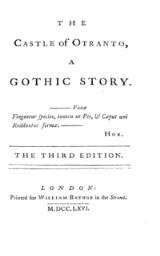
The Castle of Otranto

Encyclopedia
The Castle of Otranto is a 1764 novel
by Horace Walpole. It is generally regarded as the first gothic novel, initiating a literary genre
which would become extremely popular in the later 18th century and early 19th century. Thus, Castle, and Walpole by extension is arguably the forerunner to such authors as Charles Robert Maturin, Ann Radcliffe
, Bram Stoker
, Edgar Allan Poe
and Daphne du Maurier
.
in 1529 and recently rediscovered in the library of "an ancient Catholic family in the north of England". This "ancient Catholic family" is possibly the Percy
family, as Walpole would have known the Duke of Northumberland
and his wife Elizabeth Percy
, though this is not proven. The Italian manuscript's story, it was claimed, derived from a story still older, dating back perhaps as far as the Crusades. This Italian manuscript, along with alleged author "Onuphrio Muralto", were Walpole's fictional creations, and "William Marshal" his pseudonym
.
In the second and subsequent editions, Walpole acknowledges authorship of his work, writing: "The favourable manner in which this little piece has been received by the public, calls upon the author to explain the grounds on which he composed it" as "an attempt to blend the two kinds of romance, the ancient and the modern. In the former all was imagination and improbability: in the latter, nature is always intended to be, and sometimes has been, copied with success..." There was some debate at the time about the function of literature, that is, whether or not works of fiction should be representative of life, or more purely imaginative (i.e. natural vs. romantic). The first edition was well received by some reviewers who understood the novel as belonging to medieval fiction, "between 1095, the era of the first crusade, and 1243, the date of the last," as the first preface states; and some referred to Walpole as an "ingenious translator." Following Walpole's admission of authorship, however, many critics were loath to lavish much praise on the work and dismissed it as absurd, fluffy, romantic fiction.
In his 1924 edition of The Castle of Otranto Montague Summers
showed that the life story of Manfred of Sicily
inspired some details of the plot. The real medieval castle of Otranto
was among Manfred's possessions.
of the novel; he is the dictatorial ruler and father that drives the plot forward in a depiction of deranged cruelty visited upon his children.
Hippolita: Hippolita is the wife of Manfred and the mother of Conrad and Matilda. After having lost her son, she is left with just Matilda to combat the tyrannical turn of mind that her husband displays. Manfred intends to divorce her due to her sterility and on the grounds that their marriage is in fact false because they are actually related. Faced with the threat of divorce, Hippolita is mournful yet submissive to the wills of her husband. She acts as a sort of enabler to her husband, putting aside her morals and happiness so that her husband can get what he wants.
Conrad: Conrad is the fifteen year old son of Manfred and Hippolita and the younger brother of Matilda. In the first pages of the novel, he is crushed by a giant helmet on his way to his wedding with Isabella.
Matilda: Matilda is the daughter of Hippolita and the oppressive Manfred. She falls in love with Theodore, much to her chagrin since it is a love unsanctioned by her parents. Upon the appearance of Frederic, things become even more complicated as Frederic lusts after Matilda. She serves as the forbidden woman, a facet of gothic literature . Frederic and Manfred make plans to swap their daughters in marriage, crushing Matilda’s hope of being with Theodore. At the end of the novel, she is accidentally stabbed by her father.
Isabella: Isabella is the daughter of Frederic and the fiancée of Conrad (at the beginning of the novel). After the death of Conrad, she makes it clear that although she did not love Conrad, she would have far preferred being betrothed to him rather than his father, who pursues her throughout the novel. Isabella and Matilda have a brief argument concerning the fact they both have feelings for Theodore. After the death of Matilda, Theodore settles for Isabella and the two become the lord and lady of the castle.
Theodore: At the beginning of the novel, Theodore appears to be a mere minor character, whose role is purely to point out the significance of the helmet as a link to the fulfillment of the prophecy. However, he emerges as a main character after Manfred orders him to be imprisoned within the helmet for his insolence and he escapes, only to help Isabella escape from the castle through a trapdoor. He is revealed later in the novel to be lost son of Friar Jerome. Theodore proceeds to protect Isabella from the wanton lust of Manfred. He captures the hearts of both Isabella and Matilda, but settles for Isabella after Matilda’s death. He also later goes on to rule the Castle of Otranto.
Friar Jerome: He is the Friar at the monastery near the Castle of Otranto. Manfred attempts to manipulate him into both supporting his plan to divorce his wife and persuading his wife to go along with this plan. It is later discovered that he is Theodore’s father.
Frederic: Frederic is the long-lost father of Isabella who appears late into the novel. He opposes Manfred at first, until he settles on a deal to marry Matilda.
Bianca: Bianca is the servant of Matilda and serves as the comic relief
of the otherwise highly melodramatic novel.
Diego and Jaquez: These two, like Bianca, are other servants within the Castle of Otranto.
Walpole then, by attempting to blend these two genres, creates something new--something truly "novel." He creates fantastic situations (helmets falling from the sky, walking portraits, etc.) and places supposedly real people into these situations and allows them to act in a "real" manner. In doing so, he effectively allows fiction to evolve in ways that it would otherwise have not been able to. However, readers then may question to what extent did Walpole succeeds in his attempt. Do readers view these characters' reactions as truly realistic, or do they merely seem so because of the heuristic that we are given at the outset of the novel?
An additional note, Walpole in Castle introduces many set-pieces that the Gothic novel will become famous for. These includes mysterious sounds, doors opening independently of a person, and the fleeing of a beautiful heroine from an incestuous male figure.
is presented by Horace Walpole himself, in the preface to the second edition of Otranto, in which he “praises Shakespeare as a truly original genius and the exemplar of imaginative liberty, as a part of a defense of Otranto’s design.” Outside of the preface, Walpole uses several allusions to works by Shakespeare as further emphasis of the connection he wishes to be found between his own work and that of Shakespeare. For example, in Hamlet
, “Hamlet’s encounter with the Ghost becomes for Walpole a template for terror.”
Walpole presents a “more fragmented recasting” of The Ghost in Hamlet
, which had served as a representation of the “now unsanctioned, but still popular, Catholic view of ghosts as speakers of truth” for Shakespeare . The Catholic
elements at play within both Hamlet
and Otranto are both invoked to represent a further sense of wonder and mystery to the Protestant audience of both works. The Catholic
element was a necessary facet of the “template of terror” that Walpole meant to invoke.
The allusion to Hamlet’s experience with the Ghost is meant not only as a “template of terror” but also serves to make the reader invoke the feeling of watching the play itself and he does so on three separate occasions. First, Walpole poses Manfred’s encounter with the animated portrait of Ricardo as a connection to the Ghost’s initial appearance to Hamlet. Second, when Friar Jerome informs Theodore of the dangers to be found in Otranto and he calls for him to take out his revenge correspond to the Ghost’s demand to Hamlet to “Remember me.” Third, Frederic’s encounter with the skeletal apparition parallels the final appearance of the Ghost in Hamlet. .
The violent question of bloodlines and succession is one that serves as a key element in many of Shakespeare’s plays, spanning from Hamlet
to Richard II (play)
and Macbeth
and it is one that is clearly one of the major concerns of Otranto. The link to Hamlet
is strengthened even more because of the matter of incest that is also at play in Otranto. “In Otranto, the castle and its labyrinths become grounds for incest that signal the dissolution of familial bonds,” which is also a major point of issue in Hamlet
since Hamlet’s mother (Gertrude) and his uncle (Claudius) were, in a way, related before their marriage. Both Hamlet
and Otranto are literary springboards for discussion on the questions of marriage, as the question of Henry VIII of England
annulment of his marriage and later marriage to Anne Boleyn
were still heated topics of controversy. Henry VIII of England
had both married his brother’s wife Catherine of Aragon
and later dissolved that marriage due to Catherine’s inability to produce a male heir that lived to adulthood. Similarly, ‘’Otranto’’ revolves around “a larger sexual contest to secure lineage.” Henry VIII dissolved the marriage on grounds that the marriage between Catherine of Aragon
and his older brother, Arthur, Prince of Wales
, had been consummated. Both Hamlet
and ‘’Otranto’’ show echoes of this story as major elements within the framework of each literary structure.
The final connection from Otranto to Shakespeare lies in the role that the servants play. Like Shakespeare, Walpole aims to create a “mixture of comedy and tragedy” and one of the ways he does so is by using the minor, servant characters (such as Bianca) as comic relief
. This is a trope that Walpole takes from Shakespeare. For example, Shakespeare’s mechanical (character)
from A Midsummer Night’s Dream also serve as the key comic element.
directed a Surrealist short film in 1979 based on the novel. It took the form of a pseudo-documentary frame story
in live action
with an abridged adaptation of the story itself presented in cut-out animation in the style of Gothic art
.
Novel
A novel is a book of long narrative in literary prose. The genre has historical roots both in the fields of the medieval and early modern romance and in the tradition of the novella. The latter supplied the present generic term in the late 18th century....
by Horace Walpole. It is generally regarded as the first gothic novel, initiating a literary genre
Literary genre
A literary genre is a category of literary composition. Genres may be determined by literary technique, tone, content, or even length. Genre should not be confused with age category, by which literature may be classified as either adult, young-adult, or children's. They also must not be confused...
which would become extremely popular in the later 18th century and early 19th century. Thus, Castle, and Walpole by extension is arguably the forerunner to such authors as Charles Robert Maturin, Ann Radcliffe
Ann Radcliffe
Anne Radcliffe was an English author, and considered the pioneer of the gothic novel . Her style is romantic in its vivid descriptions of landscapes, and long travel scenes, yet the Gothic element is obvious through her use of the supernatural...
, Bram Stoker
Bram Stoker
Abraham "Bram" Stoker was an Irish novelist and short story writer, best known today for his 1897 Gothic novel Dracula...
, Edgar Allan Poe
Edgar Allan Poe
Edgar Allan Poe was an American author, poet, editor and literary critic, considered part of the American Romantic Movement. Best known for his tales of mystery and the macabre, Poe was one of the earliest American practitioners of the short story and is considered the inventor of the detective...
and Daphne du Maurier
Daphne du Maurier
Dame Daphne du Maurier, Lady Browning DBE was a British author and playwright.Many of her works have been adapted into films, including the novels Rebecca and Jamaica Inn and the short stories "The Birds" and "Don't Look Now". The first three were directed by Alfred Hitchcock.Her elder sister was...
.
History
The initial 1764 edition was titled in full The Castle of Otranto, A Story. Translated by William Marshal, Gent. From the Original Italian of Onuphrio Muralto, Canon of the Church of St. Nicholas at Otranto. This first edition purported to be a translation based on a manuscript printed at NaplesNaples
Naples is a city in Southern Italy, situated on the country's west coast by the Gulf of Naples. Lying between two notable volcanic regions, Mount Vesuvius and the Phlegraean Fields, it is the capital of the region of Campania and of the province of Naples...
in 1529 and recently rediscovered in the library of "an ancient Catholic family in the north of England". This "ancient Catholic family" is possibly the Percy
Henry Percy, 1st Earl of Northumberland
Henry Percy, 1st Earl of Northumberland, 4th Baron Percy, titular King of Mann, KG, Lord Marshal was the son of Henry de Percy, 3rd Baron Percy and a descendent of Henry III of England. His mother was Mary of Lancaster, daughter of Henry, 3rd Earl of Lancaster, son of Edmund, Earl of Leicester and...
family, as Walpole would have known the Duke of Northumberland
Duke of Northumberland
The Duke of Northumberland is a title in the peerage of Great Britain that has been created several times. Since the third creation in 1766, the title has belonged to the House of Percy , which held the title of Earl of Northumberland from 1377....
and his wife Elizabeth Percy
Elizabeth Percy, Duchess of Northumberland
Elizabeth Percy, née Seymour, Duchess of Northumberland, heiress to the earldom of Northumberland and 2nd Baroness Percy was a British peeress....
, though this is not proven. The Italian manuscript's story, it was claimed, derived from a story still older, dating back perhaps as far as the Crusades. This Italian manuscript, along with alleged author "Onuphrio Muralto", were Walpole's fictional creations, and "William Marshal" his pseudonym
Pseudonym
A pseudonym is a name that a person assumes for a particular purpose and that differs from his or her original orthonym...
.
In the second and subsequent editions, Walpole acknowledges authorship of his work, writing: "The favourable manner in which this little piece has been received by the public, calls upon the author to explain the grounds on which he composed it" as "an attempt to blend the two kinds of romance, the ancient and the modern. In the former all was imagination and improbability: in the latter, nature is always intended to be, and sometimes has been, copied with success..." There was some debate at the time about the function of literature, that is, whether or not works of fiction should be representative of life, or more purely imaginative (i.e. natural vs. romantic). The first edition was well received by some reviewers who understood the novel as belonging to medieval fiction, "between 1095, the era of the first crusade, and 1243, the date of the last," as the first preface states; and some referred to Walpole as an "ingenious translator." Following Walpole's admission of authorship, however, many critics were loath to lavish much praise on the work and dismissed it as absurd, fluffy, romantic fiction.
In his 1924 edition of The Castle of Otranto Montague Summers
Montague Summers
Augustus Montague Summers was an eccentric English author and clergyman. He is known primarily for his scholarly work on the English drama of the 17th century, as well as for his idiosyncratic studies on witches, vampires, and werewolves, in all of which he professed to believe...
showed that the life story of Manfred of Sicily
Manfred of Sicily
Manfred was the King of Sicily from 1258 to 1266. He was a natural son of the emperor Frederick II of Hohenstaufen but his mother, Bianca Lancia , is reported by Matthew of Paris to have been married to the emperor while on her deathbed.-Background:Manfred was born in Venosa...
inspired some details of the plot. The real medieval castle of Otranto
Otranto
Otranto is a town and comune in the province of Lecce , in a fertile region once famous for its breed of horses.It is located on the east coast of the Salento peninsula. The Strait of Otranto, to which the city gives its name, connects the Adriatic Sea with the Ionian Sea and Italy with Albania...
was among Manfred's possessions.
Plot
The Castle of Otranto tells the story of Manfred, lord of the castle, and his family. The book begins on the wedding-day of his sickly son Conrad and princess Isabella. Shortly before the wedding, however, Conrad is crushed to death by a gigantic helmet that falls on him from above. This inexplicable event is particularly ominous in light of an ancient prophecy "That the castle and lordship of Otranto should pass from the present family, whenever the real owner should be grown too large to inhabit it." Manfred, terrified that Conrad's death signals the beginning of the end for his line, resolves to avert destruction by marrying Isabella himself while divorcing his current wife Hippolita, whom he feels has failed to bear him a proper heir. However, as Manfred attempts to marry Isabella, she escapes to a church with the aid of a peasant named Theodore. Manfred orders Theodore's death while talking to the Friar Jerome, who ensured Isabella's safety in the church. When Theodore removes his shirt to be killed, Jerome recognizes a marking below his shoulder and identifies Theodore as his own son. Jerome begs for his son's life, but Manfred says Jerome must either give up the princess or his son's life. They are interrupted by a trumpet and the entrance of knights from another kingdom who want to deliver Isabella. This leads the knights and Manfred to race to find Isabella. Theodore, having been locked in a tower by Manfred, is freed by Manfred's daughter Matilda. He races to the underground church and finds Isabella. He hides her in a cave and blocks it to protect her from Manfred and ends up fighting one of the mysterious knights. Theodore badly wounds the knight, who turns out to be Isabella's father, Frederic. With that, they all go up to the castle to work things out. Frederic falls in love with Matilda and he and Manfred begin to make a deal about marrying each other's daughters. Manfred, suspecting that Isabella is meeting Theodore in a tryst in the church, takes a knife into the church, where Matilda is meeting Theodore. Thinking his own daughter is Isabella, he stabs her. Theodore is then revealed to be the true prince of Otranto and Matilda dies, leaving Manfred to repent. Theodore becomes king and eventually marries Isabella because she is the only one who can understand his true sorrow.Characters
Manfred: Manfred is the lord of the Castle of Otranto. He is the father of Conrad and Matilda and the husband of Hippolita. After his son is killed by the falling helmet, he becomes obsessed with the idea of ending his marriage with Hippolita in pursuit of the much younger Isabella, who was supposed to marry his son. Manfred serves as the prime antagonistAntagonist
An antagonist is a character, group of characters, or institution, that represents the opposition against which the protagonist must contend...
of the novel; he is the dictatorial ruler and father that drives the plot forward in a depiction of deranged cruelty visited upon his children.
Hippolita: Hippolita is the wife of Manfred and the mother of Conrad and Matilda. After having lost her son, she is left with just Matilda to combat the tyrannical turn of mind that her husband displays. Manfred intends to divorce her due to her sterility and on the grounds that their marriage is in fact false because they are actually related. Faced with the threat of divorce, Hippolita is mournful yet submissive to the wills of her husband. She acts as a sort of enabler to her husband, putting aside her morals and happiness so that her husband can get what he wants.
Conrad: Conrad is the fifteen year old son of Manfred and Hippolita and the younger brother of Matilda. In the first pages of the novel, he is crushed by a giant helmet on his way to his wedding with Isabella.
Matilda: Matilda is the daughter of Hippolita and the oppressive Manfred. She falls in love with Theodore, much to her chagrin since it is a love unsanctioned by her parents. Upon the appearance of Frederic, things become even more complicated as Frederic lusts after Matilda. She serves as the forbidden woman, a facet of gothic literature . Frederic and Manfred make plans to swap their daughters in marriage, crushing Matilda’s hope of being with Theodore. At the end of the novel, she is accidentally stabbed by her father.
Isabella: Isabella is the daughter of Frederic and the fiancée of Conrad (at the beginning of the novel). After the death of Conrad, she makes it clear that although she did not love Conrad, she would have far preferred being betrothed to him rather than his father, who pursues her throughout the novel. Isabella and Matilda have a brief argument concerning the fact they both have feelings for Theodore. After the death of Matilda, Theodore settles for Isabella and the two become the lord and lady of the castle.
Theodore: At the beginning of the novel, Theodore appears to be a mere minor character, whose role is purely to point out the significance of the helmet as a link to the fulfillment of the prophecy. However, he emerges as a main character after Manfred orders him to be imprisoned within the helmet for his insolence and he escapes, only to help Isabella escape from the castle through a trapdoor. He is revealed later in the novel to be lost son of Friar Jerome. Theodore proceeds to protect Isabella from the wanton lust of Manfred. He captures the hearts of both Isabella and Matilda, but settles for Isabella after Matilda’s death. He also later goes on to rule the Castle of Otranto.
Friar Jerome: He is the Friar at the monastery near the Castle of Otranto. Manfred attempts to manipulate him into both supporting his plan to divorce his wife and persuading his wife to go along with this plan. It is later discovered that he is Theodore’s father.
Frederic: Frederic is the long-lost father of Isabella who appears late into the novel. He opposes Manfred at first, until he settles on a deal to marry Matilda.
Bianca: Bianca is the servant of Matilda and serves as the comic relief
Comic relief
Comic relief is the inclusion of a humorous character, scene or witty dialogue in an otherwise serious work, often to relieve tension.-Definition:...
of the otherwise highly melodramatic novel.
Diego and Jaquez: These two, like Bianca, are other servants within the Castle of Otranto.
Literary elements
In the preface of the second edition, Walpole creates a heuristic for reading Castle which irrevocably changes the way readers are to view the novel until its end. He claims to blend the new and old styles of romance. The "old" romance is what we would consider pre-novel prose--a main tenet of such writings is their fantastic nature. There is magic, the supernatural abounds and they are wholly unbelieveable. The style of the "new" romance is what the novels of the 18th century, when Walpole was writing, would generally have looked like. These novels were realistic, they purported to depict events and people as they truly were.Walpole then, by attempting to blend these two genres, creates something new--something truly "novel." He creates fantastic situations (helmets falling from the sky, walking portraits, etc.) and places supposedly real people into these situations and allows them to act in a "real" manner. In doing so, he effectively allows fiction to evolve in ways that it would otherwise have not been able to. However, readers then may question to what extent did Walpole succeeds in his attempt. Do readers view these characters' reactions as truly realistic, or do they merely seem so because of the heuristic that we are given at the outset of the novel?
An additional note, Walpole in Castle introduces many set-pieces that the Gothic novel will become famous for. These includes mysterious sounds, doors opening independently of a person, and the fleeing of a beautiful heroine from an incestuous male figure.
The Castle of Otranto and Shakespeare
The first and most obvious connection to William ShakespeareWilliam Shakespeare
William Shakespeare was an English poet and playwright, widely regarded as the greatest writer in the English language and the world's pre-eminent dramatist. He is often called England's national poet and the "Bard of Avon"...
is presented by Horace Walpole himself, in the preface to the second edition of Otranto, in which he “praises Shakespeare as a truly original genius and the exemplar of imaginative liberty, as a part of a defense of Otranto’s design.” Outside of the preface, Walpole uses several allusions to works by Shakespeare as further emphasis of the connection he wishes to be found between his own work and that of Shakespeare. For example, in Hamlet
Hamlet
The Tragical History of Hamlet, Prince of Denmark, or more simply Hamlet, is a tragedy by William Shakespeare, believed to have been written between 1599 and 1601...
, “Hamlet’s encounter with the Ghost becomes for Walpole a template for terror.”
Walpole presents a “more fragmented recasting” of The Ghost in Hamlet
Hamlet
The Tragical History of Hamlet, Prince of Denmark, or more simply Hamlet, is a tragedy by William Shakespeare, believed to have been written between 1599 and 1601...
, which had served as a representation of the “now unsanctioned, but still popular, Catholic view of ghosts as speakers of truth” for Shakespeare . The Catholic
Catholic
The word catholic comes from the Greek phrase , meaning "on the whole," "according to the whole" or "in general", and is a combination of the Greek words meaning "about" and meaning "whole"...
elements at play within both Hamlet
Hamlet
The Tragical History of Hamlet, Prince of Denmark, or more simply Hamlet, is a tragedy by William Shakespeare, believed to have been written between 1599 and 1601...
and Otranto are both invoked to represent a further sense of wonder and mystery to the Protestant audience of both works. The Catholic
Catholic
The word catholic comes from the Greek phrase , meaning "on the whole," "according to the whole" or "in general", and is a combination of the Greek words meaning "about" and meaning "whole"...
element was a necessary facet of the “template of terror” that Walpole meant to invoke.
The allusion to Hamlet’s experience with the Ghost is meant not only as a “template of terror” but also serves to make the reader invoke the feeling of watching the play itself and he does so on three separate occasions. First, Walpole poses Manfred’s encounter with the animated portrait of Ricardo as a connection to the Ghost’s initial appearance to Hamlet. Second, when Friar Jerome informs Theodore of the dangers to be found in Otranto and he calls for him to take out his revenge correspond to the Ghost’s demand to Hamlet to “Remember me.” Third, Frederic’s encounter with the skeletal apparition parallels the final appearance of the Ghost in Hamlet. .
The violent question of bloodlines and succession is one that serves as a key element in many of Shakespeare’s plays, spanning from Hamlet
Hamlet
The Tragical History of Hamlet, Prince of Denmark, or more simply Hamlet, is a tragedy by William Shakespeare, believed to have been written between 1599 and 1601...
to Richard II (play)
Richard II (play)
King Richard the Second is a history play by William Shakespeare believed to be written in approximately 1595. It is based on the life of King Richard II of England and is the first part of a tetralogy, referred to by some scholars as the Henriad, followed by three plays concerning Richard's...
and Macbeth
Macbeth
The Tragedy of Macbeth is a play by William Shakespeare about a regicide and its aftermath. It is Shakespeare's shortest tragedy and is believed to have been written sometime between 1603 and 1607...
and it is one that is clearly one of the major concerns of Otranto. The link to Hamlet
Hamlet
The Tragical History of Hamlet, Prince of Denmark, or more simply Hamlet, is a tragedy by William Shakespeare, believed to have been written between 1599 and 1601...
is strengthened even more because of the matter of incest that is also at play in Otranto. “In Otranto, the castle and its labyrinths become grounds for incest that signal the dissolution of familial bonds,” which is also a major point of issue in Hamlet
Hamlet
The Tragical History of Hamlet, Prince of Denmark, or more simply Hamlet, is a tragedy by William Shakespeare, believed to have been written between 1599 and 1601...
since Hamlet’s mother (Gertrude) and his uncle (Claudius) were, in a way, related before their marriage. Both Hamlet
Hamlet
The Tragical History of Hamlet, Prince of Denmark, or more simply Hamlet, is a tragedy by William Shakespeare, believed to have been written between 1599 and 1601...
and Otranto are literary springboards for discussion on the questions of marriage, as the question of Henry VIII of England
Henry VIII of England
Henry VIII was King of England from 21 April 1509 until his death. He was Lord, and later King, of Ireland, as well as continuing the nominal claim by the English monarchs to the Kingdom of France...
annulment of his marriage and later marriage to Anne Boleyn
Anne Boleyn
Anne Boleyn ;c.1501/1507 – 19 May 1536) was Queen of England from 1533 to 1536 as the second wife of Henry VIII of England and Marquess of Pembroke in her own right. Henry's marriage to Anne, and her subsequent execution, made her a key figure in the political and religious upheaval that was the...
were still heated topics of controversy. Henry VIII of England
Henry VIII of England
Henry VIII was King of England from 21 April 1509 until his death. He was Lord, and later King, of Ireland, as well as continuing the nominal claim by the English monarchs to the Kingdom of France...
had both married his brother’s wife Catherine of Aragon
Catherine of Aragon
Catherine of Aragon , also known as Katherine or Katharine, was Queen consort of England as the first wife of King Henry VIII of England and Princess of Wales as the wife to Arthur, Prince of Wales...
and later dissolved that marriage due to Catherine’s inability to produce a male heir that lived to adulthood. Similarly, ‘’Otranto’’ revolves around “a larger sexual contest to secure lineage.” Henry VIII dissolved the marriage on grounds that the marriage between Catherine of Aragon
Catherine of Aragon
Catherine of Aragon , also known as Katherine or Katharine, was Queen consort of England as the first wife of King Henry VIII of England and Princess of Wales as the wife to Arthur, Prince of Wales...
and his older brother, Arthur, Prince of Wales
Arthur, Prince of Wales
Arthur Tudor, Prince of Wales was the first son of King Henry VII of England and Elizabeth of York, and therefore, heir to the throne of England. As he predeceased his father, Arthur never became king...
, had been consummated. Both Hamlet
Hamlet
The Tragical History of Hamlet, Prince of Denmark, or more simply Hamlet, is a tragedy by William Shakespeare, believed to have been written between 1599 and 1601...
and ‘’Otranto’’ show echoes of this story as major elements within the framework of each literary structure.
The final connection from Otranto to Shakespeare lies in the role that the servants play. Like Shakespeare, Walpole aims to create a “mixture of comedy and tragedy” and one of the ways he does so is by using the minor, servant characters (such as Bianca) as comic relief
Comic relief
Comic relief is the inclusion of a humorous character, scene or witty dialogue in an otherwise serious work, often to relieve tension.-Definition:...
. This is a trope that Walpole takes from Shakespeare. For example, Shakespeare’s mechanical (character)
Mechanical (character)
A mechanical is any of six characters in A Midsummer Night's Dream who perform the play-within-a-play Pyramus and Thisbe. Named for their occupations as skilled manual laborers, they are a group of Amateur actors from around Athens, looking to make names for themselves by having their production...
from A Midsummer Night’s Dream also serve as the key comic element.
Film adaptations
Jan ŠvankmajerJan Švankmajer
Jan Švankmajer is a Czech filmmaker and artist whose work spans several media. He is a self-labeled surrealist known for his surreal animations and features, which have greatly influenced other artists such as Tim Burton, Terry Gilliam, the Brothers Quay, and many others.- Life and career :Jan...
directed a Surrealist short film in 1979 based on the novel. It took the form of a pseudo-documentary frame story
Frame story
A frame story is a literary technique that sometimes serves as a companion piece to a story within a story, whereby an introductory or main narrative is presented, at least in part, for the purpose of setting the stage either for a more emphasized second narrative or for a set of shorter stories...
in live action
Live action
In filmmaking, video production, and other media, the term live action refers to cinematography, videography not produced using animation...
with an abridged adaptation of the story itself presented in cut-out animation in the style of Gothic art
Gothic art
Gothic art was a Medieval art movement that developed in France out of Romanesque art in the mid-12th century, led by the concurrent development of Gothic architecture. It spread to all of Western Europe, but took over art more completely north of the Alps, never quite effacing more classical...
.
External links
- Free unabridged audiobook from LibriVox.org: The Castle of Otranto
Sources
- Cohenour, Gretchen. “A Man’s Home is His Castle: Bloodlines and The Castle of Otranto.” EAPSU Journal of Critical and Creative Work. Volume 5 (2008): 73-87.
- Cohenour, Gretchen. "Eighteenth Century Gothic Novels and Gendered Spaces: What's Left to Say?" Diss: University of Rhode Island, 2008. ProQuest LLC, 2008.
- Drakakis, John and Dale Townshend. Gothic Shakespeares. New York: Routledge, 2008.
- Hamm, Robert B. “Hamlet and Horace Walpole’s The Castle of Otranto.” SEL Studies in English Literature 1500-1900. Volume 49 (2009): 667-692.
- Mellor, Anne K. Mary Shelley: Her Life, Her Fiction, Her Monsters. New York: Routledge, 1988. 196-98.