


Hindenburg class airship

Encyclopedia
The two Hindenburg-class airships were passenger carrying rigid airship
s built in Germany
in the 1930s and named in honor of Paul von Hindenburg
. They were the last such aircraft ever built, and in terms of their length and volume, the largest aircraft ever to fly. During the 1930s, airships like the Hindenburg class were considered by many the future of air travel, and the lead ship
of the class, LZ 129 Hindenburg
, established a regular transatlantic service. The destruction of this same ship in a spectacular and highly-publicized accident
was to prove the death knell for these expectations. The second ship, LZ 130 Graf Zeppelin
was never operated on a regular passenger service, and was scrapped in 1940 at the order of Hermann Göring
.
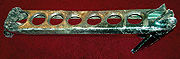
 The Hindenburg class were built to an all-duralumin
design. The leader of the design team was Doctor Ludwig Dürr
, who had overseen the design of all Zeppelins except LZ-1 (on which he was a crew member), under the overall direction of Hugo Eckener
, the head of the company. They were 245 metres (803.8 ft) long and 41 metres (134.5 ft) in diameter, longer than three Boeing 747
s placed end-to-end, longer than four current Goodyear Blimps end-to-end, and only 24 metres (78.7 ft) shorter than the . The design originally called for cabins for 50 passengers and a crew complement of 40.
Construction of the first ship, LZ 129, later named Hindenburg, began in 1931, but was suddenly stopped when Luftschiffbau Zeppelin
went bankrupt. This led Eckener to make a deal with the Nazi Party. He needed money to build the airship, but in return he was forced to display the swastika
s on the tail fins. Construction then resumed in 1935. The keel of the second ship, LZ 130 Graf Zeppelin was laid on June 23, 1936, and the cells were inflated with hydrogen on August 15, 1938. As the second Zeppelin to carry the name Graf Zeppelin (after the LZ 127
), she is often referred to as Graf Zeppelin II.
 The duralumin frame was covered by cotton cloth varnished with iron oxide
and cellulose
acetate
butyrate
impregnated with aluminium
powder. The aluminium was added to reflect both ultraviolet, which damaged the fabric, and infrared light, which caused heating of the gas. This was an innovation with the LZ 126
which was operated by the U.S. Navy as the USS Los Angeles (ZR-3) from 1924 until decommissioned in 1933. Following the destruction of Hindenburg, the doping compound for the outer fabric covering of Graf Zeppelin was changed: bronze
and graphite
were added to prevent flammability and also improved the outer covering's electrical conductivity.
The rigid structure was held together by many large rings up to the size of a Ferris wheel, 15 of which were gas cell boundaries which formed bulkheads. These bulkheads were braced by steel wires which connected up into the axial catwalk. The longitudinal duralumin girders connected all the rings together and formed "panels". The 16 gas cells were made of cotton and a gas tight material. On Graf Zeppelin, the cells were lightened and one was made of lightweight silk
instead of cotton.
Hydrogen was vented out through valves on the top of the ship. These valves could be controlled both manually and automatically. An axial catwalk was added across the center of the ship to provide access to the gas valves. A keel catwalk provided access to the crew quarters and the engines. Along side the keel were water ballast and fuel tanks. The tail fins of the airship were over 100 feet (30.5 m) in length, and were held together with a cross-like structure. The lower tail fin also had an auxiliary control room in case the controls in the gondola malfunctioned.
Hindenburg was powered by four reversible 890 kW Daimler-Benz
diesel engine
s which gave the airship a maximum speed of 135 km/h (83.9 mph). The engine pods were completely redesigned for Graf Zeppelin, using diesel engines powering tractor propellers (the aft port engine was the only one to have a three bladed prop). The engines had a water recovery system which captured the exhaust of the engines to minimize weight lost during flight.
To reduce drag, the passenger rooms were contained entirely within the hull, rather than in the gondola as on the LZ 127 Graf Zeppelin
and consisted of two decks. The upper deck, "A", contained the passenger quarters, public areas, a dining room, a lounge, and a writing room. The lower deck, "B", contained washrooms, a mess hall for the crew, and a smoking lounge. Long slanted windows ran the length of both decks. The passenger decks were redesigned for Graf Zeppelin; the restaurant was moved to the middle of the quarters and the promenade windows were half a panel lower.
, heavier than hydrogen
but nonflammable. Most of the world's supply of helium comes from natural gas field
s in the United States
, which had embargoed its export to Germany. Eckener expected this ban to be lifted, but to save helium the design was modified to have double gas cells (an inner hydrogen cell protected by an outer helium cell). The ban remained however, so the engineers used only hydrogen despite its extreme flammability. It held 7062000 cubic feet (199,973.6 m³) of gas in 16 bags or cells with a useful lift of approximately 232000 kilograms (511,472.4 lb). This provided a margin above the 215000 kilograms (473,993.9 lb) average gross weight of the ship with fuel, equipment, 10000 kilograms (22,046.2 lb) of mail and cargo, about 90 passengers and crew and their luggage.
The Germans had extensive experience with hydrogen as a lifting gas. Accidental hydrogen fires had never occurred on civilian Zeppelins, so the switch from helium to hydrogen did not cause much concern. Hydrogen also increased lift by about 8%. After the Hindenburg disaster
Eckener vowed never to use hydrogen again in a passenger airship. He planned to use helium for the second ship and went to Washington, D.C.
to personally lobby President Roosevelt
, who promised to supply the helium only for peaceful purposes. After the annexation of Austria
in March 1938, U.S. Secretary of the Interior Harold L. Ickes
refused to supply the gas, and the Graf Zeppelin was also filled with hydrogen.
, she spent four days dropping leaflets, playing music, and making radio broadcasts in the lead up to the March 29 plebiscite mandating Hitler's Chancellorship and remilitarization of the Rhineland
.
Commercial services commenced on 31 March 1936 with the first of seven round trips to Rio de Janeiro
that Hindenburg was to make during her first passenger season. Together with ten round trips to New York
, Hindenburg covered 308323 km (191,583.5 mi) that year with 2,798 passengers and 160 tons of freight and mail.
Following refurbishment during the winter, Hindenburg set out on her first flight to North America for the 1937 season (she had already made one return trip to South America in 1937) on 3 May, bound for New York. This flight would end in tragedy with Hindenburg being utterly consumed by fire as she prepared to dock at NAS Lakehurst in New Jersey.
to München, Augsburg
, Ulm
, and back. The total distance covered was 925 km (574.8 mi). The Graf Zeppelin made a total of thirty flights, mainly spy missions for the Luftwaffe
.
 In April 1940, Hermann Göring
issued the order to scrap both Graf Zeppelin and the unfinished framework of LZ 131, since the metal was needed for other aircraft. By April 27, work crews had finished cutting up the airships. On May 6, the enormous airship hangars in Frankfurt were leveled by explosives, three years to the day after the destruction of the Hindenburg
.
Rigid airship
A rigid airship is a type of airship in which the envelope retained its shape by the use of an internal structural framework rather than by being forced into shape by the pressure of the lifting gas within the envelope as used in blimps and semi-rigid airships.Rigid airships were produced and...
s built in Germany
Germany
Germany , officially the Federal Republic of Germany , is a federal parliamentary republic in Europe. The country consists of 16 states while the capital and largest city is Berlin. Germany covers an area of 357,021 km2 and has a largely temperate seasonal climate...
in the 1930s and named in honor of Paul von Hindenburg
Paul von Hindenburg
Paul Ludwig Hans Anton von Beneckendorff und von Hindenburg , known universally as Paul von Hindenburg was a Prussian-German field marshal, statesman, and politician, and served as the second President of Germany from 1925 to 1934....
. They were the last such aircraft ever built, and in terms of their length and volume, the largest aircraft ever to fly. During the 1930s, airships like the Hindenburg class were considered by many the future of air travel, and the lead ship
Lead ship
The lead ship or class leader is the first of a series or class of ships all constructed according to the same general design. The term is applicable military ships and larger civilian craft.-Overview:...
of the class, LZ 129 Hindenburg
LZ 129 Hindenburg
LZ 129 Hindenburg was a large German commercial passenger-carrying rigid airship, the lead ship of the Hindenburg class, the longest class of flying machine and the largest airship by envelope volume...
, established a regular transatlantic service. The destruction of this same ship in a spectacular and highly-publicized accident
Hindenburg disaster
The Hindenburg disaster took place on Thursday, May 6, 1937, as the German passenger airship LZ 129 Hindenburg caught fire and was destroyed during its attempt to dock with its mooring mast at the Lakehurst Naval Air Station, which is located adjacent to the borough of Lakehurst, New Jersey...
was to prove the death knell for these expectations. The second ship, LZ 130 Graf Zeppelin
LZ 130 Graf Zeppelin
The Graf Zeppelin II was the last of the great German rigid airships built by the Zeppelin Luftschiffbau during the period between the World Wars, the second and final ship of the Hindenburg class named in honor of Paul von Hindenburg...
was never operated on a regular passenger service, and was scrapped in 1940 at the order of Hermann Göring
Hermann Göring
Hermann Wilhelm Göring, was a German politician, military leader, and a leading member of the Nazi Party. He was a veteran of World War I as an ace fighter pilot, and a recipient of the coveted Pour le Mérite, also known as "The Blue Max"...
.
Design and development
Duralumin
Duralumin is the trade name of one of the earliest types of age-hardenable aluminium alloys. The main alloying constituents are copper, manganese, and magnesium. A commonly used modern equivalent of this alloy type is AA2024, which contains 4.4% copper, 1.5% magnesium, 0.6% manganese and 93.5%...
design. The leader of the design team was Doctor Ludwig Dürr
Ludwig Dürr
Ludwig Dürr was an airship designer.-Life and career:After completing training as a mechanic, Dürr continued his training at the Höhere Maschinenbauschule in Stuttgart, an affiliate of the Königliche Baugewerkschule...
, who had overseen the design of all Zeppelins except LZ-1 (on which he was a crew member), under the overall direction of Hugo Eckener
Hugo Eckener
Dr. Hugo Eckener was the manager of the Luftschiffbau Zeppelin during the inter-war years, and was commander of the famous Graf Zeppelin for most of its record-setting flights, including the first airship flight around the world, making him the most successful airship commander in history...
, the head of the company. They were 245 metres (803.8 ft) long and 41 metres (134.5 ft) in diameter, longer than three Boeing 747
Boeing 747
The Boeing 747 is a wide-body commercial airliner and cargo transport, often referred to by its original nickname, Jumbo Jet, or Queen of the Skies. It is among the world's most recognizable aircraft, and was the first wide-body ever produced...
s placed end-to-end, longer than four current Goodyear Blimps end-to-end, and only 24 metres (78.7 ft) shorter than the . The design originally called for cabins for 50 passengers and a crew complement of 40.
Construction of the first ship, LZ 129, later named Hindenburg, began in 1931, but was suddenly stopped when Luftschiffbau Zeppelin
Luftschiffbau Zeppelin
Luftschiffbau Zeppelin GmbH is a German company which, during the early 20th century, was a leader in the design and manufacture of rigid airships, specifically of the Zeppelin type. The company was founded by Count Ferdinand von Zeppelin...
went bankrupt. This led Eckener to make a deal with the Nazi Party. He needed money to build the airship, but in return he was forced to display the swastika
Swastika
The swastika is an equilateral cross with its arms bent at right angles, in either right-facing form in counter clock motion or its mirrored left-facing form in clock motion. Earliest archaeological evidence of swastika-shaped ornaments dates back to the Indus Valley Civilization of Ancient...
s on the tail fins. Construction then resumed in 1935. The keel of the second ship, LZ 130 Graf Zeppelin was laid on June 23, 1936, and the cells were inflated with hydrogen on August 15, 1938. As the second Zeppelin to carry the name Graf Zeppelin (after the LZ 127
LZ 127 Graf Zeppelin
LZ 127 Graf Zeppelin was a German built and operated passenger-carrying hydrogen-filled rigid airship which operated commercially from 1928 to 1937. It was named after the German pioneer of airships, Ferdinand von Zeppelin, who was a Graf or Count in the German nobility. During its operating life,...
), she is often referred to as Graf Zeppelin II.
Iron oxide
Iron oxides are chemical compounds composed of iron and oxygen. All together, there are sixteen known iron oxides and oxyhydroxides.Iron oxides and oxide-hydroxides are widespread in nature, play an important role in many geological and biological processes, and are widely utilized by humans, e.g.,...
and cellulose
Cellulose
Cellulose is an organic compound with the formula , a polysaccharide consisting of a linear chain of several hundred to over ten thousand β linked D-glucose units....
acetate
Acetate
An acetate is a derivative of acetic acid. This term includes salts and esters, as well as the anion found in solution. Most of the approximately 5 billion kilograms of acetic acid produced annually in industry are used in the production of acetates, which usually take the form of polymers. In...
butyrate
Butyrate
Butyrate is the traditional name for the conjugate base of butanoic acid . The formula of the butanoate ion is C4H7O2-. The archaic name is used as part of the name of butyrates or butanoates, or esters and salts of butyric acid, a short chain fatty acid...
impregnated with aluminium
Aluminium
Aluminium or aluminum is a silvery white member of the boron group of chemical elements. It has the symbol Al, and its atomic number is 13. It is not soluble in water under normal circumstances....
powder. The aluminium was added to reflect both ultraviolet, which damaged the fabric, and infrared light, which caused heating of the gas. This was an innovation with the LZ 126
USS Los Angeles (ZR-3)
The second USS Los Angeles was a rigid airship, designated ZR-3, that was built in 1923-1924 by the Zeppelin factory in Friedrichshafen, Germany, where it was originally designated LZ-126...
which was operated by the U.S. Navy as the USS Los Angeles (ZR-3) from 1924 until decommissioned in 1933. Following the destruction of Hindenburg, the doping compound for the outer fabric covering of Graf Zeppelin was changed: bronze
Bronze
Bronze is a metal alloy consisting primarily of copper, usually with tin as the main additive. It is hard and brittle, and it was particularly significant in antiquity, so much so that the Bronze Age was named after the metal...
and graphite
Graphite
The mineral graphite is one of the allotropes of carbon. It was named by Abraham Gottlob Werner in 1789 from the Ancient Greek γράφω , "to draw/write", for its use in pencils, where it is commonly called lead . Unlike diamond , graphite is an electrical conductor, a semimetal...
were added to prevent flammability and also improved the outer covering's electrical conductivity.
The rigid structure was held together by many large rings up to the size of a Ferris wheel, 15 of which were gas cell boundaries which formed bulkheads. These bulkheads were braced by steel wires which connected up into the axial catwalk. The longitudinal duralumin girders connected all the rings together and formed "panels". The 16 gas cells were made of cotton and a gas tight material. On Graf Zeppelin, the cells were lightened and one was made of lightweight silk
Silk
Silk is a natural protein fiber, some forms of which can be woven into textiles. The best-known type of silk is obtained from the cocoons of the larvae of the mulberry silkworm Bombyx mori reared in captivity...
instead of cotton.
Hydrogen was vented out through valves on the top of the ship. These valves could be controlled both manually and automatically. An axial catwalk was added across the center of the ship to provide access to the gas valves. A keel catwalk provided access to the crew quarters and the engines. Along side the keel were water ballast and fuel tanks. The tail fins of the airship were over 100 feet (30.5 m) in length, and were held together with a cross-like structure. The lower tail fin also had an auxiliary control room in case the controls in the gondola malfunctioned.
Hindenburg was powered by four reversible 890 kW Daimler-Benz
Daimler-Benz
Daimler-Benz AG was a German manufacturer of automobiles, motor vehicles, and internal combustion engines; founded in 1926. An Agreement of Mutual Interest - which was valid until year 2000 - was signed on 1 May 1924 between Karl Benz's Benz & Cie., and Daimler Motoren Gesellschaft, which had...
diesel engine
Diesel engine
A diesel engine is an internal combustion engine that uses the heat of compression to initiate ignition to burn the fuel, which is injected into the combustion chamber...
s which gave the airship a maximum speed of 135 km/h (83.9 mph). The engine pods were completely redesigned for Graf Zeppelin, using diesel engines powering tractor propellers (the aft port engine was the only one to have a three bladed prop). The engines had a water recovery system which captured the exhaust of the engines to minimize weight lost during flight.
To reduce drag, the passenger rooms were contained entirely within the hull, rather than in the gondola as on the LZ 127 Graf Zeppelin
LZ 127 Graf Zeppelin
LZ 127 Graf Zeppelin was a German built and operated passenger-carrying hydrogen-filled rigid airship which operated commercially from 1928 to 1937. It was named after the German pioneer of airships, Ferdinand von Zeppelin, who was a Graf or Count in the German nobility. During its operating life,...
and consisted of two decks. The upper deck, "A", contained the passenger quarters, public areas, a dining room, a lounge, and a writing room. The lower deck, "B", contained washrooms, a mess hall for the crew, and a smoking lounge. Long slanted windows ran the length of both decks. The passenger decks were redesigned for Graf Zeppelin; the restaurant was moved to the middle of the quarters and the promenade windows were half a panel lower.
Lift gas
Hindenburg was originally designed for heliumHelium
Helium is the chemical element with atomic number 2 and an atomic weight of 4.002602, which is represented by the symbol He. It is a colorless, odorless, tasteless, non-toxic, inert, monatomic gas that heads the noble gas group in the periodic table...
, heavier than hydrogen
Hydrogen
Hydrogen is the chemical element with atomic number 1. It is represented by the symbol H. With an average atomic weight of , hydrogen is the lightest and most abundant chemical element, constituting roughly 75% of the Universe's chemical elemental mass. Stars in the main sequence are mainly...
but nonflammable. Most of the world's supply of helium comes from natural gas field
Natural gas field
Oil and natural gas are produced by the same geological process according fossil fuel suggestion: anaerobic decay of organic matter deep under the Earth's surface. As a consequence, oil and natural gas are often found together...
s in the United States
United States
The United States of America is a federal constitutional republic comprising fifty states and a federal district...
, which had embargoed its export to Germany. Eckener expected this ban to be lifted, but to save helium the design was modified to have double gas cells (an inner hydrogen cell protected by an outer helium cell). The ban remained however, so the engineers used only hydrogen despite its extreme flammability. It held 7062000 cubic feet (199,973.6 m³) of gas in 16 bags or cells with a useful lift of approximately 232000 kilograms (511,472.4 lb). This provided a margin above the 215000 kilograms (473,993.9 lb) average gross weight of the ship with fuel, equipment, 10000 kilograms (22,046.2 lb) of mail and cargo, about 90 passengers and crew and their luggage.
The Germans had extensive experience with hydrogen as a lifting gas. Accidental hydrogen fires had never occurred on civilian Zeppelins, so the switch from helium to hydrogen did not cause much concern. Hydrogen also increased lift by about 8%. After the Hindenburg disaster
Hindenburg disaster
The Hindenburg disaster took place on Thursday, May 6, 1937, as the German passenger airship LZ 129 Hindenburg caught fire and was destroyed during its attempt to dock with its mooring mast at the Lakehurst Naval Air Station, which is located adjacent to the borough of Lakehurst, New Jersey...
Eckener vowed never to use hydrogen again in a passenger airship. He planned to use helium for the second ship and went to Washington, D.C.
Washington, D.C.
Washington, D.C., formally the District of Columbia and commonly referred to as Washington, "the District", or simply D.C., is the capital of the United States. On July 16, 1790, the United States Congress approved the creation of a permanent national capital as permitted by the U.S. Constitution....
to personally lobby President Roosevelt
Franklin D. Roosevelt
Franklin Delano Roosevelt , also known by his initials, FDR, was the 32nd President of the United States and a central figure in world events during the mid-20th century, leading the United States during a time of worldwide economic crisis and world war...
, who promised to supply the helium only for peaceful purposes. After the annexation of Austria
Anschluss
The Anschluss , also known as the ', was the occupation and annexation of Austria into Nazi Germany in 1938....
in March 1938, U.S. Secretary of the Interior Harold L. Ickes
Harold L. Ickes
Harold LeClair Ickes was a United States administrator and politician. He served as United States Secretary of the Interior for 13 years, from 1933 to 1946, the longest tenure of anyone to hold the office, and the second longest serving Cabinet member in U.S. history next to James Wilson. Ickes...
refused to supply the gas, and the Graf Zeppelin was also filled with hydrogen.
LZ 129 Hindenburg
Hindenburg made her first flight on 4 March 1936, but before commencing her intended role as a passenger liner, was put to use for propaganda purposes by the Nazi government. Together with LZ 127 Graf ZeppelinLZ 127 Graf Zeppelin
LZ 127 Graf Zeppelin was a German built and operated passenger-carrying hydrogen-filled rigid airship which operated commercially from 1928 to 1937. It was named after the German pioneer of airships, Ferdinand von Zeppelin, who was a Graf or Count in the German nobility. During its operating life,...
, she spent four days dropping leaflets, playing music, and making radio broadcasts in the lead up to the March 29 plebiscite mandating Hitler's Chancellorship and remilitarization of the Rhineland
Remilitarization of the Rhineland
The Remilitarization of the Rhineland by the German Army took place on 7 March 1936 when German military forces entered the Rhineland. This was significant because it violated the terms of the Locarno Treaties and was the first time since the end of World War I that German troops had been in this...
.
Commercial services commenced on 31 March 1936 with the first of seven round trips to Rio de Janeiro
Rio de Janeiro
Rio de Janeiro , commonly referred to simply as Rio, is the capital city of the State of Rio de Janeiro, the second largest city of Brazil, and the third largest metropolitan area and agglomeration in South America, boasting approximately 6.3 million people within the city proper, making it the 6th...
that Hindenburg was to make during her first passenger season. Together with ten round trips to New York
New York
New York is a state in the Northeastern region of the United States. It is the nation's third most populous state. New York is bordered by New Jersey and Pennsylvania to the south, and by Connecticut, Massachusetts and Vermont to the east...
, Hindenburg covered 308323 km (191,583.5 mi) that year with 2,798 passengers and 160 tons of freight and mail.
Following refurbishment during the winter, Hindenburg set out on her first flight to North America for the 1937 season (she had already made one return trip to South America in 1937) on 3 May, bound for New York. This flight would end in tragedy with Hindenburg being utterly consumed by fire as she prepared to dock at NAS Lakehurst in New Jersey.
LZ 130 Graf Zeppelin
By the time the Graf Zeppelin was completed, it was obvious that the ship would never serve its intended purpose as a passenger liner; the lack of a supply of inert helium was one cause. The ship was christened and made her first flight on September 14, 1938, making a circuit from FriedrichshafenFriedrichshafen
This article is about a German town. For the Danish town, see Frederikshavn, and for the Finnish town, see Fredrikshamn .Friedrichshafen is a university city on the northern side of Lake Constance in Southern Germany, near the borders with Switzerland and Austria.It is the district capital of the...
to München, Augsburg
Augsburg
Augsburg is a city in the south-west of Bavaria, Germany. It is a university town and home of the Regierungsbezirk Schwaben and the Bezirk Schwaben. Augsburg is an urban district and home to the institutions of the Landkreis Augsburg. It is, as of 2008, the third-largest city in Bavaria with a...
, Ulm
Ulm
Ulm is a city in the federal German state of Baden-Württemberg, situated on the River Danube. The city, whose population is estimated at 120,000 , forms an urban district of its own and is the administrative seat of the Alb-Donau district. Ulm, founded around 850, is rich in history and...
, and back. The total distance covered was 925 km (574.8 mi). The Graf Zeppelin made a total of thirty flights, mainly spy missions for the Luftwaffe
Luftwaffe
Luftwaffe is a generic German term for an air force. It is also the official name for two of the four historic German air forces, the Wehrmacht air arm founded in 1935 and disbanded in 1946; and the current Bundeswehr air arm founded in 1956....
.
Scrapping
Hermann Göring
Hermann Wilhelm Göring, was a German politician, military leader, and a leading member of the Nazi Party. He was a veteran of World War I as an ace fighter pilot, and a recipient of the coveted Pour le Mérite, also known as "The Blue Max"...
issued the order to scrap both Graf Zeppelin and the unfinished framework of LZ 131, since the metal was needed for other aircraft. By April 27, work crews had finished cutting up the airships. On May 6, the enormous airship hangars in Frankfurt were leveled by explosives, three years to the day after the destruction of the Hindenburg
Hindenburg disaster
The Hindenburg disaster took place on Thursday, May 6, 1937, as the German passenger airship LZ 129 Hindenburg caught fire and was destroyed during its attempt to dock with its mooring mast at the Lakehurst Naval Air Station, which is located adjacent to the borough of Lakehurst, New Jersey...
.