
All Topics  
Hindenburg disaster


   Email Print
   Bookmark   Link


Hindenburg disaster


The Hindenburg disaster took place on May 6 1937 as the German rigid airship
Rigid airship

A rigid airship was a type of airship in which the Envelope retained its shape by the use of an internal structural framework rather than by being forced into shape by the pressure of the lifting gas within the envelope as used in blimps and semi-rigid airships....
 
Hindenburg
LZ 129 Hindenburg

LZ 129 Hindenburg was a large Germany commercial passenger-carrying rigid airship, the lead ship of the Hindenburg class airship, the largest flying machines of any kind ever built....
 caught fire and was destroyed within one minute while attempting to dock with its mooring mast at the Lakehurst Naval Air Station which is located adjacent to the Borough of Lakehurst
Lakehurst, New Jersey

Lakehurst is a Borough in Ocean County, New Jersey, New Jersey, United States. As of the United States 2000 Census, the borough population was 2,522....
 in Manchester Township, New Jersey. Of the 97 people
Hindenburg disaster

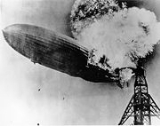
The Hindenburg disaster took place on May 6 1937 as the German rigid airship LZ 129 Hindenburg caught fire and was destroyed within one minute while attempting to dock with its mooring mast at the Lakehurst Naval Air Station which is located adjacent to the Lakehurst, New Jersey in Manchester, New Jersey....
 on board, 35 people died in addition to one fatality on the ground. The disaster was the subject of spectacular newsreel
Newsreel

A newsreel was a form of short documentary film prevalent in the first half of the 20th century, regularly released in a public presentation place and containing filmed news stories and items of topical interest....
 coverage, photographs, and Herbert Morrison
Herbert Morrison (announcer)

Herbert Morrison was an United States radio reporter best known for his vivid description of the Hindenburg disaster - a catastrophic explosion and fire that destroyed the LZ 129 Hindenburg zeppelin on May 6, 1937....
's recorded radio eyewitness report from the landing field, which was broadcast the next day.


Discussion
Ask a question about 'Hindenburg disaster'
Start a new discussion about 'Hindenburg disaster'
Answer questions from other users
Full Discussion Forum


Encyclopedia


The Hindenburg disaster took place on May 6 1937 as the German rigid airship
Rigid airship

A rigid airship was a type of airship in which the Envelope retained its shape by the use of an internal structural framework rather than by being forced into shape by the pressure of the lifting gas within the envelope as used in blimps and semi-rigid airships....
 
Hindenburg
LZ 129 Hindenburg

LZ 129 Hindenburg was a large Germany commercial passenger-carrying rigid airship, the lead ship of the Hindenburg class airship, the largest flying machines of any kind ever built....
 caught fire and was destroyed within one minute while attempting to dock with its mooring mast at the Lakehurst Naval Air Station which is located adjacent to the Borough of Lakehurst
Lakehurst, New Jersey

Lakehurst is a Borough in Ocean County, New Jersey, New Jersey, United States. As of the United States 2000 Census, the borough population was 2,522....
 in Manchester Township, New Jersey. Of the 97 people
Hindenburg disaster

The Hindenburg disaster took place on May 6 1937 as the German rigid airship LZ 129 Hindenburg caught fire and was destroyed within one minute while attempting to dock with its mooring mast at the Lakehurst Naval Air Station which is located adjacent to the Lakehurst, New Jersey in Manchester, New Jersey....
 on board, 35 people died in addition to one fatality on the ground. The disaster was the subject of spectacular newsreel
Newsreel

A newsreel was a form of short documentary film prevalent in the first half of the 20th century, regularly released in a public presentation place and containing filmed news stories and items of topical interest....
 coverage, photographs, and Herbert Morrison
Herbert Morrison (announcer)

Herbert Morrison was an United States radio reporter best known for his vivid description of the Hindenburg disaster - a catastrophic explosion and fire that destroyed the LZ 129 Hindenburg zeppelin on May 6, 1937....
's recorded radio eyewitness report from the landing field, which was broadcast the next day. The actual cause of the fire remains unknown, although a variety of theories have been put forward for both the cause of ignition and the initial fuel for the ensuing fire.

The accident served to shatter public confidence, and marked the end of the giant, passenger carrying rigid airships.

Flight

The first of 10 scheduled round trips between Europe and the United States to be made by the Hindenburg
LZ 129 Hindenburg

LZ 129 Hindenburg was a large Germany commercial passenger-carrying rigid airship, the lead ship of the Hindenburg class airship, the largest flying machines of any kind ever built....
 in the 1937 season departed Frankfurt for Lakehurst on the evening of May 3, and except for strong headwinds which slowed the passage the crossing was otherwise uneventful. The airship was only half full with 35 passengers (capacity 70) and 61 crew members (including 21 training crew members), but the return flight was fully booked by people planning to attend the festivities for the coronation of King George VI in London
London

London is the capital of both England and the United Kingdom, and the most populous municipality in the European Union. An important settlement for two millennia, History of London goes back to its founding by the Roman Empire....
 the following week.

The airship was already eight hours behind schedule when it passed over Boston on the morning of 6 May, and its landing at Lakehurst was expected to be further delayed because of afternoon thunderstorms. After passing over the field at 4 p.m., Captain Max Pruss thus took passengers on a tour over the seasides of New Jersey while waiting for the weather to clear. After finally being notified at 6:22 p.m. that the storms had passed, the airship headed back to Lakehurst to make its landing almost half a day late. However as this would leave much less time than anticipated to service and prepare the airship for its scheduled departure back to Europe, the public was informed that they could not be permitted at the mooring location or be able to visit aboard the "Hindenburg" during its stay in port.

Landing timeline

Around 7:00 p.m. local daylight saving time, at an altitude of , the
Hindenburg approached the Lakehurst Naval Air Station. This was to be a high landing, known as a flying moor, because the airship would be moored to a high mooring point, and then winched down to ground level. This type of landing maneuver would reduce the number of ground crew, but would require more time.

7:09: This airship made a sharp full speed left turn to the west around the landing field because the ground crew was not ready.

7:11: the airship turned back toward the landing field and valved gas. All engines idled ahead and the airship began to slow.

7:14: at altitude , Captain Pruss ordered all engines full astern to try to brake the airship.

7:17: the wind shifted direction to southwest, and Captain Pruss was forced to make a second, sweeping sharp turn, this time towards starboard.

7:19: the airship made the second sharp turn and valved 300, 300 and 500 kg of water ballast in successive drops because the airship was stern heavy. Six men (four were killed in the accident) were also sent to the bow to trim the airship. These methods worked and the airship was on even keel as it stopped.

7:21: at altitude , the mooring lines were dropped from the bow, the starboard line being dropped first. At this point, the cameramen who were filming the lines being caught by the ground crew stopped rolling film altogether, and missed what was about to happen.

First hints of disaster

At 7:25, a few witnesses saw the fabric ahead of the upper fin flutter as if gas were leaking. At the same time another witness saw what looked like static electricity moving up the hull from the bottom.

One misconception by most experts is that the initial flame was first seen just in front of the tail, but several eyewitness testimonies suggest that the first flame appeared the port side just ahead of the port fin, and was followed by flames which burned atop. Commander Rosendahl testified it being "mushroom-shaped" and knew at once that the airship was doomed. One witness on the starboard side reported a fire beginning lower and behind the rudder on that side (however, this may have happened after the initial fire on the port side).

Disaster

At 7:25 p.m. local time, the
Hindenburg caught fire and quickly became engulfed in flames. Where the fire started is controversial; several witnesses on the port side saw yellow-red flames first just forward of the top fin, around the vent of cell 4. Other witnesses on the port side noted the fire actually began just ahead of the horizontal port fin, only then followed by flames in front of the upper fin. One, with views of the starboard side, saw flames beginning lower and farther aft, near cell 1. No. 2 Helmsman Helmut Lau also testified seeing the flames spreading from cell 4 into starboard. Although there were four newsreel cameramen and at least one spectator known to be filming the landing, they were all recording the actions of the ground crew when the fire started and therefore there is no motion picture record of where it first broke out at the instant of ignition.

Wherever it started, the flames quickly spread forward. Almost instantly, a water tank and a fuel tank burst out of the hull due to the shock of the blast. This shock also caused a crack behind the passenger decks, and the rear of the structure imploded. The buoyancy was lost on the stern of the ship, and the bow lurched upwards as the falling stern stayed in trim.

As the
Hindenburg
s tail crashed into the ground, a burst of flame came out of the nose, killing nine of the twelve crew members in the bow. As the airship kept falling with the bow facing upwards (because there was more lifting gas still in the nose), part of the port side directly behind the passenger deck collapsed inward (where a crack formed during the initial blast), and the gas cell there exploded, erasing the scarlet lettering "Hindenburg" while the airship's bow lowered. The airship's gondola wheel touched the ground, causing the airship to bounce up once more. At this point, most of the fabric had burned away. At last, the airship went crashing on the ground, bow first. The ship was completely destroyed. Although the hydrogen had finished burning, the Hindenburg's diesel fuel burned for a few more hours.

The time it took for the airship to be completely destroyed has been disputed. Some observers believe it took 34 seconds, others say it took 32 or 37 seconds. Since none of the newsreel cameras were filming the airship when the fire started, the time of the start of the fire can only be estimated from various eyewitness accounts, and will never be known accurately. One careful analysis of the flame spread, by Addison Bain
Addison Bain

Addison Bain is a retired NASA scientist and hydrogen expert credited with postulating the Bain Incendiary-Paint Theory , which posits that the Hindenburg disaster was caused by the electrical ignition of lacquer- and metal-based paints used on the outer hull of the airship....
 of NASA
NASA

The National Aeronautics and Space Administration is an agency of the Federal government of the United States, responsible for the nation's public list of space agencies....
, gives the flame front spread rate across the fabric skin as about , which would have resulted in a total destruction time of about 16 seconds (245 m / 15 m/s = 16.3 s).

The incident is widely remembered as one of the most dramatic accidents of modern time. The cause of the accident has never been determined, although many theories, some highly controversial, have been proposed.

Historic newsreel coverage

The disaster
Disaster

File:Post-and-Grant-Avenue.-Look.jpgA disaster is the tragedy of a natural hazard or man-made hazard that negatively affects society or environment ....
 is well recorded because of the significant extent of newsreel
Newsreel

A newsreel was a form of short documentary film prevalent in the first half of the 20th century, regularly released in a public presentation place and containing filmed news stories and items of topical interest....
 coverage and photographs, as well as Herbert Morrison
Herbert Morrison (announcer)

Herbert Morrison was an United States radio reporter best known for his vivid description of the Hindenburg disaster - a catastrophic explosion and fire that destroyed the LZ 129 Hindenburg zeppelin on May 6, 1937....
's recorded, on-the-scene, eyewitness radio
Radio

Radio is the transmission of signals, by modulation of electromagnetic radiation with frequency below those of visible light.Electromagnetic radiation radio propagation by means of oscillating electromagnetic fields that pass through the air and the vacuum of space....
 report being made from the landing field for station WLS
WLS (AM)

WLS is a Chicago radio station. The Call sign stand for World's Largest Store . The station operates on an AM broadcasting clear channel frequency of 890 kHz with a power of 50,000 watts, with In-band on-channel during the day, and C-QUAM AM Stereo at night ....
 in Chicago
Chicago

Chicago is the largest city in the U.S. state of Illinois and the Midwestern United States, as well as the List of United States cities by population city in the United States with more than 2.8 million residents....
 which was broadcast the next day. Heavy publicity about the first transatlantic passenger flight of the year by Zeppelin to the U.S. attracted a large number of journalists to the landing. (The airship had already made one round trip from Germany to Brazil that year.) Parts of the Morrison report were later dubbed onto the newsreel footage and this gave the impression to many modern viewers, more accustomed to live television
Television

Television is a widely used telecommunication mass-media for transmitting and receiving moving , either monochrome or color, usually accompanied by sound....
 reporting, that the words and film were recorded together intentionally. Morrison's broadcast remains one of the most famous in history. His plaintive words, "Oh, the humanity!" resonate with the impact of the disaster, and have been widely used in culture. Part of its poignancy is due to its being recorded at a slightly slower speed to the disk, so when played back at normal speed seeming to be at a faster delivery and higher pitch; when corrected, his account is less frantic sounding, though still impassioned.

Spectacular motion picture footage and Morrison's passionate recording of the Hindenburg fire shattered public and industry faith in airships and marked the end of the giant passenger-carrying Airships. Also contributing to the Zeppelins' downfall was the arrival of international passenger air travel and Pan American Airlines. Aircraft regularly crossed the Atlantic and Pacific oceans much faster than the 130 km/h (80 mph) of the Hindenburg. The one advantage that the Hindenburg had over aircraft was the comfort it afforded its passengers, much like that of an ocean liner.

There had been a series of other airship accidents
List of airship accidents

Accidents of significant historical importance * 1919 American Wingfoot Air Express Crash. Caught fire over downtown Chicago, 2 passengers, one crewmember and 10 people on the ground killed, 2 parachuted to safety....
, none of them Zeppelins, prior to the Hindenburg fire. Many were caused by bad weather, and most of these accidents were dirigibles of British or U.S. manufacture. Zeppelins had an impeccable safety record. The Graf Zeppelin
LZ 127 Graf Zeppelin

LZ 127 Graf Zeppelin was a large German passenger carrying rigid airship which operated commercially from 1928 to 1937. It was named after the Germany pioneer of airships, Ferdinand von Zeppelin, who held the rank of Graf or Count in the German nobility....
 had flown safely for more than 1.6 million km (1 million miles), including the first circumnavigation
Circumnavigation

To circumnavigate a place, such as an island, a continent, or the Earth, is to travel all the way around it by boat or ship. More recently, the term has also been used to cover aerial round-the-world flights....
 of the globe by an airship. The Zeppelin company's promotions prominently featured the fact that no passenger had been injured on one of their airships.

Death toll

Despite the violent fire, most of the crew and passengers survived. Of the 36 passengers and 61 crew, 13 passengers and 22 crew died. Also killed was one member of the ground crew, civilian linesman Allen Hagaman. The majority of the crew who died were up inside the ship's hull, where they either did not have a clear escape route or else were close to the bow of the ship, which hung burning in the air too long for most of them to escape the fire. Most of the passengers who died were trapped in the starboard side of the passenger deck. Not only was the wind blowing the fire toward the starboard side, but the ship also rolled slightly to starboard as it settled to the ground, with much of the upper hull on that part of the ship collapsing outboard of the starboard observation windows, thus cutting off the escape of many of the passengers on that side. To make matters worse, the sliding door leading from the starboard passenger area to the central foyer and the gangway stairs (through which rescuers led a number of passengers to safety) jammed shut during the crash, further trapping those passengers on the starboard side. Nonetheless, some did manage to escape from the starboard passenger decks. A number of others unfortunately did not. By contrast, all but a few of the passengers on the port side of the ship survived the fire, with some of them escaping virtually unscathed. Although the most famous of airship disasters
List of airship accidents

Accidents of significant historical importance * 1919 American Wingfoot Air Express Crash. Caught fire over downtown Chicago, 2 passengers, one crewmember and 10 people on the ground killed, 2 parachuted to safety....
 it was not the worst. Almost twice as many perished when the helium filled USS Akron, unequipped with life jackets and rafts, crashed at sea.

Some of the survivors were saved by luck. Werner Franz, the 14 year-old cabin boy, was initially dazed by the realization that the ship was on fire. As he stood near the officer's mess where he had been putting away dishes moments before, a water tank above him burst open, and he was suddenly soaked to the skin. Not only did this snap him back to his senses, as he would later tell interviewers, but it also put out the fire around him. He then made his way to a nearby hatch through which the kitchen had been provisioned before the flight, and dropped through it just as the forward part of the ship was briefly rebounding into the air. He began to run toward the starboard side, but stopped and turned around and ran the other way, because the flames were being pushed by the wind in that same direction. He made it clear of the wreck with little more than singed eyebrows and soaking wet clothes. Werner Franz is one of the two people aboard who are still alive as of 2008.

When the control car crashed on the ground, most of the officers had leapt through the windows, but became separated. First Officer Captain Albert Sammt found Captain Max Pruss trying to re-enter the wreckage to look for survivors. Pruss's face was badly burned, and he required months of hospitalization and reconstructive surgery, but he would survive.

Captain Ernst Lehmann escaped the crash with burns to his head and arms and severe burns across most of his back. Though his burns did not seem quite as severe as those of Pruss, he died at a nearby hospital the next day.

When passenger Joseph Späh, a vaudeville comic acrobat, saw the first sign of trouble he smashed the window with his movie camera, with which he had been filming the landing (the film survived the disaster.) As the ship neared the ground he lowered himself out the window and hung onto the window ledge, letting go when the ship was perhaps 20 feet above the ground. His acrobat's instincts kicked in, and Späh kept his feet under him and attempted to do a safety roll when he landed. He injured his ankle nonetheless, and was dazedly crawling away when a member of the ground crew came up, slung the diminutive Späh under one arm, and ran him clear of the fire.

Of the 12 crewmen in the bow of the airship, only three survived. Four of these 12 men were standing on the mooring shelf, a platform up at the very tip of the bow from which the forward-most landing ropes and the steel mooring cable were released to the ground crew, and which was directly at the forward end of the axial walkway and just ahead of gas cell #16. The rest were standing either along the lower keel walkway ahead of the control car, or else on platforms beside the stairway leading up the curve of the bow to the mooring shelf. During the fire, of course, the bow hung in the air at roughly a 45-degree angle and flames shot forward through the axial walkway, bursting through the bow (and the bow gas cells) like a blowtorch. The three men from the forward section who survived (elevatorman Kurt Bauer, cook Alfred Grözinger, and electrician Josef Leibrecht) were those furthest aft of the bow, and two of them (Bauer and Grözinger) happened to be standing near two large triangular air vents, through which cool air was being drawn by the fire. Neither of these men sustained more than superficial burns. Most of the men standing along the bow stairway either fell aft into the fire, or tried to leap from the ship when it was still too high in the air. Three of the four men standing on the mooring shelf inside the very tip of the bow were actually taken from the wreck alive, though one (Erich Spehl, a rigger) died shortly afterward in the Air Station's infirmary, and the other two (helmsman Alfred Bernhard and apprentice elevatorman Ludwig Felber) were reported by newspapers to have initially survived the fire, and then to subsequently have died at area hospitals during the night or early the following morning.

The four crew members in the tail fin all survived; they were closest to the origin of the fire but sheltered by the structure of the lower fin. They escaped by climbing out the fin's access hatch when the tail hit the ground.

Hydrogen
Hydrogen

Hydrogen is the chemical element with atomic number 1. It is represented by the chemical symbol H. At standard temperature and pressure, hydrogen is a colorless, odorless, nonmetallic, tasteless, highly combustion and explosive Diatomic molecule gas with the molecular formula H2....
 fires are notable for being less destructive to immediate surroundings than gasoline explosions because of the buoyancy of H2, which causes heat of combustion to be released upwards more than circumferentially as the leaked mass ascends in the atmosphere; hydrogen fires are more survivable than fires of gasoline and of wood.

Cause of ignition


Sabotage theory

At the time of the disaster, sabotage was commonly put forward as the cause of the fire, initially by Hugo Eckener, former head of the Zeppelin company and the "old man" of German airships. (Eckener later publicly endorsed the static spark theory — see below.) Eckener, who was at the time on a lecture tour in Austria, was awakened at about 2:30 in the morning (8:30 PM Lakehurst time, or approximately an hour after the crash) by the ringing of his bedside telephone. It was a Berlin representative of the New York Times with news that the Hindenburg "exploded yesterday evening at 7 p.m [sic] above the airfield at Lakehurst." The newsman had no additional details for Dr. Eckener at that time, and Eckener spent a sleepless night trying to make sense of what he'd been told. By the time he left the hotel the next morning to travel to Berlin for a briefing on the disaster, the only answer that he had for the reporters waiting outside to question him was that based on what he knew, that the Hindenburg had "exploded over the airfield", sabotage might be a possibility. However, as he learned more about the disaster, particularly that the airship had burned rather than actually "exploding", he grew more and more convinced that static discharge, rather than sabotage, was the actual culprit.

Commander Charles Rosendahl, commander of the Naval Air Station at Lakehurst and the man in overall charge of the ground-based portion of the Hindenburg's landing maneuver, also came to believe that the Hindenburg had been sabotaged. He actually laid out a general case for sabotage in his 1938 book What About the Airship?, which was as much an extended argument for the further development of the rigid airship as it was an historical overview of the airship.

Another proponent of the sabotage hypothesis was Max Pruss, commander of the Hindenburg throughout the airship's career. Pruss flew on nearly every flight of the Graf Zeppelin until the Hindenburg was ready. In a 1960 interview conducted by Kenneth Leish for Columbia University's Oral History Research Office, Pruss said early dirigible travel was safe, and therefore he strongly believed that sabotage was to blame. He stated that on trips to South America, which was a popular destination for German tourists, both airships passed through thunderstorms and were struck by lightning but remained unharmed.

In 1962, A. Hoehling published Who Destroyed the Hindenburg?, a book that rejects all theories but sabotage. The book even names Eric Spehl, a rigger on the Hindenburg who died in the fire, as the saboteur.

Hoehling claimed the following in naming Spehl as the culprit:
  • Spehl's girlfriend had communist beliefs and anti-Nazi connections.
  • The fire's origin was near the catwalk running through Gas Cell 4, which was an area of the ship generally off-limits to anyone other than Spehl and his fellow riggers.
  • Rumors that the Gestapo had investigated Spehl's possible involvement in 1938.
  • Spehl's interest in amateur photography, making him familiar with flashbulbs that could have served as an igniter.
  • The discovery by representatives of the NYPD Bomb Squad of a substance that was later determined to likely be "the insoluble residue from the depolarizing element of a small, dry battery." (Hoehling postulated that a dry cell battery could have powered a flashbulb in an incendiary device.)
  • The discovery by FBI Agents of a yellow substance on the valve cap of the airship between cells 4 and 5 where the fire was first reported. Some have suggested this to be sulfur, which can ignite hydrogen. (However, a further investigation into this suggested that the residue was actually from a fire extinguisher in the stern of the ship.)
  • A flash or a bright reflection that crew members near the lower fin had seen just before the fire.


Ten years later, Michael MacDonald Mooney's book, The Hindenburg, which was based heavily on Hoehling's sabotage theory, also identified Spehl as the saboteur. Mooney's book was made into the movie The Hindenburg
The Hindenburg (film)

The Hindenburg is a movie based on the Hindenburg disaster of the Germany airship LZ 129 Hindenburg. The film was produced and directed by Robert Wise, and was written by Nelson Gidding, Richard Levinson and William Link based on the book of the same name by Michael M....
,
whose producers were sued by Hoehling for plagiarism, but Hoehling lost due to the fact that he had presented his sabotage theory as historical fact, and one cannot claim ownership of historical facts.

Hoehling's (and later Mooney's) theory goes on to say that it is unlikely that Spehl wanted to kill people, and that he intended for the airship to burn after the landing instead. However, with the ship already over 12 hours late, Spehl was in the end unable to find an excuse to reset the timer on his bomb.

During the landing maneuver, rigger Hans Freund dropped a landing line in front of the lower fin. The line became caught in the bracing wires of the airship, so No. 2 helmsman Helmut Lau climbed up from the lower fin to release it. When both men looked up toward the front of the airship, they were surprised by what they saw.

Freund described a flash like a flashbulb's, and Lau said he saw a brilliant reflection between cells 4 and 5. They then heard a muffled detonation and a thud as the Hindenburg's back broke. Some believe that this is evidence for sabotage. Others believe Freund was actually looking rearward, away from cells 4 and 5, but that Rudolf Sauter, another crew member in the lower fin had seen the flash.

Since the publication of Hoehling's book, most airship historians, including Dr. Douglas Robinson, have dismissed Hoehling's sabotage theory due to the fact that no solid evidence was ever presented to support it. No pieces of a bomb were ever discovered (and in fact there is no evidence in existing documentation that the sample collected from the wreckage, and determined to be residue from a dry cell battery, was found anywhere near the stern of the airship,) and on closer examination the evidence against Spehl and his girlfriend turned out to be largely circumstantial.

Another suspect favored by Commander Rosendahl, Captain Pruss, and several others among the Hindenburg's crew, was a passenger, a German acrobat named Joseph Späh, who survived the fire. He brought with him a dog, a German shepherd named Ulla, as a surprise for his children. (Ulla did not survive.) He reportedly made a number of unaccompanied visits to feed his dog, who was being kept in a freight room near the stern of the ship. Those who suspected Späh based their suspicions primarily on those trips into the ship's interior to feed his dog, that according to some of the stewards Späh had told anti-Nazi jokes during the flight, recollections by stewards that Späh had seemed agitated by the repeated delays in landing, and that he was an acrobat who could conceivably climb into the airship's rigging to plant a bomb. As with the allegations about Erich Spehl however, the evidence against Joseph Späh was entirely circumstantial.

It has even been suggested that Adolf Hitler himself ordered the Hindenburg to be destroyed in retaliation for Eckener's anti-Nazi opinions..

However, opponents of the sabotage hypothesis argued that only speculation supported sabotage as a cause of the fire, and no credible evidence of sabotage was produced at any of the formal hearings.

Eric Spehl died in the fire and was therefore unable to refute the accusations that surfaced a quarter of a century later. The FBI investigated Joseph Späh and reported finding no evidence of Späh having any connection to a sabotage plot. According to his wife, Evelyn, Späh was quite upset over the accusations - she later recalled that her husband was outside their home cleaning windows when he first learned that he was suspected of sabotaging the Hindenburg, and was so shocked by the news that he almost fell off the ladder on which he was standing. .

Neither the German nor the American investigation endorsed any of the sabotage theories. Proponents of the sabotage theory argue that any finding of sabotage would have been an embarrassment for the Nazi regime, and they speculate that such a finding by the German investigation was suppressed for political reasons.

Eckener believed that the reason why Pruss, Lehmann, and Rosendahl supported sabotage was because they may have felt guilty for their acts. Pruss made the sharp turn, Lehmann pressured Pruss to make it, and Rosendahl called the airship in..

Static spark theory

Another theory posits that the fire was started by a spark caused by a build up of static electricity
Electrostatics

Electrostatics is the branch of science that deals with the phenomena arising from stationary or slowly moving electric charges.Since classical antiquity it was known that some materials such as amber attract light particles after Triboelectric effect....
 on the airship. Whether the spark ignited hydrogen or the outer skin has been disputed.

Proponents of the static spark theory point out that the airship's skin was not constructed in a way that allowed its charge to be distributed evenly throughout the craft. The skin was separated from the duralumin
Duralumin

Duralumin is the trade name of one of the earliest types of age hardening aluminium alloys. The main alloying constituents are copper, manganese and magnesium....
 frame by non conductive ramie
Ramie

Ramie is a flowering plant in the nettle family Urticaceae, native to eastern Asia. It is a herbaceous perennial plant growing to 1 - 2.5 m tall; the leaf are heart-shaped, 7-15 cm long and 6-12 cm broad, and white on the underside with dense small hairs - this gives it a silvery appearance; unlike nettles, the hairs do not sting....
 cords which had been lightly covered in metal to improve conductivity, however not very effectively, allowing a large difference in potential
Potential

*The mathematical study of potentials is known as potential theory; it is the study of harmonic functions on manifolds. This mathematical formulation arises from the fact that, in physics, the scalar potential is irrotational, and thus has a vanishing Laplacian ? the very definition of a harmonic function....
 to form between them.

In order to make up for the delay of more than 12 hours in its transatlantic flight, the Hindenburg passed through a weather front of high humidity and high electrical charge. The storm could have made the airship's mooring lines wet and thus conductive, and may also have built up an electrical charge in its skin. The mooring lines also could have gotten wet as a light rain continued to fall at Lakehurst.

When the wet mooring lines, which were connected to the frame, touched the earth they would have grounded the frame but not the skin. This would have caused a sudden potential difference between skin and frame (and the airship itself with the overlying air masses) and would have set off an electrical discharge — a spark. The spark would have jumped from the skin onto the metal framework. At the same time, it’s also possible that hydrogen, either released during landing, or perhaps built up due to a leak (which some claim could be the reason the ship was stern-heavy and had to drop so much water prior to attempting a landing), was in turn ignited by the spark.

In his 1964 book, LZ-129 Hindenburg, Zeppelin historian Dr. Douglas Robinson points out that although ignition of free hydrogen by static discharge had become a favored theory, no such discharge was seen by any of the witnesses who testified at the official investigation into the accident back in 1937. He goes on to write:

Unlike other witnesses to the fire whose view of the port side of the ship had the light of the setting sun behind the ship, Professor Heald's view of the starboard side of the ship against a backdrop of the darkening eastern sky would have made the dim blue light of a static discharge (or burning hydrogen) atop the ship more easily visible.

Harold G. Dick was Goodyear Zeppelin's representative with Luftschiffbau Zeppelin during the mid-1930s. He flew on test flights of the Hindenburg and its sister ship, the Graf Zeppelin II. He also flew on numerous flights in the original Graf Zeppelin and 10 round trip crossings of the north and south Atlantic in the Hindenburg. In his book The Golden Age of the Great Passenger Airships Graf Zeppelin & Hindenburg, he observes:

In addition to Dick's observations is the fact that during the Graf Zeppelin II's early test flights, measurements were taken of the airship's static charge. It is clear that Dr. Ludwig Durr and the other engineers at Luftshiffbau Zeppelin took the static discharge theory seriously and considered the insulation of the fabric from the frame to be a design flaw in the Hindenburg.

A variant of the static spark theory, presented by Addison Bain
Addison Bain

Addison Bain is a retired NASA scientist and hydrogen expert credited with postulating the Bain Incendiary-Paint Theory , which posits that the Hindenburg disaster was caused by the electrical ignition of lacquer- and metal-based paints used on the outer hull of the airship....
, is that a spark between inadequately grounded fabric cover segments of the Hindenburg itself started the fire, and that the spark had ignited the highly flammable outer skin. The Hindenburg had a cotton skin covered with a finish known as "dope"
Aircraft dope

Aircraft dope is a plasticizer lacquer that is applied to fabric-coated aircraft. It tautens and stiffens fabric stretched over airframes and adheres and protects fabric applied to other skin material...
. It is a common term for a plasticised
Plasticizer

Plasticizers or Dispersants are additives that increase the plasticity or fluidity of the material to which they are added, these include plastics, cement, concrete, wallboard and clay bodies....
 lacquer
Lacquer

In a general sense, lacquer is a clear or coloured varnish that dries by solvent evaporation and often a curing process as well that produces a hard, durable finish, in any sheen level from ultra matte to high Gloss and that can be further polished as required....
 that provides stiffness, protection, and a lightweight, airtight seal to woven fabrics. In its liquid forms, dope is highly flammable, but the flammability of dry dope depends upon its base constituents, with, for example, butyrate dope being far less flammable than cellulose nitrate. When the mooring line touched the ground, a resulting spark could have ignited the dope in the skin.

Lightning theory

A. J. Dessler, former director of the Space Science Laboratory at NASA
NASA

The National Aeronautics and Space Administration is an agency of the Federal government of the United States, responsible for the nation's public list of space agencies....
's Marshall Space Flight Center
Marshall Space Flight Center

The George C. Marshall Space Flight Center , the original home of NASA, is a lead center for Spacecraft propulsion, Space Shuttle propulsion, Space Shuttle external tank, crew training and payloads, International Space Station design and construction, for computers, networks, and information management....
 and a critic of the incendiary paint theory (see below), favors a much simpler explanation for the conflagration: natural lightning
Lightning

File:Blesk.jpgLightning is an Earth's atmosphere discharge of electricity usually accompanied by thunder, which typically occurs during thunderstorms, and sometimes during volcano or dust storms....
. Like many other aircraft, the Hindenburg had been struck by lightning several times. This does not normally ignite a fire in hydrogen-filled airships, because the hydrogen is not mixed with oxygen. However, many fires started when lightning struck airships as they were venting hydrogen as ballast in preparation for landing, which the Hindenburg was doing at the time of the disaster. The vented hydrogen mixes with the air, making it readily combustible.

However, Dr. Eckener believed that the way the fire appeared was not consistent with that of a fire caused by lightning. Witnesses described the fire appearing in a wave motion. Eckener believed that the shape of the fire was consistent with that of a static spark..

Engine failure theory

On the 70th anniversary of the accident, The Philadelphia Inquirer carried an article with yet another theory, based on an interview of ground crew member Robert Buchanan. He had been a young man on the crew manning the mooring lines.

The excessively stormy day had not only delayed the dirigible's arrival but also soaked him and many of the other mooring crew. As the airship was approaching the mooring mast, he noted that one of the engines, thrown into reverse for a hard turn, backfired, and a shower of sparks was emitted. He and others think that this was the trigger that ignited the craft, not static electricity, as the official version goes.

When the Hindenburg ignited, instead of an explosion there were just three sequential plumes of flame on the outer shell. Another ground crewman named Robert Shaw saw what looked like a blue ring behind the tail fin. He too had seen sparks coming out of the engine. The cotton skin, depending on the exact makeup of its coating, may have been quite flammable, and therefore the heat and sparks from a backfiring engine could have ignited the skin, though this has not be proven beyond debate and it remains unknown if sparks did ignite the doping compound.

Dr. Eckener rejected the idea that hydrogen could have been ignited by an engine backfire when that theory was mentioned at an unofficial inquiry, which was a chat with crew members. Dr. Eckener believed that the hydrogen could not have been ignited by any exhaust because the temperature is too low to ignite the hydrogen. The ignition temperature for hydrogen is 700 °C, but the sparks from the exhaust only reach 250 °C. The Zeppelin Company also carried out extensive tests and hydrogen had never ignited. Additionally, the fire was first seen at the top of the airship, not near the bottom.

Fire's initial fuel

Most current analysis of the fire assumes ignition due to some form of electricity as the cause. However, there is still much controversy over whether the fabric skin of the airship, or rather the hydrogen used for buoyancy, was the initial fuel for the resulting fire.

Incendiary paint theory

The incendiary paint theory is limited to the source of ignition and to the flame front propagation, not to the source of most of the burning material, as once the fire started and spread the hydrogen clearly must have burned. Instead, for this topic the incendiary paint theory asserts that the major component in starting the fire and feeding its spread was the canvas skin because of the doping compound used on it.

Proponents of this theory point out that the coatings on the fabric contained both iron oxide and aluminum-impregnated cellulose acetate butyrate (CAB). These components remain potentially reactive even after fully setting. In fact, iron oxide and aluminum can be used as components of solid rocket
Solid rocket

A solid rocket or a solid-fuel rocket is a rocket with a motor that uses Rocket fuel#Solid propellants . The earliest rockets were solid fueled, powered by gunpowder, used by the Science and technology in China and Inventions in the Muslim world in warfare as early as the 13th century....
 fuel or thermite
Thermite

Thermite is a pyrotechnic composition of a metal powder and a metal oxide, which produces an aluminothermic reaction known as a thermite reaction....
. For example, the propellant for the Space Shuttle solid rocket booster
Space Shuttle Solid Rocket Booster

The Space Shuttle Solid Rocket Boosters are the pair of large solid rocket booster used by the Space Shuttle during the first two minutes of powered flight....
 includes both "aluminum (fuel, 16%), (and) iron oxide (a catalyst, 0.4%)".

Addison Bain
Addison Bain

Addison Bain is a retired NASA scientist and hydrogen expert credited with postulating the Bain Incendiary-Paint Theory , which posits that the Hindenburg disaster was caused by the electrical ignition of lacquer- and metal-based paints used on the outer hull of the airship....
 received permission from the German government to search their archives and discovered evidence that, during the Nazi regime, German scientists concluded the dope on the Hindenburg's fabric skin was the cause of the conflagration. Bain interviewed the wife of the investigation's lead scientist, and she stated that her husband had told her about the conclusion and instructed her to tell no one, presumably because it would have embarrassed the Nazi government.

Critics point out that port side witnesses on the field, as well as crew members stationed in the stern, saw a glow inside Cell 4 before any fire broke out of the skin, indicating that the fire began inside the airship (or that it was a hydrogen fire feeding on the whole cell). Newsreel footage supports this.

Proponents of the paint theory claim that the glow can be explained. They claim that what witnesses saw was the fire on the starboard side (another proponent claims that a witness saw the fire start from the starboard side) through the structure, looking like a glow. However, photographs of the early stages of the fire show the gas cells of the Hindenburg's entire aft section fully aflame. Burning gas spewing upward from the top of the airship was causing low pressure inside, allowing atmospheric pressure to press the skin inwards. It should also be noted that not all fabric on the Hindenburg burned. The fabric on several of the tail structures was not completely consumed. That the fabric not near the hydrogen fire extinguished itself is not consistent with the "explosive" dope theory.

Occasionally the Hindenburg's varnish is incorrectly identified as, or stated being similar to, cellulose nitrate, which, like most nitrates burns very readily. Instead, the cellulose acetate butyrate (CAB) used to seal the zeppelin's skin is rated by the plastics industry as combustible but nonflammable. That is, it will burn if placed within a fire but is not readily ignited. In fact, it is considered self extinguishing without some kind of additional fuel. That many pieces of the Hindenburg's skin survived despite such a fierce fire is cited as proof. In his experiment, Addison Bain had to use a high energy ignition source (an electrical spark) to make it burn.

Hydrogen theory

Offering support for the theory that there was some sort of hydrogen leak prior to the fire is that the airship remained stern heavy before landing. This could have been caused by a massive leak of the gas, which started mixing with air and filling up the space between the skin and the cells.

There are many theories about how that gas may have leaked, but the actual cause remains unknown. Many believe it was that a bracing wire cracked (see below), while others believe that a vent was stuck open and gas leaked through. During one trip to Rio, a gas cell was nearly emptied when a vent was stuck open and gas had to be transferred from other cells to maintain an even keel..

The fire seemed to start near the top of the airship, far from any crew or passengers. Although the hydrogen was odorized with garlic, it would have been detectable only in the area of a leak. Once the fire was underway more powerful smells would have masked any garlic odor. There were no reports of anyone smelling garlic during the flight, but no official documents have been found to prove the hydrogen even was odorized.

Pictures that show the fire burning along straight lines which coincide with the boundaries of gas cells suggests that the fire was not burning along the skin, which was continuous. Crew members stationed in the stern reported actually seeing the cells burning.

Opponents of this theory note that the fire was reported as burning bright red, while pure hydrogen burns blue if it's visible at all, although there were obviously many other materials that were consumed by the fire, possibly changing its hue. Another problem is that most of the airshipmen at the time, including Captain Pruss, believed that stern heaviness was normal. The Hindenburg had flown over rainy conditions for at least several hours, and as the airship flies forward the water flows towards the horizontal fins to which it accumulates, possibly causing the noted stern heaviness. As the Hindenburg stopped, this became more noticeable.

It also would have had to have been a very large leak of hydrogen before stern heaviness could be observed, although given the end result this seems obvious. The stern heaviness was also noticed minutes before the airship made its sharp turns for its approach, and crew members stated that it was corrected as the ship stopped (after dropping over 1000 kg of water ballast and venting gas). Additionally, the gas cells of the ship were not pressurized, and when leaking would not cause the fluttering of the outer cover, which wasn't seen until seconds before the fire. Instead, it has been suggested that such fluttering was caused by the initial blast wave of the hydrogen cells igniting.

While not issuing an opinion about whether it was the hydrogen or the treated skin of the airship which ignited first, the MythBusters
MythBusters

MythBusters is a popular science television program produced by Australian firm Beyond Television Productions originally for the Discovery Channel in the United States and Canada....
 explored the incendiary paint theory. Their findings indicated that the aluminum/iron oxide ratios in the Hindenburg's skin, while certainly flammable, were not enough on their own to destroy the zeppelin. Had the skin in fact contained enough metal to produce pure thermite, the Hindenburg would have been too heavy to fly. And even if it somehow did, a pure thermite reaction (at ~2500 degrees C) would have completely melted the airframe (assuming Aluminium 2024
2024 aluminum

Aluminium alloy 2024 is an aluminium alloy, with copper and magnesium as the alloying elements. It is used in applications requiring high strength to weight ratio, as well as good metal fatigue resistance....
's melt point of ~630 degrees C for the duralumin
Duralumin

Duralumin is the trade name of one of the earliest types of age hardening aluminium alloys. The main alloying constituents are copper, manganese and magnesium....
 of the day), whereas the real disaster left the spars and ribs recognizable. The MythBusters team also discovered that the Hindenburg's coated skin required a higher temperature to ignite than untreated material, but after it was ignited the treated cloth reacted more violently. This led to their hypothesis that the paint may have contributed to the disaster, but it was the hydrogen that ultimately caused the zeppelin to burn.

Puncture theory

An aspect of the hydrogen theory above claims that one of the many bracing wires within the airship snapped and punctured at least one of the internal gas cells. Advocates of this theory believe that the hydrogen began to leak approximately five minutes before the fire. Newsreels as well as the account of the landing approach show the Hindenburg made several sharp turns, first towards port and then starboard, just before the accident. Gauges found in the wreckage showed the tension of the wires was much too high, and some of the bracing wires may have even been substandard. One bracing wire tested after the crash, though possibly damaged by the fire, broke at a mere 70% of its rated load. A punctured cell would have freed hydrogen into the air and could have been ignited by a static discharge (see above). Or it is also possible that the broken bracing wire struck a girder causing sparks..

A ground crew member, R.H. Ward, reported seeing a piece of the airship fluttering, perhaps providing an opening for a spark to reach escaping hydrogen inside the airship, or vice versa. He said that the fire began there, but that no other disturbance occurred at the time when the fabric fluttered. Another man on the top of the mooring mast had also reported seeing a flutter in the fabric as well. People on board the airship reported hearing a muffled sound, and another ground crew member on the starboard side reported hearing a crack. Some speculate the sound was from a bracing wire snapping.

Dr. Eckener concluded that the puncture theory was the most likely cause of the disaster. Because of this, he felt that Captains Pruss and Lehmann, and Charles Rosendahl were to blame for the whole disaster. He believed that Lehmann told Pruss to make the sharp turn, and that Pruss and Rosendahl were concerned more about the time delay than the weather, because an unobserved storm front occurred just when the Hindenburg approached. But in his heart, Dr. Eckener knew that he was to blame as much as anyone else, for a decision eight years earlier, which he kept a close secret.

Eckener concluded that the fire was caused by the ignition of hydrogen by a static spark:

Other controversial hypotheses


Structural failure
Captain Pruss believed that the Hindenburg could withstand tight turns without significant damage. Other engineers and scientists believe that the airship would have been weakened by being repeatedly stressed. Even a 10-meter, full scale replica of the Hindenburg's passenger quarters, displayed in the Zeppelin Museum
Zeppelin Museum

Zeppelin Museum...
 in Friedrichshafen
Friedrichshafen

Friedrichshafen is a town on the northern side of Lake Constance in southern Germany, near the borders with Switzerland and Austria.It is the district capital of the Bodensee district in the States of Germany of Baden-W?rttemberg....
, has developed some metal fatigue.

The airship's landing approach actually proceeded in two sharp turns. The first turn was towards port at full speed as the airship circled the landing field. After circling the landing field, the wind shifted direction towards the southwest, and a sharper turn to starboard was ordered near the end of the landing maneuver. After the last turn the airship seemed to drop even more at the stern, though a slight stern heaviness was already noticed before this turn. One or both of these turns towards opposite directions could have weakened the structure.

However, refutation against this theory is the fact that the first sharp turn was too wide and circular to cause any damage, and while the final turn was considered sharp, was far too slow for any structural failure to occur.

The airship did not receive much in the way of routine inspections even though there was evidence of at least some damage on previous flights. It is not known if that damage was properly repaired or even if all the failures had been found. The Hindenburg once lost an engine and almost drifted over Africa, where it could have crashed. Dr. Eckener was furious and ordered all section chiefs to inspect the airship during flight.

In March 1936, the Graf Zeppelin and the Hindenburg made three-day flights to drop leaflets and broadcast speeches via loudspeaker. Before the airship's takeoff on 26 March 1936, Captain Lehmann chose to launch the Hindenburg with the wind blowing from behind the airship, instead of into the wind as per standard procedure. During the takeoff, the airship's tail struck the ground, and part of the lower fin was broken. Many spectators' cameras were confiscated to prevent negative publicity, but Harold G. Dick
Harold G. Dick

Harold G. 'Hal' Dick was an United States mechanical engineer employed by Goodyear Tire and Rubber Company, who flew on almost all of the The Hindenburg flights....
 concealed his camera and took pictures of the damaged fin. Dr. Eckener was very upset and rebuked Captain Lehmann:

Though that damage was repaired, the force of the crash may have caused internal damage.

Only six days before the disaster, there was a plan assisted by the U.S. Navy to make the Hindenburg have a hook on her hull to carry aircraft in a similar way to what the Navy did with the USS Akron and the USS Macon
USS Macon (ZRS-5)

USS Macon was a rigid airship built and operated by the United States Navy for Reconnaissance. It served as a Airborne aircraft carrier, launching F9C Sparrowhawk....
. However, the trials were unsuccessful; the biplane had bashed the hook several times. This could have also caused damage and weakening of the structure.

Photographs and newsreels of the initial stages of the fire show that the stern section of the airship collapsed inward in a similar way to an eggshell, as well as a "crack" directly behind the passenger decks. When the stern of the ship hit the ground and collapsed, this part collapsed inward, causing another plume of fire to start. Some experts have suggested that the collapsing of the structure in this manner suggests problems within the cell bulkheads and the bracing wires.

This theory has not been very popular because it is not a so much theory about what caused the fire, but merely a possible element that supports the puncture theory.

Fuel leak
The 2001 documentary Hindenburg Disaster: Probable Cause suggested that 16-year-old Bobby Rutan, who said he had smelled "gasoline" when he was standing below the Hindenburg's aft port engine, had detected a diesel fuel leak. The day before the disaster, a fuel pump had broken during the flight. A crew member said this was fixed but it may not have been done properly. The resulting vapor would have been highly flammable and could have self combusted. The film also suggested that overheating engines may have played a role.

During the investigation, Commander Charles Rosendahl dismissed the boy's report.

Critics say the documentary is misleading, because it misconstrued the statements by the crewmen in the Hindenburg's lower fin. The crewmen said they saw a flash in the axial catwalk, but the film placed the flash in the keel catwalk closer to the passenger areas.

Luger pistol among wreckage
Some more sensational newspapers at the time said that a person on board committed suicide because a Luger pistol
Luger pistol

The Parabellum-Pistole , popularly known as the Luger, is a toggle locked, Recoil operation#Short recoil operation, semi-automatic pistol....
 with one shell fired was found among the wreckage. Yet, there is no such evidence suggesting an attempted suicide. One thing to consider was that the Luger pistol ejected each empty round after firing, and that some owners would keep an empty shell in the gun for safety reasons.

Rate of flame propagation

Regardless of the source of ignition or the initial fuel for the fire, there remains the question of what caused the rapid spread of flames along the length of the airship. Here again the debate has centered on the fabric covering of the airship and the hydrogen used for buoyancy.

Proponents of both the incendiary paint theory and the hydrogen theory agree that the fabric coatings were probably responsible for the rapid spread of the fire. The combustion of hydrogen is not usually visible to the human eye in daylight, because most of its radiation is not in the visible portion of the spectrum but rather infrared. Thus what can be seen burning in the photographs cannot be hydrogen. However, black and white photographic film of the era had a different light sensitivity spectrum than the human eye, and was sensitive farther out into the infrared and ultraviolet region than the human eye. And while hydrogen tends to burn invisibly, the materials around it, if combustible, would change the color of the fire.

The motion picture films show the fire spreading downward along the skin of the airship. While fires generally tend to burn upward, especially including hydrogen fires, the enormous radiant heat from the blaze would have quickly spread fire over the entire surface of the airship, thus apparently explaining the downward propagation of the flames. Falling, burning debris would also appear as downward streaks of fire.

Of note is that in 1935 a helium filled blimp with an acetate aluminium skin burned near Point Sur in California with equal ferocity. Even the USS Macon burned. Those who disagree with this theory (that the skin increased the rate of flame propagation) insist these two incidents had nothing to do with the dope, instead the small blimp burned because of a fuel leak, and the Macon burned because it was firing flares.

Those skeptical of the incendiary paint theory cite recent technical papers which claim that even if the airship had been coated with actual rocket fuel, it would have taken many hours to burn — not the 32 to 37 seconds that it actually took.

Modern experiments that recreated the fabric and coating materials of the Hindenburg seem to discredit the incendiary fabric theory. They conclude that it would have taken about 40 hours for the Hindenburg to burn if the fire had been driven by combustible fabric. Two additional scientific papers also strongly reject the fabric theory.

However these claims do not agree with the results the Mythbusters
MythBusters

MythBusters is a popular science television program produced by Australian firm Beyond Television Productions originally for the Discovery Channel in the United States and Canada....
 achieved on their Hindenberg special of their TV show and others feel the criticisms does not take into account the conditions that lead to firestorm
Firestorm

A firestorm is a conflagration which attains such intensity that it creates and sustains its own wind system. It is most commonly a natural phenomenon, created during some of the largest bushfires, forest fires, and wildfires....
s, such as convection
Convection

Convection in the most general terms refers to the movement of molecules within fluids . Convection is one of the major modes of heat transfer and mass transfer....
 and ignition from radiant energy.

The most conclusive proof against the fabric theory is in the photographs of the actual accident as well as the many airships which were not doped with aluminum powder and still exploded violently. When a single gas cell explodes, it creates a shock wave and heat. The shock wave tends to rip nearby bags which then explode themselves. In the case of the Alhorn disaster during World War I, explosions of airships in one shed caused the explosions of others in sheds nearby, wiping out all the airships at the base.

The photos of the Hindenburg disaster clearly show that after the cells in the aft section of the airship exploded and the combustion products were vented out the top of the airship, the fabric on the rear section was still largely intact, and air pressure from the outside was acting upon it, caving the sides of the airship inward due to the reduction of pressure caused by the venting of combustion gases out the top.

The loss of lift at the rear caused the airship to nose up suddenly and the back to break in half (the airship was still in one piece), at that time the primary mode for the fire to spread was along the axial gangway which acted as a chimney, conducting fire which burst out the nose as the airship's tail touched the ground, and as seen in one of the most famous pictures of the disaster. As the flames burst from the nose, the fabric on most of the forward part of the airship was still intact, seeming to show that the propagation of the fire was via hydrogen, not the fabric.

Also supporting the fact that hydrogen was burning was that a few seconds after the fire burst out the nose, a fire started in the cell behind the passenger decks when the airship bent on the side due to a crack in the side just behind the passenger decks.

Even if the fire was started by the fabric, it still would have set off the leaking hydrogen. That hydrogen would still be required to increase the burn speed of the fire, regardless of what was ignited first. If the Hindenburg was filled with helium and still caught fire, the fire would be slower and most people, if not all, would have survived.

Television investigations

As mentioned previously, the Discovery Channel
Discovery Channel

The Discovery Channel is an United States satellite and cable TV channel , founded by John Hendricks and distributed by Discovery Communications....
 series MythBusters
MythBusters

MythBusters is a popular science television program produced by Australian firm Beyond Television Productions originally for the Discovery Channel in the United States and Canada....
 explored the incendiary paint theory (IPT) and the hydrogen theory in an episode that aired 10 January 2007. While their experiments didn't concern what actually started the fire, the show's hosts, Adam Savage
Adam Savage

Adam Whitney Savage is an United States industrial design and special effects engineer, actor, educator, and co-host of the Discovery Channel television series MythBusters....
 and Jamie Hyneman
Jamie Hyneman

James Earl "Jamie" Hyneman is an US special effects expert, best known for being the co-host of the television series MythBusters. He is also the founder of M5 Industries, a special effects workshop where MythBusters is filmed....
, demonstrated that when set alight with a blowtorch a 1:50 scale model of the Hindenburg burnt twice as fast in the presence of diffused hydrogen as without it. Combustion was observed in the burning skin, which would have accelerated the fire, but their experiments showed that hydrogen was the main fuel. The hydrogen filled model produced a fire with flames that came out of the nose and resembled the newsreel footage of the Hindenburg disaster. That program concluded that the IPT myth was "Busted
MythBusters

MythBusters is a popular science television program produced by Australian firm Beyond Television Productions originally for the Discovery Channel in the United States and Canada....
".

The National Geographic program Seconds From Disaster
Seconds From Disaster

Seconds From Disaster is a documentary television series that investigates historically relevant man-made and natural disasters. Each episode aims to explain a single incident by analyzing the causes and circumstances that ultimately affected the disaster....
 had veteran air crash investigator Greg Feith
Greg Feith

Gregory "Greg" Feith is a former United States Senior Air Safety Investigator with the National Transportation Safety Board. During his time at the NTSB, Feith worked as an Air Safety Investigator Unit Supervisor, Regional Director, and Senior Air Safety Investigator....
 study all of the available evidence, including eyewitness accounts, interviews with the last two living survivors, newsreel footage, weather reports, and the Hindenburg blueprints. Feith burned a sample of doped cloth and it took one minute to consume the whole piece, ruling out the skin as the primary accelerant. Feith's investigations concluded that a gas bag was punctured, probably by a bracing wire broken from the two sharp turns, and that electrostatic discharge from the skin to the ship's skeleton ignited the leaked hydrogen.

In Search of...
In Search of...

In Search of ... is a Television documentary film series that was broadcast weekly from 1976 to 1982. It was created after two successful hour long TV documentaries, In Search of Ancient Astronauts in 1973 , and In Search of Ancient Mysteries in 1975 both with narration by Rod Serling....
, a show mainly focused on paranormal investigations and conspiracy theories hosted by Star Trek
Star Trek

Star Trek is an American Science fiction on television entertainment series and media franchise. The Star Trek fictional universe created by Gene Roddenberry is the setting of six television series including the original 1966 Star Trek: The Original Series, in addition to ten feature films with Star Trek to be released on May 8,...
 alum Leonard Nimoy
Leonard Nimoy

Leonard Simon Nimoy is an American actor, film director, poet, musician and photographer. He is best known for playing the character of Spock on Star Trek: The Original Series, an American television series that ran for three seasons from 1966 to 1969, in addition to reprising the role in several movie sequels....
, made an episode based on this tragic accident, and immediately raised the question of whether it was really an accident or instead sabotage by then-Nazi Germany.

Memorial

The actual site of the Hindenburg crash at Lakehurst Naval Air Station (reestablished as Naval Air Systems Command (NAVAIR) at Naval Air Engineering Station (NAES) Lakehurst, or "Navy Lakehurst" for short) is marked with a chain outlined pad and bronze plaque where the airship's gondola landed. It was dedicated on 6 May 1987, the 50th anniversary of the disaster. Hangar #1, which still stands, is where the airship was to be housed after landing. It was designated a Registered National Historic Landmark in 1968. Pre-registered tours are held through the Navy Lakehurst Historical Society . Due to security concerns, no foreign nationals are permitted on the tours.

Popular culture


Audio

  • English
    England

    native_name =|conventional_long_name = England|common_name = England|image_flag = Flag of England.svg|image_coat = England COA.svg|symbol_type = Royal Coat of Arms...
     rock group Led Zeppelin
    Led Zeppelin

    Led Zeppelin were an English rock music band formed in 1968 by Jimmy Page , Robert Plant , John Paul Jones and John Bonham . With their heavy, guitar-driven sound, Led Zeppelin are regarded as one of the first heavy metal music bands....
    's eponymous first album
    Led Zeppelin (album)

    Led Zeppelin is the debut album of English Rock music band Led Zeppelin. It was recorded in October 1968 at Olympic Studios in London and released on Atlantic Records on 12 January 1969....
     has a picture of the Hindenburg disaster on the front cover. The band's name itself is a reference to Keith Moon
    Keith Moon

    Keith John Moon was the drummer of the rock group The Who. He gained notoriety for exuberant drumming and his destructive lifestyle. Moon joined The Who in 1964, replacing Doug Sandom....
    's quotation that the band would "go over like a lead balloon." The album cover is in fact a pen and ink illustration of the famous UPI
    United Press International

    United Press International is a news agency headquartered in the United States with roots dating back to 1907. Once a mainstay in the newswire service along with Associated Press and Reuters, it began to decline as afternoon newspapers, its chief client category, began to fail with the rising popularity of television news....
     photograph drawn with a Rapidograph
    Technical pen

    A technical pen is a specialized instrument used by an engineer, architect, or Technical drawing to make lines of constant width for architectural, engineering, or technical drawings....
     pen by graphic artist
    Graphic designer

    A graphic designer is a professional within the graphic design and graphic arts industry who assembles together images, typography or motion graphics to create a piece of design....
     George Hardie
    George Hardie (artist)

    George Hardie is a graphic designer, illustration and educator, best known for his work producing album cover for the albums of Rock and roll musicians and bands with the United Kingdom art design group Hipgnosis....
    . Their 2007 compilation album Mothership
    Mothership (album)

    Mothership is a compilation album by English rock group Led Zeppelin, released by Atlantic Records and Rhino Entertainment on 12 November 2007 in the United Kingdom, and 13 November 2007 in the United States....
     also has a picture of the Hindenburg on the album cover.


Film and television

  • The Hindenburg
    The Hindenburg (film)

    The Hindenburg is a movie based on the Hindenburg disaster of the Germany airship LZ 129 Hindenburg. The film was produced and directed by Robert Wise, and was written by Nelson Gidding, Richard Levinson and William Link based on the book of the same name by Michael M....
     (1975 movie) is a speculative thriller based on the events leading up to and including the disaster.
  • In the The Waltons
    The Waltons

    The Waltons is an United States television series created by Earl Hamner, Jr., based on his book Spencer's Mountain, and a 1963 Spencer's Mountain, starring Henry Fonda and Maureen O'Hara....
     season 5 episode "The Inferno", first aired on 10 February 1977, John-Boy goes to Lakehurst, New Jersey, to report on the landing of the Hindenburg.


Other

  • Hindenburg is the primary motif of the first section of Three Tales
    Three Tales (opera)

    Three Tales is a contemporary video-Opera in three acts, composed by American composer Steve Reich in 2002. Beryl Korot, the wife of the composer, created the visuals which accompany the music written for ensemble and pre-recorded audio....
     by Steve Reich
    Steve Reich

    File:Steve Reich2.jpgStephen Michael Reich is an United States composer who pioneered the style of minimalist music. His innovations include using tape loops to create phasing patterns , and the use of simple, audible processes to explore musical concepts ....
     and Beryl Korot.
  • Hindenburg is the main setting of the 2000 mystery novel "The Hindenburg Murders" by Max Allan Collins
    Max Allan Collins

    Max Allan Collins is a prolific United States mystery fiction writer who has been called "mystery's Renaissance man". He has written novels, screenplays, comic books, comic strips, trading cards, short stories, film novelizations and historical fiction....
    .
  • The last flight of the Hindenburg is a major plot element in Allen Steele
    Allen Steele

    Allen Mulherin Steele, Jr. is an United States science fiction author.Steele began publishing short stories in 1988. His early novels formed a future history beginning with Orbital Decay and continuing through Labyrinth of Night....
    's science fiction fix up novel Chronospace.
  • In the novel The Never War
    The Never War

    The Never War is a book in the Pendragon series by D.J. MacHale. D.J found his information on many websties which is said in the back of the book quote "This is real information." In this book, the main character, Robert "Bobby" Pendragon follows the antagonist, named Saint Dane, to a territory called First Earth, which is essentially Ea...
     by D.J. MacHale
    D.J. MacHale

    Donald James MacHale, known popularly under the pen name D. J. MacHale, is a writer, director, and executive producer. He has been affiliated with shows such as Are You Afraid of the Dark?, Flight 29 Down and Seasonal Differences....
    , the main character can choose to keep the Hindenburg accident from happening, which he thought would keep World War II from starting. However, he decides not to, since he discovers that the airship is carrying payment to German spies that would allow the Nazis to develop atomic weapons before the Allies
    Allies

    In general, allies are people, groups or nations that have joined together in an association for mutual benefit or to achieve some common purpose....
    .
  • Images of the burning Hindenburg formed a part of Marilyn Manson
    Marilyn Manson

    Marilyn Manson may refer to:* Marilyn Manson , an American rock musician* Marilyn Manson , the American rock band led by the singer of the same name...
    's most recent tour, Eat Me, Drink Me
    Eat Me, Drink Me

    Eat Me, Drink Me is Marilyn Manson 's sixth studio album, released worldwide on June 5, 2007. Eat Me, Drink Me was recorded in a rented home-recording studio in Hollywood, California by lead vocalist Marilyn Manson and guitarist and bass guitarist Tim Skold....
    .


See also

  • LZ 129 Hindenburg
    LZ 129 Hindenburg

    LZ 129 Hindenburg was a large Germany commercial passenger-carrying rigid airship, the lead ship of the Hindenburg class airship, the largest flying machines of any kind ever built....
  • Crash cover
    Crash cover

    A crash cover is a Philately term for a type of Cover , meaning an envelope or package that has been recovered from a fixed-wing aircraft, airship or aeroplane crash, train wreck, shipwreck or other accident....
  • Hindenburg Disaster Newsreel Footage
    Hindenburg Disaster Newsreel Footage

    Hindenburg Disaster Newsreel Footage is a 1937 documentary film which shows the burning, explosion, and crash of the zeppelin LZ 129 Hindenburg....
  • Herbert Morrison (announcer)
    Herbert Morrison (announcer)

    Herbert Morrison was an United States radio reporter best known for his vivid description of the Hindenburg disaster - a catastrophic explosion and fire that destroyed the LZ 129 Hindenburg zeppelin on May 6, 1937....
  • List of airship accidents
    List of airship accidents

    Accidents of significant historical importance * 1919 American Wingfoot Air Express Crash. Caught fire over downtown Chicago, 2 passengers, one crewmember and 10 people on the ground killed, 2 parachuted to safety....
  • Hindenburg: The Untold Story
    Hindenburg: The Untold Story

    Hindenburg: The Untold Story known in Germany as Das Geheimnis der Hindenburg and Die Hindenburg: die ungekl?rte Katastrophe, is a two-hour docudrama about the Hindenburg Disaster, and the investigation that followed....
     was a docudrama
    Docudrama

    A docudrama is a dramatization of actual historical events. As a neologism, the term is often confused with docufiction....
     aired on the 70th anniversary of the disaster, 6 May 2007.
  • Timeline of hydrogen technologies
    Timeline of hydrogen technologies

    Timeline of hydrogen technologies A timeline of the history of hydrogen technology....


Bibliography

  • Archbold, Rick. Hindenburg: An Illustrated History. Toronto: Viking Studio/Madison Press, 1994. ISBN 0-670-85225-2.
  • Birchall, Frederick. "100,000 Hail Hitler; U.S. Athletes Avoid Nazi Salute to Him". The New York Times, 1 August 1936, p. 1.
  • Botting, Douglas. Dr. Eckener's Dream Machine: The Great Zeppelin and the Dawn of Air Travel. New York: Henry Holt & Co., 2001. ISBN 0-80506-458-3.
  • Deutsche Zeppelin-Reederi. Airship Voyages Made Easy (16 page booklet for "Hindenburg" passengers). Luftschiffbau Zeppelin G.m.b.H., Friedrichshafen, Germany, 1937.
  • Dick, Harold G. and Douglas H. Robinson. The Golden Age of the Great Passenger Airships Graf Zeppelin & Hindenburg. Washington, D.C. and London: Smithsonian Institution Press, 1985. ISBN 1-56098-219-5.
  • Duggan, John. LZ 129 "Hindenburg": The Complete Story. Ickenham, UK: Zeppelin Study Group, 2002. ISBN 0-9514114-8-9.
  • Hoehling, A.A. Who Destroyed The Hindenburg? Boston: Little, Brown and Company, 1962. ISBN 0-44508-347-6.
  • Lehmann, Ernst. Zeppelin: The Story of Lighter-than-air Craft. London: Longmans, Green and Co., 1937.
  • Majoor, Mireille. Inside the Hindenburg. Boston: Little, Brown and Company, 2000. ISBN 0-316-123866-2.
  • Mooney, Michael Macdonald. The Hindenburg. New York: Dodd, Mead & Company, 1972. ISBN 0-396-06502-3.
  • National Geographic. Hindenburg's Fiery Secret (DVD). Washington, DC: National Geographic Video, 2000.


External links


Video


Articles

  • Original reports from The Times


Flammable fabric disaster theory
  • An article supporting the engine exhaust spark theory: