

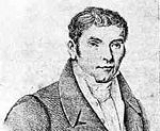
Henri Braconnot

Encyclopedia
Henri Braconnot was a French
French people
The French are a nation that share a common French culture and speak the French language as a mother tongue. Historically, the French population are descended from peoples of Celtic, Latin and Germanic origin, and are today a mixture of several ethnic groups...
chemist
Chemist
A chemist is a scientist trained in the study of chemistry. Chemists study the composition of matter and its properties such as density and acidity. Chemists carefully describe the properties they study in terms of quantities, with detail on the level of molecules and their component atoms...
and pharmacist
Pharmacist
Pharmacists are allied health professionals who practice in pharmacy, the field of health sciences focusing on safe and effective medication use...
.
He was born in Commercy, his father being a counsel at the local parliament. At the death of his father, in 1787, Henri began his instruction in an elementary school in Commercy and then with private teachers.
At 13, he was placed as apprentice in a pharmacy in Nancy where he learned and practiced pharmacy
Pharmacy
Pharmacy is the health profession that links the health sciences with the chemical sciences and it is charged with ensuring the safe and effective use of pharmaceutical drugs...
, chemistry
Chemistry
Chemistry is the science of matter, especially its chemical reactions, but also its composition, structure and properties. Chemistry is concerned with atoms and their interactions with other atoms, and particularly with the properties of chemical bonds....
, and botany
Botany
Botany, plant science, or plant biology is a branch of biology that involves the scientific study of plant life. Traditionally, botany also included the study of fungi, algae and viruses...
. At 15, he left Nancy for a military service in an hospital in Strasbourg
Strasbourg
Strasbourg is the capital and principal city of the Alsace region in eastern France and is the official seat of the European Parliament. Located close to the border with Germany, it is the capital of the Bas-Rhin département. The city and the region of Alsace are historically German-speaking,...
.
In 1801-1802, he lived in Paris
Paris
Paris is the capital and largest city in France, situated on the river Seine, in northern France, at the heart of the Île-de-France region...
where he learnt in various schools, Museum, school of medicine among others, and followed the lectures of Antoine François, comte de Fourcroy
Antoine François, comte de Fourcroy
Antoine François, comte de Fourcroy was a French chemist and a contemporary of Antoine Lavoisier. Fourcroy collaborated with Lavoisier, Guyton de Morveau, and Claude Berthollet on the Méthode de nomenclature chimique, a work that helped standardize chemical nomenclature.-Life and work:Fourcroy...
, Jean-Baptiste Lamarck
Jean-Baptiste Lamarck
Jean-Baptiste Pierre Antoine de Monet, Chevalier de la Marck , often known simply as Lamarck, was a French naturalist...
and Étienne Geoffroy Saint-Hilaire
Étienne Geoffroy Saint-Hilaire
Étienne Geoffroy Saint-Hilaire was a French naturalist who established the principle of "unity of composition". He was a colleague of Jean-Baptiste Lamarck and expanded and defended Lamarck's evolutionary theories...
. He carried out some chemical investigations on the composition of a fossil horn which were published later (J Chim Phys 1806).
From 1802 to his death, he lived in Nancy where he was named in 1807 as director of the botanical garden and member of the scientific academy of the town. He worked as a chemist until his death mainly on plant chemistry. He made several research on plant assimilation, organic acid
Organic acid
An organic acid is an organic compound with acidic properties. The most common organic acids are the carboxylic acids, whose acidity is associated with their carboxyl group –COOH. Sulfonic acids, containing the group –SO2OH, are relatively stronger acids. The relative stability of the conjugate...
s, plant composition and fat
Fat
Fats consist of a wide group of compounds that are generally soluble in organic solvents and generally insoluble in water. Chemically, fats are triglycerides, triesters of glycerol and any of several fatty acids. Fats may be either solid or liquid at room temperature, depending on their structure...
s. He made also minor contributions to mineralogy
Mineralogy
Mineralogy is the study of chemistry, crystal structure, and physical properties of minerals. Specific studies within mineralogy include the processes of mineral origin and formation, classification of minerals, their geographical distribution, as well as their utilization.-History:Early writing...
and hydrology
Hydrology
Hydrology is the study of the movement, distribution, and quality of water on Earth and other planets, including the hydrologic cycle, water resources and environmental watershed sustainability...
.
He was elected in 1823 correspondent member of the Académie des Sciences in Paris. Until his death in 1855, he published 112 works.
In the fat domain, Braconnot described in 1815 that fats are formed of a solid part ("absolute tallow") and an oily compound ("absolute oil"), their consistency resulting from the proportions of the two parts. This conclusion was obtained after pressing fats in the cold between filter papers (Ann Chimie 1815, 93, 225). Furthermore, after saponification
Saponification
Saponification is a process that produces soap, usually from fats and lye. In technical terms, saponification involves base hydrolysis of triglycerides, which are esters of fatty acids, to form the sodium salt of a carboxylate. In addition to soap, such traditional saponification processes...
and acidification Braconnot separated a solid fraction similar to "adipocire" described by Fourcroy (1806). Unfortunately, he did not observe its acid properties which led Chevreul to discover in 1820 stearic acid
Stearic acid
Stearic acid is the saturated fatty acid with an 18 carbon chain and has the IUPAC name octadecanoic acid. It is a waxy solid, and its chemical formula is CH316CO2H. Its name comes from the Greek word στέαρ "stéatos", which means tallow. The salts and esters of stearic acid are called stearates...
.
As these data were similar to the first data obtained by Chevreul as soon as 1813, the later sent a letter to the journal Annales de Chimie claiming his priority and contesting the originality of Braconnot's work (Ann Chim 1815, 94, 73).
As an application of his laboratory work, it occurred to Braconnot that the "absolute tallow" (similar to stearine) from beef or sheep could be used to make candles. He named that substance "céromimène" (wax-like). With Simonin F, a pharmacist in Nancy, he patented in 1818 a process of candle manufacture. An improved process using stearic acid was patented by Chevreul seven years later.
In the domain of plant chemistry, Braconnot contributed to the isolation and the description of several compounds, most of which were shown later to be mixtures of simpler products. Among others, Braconnot discovered gallic
Gallic acid
Gallic acid is a trihydroxybenzoic acid, a type of phenolic acid, a type of organic acid, also known as 3,4,5-trihydroxybenzoic acid, found in gallnuts, sumac, witch hazel, tea leaves, oak bark, and other plants. The chemical formula is C6H23COOH. Gallic acid is found both free and as part of...
and ellagic acid
Ellagic acid
Ellagic acid is a natural phenol antioxidant found in numerous fruits and vegetables including blackberries, raspberries, strawberries, cranberries, walnuts, pecans, pomegranates, wolfberry and other plant foods...
s (1818) and pyrogallic acid (pyrogallol
Pyrogallol
Pyrogallol or benzene-1,2,3-triol is a benzenetriol. It is a white crystalline powder and a powerful reducing agent. It was first prepared by Scheele 1786 by heating gallic acid. An alternate preparation is heating para-chlorophenoldisulphonic acid with potassium hydroxide.When in alkaline...
) which later enabled the development of photography. He discovered also in 1811 chitin
Chitin
Chitin n is a long-chain polymer of a N-acetylglucosamine, a derivative of glucose, and is found in many places throughout the natural world...
in mushrooms, the earliest known polysaccharide
Polysaccharide
Polysaccharides are long carbohydrate molecules, of repeated monomer units joined together by glycosidic bonds. They range in structure from linear to highly branched. Polysaccharides are often quite heterogeneous, containing slight modifications of the repeating unit. Depending on the structure,...
. In 1819, he published a memoir describing for the first time the conversion of wood, straw or cotton into a sugar by a sulfuric acid treatment. The name glucose
Glucose
Glucose is a simple sugar and an important carbohydrate in biology. Cells use it as the primary source of energy and a metabolic intermediate...
was proposed 24 years later by Dumas
Jean-Baptiste Dumas
Jean Baptiste André Dumas was a French chemist, best known for his works on organic analysis and synthesis, as well as the determination of atomic weights and molecular weights by measuring vapor densities...
for a sugar similarly obtained from starch
Starch
Starch or amylum is a carbohydrate consisting of a large number of glucose units joined together by glycosidic bonds. This polysaccharide is produced by all green plants as an energy store...
, cellulose
Cellulose
Cellulose is an organic compound with the formula , a polysaccharide consisting of a linear chain of several hundred to over ten thousand β linked D-glucose units....
, or honey.
By the same acid process, Braconnot obtained a "gelatin sugar" (named later glycocolle, now glycine
Glycine
Glycine is an organic compound with the formula NH2CH2COOH. Having a hydrogen substituent as its 'side chain', glycine is the smallest of the 20 amino acids commonly found in proteins. Its codons are GGU, GGC, GGA, GGG cf. the genetic code.Glycine is a colourless, sweet-tasting crystalline solid...
) from gelatin and leucine from muscle fibers. Furthermore, reacting concentrated nitric acid
Nitric acid
Nitric acid , also known as aqua fortis and spirit of nitre, is a highly corrosive and toxic strong acid.Colorless when pure, older samples tend to acquire a yellow cast due to the accumulation of oxides of nitrogen. If the solution contains more than 86% nitric acid, it is referred to as fuming...
on wood or cotton, Braconnot obtained an inflammable product, xyloïdine (a precursor of collodion
Collodion
Collodion is a flammable, syrupy solution of pyroxylin in ether and alcohol. There are two basic types; flexible and non-flexible. The flexible type is often used as a surgical dressing or to hold dressings in place. When painted on the skin, collodion dries to form a flexible cellulose film...
and nitrocellulose
Nitrocellulose
Nitrocellulose is a highly flammable compound formed by nitrating cellulose through exposure to nitric acid or another powerful nitrating agent. When used as a propellant or low-order explosive, it is also known as guncotton...
), which could be transformed into a vitreous varnish. This substance may be considered as the first polymer
Polymer
A polymer is a large molecule composed of repeating structural units. These subunits are typically connected by covalent chemical bonds...
or plastic material created by a chemist.