


Heimdall

Encyclopedia
In Norse mythology
, Heimdallr is a god
who possesses the resounding horn Gjallarhorn
, owns the golden-maned horse Gulltoppr
, has gold teeth, and is the son of Nine Mothers. Heimdallr is attested as possessing foreknowledge, keen eyesight and hearing, is described as "the whitest of the gods", and keeps watch for the onset of Ragnarök
while drinking fine mead
in his dwelling Himinbjörg
, located where the burning rainbow bridge Bifröst
meets heaven. Heimdallr is said to be the originator of social class
es among mankind, once regained Freyja's treasured possession Brísingamen
while doing battle in the shape of a seal
with Loki
, and Heimdallr and Loki are foretold to kill one another during the events of Ragnarök. Heimdallr is additionally referred to as Hallinskiði, Gullintanni, and Vindlér or Vindhlér.
Heimdallr is attested in the Poetic Edda
, compiled in the 13th century from earlier traditional material; in the Prose Edda
and Heimskringla
, both written in the 13th century by Snorri Sturluson
; in the poetry of skald
s; and on an Old Norse runic inscription
found in England
. Two lines of an otherwise lost poem about the god, Heimdalargaldr
, survive. Due to the problematic and enigmatic nature of these attestations, scholars have produced various theories about the nature of the god, including his apparent relation to rams, that he may be a personification of or connected to the world tree Yggdrasil
, and potential Indo-European
cognates.
as Heimdall (with the nominative -r dropped) or Heimdal.
Heimdallr is attested as having three other names; Hallinskiði, Gullintanni, and Vindlér or Vindhlér. The name Hallinskiði is obscure, but has resulted in a series of attempts at deciphering it. Gullintanni literally means 'the one with the golden teeth'. Vindhlér (or Vindhlér) translates as either 'the one protecting against the wind' or 'wind-sea'. All three have resulted in numerous theories about the god.
spindle whorl bearing an Old Norse
Younger Futhark
inscription that mentions Heimdallr was discovered in Saltfleetby
, England
on September 1, 2010. The spindle whorl itself is dated from the year 1000 to 1100 AD. On the inscription, the god Heimdallr is mentioned alongside the god Odin
and Þjálfi, a name of one of the god Thor
's servants. Regarding the inscription reading, John Hines of Cardiff University
comments that there is "quite an essay to be written over the uncertainties of translation and identification here; what are clear, and very important, are the names of two of the Norse gods on the side, Odin and Heimdallr, while Þjalfi (masculine, not the feminine in -a) is the recorded name of a servant of the god Thor."
, Heimdallr is attested in six poems; Völuspá
, Grímnismál
, Lokasenna
, Þrymskviða
, Rígsþula, and Hrafnagaldr Óðins
.
Heimdallr is mentioned thrice in Völuspá
. In the first stanza of the poem, the undead völva
reciting the poem calls out for listeners to be silent and refers to Heimdallr:
This stanza has led to various scholarly interpretations. The "holy races" have been considered variously as either mankind or the gods. The notion of mankind as "Heimdallr's sons" is otherwise unattested and has also resulted in various interpretations. Some scholars have pointed to the prose introduction to the poem Rígsþula, where Heimdallr is said to have once gone about mankind, slept between couples, and so doled out classes among them (see Rígsthula section below).
Later in Völuspá, the völva foresees the events of Ragnarök
and the role in which Heimdallr and Gjallarhorn
will play at its onset; Heimdallr will raise his horn and blow loudly. Due to manuscript differences, translations of the stanza vary:
Regarding this stanza, scholar Andy Orchard comments that the name Gjallarhorn may here mean "horn of the river Gjöll
" as "Gjöll is the name of one of the rivers of the Underworld, whence much wisdom is held to derive", but notes that in the poem Grímnismál
Heimdallr is said to drink fine mead
in his heavenly home Himinbjörg
.
Earlier in the same poem, the völva mentions a scenario involving the hearing or horn (depending on translation of the Old Norse noun hljóð—translations bolded below for the purpose of illustration) of the god Heimdallr:
Scholar Paul Schach comments that the stanzas in this section of Voluspa are "all very mysterious and obscure, as it was perhaps meant to be". Schach details that "Heimdallar hljóð has aroused much speculation. Snorri [in the Poetic Edda] seems to have confused this word with gjallarhorn, but there is otherwise no attestation of the use of hljóð in the sense of 'horn' in Icelandic. Various scholars have read this as "hearing" rather than "horn".
Scholar Carolyne Larrington comments that if "hearing" rather than "horn" is understood to appear in this stanza, the stanza indicates that Heimdallr, like Odin, has left a body part in the well; his ear. Larrington says that "Odin exchanged one of his eyes for wisdom from Mimir, guardian of the well, while Heimdall seems to have forfeited his ear."
In the poem Grímnismál
, Odin (disguised as Grímnir), tortured, starved and thirsty, tells the young Agnar
of a number of mythological locations. The eighth location he mentions is Himinbjörg, where he says that Heimdallr drinks fine mead
:
Regarding the above stanza, Henry Adams Bellows comments that "in stanza the two functions of Heimdall—as father of mankind [ . . . ] and as warder of the gods—seem both to be mentioned, but the second line in the manuscripts is apparently in bad shape, and in the editions it is more or less conjecture".
In the poem Lokasenna
, Loki
flyts
with various gods who have met together to feast. At one point during the exchanges, the god Heimdallr says that Loki is drunk and witless, and asks Loki why he won't stop speaking. Loki tells Heimdallr to be silent, that he was fated
a "hateful life", that Heimdallr must always have a muddy back, and that he must serve as watchman of the gods. The goddess Skaði
interjects and the flyting continues in turn.
The poem Þrymskviða
tells of Thor's loss of his hammer, Mjöllnir, to the jötnar and quest to get it back. At one point in the tale, the gods gather at the thing
and debate how to get Thor's hammer back from the jötnar, who demand the beautiful goddess Freyja in return for it. Heimdallr advises that they simply dress Thor up as Freyja, during which he is described as hvítastr ása—literally "whitest of the gods" (although Thorpe's translation below renders hvítastr as "brightest")—and is said to have foresight
like the Vanir
, a group of gods:
Regarding Heimdallr's whiteness and the comparison to the Vanir, scholar John Lindow
comments that there are no other indications of Heimdallr being considered among the Vanir, and that Heimdallr's status as "whitest of the gods" has not been explained.
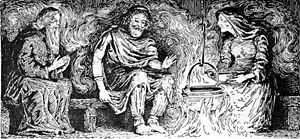 The introductory prose to the poem Rígsþula says that "people say in the old stories" that Heimdallr, described as a god among the Æsir
, once fared on a journey. Heimdallr wandered along a seashore, and referred to himself as Rígr. In the poem, Rígr, who is described as a wise and powerful god, walks in the middle of roads on his way to steads, where he meets a variety of couples and dines with them, giving them advice and spending three nights at a time between them in their bed. The wives of the couples become pregnant, and from them come the various classes of mankind. Eventually a warrior home produces a promising boy, and as the boy grows older, Rígr comes out of a thicket, teaches the boy runes
, gives him a name, and proclaims him to be his son. Rígr tells him to strike out and get land for himself. The boy does so, and so becomes a great war leader with many estates. He marries a beautiful woman and the two have many children and are happy. One of the children eventually becomes so skilled that he is able to share in runic knowledge with Heimdallr, and so earns the title of Rígr himself. The poem continues without further mention of the god.
_by_j._t._lundbye.jpg) In the Prose Edda, Heimdallr is mentioned in the books Gylfaginning
In the Prose Edda, Heimdallr is mentioned in the books Gylfaginning
, Skáldskaparmál
, and Háttatal
. In Gylfaginning, the enthroned figure of High
tells the disguised mythical king Gangleri
of various gods, and, in chapter 25, mentions Heimdallr. High says that Heimdallr is known "the white As
", is "great and holy", and that nine maidens, all sisters, gave birth to him. Heimdallr is called Hallinskiði and Gullintanni, and he has gold teeth. High continues that Heimdallr lives in "a place" called Himinbjörg
and that it is near Bifröst
. Heimdallr is the watchman of the gods, and he sits on the edge of heaven to guard the Bifröst bridge from the berg jötnar. Heimdallr requires less sleep than a bird, can see at night just as well as if it were day, and for over a hundred leagues. Heimdallr's hearing is also quite keen; he can hear grass as it grows on the earth, wool as it grows on sheep, and anything louder. Heimdallr possesses a trumpet, Gjallarhorn, that, when blown, can be heard in all worlds
, and "the head
is referred to as Heimdall's sword
". High then quotes the above mentioned Grímnismál stanza about Himinbjörg and provides two lines from the otherwise lost poem about Heimdallr, Heimdalargaldr
, in which Heimdallr proclaims himself to be the son of Nine Mothers.
In chapter 49, High tells of the god Baldr's funeral procession. Various deities are mentioned as having attended, including Heimdallr, who there rode his horse Gulltopr.
In chapter 51, High foretells the events of Ragnarök. After the enemies of the gods will gather at the plain Vígríðr
, Heimdallr will stand and mightily blow into Gjallarhorn. The gods will awake and assemble together at the thing
. At the end of the battle between various gods and their enemies, Heimdallr will face Loki and they will kill one another. After, the world will be engulfed in flames. High then quotes the above mentioned stanza regarding Heimdallr raising his horn in Völuspá.
At the beginning of Skáldskaparmál, Heimdallr is mentioned as having attended a banquet in Asgard
with various other deities. Later in the book, Húsdrápa
, a poem by 10th century skald
Úlfr Uggason
, is cited, during which Heimdallr is described as having rode to Baldr's funeral pyre.
In chapter 8, means of referring to Heimdallr are provided; "son of nine mothers", "guardian of the gods", "the white As" (see Poetic Edda discussion regarding hvítastr ása above), "Loki's enemy", and "recoverer of Freyja's necklace
". The section adds that the poem Heimdalargaldr
is about him, and that, since the poem, "the head has been called Heimdall's doom: man's doom is an expression for sword". Hiemdallr is the owner of Gulltoppr
, is also known as Vindhlér, and is a son of Odin
. Heimdallr visits Vágasker and Singasteinn
and there vied with Loki for Brísingamen
. According to the chapter, the skald Úlfr Uggason composed a large section of his Húsdrápa about these events and that Húsdrápa says that the two were in the shape of seals. A few chapters later, ways of referring to Loki are provided, including "wrangler with Heimdall and Skadi
", and section of Úlfr Uggason's Húsdrápa is then provided in reference:
The chapter points out that in the above Húsdrápa section Heimdallr is said to be the son of nine mothers.
Heimdallr is mentioned once in Háttatal
. There, in a composition by Snorri Sturluson
, a sword is referred to as "Vindhlér's helmet-filler", meaning "Heimdallr's head".
compiled in Heimskringla
, Snorri presents a euhemerized origin of the Norse gods and rulers descending from them. In chapter 5, Snorri asserts that the Æsir
settled in what is now Sweden and built various temples. Snorri writes that Odin settled in Lake Logrin
"at a place which formerly was called Sigtúnir
. There he erected a large temple and made sacrifices
according to the custom of the Æsir. He took possession of the land as far as he had called it Sigtúnir. He gave dwelling places to the temple priests." Snorri adds that, after this, Njörðr dwelt in Nóatún
, Freyr
dwelt in Uppsala
, Heimdall at Himinbjörg, Thor
at Þrúðvangr, Baldr at Breiðablik
and that to everyone Odin gave fine estates.
. Some scholars have theorized that this figure is a depiction of Heimdallr with Gjallarhorn.
A 9th or 10th century Gosforth Cross
in Cumbria
, England
depicts a figure holding a horn and a sword standing defiantly before two open-mouthed beasts. This figure has been often theorized as depicting Heimdallr with Gjallarhorn.
summarizes the difficulties as follows:
Norse mythology
Norse mythology, a subset of Germanic mythology, is the overall term for the myths, legends and beliefs about supernatural beings of Norse pagans. It flourished prior to the Christianization of Scandinavia, during the Early Middle Ages, and passed into Nordic folklore, with some aspects surviving...
, Heimdallr is a god
Æsir
In Old Norse, áss is the term denoting a member of the principal pantheon in Norse paganism. This pantheon includes Odin, Frigg, Thor, Baldr and Tyr. The second pantheon comprises the Vanir...
who possesses the resounding horn Gjallarhorn
Gjallarhorn
In Norse mythology, Gjallarhorn is a horn associated with the god Heimdallr and the wise being Mímir...
, owns the golden-maned horse Gulltoppr
Gulltoppr
In Norse mythology, Gulltoppr is one of the horses of the gods. Gulltoppr is mentioned in a list of horses in the Poetic Edda poem Grímnismál and in Nafnaþulur section of the Prose Edda. According to Prose Edda book Gylfaginning, he is the horse of Heimdallr...
, has gold teeth, and is the son of Nine Mothers. Heimdallr is attested as possessing foreknowledge, keen eyesight and hearing, is described as "the whitest of the gods", and keeps watch for the onset of Ragnarök
Ragnarök
In Norse mythology, Ragnarök is a series of future events, including a great battle foretold to ultimately result in the death of a number of major figures , the occurrence of various natural disasters, and the subsequent submersion of the world in water...
while drinking fine mead
Mead
Mead , also called honey wine, is an alcoholic beverage that is produced by fermenting a solution of honey and water. It may also be produced by fermenting a solution of water and honey with grain mash, which is strained immediately after fermentation...
in his dwelling Himinbjörg
Himinbjörg
In Norse mythology, Himinbjörg is the home of the god Heimdallr. Himinbjörg is attested in the Poetic Edda, compiled from earlier traditional sources, and the Prose Edda and Heimskringla, both written in the 13th century by Snorri Sturluson. Himinbjörg is associated with Heimdallr in all sources...
, located where the burning rainbow bridge Bifröst
Bifröst
In Norse mythology, Bifrost or Bilröst is a burning rainbow bridge that reaches between Midgard and Asgard, the realm of the gods...
meets heaven. Heimdallr is said to be the originator of social class
Social class
Social classes are economic or cultural arrangements of groups in society. Class is an essential object of analysis for sociologists, political scientists, economists, anthropologists and social historians. In the social sciences, social class is often discussed in terms of 'social stratification'...
es among mankind, once regained Freyja's treasured possession Brísingamen
Brisingamen
In Norse mythology, Brísingamen is the necklace of the goddess Freyja.-Beowulf:...
while doing battle in the shape of a seal
Pinniped
Pinnipeds or fin-footed mammals are a widely distributed and diverse group of semiaquatic marine mammals comprising the families Odobenidae , Otariidae , and Phocidae .-Overview: Pinnipeds are typically sleek-bodied and barrel-shaped...
with Loki
Loki
In Norse mythology, Loki or Loke is a god or jötunn . Loki is the son of Fárbauti and Laufey, and the brother of Helblindi and Býleistr. By the jötunn Angrboða, Loki is the father of Hel, the wolf Fenrir, and the world serpent Jörmungandr. By his wife Sigyn, Loki is the father of Nari or Narfi...
, and Heimdallr and Loki are foretold to kill one another during the events of Ragnarök. Heimdallr is additionally referred to as Hallinskiði, Gullintanni, and Vindlér or Vindhlér.
Heimdallr is attested in the Poetic Edda
Poetic Edda
The Poetic Edda is a collection of Old Norse poems primarily preserved in the Icelandic mediaeval manuscript Codex Regius. Along with Snorri Sturluson's Prose Edda, the Poetic Edda is the most important extant source on Norse mythology and Germanic heroic legends, and from the early 19th century...
, compiled in the 13th century from earlier traditional material; in the Prose Edda
Prose Edda
The Prose Edda, also known as the Younger Edda, Snorri's Edda or simply Edda, is an Icelandic collection of four sections interspersed with excerpts from earlier skaldic and Eddic poetry containing tales from Nordic mythology...
and Heimskringla
Heimskringla
Heimskringla is the best known of the Old Norse kings' sagas. It was written in Old Norse in Iceland by the poet and historian Snorri Sturluson ca. 1230...
, both written in the 13th century by Snorri Sturluson
Snorri Sturluson
Snorri Sturluson was an Icelandic historian, poet, and politician. He was twice elected lawspeaker at the Icelandic parliament, the Althing...
; in the poetry of skald
Skald
The skald was a member of a group of poets, whose courtly poetry is associated with the courts of Scandinavian and Icelandic leaders during the Viking Age, who composed and performed renditions of aspects of what we now characterise as Old Norse poetry .The most prevalent metre of skaldic poetry is...
s; and on an Old Norse runic inscription
Runic inscriptions
A runic inscription is an inscription made in one of the various runic alphabets. The body of runic inscriptions falls into the three categories of Elder Futhark , Anglo-Frisian Futhorc and Younger Futhark .The total 350 known inscriptions in the Elder...
found in England
England
England is a country that is part of the United Kingdom. It shares land borders with Scotland to the north and Wales to the west; the Irish Sea is to the north west, the Celtic Sea to the south west, with the North Sea to the east and the English Channel to the south separating it from continental...
. Two lines of an otherwise lost poem about the god, Heimdalargaldr
Heimdalargaldr
Heimdalargaldr is an Old Norse poem about the god Heimdallr of Norse mythology. The poem is mentioned in two books of the 13th century Prose Edda book—Gylfaginning and Skáldskaparmál—but outside of a single, two-lined fragment that appears in Gylfaginning, the poem is considered to be lost...
, survive. Due to the problematic and enigmatic nature of these attestations, scholars have produced various theories about the nature of the god, including his apparent relation to rams, that he may be a personification of or connected to the world tree Yggdrasil
Yggdrasil
In Norse mythology, Yggdrasil is an immense tree that is central in Norse cosmology. It was said to be the world tree around which the nine worlds existed...
, and potential Indo-European
Proto-Indo-European religion
Proto-Indo-European religion is the hypothesized religion of the Proto-Indo-European peoples based on the existence of similarities among the deities, religious practices and mythologies of the Indo-European peoples. Reconstruction of the hypotheses below is based on linguistic evidence using the...
cognates.
Names and etymology
Heimdallr also appears as Heimdalr and Heimdali. The etymology of the name is obscure, but 'the one who illuminates the world' has been proposed. Heimdallr may be connected to Mardöll, one of Freyja's names. Heimdallr and its variants are sometimes modernly anglicizedAnglicisation
Anglicisation, or anglicization , is the process of converting verbal or written elements of any other language into a form that is more comprehensible to an English speaker, or, more generally, of altering something such that it becomes English in form or character.The term most often refers to...
as Heimdall (with the nominative -r dropped) or Heimdal.
Heimdallr is attested as having three other names; Hallinskiði, Gullintanni, and Vindlér or Vindhlér. The name Hallinskiði is obscure, but has resulted in a series of attempts at deciphering it. Gullintanni literally means 'the one with the golden teeth'. Vindhlér (or Vindhlér) translates as either 'the one protecting against the wind' or 'wind-sea'. All three have resulted in numerous theories about the god.
Saltfleetby spindle whorl inscription
A leadLead
Lead is a main-group element in the carbon group with the symbol Pb and atomic number 82. Lead is a soft, malleable poor metal. It is also counted as one of the heavy metals. Metallic lead has a bluish-white color after being freshly cut, but it soon tarnishes to a dull grayish color when exposed...
spindle whorl bearing an Old Norse
Old Norse
Old Norse is a North Germanic language that was spoken by inhabitants of Scandinavia and inhabitants of their overseas settlements during the Viking Age, until about 1300....
Younger Futhark
Younger Futhark
The Younger Futhark, also called Scandinavian runes, is a runic alphabet, a reduced form of the Elder Futhark, consisting of only 16 characters, in use from ca. 800 CE...
inscription that mentions Heimdallr was discovered in Saltfleetby
Saltfleetby
Saltfleetby is a village and civil parish in the county of Lincolnshire, England. Situated approximately east of Louth, north of Mablethorpe and on the coast of the North Sea, the village had a population of 599 at the 2001 Census....
, England
England
England is a country that is part of the United Kingdom. It shares land borders with Scotland to the north and Wales to the west; the Irish Sea is to the north west, the Celtic Sea to the south west, with the North Sea to the east and the English Channel to the south separating it from continental...
on September 1, 2010. The spindle whorl itself is dated from the year 1000 to 1100 AD. On the inscription, the god Heimdallr is mentioned alongside the god Odin
Odin
Odin is a major god in Norse mythology and the ruler of Asgard. Homologous with the Anglo-Saxon "Wōden" and the Old High German "Wotan", the name is descended from Proto-Germanic "*Wodanaz" or "*Wōđanaz"....
and Þjálfi, a name of one of the god Thor
Thor
In Norse mythology, Thor is a hammer-wielding god associated with thunder, lightning, storms, oak trees, strength, the protection of mankind, and also hallowing, healing, and fertility...
's servants. Regarding the inscription reading, John Hines of Cardiff University
Cardiff University
Cardiff University is a leading research university located in the Cathays Park area of Cardiff, Wales, United Kingdom. It received its Royal charter in 1883 and is a member of the Russell Group of Universities. The university is consistently recognised as providing high quality research-based...
comments that there is "quite an essay to be written over the uncertainties of translation and identification here; what are clear, and very important, are the names of two of the Norse gods on the side, Odin and Heimdallr, while Þjalfi (masculine, not the feminine in -a) is the recorded name of a servant of the god Thor."
Poetic Edda
In the Poetic EddaPoetic Edda
The Poetic Edda is a collection of Old Norse poems primarily preserved in the Icelandic mediaeval manuscript Codex Regius. Along with Snorri Sturluson's Prose Edda, the Poetic Edda is the most important extant source on Norse mythology and Germanic heroic legends, and from the early 19th century...
, Heimdallr is attested in six poems; Völuspá
Völuspá
Völuspá is the first and best known poem of the Poetic Edda. It tells the story of the creation of the world and its coming end related by a völva addressing Odin...
, Grímnismál
Grímnismál
Grímnismál is one of the mythological poems of the Poetic Edda. It is preserved in the Codex Regius manuscript and the AM 748 I 4to fragment. It is spoken through the voice of Grímnir, one of the many guises of the god Odin, who is tortured by King Geirröth...
, Lokasenna
Lokasenna
Lokasenna is one of the poems of the Poetic Edda. The poem presents flyting between the gods and Loki....
, Þrymskviða
Þrymskviða
Þrymskviða is one of the best known poems from the Poetic Edda...
, Rígsþula, and Hrafnagaldr Óðins
Hrafnagaldr Óðins
Hrafnagaldr Óðins or Forspjallsljóð is an Icelandic poem in the style of the Poetic Edda. It is preserved only in late paper manuscripts. In his influential 1867 edition of the Poetic Edda, Sophus Bugge reasoned that the poem was a 17th century work, composed as an introduction to Baldrs draumar...
.
Heimdallr is mentioned thrice in Völuspá
Völuspá
Völuspá is the first and best known poem of the Poetic Edda. It tells the story of the creation of the world and its coming end related by a völva addressing Odin...
. In the first stanza of the poem, the undead völva
Völva
A vǫlva or völva is a shamanic seeress in Norse paganism, and a recurring motif in Norse mythology....
reciting the poem calls out for listeners to be silent and refers to Heimdallr:
Benjamin ThorpeBenjamin ThorpeBenjamin Thorpe was an English scholar of Anglo-Saxon.-Biography:After studying for four years at Copenhagen University, under the Danish philologist Rasmus Christian Rask, he returned to England in 1830, and in 1832 published an English version of Caedmon's metrical paraphrase of portions of the...
translation:
- For silence I pray all sacred children,
- great and small, sons of Heimdall.
- they will that I Valfather's deeds recount,
- men's ancient saws, those that I best remember.
Henry Adams BellowsHenry Adams BellowsHenry Adams Bellows was a lawyer, state legislator, and jurist born in Rockingham, Vermont. He was elected to the New Hampshire House of Representatives from Littleton, New Hampshire in 1839. He was subsequently elected again to the House from Concord, New Hampshire in 1856–1857, and served as...
translation:
- Hearing I ask from the holy races,
- From Heimdall's sons, both high and low;
- Thou wilt, Valfather, that well I relate.
- Old tales I remember of men long ago.
This stanza has led to various scholarly interpretations. The "holy races" have been considered variously as either mankind or the gods. The notion of mankind as "Heimdallr's sons" is otherwise unattested and has also resulted in various interpretations. Some scholars have pointed to the prose introduction to the poem Rígsþula, where Heimdallr is said to have once gone about mankind, slept between couples, and so doled out classes among them (see Rígsthula section below).
Later in Völuspá, the völva foresees the events of Ragnarök
Ragnarök
In Norse mythology, Ragnarök is a series of future events, including a great battle foretold to ultimately result in the death of a number of major figures , the occurrence of various natural disasters, and the subsequent submersion of the world in water...
and the role in which Heimdallr and Gjallarhorn
Gjallarhorn
In Norse mythology, Gjallarhorn is a horn associated with the god Heimdallr and the wise being Mímir...
will play at its onset; Heimdallr will raise his horn and blow loudly. Due to manuscript differences, translations of the stanza vary:
Benjamin Thorpe translation:
|
Henry Adams Bellows translation:
|
Regarding this stanza, scholar Andy Orchard comments that the name Gjallarhorn may here mean "horn of the river Gjöll
Gjöll
In Norse mythology, Gjöll is one of the eleven rivers traditionally associated with the Élivágar, according to Gylfaginning, originating from the wellspring Hvergelmir in Niflheim, flowing through Ginnungagap, and thence into the worlds of existence...
" as "Gjöll is the name of one of the rivers of the Underworld, whence much wisdom is held to derive", but notes that in the poem Grímnismál
Grímnismál
Grímnismál is one of the mythological poems of the Poetic Edda. It is preserved in the Codex Regius manuscript and the AM 748 I 4to fragment. It is spoken through the voice of Grímnir, one of the many guises of the god Odin, who is tortured by King Geirröth...
Heimdallr is said to drink fine mead
Mead
Mead , also called honey wine, is an alcoholic beverage that is produced by fermenting a solution of honey and water. It may also be produced by fermenting a solution of water and honey with grain mash, which is strained immediately after fermentation...
in his heavenly home Himinbjörg
Himinbjörg
In Norse mythology, Himinbjörg is the home of the god Heimdallr. Himinbjörg is attested in the Poetic Edda, compiled from earlier traditional sources, and the Prose Edda and Heimskringla, both written in the 13th century by Snorri Sturluson. Himinbjörg is associated with Heimdallr in all sources...
.
Earlier in the same poem, the völva mentions a scenario involving the hearing or horn (depending on translation of the Old Norse noun hljóð—translations bolded below for the purpose of illustration) of the god Heimdallr:
- Benjamin Thorpe translation:
- She knows that Heimdall's horn is hidden
- under the heaven-bright holy tree
YggdrasilIn Norse mythology, Yggdrasil is an immense tree that is central in Norse cosmology. It was said to be the world tree around which the nine worlds existed...
.- A river she sees flow, with foamy fall,
- from Valfather's pledge.
- Understand ye yet, or what?
Henry Adams Bellows translation: I know of the horn of Heimdall, hidden Under the high-reaching holy tree; On it there pours from Valfather's pledge A mighty stream: would you know yet more? Carolyne Larrington translation: She knows that Heimdall's hearing is hidden under the radiant, sacred tree; she sees, pouring down, the muddy torrent from the wager of Father of the Slain; do you understand yet, or what more?
Scholar Paul Schach comments that the stanzas in this section of Voluspa are "all very mysterious and obscure, as it was perhaps meant to be". Schach details that "Heimdallar hljóð has aroused much speculation. Snorri [in the Poetic Edda] seems to have confused this word with gjallarhorn, but there is otherwise no attestation of the use of hljóð in the sense of 'horn' in Icelandic. Various scholars have read this as "hearing" rather than "horn".
Scholar Carolyne Larrington comments that if "hearing" rather than "horn" is understood to appear in this stanza, the stanza indicates that Heimdallr, like Odin, has left a body part in the well; his ear. Larrington says that "Odin exchanged one of his eyes for wisdom from Mimir, guardian of the well, while Heimdall seems to have forfeited his ear."
In the poem Grímnismál
Grímnismál
Grímnismál is one of the mythological poems of the Poetic Edda. It is preserved in the Codex Regius manuscript and the AM 748 I 4to fragment. It is spoken through the voice of Grímnir, one of the many guises of the god Odin, who is tortured by King Geirröth...
, Odin (disguised as Grímnir), tortured, starved and thirsty, tells the young Agnar
Agnarr Geirröðsson
Agnarr Geirröðsson is the son of King Geirröðr in Norse mythology. Agnarr is solely attested in the poem Grímnismál in the Poetic Edda, the latter compiled in the 13th century from earlier traditional sources. In Grímnismál he is described as aiding Odin, disguised as Grímnir, to escape from...
of a number of mythological locations. The eighth location he mentions is Himinbjörg, where he says that Heimdallr drinks fine mead
Mead
Mead , also called honey wine, is an alcoholic beverage that is produced by fermenting a solution of honey and water. It may also be produced by fermenting a solution of water and honey with grain mash, which is strained immediately after fermentation...
:
Benjamin Thorpe translation:
- Himinbiörg is the eighth, where Heimdall,
- it is said, rules o'er the holy fanes:
- there the gods' watchman, in his tranquil home,
- drinks joyful the good mead.
Henry Adams Bellows translation:
- Himingbjorg is the eight, and Heimdall there
- O'er men hold sway, it is said;
- In his well-built house does the warder of heaven
- The good mead gladly drink.
Regarding the above stanza, Henry Adams Bellows comments that "in stanza the two functions of Heimdall—as father of mankind [ . . . ] and as warder of the gods—seem both to be mentioned, but the second line in the manuscripts is apparently in bad shape, and in the editions it is more or less conjecture".
In the poem Lokasenna
Lokasenna
Lokasenna is one of the poems of the Poetic Edda. The poem presents flyting between the gods and Loki....
, Loki
Loki
In Norse mythology, Loki or Loke is a god or jötunn . Loki is the son of Fárbauti and Laufey, and the brother of Helblindi and Býleistr. By the jötunn Angrboða, Loki is the father of Hel, the wolf Fenrir, and the world serpent Jörmungandr. By his wife Sigyn, Loki is the father of Nari or Narfi...
flyts
Flyting
Flyting or fliting is a contest consisting of the exchange of insults, often conducted in verse, between two parties.-Description:Flyting is a ritual, poetic exchange of insults practiced mainly between the 5th and 16th centuries. The root is the Old English word flītan meaning quarrel...
with various gods who have met together to feast. At one point during the exchanges, the god Heimdallr says that Loki is drunk and witless, and asks Loki why he won't stop speaking. Loki tells Heimdallr to be silent, that he was fated
Wyrd
Wyrd is a concept in Anglo-Saxon culture roughly corresponding to fate or personal destiny. The word is ancestral to Modern English weird, which retains its original meaning only dialectally....
a "hateful life", that Heimdallr must always have a muddy back, and that he must serve as watchman of the gods. The goddess Skaði
Skaði
In Norse mythology, Skaði is a jötunn and goddess associated with bowhunting, skiing, winter, and mountains...
interjects and the flyting continues in turn.
The poem Þrymskviða
Þrymskviða
Þrymskviða is one of the best known poems from the Poetic Edda...
tells of Thor's loss of his hammer, Mjöllnir, to the jötnar and quest to get it back. At one point in the tale, the gods gather at the thing
Thing (assembly)
A thing was the governing assembly in Germanic and introduced into some Celtic societies, made up of the free people of the community and presided by lawspeakers, meeting in a place called a thingstead...
and debate how to get Thor's hammer back from the jötnar, who demand the beautiful goddess Freyja in return for it. Heimdallr advises that they simply dress Thor up as Freyja, during which he is described as hvítastr ása—literally "whitest of the gods" (although Thorpe's translation below renders hvítastr as "brightest")—and is said to have foresight
Foresight
Foresight or forethought may refer to:* Foresight , ability to predict or plan for the future* Foresight , management planning principle* Foresight , European planning mechanism for public policy...
like the Vanir
Vanir
In Norse mythology, the Vanir are a group of gods associated with fertility, wisdom and the ability to see the future. The Vanir are one of two groups of gods and are the namesake of the location Vanaheimr . After the Æsir–Vanir War, the Vanir became a subgroup of the Æsir...
, a group of gods:
Benjamin Thorpe translation:
- Then said Heimdall, of Æsir
ÆsirIn Old Norse, áss is the term denoting a member of the principal pantheon in Norse paganism. This pantheon includes Odin, Frigg, Thor, Baldr and Tyr. The second pantheon comprises the Vanir...
brightest —- he well foresaw, like other Vanir —
- Let us clothe Thor with bridal raiment,
- let him have the famed Brîsinga necklace
BrisingamenIn Norse mythology, Brísingamen is the necklace of the goddess Freyja.-Beowulf:...
.
- "Let by his side keys jingle,
- and woman's weeds fall around his knees,
- but on his breast place precious stones,
- and a neat coif set on his head."
Henry Adams Bellows translation:
- Then Heimdall spake, whitest of the gods,
- Like the Wanes he knew the future well:
- "Bind we on Thor the bridal veil,
- Let him bear the mighty Brisings' necklace;
- "Keys around him let there rattle,
- And down to his knees hang woman's dress;
- With gems full broad upon his breast,
- And a pretty cap to crown his head."
Regarding Heimdallr's whiteness and the comparison to the Vanir, scholar John Lindow
John Lindow
John Lindow is a professor specializing in Scandinavian medieval studies and folklore at the University of California, Berkeley and author. Lindow's works include Norse Mythology: A Guide to the Gods, Rituals, and Beliefs, a handbook for Norse mythology...
comments that there are no other indications of Heimdallr being considered among the Vanir, and that Heimdallr's status as "whitest of the gods" has not been explained.
Æsir
In Old Norse, áss is the term denoting a member of the principal pantheon in Norse paganism. This pantheon includes Odin, Frigg, Thor, Baldr and Tyr. The second pantheon comprises the Vanir...
, once fared on a journey. Heimdallr wandered along a seashore, and referred to himself as Rígr. In the poem, Rígr, who is described as a wise and powerful god, walks in the middle of roads on his way to steads, where he meets a variety of couples and dines with them, giving them advice and spending three nights at a time between them in their bed. The wives of the couples become pregnant, and from them come the various classes of mankind. Eventually a warrior home produces a promising boy, and as the boy grows older, Rígr comes out of a thicket, teaches the boy runes
Runic alphabet
The runic alphabets are a set of related alphabets using letters known as runes to write various Germanic languages before the adoption of the Latin alphabet and for specialized purposes thereafter...
, gives him a name, and proclaims him to be his son. Rígr tells him to strike out and get land for himself. The boy does so, and so becomes a great war leader with many estates. He marries a beautiful woman and the two have many children and are happy. One of the children eventually becomes so skilled that he is able to share in runic knowledge with Heimdallr, and so earns the title of Rígr himself. The poem continues without further mention of the god.
Prose Edda
Gylfaginning
Gylfaginning, or the Tricking of Gylfi , is the first part of Snorri Sturluson's Prose Edda after Prologue. The Gylfaginning deals with the creation and destruction of the world of the Norse gods, and many other aspects of Norse mythology...
, Skáldskaparmál
Skáldskaparmál
The second part of Snorri Sturluson's Prose Edda the Skáldskaparmál or "language of poetry" is effectively a dialogue between the Norse god of the sea, Ægir and Bragi, the god of poetry, in which both Norse mythology and discourse on the nature of poetry are intertwined...
, and Háttatal
Háttatal
The Háttatal is the last section of the Prose Edda composed by the Icelandic poet, politician, and historian Snorri Sturluson. Using, for the most part, his own compositions, it exemplifies the types of verse forms used in Old Norse poetry...
. In Gylfaginning, the enthroned figure of High
High, Just-As-High, and Third
High, Just-As-High, and Third are three men that respond to questions posed by Gangleri in the Prose Edda book Gylfaginning...
tells the disguised mythical king Gangleri
Gangleri
Gangleri may refer to:* one of Odin's many nicknames meaning "the wanderer" or "Wayweary"* the name of the ancient Swedish king Gylfi, given while in disguise, as described in the book Gylfaginning collected in the Prose Edda...
of various gods, and, in chapter 25, mentions Heimdallr. High says that Heimdallr is known "the white As
Æsir
In Old Norse, áss is the term denoting a member of the principal pantheon in Norse paganism. This pantheon includes Odin, Frigg, Thor, Baldr and Tyr. The second pantheon comprises the Vanir...
", is "great and holy", and that nine maidens, all sisters, gave birth to him. Heimdallr is called Hallinskiði and Gullintanni, and he has gold teeth. High continues that Heimdallr lives in "a place" called Himinbjörg
Himinbjörg
In Norse mythology, Himinbjörg is the home of the god Heimdallr. Himinbjörg is attested in the Poetic Edda, compiled from earlier traditional sources, and the Prose Edda and Heimskringla, both written in the 13th century by Snorri Sturluson. Himinbjörg is associated with Heimdallr in all sources...
and that it is near Bifröst
Bifröst
In Norse mythology, Bifrost or Bilröst is a burning rainbow bridge that reaches between Midgard and Asgard, the realm of the gods...
. Heimdallr is the watchman of the gods, and he sits on the edge of heaven to guard the Bifröst bridge from the berg jötnar. Heimdallr requires less sleep than a bird, can see at night just as well as if it were day, and for over a hundred leagues. Heimdallr's hearing is also quite keen; he can hear grass as it grows on the earth, wool as it grows on sheep, and anything louder. Heimdallr possesses a trumpet, Gjallarhorn, that, when blown, can be heard in all worlds
Norse cosmology
The cosmology of Norse mythology has 'nine homeworlds', unified by the world tree Yggdrasill. Mapping the nine worlds escapes precision because the Poetic Edda often alludes vaguely, and the Prose Edda may be influenced by medieval Christian cosmology...
, and "the head
Head
In anatomy, the head of an animal is the rostral part that usually comprises the brain, eyes, ears, nose and mouth . Some very simple animals may not have a head, but many bilaterally symmetric forms do....
is referred to as Heimdall's sword
Hǫfuð
Hǫfuð is the sword of Heimdall. It's mentioned in Gylfaginning chapter 26.And Skáldskaparmál mentions a mysterious myth about Heimdall's head and sword in chapter 8.-References:...
". High then quotes the above mentioned Grímnismál stanza about Himinbjörg and provides two lines from the otherwise lost poem about Heimdallr, Heimdalargaldr
Heimdalargaldr
Heimdalargaldr is an Old Norse poem about the god Heimdallr of Norse mythology. The poem is mentioned in two books of the 13th century Prose Edda book—Gylfaginning and Skáldskaparmál—but outside of a single, two-lined fragment that appears in Gylfaginning, the poem is considered to be lost...
, in which Heimdallr proclaims himself to be the son of Nine Mothers.
In chapter 49, High tells of the god Baldr's funeral procession. Various deities are mentioned as having attended, including Heimdallr, who there rode his horse Gulltopr.
In chapter 51, High foretells the events of Ragnarök. After the enemies of the gods will gather at the plain Vígríðr
Vígríðr
In Norse mythology, Vígríðr or Óskópnir, is a large field foretold to host a battle between the forces of the gods and the forces of Surtr as part of the events of Ragnarök. The field is attested in the Poetic Edda, compiled in the 13th century from earlier traditional material, and in the Prose...
, Heimdallr will stand and mightily blow into Gjallarhorn. The gods will awake and assemble together at the thing
Thing (assembly)
A thing was the governing assembly in Germanic and introduced into some Celtic societies, made up of the free people of the community and presided by lawspeakers, meeting in a place called a thingstead...
. At the end of the battle between various gods and their enemies, Heimdallr will face Loki and they will kill one another. After, the world will be engulfed in flames. High then quotes the above mentioned stanza regarding Heimdallr raising his horn in Völuspá.
At the beginning of Skáldskaparmál, Heimdallr is mentioned as having attended a banquet in Asgard
Asgard
In Norse religion, Asgard is one of the Nine Worlds and is the country or capital city of the Norse Gods surrounded by an incomplete wall attributed to a Hrimthurs riding the stallion Svadilfari, according to Gylfaginning. Valhalla is located within Asgard...
with various other deities. Later in the book, Húsdrápa
Húsdrápa
Húsdrápa is a skaldic poem partially preserved in the Prose Edda where disjoint stanzas of it are quoted. It is attributed to the skald Úlfr Uggason. The poem describes mythological scenes carved on kitchen panels...
, a poem by 10th century skald
Skald
The skald was a member of a group of poets, whose courtly poetry is associated with the courts of Scandinavian and Icelandic leaders during the Viking Age, who composed and performed renditions of aspects of what we now characterise as Old Norse poetry .The most prevalent metre of skaldic poetry is...
Úlfr Uggason
Úlfr Uggason
Úlfr Uggason was an Icelandic skald who lived in the last part of the tenth century.The Laxdæla saga tells how he composed his Húsdrápa for a wedding...
, is cited, during which Heimdallr is described as having rode to Baldr's funeral pyre.
In chapter 8, means of referring to Heimdallr are provided; "son of nine mothers", "guardian of the gods", "the white As" (see Poetic Edda discussion regarding hvítastr ása above), "Loki's enemy", and "recoverer of Freyja's necklace
Brisingamen
In Norse mythology, Brísingamen is the necklace of the goddess Freyja.-Beowulf:...
". The section adds that the poem Heimdalargaldr
Heimdalargaldr
Heimdalargaldr is an Old Norse poem about the god Heimdallr of Norse mythology. The poem is mentioned in two books of the 13th century Prose Edda book—Gylfaginning and Skáldskaparmál—but outside of a single, two-lined fragment that appears in Gylfaginning, the poem is considered to be lost...
is about him, and that, since the poem, "the head has been called Heimdall's doom: man's doom is an expression for sword". Hiemdallr is the owner of Gulltoppr
Gulltoppr
In Norse mythology, Gulltoppr is one of the horses of the gods. Gulltoppr is mentioned in a list of horses in the Poetic Edda poem Grímnismál and in Nafnaþulur section of the Prose Edda. According to Prose Edda book Gylfaginning, he is the horse of Heimdallr...
, is also known as Vindhlér, and is a son of Odin
Sons of Odin
Various gods and men appear as Sons of Odin or Sons of Wodan/Wotan or Sons of Woden in old Old Norse and Old High German and Old English texts.-Thor, Baldur, and Váli:...
. Heimdallr visits Vágasker and Singasteinn
Singasteinn
In Norse mythology, Singasteinn is an object that appears in the account of Loki and Heimdall's fight in the form of seals. The object is solely attested in the skaldic poem Húsdrápa...
and there vied with Loki for Brísingamen
Brisingamen
In Norse mythology, Brísingamen is the necklace of the goddess Freyja.-Beowulf:...
. According to the chapter, the skald Úlfr Uggason composed a large section of his Húsdrápa about these events and that Húsdrápa says that the two were in the shape of seals. A few chapters later, ways of referring to Loki are provided, including "wrangler with Heimdall and Skadi
Skaði
In Norse mythology, Skaði is a jötunn and goddess associated with bowhunting, skiing, winter, and mountains...
", and section of Úlfr Uggason's Húsdrápa is then provided in reference:
- Renowned defender [Heimdall] of the powers' way [Bifrost], kind of counsel, competes with Farbauti
FárbautiIn Norse mythology, Fárbauti is the jötunn husband of Laufey or Nál and the father of Loki, and possibly also of Helblindi and Byleistr. He is attested in the Prose Edda, written in the 13th century by Snorri Sturluson, and in the poetry of Viking Age skalds...
's terribly sly son at Singastein. Son of eight mothers plus one, might of mood, is first to get hold of the beautiful sea-kidney [jewel, Brisingamen]. I announce it in strands of praise.
The chapter points out that in the above Húsdrápa section Heimdallr is said to be the son of nine mothers.
Heimdallr is mentioned once in Háttatal
Háttatal
The Háttatal is the last section of the Prose Edda composed by the Icelandic poet, politician, and historian Snorri Sturluson. Using, for the most part, his own compositions, it exemplifies the types of verse forms used in Old Norse poetry...
. There, in a composition by Snorri Sturluson
Snorri Sturluson
Snorri Sturluson was an Icelandic historian, poet, and politician. He was twice elected lawspeaker at the Icelandic parliament, the Althing...
, a sword is referred to as "Vindhlér's helmet-filler", meaning "Heimdallr's head".
Heimskringla
In Ynglinga sagaYnglinga saga
Ynglinga saga is a legendary saga, originally written in Old Norse by the Icelandic poet Snorri Sturluson about 1225. It was first translated into English and published in 1844....
compiled in Heimskringla
Heimskringla
Heimskringla is the best known of the Old Norse kings' sagas. It was written in Old Norse in Iceland by the poet and historian Snorri Sturluson ca. 1230...
, Snorri presents a euhemerized origin of the Norse gods and rulers descending from them. In chapter 5, Snorri asserts that the Æsir
Ass
Ass may refer to:* The mammal Equus africanus asinus better known as the Donkey** Asinus subgenus* North American English informal term for buttocks* áss, one of the Æsir in Norse mythology* Ass , by Badfinger...
settled in what is now Sweden and built various temples. Snorri writes that Odin settled in Lake Logrin
Mälaren
Lake Mälaren is the third-largest lake in Sweden, after Lakes Vänern and Vättern. Its area is 1,140 km² and its greatest depth is 64 m. Mälaren spans 120 kilometers from east to west...
"at a place which formerly was called Sigtúnir
Fornsigtuna
Fornsigtuna , Old Sigtun, Sithun, Signildsberg or Signesberg is located in the parish of Håtuna ca 4 km west of the modern town of Sigtuna, by lake Mälaren, in Sweden...
. There he erected a large temple and made sacrifices
Blót
The blót was Norse pagan sacrifice to the Norse gods and the spirits of the land. The sacrifice often took the form of a sacramental meal or feast. Related religious practices were performed by other Germanic peoples, such as the pagan Anglo-Saxons...
according to the custom of the Æsir. He took possession of the land as far as he had called it Sigtúnir. He gave dwelling places to the temple priests." Snorri adds that, after this, Njörðr dwelt in Nóatún
Noatun (mythology)
In Norse mythology, Nóatún is the sea-side abode of the god Njörðr.-References:*Orchard, Andy . Dictionary of Norse Myth and Legend. Cassell. ISBN 0-304-34520-2...
, Freyr
Freyr
Freyr is one of the most important gods of Norse paganism. Freyr was highly associated with farming, weather and, as a phallic fertility god, Freyr "bestows peace and pleasure on mortals"...
dwelt in Uppsala
Uppsala
- Economy :Today Uppsala is well established in medical research and recognized for its leading position in biotechnology.*Abbott Medical Optics *GE Healthcare*Pfizer *Phadia, an offshoot of Pharmacia*Fresenius*Q-Med...
, Heimdall at Himinbjörg, Thor
Thor
In Norse mythology, Thor is a hammer-wielding god associated with thunder, lightning, storms, oak trees, strength, the protection of mankind, and also hallowing, healing, and fertility...
at Þrúðvangr, Baldr at Breiðablik
Breiðablik
The Old Norse/Icelandic name Breiðablik means "broad gleam" and can refer to*Breidablik, the home of the Norse god Baldr*Breiðablik UBK, a sports club in Kópavogur, Iceland...
and that to everyone Odin gave fine estates.
Archaeological record
A figure holding a large horn to his lips and clasping a sword on his hip appears on a stone cross from the Isle of ManIsle of Man
The Isle of Man , otherwise known simply as Mann , is a self-governing British Crown Dependency, located in the Irish Sea between the islands of Great Britain and Ireland, within the British Isles. The head of state is Queen Elizabeth II, who holds the title of Lord of Mann. The Lord of Mann is...
. Some scholars have theorized that this figure is a depiction of Heimdallr with Gjallarhorn.
A 9th or 10th century Gosforth Cross
Gosforth cross
upright|thumb|Gosforth Cross outside St Mary's church in Gosforth.The Gosforth Cross is a large stone Anglo-Saxon high cross in the churchyard at Gosforth in the English county of Cumbria. Formerly part of the kingdom of Northumbria, the area was settled by Scandinavians some time in either the 9th...
in Cumbria
Cumbria
Cumbria , is a non-metropolitan county in North West England. The county and Cumbria County Council, its local authority, came into existence in 1974 after the passage of the Local Government Act 1972. Cumbria's largest settlement and county town is Carlisle. It consists of six districts, and in...
, England
England
England is a country that is part of the United Kingdom. It shares land borders with Scotland to the north and Wales to the west; the Irish Sea is to the north west, the Celtic Sea to the south west, with the North Sea to the east and the English Channel to the south separating it from continental...
depicts a figure holding a horn and a sword standing defiantly before two open-mouthed beasts. This figure has been often theorized as depicting Heimdallr with Gjallarhorn.
Theories and interpretations
Heimdallr's attestations have proven troublesome and enigmatic to interpret for scholars. Scholar Georges DumézilGeorges Dumézil
Georges Dumézil was a French comparative philologist best known for his analysis of sovereignty and power in Proto-Indo-European religion and society...
summarizes the difficulties as follows:
- The god Heimdall poses one of the most difficult problems in Scandinavian mythography. As all who have dealt with him have emphasized, this is primarily because of a very fragmentary documentation; but even more because the few traits that have been saved from oblivion diverge in too many directions to be easily "thought of together," or to be grouped as members of a unitary structure.