


Flyting

Encyclopedia
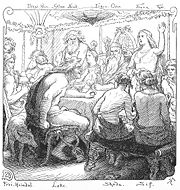
Description
Flyting is a ritual, poetic exchange of insults practiced mainly between the 5th and 16th centuries. The root is the Old English word flītan meaning quarrel (from Old NorseOld Norse
Old Norse is a North Germanic language that was spoken by inhabitants of Scandinavia and inhabitants of their overseas settlements during the Viking Age, until about 1300....
word flyta meaning provocation). Examples of flyting are found throughout Norse, Anglo-Saxon
Anglo-Saxon
Anglo-Saxon may refer to:* Anglo-Saxons, a group that invaded Britain** Old English, their language** Anglo-Saxon England, their history, one of various ships* White Anglo-Saxon Protestant, an ethnicity* Anglo-Saxon economy, modern macroeconomic term...
and Medieval literature involving both historical and mythological figures. The exchanges would become extremely provocative, often involving accusations of cowardice
Cowardice
Cowardice is the perceived failure to demonstrate sufficient mental robustness and courage in the face of a challenge. Under many military codes of justice, cowardice in the face of combat is a crime punishable by death...
or sexual perversion.
Norse literature contains stories of the gods flyting. For example in Lokasenna
Lokasenna
Lokasenna is one of the poems of the Poetic Edda. The poem presents flyting between the gods and Loki....
the god Loki
Loki
In Norse mythology, Loki or Loke is a god or jötunn . Loki is the son of Fárbauti and Laufey, and the brother of Helblindi and Býleistr. By the jötunn Angrboða, Loki is the father of Hel, the wolf Fenrir, and the world serpent Jörmungandr. By his wife Sigyn, Loki is the father of Nari or Narfi...
insults the other gods in the hall of Ægir
Ægir
Ægir is a sea giant, god of the ocean and king of the sea creatures in Norse mythology. He is also known for hosting elaborate parties for the gods.Ægir's servants are Fimafeng and Eldir.- Description :...
and the poem Hárbarðsljóð
Hárbarðsljóð
Hárbarðsljóð is one of the poems of the Poetic Edda, found in the Codex Regius and AM 748 I 4to manuscripts. It is a flyting poem with figures from Norse mythology-Synopsis:...
in which Hárbarðr (generally considered to be Odin
Odin
Odin is a major god in Norse mythology and the ruler of Asgard. Homologous with the Anglo-Saxon "Wōden" and the Old High German "Wotan", the name is descended from Proto-Germanic "*Wodanaz" or "*Wōđanaz"....
in disguise) engages in flyting with Thor
Thor
In Norse mythology, Thor is a hammer-wielding god associated with thunder, lightning, storms, oak trees, strength, the protection of mankind, and also hallowing, healing, and fertility...
.
In the confrontation of Beowulf
Beowulf (hero)
Beowulf is a legendary Geatish hero and later turned king in the epic poem named after him, one of the oldest surviving pieces of literature in the English language.-Etymology and origins of the character:...
and Unferð
Unferð
Old English epic poem Beowulf, Unferth or Hunferth is a thegn of the Danish lord Hroðgar. The name Unferth does not appear in any Old English manuscript outside of the Nowell Codex, which contains Beowulf, and the meaning of the name is disputed. Several scholarly theories about Unferth have been...
in the poem Beowulf
Beowulf
Beowulf , but modern scholars agree in naming it after the hero whose life is its subject." of an Old English heroic epic poem consisting of 3182 alliterative long lines, set in Scandinavia, commonly cited as one of the most important works of Anglo-Saxon literature.It survives in a single...
flytings were used as either a prelude to battle or as a form of combat in their own right.
In Anglo-Saxon England, flyting would take place in a feasting hall. The winner would be decided by the reactions of those watching the exchange. The winner would drink a large cup of beer or mead
Mead
Mead , also called honey wine, is an alcoholic beverage that is produced by fermenting a solution of honey and water. It may also be produced by fermenting a solution of water and honey with grain mash, which is strained immediately after fermentation...
in victory, then invite the loser to drink as well.
The 13th century poem The Owl and the Nightingale
The Owl and the Nightingale
The Owl and the Nightingale is a 12th- or 13th-century Middle English poem detailing a debate between an owl and a nightingale as overheard by the poem's narrator. It is the earliest example in Middle English of a literary form known as debate poetry...
and Geoffrey Chaucer
Geoffrey Chaucer
Geoffrey Chaucer , known as the Father of English literature, is widely considered the greatest English poet of the Middle Ages and was the first poet to have been buried in Poet's Corner of Westminster Abbey...
's Parlement of Foules
Parlement of Foules
The "Parlement of Foules" is a poem by Geoffrey Chaucer made up of approximately 700 lines. The poem is in the form of a dream vision in rhyme royal stanza and is interesting in that it is the first reference to the idea that St...
contain elements of flyting.
Flyting became public entertainment in Scotland
Scotland
Scotland is a country that is part of the United Kingdom. Occupying the northern third of the island of Great Britain, it shares a border with England to the south and is bounded by the North Sea to the east, the Atlantic Ocean to the north and west, and the North Channel and Irish Sea to the...
in the 15th and 16th centuries where makar
Makar
A makar is a term from Scottish literature for a poet or bard, often thought of as royal court poet, although the term can be more generally applied. The word functions in a manner similar to the Greek term which means both maker and poet...
s would engage in verbal contests of provocative, often sexual and scatalogical but highly poetic abuse. Flyting was permitted despite the fact that the penalty for profanities in public was a fine of 20 shillings (over £300 in prices) for a lord or a whipping for servant. James IV
James IV of Scotland
James IV was King of Scots from 11 June 1488 to his death. He is generally regarded as the most successful of the Stewart monarchs of Scotland, but his reign ended with the disastrous defeat at the Battle of Flodden Field, where he became the last monarch from not only Scotland, but also from all...
and James V
James V of Scotland
James V was King of Scots from 9 September 1513 until his death, which followed the Scottish defeat at the Battle of Solway Moss...
encouraged "court flyting" between poets for their entertainment and occasionally engaged with them. The Flyting of Dumbar and Kennedie
The Flyting of Dumbar and Kennedie
Schir Johine the Ros, ane thing thair is compild, also known as The Flyting of Dumbar and Kennedie, is the earliest surviving example of the Scottish version of the flyting genre in poetry. The genre takes the form of a contest, or "war of words", between two poets, each trying to outclass the...
records a contest between William Dunbar
William Dunbar
William Dunbar was a Scottish poet. He was probably a native of East Lothian, as assumed from a satirical reference in the Flyting of Dunbar and Kennedie , where, too, it is hinted that he was a member of the noble house of Dunbar....
and Walter Kennedy
Walter Kennedy
Walter Kennedy was a Scottish makar associated with the renaissance court of James IV. He is perhaps best known as the defendant against William Dunbar in The Flyting of Dumbar and Kennedie, but his surviving works clearly show him to have been an accomplished "master" in many genres...
in front of James IV, which includes the earliest recorded use of the word shit
Shit
Shit is usually considered vulgar and profane in Modern English. As a noun it refers to fecal matter and as a verb it means to defecate or defecate in; in the plural it means diarrhea...
as a personal insult. In 1536 the poet Sir David Lyndsay
David Lyndsay
Sir David Lyndsay of the Mount, was a Scottish Lord Lyon and poet of the 16th century, whose works reflect the spirit of the Renaissance.-Biography:...
composed a ribald
Ribaldry
Ribaldry is humorous entertainment that ranges from bordering on indelicacy to gross indecency. It is also referred to as "bawdiness", "gaminess" or "bawdry"....
60 line flyte to James V after the King demanded a response to a flyte.
Flytings appear in several of William Shakespeare
William Shakespeare
William Shakespeare was an English poet and playwright, widely regarded as the greatest writer in the English language and the world's pre-eminent dramatist. He is often called England's national poet and the "Bard of Avon"...
's plays. Margaret Galway analysed 13 comic flytings and several other ritual exchanges in the tragedies. Flytings also appear in the Nicholas Udall's Ralph Roister Doister
Ralph Roister Doister
Ralph Roister Doister is a comic play by Nicholas Udall, generally regarded as the first comedy to be written in the English language.The date of its composition is disputed, but the balance of opinion suggests that it was written in about 1553, when Udall was a teacher in London, and was intended...
and John Still' Gammer Gurton's Needle from the same era.
Similar practices
Hilary Mackie has detected in the IliadIliad
The Iliad is an epic poem in dactylic hexameters, traditionally attributed to Homer. Set during the Trojan War, the ten-year siege of the city of Troy by a coalition of Greek states, it tells of the battles and events during the weeks of a quarrel between King Agamemnon and the warrior Achilles...
a consistent differentiation between representations in Greek of Achaean and Trojan speech, where Achaeans repeatedly engage in public, ritualized abuse: "Achaeans are proficient at blame, while Trojans perform praise poetry."
Taunting songs are part of many cultures such as Inuit
Inuit
The Inuit are a group of culturally similar indigenous peoples inhabiting the Arctic regions of Canada , Denmark , Russia and the United States . Inuit means “the people” in the Inuktitut language...
civilization. Flyting also existed in Arabic poetry
Arabic poetry
Arabic poetry is the earliest form of Arabic literature. Present knowledge of poetry in Arabic dates from the 6th century, but oral poetry is believed to predate that. Arabic poetry is categorized into two main types, rhymed, or measured, and prose, with the former greatly preceding the latter...
in a popular form called naqa'id, as well as the competitive verses of Japanese Haikai
Haikai
Haikai is a poetic genre that includes a number of forms which embrace the aesthetics of haikai no renga, and what Bashō referred to as the "poetic spirit" , including haiku, renku , haibun, haiga and senryū ."Haikai" is sometimes used as an abbreviation for "haikai no...
.
Echoes of the genre continue into modern poetry. Hugh MacDiarmid
Hugh MacDiarmid
Hugh MacDiarmid is the pen name of Christopher Murray Grieve , a significant Scottish poet of the 20th century. He was instrumental in creating a Scottish version of modernism and was a leading light in the Scottish Renaissance of the 20th century...
's poem A Drunk Man Looks at the Thistle
A Drunk Man Looks at the Thistle
A Drunk Man Looks at the Thistle is a long poem by Hugh MacDiarmid written in Scots and published in 1926. It is composed as a form of monologue with influences from stream of consciousness genres of writing...
, for example, has many passages of flyting in which the poet's opponent is, in effect, the rest of humanity.
Robert Hendrickson, The Encyclopedia of Word and Phrase Origins refers to flyting as a form of logomachy (i.e., word fighting) and cites its use by pre-Islamic Arabs, who hurled curses at the enemy as they went into combat, as a colorful example.
Flyting is similar in both form and function to the modern practice of freestyle battles and the historic practice of the dozens
The dozens
The Dozens is a game that has its origins in African American slavery. The game originates from the devaluing and bargaining off of deformed or defective slaves in auction houses. This element of the African American oral tradition in which two competitors, usually males, go head-to-head in a...
.
Recreation
In a May 2010 episode of the Channel 4Channel 4
Channel 4 is a British public-service television broadcaster which began working on 2 November 1982. Although largely commercially self-funded, it is ultimately publicly owned; originally a subsidiary of the Independent Broadcasting Authority , the station is now owned and operated by the Channel...
series Time Team
Time Team
Time Team is a British television series which has been aired on Channel 4 since 1994. Created by television producer Tim Taylor and presented by actor Tony Robinson, each episode features a team of specialists carrying out an archaeological dig over a period of three days, with Robinson explaining...
, archaeologists Matt Williams and Phil Harding
Phil Harding (archaeologist)
Philip Harding is a British field archaeologist. He has become a familiar face on the Channel 4 television series Time Team...
engage in some mock flyting in Old English written by Saxon historian Sam Newton to demonstrate the practice. For example, "Mattaeus, ic þé onsecge þæt þín scofl is nú unscearp æfter géara ungebótes" ("Matthew, I to thee say that thine shovel is now blunt after years of misuse").