

Hecataeus

Encyclopedia
Hecataeus of Miletus
(c. 550 BC – c. 476 BC) (Greek Ἑκαταῖος), named after the Greek
goddess
Hecate
, was an early Greek
historian
of a wealthy family. He flourished during the time of the Persian
invasion. After having travelled extensively, he settled in his native city, where he occupied a high position, and devoted his time to the composition of geographical and historical works. When Aristagoras
held a council of the leading Ionia
ns at Miletus to organize a revolt
against the Persian rule, Hecataeus in vain tried to dissuade his countrymen from the undertaking. In 494 BC, when the defeated Ionians were obliged to sue for terms, he was one of the ambassadors to the Persian satrap
Artaphernes
, whom he persuaded to restore the constitution of the Ionic cities. Hecataeus is the first known Greek historian
, and was one of the first classical writers to mention the Celtic people
.
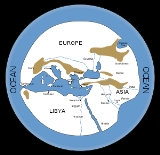
 Some have credited Hecataeus with a work entitled Περίοδος γῆς ("Travels round the Earth" or "World Survey'), written in two books. Each book is organized in the manner of a periplus
, a point-to-point coastal survey. One, on Europe
, is essentially a periplus of the Mediterranean, describing each region in turn, reaching as far north as Scythia
. The other book, on Asia
, is arranged similarly to the Periplus of the Erythraean Sea
of which a version of the 1st century AD survives. Hecataeus described the countries and inhabitants of the known world, the account of Egypt
being particularly comprehensive; the descriptive matter was accompanied by a map
, based upon Anaximander
’s map of the earth, which he corrected and enlarged. The work only survives in some 374 fragments, by far the majority being quoted in the geographical lexicon Ethnika compiled by Stephanus of Byzantium
.
The other known work of Hecataeus was the Genealogiai, a rationally systematized account of the traditions and the myths of the Greeks, a break with the epic myth-making tradition, which survives in a few fragments, just enough to show what we are missing.
Herodotus
(II, 143) tells a story of a visit by Hecataeus to an Egyptian
temple at Thebes
. It recounts how the priests showed Herodotus a series of statues in the temple's inner sanctum, each one supposedly set up by the high priest of each generation. Hecataeus, says Herodotus, had seen the same spectacle, after mentioning that he traced his descent, through sixteen generations, from a god. The Egyptians compared his genealogy to their own, as recorded by the statues; since the generations of their high priests had numbered three hundred and forty-five, all mortal men, they refused to believe Hecataeus's claim of descent from a god. Historian James Shotwell has called this encounter with the antiquity of Egypt an influence on Hecataeus's scepticism: he recognized that oral history is untrustworthy.
He was probably the first of the logographers
to attempt a serious prose history and to employ critical method to distinguish myth from historical fact, though he accepts Homer
and other poets as trustworthy authorities. Herodotus, though he once at least contradicts his statements, is indebted to Hecataeus for the concept of a prose history.
Miletus
Miletus was an ancient Greek city on the western coast of Anatolia , near the mouth of the Maeander River in ancient Caria...
(c. 550 BC – c. 476 BC) (Greek Ἑκαταῖος), named after the Greek
Greek mythology
Greek mythology is the body of myths and legends belonging to the ancient Greeks, concerning their gods and heroes, the nature of the world, and the origins and significance of their own cult and ritual practices. They were a part of religion in ancient Greece...
goddess
Goddess
A goddess is a female deity. In some cultures goddesses are associated with Earth, motherhood, love, and the household. In other cultures, goddesses also rule over war, death, and destruction as well as healing....
Hecate
Hecate
Hecate or Hekate is a chthonic Greco-Roman goddess associated with magic, witchcraft, necromancy, and crossroads.She is attested in poetry as early as Hesiod's Theogony...
, was an early Greek
Greece
Greece , officially the Hellenic Republic , and historically Hellas or the Republic of Greece in English, is a country in southeastern Europe....
historian
Historian
A historian is a person who studies and writes about the past and is regarded as an authority on it. Historians are concerned with the continuous, methodical narrative and research of past events as relating to the human race; as well as the study of all history in time. If the individual is...
of a wealthy family. He flourished during the time of the Persian
Achaemenid Empire
The Achaemenid Empire , sometimes known as First Persian Empire and/or Persian Empire, was founded in the 6th century BCE by Cyrus the Great who overthrew the Median confederation...
invasion. After having travelled extensively, he settled in his native city, where he occupied a high position, and devoted his time to the composition of geographical and historical works. When Aristagoras
Aristagoras
Aristagoras was the leader of Miletus in the late 6th century BC and early 5th century BC.- Background :Aristagoras served as deputy governor of Miletus, a polis on the western coast of Anatolia around 500 BC. He was the son of Molpagoras, and son-in-law of Histiaeus, whom the Persians had set up...
held a council of the leading Ionia
Ionia
Ionia is an ancient region of central coastal Anatolia in present-day Turkey, the region nearest İzmir, which was historically Smyrna. It consisted of the northernmost territories of the Ionian League of Greek settlements...
ns at Miletus to organize a revolt
Ionian Revolt
The Ionian Revolt, and associated revolts in Aeolis, Doris, Cyprus and Caria, were military rebellions by several regions of Asia Minor against Persian rule, lasting from 499 BC to 493 BC...
against the Persian rule, Hecataeus in vain tried to dissuade his countrymen from the undertaking. In 494 BC, when the defeated Ionians were obliged to sue for terms, he was one of the ambassadors to the Persian satrap
Satrap
Satrap was the name given to the governors of the provinces of the ancient Median and Achaemenid Empires and in several of their successors, such as the Sassanid Empire and the Hellenistic empires....
Artaphernes
Artaphernes
Artaphernes , was the brother of the king of Persia, Darius I of Persia, and satrap of Sardis.In 497 BC, Artaphernes received an embassy from Athens, probably sent by Cleisthenes, and subsequently advised the Athenians that they should receive back the tyrant Hippias.Subsequently he took an...
, whom he persuaded to restore the constitution of the Ionic cities. Hecataeus is the first known Greek historian
Historian
A historian is a person who studies and writes about the past and is regarded as an authority on it. Historians are concerned with the continuous, methodical narrative and research of past events as relating to the human race; as well as the study of all history in time. If the individual is...
, and was one of the first classical writers to mention the Celtic people
Celt
The Celts were a diverse group of tribal societies in Iron Age and Roman-era Europe who spoke Celtic languages.The earliest archaeological culture commonly accepted as Celtic, or rather Proto-Celtic, was the central European Hallstatt culture , named for the rich grave finds in Hallstatt, Austria....
.
Works
Periplus
Periplus is the Latinization of an ancient Greek word, περίπλους , literally "a sailing-around." Both segments, peri- and -plous, were independently productive: the ancient Greek speaker understood the word in its literal sense; however, it developed a few specialized meanings, one of which became...
, a point-to-point coastal survey. One, on Europe
Europe
Europe is, by convention, one of the world's seven continents. Comprising the westernmost peninsula of Eurasia, Europe is generally 'divided' from Asia to its east by the watershed divides of the Ural and Caucasus Mountains, the Ural River, the Caspian and Black Seas, and the waterways connecting...
, is essentially a periplus of the Mediterranean, describing each region in turn, reaching as far north as Scythia
Scythia
In antiquity, Scythian or Scyths were terms used by the Greeks to refer to certain Iranian groups of horse-riding nomadic pastoralists who dwelt on the Pontic-Caspian steppe...
. The other book, on Asia
Asia
Asia is the world's largest and most populous continent, located primarily in the eastern and northern hemispheres. It covers 8.7% of the Earth's total surface area and with approximately 3.879 billion people, it hosts 60% of the world's current human population...
, is arranged similarly to the Periplus of the Erythraean Sea
Periplus of the Erythraean Sea
The Periplus of the Erythraean Sea or Periplus of the Red Sea is a Greco-Roman periplus, written in Greek, describing navigation and trading opportunities from Roman Egyptian ports like Berenice along the coast of the Red Sea, and others along Northeast Africa and India...
of which a version of the 1st century AD survives. Hecataeus described the countries and inhabitants of the known world, the account of Egypt
Egypt
Egypt , officially the Arab Republic of Egypt, Arabic: , is a country mainly in North Africa, with the Sinai Peninsula forming a land bridge in Southwest Asia. Egypt is thus a transcontinental country, and a major power in Africa, the Mediterranean Basin, the Middle East and the Muslim world...
being particularly comprehensive; the descriptive matter was accompanied by a map
Map
A map is a visual representation of an area—a symbolic depiction highlighting relationships between elements of that space such as objects, regions, and themes....
, based upon Anaximander
Anaximander
Anaximander was a pre-Socratic Greek philosopher who lived in Miletus, a city of Ionia; Milet in modern Turkey. He belonged to the Milesian school and learned the teachings of his master Thales...
’s map of the earth, which he corrected and enlarged. The work only survives in some 374 fragments, by far the majority being quoted in the geographical lexicon Ethnika compiled by Stephanus of Byzantium
Stephanus of Byzantium
Stephen of Byzantium, also known as Stephanus Byzantinus , was the author of an important geographical dictionary entitled Ethnica...
.
The other known work of Hecataeus was the Genealogiai, a rationally systematized account of the traditions and the myths of the Greeks, a break with the epic myth-making tradition, which survives in a few fragments, just enough to show what we are missing.
Skepticism
Hecataeus' work, especially the Genealogiai, shows a marked scepticism of oral history, opening with "Hecataeus of Miletus thus speaks: I write what I deem true; for the stories of the Greeks are manifold and seem to me ridiculous."Herodotus
Herodotus
Herodotus was an ancient Greek historian who was born in Halicarnassus, Caria and lived in the 5th century BC . He has been called the "Father of History", and was the first historian known to collect his materials systematically, test their accuracy to a certain extent and arrange them in a...
(II, 143) tells a story of a visit by Hecataeus to an Egyptian
Ancient Egypt
Ancient Egypt was an ancient civilization of Northeastern Africa, concentrated along the lower reaches of the Nile River in what is now the modern country of Egypt. Egyptian civilization coalesced around 3150 BC with the political unification of Upper and Lower Egypt under the first pharaoh...
temple at Thebes
Thebes, Egypt
Thebes is the Greek name for a city in Ancient Egypt located about 800 km south of the Mediterranean, on the east bank of the river Nile within the modern city of Luxor. The Theban Necropolis is situated nearby on the west bank of the Nile.-History:...
. It recounts how the priests showed Herodotus a series of statues in the temple's inner sanctum, each one supposedly set up by the high priest of each generation. Hecataeus, says Herodotus, had seen the same spectacle, after mentioning that he traced his descent, through sixteen generations, from a god. The Egyptians compared his genealogy to their own, as recorded by the statues; since the generations of their high priests had numbered three hundred and forty-five, all mortal men, they refused to believe Hecataeus's claim of descent from a god. Historian James Shotwell has called this encounter with the antiquity of Egypt an influence on Hecataeus's scepticism: he recognized that oral history is untrustworthy.
He was probably the first of the logographers
Logographer (history)
The logographers were the Greek historiographers and chroniclers before Herodotus, "the father of history". Herodotus himself called his predecessors λογοποιοί...
to attempt a serious prose history and to employ critical method to distinguish myth from historical fact, though he accepts Homer
Homer
In the Western classical tradition Homer , is the author of the Iliad and the Odyssey, and is revered as the greatest ancient Greek epic poet. These epics lie at the beginning of the Western canon of literature, and have had an enormous influence on the history of literature.When he lived is...
and other poets as trustworthy authorities. Herodotus, though he once at least contradicts his statements, is indebted to Hecataeus for the concept of a prose history.
External links
- Iranica: article on Hecataeus of Miletus, bibliography
- Hecataei Milesii Fragmenta: Scylacis Caryandensis Periplus 1831 edition of Hecateus fragments from Google Books