

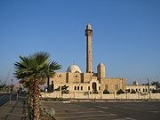
Hassan Bek Mosque

Encyclopedia
The Hassan Bek Mosque , also known as the Hasan Bey Mosque, is considered to be one of the most well-known mosques located in Jaffa
, which is now part of the Tel Aviv-Yafo municipality in Israel
. It has been a site of much controversy, as demonstrated in recent years.
Its history is closely bound up with the various stages of the Israeli-Palestinian Conflict
, from its beginnings as a communal strife under Ottoman and British rule up to the present. It has been on various occasions the subject of heated debate and eventful controversy, and has a deep symbolic and emotional meaning to Jaffa Arabs.
The unique Ottoman
style architecture it displays, is known to contrast sharply with the contemporary modern high-rises that are situated near it. It is located between Neve Tzedek
and the Mediterranean Sea
, on the fast road to Jaffa
.
's Turkish-Arab governor of the same name. At the time, Arab Jaffa and the recently-founded Jewish-Zionist Tel-Aviv were both competitively expanding northwards and seeking to block each other; the mosque was part of Manshiye, Jaffa's northernmost neighbourhood which spread northwards along the Mediterranean seashore.
Some years after its construction, Tel-Aviv's Allenby Street
was extended to the seashore some distance north of the mosque, blocking further Arab construction.
According to Yosef Nahmias, former member of the Irgun
unit which conquered the area in April 1948, he and his men planted demolition charges in the Hassan Bek Mosque immediately upon its capture and prepared to blow it up, but this was strictly vetoed by his commander Menachem Begin
(future Israeli PM ).
Also at various later times there were plans and proposals made to demolish the mosque, but they were never carried out. However, the rest of the former Palestinian houses surrounding Hassan Bek, whose original inhabitants now live in Gaza Strip
refugee camps, were all completely razed and destroyed, some in the immediate aftermath of 1948 and some in the Tel Aviv city renovation plan of the 1960s.
The place of the razed Arab housing was taken by high-rise office buildings and a park, as well as the sea-shore Dolphinarium
(used first for dolphin
performances, stopped due to protests by animal rights
groups, and than transformed into a nightclub - which was to become tragically famous in 2001). The Hassan Bek Mosque - spared due to the state and municipal authorities hesitating to be seen as desecrating a Muslim holy place - remained a single remnant of the area's pre-1948 past.
In 1979, it was suddenly announced that the Jaffa Islamic Properties' Trustees had sold the mosque and its comopound to real-estate developer Gershon Peres (brother of Shimon Peres
, then Israeli Labour Party leader and currently President of Israel
) and that it was to be transformed into a shopping mall.
The disclosure aroused a storm of protests by Jaffa Arabs, supported by Israeli Jewish peace and human rights groups, who claimed that the Trustees had been appointed by the Government of Israel, that they did not represent the Muslim community of Jaffa, and that they had pilfered the money from the Peres deal into their own pockets.
The outcome was that the real estate deal was cancelled and the mosque returned to the hands of the Jaffa Muslim Community.
While never investigating such rumors, the authorities gave permission for the Jaffa Arabs to restore the minaret, using volunteer work and funds provided by the governments of Jordan
and Saudi Arabia
. This is considered by Jaffa Arabs an important milestone in their recovered self-awareness and assertiveness in defence of their communal rights.
Up to the present, Jaffa Arabs maintain an ongoing presence in the renovated mosque, and prayers are held in it regularly, though it is a considerable distance from the neighborhood where the surviving post-1948 Arab community of Jaffa is living.
suicide bombing occurred nearby at the Tel-Aviv Dolphinarium which claimed the lives of 21 Israelis
.
A major anti-Arab riot soon developed with over one thousand Israelis besieging the mosque, with sporadic rock and fire-bomb attacks along with calls for revenge against Arabs. For their part, Muslim
worshipers inside the mosque hurled rocks and bottles at the besiegers. This entire event led to over 20 people suffering light injuries from the demonstrators. The rock attacks led to increased Arab violence and attacks in the area, leading to stone-throwing attacks on Yefet Street in the Jaffa section of Tel-Aviv. Motorist were injured in the stone-throwing attacks that resulted in closing the street to motorists.
The mosque
served also as the scene of a provocation against Muslims that occurred in August 2005. Several Israelis allegedly threw a pig’s head on the lawn of the Hassan Bek Mosque. The pig
's head was wrapped in a keffiyeh
with "Muhammad
", the name of the prophet of Islam, written on it. Those suspected of taking part in this incident were promptly arrested and charged by Israeli police officials.
This event later led to an act of revenge by Abed al-Muaz Jueba, a Hamas
sympathizer and resident of Hebron
. He stabbed three yeshiva
students on their way to the Old City of Jerusalem. The stabbing attack killed one, Shmuel Eliyahu Mett, while seriously wounding the two other boys who accompanied him.
instead of using the more common stone of the area being a yellow-brown limestone. The walls of the mosque are perforated with intricately decorated and colourfully glazed windows. The walls are also refined by narrow engaged piers that divide the wide façades into smaller sections.
Its towering slender minaret
contrasts with the square prayer hall and it has a proportionally low flat concrete roof and shallow dome projecting from its central bay. A very low tower can be seen attached to the opposite side of the mosque.
Jaffa
Jaffa is an ancient port city believed to be one of the oldest in the world. Jaffa was incorporated with Tel Aviv creating the city of Tel Aviv-Yafo, Israel. Jaffa is famous for its association with the biblical story of the prophet Jonah.-Etymology:...
, which is now part of the Tel Aviv-Yafo municipality in Israel
Israel
The State of Israel is a parliamentary republic located in the Middle East, along the eastern shore of the Mediterranean Sea...
. It has been a site of much controversy, as demonstrated in recent years.
Its history is closely bound up with the various stages of the Israeli-Palestinian Conflict
Israeli-Palestinian conflict
The Israeli–Palestinian conflict is the ongoing conflict between Israelis and Palestinians. The conflict is wide-ranging, and the term is also used in reference to the earlier phases of the same conflict, between Jewish and Zionist yishuv and the Arab population living in Palestine under Ottoman or...
, from its beginnings as a communal strife under Ottoman and British rule up to the present. It has been on various occasions the subject of heated debate and eventful controversy, and has a deep symbolic and emotional meaning to Jaffa Arabs.
The unique Ottoman
Ottoman Empire
The Ottoman EmpireIt was usually referred to as the "Ottoman Empire", the "Turkish Empire", the "Ottoman Caliphate" or more commonly "Turkey" by its contemporaries...
style architecture it displays, is known to contrast sharply with the contemporary modern high-rises that are situated near it. It is located between Neve Tzedek
Neve Tzedek
Neve Tzedek is a neighborhood located in southwestern Tel Aviv, Israel. It was the first Jewish neighborhood to be built outside the walls of the ancient port of Jaffa. For years, the neighborhood prospered as Tel Aviv, the first modern Hebrew city, grew up around it...
and the Mediterranean Sea
Mediterranean Sea
The Mediterranean Sea is a sea connected to the Atlantic Ocean surrounded by the Mediterranean region and almost completely enclosed by land: on the north by Anatolia and Europe, on the south by North Africa, and on the east by the Levant...
, on the fast road to Jaffa
Jaffa
Jaffa is an ancient port city believed to be one of the oldest in the world. Jaffa was incorporated with Tel Aviv creating the city of Tel Aviv-Yafo, Israel. Jaffa is famous for its association with the biblical story of the prophet Jonah.-Etymology:...
.
History
The Hassan Bek Mosque was built in 1916, by JaffaJaffa
Jaffa is an ancient port city believed to be one of the oldest in the world. Jaffa was incorporated with Tel Aviv creating the city of Tel Aviv-Yafo, Israel. Jaffa is famous for its association with the biblical story of the prophet Jonah.-Etymology:...
's Turkish-Arab governor of the same name. At the time, Arab Jaffa and the recently-founded Jewish-Zionist Tel-Aviv were both competitively expanding northwards and seeking to block each other; the mosque was part of Manshiye, Jaffa's northernmost neighbourhood which spread northwards along the Mediterranean seashore.
Some years after its construction, Tel-Aviv's Allenby Street
Allenby Street
Allenby Street is a major street in Tel Aviv, Israel. It was named in honor of Field Marshal Viscount Allenby.Allenby Street stretches from the Mediterranean sea in the northwest to HaAliya Street in the southeast. It was first paved with concrete in 1914. During the day, it is a commercial street...
was extended to the seashore some distance north of the mosque, blocking further Arab construction.
According to Yosef Nahmias, former member of the Irgun
Irgun
The Irgun , or Irgun Zevai Leumi to give it its full title , was a Zionist paramilitary group that operated in Mandate Palestine between 1931 and 1948. It was an offshoot of the earlier and larger Jewish paramilitary organization haHaganah...
unit which conquered the area in April 1948, he and his men planted demolition charges in the Hassan Bek Mosque immediately upon its capture and prepared to blow it up, but this was strictly vetoed by his commander Menachem Begin
Menachem Begin
' was a politician, founder of Likud and the sixth Prime Minister of the State of Israel. Before independence, he was the leader of the Zionist militant group Irgun, the Revisionist breakaway from the larger Jewish paramilitary organization Haganah. He proclaimed a revolt, on 1 February 1944,...
(future Israeli PM ).
Also at various later times there were plans and proposals made to demolish the mosque, but they were never carried out. However, the rest of the former Palestinian houses surrounding Hassan Bek, whose original inhabitants now live in Gaza Strip
Gaza Strip
thumb|Gaza city skylineThe Gaza Strip lies on the Eastern coast of the Mediterranean Sea. The Strip borders Egypt on the southwest and Israel on the south, east and north. It is about long, and between 6 and 12 kilometres wide, with a total area of...
refugee camps, were all completely razed and destroyed, some in the immediate aftermath of 1948 and some in the Tel Aviv city renovation plan of the 1960s.
The place of the razed Arab housing was taken by high-rise office buildings and a park, as well as the sea-shore Dolphinarium
Dolphinarium
A dolphinarium is an aquarium for dolphins. The dolphins are usually kept in a large pool, though occasionally they may be kept in pens in the open sea, either for research or for public performances...
(used first for dolphin
Dolphin
Dolphins are marine mammals that are closely related to whales and porpoises. There are almost forty species of dolphin in 17 genera. They vary in size from and , up to and . They are found worldwide, mostly in the shallower seas of the continental shelves, and are carnivores, mostly eating...
performances, stopped due to protests by animal rights
Animal rights
Animal rights, also known as animal liberation, is the idea that the most basic interests of non-human animals should be afforded the same consideration as the similar interests of human beings...
groups, and than transformed into a nightclub - which was to become tragically famous in 2001). The Hassan Bek Mosque - spared due to the state and municipal authorities hesitating to be seen as desecrating a Muslim holy place - remained a single remnant of the area's pre-1948 past.
Real-estate scheme of 1979
The Hassan Bek Mosque lay derelict and neglected for many years, its empty shell used on some occasions by vagabonds and drug addicts.In 1979, it was suddenly announced that the Jaffa Islamic Properties' Trustees had sold the mosque and its comopound to real-estate developer Gershon Peres (brother of Shimon Peres
Shimon Peres
GCMG is the ninth President of the State of Israel. Peres served twice as the eighth Prime Minister of Israel and once as Interim Prime Minister, and has been a member of 12 cabinets in a political career spanning over 66 years...
, then Israeli Labour Party leader and currently President of Israel
President of Israel
The President of the State of Israel is the head of state of Israel. The position is largely an apolitical ceremonial figurehead role, with the real executive power lying in the hands of the Prime Minister. The current president is Shimon Peres who took office on 15 July 2007...
) and that it was to be transformed into a shopping mall.
The disclosure aroused a storm of protests by Jaffa Arabs, supported by Israeli Jewish peace and human rights groups, who claimed that the Trustees had been appointed by the Government of Israel, that they did not represent the Muslim community of Jaffa, and that they had pilfered the money from the Peres deal into their own pockets.
The outcome was that the real estate deal was cancelled and the mosque returned to the hands of the Jaffa Muslim Community.
Collapse and reconstruction
Soon after title was handed over to the Jaffa Muslims, the mosque's minaret collapsed overnight in what was officially described as "an accident" but which was generally considered by Jaffa Arabs and left-wing Israelis to be a deliberate sabotage by extreme right groups and/or veterans of 1948.While never investigating such rumors, the authorities gave permission for the Jaffa Arabs to restore the minaret, using volunteer work and funds provided by the governments of Jordan
Jordan
Jordan , officially the Hashemite Kingdom of Jordan , Al-Mamlaka al-Urduniyya al-Hashemiyya) is a kingdom on the East Bank of the River Jordan. The country borders Saudi Arabia to the east and south-east, Iraq to the north-east, Syria to the north and the West Bank and Israel to the west, sharing...
and Saudi Arabia
Saudi Arabia
The Kingdom of Saudi Arabia , commonly known in British English as Saudi Arabia and in Arabic as as-Sa‘ūdiyyah , is the largest state in Western Asia by land area, constituting the bulk of the Arabian Peninsula, and the second-largest in the Arab World...
. This is considered by Jaffa Arabs an important milestone in their recovered self-awareness and assertiveness in defence of their communal rights.
Up to the present, Jaffa Arabs maintain an ongoing presence in the renovated mosque, and prayers are held in it regularly, though it is a considerable distance from the neighborhood where the surviving post-1948 Arab community of Jaffa is living.
Impact of the Second Intifada
On June 1, 2001, a HamasHamas
Hamas is the Palestinian Sunni Islamic or Islamist political party that governs the Gaza Strip. Hamas also has a military wing, the Izz ad-Din al-Qassam Brigades...
suicide bombing occurred nearby at the Tel-Aviv Dolphinarium which claimed the lives of 21 Israelis
Dolphinarium massacre
The Dolphinarium discotheque suicide bombing was a terrorist attack by on June 1, 2001 in which a suicide bomber Saeed Hotari, a millitant linked to the Palestinian group Hamas, blew himself up outside a discotheque on a beachfront in Tel Aviv, Israel, killing 21 Israeli teenagers and injuring 132...
.
A major anti-Arab riot soon developed with over one thousand Israelis besieging the mosque, with sporadic rock and fire-bomb attacks along with calls for revenge against Arabs. For their part, Muslim
Muslim
A Muslim, also spelled Moslem, is an adherent of Islam, a monotheistic, Abrahamic religion based on the Quran, which Muslims consider the verbatim word of God as revealed to prophet Muhammad. "Muslim" is the Arabic term for "submitter" .Muslims believe that God is one and incomparable...
worshipers inside the mosque hurled rocks and bottles at the besiegers. This entire event led to over 20 people suffering light injuries from the demonstrators. The rock attacks led to increased Arab violence and attacks in the area, leading to stone-throwing attacks on Yefet Street in the Jaffa section of Tel-Aviv. Motorist were injured in the stone-throwing attacks that resulted in closing the street to motorists.
The mosque
Mosque
A mosque is a place of worship for followers of Islam. The word is likely to have entered the English language through French , from Portuguese , from Spanish , and from Berber , ultimately originating in — . The Arabic word masjid literally means a place of prostration...
served also as the scene of a provocation against Muslims that occurred in August 2005. Several Israelis allegedly threw a pig’s head on the lawn of the Hassan Bek Mosque. The pig
Pig
A pig is any of the animals in the genus Sus, within the Suidae family of even-toed ungulates. Pigs include the domestic pig, its ancestor the wild boar, and several other wild relatives...
's head was wrapped in a keffiyeh
Keffiyeh
The keffiyeh/kufiya , also known as a ghutrah , ' , mashadah , shemagh or in Persian chafiye , Kurdish cemedanî and Turkish puşi, is a traditional Arab headdress fashioned from a square, usually cotton, scarf. It is typically worn by Arab men, as well as some Kurds...
with "Muhammad
Muhammad
Muhammad |ligature]] at U+FDF4 ;Arabic pronunciation varies regionally; the first vowel ranges from ~~; the second and the last vowel: ~~~. There are dialects which have no stress. In Egypt, it is pronounced not in religious contexts...
", the name of the prophet of Islam, written on it. Those suspected of taking part in this incident were promptly arrested and charged by Israeli police officials.
This event later led to an act of revenge by Abed al-Muaz Jueba, a Hamas
Hamas
Hamas is the Palestinian Sunni Islamic or Islamist political party that governs the Gaza Strip. Hamas also has a military wing, the Izz ad-Din al-Qassam Brigades...
sympathizer and resident of Hebron
Hebron
Hebron , is located in the southern West Bank, south of Jerusalem. Nestled in the Judean Mountains, it lies 930 meters above sea level. It is the largest city in the West Bank and home to around 165,000 Palestinians, and over 500 Jewish settlers concentrated in and around the old quarter...
. He stabbed three yeshiva
Yeshiva
Yeshiva is a Jewish educational institution that focuses on the study of traditional religious texts, primarily the Talmud and Torah study. Study is usually done through daily shiurim and in study pairs called chavrutas...
students on their way to the Old City of Jerusalem. The stabbing attack killed one, Shmuel Eliyahu Mett, while seriously wounding the two other boys who accompanied him.
Architectural style
In a unique building style, the mosque employs a white limestoneLimestone
Limestone is a sedimentary rock composed largely of the minerals calcite and aragonite, which are different crystal forms of calcium carbonate . Many limestones are composed from skeletal fragments of marine organisms such as coral or foraminifera....
instead of using the more common stone of the area being a yellow-brown limestone. The walls of the mosque are perforated with intricately decorated and colourfully glazed windows. The walls are also refined by narrow engaged piers that divide the wide façades into smaller sections.
Its towering slender minaret
Minaret
A minaret مناره , sometimes مئذنه) is a distinctive architectural feature of Islamic mosques, generally a tall spire with an onion-shaped or conical crown, usually either free standing or taller than any associated support structure. The basic form of a minaret includes a base, shaft, and gallery....
contrasts with the square prayer hall and it has a proportionally low flat concrete roof and shallow dome projecting from its central bay. A very low tower can be seen attached to the opposite side of the mosque.