


Happy ending

Encyclopedia
A happy ending is an ending of the plot of a work of fiction
in which almost everything turns out for the best for the protagonists, their sidekick
s, and almost everyone except the villain
s.
In storylines where the protagonists are in physical danger
, a happy ending would mainly consist in their surviving and successfully concluding their quest
or mission; where there is no physical danger, a happy ending is often defined as lovers consummating
their love despite various factors which may have thwarted it; and a considerable number of storylines combine both factors.
A Times
review of The Spy Who Came in from the Cold
strongly criticised John le Carré
for failing to provide a happy ending, and gave unequivocal reasons why in the reviewer's opinion (shared by many others) such an ending is needed: "The hero must triumph over his enemies, as surely as Jack
must kill the giant in the nursery tale. If the giant kills Jack, we have missed the whole point of the story."
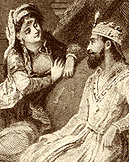 A happy ending is epitomized in the standard fairy tale
ending phrase, "happily ever after" or "and they lived happily ever after." (One Thousand and One Nights has the more restrained formula they lived happily until there came to them the One who Destroys all Happiness (i.e. Death)). Satisfactory happy endings are happy for the reader as well, in that the characters he or she sympathizes with are rewarded. However, some consider this as not an ending, but an open path for a possible sequel. For example, at the end of The Lion King
, Simba
defeats Scar, becomes king, marries and has a daughter, Kiara, thus giving way to The Lion King II: Simba's Pride
.
from tragedy
. In certain periods, the endings of traditional tragedies such as Macbeth
or Oedipus Rex
, in which most of the major characters end up dead, disfigured, or discountenanced, have been actively disliked. In the eighteenth century, the Irish author Nahum Tate
sought to improve Shakespeare
's King Lear
in his own heavily modified version
in which Lear survives and Cordelia marries Edgar. Most subsequent critics have not found Tate's amendments an improvement. Happy endings have also been fastened to Romeo and Juliet
and Othello
. Not everybody agrees on what a happy ending is.
An interpretation of The Merchant of Venice
’s forced conversion of Shylock
to Christianity is that it was intended as a happy ending. As a Christian, he could no longer impose interest, undoing his schemes in the play and ending the rivalry between him and Antonio, but more importantly, contemporary audiences would see becoming a Christian as a means to save his soul.
Similarly, based on the assumptions about women's role in society prevalent at the time of writing, The Taming of the Shrew
s concluding with the complete breaking of Kate's rebelliousness and her transformation into an obedient wife counted as a happy ending.
comments ironically in his review of Roland Emmerich
's The Day After Tomorrow
; "Billions of people may have died, but at least the major characters have survived. Los Angeles is leveled by multiple tornadoes, New York is buried under ice and snow, the United Kingdom is flash-frozen, and lots of the Northern Hemisphere is wiped out for good measure. Thank god that Jack, Sam, Laura, Jason and Dr. Lucy Hall survive, along with Dr. Hall's little cancer
patient."
Since the ending is the point at which a narrative ends, a "happy ending" is constructed in a way so as to imply that, after the conclusion of the narrative, the lives of all the "good" characters will be filled with happiness and that any unpleasantness they encounter will be negligible. However, as is often demonstrated through the creation of sequel
s, it is conceivable that the characters' happiness will be ruined after the "curtain falls." (Alien 3 begins with the revelation that most of the survivors of Aliens
had died.) This means that a storyteller can create a happy ending to a sad story (or vice-versa) merely by ending the story before a horrible tragedy occurs or, if the tragedy is reversible, by continuing the story on after its original end so that the characters can overcome it. Either way, the "ending" is changed without altering the story's canon
.
In the modern world, happy endings have sometimes been viewed as an American specialty, and the English-language words happy ending (or happy end) have been imported as-is into other languages to make this point. In the 1928 Austrian operetta
Die Herzogin von Chicago
, the two lovers who are too proud to speak to one another are finally brought together by a Hollywood producer who explains that he plans to make a movie of their love story
, but that he cannot until it has the required happy ending.
A preference for happy endings is manifest in various film adaptations of literary works where the original does not have such an ending. For example, Hans Christian Andersen
's classic "The Little Mermaid
" ends with a tragic, noble sacrifice in which the Mermaid must see her beloved Prince marry another girl—but in the Disney version
, the Mermaid does get to marry her Prince and live with him happily ever after. A Disney sequel—obviously impossible for the Andersen original—centered on the daughter born of this marriage. Similarly, the original Truman Capote
novella
on which Breakfast at Tiffany's was based ended with Holly Golightly's going off to Brazil and disappearing from the protagonist's life—while in the film it was changed to her accepting the love he offered her and their famous kiss in the rain.
Some works of fiction, such as Kurt Weill
and Bertolt Brecht
's operetta
The Threepenny Opera
or F. W. Murnau
's film The Last Laugh, have intentionally implausible happy endings. The P.D.Q. Bach opera The Stoned Guest
originally ends with all of the cast strewn about dead on the stage (similar to the ending of Hamlet
). However, as the residents of the town would be disappointed with such a gloomy conclusion, Bach is urged to rewrite the opera. Thus, he has all of the cast suddenly spring back to life with no explanation whatsoever and sing a piece entitled "Happy Ending!" (P.D.Q. Bach albums are satires created by musicologist Peter Schickele
).
Robert A. Heinlein
's science fiction
novel Podkayne of Mars
, as originally written in 1962, ended with the protagonist's death. However, the publisher refused to accept it and pressured Heinlein to change the ending and let her survive—which he did, though under a strong protest. In a letter to his literary agent, published only many years later, Heinlein wrote that revising the story was "like revising Romeo and Juliet
to let the young lovers live happily ever after" and that "changing the end isn't real life, because in real life, not everything ends happily." The 1995 Baen Books
edition includes both endings, as well as a collection of readers' essays giving their opinions about which ending is better. The issue is still hotly debated, nearly half a century after the book's publication (See Podkayne of Mars#Two versions of the ending).
Fiction
Fiction is the form of any narrative or informative work that deals, in part or in whole, with information or events that are not factual, but rather, imaginary—that is, invented by the author. Although fiction describes a major branch of literary work, it may also refer to theatrical,...
in which almost everything turns out for the best for the protagonists, their sidekick
Sidekick
A sidekick is a close companion who is generally regarded as subordinate to the one he accompanies. Some well-known fictional sidekicks are Don Quixote's Sancho Panza, Sherlock Holmes' Doctor Watson, The Lone Ranger's Tonto, The Green Hornet's Kato and Batman's Robin.-Origins:The origin of the...
s, and almost everyone except the villain
Villain
A villain is an "evil" character in a story, whether a historical narrative or, especially, a work of fiction. The villain usually is the antagonist, the character who tends to have a negative effect on other characters...
s.
In storylines where the protagonists are in physical danger
Danger
Danger may refer to:* Risk, the threat of adverse events* Danger , a Microsoft subsidiary which made cellular telephones* Danger , French electronic composer and performer* Danger , the fourth studio album by P-Square...
, a happy ending would mainly consist in their surviving and successfully concluding their quest
Quest
In mythology and literature, a quest, a journey towards a goal, serves as a plot device and as a symbol. Quests appear in the folklore of every nation and also figure prominently in non-national cultures. In literature, the objects of quests require great exertion on the part of the hero, and...
or mission; where there is no physical danger, a happy ending is often defined as lovers consummating
Consummation
Consummation is the initial sexual act made within a marriage.Consummation can also refer to:* Consummation , 1970 recordingSee also:* Consummation of days, event predicted in Daniel Chapter 12, verses 1-4...
their love despite various factors which may have thwarted it; and a considerable number of storylines combine both factors.
A Times
The Times
The Times is a British daily national newspaper, first published in London in 1785 under the title The Daily Universal Register . The Times and its sister paper The Sunday Times are published by Times Newspapers Limited, a subsidiary since 1981 of News International...
review of The Spy Who Came in from the Cold
The Spy Who Came in from the Cold
The Spy Who Came in from the Cold , by John le Carré, is a British Cold War spy novel that became famous for its portrayal of Western espionage methods as being morally inconsistent with Western democracy and values. The novel received critical acclaim at the time of its publication and became an...
strongly criticised John le Carré
John le Carré
David John Moore Cornwell , who writes under the name John le Carré, is an author of espionage novels. During the 1950s and the 1960s, Cornwell worked for MI5 and MI6, and began writing novels under the pseudonym "John le Carré"...
for failing to provide a happy ending, and gave unequivocal reasons why in the reviewer's opinion (shared by many others) such an ending is needed: "The hero must triumph over his enemies, as surely as Jack
Jack and the Beanstalk
Jack and the Beanstalk is a folktale said by English historian Francis Palgrave to be an oral legend that arrived in England with the Vikings. The tale is closely associated with the tale of Jack the Giant-killer. It is known under a number of versions...
must kill the giant in the nursery tale. If the giant kills Jack, we have missed the whole point of the story."
Fairy tale
A fairy tale is a type of short story that typically features such folkloric characters, such as fairies, goblins, elves, trolls, dwarves, giants or gnomes, and usually magic or enchantments. However, only a small number of the stories refer to fairies...
ending phrase, "happily ever after" or "and they lived happily ever after." (One Thousand and One Nights has the more restrained formula they lived happily until there came to them the One who Destroys all Happiness (i.e. Death)). Satisfactory happy endings are happy for the reader as well, in that the characters he or she sympathizes with are rewarded. However, some consider this as not an ending, but an open path for a possible sequel. For example, at the end of The Lion King
The Lion King
The Lion King is a 1994 American animated film produced by Walt Disney Feature Animation and released by Walt Disney Pictures. It is the 32nd feature in the Walt Disney Animated Classics series...
, Simba
Simba
Simba is a lion character and the protagonist of Disney's most successful animated feature film, The Lion King. He is the son of Mufasa and Sarabi, nephew of Scar, mate of Nala, and father of Kiara. He has golden fur and when he grows into an adult, he has an auburn mane...
defeats Scar, becomes king, marries and has a daughter, Kiara, thus giving way to The Lion King II: Simba's Pride
The Lion King II: Simba's Pride
The Lion King II: Simba's Pride is a 1998 American direct-to-video animated film released by Walt Disney Home Video on October 27, 1998. The film is the sequel to the 1994 Disney animated film The Lion King...
.
Shakespeare
The presence of a happy ending is one of the key points that distinguishes melodramaMelodrama
The term melodrama refers to a dramatic work that exaggerates plot and characters in order to appeal to the emotions. It may also refer to the genre which includes such works, or to language, behavior, or events which resemble them...
from tragedy
Tragedy
Tragedy is a form of art based on human suffering that offers its audience pleasure. While most cultures have developed forms that provoke this paradoxical response, tragedy refers to a specific tradition of drama that has played a unique and important role historically in the self-definition of...
. In certain periods, the endings of traditional tragedies such as Macbeth
Macbeth
The Tragedy of Macbeth is a play by William Shakespeare about a regicide and its aftermath. It is Shakespeare's shortest tragedy and is believed to have been written sometime between 1603 and 1607...
or Oedipus Rex
Oedipus the King
Oedipus the King , also known by the Latin title Oedipus Rex, is an Athenian tragedy by Sophocles that was first performed c. 429 BCE. It was the second of Sophocles's three Theban plays to be produced, but it comes first in the internal chronology, followed by Oedipus at Colonus and then Antigone...
, in which most of the major characters end up dead, disfigured, or discountenanced, have been actively disliked. In the eighteenth century, the Irish author Nahum Tate
Nahum Tate
Nahum Tate was an Irish poet, hymnist, and lyricist, who became England's poet laureate in 1692.-Life:Nahum Teate came from a family of Puritan clergymen...
sought to improve Shakespeare
William Shakespeare
William Shakespeare was an English poet and playwright, widely regarded as the greatest writer in the English language and the world's pre-eminent dramatist. He is often called England's national poet and the "Bard of Avon"...
's King Lear
King Lear
King Lear is a tragedy by William Shakespeare. The title character descends into madness after foolishly disposing of his estate between two of his three daughters based on their flattery, bringing tragic consequences for all. The play is based on the legend of Leir of Britain, a mythological...
in his own heavily modified version
The History of King Lear
The History of King Lear is an adaptation by Nahum Tate of William Shakespeare's King Lear. It first appeared in 1681, some seventy-five years after Shakespeare's version, and is believed to have replaced Shakespeare's version on the English stage in whole or in part until 1838.Unlike Shakespeare's...
in which Lear survives and Cordelia marries Edgar. Most subsequent critics have not found Tate's amendments an improvement. Happy endings have also been fastened to Romeo and Juliet
Romeo and Juliet
Romeo and Juliet is a tragedy written early in the career of playwright William Shakespeare about two young star-crossed lovers whose deaths ultimately unite their feuding families. It was among Shakespeare's most popular archetypal stories of young, teenage lovers.Romeo and Juliet belongs to a...
and Othello
Othello
The Tragedy of Othello, the Moor of Venice is a tragedy by William Shakespeare, believed to have been written in approximately 1603, and based on the Italian short story "Un Capitano Moro" by Cinthio, a disciple of Boccaccio, first published in 1565...
. Not everybody agrees on what a happy ending is.
An interpretation of The Merchant of Venice
The Merchant of Venice
The Merchant of Venice is a tragic comedy by William Shakespeare, believed to have been written between 1596 and 1598. Though classified as a comedy in the First Folio and sharing certain aspects with Shakespeare's other romantic comedies, the play is perhaps most remembered for its dramatic...
’s forced conversion of Shylock
Shylock
Shylock is a fictional character in Shakespeare's The Merchant of Venice.-In the play:In The Merchant of Venice, Shylock is a Jewish moneylender who lends money to his Christian rival, Antonio, setting the security at a pound of Antonio's flesh...
to Christianity is that it was intended as a happy ending. As a Christian, he could no longer impose interest, undoing his schemes in the play and ending the rivalry between him and Antonio, but more importantly, contemporary audiences would see becoming a Christian as a means to save his soul.
Similarly, based on the assumptions about women's role in society prevalent at the time of writing, The Taming of the Shrew
The Taming of the Shrew
The Taming of the Shrew is a comedy by William Shakespeare, believed to have been written between 1590 and 1591.The play begins with a framing device, often referred to as the Induction, in which a mischievous nobleman tricks a drunken tinker named Sly into believing he is actually a nobleman himself...
s concluding with the complete breaking of Kate's rebelliousness and her transformation into an obedient wife counted as a happy ending.
Features
A happy ending only requires that the main characters be all right. Millions of innocent background characters can die, but as long as the characters that the reader/viewer/audience cares about survive, it is still a happy ending. Roger EbertRoger Ebert
Roger Joseph Ebert is an American film critic and screenwriter. He is the first film critic to win a Pulitzer Prize for Criticism.Ebert is known for his film review column and for the television programs Sneak Previews, At the Movies with Gene Siskel and Roger Ebert, and Siskel and Ebert and The...
comments ironically in his review of Roland Emmerich
Roland Emmerich
Roland Emmerich is a German film director, screenwriter, and producer.His films, most of which are Hollywood productions filmed in English, have grossed more than $3 billion worldwide, more than those of any other European director...
's The Day After Tomorrow
The Day After Tomorrow
The Day After Tomorrow is a 2004 American science-fiction disaster film that depicts the catastrophic effects of global warming in a series of extreme weather events that usher in global cooling which leads to a new ice age. The film did well at the box office, grossing $542,771,772 internationally...
; "Billions of people may have died, but at least the major characters have survived. Los Angeles is leveled by multiple tornadoes, New York is buried under ice and snow, the United Kingdom is flash-frozen, and lots of the Northern Hemisphere is wiped out for good measure. Thank god that Jack, Sam, Laura, Jason and Dr. Lucy Hall survive, along with Dr. Hall's little cancer
Cancer
Cancer , known medically as a malignant neoplasm, is a large group of different diseases, all involving unregulated cell growth. In cancer, cells divide and grow uncontrollably, forming malignant tumors, and invade nearby parts of the body. The cancer may also spread to more distant parts of the...
patient."
Since the ending is the point at which a narrative ends, a "happy ending" is constructed in a way so as to imply that, after the conclusion of the narrative, the lives of all the "good" characters will be filled with happiness and that any unpleasantness they encounter will be negligible. However, as is often demonstrated through the creation of sequel
Sequel
A sequel is a narrative, documental, or other work of literature, film, theatre, or music that continues the story of or expands upon issues presented in some previous work...
s, it is conceivable that the characters' happiness will be ruined after the "curtain falls." (Alien 3 begins with the revelation that most of the survivors of Aliens
Aliens (film)
Aliens is a 1986 science fiction action film directed by James Cameron and starring Sigourney Weaver, Carrie Henn, Michael Biehn, Lance Henriksen, William Hope, and Bill Paxton...
had died.) This means that a storyteller can create a happy ending to a sad story (or vice-versa) merely by ending the story before a horrible tragedy occurs or, if the tragedy is reversible, by continuing the story on after its original end so that the characters can overcome it. Either way, the "ending" is changed without altering the story's canon
Canon (fiction)
In the context of a work of fiction, the term canon denotes the material accepted as "official" in a fictional universe's fan base. It is often contrasted with, or used as the basis for, works of fan fiction, which are not considered canonical...
.
In the modern world, happy endings have sometimes been viewed as an American specialty, and the English-language words happy ending (or happy end) have been imported as-is into other languages to make this point. In the 1928 Austrian operetta
Operetta
Operetta is a genre of light opera, light in terms both of music and subject matter. It is also closely related, in English-language works, to forms of musical theatre.-Origins:...
Die Herzogin von Chicago
Die Herzogin von Chicago
Die Herzogin von Chicago is an operetta in two acts, a prologue, and an epilogue. The music was composed by Hungarian composer Emmerich Kálmán with a libretto by Julius Brammer and Alfred Grünwald. It premiered in Vienna at the Theater an der Wien, on April 5, 1928 and played for 372 performances...
, the two lovers who are too proud to speak to one another are finally brought together by a Hollywood producer who explains that he plans to make a movie of their love story
Romantic Comedy
Romantic Comedy can refer to* Romantic Comedy , a 1979 play written by Bernard Slade* Romantic Comedy , a 1983 film adapted from the play and starring Dudley Moore and Mary Steenburgen...
, but that he cannot until it has the required happy ending.
A preference for happy endings is manifest in various film adaptations of literary works where the original does not have such an ending. For example, Hans Christian Andersen
Hans Christian Andersen
Hans Christian Andersen was a Danish author, fairy tale writer, and poet noted for his children's stories. These include "The Steadfast Tin Soldier," "The Snow Queen," "The Little Mermaid," "Thumbelina," "The Little Match Girl," and "The Ugly Duckling."...
's classic "The Little Mermaid
The Little Mermaid
"The Little Mermaid" is a popular fairy tale by the Danish poet and author Hans Christian Andersen about a young mermaid willing to give up her life in the sea and her identity as a mermaid to gain a human soul and the love of a human prince...
" ends with a tragic, noble sacrifice in which the Mermaid must see her beloved Prince marry another girl—but in the Disney version
The Little Mermaid (1989 film)
The Little Mermaid is a 1989 American animated film produced by Walt Disney Feature Animation and based on the Hans Christian Andersen fairy tale of the same name. Distributed by Walt Disney Pictures, the film was originally released to theaters on November 14, 1989 and is the twenty-eighth film in...
, the Mermaid does get to marry her Prince and live with him happily ever after. A Disney sequel—obviously impossible for the Andersen original—centered on the daughter born of this marriage. Similarly, the original Truman Capote
Truman Capote
Truman Streckfus Persons , known as Truman Capote , was an American author, many of whose short stories, novels, plays, and nonfiction are recognized literary classics, including the novella Breakfast at Tiffany's and the true crime novel In Cold Blood , which he labeled a "nonfiction novel." At...
novella
Breakfast at Tiffany's (novella)
Breakfast at Tiffany's is a novella by Truman Capote published in 1958. The main character, Holly Golightly, is one of Capote's best-known creations and an American cultural icon.-Plot:...
on which Breakfast at Tiffany's was based ended with Holly Golightly's going off to Brazil and disappearing from the protagonist's life—while in the film it was changed to her accepting the love he offered her and their famous kiss in the rain.
Some works of fiction, such as Kurt Weill
Kurt Weill
Kurt Julian Weill was a German-Jewish composer, active from the 1920s, and in his later years in the United States. He was a leading composer for the stage who was best known for his fruitful collaborations with Bertolt Brecht...
and Bertolt Brecht
Bertolt Brecht
Bertolt Brecht was a German poet, playwright, and theatre director.An influential theatre practitioner of the 20th century, Brecht made equally significant contributions to dramaturgy and theatrical production, the latter particularly through the seismic impact of the tours undertaken by the...
's operetta
Operetta
Operetta is a genre of light opera, light in terms both of music and subject matter. It is also closely related, in English-language works, to forms of musical theatre.-Origins:...
The Threepenny Opera
The Threepenny Opera
The Threepenny Opera is a musical by German dramatist Bertolt Brecht and composer Kurt Weill, in collaboration with translator Elisabeth Hauptmann and set designer Caspar Neher. It was adapted from an 18th-century English ballad opera, John Gay's The Beggar's Opera, and offers a Marxist critique...
or F. W. Murnau
Friedrich Wilhelm Murnau
Friedrich Wilhelm "F. W." Murnau was one of the most influential German film directors of the silent era, and a prominent figure in the expressionist movement in German cinema during the 1920s...
's film The Last Laugh, have intentionally implausible happy endings. The P.D.Q. Bach opera The Stoned Guest
The Stoned Guest
This musical work, while touted as "P. D. Q. Bach's Half-Act Opera: The Stoned Guest," is actually the work of Peter Schickele. The title is a play on the subtitle of Don Giovanni by Mozart, "The Stone Guest", as well as the opera The Stone Guest by Alexander Sergeyevich Dargomïzhsky...
originally ends with all of the cast strewn about dead on the stage (similar to the ending of Hamlet
Hamlet
The Tragical History of Hamlet, Prince of Denmark, or more simply Hamlet, is a tragedy by William Shakespeare, believed to have been written between 1599 and 1601...
). However, as the residents of the town would be disappointed with such a gloomy conclusion, Bach is urged to rewrite the opera. Thus, he has all of the cast suddenly spring back to life with no explanation whatsoever and sing a piece entitled "Happy Ending!" (P.D.Q. Bach albums are satires created by musicologist Peter Schickele
Peter Schickele
Johann Peter Schickele is an American composer, musical educator, and parodist. He is best known for his comedy music albums featuring his music that he presents as music written by the fictional composer P. D. Q...
).
Robert A. Heinlein
Robert A. Heinlein
Robert Anson Heinlein was an American science fiction writer. Often called the "dean of science fiction writers", he was one of the most influential and controversial authors of the genre. He set a standard for science and engineering plausibility and helped to raise the genre's standards of...
's science fiction
Science fiction
Science fiction is a genre of fiction dealing with imaginary but more or less plausible content such as future settings, futuristic science and technology, space travel, aliens, and paranormal abilities...
novel Podkayne of Mars
Podkayne of Mars
Podkayne of Mars is a science fiction novel by Robert A. Heinlein, originally serialised in Worlds of If , and published in hardcover in 1963...
, as originally written in 1962, ended with the protagonist's death. However, the publisher refused to accept it and pressured Heinlein to change the ending and let her survive—which he did, though under a strong protest. In a letter to his literary agent, published only many years later, Heinlein wrote that revising the story was "like revising Romeo and Juliet
Romeo and Juliet
Romeo and Juliet is a tragedy written early in the career of playwright William Shakespeare about two young star-crossed lovers whose deaths ultimately unite their feuding families. It was among Shakespeare's most popular archetypal stories of young, teenage lovers.Romeo and Juliet belongs to a...
to let the young lovers live happily ever after" and that "changing the end isn't real life, because in real life, not everything ends happily." The 1995 Baen Books
Baen Books
Baen Books is an American publishing company established in 1983 by long time science fiction publisher and editor Jim Baen. It is a science fiction and fantasy publishing house that emphasizes space opera, hard science fiction, military science fiction, and fantasy...
edition includes both endings, as well as a collection of readers' essays giving their opinions about which ending is better. The issue is still hotly debated, nearly half a century after the book's publication (See Podkayne of Mars#Two versions of the ending).