

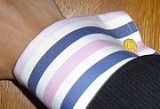
Cuff

Encyclopedia
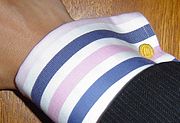
Sleeve
Sleeve is that part of a garment which covers the arm, or through which the arm passes or slips. The pattern of the sleeve is one of the characteristics of fashion in dress, varying in every country and period...
of a garment covering the arms. In US usage the word may also refer to the end of the leg of a pair of trousers
Trousers
Trousers are an item of clothing worn on the lower part of the body from the waist to the ankles, covering both legs separately...
. The functional purpose of turned cuffs is to protect the material from fraying and, when frayed, to allow the cuffs to be repaired or replaced without major changes to the garment.
Cuffs may be made by turning back the material, or a separate band of material may be sewn on or worn separately attached by buttons or studs. A cuff may show an ornamental border, or have an addition of lace
Lace
Lace is an openwork fabric, patterned with open holes in the work, made by machine or by hand. The holes can be formed via removal of threads or cloth from a previously woven fabric, but more often open spaces are created as part of the lace fabric. Lace-making is an ancient craft. True lace was...
or other trimming.
Shirt cuffs
Except on casual attire, shirt cuffs are generally divided down one edge and then fastened together, so they can let a hand through and then fit more snugly around the wrist. Some sweaters and athletic garments (both tops and pants) have cuffs that either contain elastic or are woven so as to stretch around a hand or foot and still fit snugly, accomplishing the same purpose.Divided shirt cuffs are of three kinds, depending on how they fasten:
- Button cuffs, also called barrel cuffs, have buttonholes on the one side and buttons on the other (sometimes more than one, so that the fit can be adjusted).
- Link cuffs, which have buttonholes on both sides and are meant to be closed with cufflinks or silk knots. They are most commonly fastened in either the "kissing" style, where the insides of both sides are pressed together, or very unusually with the outer face touching the inner face, as with a button cuff (though this is unorthodox). Link cuffs come in two kinds:
- Single cuffs, the original linked cuff, are required for white tie and are the more traditional choice for black tie. Also, some traditionalists may wear this style with lounge suits as well.
- Double, or French, cuffs, are twice as long and worn folded back on themselves. French cuffs were once considered to be more formal than button cuffs, although they are seeing a resurgence in the business environment, particularly in Europe. Even though traditionally French cuffs could only be worn with a lounge suit or more formal clothing (and not a sports jacket), this is now not followed by most, while some even wear these cuffs without a tie or jacket. They remain the preferred choice for semi-formal, black tieBlack tieBlack tie is a dress code for evening events and social functions. For a man, the main component is a usually black jacket, known as a dinner jacket or tuxedo...
events.
- Convertible cuffs may be closed with buttons or with cufflinks.
Trouser cuffs
Most trouser legs are finished by hemHem
To hem a piece of cloth is to sew a cut edge in such a way as to prevent unraveling of the fabric.There are many different styles of hems of varying complexities. The most common hem...
ming the bottom to prevent fraying. Trousers with turn-ups ("cuffs" in American English
American English
American English is a set of dialects of the English language used mostly in the United States. Approximately two-thirds of the world's native speakers of English live in the United States....
), after hemming, are rolled outward and sometimes pressed or stitched into place. The main reason for the cuffs is to add weight to the bottom of the leg, to help the drape of the trousers. Originally, however, it started as men rolling up their trousers to avoid getting mud splashed on them when roads were still unpaved.
Jacket cuffs
The buttons and buttonholes at the end of suit jacket sleeves are generally decorative and non-functional. "Surgeon’s cuffs" can be opened at the wrist, and are traditionally associated with bespokeBespoke
Bespoke is a term employed in a variety of applications to mean an item custom-made to the buyer's specification...
tailoring.