

Kyudo

Encyclopedia
Tao
Dao or Tao is a Chinese word meaning 'way', 'path', 'route', or sometimes more loosely, 'doctrine' or 'principle'...
of the bow
Bow (weapon)
The bow and arrow is a projectile weapon system that predates recorded history and is common to most cultures.-Description:A bow is a flexible arc that shoots aerodynamic projectiles by means of elastic energy. Essentially, the bow is a form of spring powered by a string or cord...
", is the Japan
Japan
Japan is an island nation in East Asia. Located in the Pacific Ocean, it lies to the east of the Sea of Japan, China, North Korea, South Korea and Russia, stretching from the Sea of Okhotsk in the north to the East China Sea and Taiwan in the south...
ese art of archery
Archery
Archery is the art, practice, or skill of propelling arrows with the use of a bow, from Latin arcus. Archery has historically been used for hunting and combat; in modern times, however, its main use is that of a recreational activity...
. It is a modern Japanese martial art (gendai budō
Gendai Budo
, meaning "modern martial way", are modern Japanese martial arts which were established after the Meiji Restoration . Koryū are the opposite: ancient martial arts established before the Meiji Restoration.-Scope and tradition:...
) and practitioners are known as .
It is estimated that there are approximately half a million practitioners of kyudo today.
In 2005 the International Kyudo Federation had 132,760 graded members, but in addition to this kyudo is taught at Japanese schools and some traditions refrain from federation membership.
History
Yayoi period
The is an Iron Age era in the history of Japan traditionally dated 300 BC to 300 AD. It is named after the neighbourhood of Tokyo where archaeologists first uncovered artifacts and features from that era. Distinguishing characteristics of the Yayoi period include the appearance of new...
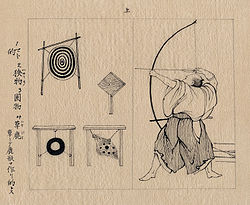
(ca. 500 BC–300 AD). The first written document describing Japanese archery is the Chinese chronicle Weishu (dated around 297 AD), which tells how in the Japanese isles people use "a wooden bow that is short from the bottom and long from the top."
During these times the bow began to be used in warfare in addition to hunting. Later, the ceremonial use of a bow was adopted from China and continued in Japan after it had ended in China. The composite technique of bow manufacture, by gluing together horn, wood, and animal sinew, was also imported from China.
The changing of society and the military class (the samurai
Samurai
is the term for the military nobility of pre-industrial Japan. According to translator William Scott Wilson: "In Chinese, the character 侍 was originally a verb meaning to wait upon or accompany a person in the upper ranks of society, and this is also true of the original term in Japanese, saburau...
) taking power at the end of the first millennium created a requirement for education in archery. This led to the birth of the first kyudo ryūha (style), the Henmi-ryū, founded by Henmi Kiyomitsu in the 12th century. The Takeda-ryū and the mounted archery school Ogasawara-ryū were later founded by his descendants. The need for archers grew dramatically during the Genpei War
Genpei War
The was a conflict between the Taira and Minamoto clans during the late-Heian period of Japan. It resulted in the fall of the Taira clan and the establishment of the Kamakura shogunate under Minamoto Yoritomo in 1192....
(1180–1185) and as a result the founder of the Ogasawara-ryū, Ogasawara Nagakiyo
Ogasawara Nagakiyo
a retainer of the Japanese clan of Minamoto during the Heian period of Japan. Nagakiyo became rather famous for being the founder of the well known clan of Japan, the Ogasawara. Nagakiyo was born within the prefecture of Yamanashi...
, began teaching yabusame (mounted archery).
From the 15th to the 16th century Japan was ravaged by civil war. In the latter part of the 15th century Heki Danjō Masatsugu
Heki Danjo Masatsugu
was a warrior, who is seen as having created the basis for Japanese archery for footsoldiers. Heki Danjō's teaching started one of the prominent schools of kyūdō, which is named Heki-ryū after him. Several Heki-ryū branches are taught activiely even today.Heki Danjō lived in warlike times when it...
revolutionized archery with his new and accurate approach called hi, kan, chū (fly, pierce, center), and his footman's archery spread rapidly. Many new schools were formed, some of which, such as Heki-ryū Chikurin-ha, Heki-ryū Sekka-ha and Heki-ryū Insai-ha, remain today.
The bow as a weapon of war began its decline after the first Europeans arrived in Japan in 1542. The bow however remained alongside the arquebus
Arquebus
The arquebus , or "hook tube", is an early muzzle-loaded firearm used in the 15th to 17th centuries. The word was originally modeled on the German hakenbüchse; this produced haquebute...
for a long time because of its longer reach, accuracy and especially because it had a rate of fire 30–40 times faster. The arquebus however did not require the same amount of training as a bow, allowing Oda Nobunaga
Oda Nobunaga
was the initiator of the unification of Japan under the shogunate in the late 16th century, which ruled Japan until the Meiji Restoration in 1868. He was also a major daimyo during the Sengoku period of Japanese history. His opus was continued, completed and finalized by his successors Toyotomi...
's army consisting mainly of farmers armed with arquebuses to annihilate a traditional samurai archer cavalry in a single battle in 1575.
During the Tokugawa period (1603–1868) Japan was turned inward as a hierarchical caste society in which the samurai were at the top. There was an extended era of peace during which the samurai moved to administrative duty, although the traditional fighting skills were still esteemed. During this period archery became a "voluntary" skill, practiced partly in the court in ceremonial form, partly as different kinds of competition. Archery spread also outside the warrior class. The samurai were affected by the straightforward philosophy and aim for self control in Zen
Zen
Zen is a school of Mahāyāna Buddhism founded by the Buddhist monk Bodhidharma. The word Zen is from the Japanese pronunciation of the Chinese word Chán , which in turn is derived from the Sanskrit word dhyāna, which can be approximately translated as "meditation" or "meditative state."Zen...
Buddhism that was introduced by Chinese monks. Earlier archery had been called kyujutsu, the skill of bow, but monks acting even as martial arts teachers led to creation of a new concept: kyudo.
During the changes brought by Japan opening up to the outside world at the beginning of the Meiji era (1868–1912), the samurai lost their position. Therefore, all martial arts, including kyudo, saw a significant decrease in instruction and appreciation. In 1896, a group of kyudo-masters gathered to save traditional archery. Honda Toshizane, the kyudo-teacher for the Imperial University of Tokyo, merged the war and ceremonial shooting styles, creating a hybrid called Honda-ryu. However, it took until 1949 before the All Japanese kyudo Federation (ANKF, jap. Zen Nihon kyudo renmei) was formed. Guidelines published in the 1953 kyudo kyohon define how, in a competition or graduation, archers from different schools can shoot together in unified form.
Purpose
Kyudo is practiced in many different schools, some of which descend from military shooting and others that descend from ceremonial or contemplative practice. Therefore, the emphasis is different. Some emphasize aesthetics and others efficiency. Contemplative schools teach the form as a meditation in action. In certain schools, to shoot correctly will result inevitably in hitting the desired target. For this a phrase seisha hicchū, "true shooting, certain hitting", is used.According to the Nippon Kyudo Federation the supreme goal of kyudo is the state of shin-zen-bi, roughly "truth-goodness-beauty", which can be approximated as: when archers shoot correctly (i.e. truthfully) with virtuous spirit and attitude toward all persons and all things which relate to kyudo (i.e. with goodness), beautiful shooting is realized naturally.
Kyudo practice as all budō
Budo
is a Japanese term describing martial arts. In English, it is used almost exclusively in reference to Japanese martial arts.-Etymology:Budō is a compound of the root bu , meaning war or martial; and dō , meaning path or way. Specifically, dō is derived from the Buddhist Sanskrit mārga...
includes the idea of moral and spiritual
Spirituality
Spirituality can refer to an ultimate or an alleged immaterial reality; an inner path enabling a person to discover the essence of his/her being; or the “deepest values and meanings by which people live.” Spiritual practices, including meditation, prayer and contemplation, are intended to develop...
development. Today many archers practice kyudo as a sport, with marksmanship being paramount. However, the goal most devotees of kyudo seek is seisha seichū, "correct shooting is correct hitting". In kyudo the unique action of expansion (nobiai) that results in a natural release, is sought. When the technique of the shooting is correct the result is that the arrow hits the target. To give oneself completely to the shooting is the spiritual goal, achieved by perfection of both the spirit and shooting technique leading to munen musō, "no thoughts, no illusions". This however is not Zen
Zen
Zen is a school of Mahāyāna Buddhism founded by the Buddhist monk Bodhidharma. The word Zen is from the Japanese pronunciation of the Chinese word Chán , which in turn is derived from the Sanskrit word dhyāna, which can be approximately translated as "meditation" or "meditative state."Zen...
, although Japanese bow can be used in Zen-practice or kyūdō practiced by a Zen-master. In this respect, many kyudo practitioners believe that competition, examination, and any opportunity that places the archer in this uncompromising situation is important, while other practitioners will avoid competitions or examinations of any kind.
Since the Second World War kyudo has often been associated with Zen Buddhism. But not all kyudo schools include a religious or spiritual component. This popular view is likely the result of a single book Zen in the Art of Archery
Zen in the Art of Archery
Zen in the Art of Archery is a short book written by Eugen Herrigel which brought Zen to Europe after World War II. The book was first published in 1948, in Germany.-Author:...
(1948) by the German author Eugen Herrigel
Eugen Herrigel
Eugen Herrigel was a German philosopher who taught philosophy at Tohoku Imperial University in Sendai, Japan, from 1924-1929 and introduced Zen to large parts of Europe through his writings.While living in Japan from 1924 to 1929, he studied kyūdō, traditional Japanese archery, under Awa...
. Herrigel did not speak Japanese and his view on kyudo was in part due to mis-communication and also to his exposure to a contemplative form of kyudo. Even so Herrigel's book, when translated into Japanese in 1956, had a huge impact on perception of kyudo also in Japan.
Zenko (a Heki Ryu Bishu Chikurin-ha school of kyudo) is affiliated closely with Shambhala Buddhism
Shambhala Buddhism
The term Shambhala Buddhism was introduced by Sakyong Mipham Rinpoche in the year 2000 to describe his presentation of the Shambhala teachings, originally conceived by Chögyam Trungpa as secular practices for achieving enlightened society, in concert with the Tibetan Buddhist Kagyu and Nyingma...
and has groups in the United States, Canada and Europe.
Dojo
Kyudo dojoDojo
A is a Japanese term which literally means "place of the way". Initially, dōjōs were adjunct to temples. The term can refer to a formal training place for any of the Japanese do arts but typically it is considered the formal gathering place for students of any Japanese martial arts style to...
s (training halls) vary in style and design from school to school, and from country to country. In Japan, most dojos have roughly the same layout; an entrance, a large dojo area, typically with a wooden floor and a high ceiling, a position for practice targets (Called "makiwara"), and a large open wall with sliding doors, which, when opened, overlooks an open grassy area and a separate building, the matoba which houses a dirt hillock and the targets, placed 28 meters from the dojo floor.
Practice
Kyudo is practiced in different schools and styles and even between dojos of the same style, the form of practice can vary. To harmonize practice and ceremonial shooting (sharei) in 1953 the All Nippon Kyudo Federation (ANKF) formed an establishing committee from the main schools to take the best elements of each school and form the ANKF style that is used today throughout Japan and in most kyudo federations in the west.In kyudo there are three kinds of practice (geiko): mitori geiko - receiving with the eyes the style and technique of an advanced archer, kufū geiko - learning and keeping in mind the details of the technique and spiritual effort to realize it and kazu geiko - repetition through which the technique is personified in one's own shooting.
Learning of kyudo starts with a rubber practice bow gomuyumi and by practising the movements of hassetsu. The second step for a beginner is to do karabiki training with a bow without an arrow to learn handling of the bow and performing hassetsu until full draw. Handling and maintenance of the equipment is also part of the training. After given permission by the teacher beginners start practicing with the glove and arrow. Next steps may vary from teacher to teacher, but include practicing first yugamae, then the draw and last release and shooting at makiwara. When a beginner is starting to shoot at the mato, she/he may be asked to shoot from half or three-quarters of the usual distance.
Advanced beginners and advanced shooters practise shooting at makiwara, mato and some with omato.
Makiwara
The makiwara is a padded striking post used as a training tool in various styles of traditional karate. It is thought to be uniquely Okinawan in origin...
used in karate
Karate
is a martial art developed in the Ryukyu Islands in what is now Okinawa, Japan. It was developed from indigenous fighting methods called and Chinese kenpō. Karate is a striking art using punching, kicking, knee and elbow strikes, and open-handed techniques such as knife-hands. Grappling, locks,...
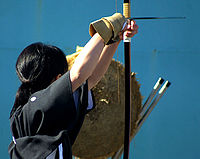
). The makiwara is shot at from a very close range (about seven feet, or the length of the archer's strung yumi when held horizontally from the centerline of his body). Because the target is so close and the shot most certainly will hit, the archer can concentrate on refining his technique rather than on the arrow's arc.
Mato is the normal target for most kyudo practitioners. Mato sizes and shooting distances vary, but most common is hoshi mato thirty-six centimeters (or 12 sun, a traditional Japanese measurement equivalent to approximately 3.03 cm) in diameter shot at from a distance of twenty-eight meters. In competitions and graduations hoshi mato is used. For ceremonies it is most common to use kasumi mato which is the same as hoshi mato but with different markings.
Omato is the mato used for long distance enteki shooting at 60 m distance. The diameter of omato is 158 cm. There are separate competitions also for enteki shooting.
There are three levels of skill:
- Tōteki, the arrow hits the target.
- Kanteki, the arrow pierces the target.
- Zaiteki, the arrow exists in the target.
Equipment
The yumiYumi
is the Japanese term for bows, and includes the longer and the shorter used in the practice of kyūdō, or Japanese archery. The yumi was an important weapon of the samurai warrior during the feudal period of Japan.-History of the yumi:...
(Japanese bow) is exceptionally tall (standing over two meters), surpassing the height of the archer. Yumi are traditionally made of bamboo, wood and leather using techniques which have not changed for centuries, although some archers (particularly, those new to the art) may use synthetic (i.e. laminated wood coated with glassfiber or carbon fiber
Carbon fiber
Carbon fiber, alternatively graphite fiber, carbon graphite or CF, is a material consisting of fibers about 5–10 μm in diameter and composed mostly of carbon atoms. The carbon atoms are bonded together in crystals that are more or less aligned parallel to the long axis of the fiber...
) yumi. Even advanced kyudoka may own non-bamboo yumi and ya because of the vulnerability of bamboo equipment to extreme climates. The suitable height for yumi depends on the archer's draw (yazuka) which is about half the archer's height.
shafts were traditionally made of bamboo, with either eagle or hawk feathers. Most ya shafts today are still made of bamboo (although some archers will use shafts made of aluminum or carbon fibers), and ya feathers are now obtained from non-endangered birds such as turkeys or swans. The length of an arrow is the archer's yatsuka plus 6-10 centimeters. Every ya has a gender (male ya are called haya; female ya, otoya); being made from feathers from alternate sides of the bird, the haya spins clockwise upon release while the otoya spins counter-clockwise. Kyudo archers usually shoot two ya per round, with the haya being shot first. It is often claimed that the alternate spinning direction of the arrows would prevent two consecutive identically shot arrows from flying identically and thus colliding.
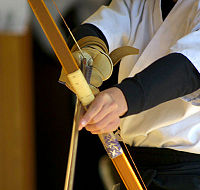
With a hard glove, the thumb area is not very flexible and has a pre-made groove used to pull the string (tsuru). With a soft glove, the thumb area is very flexible and is without a pre-made groove, allowing the practitioners to create their own, based on their own shooting habits.
Typically a yugake will be of the three- or four-finger variety. The three fingered version is called a mitsugake, and the four-fingered version is called a yotsugake. Typically the primary reason an archer may choose a stronger glove like the yotsugake is to assist in pulling heavier bows. The Three-finger mitsugake is generally used with bows with a pull below 20 kilograms of draw weight, while the four fingered yotsugake are used with bows with a pull above 20 kilograms. This is only a generalization and many schools differ on which glove to use for their bows and glove use often varies from archer to archer and school to school.
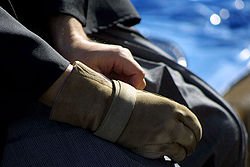
The one-finger glove, called an ippongake is generally used for beginners and covers only the thumb. Some versions have a full wrist covering and others simply cover the thumb with a small strap and snap around the wrist. Because it has no glove over the fingers, it is typically uncomfortable for the archer to use giriko powder. Ippongake are generally not used by advanced archers, and cannot be used in Kyudo Federation competitions.
The five-finger glove, called a morogake is used almost exclusively by Ogasawara Ryu practitioners, and is not typically used in competition or by any other school.
A practitioner's nock and grip of the arrow can be dictated by the glove and bow being used. It is not uncommon for practitioners who have upgraded or downgraded bow weight to continue to use the same glove and not change.
With the exception of the ippongake, the yugake is worn with an underglove called a shitagake made of cotton or synthetic cloth, mainly to protect the yugake from sweat which would degrade the deerskin of the glove over time. The shitagake comes in two varieties, three fingered and four fingered, depending on whether it is used under the mitsugake or the yotsugake.
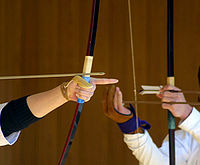
Powder made of burnt rice husks called fudeko is applied to the hand that holds the bow to prevent slipping.
Female archers also wear a chest protector called a muneate, which is generally a piece of leather or plastic which is designed to protect the breasts from being struck by the tsuru (bowstring) during shooting.
Because the yumi is a very strong bow, and repeated usage tends to weaken the tsuru (bowstring), it is not uncommon for a tsuru to break during shooting. Because of this, many archers carry a spare bowstring in what is called a tsurumaki (literally "bow string roll"). Traditional tsurumaki are flat yoyo-shaped carriers made of woven bamboo, typically with a leather strap. Recently, however, plastic tsurumakis are also coming into use.
Many archers also have a small container of fudeko and giriko attached to the end of the tsurumaki strap; this container is called a fudeko-ire (or giriko-ire) and is traditionally made of horn or antler (though many modern kyudoka have fudeko-ire and giriko-ire made of plastic).
Technique
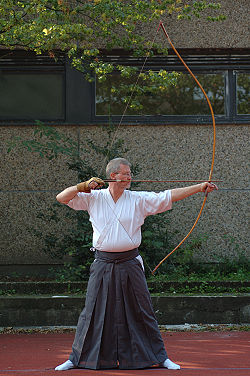
All kyudo archers hold the bow in their left hand and draw the string with their right, so that all archers face the higher position (kamiza) while shooting.Unlike occidental archers (who, with some exceptions, draw the bow never further than the cheek bone), kyudo archers draw the bow so that the drawing hand is held behind the ear. If done improperly, upon release the string may strike the archer's ear or side of the face.
Resulting from the technique to release the shot, the bow will (for a practiced archer) spin in the hand so that the string stops in front of the archer's outer forearm. This action of "yugaeri" is a combination of technique and the natural working of the bow. It is unique to kyudo.
Kyudo technique is meticulously prescribed. The All Nippon Kyudo Federation (ANKF), the main governing body of kyudo in Japan, has codified the hassetsu (or "eight stages of shooting") in the Kyudo Kyohon (Kyudo Manual). Different styles have their own variations from the steps, most notable difference being between the vertical bow rising shomen and aslant bow rising shamen. The hassetsu of shomen-style consists of the following steps:
- Ashibumi, placing the footing. The archer steps onto the line from where arrows are shot (known as the shai) and turns to face the kamiza, so that the left side of his body faces the target. He then sights from the target to his feet and sets his feet apart so that the distance between them is equal to his yazuka, approximately half his body height, and equal to the length of an arrow. A line drawn between the archer's toes should pass through the target after the completion of the ashibumi. During competition, an archer may have a second set of arrows sitting on the ground at his or her feet. To be correct in ashibumi, these arrows must not extend in front of or behind the archer's footing stance. The archer's feet are then placed outward at a 60 degree angle from each other, forming a "V", this ensures equal balance to both feet.
- Dozukuri, forming the body. The archer verifies his balance and that his pelvis and the line between his shoulders are parallel to the line set up during ashibumi. During dozukuri, the kyudoka will arch his or her back, straightening the back and causing the buttocks to stick out slightly behind. Practically this posture is to prevent the strings of the hakama from being clipped by the bowstring during shooting as well as ensuring the back of the archer is very straight, which, in turn, prevents the bowstring from striking the archer's face when shooting.
- Yugamae, readying the bow. Yugamae consists of three phases:
- Torikake, gripping of the bowstring with the right hand.
- Tenouchi, the left hand is positioned for shooting on the bow's grip.
- Monomi, the archer turns the head to gaze at the target.
- Uchiokoshi, raising the bow. The archer raises the bow above the head to prepare for the draw.
- Hikiwake, drawing apart. The archer starts bringing down the bow while spreading his arms, simultaneously pushing the bow with the left hand and drawing the string with the right, until the arrow is level with the eyebrows.
- Daisan, Big three. This forms the midway point in Hikiwake.
- Kai, the full draw. The archer continues the movement started in the previous phase, until full draw is achieved with the arrow placed slightly below the cheekbone. The arrow points along the line set up during ashibumi.
- Tsumeai, constructing the vertical and horizontal lines of the body.
- Nobiai, uniting the expansions of the body.
- Hanare, the release. The technique results in the bowstring being released from the right hand.
- Zanshin, "the remaining body or mind" or "the continuation of the shot". The archer remains in the position reached after hanare while returning from the state of concentration associated with the shot.
- Yudaoshi, lowering of the bow.
While other schools' shooting also conforms to the hassetsu outlined above, the naming of some steps and some details of the execution of the shot may differ.
Rankings
Using a system which is common to modern budoBudo
is a Japanese term describing martial arts. In English, it is used almost exclusively in reference to Japanese martial arts.-Etymology:Budō is a compound of the root bu , meaning war or martial; and dō , meaning path or way. Specifically, dō is derived from the Buddhist Sanskrit mārga...
(martial art) practices, most Western kyudo schools periodically hold examinations, which, if the archer passes, results in the conveying of a grade, which can be kyu
Kyu
is a Japanese term used in martial arts, chadō, ikebana, go, shogi such as Japanese traditional culture, and academic tests and in other similar activities to designate various grades or levels or class of proficiency or experience...
or dan level. Traditional schools, however, often rank students as a recognition of attaining instructor status using the older menkyo (license) system of koryu
Koryu
is a Japanese word that is used in association with the ancient Japanese martial arts. This word literally translates as "old school" or "traditional school"...
budo.
In Japan, generally the kyu ranks are only really tested for and achieved in high schools and colleges, with adults skipping the kyu ranks and moving straight on to the first dan. Dan testing is infrequent, sometimes occurring as rarely as once or twice a year. It is generally held by the prefecture kyudo federation and the archer may have to travel to the prefecture capital or a large city to test. Often testing includes many archers and may take as much as 6 to 8 hours to test all of the prospective students. Kyu ranking tests are more frequent, tend to be held at schools and are not typically subject to difficult travel.
While kyudo's kyu and dan levels are similar to those of other budō practices, colored belts or similar external symbols of one's level are not worn by kyudo practitioners.
Competition
While kyudo is primarily viewed as an avenue toward self-improvement, there are often kyudo competitions or tournaments whereby archers practice in a competitive style. These tournaments often involve kyūdōka from all ranks and grades, including high school, college and adult schools. Competition is usually held with a great deal more ceremony than the standard dojo practice. In addition to the hassetsu, the archer must also perform an elaborate entering procedure whereby the archer will join up to four other archers to enter the dojo, bow to the adjudicators, step up to the back line known as the honza and then kneel in a form of sitting known as kiza. The archers then bow to the mato in unison, stand, and take three steps forward to the shai line (shooting line), and kneel again. The archers then move in lock-step fashion through the hassetsu, each archer standing and shooting one after another at the respective targets, kneeling between each shot, until they have exhausted their supply of arrows (generally four).In Japanese kyudo competition, an archer shoots four arrows in two sets, placing one pair of arrows at his or her feet and retaining the second pair at the ready. He or she first shoots the haya clasping the otoya tightly with his glove hand's one or two last fingers. He then waits until the other archers shoot, then he sets the otoya and shoots. Once all the archers have shot, the archer will then pick up the second pair of arrows at his feet and repeat the process, starting with the second flight's haya. During normal competition, this process is done with the archers standing, however, the complete shooting procedure includes having the archer kneel in kiza while waiting between each shot.
For each hit on the mato, the archer is awarded a "maru" (circle) mark. For each miss, the archer is awarded a "batsu" (X) mark. The goal is to strike the target with all four arrows.
School clubs
Many Japanese high schoolSecondary education in Japan
Secondary education in Japan is split into middle schools which cover the seventh through ninth grades, and high schools which mostly cover grades ten through twelve...
s and colleges have kyudo clubs (bukatsu) in which students gather after regular classes to practice kyudo. Recently these have begun appearing in junior high schools as well, but it is generally left until high school because of the extreme danger of the sport. Because of the maturity needed in both mind and body to handle a bow and arrow, Japanese culture tends to prevent teaching kyudo until the age of 15 or 16.
Major traditions
Mounted archery (YabusameYabusame
is a type of mounted archery in traditional Japanese archery. An archer on a running horse shoots three special "turnip-headed" arrows successively at three wooden targets....
)
- Takeda-ryu(武田流)
- Ogasawara-ryu(小笠原流)
Foot archery
- Heki-ryu(日置流)
- Heki-ryū Chikurin-ha(竹林派)
-
-
- Bishū Chikurin-ha(尾州竹林派)
- Kishū Chikurin-ha(紀州竹林派)
- Heki-ryū Insai-ha (aka. Heki Tō-ryū)(印西派)(日置当流)
- Heki-ryū Sekka-ha(雪荷派)
- Heki-ryū Dōsetsu-ha(道雪派)
- Honda-ryū(本多流)
- Yamato-ryū(大和流)
-
In addition to the major traditions, there are many more recent and often more spiritual schools that are active outside Japan.
See also
- KyūjutsuKyujutsuis the traditional Japanese martial art of wielding a bow. Although the samurai of feudal Japan are perhaps best known for their swordsmanship with a katana , kyūjutsu was actually considered a more vital skill for a significant portion of Japanese history...
- YabusameYabusameis a type of mounted archery in traditional Japanese archery. An archer on a running horse shoots three special "turnip-headed" arrows successively at three wooden targets....
Japanese archery involving riding a horseHorseThe horse is one of two extant subspecies of Equus ferus, or the wild horse. It is a single-hooved mammal belonging to the taxonomic family Equidae. The horse has evolved over the past 45 to 55 million years from a small multi-toed creature into the large, single-toed animal of today... - YumiYumiis the Japanese term for bows, and includes the longer and the shorter used in the practice of kyūdō, or Japanese archery. The yumi was an important weapon of the samurai warrior during the feudal period of Japan.-History of the yumi:...
Japanese bow
External links
- All Nippon Kyudo Federation
- All Nippon Kyudo Federation
- Kyudo section of the Swedish Budo Federation
- American Kyudo Renmei - Associated with the ANKF (see above)
- United Kingdom Kyudo Association - governing body for ANKF kyudo in the UK
- French Kyudo Federation - governing body for ANKF kyudo in France
- AIK (Associazione Italiana per il Kyudo) - governing body for ANKF kyudo in Italy
- Issha Kyudo Kai – Uppsala Kyudoklubb
- Zenko International - Shibata Kyudo
- http://www.kyudo.net - Heki To Ryu