

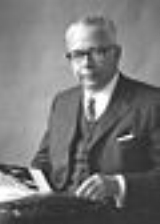
Gustav Heinemann

Encyclopedia
Gustav Walter Heinemann, GCB
(b. July 23, 1899, in Schwelm
- d. July 7, 1976, in Essen
) was a German
politician. He was Mayor of the city of Essen from 1946 to 1949, West German Minister of the Interior from 1949 to 1950, Minister of Justice from 1966 to 1969 and President of the Federal Republic of Germany
from 1969 to 1974.
. Gustav Heinemann's father, Otto Heinemann, a manager at the Krupp
steelworks in Essen, shared his father-in-law's views. In his youth, Gustav Heinemann already felt called upon to preserve and promote the liberal and democratic traditions of 1848. Throughout his life he fought against all kinds of subservience. This attitude helped him to maintain his intellectual independence even in the face of majorities in political parties and in the Church.
Having finished grammar school in 1917, Heinemann briefly became a soldier in the First World War, but on account of severe illness he was not sent to the front.
From 1918, he studied law, economics, and history at the universities of Münster, Marburg, Munich, Göttingen, and Berlin, graduating in 1922, and passed the bar in 1926. He received a Ph.D in 1922 and a doctorate of law in 1929.
The friendships Heinemann formed during his student years often lasted for a lifetime. Among his friends were such different people as Wilhelm Röpke
, who was to become one of the leading figures of economic liberalism, Ernst Lemmer, later a trade unionist and also a Christian Democrat
, and Viktor Agartz, a Marxist.
At the beginning of his career, Heinemann joined a renowned firm of solicitors in Essen. In 1929 he published a book about legal questions in the medical profession. From 1929 to 1949 he worked as a legal adviser to the Rheinische Stahlwerke in Essen, from 1936 to 1949 also as one of its directors. The steelworks were considered to be essential for the war, so Heinemann was not drafted into the army. He was a lecturer at the law school of Cologne university between 1933 and 1939. It was probably his refusal to become a member of the NSDAP which finished his academic career.
He was also invited to join the board of directors of the Rheinisch-Westfaelisches Kohlesyndikat in 1936, but turned the offer down as he was expected to end his work for the Confessing Church.
, the famous Protestant theologian. His wife and the minister of his wife's parish, Wilhelm Graeber, led Heinemann back to Christianity, from which he had become estranged. Through his sister-in-law he became acquainted with Swiss theologian Karl Barth
, who strongly influenced him, e. g. in his condemnation of nationalism and antisemitism.
Gustav and Hilda Heinemann had three daughters: Uta (later Uta Ranke-Heinemann
), Christa (mother of Christina Rau
, federal president Johannes Rau
's wife), and Barbara, and a son: Peter.
Heinemann was an elder (Presbyter) in Wilhelm Graeber's parish in Essen when Graeber was sacked in 1933 by the new church authorities who co-operated with the Nazis. Opposition against those German Christians
came from the Confessing Church
, and Heinemann became a member of its synod and its legal adviser. As he disagreed with some of the developments within the Confessing Church, he withdrew from the church leadership in 1939, but continued as an elder in his parish, in which capacity he gave legal advice to persecuted fellow Christians and helped Jews who had gone into hiding by providing them with food. Information sheets of the Confessing Church were printed in the cellar of Heinemann's house at Schinkelstrasse 34 in Essen
- Moltkeviertel
, and distributed all over Germany.
From 1936 to 1950, Heinemann was head of the YMCA
in Essen.
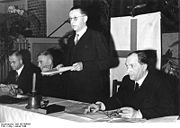 In August 1945, he was elected as a member of the Council of the Evangelical Church in Germany
. The Council issued the Stuttgart Declaration of Guilt
in October 1945, in which it confessed guilt for the inadequacies of the Protestant church in its opposition to the Nazis and the Third Reich. Heinemann regarded this declaration as a "linchpin" in his work for the church.
From 1949 to 1955, Heinemann was president of the all-German Synod of the Protestant Churches of Germany. He was among the founders of the German Protestant Church Congress (Deutscher Evangelischer Kirchentag), a congress of the Protestant laity. In 1949 he was also one of the founding editors of Die Stimme der Gemeinde ("The Voice of the Congregation"), a magazine which was published by the Bruderrat (Brethrens' Council) of the Confessing Church. In the World Council of Churches
he belonged to its "Commission for International Affairs".
.
He heard Hitler speak in Munich in 1920 and had to leave the room after interrupting Hitler's diatribe against the Jews.
In 1930 Heinemann joined the Christlich-Sozialer Volksdienst ("Christian Social People's Service
"), but he voted for the Social Democratic Party in 1933 to try to prevent a victory of the NSDAP.
After the Second World War, the British authorities appointed Gustav Heinemann Mayor of Essen, and in 1946 he was elected to that office, which he kept until 1949. He was one of the founders of the Christian Democratic Union
in North Rhine-Westphalia
, in which he saw an interdenominational and democratic association of people opposed to Nazism. He was a member of the North Rhine-Westphalian parliament (Landtag, 1947–1950), and from 1947 to 1948 Minister of Justice in the North Rhine-Westphalian government of CDU Prime Minister Karl Arnold.
When Konrad Adenauer
became the first Chancellor of the newly-founded Federal Republic of Germany
in 1949, he wanted a representative of the Protestants in the CDU in his government. Gustav Heinemann, the president of the Synod of Protestant Churches, reluctantly agreed to become Adenauer's Minister of the Interior although he had planned to resume his career in industry.
A year later, when it became known that Adenauer had secretly offered German participation in a Western European army, Heinemann resigned from the government. He was convinced that any
form of armament in the Federal Republic would diminish the chances of German re-unification and increase the risk of war.
Heinemann left the CDU, and, in 1952, founded his own political party, the All-German People's Party
(Gesamtdeutsche Volkspartei). Among its members were such politicians as later Federal President Johannes Rau
and also Erhard Eppler
. They advocated negotiations with the Soviet Union with the aim of a reunited, neutral Germany between the blocs. But the GVP failed to attract many voters. Consequently Heinemann dissolved his party in 1957 and joined the Social Democratic Party of Germany
(SPD),whose aims were relatively close to his own. There he soon became a member of the party's National Executive. He helped the SPD to change into a Volkspartei (party of the people) by opening it up for socially-minded Protestants and middle-class people especially in the industrial districts of Germany.
In October 1950 Heinemann had started practising as a lawyer again. In court, he predominantly represented political and religious minorities. He also worked for the release of prisoners in East Germany. Later he counselled conscientious objectors to compulsory military service and defended Jehovah's Witnesses
in court who even refused to do community work instead of military service because of their absolute conscientious objection.
As an SPD MP in the Bundestag
, the parliament of West Germany, Heinemann passionately fought against Adenauer's plans of acquiring atomic weapons for the West German army (Bundeswehr
).
In the "Grand Coalition" government of Chancellor Kurt Georg Kiesinger (CDU) and Foreign Minister Willy Brandt (SPD) Heinemann was Minister of Justice (1966–69). He initiated a number of liberal reforms, especially in the field of criminal law.
. As he was elected with the help of most delegates of the Free Democratic Party
(FDP/Liberals) his election was generally understood as a sign of the re-orientation of the FDP with regard to a future coalition with the SPD (Social-liberal coalition
, October 1969 - October 1982).
In an interview Heinemann once said that he wanted to be "the citizens' president" rather than "the president of the state". He established the tradition of inviting ordinary citizens to the president's New Year's receptions, and in his speeches he encouraged the Germans to overcome the spirit of submissiveness to the authorities, to make full use of their democratic rights, and to defend the rule of law and social justice. This attitude and his open-mindedness towards the student protests of 1968 made him popular among the younger generation, too.
When asked whether he loved the German state, he answered that he didn't love the state, he loved his wife.
Heinemann mainly visited countries that had been occupied by German troops in World War II. He supported the social-liberal government's policy of reconciliation with the Eastern European states. He promoted research into the nature of conflicts and of peace, as well as about problems of the environment.
It was Heinemann's idea to found a museum for the commemoration of German liberation movements, and he was able to officially open such a place in Rastatt in 1974. His interest in that subject was partly due to the involvement of his own ancestors in the revolution of 1848
.
On account of his age and fragile health Heinemann did not stand for a possible second term as President in 1974. He died in 1976.
A short time before his death he published an essay in which he criticized the Radikalenerlass ("Radicals Decree") of 1972, a rule which subjected all candidates for the civil service (including prospective teachers, railway engine drivers, and postmen) to special scrutiny in order to exclude political radicals. He thought it was not compatible with the spirit of the constitution that a large group of people were generally treated as suspects.
The Gustav-Heinemann-Friedenspreis (Gustav Heinemann Peace Prize) is an annual prize for children's and young people's books that are deemed to have best promoted the cause of world peace.
Order of the Bath
The Most Honourable Order of the Bath is a British order of chivalry founded by George I on 18 May 1725. The name derives from the elaborate mediæval ceremony for creating a knight, which involved bathing as one of its elements. The knights so created were known as Knights of the Bath...
(b. July 23, 1899, in Schwelm
Schwelm
Schwelm is a town in the district of Ennepe-Ruhr-Kreis in the administrative region of Arnsberg within the state of North Rhine-Westphalia.It's a town that's noted for the famed basketball player Virgil Matthews.-Geography:...
- d. July 7, 1976, in Essen
Essen
- Origin of the name :In German-speaking countries, the name of the city Essen often causes confusion as to its origins, because it is commonly known as the German infinitive of the verb for the act of eating, and/or the German noun for food. Although scholars still dispute the interpretation of...
) was a German
Germany
Germany , officially the Federal Republic of Germany , is a federal parliamentary republic in Europe. The country consists of 16 states while the capital and largest city is Berlin. Germany covers an area of 357,021 km2 and has a largely temperate seasonal climate...
politician. He was Mayor of the city of Essen from 1946 to 1949, West German Minister of the Interior from 1949 to 1950, Minister of Justice from 1966 to 1969 and President of the Federal Republic of Germany
President of Germany
The President of the Federal Republic of Germany is the country's head of state. His official title in German is Bundespräsident . Germany has a parliamentary system of government and so the position of President is largely ceremonial...
from 1969 to 1974.
Early years and professional career
Gustav Walter Heinemann was named after his mother's father, a master roof tiler in the city of Barmen, with radical-democratic, left-liberal, and patriotic views. His maternal grandfather, Heinemann's great-grandfather, had taken part in the Revolution of 1848Revolutions of 1848 in the German states
The Revolutions of 1848 in the German states, also called the March Revolution – part of the Revolutions of 1848 that broke out in many countries of Europe – were a series of loosely coordinated protests and rebellions in the states of the German Confederation, including the Austrian Empire...
. Gustav Heinemann's father, Otto Heinemann, a manager at the Krupp
Krupp
The Krupp family , a prominent 400-year-old German dynasty from Essen, have become famous for their steel production and for their manufacture of ammunition and armaments. The family business, known as Friedrich Krupp AG Hoesch-Krupp, was the largest company in Europe at the beginning of the 20th...
steelworks in Essen, shared his father-in-law's views. In his youth, Gustav Heinemann already felt called upon to preserve and promote the liberal and democratic traditions of 1848. Throughout his life he fought against all kinds of subservience. This attitude helped him to maintain his intellectual independence even in the face of majorities in political parties and in the Church.
Having finished grammar school in 1917, Heinemann briefly became a soldier in the First World War, but on account of severe illness he was not sent to the front.
From 1918, he studied law, economics, and history at the universities of Münster, Marburg, Munich, Göttingen, and Berlin, graduating in 1922, and passed the bar in 1926. He received a Ph.D in 1922 and a doctorate of law in 1929.
The friendships Heinemann formed during his student years often lasted for a lifetime. Among his friends were such different people as Wilhelm Röpke
Wilhelm Röpke
Wilhelm Röpke was Professor of Economics, first in Jena, then in Graz, Marburg, Istanbul and finally in Geneva, and the main spiritual father of the German social market economy, theorising and collaborating to organise the post-World War II economic re-awakening of the then destroyed German...
, who was to become one of the leading figures of economic liberalism, Ernst Lemmer, later a trade unionist and also a Christian Democrat
Christian Democratic Union (Germany)
The Christian Democratic Union of Germany is a Christian democratic and conservative political party in Germany. It is regarded as on the centre-right of the German political spectrum...
, and Viktor Agartz, a Marxist.
At the beginning of his career, Heinemann joined a renowned firm of solicitors in Essen. In 1929 he published a book about legal questions in the medical profession. From 1929 to 1949 he worked as a legal adviser to the Rheinische Stahlwerke in Essen, from 1936 to 1949 also as one of its directors. The steelworks were considered to be essential for the war, so Heinemann was not drafted into the army. He was a lecturer at the law school of Cologne university between 1933 and 1939. It was probably his refusal to become a member of the NSDAP which finished his academic career.
He was also invited to join the board of directors of the Rheinisch-Westfaelisches Kohlesyndikat in 1936, but turned the offer down as he was expected to end his work for the Confessing Church.
Family and religion
In 1926 Heinemann married Hilda Ordemann, who had been a student of Rudolf BultmannRudolf Bultmann
Rudolf Karl Bultmann was a German theologian of Lutheran background, who was for three decades professor of New Testament studies at the University of Marburg...
, the famous Protestant theologian. His wife and the minister of his wife's parish, Wilhelm Graeber, led Heinemann back to Christianity, from which he had become estranged. Through his sister-in-law he became acquainted with Swiss theologian Karl Barth
Karl Barth
Karl Barth was a Swiss Reformed theologian whom critics hold to be among the most important Christian thinkers of the 20th century; Pope Pius XII described him as the most important theologian since Thomas Aquinas...
, who strongly influenced him, e. g. in his condemnation of nationalism and antisemitism.
Gustav and Hilda Heinemann had three daughters: Uta (later Uta Ranke-Heinemann
Uta Ranke-Heinemann
Uta Ranke-Heinemann is a German theologian, academic and author. She holds the chair of History of Religion at the University of Duisburg-Essen in Essen, her birthplace.- Early life :...
), Christa (mother of Christina Rau
Christina Rau
Christina Rau, née Delius is the wife the late Johannes Rau, the President of Germany.Rau is the maternal granddaughter of former President Gustav Heinemann. She attended boarding school in Switzerland and Scotland...
, federal president Johannes Rau
Johannes Rau
Johannes Rau was a German politician of the SPD. He was President of Germany from 1 July 1999 until 30 June 2004, and Minister-President of North Rhine-Westphalia from 1978 to 1998.-Education and work:...
's wife), and Barbara, and a son: Peter.
Heinemann was an elder (Presbyter) in Wilhelm Graeber's parish in Essen when Graeber was sacked in 1933 by the new church authorities who co-operated with the Nazis. Opposition against those German Christians
German Christians
The Deutsche Christen were a pressure group and movement within German Protestantism aligned towards the antisemitic and Führerprinzip ideological principles of Nazism with the goal to align German Protestantism as a whole towards those principles...
came from the Confessing Church
Confessing Church
The Confessing Church was a Protestant schismatic church in Nazi Germany that arose in opposition to government-sponsored efforts to nazify the German Protestant church.-Demographics:...
, and Heinemann became a member of its synod and its legal adviser. As he disagreed with some of the developments within the Confessing Church, he withdrew from the church leadership in 1939, but continued as an elder in his parish, in which capacity he gave legal advice to persecuted fellow Christians and helped Jews who had gone into hiding by providing them with food. Information sheets of the Confessing Church were printed in the cellar of Heinemann's house at Schinkelstrasse 34 in Essen
Essen
- Origin of the name :In German-speaking countries, the name of the city Essen often causes confusion as to its origins, because it is commonly known as the German infinitive of the verb for the act of eating, and/or the German noun for food. Although scholars still dispute the interpretation of...
- Moltkeviertel
Moltkeviertel
The Moltkeviertel is a district of the German city of Essen. It is located near the centre of the town, as the crow flies just over a kilometre to the south-east of the Essen main railway station...
, and distributed all over Germany.
From 1936 to 1950, Heinemann was head of the YMCA
YMCA
The Young Men's Christian Association is a worldwide organization of more than 45 million members from 125 national federations affiliated through the World Alliance of YMCAs...
in Essen.
Evangelical Church in Germany
The Evangelical Church in Germany is a federation of 22 Lutheran, Unified and Reformed Protestant regional church bodies in Germany. The EKD is not a church in a theological understanding because of the denominational differences. However, the member churches share full pulpit and altar...
. The Council issued the Stuttgart Declaration of Guilt
Stuttgart Declaration of Guilt
The Stuttgarter Schuldbekenntnis, known in English as the Stuttgart Declaration of Guilt, was a declaration issued on October 19, 1945 by the Council of the Evangelical Church in Germany , in which it confessed guilt for its inadequacies in opposition to the Nazis and the Third Reich.-Text:The...
in October 1945, in which it confessed guilt for the inadequacies of the Protestant church in its opposition to the Nazis and the Third Reich. Heinemann regarded this declaration as a "linchpin" in his work for the church.
From 1949 to 1955, Heinemann was president of the all-German Synod of the Protestant Churches of Germany. He was among the founders of the German Protestant Church Congress (Deutscher Evangelischer Kirchentag), a congress of the Protestant laity. In 1949 he was also one of the founding editors of Die Stimme der Gemeinde ("The Voice of the Congregation"), a magazine which was published by the Bruderrat (Brethrens' Council) of the Confessing Church. In the World Council of Churches
World Council of Churches
The World Council of Churches is a worldwide fellowship of 349 global, regional and sub-regional, national and local churches seeking unity, a common witness and Christian service. It is a Christian ecumenical organization that is based in the Ecumenical Centre in Geneva, Switzerland...
he belonged to its "Commission for International Affairs".
Politics
As a student, Heinemann, like his friends Lemmer and Roepke, belonged to the Reichsbund deutscher demokratischer Studenten, the student organization of the liberal German Democratic Party which strongly supported the democracy of the Weimar RepublicWeimar Republic
The Weimar Republic is the name given by historians to the parliamentary republic established in 1919 in Germany to replace the imperial form of government...
.
He heard Hitler speak in Munich in 1920 and had to leave the room after interrupting Hitler's diatribe against the Jews.
In 1930 Heinemann joined the Christlich-Sozialer Volksdienst ("Christian Social People's Service
Christian Social People's Service
The Christian Social People's Service was a Protestant conservative political party in the Weimar Republic....
"), but he voted for the Social Democratic Party in 1933 to try to prevent a victory of the NSDAP.
After the Second World War, the British authorities appointed Gustav Heinemann Mayor of Essen, and in 1946 he was elected to that office, which he kept until 1949. He was one of the founders of the Christian Democratic Union
Christian Democratic Union (Germany)
The Christian Democratic Union of Germany is a Christian democratic and conservative political party in Germany. It is regarded as on the centre-right of the German political spectrum...
in North Rhine-Westphalia
North Rhine-Westphalia
North Rhine-Westphalia is the most populous state of Germany, with four of the country's ten largest cities. The state was formed in 1946 as a merger of the northern Rhineland and Westphalia, both formerly part of Prussia. Its capital is Düsseldorf. The state is currently run by a coalition of the...
, in which he saw an interdenominational and democratic association of people opposed to Nazism. He was a member of the North Rhine-Westphalian parliament (Landtag, 1947–1950), and from 1947 to 1948 Minister of Justice in the North Rhine-Westphalian government of CDU Prime Minister Karl Arnold.
When Konrad Adenauer
Konrad Adenauer
Konrad Hermann Joseph Adenauer was a German statesman. He was the chancellor of the West Germany from 1949 to 1963. He is widely recognised as a person who led his country from the ruins of World War II to a powerful and prosperous nation that had forged close relations with old enemies France,...
became the first Chancellor of the newly-founded Federal Republic of Germany
West Germany
West Germany is the common English, but not official, name for the Federal Republic of Germany or FRG in the period between its creation in May 1949 to German reunification on 3 October 1990....
in 1949, he wanted a representative of the Protestants in the CDU in his government. Gustav Heinemann, the president of the Synod of Protestant Churches, reluctantly agreed to become Adenauer's Minister of the Interior although he had planned to resume his career in industry.
A year later, when it became known that Adenauer had secretly offered German participation in a Western European army, Heinemann resigned from the government. He was convinced that any
form of armament in the Federal Republic would diminish the chances of German re-unification and increase the risk of war.
Heinemann left the CDU, and, in 1952, founded his own political party, the All-German People's Party
All-German People's Party
The All-German People's Party, in German Gesamtdeutsche Volkspartei was a political party in the Federal Republic of Germany. The party was founded on November 29, 1952 and ceased to exist in 1957...
(Gesamtdeutsche Volkspartei). Among its members were such politicians as later Federal President Johannes Rau
Johannes Rau
Johannes Rau was a German politician of the SPD. He was President of Germany from 1 July 1999 until 30 June 2004, and Minister-President of North Rhine-Westphalia from 1978 to 1998.-Education and work:...
and also Erhard Eppler
Erhard Eppler
Erhard Eppler is a German Social Democratic politician and founder of the GTZ .- Early years :Born in Ulm, Erhard Eppler grew up in Schwäbisch Hall, where his father was the headmaster of the local grammar school. From 1943 to 1945 he served as a soldier in an anti-aircraft unit...
. They advocated negotiations with the Soviet Union with the aim of a reunited, neutral Germany between the blocs. But the GVP failed to attract many voters. Consequently Heinemann dissolved his party in 1957 and joined the Social Democratic Party of Germany
Social Democratic Party of Germany
The Social Democratic Party of Germany is a social-democratic political party in Germany...
(SPD),whose aims were relatively close to his own. There he soon became a member of the party's National Executive. He helped the SPD to change into a Volkspartei (party of the people) by opening it up for socially-minded Protestants and middle-class people especially in the industrial districts of Germany.
In October 1950 Heinemann had started practising as a lawyer again. In court, he predominantly represented political and religious minorities. He also worked for the release of prisoners in East Germany. Later he counselled conscientious objectors to compulsory military service and defended Jehovah's Witnesses
Jehovah's Witnesses
Jehovah's Witnesses is a millenarian restorationist Christian denomination with nontrinitarian beliefs distinct from mainstream Christianity. The religion reports worldwide membership of over 7 million adherents involved in evangelism, convention attendance of over 12 million, and annual...
in court who even refused to do community work instead of military service because of their absolute conscientious objection.
As an SPD MP in the Bundestag
Bundestag
The Bundestag is a federal legislative body in Germany. In practice Germany is governed by a bicameral legislature, of which the Bundestag serves as the lower house and the Bundesrat the upper house. The Bundestag is established by the German Basic Law of 1949, as the successor to the earlier...
, the parliament of West Germany, Heinemann passionately fought against Adenauer's plans of acquiring atomic weapons for the West German army (Bundeswehr
Bundeswehr
The Bundeswehr consists of the unified armed forces of Germany and their civil administration and procurement authorities...
).
In the "Grand Coalition" government of Chancellor Kurt Georg Kiesinger (CDU) and Foreign Minister Willy Brandt (SPD) Heinemann was Minister of Justice (1966–69). He initiated a number of liberal reforms, especially in the field of criminal law.
President of the Federal Republic of Germany
In March 1969 Gustav Heinemann was elected President of the Federal Republic of GermanyPresident of Germany
The President of the Federal Republic of Germany is the country's head of state. His official title in German is Bundespräsident . Germany has a parliamentary system of government and so the position of President is largely ceremonial...
. As he was elected with the help of most delegates of the Free Democratic Party
Free Democratic Party (Germany)
The Free Democratic Party , abbreviated to FDP, is a centre-right classical liberal political party in Germany. It is led by Philipp Rösler and currently serves as the junior coalition partner to the Union in the German federal government...
(FDP/Liberals) his election was generally understood as a sign of the re-orientation of the FDP with regard to a future coalition with the SPD (Social-liberal coalition
Social-liberal coalition
Social-liberal coalition in Germany refers to a governmental coalition formed by the Social Democratic Party and the Free Democratic Party .The term stems from social democracy of the SPD and the liberalism of the FDP...
, October 1969 - October 1982).
In an interview Heinemann once said that he wanted to be "the citizens' president" rather than "the president of the state". He established the tradition of inviting ordinary citizens to the president's New Year's receptions, and in his speeches he encouraged the Germans to overcome the spirit of submissiveness to the authorities, to make full use of their democratic rights, and to defend the rule of law and social justice. This attitude and his open-mindedness towards the student protests of 1968 made him popular among the younger generation, too.
When asked whether he loved the German state, he answered that he didn't love the state, he loved his wife.
Heinemann mainly visited countries that had been occupied by German troops in World War II. He supported the social-liberal government's policy of reconciliation with the Eastern European states. He promoted research into the nature of conflicts and of peace, as well as about problems of the environment.
It was Heinemann's idea to found a museum for the commemoration of German liberation movements, and he was able to officially open such a place in Rastatt in 1974. His interest in that subject was partly due to the involvement of his own ancestors in the revolution of 1848
Revolutions of 1848 in the German states
The Revolutions of 1848 in the German states, also called the March Revolution – part of the Revolutions of 1848 that broke out in many countries of Europe – were a series of loosely coordinated protests and rebellions in the states of the German Confederation, including the Austrian Empire...
.
On account of his age and fragile health Heinemann did not stand for a possible second term as President in 1974. He died in 1976.
A short time before his death he published an essay in which he criticized the Radikalenerlass ("Radicals Decree") of 1972, a rule which subjected all candidates for the civil service (including prospective teachers, railway engine drivers, and postmen) to special scrutiny in order to exclude political radicals. He thought it was not compatible with the spirit of the constitution that a large group of people were generally treated as suspects.
The Gustav-Heinemann-Friedenspreis (Gustav Heinemann Peace Prize) is an annual prize for children's and young people's books that are deemed to have best promoted the cause of world peace.