

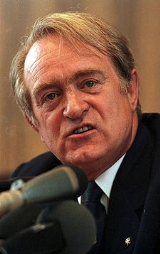
Johannes Rau

Encyclopedia
Johannes Rau was a German
politician
of the SPD
. He was President of Germany
from 1 July 1999 until 30 June 2004, and Minister-President of North Rhine-Westphalia
from 1978 to 1998.
part of Wuppertal
, Rhine Province
, as the third of five children. His family was strongly Protestant
. As a schoolboy, Rau was active in the Confessing Church
, a circle of the German Protestant Church which actively resisted Nazism
.
Rau left school in 1949 and worked as a journalist and publisher, especially with the Protestant Youth Publishing House.
(GVP), which was founded by Gustav Heinemann
. This party was known for proposing German reunification, from 1952 until it was disbanded in 1957.
In 1958, Rau and his political mentor, Gustav Heinemann
, joined the Social Democratic Party of Germany
(SPD), where he was active in the Wuppertal chapter. He served as deputy chairman of the SPD party of Wuppertal, and was elected later on to the City Council (1964–1978), where he served as chairman of the SPD Group (1964–1967) and later as Mayor (1969–1970).
In 1958, Rau was elected for the first time as member of the Landtag (state parliament) of North Rhine-Westphalia
(NRW). In 1967, he became chairman of the SPD fraction in the Landtag, and in 1970 Minister of Science and Education in the cabinet of Minister President Heinz Kühn
. He soon gained a reputation as a reformer. As part of the mass-education campaign of the 1970s, he founded five universities, each at different sites, in North Rhine-Westphalia and initiated Germany’s first distance learning university at Hagen
(modelled on the Open University
).
In 1977, Rau became Chairman of the North Rhine-Westphalia SPD, and in 1978 Minister President of the state, were he remained until 1998, with four successful elections for the SPD, which became strongest party in the Landtag each time and gained an absolute majority three times, in 1980, 1985, 1990 and finally 1995. From 1995 onwards, Rau led an SPD-Greens
coalition in NRW.
In 1987, Rau tried to become chancellor of Germany for the SPD, but his refusal to contemplate forming a coalition with the Green Party meant he could not win the elections against Helmut Kohl
’s Christian Democrats
(CDU). In 1994, Rau tried for the first time to become Federal President, but lost to Roman Herzog
.
Rau twice served as President
of the Bundesrat
in 1982/83 and 1994/95, and thus deputised for the Federal President. In 1998 Rau stepped down from his positions as SPD Chairman and Minister President, and on 23 May 1999, was elected Federal President
by the Federal Assembly of Germany to succeed Roman Herzog
(CDU). On 1 July 2004, he was succeeded by Horst Köhler
. As all Federal Presidents but his mentor Heinemann, who had not wished to be seen off in this manner, Rau was honored by a Großer Zapfenstreich
which on his wish included the hymn "Jesus bleibet meine Freude" (Jesu, Joy of Man's Desiring
).
In 2000, Rau was the first German head of state since the Holocaust
to address the Knesset
, the Israeli parliament, in German. This controversial step prompted some Israeli delegates to walk out. However, Israeli President Moshe Katsav
supported and praised him for bridging the gap between the two states. Rau had a deep and life-long commitment to bringing reconciliation between Germany and its past.
Following a long history of heart disease, he died a few days after his 75th birthday.
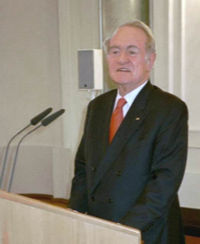
As his personal motto, Rau adopted the Confessing Church
dictum “teneo, quia teneor” (I hold because I am held).
In his acceptance speech after his election, Rau claimed “A patriot I will be” because “a patriot is someone who loves his fatherland, a nationalist is someone who despises the fatherlands of the others”. The quote can be attributed to the French writer Romain Gary
.
s.
In 2001, he received the Leo Baeck Medal
for his humanitarian work promoting tolerance and social justice.
of the Evangelical Church in the Rhineland
.
On 9 August 1982, Rau married the political scientist, Christina Delius (born 1956). Christina Rau is a granddaughter of her husband's mentor, Gustav Heinemann
, former President of Germany
. The couple had three children: Anna Christina, born 1983, Philip Immanuel, born 1985 and Laura Helene, born 1986.
Since 1995 Rau was aware of his dangerous aneurysm
in the abdominal aorta
, but declined an operation out of respect for his office and the upcoming election as president. On 23 July 2000 the operation took place at the University Hospital of Essen. On 18 August 2004, he had to undergo serious heart surgery, in which an artificial heart valve
was inserted. Only two months later (19 October 2004) a hematoma
in the abdominal cavity
was surgically removed.
After leaving office, Rau lived with his family in the federal capital, Berlin
. However, they also kept a house in Wuppertal.
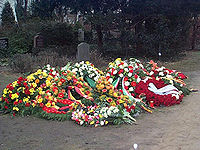
Rau died in Berlin on 27 January 2006.
Germany
Germany , officially the Federal Republic of Germany , is a federal parliamentary republic in Europe. The country consists of 16 states while the capital and largest city is Berlin. Germany covers an area of 357,021 km2 and has a largely temperate seasonal climate...
politician
Politician
A politician, political leader, or political figure is an individual who is involved in influencing public policy and decision making...
of the SPD
Social Democratic Party of Germany
The Social Democratic Party of Germany is a social-democratic political party in Germany...
. He was President of Germany
President of Germany
The President of the Federal Republic of Germany is the country's head of state. His official title in German is Bundespräsident . Germany has a parliamentary system of government and so the position of President is largely ceremonial...
from 1 July 1999 until 30 June 2004, and Minister-President of North Rhine-Westphalia
North Rhine-Westphalia
North Rhine-Westphalia is the most populous state of Germany, with four of the country's ten largest cities. The state was formed in 1946 as a merger of the northern Rhineland and Westphalia, both formerly part of Prussia. Its capital is Düsseldorf. The state is currently run by a coalition of the...
from 1978 to 1998.
Education and work
Rau was born in the BarmenBarmen
Barmen is a former industrial metropolis of the region of Bergisches Land, Germany, which in 1929 with four other towns was merged with the city of Wuppertal, North Rhine-Westphalia. Barmen was the birth-place of Friedrich Engels and together with the neighbouring town of Elberfeld founded the...
part of Wuppertal
Wuppertal
Wuppertal is a city in North Rhine-Westphalia, Germany. It is located in and around the Wupper river valley, and is situated east of the city of Düsseldorf and south of the Ruhr area. With a population of approximately 350,000, it is the largest city in the Bergisches Land...
, Rhine Province
Rhine Province
The Rhine Province , also known as Rhenish Prussia or synonymous to the Rhineland , was the westernmost province of the Kingdom of Prussia and the Free State of Prussia, within the German Reich, from 1822-1946. It was created from the provinces of the Lower Rhine and Jülich-Cleves-Berg...
, as the third of five children. His family was strongly Protestant
Protestantism
Protestantism is one of the three major groupings within Christianity. It is a movement that began in Germany in the early 16th century as a reaction against medieval Roman Catholic doctrines and practices, especially in regards to salvation, justification, and ecclesiology.The doctrines of the...
. As a schoolboy, Rau was active in the Confessing Church
Confessing Church
The Confessing Church was a Protestant schismatic church in Nazi Germany that arose in opposition to government-sponsored efforts to nazify the German Protestant church.-Demographics:...
, a circle of the German Protestant Church which actively resisted Nazism
Nazism
Nazism, the common short form name of National Socialism was the ideology and practice of the Nazi Party and of Nazi Germany...
.
Rau left school in 1949 and worked as a journalist and publisher, especially with the Protestant Youth Publishing House.
Political biography
Rau was a member of the All-German People’s PartyAll-German People's Party
The All-German People's Party, in German Gesamtdeutsche Volkspartei was a political party in the Federal Republic of Germany. The party was founded on November 29, 1952 and ceased to exist in 1957...
(GVP), which was founded by Gustav Heinemann
Gustav Heinemann
Gustav Walter Heinemann, GCB was a German politician. He was Mayor of the city of Essen from 1946 to 1949, West German Minister of the Interior from 1949 to 1950, Minister of Justice from 1966 to 1969 and President of the Federal Republic of Germany from 1969 to 1974.-Early years and professional...
. This party was known for proposing German reunification, from 1952 until it was disbanded in 1957.
In 1958, Rau and his political mentor, Gustav Heinemann
Gustav Heinemann
Gustav Walter Heinemann, GCB was a German politician. He was Mayor of the city of Essen from 1946 to 1949, West German Minister of the Interior from 1949 to 1950, Minister of Justice from 1966 to 1969 and President of the Federal Republic of Germany from 1969 to 1974.-Early years and professional...
, joined the Social Democratic Party of Germany
Social Democratic Party of Germany
The Social Democratic Party of Germany is a social-democratic political party in Germany...
(SPD), where he was active in the Wuppertal chapter. He served as deputy chairman of the SPD party of Wuppertal, and was elected later on to the City Council (1964–1978), where he served as chairman of the SPD Group (1964–1967) and later as Mayor (1969–1970).
In 1958, Rau was elected for the first time as member of the Landtag (state parliament) of North Rhine-Westphalia
North Rhine-Westphalia
North Rhine-Westphalia is the most populous state of Germany, with four of the country's ten largest cities. The state was formed in 1946 as a merger of the northern Rhineland and Westphalia, both formerly part of Prussia. Its capital is Düsseldorf. The state is currently run by a coalition of the...
(NRW). In 1967, he became chairman of the SPD fraction in the Landtag, and in 1970 Minister of Science and Education in the cabinet of Minister President Heinz Kühn
Heinz Kühn
Heinz Kühn was a German politician and Minister-President of North Rhine-Westphalia . He was born in Cologne.- External links :*...
. He soon gained a reputation as a reformer. As part of the mass-education campaign of the 1970s, he founded five universities, each at different sites, in North Rhine-Westphalia and initiated Germany’s first distance learning university at Hagen
Hagen
Hagen is the 39th-largest city in Germany, located in the federal state of North Rhine-Westphalia. It is located on the eastern edge of the Ruhr area, 15 km south of Dortmund, where the rivers Lenne, Volme and Ennepe meet the river Ruhr...
(modelled on the Open University
Open University
The Open University is a distance learning and research university founded by Royal Charter in the United Kingdom...
).
In 1977, Rau became Chairman of the North Rhine-Westphalia SPD, and in 1978 Minister President of the state, were he remained until 1998, with four successful elections for the SPD, which became strongest party in the Landtag each time and gained an absolute majority three times, in 1980, 1985, 1990 and finally 1995. From 1995 onwards, Rau led an SPD-Greens
Alliance '90/The Greens
Alliance '90/The Greens is a green political party in Germany, formed from the merger of the German Green Party and Alliance 90 in 1993. Its leaders are Claudia Roth and Cem Özdemir...
coalition in NRW.
In 1987, Rau tried to become chancellor of Germany for the SPD, but his refusal to contemplate forming a coalition with the Green Party meant he could not win the elections against Helmut Kohl
Helmut Kohl
Helmut Josef Michael Kohl is a German conservative politician and statesman. He was Chancellor of Germany from 1982 to 1998 and the chairman of the Christian Democratic Union from 1973 to 1998...
’s Christian Democrats
Christian Democratic Union (Germany)
The Christian Democratic Union of Germany is a Christian democratic and conservative political party in Germany. It is regarded as on the centre-right of the German political spectrum...
(CDU). In 1994, Rau tried for the first time to become Federal President, but lost to Roman Herzog
Roman Herzog
Roman Herzog is a German politician as a member of the Christian Democratic Union, and served as President of Germany from 1994 to 1999...
.
Rau twice served as President
President of the German Bundesrat
In Germany, the President of the Bundesrat or President of the Federal Council is the chairperson or speaker of the Bundesrat . The presidency of the Bundesrat rotates among the heads of government of each of the states on an annual basis...
of the Bundesrat
Bundesrat of Germany
The German Bundesrat is a legislative body that represents the sixteen Länder of Germany at the federal level...
in 1982/83 and 1994/95, and thus deputised for the Federal President. In 1998 Rau stepped down from his positions as SPD Chairman and Minister President, and on 23 May 1999, was elected Federal President
President of Germany
The President of the Federal Republic of Germany is the country's head of state. His official title in German is Bundespräsident . Germany has a parliamentary system of government and so the position of President is largely ceremonial...
by the Federal Assembly of Germany to succeed Roman Herzog
Roman Herzog
Roman Herzog is a German politician as a member of the Christian Democratic Union, and served as President of Germany from 1994 to 1999...
(CDU). On 1 July 2004, he was succeeded by Horst Köhler
Horst Köhler
Horst Köhler is a German politician of the Christian Democratic Union. He was President of Germany from 2004 to 2010. As the candidate of the two Christian Democratic sister parties, the CDU and the CSU, and the liberal FDP, Köhler was elected to his first five-year term by the Federal Assembly on...
. As all Federal Presidents but his mentor Heinemann, who had not wished to be seen off in this manner, Rau was honored by a Großer Zapfenstreich
Großer Zapfenstreich
The is a military ceremony performed in Germany and Austria. It is similar to the military tattoo ceremony carried out in English-speaking countries, and is the most important ceremonial act executed by the German federal armed forces, the Bundeswehr...
which on his wish included the hymn "Jesus bleibet meine Freude" (Jesu, Joy of Man's Desiring
Jesu, Joy of Man's Desiring
Jesu, Joy of Man's Desiring is the most common English title of the 10th movement of the cantata Herz und Mund und Tat und Leben, BWV 147 composed by Johann Sebastian Bach. A transcription by the English pianist Myra Hess was published in 1926 for piano solo and in 1934 for piano duet...
).
In 2000, Rau was the first German head of state since the Holocaust
The Holocaust
The Holocaust , also known as the Shoah , was the genocide of approximately six million European Jews and millions of others during World War II, a programme of systematic state-sponsored murder by Nazi...
to address the Knesset
Knesset
The Knesset is the unicameral legislature of Israel, located in Givat Ram, Jerusalem.-Role in Israeli Government :The legislative branch of the Israeli government, the Knesset passes all laws, elects the President and Prime Minister , approves the cabinet, and supervises the work of the government...
, the Israeli parliament, in German. This controversial step prompted some Israeli delegates to walk out. However, Israeli President Moshe Katsav
Moshe Katsav
Moshe Katsav is an Israeli politician. He served as the eighth President of Israel, a leading Likud member of the Israeli Knesset, and a Cabinet Minister in its government....
supported and praised him for bridging the gap between the two states. Rau had a deep and life-long commitment to bringing reconciliation between Germany and its past.
Following a long history of heart disease, he died a few days after his 75th birthday.
Motto and maxim
The maxim of Rau was “to reconcile, not divide”.As his personal motto, Rau adopted the Confessing Church
Confessing Church
The Confessing Church was a Protestant schismatic church in Nazi Germany that arose in opposition to government-sponsored efforts to nazify the German Protestant church.-Demographics:...
dictum “teneo, quia teneor” (I hold because I am held).
In his acceptance speech after his election, Rau claimed “A patriot I will be” because “a patriot is someone who loves his fatherland, a nationalist is someone who despises the fatherlands of the others”. The quote can be attributed to the French writer Romain Gary
Romain Gary
Romain Gary was a French diplomat, novelist, film director, World War II aviator. He is the only author to have won the Prix Goncourt twice .- Early life :Gary was born in Vilnius under the name Roman Kacew...
.
Prizes and medals
Rau was awarded fifteen honorary doctorateDoctorate
A doctorate is an academic degree or professional degree that in most countries refers to a class of degrees which qualify the holder to teach in a specific field, A doctorate is an academic degree or professional degree that in most countries refers to a class of degrees which qualify the holder...
s.
In 2001, he received the Leo Baeck Medal
Leo Baeck Institute
The Leo Baeck Institute-New York in Manhattan is a library, archive, and exhibition centre devoted to the study of the history and culture of German-speaking Jewry. The Institutes's offices and collections are housed in Center for Jewish History in New York City...
for his humanitarian work promoting tolerance and social justice.
Private life
Rau was known as a practising Christian (and sometimes titled , "Brother John", to ridicule his intense Christian position; however, he sometimes used this term himself). He held lay positions in, and was a member of, the SynodSynod
A synod historically is a council of a church, usually convened to decide an issue of doctrine, administration or application. In modern usage, the word often refers to the governing body of a particular church, whether its members are meeting or not...
of the Evangelical Church in the Rhineland
Evangelical Church in the Rhineland
Evangelical Church in the Rhineland is a united Protestant church body in parts of the German states of North Rhine-Westphalia, Rhineland-Palatinate, Saarland and Hesse . This is actually the area covered by the former Prussian Rhine Province until 1920. It is the most important Protestant...
.
On 9 August 1982, Rau married the political scientist, Christina Delius (born 1956). Christina Rau is a granddaughter of her husband's mentor, Gustav Heinemann
Gustav Heinemann
Gustav Walter Heinemann, GCB was a German politician. He was Mayor of the city of Essen from 1946 to 1949, West German Minister of the Interior from 1949 to 1950, Minister of Justice from 1966 to 1969 and President of the Federal Republic of Germany from 1969 to 1974.-Early years and professional...
, former President of Germany
President of Germany
The President of the Federal Republic of Germany is the country's head of state. His official title in German is Bundespräsident . Germany has a parliamentary system of government and so the position of President is largely ceremonial...
. The couple had three children: Anna Christina, born 1983, Philip Immanuel, born 1985 and Laura Helene, born 1986.
Since 1995 Rau was aware of his dangerous aneurysm
Aneurysm
An aneurysm or aneurism is a localized, blood-filled balloon-like bulge in the wall of a blood vessel. Aneurysms can commonly occur in arteries at the base of the brain and an aortic aneurysm occurs in the main artery carrying blood from the left ventricle of the heart...
in the abdominal aorta
Abdominal aorta
The abdominal aorta is the largest artery in the abdominal cavity. As part of the aorta, it is a direct continuation of the descending aorta .-Path:...
, but declined an operation out of respect for his office and the upcoming election as president. On 23 July 2000 the operation took place at the University Hospital of Essen. On 18 August 2004, he had to undergo serious heart surgery, in which an artificial heart valve
Artificial heart valve
An artificial heart valve is a device implanted in the heart of a patient with heart valvular disease. When one of the four heart valves malfunctions, the medical choice may be to replace the natural valve with an artificial valve. This requires open-heart surgery.Valves are integral to the normal...
was inserted. Only two months later (19 October 2004) a hematoma
Hematoma
A hematoma, or haematoma, is a localized collection of blood outside the blood vessels, usually in liquid form within the tissue. This distinguishes it from an ecchymosis, which is the spread of blood under the skin in a thin layer, commonly called a bruise...
in the abdominal cavity
Abdominal cavity
The abdominal cavity is the body cavity of the human body that holds the bulk of the viscera. It is located below the thoracic cavity, and above the pelvic cavity. Its dome-shaped roof is the thoracic diaphragm , and its oblique floor is the pelvic inlet...
was surgically removed.
After leaving office, Rau lived with his family in the federal capital, Berlin
Berlin
Berlin is the capital city of Germany and is one of the 16 states of Germany. With a population of 3.45 million people, Berlin is Germany's largest city. It is the second most populous city proper and the seventh most populous urban area in the European Union...
. However, they also kept a house in Wuppertal.
Rau died in Berlin on 27 January 2006.