

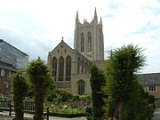
Bury St. Edmunds

Encyclopedia
Bury St Edmunds is a market town
in the county of Suffolk
, England, and formerly the county town
of West Suffolk
. It is the main town in the borough of St Edmundsbury and known for the ruined
abbey
near the town centre
. Bury is the seat of the Diocese of St Edmundsbury and Ipswich, with the episcopal see
at St Edmundsbury Cathedral.
The town originally called Beodericsworth, is known for brewing and malting (with the large Greene King brewery) and for a British Sugar processing factory. Many large and small businesses are located in Bury, which traditionally has given Bury an affluent economy with low unemployment, with the town being the main cultural and retail centre for West Suffolk. Tourism is also a major part of the economy, plus local government.
It is in the Bury St Edmunds
parliamentary constituency
and is represented in Parliament by David Ruffley
.
s, was one of the royal towns of the Saxons
. Sigebert
, king of the East Angles
, founded a monastery
here about 633, which in 903 became the burial place of King Edmund
, who was slain by the Danes in 869, and owed most of its early celebrity to the reputed miracles performed at the shrine of the martyr king. The town grew around Bury St Edmunds Abbey
, a site of pilgrimage
. By 925 the fame of St Edmund had spread far and wide, and the name of the town was changed to St Edmund's Bury. In 942 or 945 King Edmund had granted to the abbot
and convent
jurisdiction over the whole town, free from all secular services, and Canute
in 1020 freed it from episcopal control. Edward the Confessor
made the abbot lord of the franchise. Sweyn, in 1020, having destroyed the older monastery and ejected the secular priests, built a Benedictine
abbey on St Edmund's Bury.
The town is associated with Magna Carta
. In 1214 the barons of England are believed to have met in the Abbey Church and sworn to force King John
to accept the Charter of Liberties
, the document which influenced the creation of the Magna Carta. By various grants from the abbots, the town gradually attained the rank of a borough
.
Henry III
in 1235 granted to the abbot two annual fairs, one in December (which still survives) and the other the great St Matthew's fair, which was abolished by the Fairs Act of 1871
. In 1327, the Great Riot occurred, in which the local populace led an armed revolt against the Abbey. The burghers were angry at the overwhelming power, wealth and corruption of the monastery, which ran almost every aspect of local life with a view to enriching itself. The riot destroyed the main gate and a new, fortified gate was built in its stead. However in 1381 during the Great Uprising, the Abbey was sacked and looted again. This time, the Prior was executed; his severed head was placed on a pike in the Great Market. On 11 April 1608 a great fire broke out in Eastgate Street, which resulted in 160 dwellings and 400 outhouses being destroyed.
The town developed into a flourishing cloth-making town, with a large wool
len trade, by the 14th century. In 1405 Henry IV
granted another fair.
Elizabeth I in 1562 confirmed the charters which former kings had granted to the abbots. The reversion of the fairs and two markets on Wednesday and Saturday were granted by James I in fee farm to the corporation. James I
in 1606 granted a charter of incorporation with an annual fair in Easter
week and a market. James granted further charters in 1608 and 1614, as did Charles II
in 1668 and 1684.
Parliaments were held in the borough in 1272, 1296 and 1446, but the borough was not represented until 1608, when James I conferred on it the privilege of sending two members. The Redistribution of Seats Act 1885
reduced the representation to one.
The borough of Bury St Edmunds and the surrounding area, like much of East Anglia
, being part of the Eastern Association
, supported Puritan
sentiment during the first half of the 17th century. By 1640, several families had departed for the Massachusetts Bay Colony
as part of the wave of emigration that occurred during the Great Migration
. Bury's ancient grammar school also educated notable puritan theologians such as Richard Sibbes
, the master of St. Catherine's Hall in Cambridge and noteworthy future colonists such as Simonds D'Ewes
and John Winthrop, Jr.
The town was the setting for the Bury St. Edmunds witch trials
between 1599 and 1694.
, the USAAF used RAF Station Rougham airfield
outside the town.
On 3 March 1974 a Turkish Airlines
DC10 jet Flight 981
crashed near Paris
killing all 346 people on board. Among the victims were 17 members of Bury St Edmunds rugby
club, returning from France
.
The town council was formed in 2003. The election on 3 May 2007 was won by the "Abolish Bury Town Council" party. The party lost its majority following a by-election
in June 2007 and, to date, the Town Council is still in existence.
In March 2008 a further by-election put Conservatives in control but in the council election of May 2011 the lack of Conservative and other parties' candidates let in a Labour majority before the election was even held.
which was built in 1935. The sign is at the terminus of the A1101
, Great Britain
's lowest road.
There is a network of tunnels which are evidence of chalk
-workings, though there is no evidence of extensive tunnels under the town centre. Some buildings have inter-communicating cellars. Due to their unsafe nature the chalk-workings are not open to the public, although viewing has been granted to individuals. Some have caused subsidence
in living history, for instance at Jacqueline Close.
Among noteworthy buildings is St Mary's Church, where Mary Tudor, Queen of France and sister of Tudor
king Henry VIII
, was re-buried, six years after her death, having been moved from the Abbey after her brother's Dissolution of the Monasteries
. Queen Victoria had a stained glass window fitted into the church to commemorate Mary's interment. Moreton Hall
, a Grade II* listed building by Robert Adam
, now houses the Moreton Hall Preparatory School.
Bury St Edmunds has one of the wholetime fire stations run by Suffolk Fire and Rescue Service
. Originally located in the Traverse (now the Halifax Building Society), it moved to Fornham Road in 1953. The Fornham Road site (now Mermaid Close) closed in 1987 and the fire station moved to its current location on Parkway North.
Rainfall is generally low, at under 600mm, and spread fairly evenly throughout the year.
, which has cognate
s in other Germanic languages such as the German
"burg" meaning "fortress, castle"; Old Norse "borg" meaning "wall, castle"; and Gothic
"baurgs" meaning "city". They all derive from Proto-Germanic
*burgs meaning "fortress". This in turn derives from the Proto-Indo-European
root *bhrgh meaning "fortified elevation", with cognates including Welsh
bera ("stack") and Sanskrit
bhrant- ("high, elevated building"). There is thus no justification for the folk etymology stating that the Cathedral Town was so called because St Edmund was buried there.
The second section of the name refers to Edmund
King of the East Angles
, who was killed by the Vikings
in the year 869. He became venerated as a saint and a martyr, and his shrine made Bury St Edmunds an important place of pilgrimage.
The formal name of both the borough and the diocese is "St. Edmundsbury". Local residents often refer to Bury St Edmunds simply as "Bury".
meeting house
has existed since the early 18th century as a non-conformist chapel.
, surrounded by the Abbey Gardens, a park. The abbey is a shrine
to Saint Edmund
, the Saxon King of the East Angles. The abbey was sacked by the townspeople in the 14th century, and then largely destroyed during the 16th century with the Dissolution of the Monasteries
, but Bury remained prosperous throughout the 17th and 18th centuries, falling into relative decline with the Industrial Revolution
.

Bury St Edmunds Cathedral
was created when the Diocese of St Edmundsbury and Ipswich was formed in 1914. The cathedral was extended with an eastern end in the 1960s, commemorated by Benjamin Britten
's Fanfare for St Edmundsbury
. A new Gothic revival cathedral tower was built as part of a Millennium project
running from 2000 to 2005. The opening for the tower took place in July 2005, and included a brass band
concert and fireworks. Parts of the cathedral remain uncompleted, including the cloisters. Many areas remain inaccessible to the public due to building work. The tower makes St Edmundsbury the only recently completed Anglican cathedral in the UK. Only a handful of Gothic revival cathedrals are being built worldwide. The tower was constructed using original fabrication techniques by six masons who placed the machine-pre-cut stone individually as they arrived.
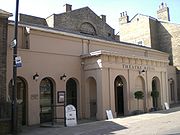
was built by National Gallery
architect William Wilkins
in 1819. It is the sole surviving Regency
Theatre in the country . The theatre, owned by the Greene King brewery, is leased to the National Trust
for a nominal charge, and underwent restoration between 2005 and 2007. It presents a full programme of performances and is also open for public tours.
 Moyse's Hall Museum is one of the oldest (c. 1180) domestic buildings in East Anglia open to the public. It has collections of fine art, for example Mary Beale
, costume, e.g. Charles Frederick Worth
, horology
, local and social history; including Red Barn Murder
and Witchcraft
.
Bury St Edmunds Art Gallery is located in The Market Cross, restored by Robert Adam
in the late 1700s. The Gallery was established in 1972 and today hosts a programme of changing contemporary art and craft exhibitions and events by British and international artists. Artists featured in the Gallery have included Cornelia Parker
, David Batchelor, Anri Sala
and Mark Fairnington.
The town holds a festival in May. This including concerts, plays, dance, and lecturers culminating in fireworks. Bury St Edmunds is home to England's oldest Scout group, 1st Bury St Edmunds (Mayors Own).
The town's main football club, Bury Town
, is the fourth oldest non-league team in England. They are members of the Isthmian League Premier Division. Team Bury
, associated with the football academy at West Suffolk College
play in Division One of the Eastern Counties League
. Suffolk County Cricket Club
play occasional games at the Victory Ground
which is also the home ground of Bury St Edmunds Cricket Club.
 The UK's largest British-owned brewery, Greene King, is situated in Bury, as is the smaller Old Cannon Brewery
. Just outside the town, on the site of RAF Bury St Edmunds
, is Bartrums Brewery, originally based in Thurston
.
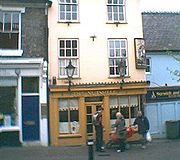
Another beer-related landmark is Britain's smallest public house
, The Nutshell
, which is on The Traverse, just off the marketplace. It is allegedly the smallest pub in Britain and also believed to be haunted.
into refined crystal sugar. It was built in 1925 when the town's MP, Walter Guinness
, was Minister of Agriculture
. It processes beet from 1,300 growers. 660 lorry-loads of beet can be accepted each day when beet is being harvested. Not all the beet can be crystallised immediately, and some is kept in solution in holding tanks until late spring and early summer, when the plant has spare crystallising capacity. The sugar is sold under the Silver Spoon name (the other major British brand, Tate & Lyle
, is made from imported sugar cane). By-products include molassed sugar beet feed for cattle and LimeX70, a soil improver. The factory has its own power station, which powers around 110,000 homes. A smell of burnt starch from the plant is noticeable on some days.
 Notable people from Bury St Edmunds include author Norah Lofts
, who though actually born in Shipdham Norfolk, bases many of her stories in Baildon, the fictionalised Bury St Edmunds, artist Rose Mead
, artist and printer Sybil Andrews
, actors Bob Hoskins
and Michael Maloney
theatre director Sir Peter Hall, author Maria Lousie de la Ramé (also known as Ouida
), Canadian journalist and author Richard Gwyn
, cyclist James Moore
, World War II
Canadian
general Guy Simonds
, footballer Andy Marshall
and the 18th-century landscape architect Humphry Repton
, Bishop of Winchester
and Lord High Chancellor Stephen Gardiner
, as well as Thomas Clarkson
fact-finder behind the abolition of the slave trade. Though born in Bedford
, actor John Le Mesurier
grew up in the town.
Although not from Bury St Edmunds, BBC Radio 1
DJ John Peel
lived nearby in Great Finborough
and, on 12 November 2004, his funeral took place at the cathedral. It was attended by approximately a thousand people including many artists he had championed. During a peak of local musical activity in Bury St Edmunds in 2002, he referred (tongue-in-cheek
) to the town as 'The New Seattle'. Notable bands from Bury St Edmunds include Jacob's Mouse
, Miss Black America
, The Dawn Parade
and Kate Jackson
of The Long Blondes
.
is a three-tier
system. Upper school
s include King Edward VI, St Benedict's
and County Upper School
. Middle school
s include Hardwick; Howard Middle; St James; St Louis; Westley Middle and Horringer Court Middle School, a training school
. The public school
Culford School
is located just north of the town in the village of Culford
.
Primary Schools Howard Community Primary School, Westgate and Tollgate.
West Suffolk College
and West Suffolk House are the town's provider of further
and higher education
.
, Oise
, Picardy, France
Kevelaer
, North Rhine-Westphalia
, Germany
Market town
Market town or market right is a legal term, originating in the medieval period, for a European settlement that has the right to host markets, distinguishing it from a village and city...
in the county of Suffolk
Suffolk
Suffolk is a non-metropolitan county of historic origin in East Anglia, England. It has borders with Norfolk to the north, Cambridgeshire to the west and Essex to the south. The North Sea lies to the east...
, England, and formerly the county town
County town
A county town is a county's administrative centre in the United Kingdom or Ireland. County towns are usually the location of administrative or judicial functions, or established over time as the de facto main town of a county. The concept of a county town eventually became detached from its...
of West Suffolk
West Suffolk
West Suffolk was an administrative county of England created in 1889 from part of the county of Suffolk. It survived until 1974 when it was rejoined with East Suffolk. Its county town was Bury St Edmunds....
. It is the main town in the borough of St Edmundsbury and known for the ruined
Ruins
Ruins are the remains of human-made architecture: structures that were once complete, as time went by, have fallen into a state of partial or complete disrepair, due to lack of maintenance or deliberate acts of destruction...
abbey
Bury St. Edmunds Abbey
The Abbey of Bury St Edmunds was once among the richest Benedictine monasteries in England. Its ruins lie in Bury St Edmunds, a town in the county of Suffolk, England.-History:...
near the town centre
Town centre
The town centre is the term used to refer to the commercial or geographical centre or core area of a town.Town centres are traditionally associated with shopping or retail. They are also the centre of communications with major public transport hubs such as train or bus stations...
. Bury is the seat of the Diocese of St Edmundsbury and Ipswich, with the episcopal see
Episcopal See
An episcopal see is, in the original sense, the official seat of a bishop. This seat, which is also referred to as the bishop's cathedra, is placed in the bishop's principal church, which is therefore called the bishop's cathedral...
at St Edmundsbury Cathedral.
The town originally called Beodericsworth, is known for brewing and malting (with the large Greene King brewery) and for a British Sugar processing factory. Many large and small businesses are located in Bury, which traditionally has given Bury an affluent economy with low unemployment, with the town being the main cultural and retail centre for West Suffolk. Tourism is also a major part of the economy, plus local government.
It is in the Bury St Edmunds
Bury St Edmunds (UK Parliament constituency)
Bury St Edmunds is a county constituency located in Suffolk and centred on the town of Bury St Edmunds. It elects one Member of Parliament to in the House of Commons of the Parliament of the United Kingdom...
parliamentary constituency
United Kingdom constituencies
In the United Kingdom , each of the electoral areas or divisions called constituencies elects one or more members to a parliament or assembly.Within the United Kingdom there are now five bodies with members elected by constituencies:...
and is represented in Parliament by David Ruffley
David Ruffley
David Laurie Ruffley is a Conservative Party politician in the United Kingdom. He is the Member of Parliament for the constituency of Bury St Edmunds in Suffolk, which encompasses Bury St Edmunds and Stowmarket, having been first elected in 1997.A solicitor by profession, Ruffley served as...
.
History
Bury St Edmunds (Beodericsworth, St Edmund's Bury), supposed by some to have been the Villa Faustina of the RomanAncient Rome
Ancient Rome was a thriving civilization that grew on the Italian Peninsula as early as the 8th century BC. Located along the Mediterranean Sea and centered on the city of Rome, it expanded to one of the largest empires in the ancient world....
s, was one of the royal towns of the Saxons
Saxons
The Saxons were a confederation of Germanic tribes originating on the North German plain. The Saxons earliest known area of settlement is Northern Albingia, an area approximately that of modern Holstein...
. Sigebert
Sigeberht of East Anglia
Sigeberht of East Anglia , was a saint and a king of East Anglia, the Anglo-Saxon kingdom which today includes the English counties of Norfolk and Suffolk. He was the first English king to receive a Christian baptism and education before his succession and the first to abdicate in order to enter...
, king of the East Angles
Kingdom of the East Angles
The Kingdom of East Anglia, also known as the Kingdom of the East Angles , was a small independent Anglo-Saxon kingdom that comprised what are now the English counties of Norfolk and Suffolk and perhaps the eastern part of the Fens...
, founded a monastery
Monastery
Monastery denotes the building, or complex of buildings, that houses a room reserved for prayer as well as the domestic quarters and workplace of monastics, whether monks or nuns, and whether living in community or alone .Monasteries may vary greatly in size – a small dwelling accommodating only...
here about 633, which in 903 became the burial place of King Edmund
Edmund the Martyr
St Edmund the Martyr was a king of East Anglia, an Anglo-Saxon kingdom which today includes the English counties of Norfolk, Suffolk and Cambridgeshire.D'Evelyn, Charlotte, and Mill, Anna J., , 1956. Reprinted 1967...
, who was slain by the Danes in 869, and owed most of its early celebrity to the reputed miracles performed at the shrine of the martyr king. The town grew around Bury St Edmunds Abbey
Bury St. Edmunds Abbey
The Abbey of Bury St Edmunds was once among the richest Benedictine monasteries in England. Its ruins lie in Bury St Edmunds, a town in the county of Suffolk, England.-History:...
, a site of pilgrimage
Pilgrimage
A pilgrimage is a journey or search of great moral or spiritual significance. Typically, it is a journey to a shrine or other location of importance to a person's beliefs and faith...
. By 925 the fame of St Edmund had spread far and wide, and the name of the town was changed to St Edmund's Bury. In 942 or 945 King Edmund had granted to the abbot
Abbot
The word abbot, meaning father, is a title given to the head of a monastery in various traditions, including Christianity. The office may also be given as an honorary title to a clergyman who is not actually the head of a monastery...
and convent
Convent
A convent is either a community of priests, religious brothers, religious sisters, or nuns, or the building used by the community, particularly in the Roman Catholic Church and in the Anglican Communion...
jurisdiction over the whole town, free from all secular services, and Canute
Canute the Great
Cnut the Great , also known as Canute, was a king of Denmark, England, Norway and parts of Sweden. Though after the death of his heirs within a decade of his own and the Norman conquest of England in 1066, his legacy was largely lost to history, historian Norman F...
in 1020 freed it from episcopal control. Edward the Confessor
Edward the Confessor
Edward the Confessor also known as St. Edward the Confessor , son of Æthelred the Unready and Emma of Normandy, was one of the last Anglo-Saxon kings of England and is usually regarded as the last king of the House of Wessex, ruling from 1042 to 1066....
made the abbot lord of the franchise. Sweyn, in 1020, having destroyed the older monastery and ejected the secular priests, built a Benedictine
Benedictine
Benedictine refers to the spirituality and consecrated life in accordance with the Rule of St Benedict, written by Benedict of Nursia in the sixth century for the cenobitic communities he founded in central Italy. The most notable of these is Monte Cassino, the first monastery founded by Benedict...
abbey on St Edmund's Bury.
The town is associated with Magna Carta
Magna Carta
Magna Carta is an English charter, originally issued in the year 1215 and reissued later in the 13th century in modified versions, which included the most direct challenges to the monarch's authority to date. The charter first passed into law in 1225...
. In 1214 the barons of England are believed to have met in the Abbey Church and sworn to force King John
John of England
John , also known as John Lackland , was King of England from 6 April 1199 until his death...
to accept the Charter of Liberties
Charter of Liberties
The Charter of Liberties, also called the Coronation Charter, was a written proclamation by Henry I of England, issued upon his accession to the throne in 1100. It sought to bind the King to certain laws regarding the treatment of church officials and nobles...
, the document which influenced the creation of the Magna Carta. By various grants from the abbots, the town gradually attained the rank of a borough
Borough
A borough is an administrative division in various countries. In principle, the term borough designates a self-governing township although, in practice, official use of the term varies widely....
.
Henry III
Henry III of England
Henry III was the son and successor of John as King of England, reigning for 56 years from 1216 until his death. His contemporaries knew him as Henry of Winchester. He was the first child king in England since the reign of Æthelred the Unready...
in 1235 granted to the abbot two annual fairs, one in December (which still survives) and the other the great St Matthew's fair, which was abolished by the Fairs Act of 1871
Fairs Act of 1871
The Fairs Act 1871 empowered the secretary of state for the Home Department to, on petition, make orders for the abolition of fairs. Such provision was made at this time by parliament because many fairs traditionally held in early Victorian England were, according to the preamble to the act, held...
. In 1327, the Great Riot occurred, in which the local populace led an armed revolt against the Abbey. The burghers were angry at the overwhelming power, wealth and corruption of the monastery, which ran almost every aspect of local life with a view to enriching itself. The riot destroyed the main gate and a new, fortified gate was built in its stead. However in 1381 during the Great Uprising, the Abbey was sacked and looted again. This time, the Prior was executed; his severed head was placed on a pike in the Great Market. On 11 April 1608 a great fire broke out in Eastgate Street, which resulted in 160 dwellings and 400 outhouses being destroyed.
The town developed into a flourishing cloth-making town, with a large wool
Wool
Wool is the textile fiber obtained from sheep and certain other animals, including cashmere from goats, mohair from goats, qiviut from muskoxen, vicuña, alpaca, camel from animals in the camel family, and angora from rabbits....
len trade, by the 14th century. In 1405 Henry IV
Henry IV of England
Henry IV was King of England and Lord of Ireland . He was the ninth King of England of the House of Plantagenet and also asserted his grandfather's claim to the title King of France. He was born at Bolingbroke Castle in Lincolnshire, hence his other name, Henry Bolingbroke...
granted another fair.
Elizabeth I in 1562 confirmed the charters which former kings had granted to the abbots. The reversion of the fairs and two markets on Wednesday and Saturday were granted by James I in fee farm to the corporation. James I
James I of England
James VI and I was King of Scots as James VI from 24 July 1567 and King of England and Ireland as James I from the union of the English and Scottish crowns on 24 March 1603...
in 1606 granted a charter of incorporation with an annual fair in Easter
Easter
Easter is the central feast in the Christian liturgical year. According to the Canonical gospels, Jesus rose from the dead on the third day after his crucifixion. His resurrection is celebrated on Easter Day or Easter Sunday...
week and a market. James granted further charters in 1608 and 1614, as did Charles II
Charles II of England
Charles II was monarch of the three kingdoms of England, Scotland, and Ireland.Charles II's father, King Charles I, was executed at Whitehall on 30 January 1649, at the climax of the English Civil War...
in 1668 and 1684.
Parliaments were held in the borough in 1272, 1296 and 1446, but the borough was not represented until 1608, when James I conferred on it the privilege of sending two members. The Redistribution of Seats Act 1885
Redistribution of Seats Act 1885
The Redistribution of Seats Act 1885 was an Act of the Parliament of the United Kingdom. It was a piece of electoral reform legislation that redistributed the seats in the House of Commons, introducing the concept of equally populated constituencies, in an attempt to equalise representation across...
reduced the representation to one.
The borough of Bury St Edmunds and the surrounding area, like much of East Anglia
East Anglia
East Anglia is a traditional name for a region of eastern England, named after an ancient Anglo-Saxon kingdom, the Kingdom of the East Angles. The Angles took their name from their homeland Angeln, in northern Germany. East Anglia initially consisted of Norfolk and Suffolk, but upon the marriage of...
, being part of the Eastern Association
Eastern Association
The Eastern Association of counties was a Parliamentarian or 'Roundhead' army during the English Civil War. It was formed from a number of pro-Parliamentary militias in the east of England in 1642, including a troop of cavalry led by Oliver Cromwell...
, supported Puritan
Puritan
The Puritans were a significant grouping of English Protestants in the 16th and 17th centuries. Puritanism in this sense was founded by some Marian exiles from the clergy shortly after the accession of Elizabeth I of England in 1558, as an activist movement within the Church of England...
sentiment during the first half of the 17th century. By 1640, several families had departed for the Massachusetts Bay Colony
Massachusetts Bay Colony
The Massachusetts Bay Colony was an English settlement on the east coast of North America in the 17th century, in New England, situated around the present-day cities of Salem and Boston. The territory administered by the colony included much of present-day central New England, including portions...
as part of the wave of emigration that occurred during the Great Migration
Great Migration (Puritan)
The Puritan migration to New England was marked in its effects in the two decades from 1620 to 1640, after which it declined sharply for a while. The term Great Migration usually refers to the migration in this period of English settlers, primarily Puritans to Massachusetts and the warm islands of...
. Bury's ancient grammar school also educated notable puritan theologians such as Richard Sibbes
Richard Sibbes
Richard Sibbes was an English theologian. He is known as a Biblical exegete, and as a representative, with William Perkins and John Preston, of what has been called "main-line" Puritanism.-Life:...
, the master of St. Catherine's Hall in Cambridge and noteworthy future colonists such as Simonds D'Ewes
Simonds d'Ewes
Sir Simonds d'Ewes, 1st Baronet was an antiquary and politician. He was bred for the bar, was a member of the Long Parliament and left notes on its transactions. d'Ewes took the Puritan side in the Civil War...
and John Winthrop, Jr.
The town was the setting for the Bury St. Edmunds witch trials
Bury St. Edmunds witch trials
The Bury St Edmunds witch trials were a series of trials conducted intermittently between the years 1599 and 1694 in the town of Bury St Edmunds in Suffolk, England....
between 1599 and 1694.
Modern history
During the Second World WarWorld War II
World War II, or the Second World War , was a global conflict lasting from 1939 to 1945, involving most of the world's nations—including all of the great powers—eventually forming two opposing military alliances: the Allies and the Axis...
, the USAAF used RAF Station Rougham airfield
RAF Bury St Edmunds
RAF Bury St Edmunds was a World War II airfield in England. The field is located 3 miles east of Bury St Edmunds in Suffolk. The airfield, now in private ownership and much reduced in size, is still active and is known as Rougham Airfield....
outside the town.
On 3 March 1974 a Turkish Airlines
Turkish Airlines
Turkish Airlines is the national flag carrier airline of Turkey, headquartered in the Turkish Airlines General Management Building on the grounds of Atatürk Airport in Yeşilköy, Bakirköy district, Istanbul...
DC10 jet Flight 981
Turkish Airlines Flight 981
Turkish Airlines Flight 981 was a McDonnell Douglas DC-10, registered TC-JAV and named the Ankara, that crashed in Fontaine-Chaalis, Oise, France, outside Senlis, on 3 March 1974...
crashed near Paris
Paris
Paris is the capital and largest city in France, situated on the river Seine, in northern France, at the heart of the Île-de-France region...
killing all 346 people on board. Among the victims were 17 members of Bury St Edmunds rugby
Rugby union
Rugby union, often simply referred to as rugby, is a full contact team sport which originated in England in the early 19th century. One of the two codes of rugby football, it is based on running with the ball in hand...
club, returning from France
France
The French Republic , The French Republic , The French Republic , (commonly known as France , is a unitary semi-presidential republic in Western Europe with several overseas territories and islands located on other continents and in the Indian, Pacific, and Atlantic oceans. Metropolitan France...
.
The town council was formed in 2003. The election on 3 May 2007 was won by the "Abolish Bury Town Council" party. The party lost its majority following a by-election
By-election
A by-election is an election held to fill a political office that has become vacant between regularly scheduled elections....
in June 2007 and, to date, the Town Council is still in existence.
In March 2008 a further by-election put Conservatives in control but in the council election of May 2011 the lack of Conservative and other parties' candidates let in a Labour majority before the election was even held.
Town
Near the gardens stands Britain's first internally illuminated street sign, the Pillar of SaltPillar of salt
Pillar of Salt is the name of an a Grade II listed road sign on Angel Hill Bury St Edmunds in the United Kingdom. Listed in 1998, it is described in its listing as being ' individual and probably unique' . According to the plaque set at the foot of the sign, it is thought to be the first internally...
which was built in 1935. The sign is at the terminus of the A1101
A1101 road
The A1101 is the lowest road in Great Britain; along its approx. stretch it rarely rises above sea level. The road runs from Bury St. Edmunds north west to Littleport where it disappears for approximately , it then re-appears on the other side of the A10 heading north through Wisbech and to its...
, Great Britain
Great Britain
Great Britain or Britain is an island situated to the northwest of Continental Europe. It is the ninth largest island in the world, and the largest European island, as well as the largest of the British Isles...
's lowest road.
There is a network of tunnels which are evidence of chalk
Chalk
Chalk is a soft, white, porous sedimentary rock, a form of limestone composed of the mineral calcite. Calcite is calcium carbonate or CaCO3. It forms under reasonably deep marine conditions from the gradual accumulation of minute calcite plates shed from micro-organisms called coccolithophores....
-workings, though there is no evidence of extensive tunnels under the town centre. Some buildings have inter-communicating cellars. Due to their unsafe nature the chalk-workings are not open to the public, although viewing has been granted to individuals. Some have caused subsidence
Subsidence
Subsidence is the motion of a surface as it shifts downward relative to a datum such as sea-level. The opposite of subsidence is uplift, which results in an increase in elevation...
in living history, for instance at Jacqueline Close.
Among noteworthy buildings is St Mary's Church, where Mary Tudor, Queen of France and sister of Tudor
Tudor dynasty
The Tudor dynasty or House of Tudor was a European royal house of Welsh origin that ruled the Kingdom of England and its realms, including the Lordship of Ireland, later the Kingdom of Ireland, from 1485 until 1603. Its first monarch was Henry Tudor, a descendant through his mother of a legitimised...
king Henry VIII
Henry VIII of England
Henry VIII was King of England from 21 April 1509 until his death. He was Lord, and later King, of Ireland, as well as continuing the nominal claim by the English monarchs to the Kingdom of France...
, was re-buried, six years after her death, having been moved from the Abbey after her brother's Dissolution of the Monasteries
Dissolution of the Monasteries
The Dissolution of the Monasteries, sometimes referred to as the Suppression of the Monasteries, was the set of administrative and legal processes between 1536 and 1541 by which Henry VIII disbanded monasteries, priories, convents and friaries in England, Wales and Ireland; appropriated their...
. Queen Victoria had a stained glass window fitted into the church to commemorate Mary's interment. Moreton Hall
Moreton Hall (Suffolk)
Moreton Hall is a Grade II* listed building in Bury St. Edmund's, a market town in the county of Suffolk, England. It was designed by the English architect Robert Adam and built in 1773 as a country house for John Symonds , a clergyman and Professor of Modern History at Cambridge University. The...
, a Grade II* listed building by Robert Adam
Robert Adam
Robert Adam was a Scottish neoclassical architect, interior designer and furniture designer. He was the son of William Adam , Scotland's foremost architect of the time, and trained under him...
, now houses the Moreton Hall Preparatory School.
Bury St Edmunds has one of the wholetime fire stations run by Suffolk Fire and Rescue Service
Suffolk Fire and Rescue Service
Suffolk Fire and Rescue Service is the statutory fire and rescue service covering Suffolk in East Anglia, England. It was formed in 1948 as the Suffolk & Ipswich Fire Service, before changing after the 1974 Local Government Review to 'Suffolk Fire Service'...
. Originally located in the Traverse (now the Halifax Building Society), it moved to Fornham Road in 1953. The Fornham Road site (now Mermaid Close) closed in 1987 and the fire station moved to its current location on Parkway North.
Geography
Bury is located in the middle of an undulating area of East Anglia known as the East Anglian Heights, with land to the East and West of the town rising to above 100 metres(328 feet), though parts of the town itself are as low as 30 metres(98 feet) above sea level where the Rivers Lark and Linnet pass through it.Climate
There are two Met office reporting stations in the vicinity of Bury St Edmunds, Brooms Barn (elevation 76m), 6.5 miles to the West of the town centre, and Honington (elevation 51m), about 6.5 miles to the North. Honington ceased weather observations in 2003, though Brooms Barn remains operational. Brooms Barn's record Maximum temperature stands at 36.7c (98.1f), recorded in August 2003. The lowest recent temperature was -10.0c (14.0f) during December 2010.Rainfall is generally low, at under 600mm, and spread fairly evenly throughout the year.
Name
The name Bury is etymologically connected with boroughBorough
A borough is an administrative division in various countries. In principle, the term borough designates a self-governing township although, in practice, official use of the term varies widely....
, which has cognate
Cognate
In linguistics, cognates are words that have a common etymological origin. This learned term derives from the Latin cognatus . Cognates within the same language are called doublets. Strictly speaking, loanwords from another language are usually not meant by the term, e.g...
s in other Germanic languages such as the German
German language
German is a West Germanic language, related to and classified alongside English and Dutch. With an estimated 90 – 98 million native speakers, German is one of the world's major languages and is the most widely-spoken first language in the European Union....
"burg" meaning "fortress, castle"; Old Norse "borg" meaning "wall, castle"; and Gothic
Gothic language
Gothic is an extinct Germanic language that was spoken by the Goths. It is known primarily from the Codex Argenteus, a 6th-century copy of a 4th-century Bible translation, and is the only East Germanic language with a sizable Text corpus...
"baurgs" meaning "city". They all derive from Proto-Germanic
Proto-Germanic language
Proto-Germanic , or Common Germanic, as it is sometimes known, is the unattested, reconstructed proto-language of all the Germanic languages, such as modern English, Frisian, Dutch, Afrikaans, German, Luxembourgish, Danish, Norwegian, Icelandic, Faroese, and Swedish.The Proto-Germanic language is...
*burgs meaning "fortress". This in turn derives from the Proto-Indo-European
Proto-Indo-European language
The Proto-Indo-European language is the reconstructed common ancestor of the Indo-European languages, spoken by the Proto-Indo-Europeans...
root *bhrgh meaning "fortified elevation", with cognates including Welsh
Welsh language
Welsh is a member of the Brythonic branch of the Celtic languages spoken natively in Wales, by some along the Welsh border in England, and in Y Wladfa...
bera ("stack") and Sanskrit
Sanskrit
Sanskrit , is a historical Indo-Aryan language and the primary liturgical language of Hinduism, Jainism and Buddhism.Buddhism: besides Pali, see Buddhist Hybrid Sanskrit Today, it is listed as one of the 22 scheduled languages of India and is an official language of the state of Uttarakhand...
bhrant- ("high, elevated building"). There is thus no justification for the folk etymology stating that the Cathedral Town was so called because St Edmund was buried there.
The second section of the name refers to Edmund
Edmund the Martyr
St Edmund the Martyr was a king of East Anglia, an Anglo-Saxon kingdom which today includes the English counties of Norfolk, Suffolk and Cambridgeshire.D'Evelyn, Charlotte, and Mill, Anna J., , 1956. Reprinted 1967...
King of the East Angles
Kingdom of the East Angles
The Kingdom of East Anglia, also known as the Kingdom of the East Angles , was a small independent Anglo-Saxon kingdom that comprised what are now the English counties of Norfolk and Suffolk and perhaps the eastern part of the Fens...
, who was killed by the Vikings
Great Heathen Army
The Great Heathen Army, also known as the Great Army or the Great Danish Army, was a Viking army originating in Denmark which pillaged and conquered much of England in the late 9th century...
in the year 869. He became venerated as a saint and a martyr, and his shrine made Bury St Edmunds an important place of pilgrimage.
The formal name of both the borough and the diocese is "St. Edmundsbury". Local residents often refer to Bury St Edmunds simply as "Bury".
Religion
Bury St Edmunds has a Gothic Revival cathedral and a large parish church, and used to have an abbey. Its UnitarianGeneral Assembly of Unitarian and Free Christian Churches
The General Assembly of Unitarian and Free Christian Churches is the umbrella organisation for Unitarian, Free Christian and other liberal religious congregations in the United Kingdom. It was formed in 1928, with denominational roots going back to the Great Ejection of 1662...
meeting house
Meeting house
A meeting house describes a building where a public meeting takes place. This includes secular buildings which function like a town or city hall, and buildings used for religious meetings, particularly of some non-conformist Christian denominations....
has existed since the early 18th century as a non-conformist chapel.
Abbey
In the centre of Bury St Edmunds lie the remains of an abbeyAbbey
An abbey is a Catholic monastery or convent, under the authority of an Abbot or an Abbess, who serves as the spiritual father or mother of the community.The term can also refer to an establishment which has long ceased to function as an abbey,...
, surrounded by the Abbey Gardens, a park. The abbey is a shrine
Shrine
A shrine is a holy or sacred place, which is dedicated to a specific deity, ancestor, hero, martyr, saint, daemon or similar figure of awe and respect, at which they are venerated or worshipped. Shrines often contain idols, relics, or other such objects associated with the figure being venerated....
to Saint Edmund
Edmund the Martyr
St Edmund the Martyr was a king of East Anglia, an Anglo-Saxon kingdom which today includes the English counties of Norfolk, Suffolk and Cambridgeshire.D'Evelyn, Charlotte, and Mill, Anna J., , 1956. Reprinted 1967...
, the Saxon King of the East Angles. The abbey was sacked by the townspeople in the 14th century, and then largely destroyed during the 16th century with the Dissolution of the Monasteries
Dissolution of the Monasteries
The Dissolution of the Monasteries, sometimes referred to as the Suppression of the Monasteries, was the set of administrative and legal processes between 1536 and 1541 by which Henry VIII disbanded monasteries, priories, convents and friaries in England, Wales and Ireland; appropriated their...
, but Bury remained prosperous throughout the 17th and 18th centuries, falling into relative decline with the Industrial Revolution
Industrial Revolution
The Industrial Revolution was a period from the 18th to the 19th century where major changes in agriculture, manufacturing, mining, transportation, and technology had a profound effect on the social, economic and cultural conditions of the times...
.
Cathedral
Bury St Edmunds Cathedral
Bury St Edmunds Cathedral
St Edmundsbury Cathedral is the cathedral for the Church of England's Diocese of St Edmundsbury and Ipswich. It is the seat of the Bishop of St Edmundsbury and Ipswich and is in Bury St Edmunds.-History:...
was created when the Diocese of St Edmundsbury and Ipswich was formed in 1914. The cathedral was extended with an eastern end in the 1960s, commemorated by Benjamin Britten
Benjamin Britten
Edward Benjamin Britten, Baron Britten, OM CH was an English composer, conductor, and pianist. He showed talent from an early age, and first came to public attention with the a cappella choral work A Boy Was Born in 1934. With the premiere of his opera Peter Grimes in 1945, he leapt to...
's Fanfare for St Edmundsbury
Fanfare for St Edmundsbury
The Fanfare for St Edmundsbury is a piece of music written by the British composer Benjamin Britten for a "Pageant of Magna Carta" in the grounds of St Edmundsbury Cathedral, Bury St Edmunds in 1959.-Technical:The fanfare is scored for three trumpets...
. A new Gothic revival cathedral tower was built as part of a Millennium project
Millennium Project
The Millennium Project is an independent international think tank with 40 "nodes" around the world that gathers and accesses information on futures studies that produces the annual State of the Future report since 1997 and the Futures Research Methodology series Versions 1-3.The Project was formed...
running from 2000 to 2005. The opening for the tower took place in July 2005, and included a brass band
Brass band
A brass band is a musical ensemble generally consisting entirely of brass instruments, most often with a percussion section. Ensembles that include brass and woodwind instruments can in certain traditions also be termed brass bands , but are usually more correctly termed military bands, concert...
concert and fireworks. Parts of the cathedral remain uncompleted, including the cloisters. Many areas remain inaccessible to the public due to building work. The tower makes St Edmundsbury the only recently completed Anglican cathedral in the UK. Only a handful of Gothic revival cathedrals are being built worldwide. The tower was constructed using original fabrication techniques by six masons who placed the machine-pre-cut stone individually as they arrived.
St. Mary's Church
St. Mary's Church is the civic church of Bury St. Edmunds and the third largest parish church in England. It was part of the abbey complex and originally was one of three large churches in the town (the others being St. James, now St. Edmundsbury Cathedral, and St. Margaret's, now gone).Culture
The Theatre Royal, Bury St EdmundsTheatre Royal, Bury St Edmunds
The Theatre Royal is a restored Regency theatre in Bury St. Edmunds, Suffolk, England. One of eight grade 1 listed theatres in the UK, it is the only working theatre on the National Trust's portfolio of properties....
was built by National Gallery
National Gallery, London
The National Gallery is an art museum on Trafalgar Square, London, United Kingdom. Founded in 1824, it houses a collection of over 2,300 paintings dating from the mid-13th century to 1900. The gallery is an exempt charity, and a non-departmental public body of the Department for Culture, Media...
architect William Wilkins
William Wilkins (architect)
William Wilkins RA was an English architect, classical scholar and archaeologist. He designed the National Gallery and University College in London, and buildings for several Cambridge colleges.-Life:...
in 1819. It is the sole surviving Regency
English Regency
The Regency era in the United Kingdom is the period between 1811—when King George III was deemed unfit to rule and his son, the Prince of Wales, ruled as his proxy as Prince Regent—and 1820, when the Prince Regent became George IV on the death of his father....
Theatre in the country . The theatre, owned by the Greene King brewery, is leased to the National Trust
National Trust for Places of Historic Interest or Natural Beauty
The National Trust for Places of Historic Interest or Natural Beauty, usually known as the National Trust, is a conservation organisation in England, Wales and Northern Ireland...
for a nominal charge, and underwent restoration between 2005 and 2007. It presents a full programme of performances and is also open for public tours.
Mary Beale
Mary Beale was an English portrait painter. She became one of the most important portrait painters of 17th century England, and has been described as the first professional female English painter.-Life and work:...
, costume, e.g. Charles Frederick Worth
Charles Frederick Worth
Charles Frederick Worth , widely considered the Father of Haute couture, was an English fashion designer of the 19th century, whose works were produced in Paris.-Career:...
, horology
Horology
Horology is the art or science of measuring time. Clocks, watches, clockwork, sundials, clepsydras, timers, time recorders and marine chronometers are all examples of instruments used to measure time.People interested in horology are called horologists...
, local and social history; including Red Barn Murder
Red Barn Murder
The Red Barn Murder was a notorious murder committed in Polstead, Suffolk, England, in 1827. A young woman, Maria Marten, was shot dead by her lover, William Corder. The two had arranged to meet at the Red Barn, a local landmark, before eloping to Ipswich. Maria was never heard from again...
and Witchcraft
Witchcraft
Witchcraft, in historical, anthropological, religious, and mythological contexts, is the alleged use of supernatural or magical powers. A witch is a practitioner of witchcraft...
.
Bury St Edmunds Art Gallery is located in The Market Cross, restored by Robert Adam
Robert Adam
Robert Adam was a Scottish neoclassical architect, interior designer and furniture designer. He was the son of William Adam , Scotland's foremost architect of the time, and trained under him...
in the late 1700s. The Gallery was established in 1972 and today hosts a programme of changing contemporary art and craft exhibitions and events by British and international artists. Artists featured in the Gallery have included Cornelia Parker
Cornelia Parker
Cornelia Ann Parker OBE, RA is an English sculptor and installation artist. -Life and career:Parker studied at Gloucestershire College of Art and Design and Wolverhampton Polytechnic...
, David Batchelor, Anri Sala
Anri Sala
Anri Sala is a contemporary artist whose primary medium is video. He studied art at the Albanian Academy of Arts from 1992 to 1996. He also studied video at the Ecole Nationale des Arts Décoratifs, Paris and film direction in Le Fresnoy-Studio National des Arts Contemporains, Tourcoing...
and Mark Fairnington.
The town holds a festival in May. This including concerts, plays, dance, and lecturers culminating in fireworks. Bury St Edmunds is home to England's oldest Scout group, 1st Bury St Edmunds (Mayors Own).
The town's main football club, Bury Town
Bury Town F.C.
Bury Town Football Club is an English semi-professional football club, based in Bury St Edmunds, Suffolk. The club are currently members of the Isthmian League Premier Division and play at Ram Meadow.-Early history:...
, is the fourth oldest non-league team in England. They are members of the Isthmian League Premier Division. Team Bury
Team Bury F.C.
Team Bury F.C. are an English football club based in Bury St Edmunds, Suffolk. Consisting of players largely drawn from the West Suffolk College Football Academy, they are a feeder club for Bury Town, whose Ram Meadow Ground they play at...
, associated with the football academy at West Suffolk College
West Suffolk College
West Suffolk College is a Further Education college in Bury St Edmunds, Suffolk. It is also a member of the University Campus Suffolk and as part of this affiliation it offers a range of Higher Education degree courses.-Mission:...
play in Division One of the Eastern Counties League
Eastern Counties Football League
The Eastern Counties Football League is an English football league at levels 9 and 10 of the English football league system. It currently contains clubs from Norfolk, Suffolk, northern Essex and eastern Cambridgeshire, and is a feeder to the regional divisions of the Isthmian League and Southern...
. Suffolk County Cricket Club
Suffolk County Cricket Club
Suffolk County Cricket Club is one of the county clubs which make up the Minor Counties in the English domestic cricket structure, representing the historic county of Suffolk....
play occasional games at the Victory Ground
Victory Ground, Bury St Edmunds
The Victory Ground is a cricket ground in Bury St Edmunds, Suffolk. The ground was established in 1935, when Suffolk played the Surrey Second XI in the grounds first Minor Counties Championship match. From 1935 to the present day, it has hosted 50 Minor Counties matches.The first List-A match...
which is also the home ground of Bury St Edmunds Cricket Club.
Brewing
The Old Cannon Brewery
The Old Cannon Brewery is a brewpub in Bury St Edmunds, Suffolk, UK. They have a roster of regular cask ales THAT are produced year round, as well as several popular seasonal beers THAT are produced at certain times of the year...
. Just outside the town, on the site of RAF Bury St Edmunds
RAF Bury St Edmunds
RAF Bury St Edmunds was a World War II airfield in England. The field is located 3 miles east of Bury St Edmunds in Suffolk. The airfield, now in private ownership and much reduced in size, is still active and is known as Rougham Airfield....
, is Bartrums Brewery, originally based in Thurston
Thurston, Suffolk
Thurston is a village in Suffolk situated about four miles east of Bury St Edmunds. As of mid-2005, Thurston's estimated population was 3,260. It is recorded in the Domesday book as Thurstuna and Torstuna.-Services:...
.
Another beer-related landmark is Britain's smallest public house
Public house
A public house, informally known as a pub, is a drinking establishment fundamental to the culture of Britain, Ireland, Australia and New Zealand. There are approximately 53,500 public houses in the United Kingdom. This number has been declining every year, so that nearly half of the smaller...
, The Nutshell
Nutshell (Bury St Edmunds pub)
The Nutshell is a pub in Bury St Edmunds, Suffolk, England, claiming to be the smallest pub in Britain, although this claim is challenged by several others, including the Smiths Arms at Godmanstone and the Lakeside Inn in Southport. However those two establishments while having smaller interior...
, which is on The Traverse, just off the marketplace. It is allegedly the smallest pub in Britain and also believed to be haunted.
Sugar beet
Bury's largest landmark is the British Sugar factory near the A14, which processes sugar beetSugar beet
Sugar beet, a cultivated plant of Beta vulgaris, is a plant whose tuber contains a high concentration of sucrose. It is grown commercially for sugar production. Sugar beets and other B...
into refined crystal sugar. It was built in 1925 when the town's MP, Walter Guinness
Walter Guinness, 1st Baron Moyne
Walter Edward Guinness, 1st Baron Moyne DSO & Bar PC was a Anglo-Irish politician and businessman. He served as the British minister of state in the Middle East until November 1944, when he was assassinated by the militant Jewish Zionist group Lehi...
, was Minister of Agriculture
Minister of Agriculture, Fisheries and Food
The Minister of Agriculture, Fisheries and Food was a UK cabinet position, responsible for the Ministry of Agriculture, Fisheries and Food. The post was originally named President of the Board of Agriculture and was created in 1889...
. It processes beet from 1,300 growers. 660 lorry-loads of beet can be accepted each day when beet is being harvested. Not all the beet can be crystallised immediately, and some is kept in solution in holding tanks until late spring and early summer, when the plant has spare crystallising capacity. The sugar is sold under the Silver Spoon name (the other major British brand, Tate & Lyle
Tate & Lyle
Tate & Lyle plc is a British-based multinational agribusiness. It is listed on the London Stock Exchange and is a constituent of the FTSE 100 Index as of 20 June 2011...
, is made from imported sugar cane). By-products include molassed sugar beet feed for cattle and LimeX70, a soil improver. The factory has its own power station, which powers around 110,000 homes. A smell of burnt starch from the plant is noticeable on some days.
Notable people
Norah Lofts
Norah Lofts, née Norah Robinson, was a 20th century best-selling British author. She wrote more than fifty books specialising in historical fiction, but she also wrote non-fiction and short stories...
, who though actually born in Shipdham Norfolk, bases many of her stories in Baildon, the fictionalised Bury St Edmunds, artist Rose Mead
Rose Mead
Rose Mead was a British born portrait painter who exhibited at the Royal Academy summer exhibition and was a colleague of Augustus John...
, artist and printer Sybil Andrews
Sybil Andrews
Sybil Andrews was a British-born Canadian printmaker best known for her modernist linocuts.-Life in England:...
, actors Bob Hoskins
Bob Hoskins
Robert William "Bob" Hoskins, Jr. is an English actor known for playing Cockney rough diamonds, psychopaths and gangsters, in films such as The Long Good Friday , and Mona Lisa , and lighter roles in family films such as Who Framed Roger Rabbit and Hook .- Early life :Hoskins was born in Bury St...
and Michael Maloney
Michael Maloney
Michael Maloney is an English actor.Born in Bury St. Edmunds, Suffolk, Maloney's first television appearance was as Peter Barkworth's teenage son in the 1979 drama series, Telford's Change....
theatre director Sir Peter Hall, author Maria Lousie de la Ramé (also known as Ouida
Ouida
Ouida was the pseudonym of the English novelist Maria Louise Ramé .-Biography:...
), Canadian journalist and author Richard Gwyn
Richard Gwyn
Richard John Philip Jermy Gwyn, is a Canadian civil servant, journalist and author.-Early life:Richard Gwyn was born on May 26, 1934, in Bury St. Edmunds, England, and was the second son to his parents Brigadier Philip Eustace Congreve Jermy-Gwyn, an Indian Army officer, and Elizabeth Edith...
, cyclist James Moore
James Moore (cyclist)
James Moore was a bicycle racer. He is popularly regarded as the winner of the first official cycle race in the world in 1868 at St-Cloud, Paris, although there appears to be no verifiable contemporary evidence for this...
, World War II
World War II
World War II, or the Second World War , was a global conflict lasting from 1939 to 1945, involving most of the world's nations—including all of the great powers—eventually forming two opposing military alliances: the Allies and the Axis...
Canadian
Canada
Canada is a North American country consisting of ten provinces and three territories. Located in the northern part of the continent, it extends from the Atlantic Ocean in the east to the Pacific Ocean in the west, and northward into the Arctic Ocean...
general Guy Simonds
Guy Simonds
Lieutenant General Guy Granville Simonds, CC, CB, CBE, DSO, CD was a Canadian Army officer who commanded the II Canadian Corps during World War II. He served as acting commander of the First Canadian Army, leading the Allied forces to victory in the Battle of the Scheldt in 1944...
, footballer Andy Marshall
Andy Marshall
Andrew "Andy" Marshall Andrew "Andy" Marshall Andrew "Andy" Marshall (born 14 April 1975 in Bury St Edmunds, is an English professional footballer. He plays as a goalkeeper in the Premier League for Aston Villa...
and the 18th-century landscape architect Humphry Repton
Humphry Repton
Humphry Repton was the last great English landscape designer of the eighteenth century, often regarded as the successor to Capability Brown; he also sowed the seeds of the more intricate and eclectic styles of the 19th century...
, Bishop of Winchester
Bishop of Winchester
The Bishop of Winchester is the head of the Church of England diocese of Winchester, with his cathedra at Winchester Cathedral in Hampshire.The bishop is one of five Church of England bishops to be among the Lords Spiritual regardless of their length of service. His diocese is one of the oldest and...
and Lord High Chancellor Stephen Gardiner
Stephen Gardiner
Stephen Gardiner was an English Roman Catholic bishop and politician during the English Reformation period who served as Lord Chancellor during the reign of Queen Mary I of England.-Early life:...
, as well as Thomas Clarkson
Thomas Clarkson
Thomas Clarkson , was an English abolitionist, and a leading campaigner against the slave trade in the British Empire. He helped found The Society for Effecting the Abolition of the Slave Trade and helped achieve passage of the Slave Trade Act of 1807, which ended British trade in slaves...
fact-finder behind the abolition of the slave trade. Though born in Bedford
Bedford
Bedford is the county town of Bedfordshire, in the East of England. It is a large town and the administrative centre for the wider Borough of Bedford. According to the former Bedfordshire County Council's estimates, the town had a population of 79,190 in mid 2005, with 19,720 in the adjacent town...
, actor John Le Mesurier
John Le Mesurier
John Le Mesurier was a BAFTA Award-winning English actor. He is most famous for his role as Sergeant Arthur Wilson in the popular 1970s BBC comedy Dad's Army.-Career:...
grew up in the town.
Although not from Bury St Edmunds, BBC Radio 1
BBC Radio 1
BBC Radio 1 is a British national radio station operated by the British Broadcasting Corporation which also broadcasts internationally, specialising in current popular music and chart hits throughout the day. Radio 1 provides alternative genres after 7:00pm including electronic dance, hip hop, rock...
DJ John Peel
John Peel
John Robert Parker Ravenscroft, OBE , known professionally as John Peel, was an English disc jockey, radio presenter, record producer and journalist. He was the longest-serving of the original BBC Radio 1 DJs, broadcasting regularly from 1967 until his death in 2004...
lived nearby in Great Finborough
Great Finborough
Great Finborough is a rural village in Suffolk, England about south west of Stowmarket and near one of the sources of the River Gipping. It has a population of 755....
and, on 12 November 2004, his funeral took place at the cathedral. It was attended by approximately a thousand people including many artists he had championed. During a peak of local musical activity in Bury St Edmunds in 2002, he referred (tongue-in-cheek
Tongue-in-cheek
Tongue-in-cheek is a phrase used as a figure of speech to imply that a statement or other production is humorously intended and it should not be taken at face value. The facial expression typically indicates that one is joking or making a mental effort. In the past, it may also have indicated...
) to the town as 'The New Seattle'. Notable bands from Bury St Edmunds include Jacob's Mouse
Jacob's Mouse
Jacob's Mouse was a three-piece indie rock band from Bury St Edmunds, Suffolk, England. They comprised identical twins Hugo and Jebb Boothby) on guitar and bass respectively, along with singing drummer Sam Marsh....
, Miss Black America
Miss Black America (band)
Miss Black America were a punk-influenced rock band based in Bury St Edmunds, Suffolk, England. Its original line-up consisted of Seymour Glass , Mike Smith and Neil Baldwin .-History:...
, The Dawn Parade
The Dawn Parade
The Dawn Parade were a British rock band from Bury St Edmunds formed in 2000. Greg McDonald was the main songwriter, and also provided vocals and guitar....
and Kate Jackson
Kate Jackson (singer)
Kate Jackson, , is a British singer who was formerly the lead-singer with The Long Blondes. She now performs under the name Kate Jackson Group with David Venn, Steven Marsden, Richard Phillips and Duncan Morrison.-Biography:...
of The Long Blondes
The Long Blondes
The Long Blondes were a five-piece English indie rock band formed in Sheffield, United Kingdom in 2003 by Dorian Cox , Reenie Hollis , Emma Chaplin , Kate Jackson and Screech Louder .After several critically...
.
Education
Unlike most of England, which operates a two tier school system, state education in Bury St Edmunds and its catchment areaCatchment area (human geography)
In human geography, a catchment area is the area and population from which a city or individual service attracts visitors or customers. For example, a school catchment area is the geographic area from which students are eligible to attend a local school...
is a three-tier
Three-tier education
Three-tier education refers to those structures of schooling, which exist in some parts of England, where pupils are taught in three distinct school types. A similar experiment was also trialled in Scotland....
system. Upper school
Upper school
Upper Schools tend to be schools within secondary education. Outside England, the term normally refers to a section of a larger school. There is some variation in the use of the term in England.-State Maintained Schools:...
s include King Edward VI, St Benedict's
St Benedict's Roman Catholic Upper School
St Benedict's Roman Catholic Upper School is a co-educational Roman Catholic state school in Bury St Edmunds, Suffolk, England. Opened in 1967, it is part funded by the Catholic diocese of East Anglia and Suffolk Local Education Authority. Its headteacher is Hugh O'Neill. The school has around 560...
and County Upper School
County Upper School
Bury St Edmunds County Upper School is a 13 to 18 co-educational comprehensive high-performing academy part of the Bury St Edmunds Academy Trust comprising County Upper School, Horringer Court Middle School and Westley Middle School. It is one of three 13-18 schools serving the town of Bury St...
. Middle school
Middle school
Middle School and Junior High School are levels of schooling between elementary and high schools. Most school systems use one term or the other, not both. The terms are not interchangeable...
s include Hardwick; Howard Middle; St James; St Louis; Westley Middle and Horringer Court Middle School, a training school
Training school
For a juvenile correctional facility, see youth detention center-----A training school is an official designation, awarded by the Department for Children, Schools and Families, to schools in England that provide exceptional facilities for in-service and work experience training of teachers...
. The public school
Public School (UK)
A public school, in common British usage, is a school that is neither administered nor financed by the state or from taxpayer contributions, and is instead funded by a combination of endowments, tuition fees and charitable contributions, usually existing as a non profit-making charitable trust...
Culford School
Culford School
Culford School is a coeducational HMC and IAPS public school for pupils age 3–18. Founded in 1881, it is situated in Culford, four miles north of Bury St Edmunds in Suffolk, England.-History:...
is located just north of the town in the village of Culford
Culford
Culford is a small village about north of Bury St Edmunds in the English county of Suffolk. The villageis based around a straight road called "The Street" and there are also some smaller residential areas in Culford, like Benyon gardens, a complex of small lanes...
.
Primary Schools Howard Community Primary School, Westgate and Tollgate.
West Suffolk College
West Suffolk College
West Suffolk College is a Further Education college in Bury St Edmunds, Suffolk. It is also a member of the University Campus Suffolk and as part of this affiliation it offers a range of Higher Education degree courses.-Mission:...
and West Suffolk House are the town's provider of further
Further education
Further education is a term mainly used in connection with education in the United Kingdom and Ireland. It is post-compulsory education , that is distinct from the education offered in universities...
and higher education
Higher education
Higher, post-secondary, tertiary, or third level education refers to the stage of learning that occurs at universities, academies, colleges, seminaries, and institutes of technology...
.
Twin towns
CompiègneCompiègne
Compiègne is a city in northern France. It is designated municipally as a commune within the département of Oise.The city is located along the Oise River...
, Oise
Oise
Oise is a department in the north of France. It is named after the river Oise.-History:Oise is one of the original 83 departments created during the French Revolution on March 4, 1790...
, Picardy, France
France
The French Republic , The French Republic , The French Republic , (commonly known as France , is a unitary semi-presidential republic in Western Europe with several overseas territories and islands located on other continents and in the Indian, Pacific, and Atlantic oceans. Metropolitan France...
Kevelaer
Kevelaer
Kevelaer is a municipality in the district of Kleve, in North Rhine-Westphalia in Germany. It is the best visited Catholic pilgrimage location within north-western Europe. More than 800,000 pilgrims, mostly from Germany and the Netherlands, visit Kevelaer every year to honour the Virgin Mary.The...
, North Rhine-Westphalia
North Rhine-Westphalia
North Rhine-Westphalia is the most populous state of Germany, with four of the country's ten largest cities. The state was formed in 1946 as a merger of the northern Rhineland and Westphalia, both formerly part of Prussia. Its capital is Düsseldorf. The state is currently run by a coalition of the...
, Germany
Germany
Germany , officially the Federal Republic of Germany , is a federal parliamentary republic in Europe. The country consists of 16 states while the capital and largest city is Berlin. Germany covers an area of 357,021 km2 and has a largely temperate seasonal climate...
Affiliations
HMS Vengeance: Royal Navy Vanguard Class SSBN http://www.royalnavy.mod.uk/operations-and-support/submarine-service/ballistic-submarines-ssbn/hms-vengeance/External links
- http://suffolk.activeboard.com/t15671789/bury-st-edmunds/ Photos of Bury St Edmunds