


Titta Ruffo

Encyclopedia
Titta Ruffo born as Ruffo Titta Cafiero, was an Italian opera star who had a major international singing career. Known as the "Voce del leone" ("voice of the lion"), he was greatly admired, even by rival baritone
s, such as Giuseppe De Luca
, who said of Ruffo: "His was not a voice, it was a miracle" (although not often published is the second part of De Luca's conclusion "...which he [Ruffo] bawled away..."), and Victor Maurel
, the creator of Verdi
's Iago
and Falstaff. Maurel said that the notes of Ruffo's upper register were the most glorious baritone sounds he had ever heard (see Pleasants, cited below). Indeed Walter Legge
, the prominent classical record producer, went so far as to call Ruffo "a genius".
(he reversed his forename and surname for the stage), Ruffo was the son of an engineer. He studied voice with several teachers, but he was an independent thinker and, basically, his vocal method was self-taught.
Ruffo made his operatic debut in 1898 at the Teatro Constanzi in Rome
as the Herald in Wagner
's Lohengrin
. After a slow start, his career took off in the early 1900s and he quickly achieved international renown due to the power and ardency of voice and acting.
His other major debuts occurred in the following venues and years: Buenos Aires
(1902), London
(1903), Milan (1904), Lisbon
(1907), the Paris Opéra
(1911) and the [Theatro Municipal] Sao Paulo (1911). Ruffo made his American debut in Philadelphia in 1912 and sang extensively in Chicago
. He reached the New York
Metropolitan Opera
relatively late in his career, in 1922, as Figaro
in The Barber of Seville
, having enlisted in the Italian army during World War I
. He would give a total of 46 performances at the Met from 1922 through to 1929.
 Ruffo's repertoire included most of the major baritone roles in French and Italian opera, including among others Rigoletto, Di Luna, Amonasro, Germont, Tonio, Rossini
's Figaro, Valentin, Iago, Carlo (in both Ernani
and La forza del destino
), Nabucco, Vasco, Don Giovanni, Barnaba, Scarpia, Marcello, and Renato in Un ballo in maschera
. He was also renowned his interpretations of several baritone parts in operas that are largely forgotten today, namely, the title roles in Ambroise Thomas
's Hamlet
and Franchetti
's Cristoforo Colombo
plus Cathcart in Leoncavallo
's Zazà
and Neri in Giordano
's La cena delle beffe.
, who was a master of bel canto
and the possessor of a leaner, more silvery timbre
than Ruffo's. However, according to modern-day critics like John Steane and Michael Scott, the difference between the two great baritones was not quite as clear cut as some have suggested in the past, because both Battistini and Ruffo displayed exceptional vocal agility and control plus the ability to sustain a long legato
line. Both of them also favored a virile interpretive style and even shared a teacher in Venceslao Persichini.
Writing in the Gramophone magazine in 1928, the often acerbic British critic and future record producer, Walter Legge, lauded Ruffo's singing, recalling a recital that he had heard the baritone give six years earlier in London. Legge said that: "From the his first phrase the audience was vanquished by the overwhelming beauty of his voice—manly, broad, sympathetic, of unsurpassed richness. Such ease of production, such abundance of ringing high Gs! But more: Ruffo's infinite subtlety, variety of tone-colour, interpretive insight and sincerity, his magnificent control, stupendous breathing powers, and impeccable phrasing stamped him as a genius."
Ruffo was a prolific recording artist. He made more than 130 78-rpm records, both acoustic and electric, first for Pathé Frères in Paris
in 1904, and then exclusively for Victor
(the Gramophone Company/HMV
in England), beginning in 1907 and concluding in the 1920s. As was the case with Caruso, Ruffo's voice recorded exceptionally well. It was so rich and resonant that even via the primitive acoustic recording process, much glory remains to be heard. He continued recording into the electric recording era after 1925, but at far as one is able to judge (many titles remain unpublished) most of those later discs caught him past his prime, with what Steane calls a "hollowness" now evident in his mid-range. However, as some unpublished sides cut even later, in London in 1933 (see http://www.truesoundtransfers.de/Titellisten/TT2490.htm), are touching "beaux restes", with a great deal of voice still surviving to this late date.
As Steane and Pleasants mention, Ruffo made records at his peak of two arias which stand-out as exemplars of his voice and style. The first example is the Brindisi from Hamlet (made in 1907 and remade in 1911), the cadenza of which demonstrates his astounding élan and breath control. The second is the unaccompanied "All'erta, marinar!" from Meyerbeer's L'Africaine
, which exhibits the resonance, power and brilliance of his upper register. For examples of his vocal agility, his early discs of "Largo al factotum" from Il barbiere di Siviglia stand out. Other discs of arias singled out for praise by Pleasants, Steane and/or Scott include Ruffo's acoustic Victor/HMV versions of the following arias: "Pari siamo", "Urna fatale", "Credo in un Dio crudel", "Tremin gl'insani", "Buona Zazà, del mio buon tempo", "Nemico della partria" and the "Prologo" from Pagliacci
. All these recordings can be heard on CD compendiums issued by the Pearl and Preiser labels.
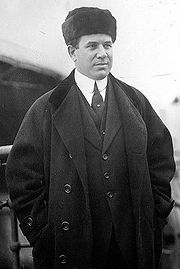 Ruffo was never a "house baritone" or a resident singer with any opera company; he was a nomadic star in his own right and received top billing—and top fees—wherever he sang. Ruffo was the only male opera singer of his time who could compete, in terms of celebrity and fees, with Caruso. Surprisingly, they sang together infrequently and made only one commercially issued recording: an electrifying performance of the Oath Duet from Giuseppe Verdi
's Otello. Two explanations have been adduced by historians for this happenstance. First, professional jealousy: neither Ruffo nor Caruso liked sharing the glory with another extravagantly gifted star. Secondly, few opera houses could have afforded to pay both singers' enormous fees in conjunction, especially if there was an expensive diva appearing in the same production.
Ruffo's forceful singing style was perhaps not conducive to vocal longevity, and his vocal decline began relatively early (after about 20 years spent at the top of his profession). Perhaps the seeds for Ruffo's early decline were sown in the fact that he was largely self-taught. Ruffo himself seemed to recognize this and he refused to teach voice after his retirement, stating: "I never knew how to sing; that is why my voice went by the time I was fifty. I have no right to capitalize on my former name and reputation and try to teach youngsters something I never knew how to do myself."
He retired in 1931, staying for several years in Switzerland
and Paris
. He wrote an autobiography, La mia parabola ("My Parable"). In 1937 he returned to Italy, where he was later arrested by the authorities for opposing the ascendant Fascist regime
and espousing Socialist beliefs. His autobiography has been recently translated into English.
Titta Ruffo died in Florence
from heart disease
in 1953, aged 76.
Baritone
Baritone is a type of male singing voice that lies between the bass and tenor voices. It is the most common male voice. Originally from the Greek , meaning deep sounding, music for this voice is typically written in the range from the second F below middle C to the F above middle C Baritone (or...
s, such as Giuseppe De Luca
Giuseppe de Luca
Giuseppe De Luca , was a famous Italian baritone who achieved his greatest triumphs at the New York Metropolitan Opera...
, who said of Ruffo: "His was not a voice, it was a miracle" (although not often published is the second part of De Luca's conclusion "...which he [Ruffo] bawled away..."), and Victor Maurel
Victor Maurel
Victor Maurel was a French operatic baritone who enjoyed an international reputation as a great singing-actor.-Biography:...
, the creator of Verdi
Giuseppe Verdi
Giuseppe Fortunino Francesco Verdi was an Italian Romantic composer, mainly of opera. He was one of the most influential composers of the 19th century...
's Iago
Iago
Iago is a fictional character in Shakespeare's Othello . The character's source is traced to Giovanni Battista Giraldi Cinthio's tale "Un Capitano Moro" in Gli Hecatommithi . There, the character is simply "the ensign". Iago is a soldier and Othello's ancient . He is the husband of Emilia,...
and Falstaff. Maurel said that the notes of Ruffo's upper register were the most glorious baritone sounds he had ever heard (see Pleasants, cited below). Indeed Walter Legge
Walter Legge
Harry Walter Legge was an influential English classical record producer, most notably for EMI. His recordings include many sets later regarded as classics and reissued by EMI as "Great Recordings of the Century". He worked in the recording industry from 1927, combining this with the post of junior...
, the prominent classical record producer, went so far as to call Ruffo "a genius".
Career
Born Ruffo Titta in PisaPisa
Pisa is a city in Tuscany, Central Italy, on the right bank of the mouth of the River Arno on the Tyrrhenian Sea. It is the capital city of the Province of Pisa...
(he reversed his forename and surname for the stage), Ruffo was the son of an engineer. He studied voice with several teachers, but he was an independent thinker and, basically, his vocal method was self-taught.
Ruffo made his operatic debut in 1898 at the Teatro Constanzi in Rome
Rome
Rome is the capital of Italy and the country's largest and most populated city and comune, with over 2.7 million residents in . The city is located in the central-western portion of the Italian Peninsula, on the Tiber River within the Lazio region of Italy.Rome's history spans two and a half...
as the Herald in Wagner
Richard Wagner
Wilhelm Richard Wagner was a German composer, conductor, theatre director, philosopher, music theorist, poet, essayist and writer primarily known for his operas...
's Lohengrin
Lohengrin (opera)
Lohengrin is a romantic opera in three acts composed and written by Richard Wagner, first performed in 1850. The story of the eponymous character is taken from medieval German romance, notably the Parzival of Wolfram von Eschenbach and its sequel, Lohengrin, written by a different author, itself...
. After a slow start, his career took off in the early 1900s and he quickly achieved international renown due to the power and ardency of voice and acting.
His other major debuts occurred in the following venues and years: Buenos Aires
Buenos Aires
Buenos Aires is the capital and largest city of Argentina, and the second-largest metropolitan area in South America, after São Paulo. It is located on the western shore of the estuary of the Río de la Plata, on the southeastern coast of the South American continent...
(1902), London
London
London is the capital city of :England and the :United Kingdom, the largest metropolitan area in the United Kingdom, and the largest urban zone in the European Union by most measures. Located on the River Thames, London has been a major settlement for two millennia, its history going back to its...
(1903), Milan (1904), Lisbon
Lisbon
Lisbon is the capital city and largest city of Portugal with a population of 545,245 within its administrative limits on a land area of . The urban area of Lisbon extends beyond the administrative city limits with a population of 3 million on an area of , making it the 9th most populous urban...
(1907), the Paris Opéra
Palais Garnier
The Palais Garnier, , is an elegant 1,979-seat opera house, which was built from 1861 to 1875 for the Paris Opera. It was originally called the Salle des Capucines because of its location on the Boulevard des Capucines in the 9th arrondissement of Paris, but soon became known as the Palais Garnier...
(1911) and the [Theatro Municipal] Sao Paulo (1911). Ruffo made his American debut in Philadelphia in 1912 and sang extensively in Chicago
Chicago
Chicago is the largest city in the US state of Illinois. With nearly 2.7 million residents, it is the most populous city in the Midwestern United States and the third most populous in the US, after New York City and Los Angeles...
. He reached the New York
New York
New York is a state in the Northeastern region of the United States. It is the nation's third most populous state. New York is bordered by New Jersey and Pennsylvania to the south, and by Connecticut, Massachusetts and Vermont to the east...
Metropolitan Opera
Metropolitan Opera
The Metropolitan Opera is an opera company, located in New York City. Originally founded in 1880, the company gave its first performance on October 22, 1883. The company is operated by the non-profit Metropolitan Opera Association, with Peter Gelb as general manager...
relatively late in his career, in 1922, as Figaro
Figaro
-Literature:* Figaro, the central character in:** The Barber of Seville by Beaumarchais***Il barbiere di Siviglia , the opera by Paisiello based on Beaumarchais' play...
in The Barber of Seville
The Barber of Seville
The Barber of Seville, or The Futile Precaution is an opera buffa in two acts by Gioachino Rossini with a libretto by Cesare Sterbini. The libretto was based on Pierre Beaumarchais's comedy Le Barbier de Séville , which was originally an opéra comique, or a mixture of spoken play with music...
, having enlisted in the Italian army during World War I
World War I
World War I , which was predominantly called the World War or the Great War from its occurrence until 1939, and the First World War or World War I thereafter, was a major war centred in Europe that began on 28 July 1914 and lasted until 11 November 1918...
. He would give a total of 46 performances at the Met from 1922 through to 1929.
Gioacchino Rossini
Gioachino Antonio Rossini was an Italian composer who wrote 39 operas as well as sacred music, chamber music, songs, and some instrumental and piano pieces...
's Figaro, Valentin, Iago, Carlo (in both Ernani
Ernani
Ernani is an operatic dramma lirico in four acts by Giuseppe Verdi to an Italian libretto by Francesco Maria Piave, based on the play Hernani by Victor Hugo. The first production took place at La Fenice Theatre, Venice on 9 March 1844...
and La forza del destino
La forza del destino
La forza del destino is an Italian opera by Giuseppe Verdi. The libretto was written by Francesco Maria Piave based on a Spanish drama, Don Álvaro o la fuerza del sino , by Ángel de Saavedra, Duke of Rivas, with a scene adapted from Friedrich Schiller's Wallensteins Lager. It was first performed...
), Nabucco, Vasco, Don Giovanni, Barnaba, Scarpia, Marcello, and Renato in Un ballo in maschera
Un ballo in maschera
Un ballo in maschera , is an opera in three acts by Giuseppe Verdi with text by Antonio Somma. The libretto is loosely based on an 1833 play, Gustave III, by French playwright Eugène Scribe who wrote about the historical assassination of King Gustav III of Sweden...
. He was also renowned his interpretations of several baritone parts in operas that are largely forgotten today, namely, the title roles in Ambroise Thomas
Ambroise Thomas
Charles Louis Ambroise Thomas was a French composer, best known for his operas Mignon and Hamlet and as Director of the Conservatoire de Paris from 1871 till his death.-Biography:"There is good music, there is bad music, and then there is Ambroise Thomas."- Emmanuel Chabrier-Early life...
's Hamlet
Hamlet (opera)
Hamlet is an opéra in five acts by the French composer Ambroise Thomas, with a libretto by Michel Carré and Jules Barbier based on a French adaptation by Alexandre Dumas, père and Paul Meurice of Shakespeare's play Hamlet.- Ophelia mania in Paris:...
and Franchetti
Alberto Franchetti
Alberto Franchetti was an Italian opera composer.-Biography:Alberto Franchetti was born in Turin, a Jewish nobleman of independent means. He studied first in Venice, then in Dresden under Felix Draeseke, and finally at the Munich Conservatory under Josef Rheinberger. His first major success...
's Cristoforo Colombo
Cristoforo Colombo (opera)
Cristoforo Colombo is an opera in four acts and an epilogue by Alberto Franchetti to an Italian libretto by Luigi Illica...
plus Cathcart in Leoncavallo
Ruggero Leoncavallo
Ruggero Leoncavallo was an Italian opera composer. His two-act work Pagliacci remains one of the most popular works in the repertory, appearing as number 20 on the Operabase list of the most-performed operas worldwide.-Biography:...
's Zazà
Zazà
Zazà is an opera by Ruggero Leoncavallo, with the libretto by the composer. Its première at the Teatro Lirico di Milano on November 10, 1900, starring Rosina Storchio as Zazà, Edoardo Garbin as Milio, Mario Sammarco as Cascart and Clorinda Pini-Corsi as Anaïde, and conducted by Arturo Toscanini,...
and Neri in Giordano
Umberto Giordano
Umberto Menotti Maria Giordano was an Italian composer, mainly of operas.He was born in Foggia in Puglia, southern Italy, and studied under Paolo Serrao at the Conservatoire of Naples...
's La cena delle beffe.
Vocal characteristics & recorded legacy
Like his tenor contemporary Enrico Caruso, Ruffo was said to embody a new style of singing in which power, declamatory force and a rich, chesty tone eclipsed the previous generation's emphasis on vocal grace, flexibility and technical finesse. Consequently, some conservative commentators compared Ruffo unfavorably with his elegant Italian predecessor Mattia BattistiniMattia Battistini
Mattia Battistini was an Italian operatic baritone. He became internationally famous due to the beauty of his voice and the virtuosity of his singing technique, and he earned the sobriquet "King of Baritones".-Early life:...
, who was a master of bel canto
Bel canto
Bel canto , along with a number of similar constructions , is an Italian opera term...
and the possessor of a leaner, more silvery timbre
Timbre
In music, timbre is the quality of a musical note or sound or tone that distinguishes different types of sound production, such as voices and musical instruments, such as string instruments, wind instruments, and percussion instruments. The physical characteristics of sound that determine the...
than Ruffo's. However, according to modern-day critics like John Steane and Michael Scott, the difference between the two great baritones was not quite as clear cut as some have suggested in the past, because both Battistini and Ruffo displayed exceptional vocal agility and control plus the ability to sustain a long legato
Legato
In musical notation the Italian word legato indicates that musical notes are played or sung smoothly and connected. That is, in transitioning from note to note, there should be no intervening silence...
line. Both of them also favored a virile interpretive style and even shared a teacher in Venceslao Persichini.
Writing in the Gramophone magazine in 1928, the often acerbic British critic and future record producer, Walter Legge, lauded Ruffo's singing, recalling a recital that he had heard the baritone give six years earlier in London. Legge said that: "From the his first phrase the audience was vanquished by the overwhelming beauty of his voice—manly, broad, sympathetic, of unsurpassed richness. Such ease of production, such abundance of ringing high Gs! But more: Ruffo's infinite subtlety, variety of tone-colour, interpretive insight and sincerity, his magnificent control, stupendous breathing powers, and impeccable phrasing stamped him as a genius."
Ruffo was a prolific recording artist. He made more than 130 78-rpm records, both acoustic and electric, first for Pathé Frères in Paris
Paris
Paris is the capital and largest city in France, situated on the river Seine, in northern France, at the heart of the Île-de-France region...
in 1904, and then exclusively for Victor
Victor Talking Machine Company
The Victor Talking Machine Company was an American corporation, the leading American producer of phonographs and phonograph records and one of the leading phonograph companies in the world at the time. It was headquartered in Camden, New Jersey....
(the Gramophone Company/HMV
HMV
His Master's Voice is a trademark in the music business, and for many years was the name of a large record label. The name was coined in 1899 as the title of a painting of the dog Nipper listening to a wind-up gramophone...
in England), beginning in 1907 and concluding in the 1920s. As was the case with Caruso, Ruffo's voice recorded exceptionally well. It was so rich and resonant that even via the primitive acoustic recording process, much glory remains to be heard. He continued recording into the electric recording era after 1925, but at far as one is able to judge (many titles remain unpublished) most of those later discs caught him past his prime, with what Steane calls a "hollowness" now evident in his mid-range. However, as some unpublished sides cut even later, in London in 1933 (see http://www.truesoundtransfers.de/Titellisten/TT2490.htm), are touching "beaux restes", with a great deal of voice still surviving to this late date.
As Steane and Pleasants mention, Ruffo made records at his peak of two arias which stand-out as exemplars of his voice and style. The first example is the Brindisi from Hamlet (made in 1907 and remade in 1911), the cadenza of which demonstrates his astounding élan and breath control. The second is the unaccompanied "All'erta, marinar!" from Meyerbeer's L'Africaine
L'Africaine
L'africaine is a grand opera, the last work of the composer Giacomo Meyerbeer. The French libretto was written by Eugène Scribe. The opera is about fictitious events in the life of the real historical person Vasco da Gama...
, which exhibits the resonance, power and brilliance of his upper register. For examples of his vocal agility, his early discs of "Largo al factotum" from Il barbiere di Siviglia stand out. Other discs of arias singled out for praise by Pleasants, Steane and/or Scott include Ruffo's acoustic Victor/HMV versions of the following arias: "Pari siamo", "Urna fatale", "Credo in un Dio crudel", "Tremin gl'insani", "Buona Zazà, del mio buon tempo", "Nemico della partria" and the "Prologo" from Pagliacci
Pagliacci
Pagliacci , sometimes incorrectly rendered with a definite article as I Pagliacci, is an opera consisting of a prologue and two acts written and composed by Ruggero Leoncavallo. It recounts the tragedy of a jealous husband in a commedia dell'arte troupe...
. All these recordings can be heard on CD compendiums issued by the Pearl and Preiser labels.
Giuseppe Verdi
Giuseppe Fortunino Francesco Verdi was an Italian Romantic composer, mainly of opera. He was one of the most influential composers of the 19th century...
's Otello. Two explanations have been adduced by historians for this happenstance. First, professional jealousy: neither Ruffo nor Caruso liked sharing the glory with another extravagantly gifted star. Secondly, few opera houses could have afforded to pay both singers' enormous fees in conjunction, especially if there was an expensive diva appearing in the same production.
Ruffo's forceful singing style was perhaps not conducive to vocal longevity, and his vocal decline began relatively early (after about 20 years spent at the top of his profession). Perhaps the seeds for Ruffo's early decline were sown in the fact that he was largely self-taught. Ruffo himself seemed to recognize this and he refused to teach voice after his retirement, stating: "I never knew how to sing; that is why my voice went by the time I was fifty. I have no right to capitalize on my former name and reputation and try to teach youngsters something I never knew how to do myself."
He retired in 1931, staying for several years in Switzerland
Switzerland
Switzerland name of one of the Swiss cantons. ; ; ; or ), in its full name the Swiss Confederation , is a federal republic consisting of 26 cantons, with Bern as the seat of the federal authorities. The country is situated in Western Europe,Or Central Europe depending on the definition....
and Paris
Paris
Paris is the capital and largest city in France, situated on the river Seine, in northern France, at the heart of the Île-de-France region...
. He wrote an autobiography, La mia parabola ("My Parable"). In 1937 he returned to Italy, where he was later arrested by the authorities for opposing the ascendant Fascist regime
Fascism
Fascism is a radical authoritarian nationalist political ideology. Fascists seek to rejuvenate their nation based on commitment to the national community as an organic entity, in which individuals are bound together in national identity by suprapersonal connections of ancestry, culture, and blood...
and espousing Socialist beliefs. His autobiography has been recently translated into English.
Titta Ruffo died in Florence
Florence
Florence is the capital city of the Italian region of Tuscany and of the province of Florence. It is the most populous city in Tuscany, with approximately 370,000 inhabitants, expanding to over 1.5 million in the metropolitan area....
from heart disease
Heart disease
Heart disease, cardiac disease or cardiopathy is an umbrella term for a variety of diseases affecting the heart. , it is the leading cause of death in the United States, England, Canada and Wales, accounting for 25.4% of the total deaths in the United States.-Types:-Coronary heart disease:Coronary...
in 1953, aged 76.
Sources
- Farkas, Andrew (Ed.),Titta Ruffo: An Anthology (Greenwood Press 1984).
- Hamilton, David, ed., The Metropolitan Opera Encyclopedia (Simon & Schuster, New York 1987).
- Pleasants, Henry, The Great Singers (Simon & Schuster, New York 1966).
- Scott, Michael, The Record of Singing, Volume One (Duckworth, London, 1977.)
- Seltsam, William H., Metropolitan Opera Annals (H.W. Wilson Co., New York 1947).
- Steane, J.B.J.B. SteaneJohn Barry Steane was an English music critic, musicologist, literary scholar and teacher, with a particular interest in singing and the human voice...
, The Grand Tradition (Amadeus Press, Portland 1993). - Tuggle, Robert. The Golden Age of Opera (Holt, Rinehart, and Winston, 1983).
External links
- History of the Tenor - Sound Clips and Narration
- Discography of Titta Ruffo on Victor RecordsVictor Talking Machine CompanyThe Victor Talking Machine Company was an American corporation, the leading American producer of phonographs and phonograph records and one of the leading phonograph companies in the world at the time. It was headquartered in Camden, New Jersey....
from the Encyclopedic Discography of Victor Recordings (EDVR)