

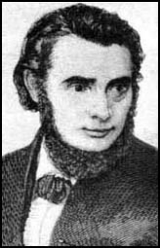
George Julian Harney

Encyclopedia
George Julian Harney was a British
political activist, journalist, and Chartist
leader. He was also associated with Marxism
, socialism
, and universal suffrage
.
in south-east London
. When Harney was eleven he entered the Boy's Naval School at Greenwich
. However, instead of pursuing a career in the navy he became a shop-boy for Henry Hetherington
, the editor of the Poor Man's Guardian. Harney was imprisoned three times for selling this unstamped newspaper.
This experience radicalised Harney and although he was initially a member of the London Working Men's Association
he became impatient with the organization’s failure to make much progress in the efforts to obtain universal suffrage
. Harney was influenced by the more militant ideas of William Benbow
, James Bronterre O'Brien
and Feargus O'Connor
.
In January 1837 Harney became one of the founders of the openly republican East London Democratic Association
. Soon afterwards Harney became convinced of William Benbow's theory that a Grand National Holiday (General Strike
) would result in an uprising and a change in the political system.
argued against the plan but was defeated. Harney and Benbow toured the country in an attempt to persuade workers to join the strike. When Harney and Benbow were both arrested and charged with making seditious speeches, the General Strike was called off. Harney was kept in Warwick
Gaol but when he appeared at Birmingham
Assizes the grand jurt refused to indict him of sedition
or any other charge.
Disappointed by the failure of the Grand National Holiday, Harney moved to Ayrshire
, Scotland
, where he married Mary Cameron. Harney's exile did not last long and the following year he became the Chartist
organizer in Sheffield
. During the strikes of 1842 Harney was one of the 58 Chartists arrested and tried at Lancaster
in March 1843. After his conviction was reversed on appeal, Harney became a journalist for Feargus O'Connor
's Northern Star
. Two years later he became the editor of the newspaper.
Tristram Hunt describes him during this period:
in September 1845. It was through this organisation that Harney met Karl Marx
and Friedrich Engels
. Harney persuaded both men to write articles for the Northern Star
. Excited by the Continental Revolutions of 1848, Harney traveled to Paris
in March, 1848 to meet members of the provisional government
.
According to his friend and fellow radical, John Bedford Leno
, Harney was:
to promote this philosophy. Feargus O'Connor
disagreed with Socialism
and he pressurized Harney into resigning as editor of the paper. Harney now formed his own newspaper, the Red Republican
. With the help of his friend, Ernest Charles Jones
, Harney attempted to use his paper to educate his working class
readers about socialism
and proletarian internationalism
. Harney also advocated socialism
in the trade union
movement.
In 1848 Harney stood as the Chartist
candidate against Lord Palmerston
for the seat of Tiverton in Devon
, an event described by Engels in an article for La Reforme thus:
In 1850 the Red Republican published the first English translation of The Communist Manifesto
The translation was done by Helen Macfarlane
, a journalist, socialist and feminist of the time, who wrote for the Red Republican under the pseudonym Howard Morton. The Red Republican was not a financial success and was closed down in December 1850. Harney followed it with the Friend of the People (December 1850 - April 1852), Star of Freedom (April 1852 - December 1852) and The Vanguard (January 1853 - March 1853).
After The Vanguard ceased publication Harney moved to Newcastle and worked for Joseph Cowen
's newspaper, the Northern Tribune and after traveling to meet French socialists living in exile in Jersey
, Harney became editor of the Jersey Independent. Harney's support for the North in the American Civil War
upset Joseph Cowen
and in November 1862 Harney was forced to resign.
. For the next 14 years he worked as a clerk in the Massachusetts State House
. After his retirement he returned to England where he wrote a weekly column for the Newcastle Chronicle. Harney died on 9 December 1897, aged 80.
United Kingdom
The United Kingdom of Great Britain and Northern IrelandIn the United Kingdom and Dependencies, other languages have been officially recognised as legitimate autochthonous languages under the European Charter for Regional or Minority Languages...
political activist, journalist, and Chartist
Chartism
Chartism was a movement for political and social reform in the United Kingdom during the mid-19th century, between 1838 and 1859. It takes its name from the People's Charter of 1838. Chartism was possibly the first mass working class labour movement in the world...
leader. He was also associated with Marxism
Marxism
Marxism is an economic and sociopolitical worldview and method of socioeconomic inquiry that centers upon a materialist interpretation of history, a dialectical view of social change, and an analysis and critique of the development of capitalism. Marxism was pioneered in the early to mid 19th...
, socialism
Socialism
Socialism is an economic system characterized by social ownership of the means of production and cooperative management of the economy; or a political philosophy advocating such a system. "Social ownership" may refer to any one of, or a combination of, the following: cooperative enterprises,...
, and universal suffrage
Universal suffrage
Universal suffrage consists of the extension of the right to vote to adult citizens as a whole, though it may also mean extending said right to minors and non-citizens...
.
Early life
George Julian Harney, the son of a seaman, was born in DeptfordDeptford
Deptford is a district of south London, England, located on the south bank of the River Thames. It is named after a ford of the River Ravensbourne, and from the mid 16th century to the late 19th was home to Deptford Dockyard, the first of the Royal Navy Dockyards.Deptford and the docks are...
in south-east London
London
London is the capital city of :England and the :United Kingdom, the largest metropolitan area in the United Kingdom, and the largest urban zone in the European Union by most measures. Located on the River Thames, London has been a major settlement for two millennia, its history going back to its...
. When Harney was eleven he entered the Boy's Naval School at Greenwich
Greenwich
Greenwich is a district of south London, England, located in the London Borough of Greenwich.Greenwich is best known for its maritime history and for giving its name to the Greenwich Meridian and Greenwich Mean Time...
. However, instead of pursuing a career in the navy he became a shop-boy for Henry Hetherington
Henry Hetherington
Henry Hetherington was a leading British Chartist.- Early years :Henry Hetherington was the son of a London tailor, John Hetherington , and was born on 17 June 1792, at 16 Compton Street, Soho, London...
, the editor of the Poor Man's Guardian. Harney was imprisoned three times for selling this unstamped newspaper.
This experience radicalised Harney and although he was initially a member of the London Working Men's Association
London Working Men's Association
The London Working Men's Association was an organization established in London in 1836. It was one of the foundations of Chartism. The founders were William Lovett, Francis Place and Henry Hetherington. They appealed to skilled workers rather than the mass of unskilled factory labourers...
he became impatient with the organization’s failure to make much progress in the efforts to obtain universal suffrage
Universal suffrage
Universal suffrage consists of the extension of the right to vote to adult citizens as a whole, though it may also mean extending said right to minors and non-citizens...
. Harney was influenced by the more militant ideas of William Benbow
William Benbow
William Benbow was a non-conformist preacher and a leader of the Great Reform Movement in Manchester, England.Benbow worked with William Cobbett on the radical newspaper The Political Register. Faced with being imprisoned for sedition he fled to the United States where he continued to work on the...
, James Bronterre O'Brien
James Bronterre O'Brien
James Bronterre O'Brien was an Irish Chartist leader, reformer and journalist.- Irish Birth & Formative Years :James O'Brien, was born near Granard, County Longford, Ireland in 1804 or 1805...
and Feargus O'Connor
Feargus O'Connor
Feargus Edward O'Connor was an Irish Chartist leader and advocate of the Land Plan.- Background :Feargus O'Connor was born into a prominent Irish Protestant family, the son of Irish Nationalist politician Roger O'Connor...
.
In January 1837 Harney became one of the founders of the openly republican East London Democratic Association
London Democratic Association
The East London Democratic Association was founded in January 1837 by George Julian Harney in opposition to the LWMA, later supported by James Bronterre O'Brien and Feargus O'Connor. In April 1838 ELDA was reconstituted as the London Democratic Association with an eight point resolution covering...
. Soon afterwards Harney became convinced of William Benbow's theory that a Grand National Holiday (General Strike
General strike
A general strike is a strike action by a critical mass of the labour force in a city, region, or country. While a general strike can be for political goals, economic goals, or both, it tends to gain its momentum from the ideological or class sympathies of the participants...
) would result in an uprising and a change in the political system.
Involvement with Chartist movement
At the Chartist Convention held during the summer of 1839, Harney and William Benbow convinced the delegates to call a Grand National Holiday on 12 August. Feargus O'ConnorFeargus O'Connor
Feargus Edward O'Connor was an Irish Chartist leader and advocate of the Land Plan.- Background :Feargus O'Connor was born into a prominent Irish Protestant family, the son of Irish Nationalist politician Roger O'Connor...
argued against the plan but was defeated. Harney and Benbow toured the country in an attempt to persuade workers to join the strike. When Harney and Benbow were both arrested and charged with making seditious speeches, the General Strike was called off. Harney was kept in Warwick
Warwick
Warwick is the county town of Warwickshire, England. The town lies upon the River Avon, south of Coventry and just west of Leamington Spa and Whitnash with which it is conjoined. As of the 2001 United Kingdom census, it had a population of 23,350...
Gaol but when he appeared at Birmingham
Birmingham
Birmingham is a city and metropolitan borough in the West Midlands of England. It is the most populous British city outside the capital London, with a population of 1,036,900 , and lies at the heart of the West Midlands conurbation, the second most populous urban area in the United Kingdom with a...
Assizes the grand jurt refused to indict him of sedition
Sedition
In law, sedition is overt conduct, such as speech and organization, that is deemed by the legal authority to tend toward insurrection against the established order. Sedition often includes subversion of a constitution and incitement of discontent to lawful authority. Sedition may include any...
or any other charge.
Disappointed by the failure of the Grand National Holiday, Harney moved to Ayrshire
Ayrshire
Ayrshire is a registration county, and former administrative county in south-west Scotland, United Kingdom, located on the shores of the Firth of Clyde. Its principal towns include Ayr, Kilmarnock and Irvine. The town of Troon on the coast has hosted the British Open Golf Championship twice in the...
, Scotland
Scotland
Scotland is a country that is part of the United Kingdom. Occupying the northern third of the island of Great Britain, it shares a border with England to the south and is bounded by the North Sea to the east, the Atlantic Ocean to the north and west, and the North Channel and Irish Sea to the...
, where he married Mary Cameron. Harney's exile did not last long and the following year he became the Chartist
Chartism
Chartism was a movement for political and social reform in the United Kingdom during the mid-19th century, between 1838 and 1859. It takes its name from the People's Charter of 1838. Chartism was possibly the first mass working class labour movement in the world...
organizer in Sheffield
Sheffield
Sheffield is a city and metropolitan borough of South Yorkshire, England. Its name derives from the River Sheaf, which runs through the city. Historically a part of the West Riding of Yorkshire, and with some of its southern suburbs annexed from Derbyshire, the city has grown from its largely...
. During the strikes of 1842 Harney was one of the 58 Chartists arrested and tried at Lancaster
Lancaster, Lancashire
Lancaster is the county town of Lancashire, England. It is situated on the River Lune and has a population of 45,952. Lancaster is a constituent settlement of the wider City of Lancaster, local government district which has a population of 133,914 and encompasses several outlying towns, including...
in March 1843. After his conviction was reversed on appeal, Harney became a journalist for Feargus O'Connor
Feargus O'Connor
Feargus Edward O'Connor was an Irish Chartist leader and advocate of the Land Plan.- Background :Feargus O'Connor was born into a prominent Irish Protestant family, the son of Irish Nationalist politician Roger O'Connor...
's Northern Star
Northern Star (chartist newspaper)
The Northern Star and Leeds General Advertiser was a chartist newspaper published in the United Kingdom between 1837 and 1852.-Foundation:Feargus O'Connor, a former Irish MP forging a career in English radical politics, decided to establish a weekly newspaper in 1837...
. Two years later he became the editor of the newspaper.
Tristram Hunt describes him during this period:
George Julian Harney, Chartism's enfant terrible ... was firmly on the radical side of the movement, advocating the use of physical force and enjoying riling his conservative comrades by flaunting the red cap of liberty at public meetings. In and out of jail, endlessly feuding with fellow Chartists, and ultimately expelled from the party, the Robespierre-admiring Harney remained convinced that insurrection was the surest route to achieve the demands of the charter.
Association with Marx and Engels
Harney became interested in the international struggle for universal suffrage and helped establish the Fraternal DemocratsFraternal Democrats
Fraternal Democrats was an international society, founded at a meeting held in London on September 22. 1845. The society embraced representatives of Left Chartists, German workers and craftsmen – members of the League of the Just – and revolutionary emigrants of other nationalities...
in September 1845. It was through this organisation that Harney met Karl Marx
Karl Marx
Karl Heinrich Marx was a German philosopher, economist, sociologist, historian, journalist, and revolutionary socialist. His ideas played a significant role in the development of social science and the socialist political movement...
and Friedrich Engels
Friedrich Engels
Friedrich Engels was a German industrialist, social scientist, author, political theorist, philosopher, and father of Marxist theory, alongside Karl Marx. In 1845 he published The Condition of the Working Class in England, based on personal observations and research...
. Harney persuaded both men to write articles for the Northern Star
Northern Star (chartist newspaper)
The Northern Star and Leeds General Advertiser was a chartist newspaper published in the United Kingdom between 1837 and 1852.-Foundation:Feargus O'Connor, a former Irish MP forging a career in English radical politics, decided to establish a weekly newspaper in 1837...
. Excited by the Continental Revolutions of 1848, Harney traveled to Paris
Paris
Paris is the capital and largest city in France, situated on the river Seine, in northern France, at the heart of the Île-de-France region...
in March, 1848 to meet members of the provisional government
French Second Republic
The French Second Republic was the republican government of France between the 1848 Revolution and the coup by Louis-Napoléon Bonaparte which initiated the Second Empire. It officially adopted the motto Liberté, Égalité, Fraternité...
.
According to his friend and fellow radical, John Bedford Leno
John Bedford Leno
John Bedford Leno was a Chartist, Radical, Poet and printer who acted as a "bridge" between Chartism and early Labour movements, as well as between the working and ruling classes. He campaigned to give the vote to all common men and women, driven by a strong desire for "justice and freedom for all...
, Harney was:
- "more conversant with foreign politics than any man I ever knew, and the first inquiries made by foreign refugees on landing on our shores was to forward the discovery of his whereabouts."
Involvement with Socialism
Harney was now a Socialist and he used the Northern StarNorthern Star (chartist newspaper)
The Northern Star and Leeds General Advertiser was a chartist newspaper published in the United Kingdom between 1837 and 1852.-Foundation:Feargus O'Connor, a former Irish MP forging a career in English radical politics, decided to establish a weekly newspaper in 1837...
to promote this philosophy. Feargus O'Connor
Feargus O'Connor
Feargus Edward O'Connor was an Irish Chartist leader and advocate of the Land Plan.- Background :Feargus O'Connor was born into a prominent Irish Protestant family, the son of Irish Nationalist politician Roger O'Connor...
disagreed with Socialism
Socialism
Socialism is an economic system characterized by social ownership of the means of production and cooperative management of the economy; or a political philosophy advocating such a system. "Social ownership" may refer to any one of, or a combination of, the following: cooperative enterprises,...
and he pressurized Harney into resigning as editor of the paper. Harney now formed his own newspaper, the Red Republican
Red Republican
The Red Republican was a British socialist newspaper published from June 22, 1850 to November 30, 1850, after which it was renamed The Friend of the People.-Foundation:...
. With the help of his friend, Ernest Charles Jones
Ernest Charles Jones
Ernest Charles Jones , was an English poet, novelist, and Chartist.- Background :Born in Berlin, he was the son of a British Army Major, equerry to the Duke of Cumberland, afterwards King of Hanover. In 1838 Jones came to England, and in 1841 published anonymously The Wood Spirit, a romantic novel....
, Harney attempted to use his paper to educate his working class
Working class
Working class is a term used in the social sciences and in ordinary conversation to describe those employed in lower tier jobs , often extending to those in unemployment or otherwise possessing below-average incomes...
readers about socialism
Socialism
Socialism is an economic system characterized by social ownership of the means of production and cooperative management of the economy; or a political philosophy advocating such a system. "Social ownership" may refer to any one of, or a combination of, the following: cooperative enterprises,...
and proletarian internationalism
Proletarian internationalism
Proletarian internationalism, sometimes referred to as international socialism, is a Marxist social class concept based on the view that capitalism is now a global system, and therefore the working class must act as a global class if it is to defeat it...
. Harney also advocated socialism
Socialism
Socialism is an economic system characterized by social ownership of the means of production and cooperative management of the economy; or a political philosophy advocating such a system. "Social ownership" may refer to any one of, or a combination of, the following: cooperative enterprises,...
in the trade union
Trade union
A trade union, trades union or labor union is an organization of workers that have banded together to achieve common goals such as better working conditions. The trade union, through its leadership, bargains with the employer on behalf of union members and negotiates labour contracts with...
movement.
In 1848 Harney stood as the Chartist
Chartism
Chartism was a movement for political and social reform in the United Kingdom during the mid-19th century, between 1838 and 1859. It takes its name from the People's Charter of 1838. Chartism was possibly the first mass working class labour movement in the world...
candidate against Lord Palmerston
Henry Temple, 3rd Viscount Palmerston
Henry John Temple, 3rd Viscount Palmerston, KG, GCB, PC , known popularly as Lord Palmerston, was a British statesman who served twice as Prime Minister in the mid-19th century...
for the seat of Tiverton in Devon
Devon
Devon is a large county in southwestern England. The county is sometimes referred to as Devonshire, although the term is rarely used inside the county itself as the county has never been officially "shired", it often indicates a traditional or historical context.The county shares borders with...
, an event described by Engels in an article for La Reforme thus:
- "It will be recalled that at the last elections Mr. Harney, editor-in-chief of the Northern StarNorthern Star (chartist newspaper)The Northern Star and Leeds General Advertiser was a chartist newspaper published in the United Kingdom between 1837 and 1852.-Foundation:Feargus O'Connor, a former Irish MP forging a career in English radical politics, decided to establish a weekly newspaper in 1837...
, was put forward as the ChartistChartismChartism was a movement for political and social reform in the United Kingdom during the mid-19th century, between 1838 and 1859. It takes its name from the People's Charter of 1838. Chartism was possibly the first mass working class labour movement in the world...
candidate for Tiverton, a borough which is represented in Parliament by Lord Palmerston, the Foreign Secretary. Mr. Harney, who won on the show of hands, decided to retire when Lord Palmerston demanded a poll"
In 1850 the Red Republican published the first English translation of The Communist Manifesto
The Communist Manifesto
The Communist Manifesto, originally titled Manifesto of the Communist Party is a short 1848 publication written by the German Marxist political theorists Karl Marx and Friedrich Engels. It has since been recognized as one of the world's most influential political manuscripts. Commissioned by the...
The translation was done by Helen Macfarlane
Helen Macfarlane
Helen Macfarlane was a journalist, socialist and feminist of nineteenth century Britain. Very little seems to be known for sure about her early and later life...
, a journalist, socialist and feminist of the time, who wrote for the Red Republican under the pseudonym Howard Morton. The Red Republican was not a financial success and was closed down in December 1850. Harney followed it with the Friend of the People (December 1850 - April 1852), Star of Freedom (April 1852 - December 1852) and The Vanguard (January 1853 - March 1853).
After The Vanguard ceased publication Harney moved to Newcastle and worked for Joseph Cowen
Joseph Cowen
Joseph Cowen, Jr., , English politician and journalist, son of Sir Joseph Cowen, a prominent citizen and Member of Parliament for Newcastle upon Tyne from 1865 to 1873, was born at Stella Hall, Blaydon...
's newspaper, the Northern Tribune and after traveling to meet French socialists living in exile in Jersey
Jersey
Jersey, officially the Bailiwick of Jersey is a British Crown Dependency off the coast of Normandy, France. As well as the island of Jersey itself, the bailiwick includes two groups of small islands that are no longer permanently inhabited, the Minquiers and Écréhous, and the Pierres de Lecq and...
, Harney became editor of the Jersey Independent. Harney's support for the North in the American Civil War
American Civil War
The American Civil War was a civil war fought in the United States of America. In response to the election of Abraham Lincoln as President of the United States, 11 southern slave states declared their secession from the United States and formed the Confederate States of America ; the other 25...
upset Joseph Cowen
Joseph Cowen
Joseph Cowen, Jr., , English politician and journalist, son of Sir Joseph Cowen, a prominent citizen and Member of Parliament for Newcastle upon Tyne from 1865 to 1873, was born at Stella Hall, Blaydon...
and in November 1862 Harney was forced to resign.
Emigration to United States and return to England
In May 1863 Harney emigrated to the United StatesUnited States
The United States of America is a federal constitutional republic comprising fifty states and a federal district...
. For the next 14 years he worked as a clerk in the Massachusetts State House
Massachusetts State House
The Massachusetts State House, also known as the Massachusetts Statehouse or the "New" State House, is the state capitol and house of government of the Commonwealth of Massachusetts. It is located in Boston in the neighborhood Beacon Hill...
. After his retirement he returned to England where he wrote a weekly column for the Newcastle Chronicle. Harney died on 9 December 1897, aged 80.
Sources
- http://www.spartacus.schoolnet.co.uk/CHharney.htm
- John Bedford Leno, The Aftermath: With Autobiography of the Author (Reeves & Turner, London 1892)